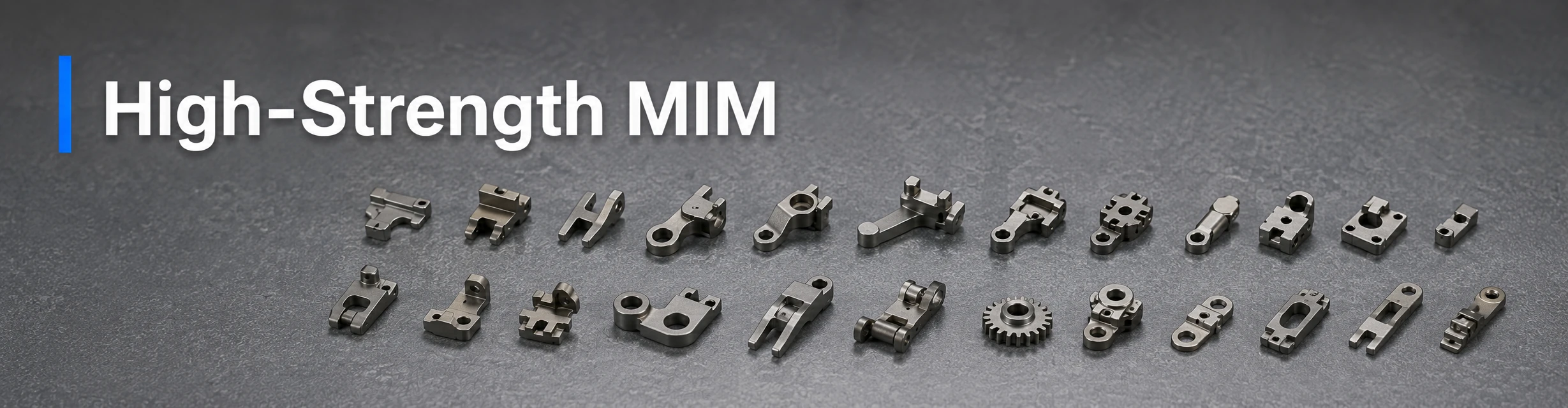
MIM-Werkstoffeigenschaften
High-strength MIM materials are selected when a small, complex metal component must carry load, resist permanent deformation, or maintain mechanical function after injection molding, debinding, sintering, and possible heat treatment. For most engineering projects, 17-4 PH Edelstahl is a common starting point when strength and stainless behavior are both required; 4605, 4140, und 4340 low-alloy steels are reviewed when structural strength is more important than corrosion resistance; and Ti-6Al-4V is considered when strength-to-weight value can justify higher material and process-control requirements.
The correct choice is not simply the material with the highest published strength. In Metallpulverspritzguss, final performance depends on fine metal powder and binder feedstock, molding stability, green part handling, debinding, sintering shrinkage, density, heat treatment, part geometry, and inspection planning. A high-strength alloy can still fail if the part has sharp internal corners, thin loaded sections, poor load paths, or heat-treatment distortion.
This page helps design engineers, sourcing managers, and project teams narrow the high-strength MIM material direction before tooling, RFQ, or drawing-based DFM review.
Kurze technische Antwort
High-Strength MIM Material Selection in One Page
Use a high-strength MIM material when the part is small, complex, difficult to machine economically at production volume, and expected to carry mechanical load. Do not select a material only because its published tensile strength is high. In practice, the correct choice depends on the failure mode that must be prevented: yielding, fracture, wear, corrosion, fatigue, impact damage, or heat-treatment distortion.
Start with the failure mode first: yielding, fracture, fatigue, wear, corrosion, impact, or weight reduction. Then narrow the material family and confirm whether the supplier’s feedstock route, heat-treatment capability, and inspection plan can support the project before tooling.
| Technische Anforderung | Practical Starting Direction | Do Not Use This Page as the Main Guide When |
|---|---|---|
| Strength with stainless corrosion behavior | Review 17-4 PH first, then compare with 316L, 420, or special alloys if corrosion, hardness, or ductility dominates. | The primary issue is corrosion resistance rather than load-bearing strength. |
| Structural strength with cost-sensitive production | Review 4605, 4140, or 4340 low-alloy steel directions together with heat treatment and corrosion protection. | The part cannot accept coating, plating, oiling, or other corrosion-control strategy. |
| Strength-to-weight requirement | Review Ti-6Al-4V when weight reduction creates functional value and cost can be justified. | The project only needs ordinary structural strength at the lowest possible material cost. |
| Strength plus contact damage resistance | Review high-strength materials together with hardness, surface finish, and wear behavior. | The real requirement is sliding wear, surface indentation, or edge retention. |
Verwenden Sie diese Seite, wenn
You need to compare high-strength MIM material families for hinges, latches, small brackets, locking arms, gears, precision hardware, or compact load-bearing components.
Do Not Overextend It
If the main requirement is corrosion resistance, surface hardness, wear resistance, magnetic behavior, heat resistance, or controlled expansion, use the relevant property page instead of treating strength as the only decision factor.
Before RFQ
Prepare 2D drawings, 3D CAD, target material, load direction, critical tolerances, surface finish, heat-treatment requirements, and estimated annual volume.
Definition
What Are High-Strength MIM Materials?
High-strength MIM materials are metal injection molding materials selected for load-bearing performance, structural stability, or resistance to permanent deformation in compact metal parts. In practice, this usually includes precipitation-hardening stainless steels, low-alloy steels, martensitic stainless steels, titanium alloys, and selected special alloys.
From a design review perspective, “high strength” should not be judged by tensile strength alone. Engineers also need to compare yield strength, hardness, ductility, impact resistance, fatigue behavior, corrosion exposure, heat-treatment response, and dimensional stability after sintering.
What “High Strength” Means in MIM Material Selection
In a MIM project, strength is influenced by both material and process route. A high-strength alloy can still fail if the part has sharp internal corners, poor gate location, non-uniform wall thickness, inadequate sintering support, or heat-treatment distortion.
The MIM route normally includes fine metal powder and binder feedstock preparation, injection molding of the green part, debinding, sintering with controlled shrinkage, and optional heat treatment, secondary machining, surface finishing, or inspection. Because sintering shrinkage and density strongly influence final properties, the material decision should be reviewed together with geometry and tolerance requirements.
Why Tensile Strength Alone Is Not Enough
A common mistake is to select a material based only on a published strength value. For small precision components, the part may fail because of local stress concentration, insufficient ductility, notch sensitivity, fatigue loading, or heat-treatment movement rather than low material strength.
For example, a hinge component may need a balanced combination of strength, ductility, hardness, and dimensional stability. A material with very high hardness may not be the best choice if the hinge root is thin and exposed to repeated bending.
Strength, Yield Strength, Hardness, Ductility, and Fatigue: What Engineers Should Compare
| Eigenschaft | What It Tells the Engineer | Why It Matters in MIM Design |
|---|---|---|
| Tensile strength | Maximum stress before fracture under tensile loading | Useful for general material comparison, but not enough alone |
| Streckgrenze | Resistance to permanent deformation | Critical for clips, brackets, locking parts, hinges, and structural supports |
| Härte | Resistance to indentation or surface damage | Important for contact surfaces, but high hardness may reduce ductility |
| Ductility | Ability to deform before fracture | Important for impact, assembly load, and thin load-bearing features |
| Fatigue behavior | Performance under repeated cyclic load | Critical for hinges, rotating parts, locking arms, gears, and repeated-load mechanisms |
| Impact toughness | Resistance to sudden load or shock | Important when parts may experience drops, snap-fit stress, or impact load |
| Maßhaltigkeit | Shape and tolerance retention after sintering or heat treatment | Critical for precision assemblies, mating features, and inspection planning |
Technischer Hinweis: High strength, high hardness, and wear resistance are related but not identical. If the main problem is indentation or sliding wear, review MIM-Werkstoffe mit hoher Härte oder verschleißfeste MIM-Werkstoffe before locking the material direction.
Anwendungseignung
When Should Engineers Consider High-Strength MIM Materials?
Engineers should consider high-strength MIM materials when the part is small, geometrically complex, and expected to carry functional load. MIM is especially relevant when the geometry would be costly to machine, difficult to cast, or unsuitable for conventional press-and-sinter PM compaction.
Small Load-Bearing Parts with Complex Geometry
High-strength MIM materials are often reviewed for compact parts with thin load-bearing walls, holes, slots, undercuts, internal steps, small bosses, hooks, pins, locking arms, hinge features, and tight assembly requirements. The advantage is not only material strength. The advantage is the ability to combine strength with small complex geometry in repeatable production.
Structural Components Converted from CNC or Casting
MIM may be considered when a CNC-machined part has high machining waste, long cycle time, difficult internal features, or high labor cost. It may also be considered when casting cannot provide the required dimensional detail, surface consistency, or small-feature definition.
The conversion is not automatic. Before replacing CNC, casting, or another process, engineers should review annual volume, tooling investment, critical tolerances, post-machining requirements, strength and fatigue expectations, surface finish, and assembly load.
Hinges, Locking Parts, Brackets, Transmission Parts, and Precision Device Components
| Teiletyp | Warum Festigkeit wichtig ist | Common Review Points |
|---|---|---|
| Scharniere | Repeated rotation, bending load, pin contact | Root thickness, fatigue, hardness, dimensional stability |
| Verriegelungsteile | Contact pressure, snap load, repeated engagement | Yield strength, wear, local stress concentration |
| Halterungen | Structural support and assembly load | Wall thickness, screw load, flatness, tolerance |
| Transmission parts | Torque, contact stress, and wear | Hardness, density, secondary machining, surface finish |
| Instrument components | Strength, corrosion resistance, precision | Material standard, passivation, inspection, application requirement |
| Consumer electronics structural parts | Compact load-bearing function | Strength-to-size ratio, cosmetic surface, assembly tolerance |
If your question is mainly about part categories, application examples, or load-bearing component design, review MIM-Teile. For application-level examples, review high-strength MIM parts and load-bearing component examples. This page focuses on material selection for high-strength MIM applications.
When MIM Is Not the Right Process for High-Strength Parts
MIM may not be the right process when the part is large, simple, low-volume, or requires forged-level fatigue resistance under severe impact. If the geometry can be machined easily in a low quantity, CNC may be more practical. If the part is a large, simple structural element, forging, casting, stamping, or another process may be more suitable.
Werkstoffoptionen
Common High-Strength MIM Material Options
High-strength MIM material selection should start from the application requirement, not from a material list. The table below gives an engineering starting point. Final selection should be confirmed through drawing review, material data sheet review, supplier capability review, and project-specific validation.
Not every listed alloy is available from every MIM supplier. Feedstock route, powder chemistry, heat-treatment capability, sintering control, and inspection requirements should be confirmed before tooling or production planning.

| Material Option | Main Strength Value | Besser geeignet für | Key Trade-Off | Suggested Internal Link |
|---|---|---|---|---|
| 17-4 PH Edelstahl | Strength with stainless corrosion resistance | Structural stainless parts, locking parts, precision mechanisms | Not always suitable for severe corrosion or high ductility needs | 17-4 PH Edelstahl |
| 4605 low-alloy steel | Structural strength after suitable processing | Load-bearing low-alloy MIM parts | Corrosion protection may be required | 4605 low-alloy steel |
| 4140 low-alloy steel | Strength and toughness direction | Heat-treated engineering components | Project-specific grade and heat-treatment review needed | 4140 low-alloy steel |
| 4340 low-alloy steel | Higher toughness / demanding structural review | Structural parts requiring a stronger low-alloy steel direction | Availability and supplier capability must be confirmed | 4340 low-alloy steel |
| 420 Edelstahl | Strength with martensitic stainless hardness | Components needing hardness and moderate corrosion resistance | More hardness-driven than pure strength-driven | 420 Edelstahl |
| 440C Edelstahl | High hardness and wear-related performance | Bearing-like, sliding, or wear-related precision parts | Ductility and impact loading must be reviewed carefully | 440C Edelstahl |
| Ti-6Al-4V | Strength-to-weight and specialized performance | Lightweight, high-value precision parts | Higher material and process-control requirements | Ti-6Al-4V |
| Co-Cr-Legierungen | Strength with corrosion and wear resistance in specialized applications | High-value corrosion / wear environments | Not a default low-cost structural material | Kobalt-Chrom-Legierungen |
| Nickellegierungen | Strength in heat or corrosive environments | Harsh service environments | Usually selected for environment resistance, not only strength | Nickellegierungen |
17-4 PH Stainless Steel for Strength with Corrosion Resistance
17-4 PH is often reviewed when a project needs both mechanical strength and stainless steel behavior. It can be a practical starting point for precision mechanisms, structural stainless components, locking parts, and compact parts exposed to moderate corrosion environments.
The important boundary is this: 17-4 PH should not be treated as a universal stainless solution. If the primary requirement is severe corrosion resistance rather than strength, a different stainless or special alloy direction may be needed.
4605 Low-Alloy Steel for Structural Strength
4605 is commonly considered when structural strength is the main requirement and stainless corrosion resistance is not the primary driver. It may be suitable for load-bearing MIM components, but engineers should review corrosion protection, heat treatment, surface finishing, and dimensional risk.
For sourcing managers, this material direction can be attractive when the application needs strength and the environment can be controlled. For engineers, the main question is whether the geometry, tolerance, and post-treatment plan support stable production.
4140 and 4340 Low-Alloy Steels for Heat-Treated Strength and Toughness
4140 and 4340 are often considered when the project needs a low-alloy steel direction with strength and toughness potential. In practice, they should be reviewed as project-specific options, not as automatic substitutions for wrought steel.
The real issue is whether the MIM supplier can support the required material route, heat treatment, tolerance control, and inspection plan. Availability, feedstock control, and validation requirements should be confirmed before tooling.
420 and 440C Stainless Steels When Hardness Is Also Required
420 and 440C may appear in high-strength material discussions, but they are usually more closely related to hardness, edge retention, contact resistance, and wear-related applications. A common mistake is to choose 440C simply because it sounds “stronger,” without reviewing ductility, impact load, or fatigue.
If the part has sliding contact, bearing-like function, or surface wear, the engineer should also review MIM-Werkstoffe mit hoher Härte und verschleißfeste MIM-Werkstoffe.
Ti-6Al-4V for Strength-to-Weight Requirements
Ti-6Al-4V is not normally chosen as a low-cost structural material. It is reviewed when strength-to-weight ratio, corrosion behavior, biocompatibility direction, or application value justifies the material and process cost.
For MIM, titanium alloys require careful control because chemistry, density, contamination risk, surface condition, and post-sinter processing may affect final performance. Medical or implant-related applications require a separate regulatory and material-standard review and should not be treated as general industrial titanium projects.
Co-Cr and Nickel Alloys for Specialized Strength Environments
Co-Cr and nickel alloys should not be positioned as general high-strength MIM materials for every structural part. They are more appropriate when strength must be combined with corrosion resistance, wear resistance, high-temperature exposure, or specialized application requirements.
This matters because special alloys can increase material cost, sintering difficulty, post-processing requirements, and inspection expectations. They should be selected only when the application environment justifies them.
Auswahllogik
How to Choose Between 17-4 PH, 4605, 4140, 4340, and Ti-6Al-4V
Material selection should begin with the part’s functional requirement. The starting question is not “Which material is strongest?” but “Which failure mode must be prevented?”

| Projektanforderung | Better Starting Material Direction | Warum | Prüfung vor dem Werkzeugbau |
|---|---|---|---|
| Strength + corrosion resistance | 17-4 PH | Balances strength and stainless behavior | Heat treatment, corrosion exposure, tolerance stability |
| Structural strength with cost control | 4605 / 4140 / 4340 | Low-alloy steel direction for load-bearing parts | Corrosion protection, heat treatment, dimensional distortion |
| Strength-to-weight | Ti-6Al-4V | Useful when weight reduction has functional value | Cost, chemistry control, density, application requirements |
| Strength + hardness | 420 / 440C / heat-treated low-alloy steel | Supports contact or hardness-driven applications | Ductility, impact load, grinding, polishing |
| Strength in harsh environment | Co-Cr / nickel alloys | Combines strength with corrosion, wear, or heat resistance | Service temperature, media, standard requirements |
| General stainless part without high load | 304 / 316L direction | Corrosion may matter more than strength | Do not over-specify high-strength grades |
If Strength and Corrosion Resistance Are Both Important
17-4 PH is usually a strong candidate when the part must resist load while also needing stainless steel behavior. It may be suitable for structural stainless mechanisms, locking components, precision hardware, and compact components in moderately corrosive environments.
However, if corrosion resistance is the dominant requirement and strength is secondary, an austenitic stainless steel or special alloy path may be more appropriate. This is why the application environment must be reviewed together with the load requirement.
If Structural Strength Is More Important Than Corrosion Resistance
4605, 4140, and 4340 may be more relevant when the project is driven by structural strength and the operating environment allows coating, plating, oiling, or other corrosion protection strategies. These materials can be useful for compact load-bearing components, but the design must account for heat treatment, dimensional change, and inspection.
If Heat Treatment Is Part of the Project Plan
Heat treatment can improve strength or hardness, but it can also change dimensions, flatness, and stress distribution. In MIM, this is especially important because the part has already gone through sintering shrinkage. If a critical tolerance must be held after heat treatment, the drawing should define inspection points clearly.
For heat-treatment-specific material review, see wärmebehandelbare MIM-Werkstoffe.
If Weight Reduction Matters
Ti-6Al-4V may be reviewed when the part needs strength with lower weight. This can matter for compact precision mechanisms, instrument components, wearable devices, or other weight-sensitive parts where mass reduction has functional value.
The trade-off is that titanium MIM requires more careful material and process control than many ferrous MIM materials. It should be evaluated early, not after the drawing is already fixed for a lower-cost steel route.
If Hardness or Wear Resistance Becomes the Main Requirement
If the main problem is contact wear, edge retention, surface indentation, or sliding contact, the material selection should shift toward high-hardness or wear-resistant logic. In that situation, 420, 440C, cemented carbides, or special surface treatment may be more relevant than simply selecting a “high-strength” steel.
For deeper comparison between strength plus corrosion resistance and structural low-alloy strength, review 17-4 PH vs. MIM 4605.
Boundary Control
High Strength vs High Hardness vs Wear Resistance
High strength, high hardness, and wear resistance are related, but they are not the same engineering requirement. Confusing them can lead to the wrong material choice.
| User Requirement | Main Property to Review | Better Page Direction |
|---|---|---|
| Load-bearing structure | Tensile strength, yield strength, ductility | Diese Seite |
| Resistance to permanent deformation | Streckgrenze | Diese Seite |
| Repeated cyclic load | Fatigue behavior, notch sensitivity, surface condition, and part-specific validation | This page + DFM / testing review |
| Surface indentation resistance | Härte | Hochharte MIM-Werkstoffe |
| Sliding or abrasive contact | Wear resistance, surface hardness, friction condition | Wear-resistant MIM materials |
| Adjustable strength or hardness | Wärmebehandelbarkeit | Heat-treatable MIM materials |
| Strength in corrosive environment | Strength + corrosion resistance | Corrosion-resistant MIM materials |
| Strength-to-weight | Specific strength, density, application value | Ti-6Al-4V material page |
When Strength Is the Main Requirement
Strength is the main requirement when the part must carry load, resist deformation, or maintain structural function during assembly and service. Examples include brackets, latches, load-bearing hinges, locking arms, and small mechanical support components.
When Hardness Is More Important
Hardness becomes more important when the part must resist indentation, local surface pressure, or contact damage. A high-hardness material may be useful for wear surfaces, but it may also be less forgiving under impact or bending.
When Wear Resistance Is the Real Problem
Wear resistance depends on contact type, surface finish, hardness, lubrication, mating material, load, and movement. If the part slides, rotates, or rubs against another component, the material review should not stop at strength.
DFM-Risiko
Engineering Risks When Using High-Strength MIM Materials
High-strength MIM material selection must be reviewed together with geometry, tooling, sintering, heat treatment, and inspection. A strong alloy does not correct a weak design.

Sinterschwindung und Verzugsrisiko
MIM parts shrink during sintering. Tooling must compensate for this shrinkage, and the part must be supported in a way that reduces distortion risk. High-strength materials may still warp, bend, or move if the part has uneven wall thickness, asymmetric mass, long unsupported spans, or poor sintering support surfaces.
A common mistake is to focus only on material strength while ignoring sintering stability. In production, dimensional control usually depends on material, feedstock, mold design, debinding, sintering support, and inspection strategy. Review MIM-Schwindungskompensation und Sinterunterstützungen early when the part has loaded thin sections or flatness requirements.
Heat Treatment Distortion and Dimensional Change
Some high-strength MIM materials require heat treatment to reach the intended mechanical condition. Heat treatment may improve strength or hardness, but it can also influence dimensional stability. If the part includes flatness, coaxiality, hole position, or tight mating dimensions, the heat-treatment plan should be reviewed before tooling.
Scharfe Kanten und Spannungskonzentration
Sharp internal corners, sudden wall transitions, thin hook roots, and narrow slots can concentrate stress. In a high-strength part, these features may become crack initiation points during assembly, impact, or repeated service load.
Design engineers should use suitable fillets, balanced wall sections, and realistic tolerance strategies where possible.
Thin Walls Under Load
MIM can support thin walls, but thin walls under structural load require careful review. The question is not only whether the wall can be molded. The question is whether it can survive debinding, sintering, heat treatment, assembly, and service load without distortion or fracture.
For wall design boundaries, review MIM-Wanddickendesign.
Fatigue and Impact Limits
High static strength does not automatically mean strong fatigue or impact performance. Parts exposed to repeated motion, vibration, snap loading, or impact should be reviewed for fatigue behavior, notch sensitivity, ductility, surface finish, and stress distribution. Critical fatigue parts need part-specific validation rather than relying only on a material name or a general material table.
Density, Porosity, and Inspection Planning
Density and residual porosity affect mechanical performance. For critical parts, engineers should define inspection requirements early, including critical dimensions, hardness targets if applicable, density-related checks, surface condition, and functional testing expectations.
For inspection planning, review XTMIM inspection and testing capability.
Komplexes Feldszenario
Szenario mit zusammengesetzten Feldern für die technische Schulung
The following scenario is a composite engineering example. It is included to explain common material-selection and DFM logic, not to claim a specific customer case.
High-Strength Material Selected, but the Hinge Root Still Cracked
Welches Problem ist aufgetreten: A compact hinge component was changed from a corrosion-focused stainless direction to a higher-strength material direction. During review, the hinge root still showed a thin cross-section and a sharp internal transition near the rotation area.
Warum es passiert ist: The material upgrade improved the strength direction, but the load path still concentrated bending stress at the hinge root. The design expected material strength to compensate for an unfavorable local section.
Was die eigentliche Systemursache war: The problem was not only material strength. It involved geometry, local wall thickness, radius design, pin contact, heat-treatment expectation, and inspection strategy.
Wie wurde es korrigiert: The hinge root radius was increased, the wall transition was adjusted, the load path was reviewed, and the material direction was reconsidered together with heat treatment and critical-dimension inspection.
Wie kann ein erneutes Auftreten verhindert werden: For high-strength MIM hinges, brackets, locks, and structural micro-components, review material, root geometry, wall thickness, fatigue load, pin contact, heat treatment, datum strategy, and inspection points before tooling.
Zeichnungsprüfung
DFM Checklist for High-Strength MIM Material Selection
Before selecting a high-strength MIM material, the engineering team should review the part as a system: material, geometry, tooling, shrinkage, heat treatment, inspection, and application environment.

Material Requirement Checklist
| Prüfpunkt | Warum das wichtig ist |
|---|---|
| Zielwerkstoff oder aktueller Werkstoff | Helps identify whether the project is a material replacement or a new design |
| Required tensile / yield / hardness target | Clarifies whether strength, hardness, or both are needed |
| Korrosionsumgebung | Prevents selecting low-alloy steel where stainless or special alloy is needed |
| Wear or sliding contact | May shift selection toward high-hardness or wear-resistant materials |
| Temperature exposure | May require special alloy or heat-resistant material review |
| Regulatory or industry requirement | Especially important for medical, safety-related, or customer-controlled parts |
Geometry and Load Review Checklist
| Prüfpunkt | Warum das wichtig ist |
|---|---|
| Lastrichtung | Helps identify stress concentration and weak sections |
| Thin walls under load | Requires review of molding, sintering, and service performance |
| Sharp corners and slot roots | May create crack initiation points |
| Hole edges and pin contact | Important for hinges, gears, locks, and rotating features |
| Ungleichmäßige Wandstärke | Can increase shrinkage and distortion risk |
| Assembly force | May affect material and ductility selection |
Tolerance and Inspection Checklist
| Prüfpunkt | Warum das wichtig ist |
|---|---|
| Kritische Maße | Should be separated from non-critical dimensions |
| Bezugsstrategie | Helps inspection and tooling compensation |
| Flatness / roundness / coaxiality | May be affected by sintering and heat treatment |
| Oberflächenbeschaffenheit | May require polishing, machining, coating, or passivation |
| Hardness inspection | Relevant if heat treatment or wear resistance is required |
| Functional testing | Needed for hinges, locks, gears, and repeated-load parts |
RFQ Information to Prepare
- 2D drawing;
- 3D-CAD-Datei;
- target material or current material;
- strength, hardness, or corrosion requirement if available;
- critical dimensions and tolerance;
- load direction and failure concern;
- Oberflächenanforderung;
- heat treatment or coating requirement;
- annual volume estimate;
- current manufacturing process if converting from CNC, casting, PM, or machining.
RFQ direction: A high-strength MIM quote should not be based on material name alone. It should include drawing review, tolerance strategy, load path, heat treatment, surface finish, expected production volume, and inspection requirements.
Process Boundary
When High-Strength MIM Materials May Not Be the Best Choice
High-strength MIM materials are useful when the part needs both material performance and MIM geometry advantages. They are not the best choice for every metal component.
Large or Simple Parts May Be Better for CNC, Forging, Casting, or PM
If the part is large, simple, and does not require complex MIM geometry, another process may be more practical. CNC may be better for low-volume prototypes or simple parts. Forging may be better for severe impact or fatigue requirements. Press-and-sinter PM may be suitable for simpler high-volume powder metal parts with more regular geometry.
For process boundary review, see CNC-Bearbeitung, Pulvermetallurgie, und metal 3D printing.
Low-Volume Projects May Not Justify MIM Tooling
MIM requires tooling. If the quantity is too low or the design is still changing, machining or additive manufacturing may be more suitable for early validation.
Severe Fatigue or Impact Requirements Need Careful Validation
If the component is safety-critical, exposed to severe cyclic load, or expected to perform like a wrought or forged component, the project should be validated carefully. Material standards and data sheets can guide evaluation, but they do not replace part-specific testing and supplier process review.
Corrosion-Only Projects May Need a Different Material Path
If the part mainly needs corrosion resistance and is not highly loaded, selecting a high-strength material may increase cost or risk without improving the application. In that case, corrosion-resistant MIM material selection should be reviewed first.
Technische Referenzen
Standards and Technical References for High-Strength MIM Materials
Standards help engineers and buyers define material expectations, but they should not be used as a substitute for drawing-based DFM review. For high-strength MIM materials, standards are most useful for confirming material families, process route, composition scope, mechanical-property evaluation logic, and application-specific requirements.
- MPIF Standard 35-MIM is relevant because it covers common materials used in metal injection molding, with explanatory notes and definitions for specifying MIM materials.
- MPIF 2025 Standard 35-MIM Update is relevant to this page because it includes new material standards for MIM-CpTi, MIM-Ti-6Al-4V, and MIM-420 HIP’d and heat treated, plus updates for MIM-17-4 PH stainless steel corrosion resistance.
- ASTM B883-24, Standard Specification for Metal Injection Molded (MIM) Materials, is relevant for ferrous MIM materials because it covers materials fabricated by mixing elemental or pre-alloyed metal powders with binders, injection molding, debinding, and sintering, with or without subsequent heat treatment.
- ASTM F2885-17(2023) is relevant only when Ti-6Al-4V MIM components are being evaluated for surgical implant applications. It should not be generalized to every titanium MIM project.
- MIMA’s materials range resource is useful for understanding MIM material families, including low-alloy steels, stainless steels, titanium alloys, nickel-based alloys, cobalt-based alloys, hardmetals, and other specialty materials.
Normenhinweis: This page does not replace a material data sheet, customer drawing, or project-specific validation plan. Final material selection should be confirmed through drawing review, application conditions, supplier capability, and agreed inspection requirements.
Request a High-Strength MIM Material and DFM Review
If your component needs high strength, compact geometry, tight assembly fit, or possible heat treatment, XTMIM can review the project before tooling. Please send 2D drawings, 3D CAD files, target material or current material, strength or hardness requirements, critical tolerances, surface finish needs, application environment, and estimated annual volume.
Our engineering review will focus on material suitability, MIM process feasibility, sintering shrinkage, heat-treatment risk, tolerance strategy, inspection requirements, and production feasibility. This helps identify material mismatch, geometry risk, distortion risk, and post-processing requirements before tooling or production planning.
FAQ
FAQ: High-Strength MIM Materials
What is the strongest material for MIM parts?
There is no single strongest MIM material for every project. The right choice depends on the required strength, yield resistance, hardness, ductility, corrosion exposure, fatigue load, part geometry, heat treatment, and inspection requirements. 17-4 PH, 4605, 4140, 4340, Ti-6Al-4V, Co-Cr, and selected nickel alloys may all be considered in different high-strength applications.
Is 17-4 PH stronger than 316L for MIM applications?
17-4 PH is usually selected when higher strength is required together with stainless steel behavior. 316L is more commonly reviewed when corrosion resistance and ductility are more important than high strength. The final choice should be based on the application environment, load condition, tolerance requirement, and post-processing plan.
Is 4605 a good MIM material for structural parts?
4605 can be a practical MIM material direction for structural strength when corrosion resistance is not the primary requirement. It should be reviewed together with heat treatment, coating or surface protection, dimensional stability, and the part’s load-bearing geometry.
Does high hardness mean high strength?
No. High hardness means resistance to indentation or surface damage, while high strength usually refers to resistance to deformation or fracture under load. A hard material may not always be suitable for impact, bending, or fatigue. If the part has sliding or abrasive contact, wear resistance should also be reviewed.
Can MIM parts be heat treated for higher strength?
Some MIM materials can be heat treated to improve strength or hardness. However, heat treatment may also affect dimensions, flatness, and distortion risk. Critical dimensions and inspection requirements should be reviewed before tooling.
Can MIM parts be as strong as machined or wrought steel parts?
MIM parts can achieve strong mechanical properties when the material, density, sintering, heat treatment, and geometry are controlled. However, they should not be assumed equivalent to machined, wrought, or forged steel parts without project-specific validation, especially for severe fatigue, impact, or safety-critical applications.
Can high-strength MIM replace CNC-machined steel parts?
High-strength MIM can replace some CNC-machined steel parts when the component is small, complex, produced at suitable volume, and the design can accept MIM tooling, sintering shrinkage, and inspection planning. It is not an automatic replacement for large, simple, low-volume, or severe fatigue-critical parts.
Are high-strength MIM materials suitable for gears or hinges?
They can be suitable when the part is small, complex, and produced at a volume that justifies MIM tooling. For gears and hinges, engineers should review load direction, contact stress, fatigue, hardness, dimensional tolerance, and any secondary machining or surface treatment requirements.
What information should I send for a high-strength MIM material review?
Send 2D drawings, 3D CAD files, target material or current material, strength or hardness requirements, critical dimensions, tolerance requirements, load direction, surface finish, application environment, estimated annual volume, and current manufacturing process if the part is being converted from CNC, casting, PM, or another process.