
MIM-Werkstoffeigenschaften
High-hardness MIM materials are used when a small, complex metal part must resist indentation, edge deformation, hard contact, sliding damage, or localized surface wear. The correct choice is not simply the material with the highest hardness value. It must also match the required toughness, corrosion exposure, heat treatment condition, dimensional stability, surface finish and inspection method. Common MIM material directions include 420 stainless steel, 440C stainless steel, 17-4 PH stainless steel, selected heat-treatable low-alloy steels and cemented carbide candidates for severe wear. This page helps engineers and sourcing teams decide when a high-hardness MIM material is appropriate, when another material path may be safer, and what should be reviewed before tooling or RFQ submission.
The practical question is not “which MIM material is hardest?” The better question is whether the selected material can meet the functional hardness requirement without creating unacceptable cracking, heat treatment distortion, inspection difficulty, cost increase, or production risk.
Small hard-contact components, edge-retention features, precision wear surfaces, miniature gears, latch features, valve parts, pump components and compact mechanisms where material selection must be checked together with MIM geometry, sintering shrinkage and final hardness inspection.
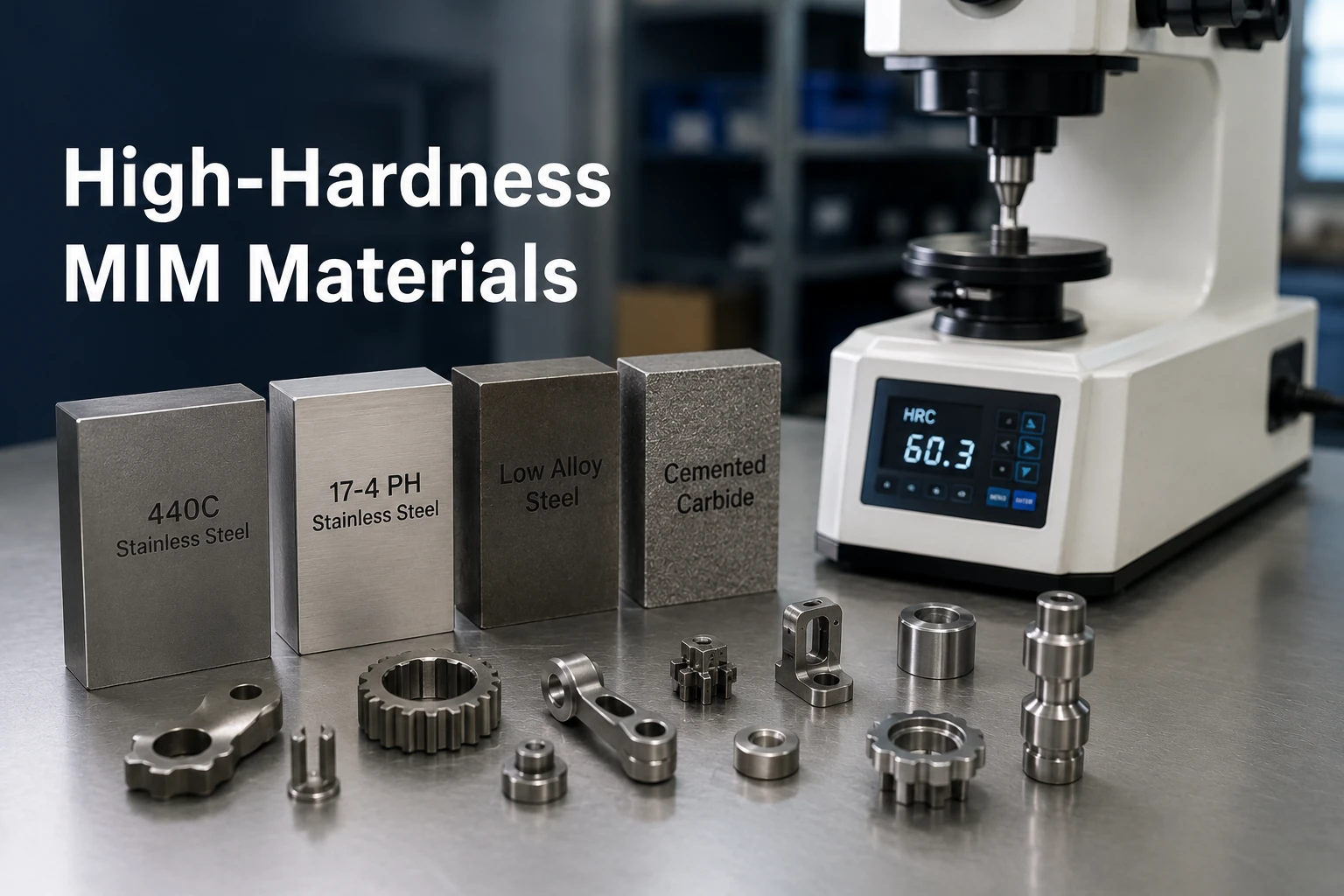
When High-Hardness MIM Materials Are Needed
High-hardness MIM materials are usually considered when the part function involves contact stress, surface deformation, edge retention, sliding movement, or localized wear. In practice, this requirement appears in small mechanical mechanisms, locking features, miniature gears, precision hardware, regulated device components, pump components, valve components and compact assemblies where machining a complex geometry from hardened stock may be inefficient.
Important distinction: A hard material is not automatically the strongest or most wear-resistant material for every application. The correct material direction should start from the failure mode: local indentation, sliding wear, abrasive contact, structural load, corrosion exposure, edge chipping, or dimensional instability after heat treatment.
Parts that require resistance to indentation or edge deformation
High-hardness MIM materials may be appropriate when the part has functional edges that must resist rounding, contact surfaces that repeatedly press against another metal part, small gear teeth, ratchet features, latch features, locking surfaces, sliding contact areas, or compact precision geometry that would be expensive to machine after hardening.
From a MIM process perspective, these parts still need normal MIM design review: feedstock flow, injection molding feasibility, green part handling, debinding stability, sintering shrinkage, tooling compensation and final inspection. High hardness does not remove the need for geometry review; in many cases, it makes geometry review more important because thin walls, small holes, sharp transitions and hard contact surfaces are more sensitive to cracking, distortion and finishing risk.
When a high-hardness material may not be the right starting point
A high-hardness material may not be the best first choice when the real requirement is corrosion resistance, elastic load capacity, impact toughness, appearance, low-cost volume production, or a broad tolerance window. For example, 316L-Edelstahl may be a better starting point when corrosion resistance dominates, 17-4 PH Edelstahl may be a better direction when the part needs strength and stainless performance, and a low-alloy steel may be more practical when the part works inside a protected mechanism and corrosion exposure is limited.
When high hardness may be over-specified
High hardness can increase material, heat treatment, finishing and inspection complexity. It may be over-specified when the part is not failing by indentation, edge deformation or hard contact. Before selecting the hardest available material, confirm whether the real requirement is corrosion resistance, structural load capacity, fatigue behavior, smooth assembly, cosmetic finish, low friction, or lower-cost production.
- If corrosion is the dominant issue, start with corrosion-resistant stainless or special alloy review rather than maximum hardness.
- If impact or shock loading is dominant, review toughness and geometry before increasing hardness.
- If the part is mainly load-bearing, review high-strength materials rather than hard-contact materials first.
- If the part has thin unsupported edges, sharp corners, or tight post-treatment dimensions, check heat treatment distortion and cracking risk early.
- If the part only needs moderate surface durability, a balanced material may be safer and more economical than an extreme-hardness option.
Mobile note: swipe horizontally to view the full table.
| User requirement | Better material direction | Risk to review before tooling |
|---|---|---|
| Edge retention | 420 stainless steel, 440C stainless steel, or tool-steel-type candidate | Brittleness, edge chipping, stress concentration and heat treatment distortion |
| Wear surface | 440C stainless steel, cemented carbide, or another wear-resistant material direction | Contact pressure, lubrication, surface roughness and mating material |
| Strength and corrosion balance | 17-4 PH Edelstahl | Useful engineering balance, but not the highest-hardness stainless route |
| Cost-sensitive structural hardness | 4140, 4340, 4605-type low-alloy steel | Corrosion protection, heat treatment response and dimensional control |
| Extreme hard contact or abrasive wear | Cemented carbide candidate | Cost, brittleness, geometry limits and impact sensitivity |
High-Hardness MIM Material Options
The best high-hardness MIM material depends on whether the part needs stainless corrosion resistance, higher wear resistance, structural strength, impact tolerance, or extreme hardness. The following material groups should be treated as selection directions, not automatic replacements for one another.

420 stainless steel for hardenable corrosion-resistant parts
420 stainless steel for hardenable MIM parts is often reviewed when a part needs hardenability, moderate corrosion resistance and better hardness potential than austenitic stainless steels such as 304 or 316L. It can be useful for small mechanical components, latch parts, precision hardware and functional surfaces where corrosion exposure exists but extreme corrosion resistance is not the only priority.
440C stainless steel for higher hardness and wear resistance
440C stainless steel for higher-hardness MIM parts is commonly evaluated when the design requires a higher-hardness stainless material direction. It may be considered for small wear components, bearing-like surfaces, valve-related components, contact pins and precision parts where the main requirement is a harder functional surface.
17-4 PH stainless steel when strength and corrosion balance matter
17-4 PH Edelstahl für MIM is better understood as a strength-and-corrosion-balance material direction, not as the highest-hardness stainless option. It may be suitable when the part needs precipitation-hardened strength, stainless performance and dimensional reliability.
Low-alloy steels for heat-treated structural hardness
Low-alloy steel MIM materials such as 4140, 4340 und 4605 may be reviewed when the project needs heat-treated structural performance rather than stainless corrosion resistance.
Cemented carbide materials for extreme hardness and wear
Cemented carbide materials for MIM should be considered only when the application requires extreme wear resistance, hard contact performance, or service conditions beyond typical steel-based MIM materials. They are not simple substitutes for 420 or 440C stainless steel. The review must include geometry, impact load, brittleness, edge design, cost, sintering behavior and finishing requirements.
Mobile note: swipe horizontally to view the full table.
| Material group | Best-fit need | Main advantage | Main limitation | Recommended next page |
|---|---|---|---|---|
| 420 Edelstahl | Hardenable stainless MIM parts | Hardness plus moderate corrosion balance | Lower wear potential than 440C; final result depends on heat treatment and geometry | 420 Edelstahl |
| 440C Edelstahl | Higher-hardness stainless parts | Strong hardness and wear-resistance direction | Toughness, distortion and corrosion trade-offs | 440C Edelstahl |
| 17-4 PH Edelstahl | Strength plus corrosion balance | Good engineering balance for structural parts | Not the highest-hardness route | 17-4 PH Edelstahl |
| 4140 / 4340 low-alloy steels | Heat-treated load-bearing parts | Structural strength and hardenability direction | Corrosion protection usually needed | Low-alloy steel materials |
| 4605 low-alloy steel | Cost-sensitive structural MIM parts | Mature structural material direction | Not a premium high-hardness material | 4605 low-alloy steel |
| Hartmetall | Extreme wear or hard contact | Very high hardness and wear direction | Cost, brittleness and geometry limits | Hartmetalle (Cemented Carbides) |
Relative hardness expectation and inspection method
The table below is a non-absolute engineering guide. It does not replace a material datasheet, customer drawing, latest applicable standard, heat treatment specification, or actual hardness test result. Final hardness should be verified according to the selected material condition, MIM process route, heat treatment route and inspection method.
Mobile note: swipe horizontally to view the full table.
| Materialrichtung | Relative hardness expectation | Typical inspection direction | Am besten geeignet, wenn | Review caution |
|---|---|---|---|---|
| 420 Edelstahl | Medium-to-high hardenable stainless direction | Rockwell may be suitable if the test area allows; microhardness may be needed for small features | The part needs hardenability with moderate stainless performance | Confirm heat treatment condition, corrosion exposure and edge sensitivity |
| 440C Edelstahl | Higher-hardness stainless direction | Rockwell or microhardness depending on part size, section thickness and test surface | The part needs a harder stainless wear or contact surface | Review toughness, distortion, surface finish and corrosion trade-offs |
| 17-4 PH Edelstahl | Balanced strength-and-hardness direction after suitable aging condition | Rockwell may be practical on suitable surfaces; define the condition and location | The part needs strength, stainless behavior and controlled heat treatment response | Do not treat it as the highest-hardness stainless choice |
| 4140 / 4340 / selected low-alloy steels | Heat-treatment-dependent structural hardness direction | Rockwell or microhardness depending on geometry and final condition | The part needs protected structural performance and hardenability | Corrosion protection and post-treatment dimensional control may be required |
| 4605-type low-alloy steel | Practical structural material direction, not a premium high-hardness route | Define hardness scale and condition according to the drawing requirement | The part needs a cost-sensitive structural MIM material direction | Do not use it as the default answer for severe wear or extreme hardness |
| Cemented carbide candidate | Extreme hardness and wear-resistance direction | Inspection method should be confirmed by material system, geometry and customer requirement | The part faces severe abrasive wear or hard contact beyond typical steel-based MIM materials | Review brittleness, impact load, edge design, finishing and cost before selection |
Hardness, Wear Resistance and Strength Are Not the Same
This is the most important engineering boundary for this page. Hardness is a useful material property, but it does not automatically solve every mechanical failure mode. A hard material can still fail by cracking, fatigue, corrosion, galling, adhesive wear, abrasive wear, poor lubrication, poor surface finish, or dimensional instability.

Hardness measures resistance to indentation, not every failure mode
Hardness testing measures resistance to indentation under a defined method, load, indenter and test condition. It is useful for material comparison and quality control, but it does not replace full design validation. A single hardness value does not automatically describe toughness, corrosion resistance, fatigue behavior, surface finish, or wear life.
For MIM parts, this matters because the manufacturing route includes feedstock preparation, injection molding, debinding, sintering shrinkage and sometimes heat treatment. The final hardness depends not only on the alloy name but also on density, microstructure, carbon control, heat treatment condition and inspection method.
Wear depends on contact condition, not hardness alone
Wear performance depends on the actual wear mechanism. A high-hardness material may perform well in one contact condition and poorly in another. Important review points include sliding or rolling contact, abrasive particles, dry or lubricated conditions, mating material hardness, surface roughness, contact pressure, edge geometry, temperature and corrosion exposure.
If the main concern is friction, abrasion, mating-surface behavior, or life under repeated sliding contact, the project should also be reviewed through wear-resistant MIM materials for sliding and abrasive wear.
High strength is a different material question
Strength relates to load-bearing capacity, tensile behavior, yield resistance and structural reliability. Hardness relates more closely to resistance against local indentation or surface deformation. A part may need high strength without requiring the highest hardness. Another part may need a hard contact surface without carrying a high structural load.
For structural load capacity, review high-strength MIM materials for load-bearing parts. For hard contact or surface wear, 420, 440C, selected low-alloy steels, or cemented carbide candidates may be more relevant depending on the environment.
How Heat Treatment Affects High-Hardness MIM Parts
Many high-hardness MIM projects depend on heat treatment, but heat treatment should not be treated as a final shortcut after design decisions are already fixed. It affects hardness, strength, toughness, distortion risk, surface condition and inspection planning.
Hardness depends on alloy, sintered density and heat treatment condition
The same material family can produce different results depending on processing and final condition. A drawing that only says “hard material” is not enough. From a manufacturing review perspective, the requirement should define the material direction, heat treatment condition, hardness scale, target or acceptance range, and the functional surface that must be tested.
Variables that affect final hardness
- Alloy composition and powder/feedstock route
- Debinding and sintering condition
- Final density and microstructure
- Carbon control where relevant
- Wärmebehandlungszustand
- Part geometry and section thickness
- Surface finishing after treatment
- Inspection location and hardness scale
Was sollte frühzeitig geprüft werden
- Whether the hardness target is functional or over-specified
- Whether the part can tolerate post-treatment distortion
- Whether a critical surface needs final machining or polishing
- Whether the chosen hardness test suits the part geometry
- Whether the material should be reviewed under a heat-treatable MIM materials and post-sintering treatment path
Heat treatment can improve hardness but may affect dimensions
Heat treatment can create distortion, especially in asymmetric parts, thin sections, long unsupported features, sharp transitions and parts with uneven mass distribution. For MIM parts, this risk combines with normal sintering shrinkage and tooling compensation. The design team should review datum strategy, critical dimensions, heat treatment sequence and whether any final sizing, grinding, polishing, or machining is needed.
Pre-tooling warning: When a project requires both high hardness and tight dimensions, the question is not only whether the material can be hardened. The better question is whether the part can meet hardness, dimensional, surface and cost requirements after the complete process route.
Material Selection Table for High-Hardness MIM Components
The most useful material selection starts from part function. The table below should be treated as a review direction, not a final material specification.
Mobile note: swipe horizontally to view the full table.
| Part requirement | Candidate material direction | What to confirm before tooling |
|---|---|---|
| Small gear with sliding contact | 420, 440C, or low-alloy steel | Wear mode, heat treatment, tooth distortion and lubrication |
| Locking latch or mechanical catch | 420, 17-4 PH, or 4140 | Edge wear, impact load and corrosion exposure |
| Hard contact pin or plunger | 440C, 4340, or cemented carbide | Contact pressure, mating material and brittleness |
| Regulated precision device component | 420, 440C, or Co-Cr if applicable | Cleaning requirement, passivation, hardness test method and material compliance requirement |
| Pump or valve wear part | 440C, cemented carbide, or corrosion-resistant alloy | Fluid exposure, wear particles and sealing surface condition |
| Electronics or consumer mechanism | 420, 17-4 PH, or low-alloy steel | Surface finish, corrosion condition and assembly friction |
| Miniature cam or rotating feature | 440C, 4140, or 4340 | Fatigue, surface roughness and heat treatment distortion |
| High-wear abrasive contact part | Cemented carbide candidate | Impact load, edge design, cost and finishing requirement |
From a product engineering perspective, the material review should be completed before tooling. Once the mold is designed, late material changes can affect shrinkage behavior, dimensional compensation, heat treatment route and trial schedule. For broader material comparison, use the broader MIM material selection guide oder die 420 vs 440C Edelstahl comparison page.
Design and Process Risks in High-Hardness MIM Parts
High-hardness materials can improve surface performance, but they can also make design weaknesses more visible. Small MIM parts often have thin walls, holes, slots, ribs, undercuts and small functional edges. These features must be reviewed together with the material and heat treatment condition.

Thin edges and sharp corners may become failure points
A hard material can be less tolerant of sharp transitions, thin unsupported edges and local stress concentration. In production, a sharp corner may look acceptable in CAD but become a cracking or chipping risk after sintering, heat treatment, assembly, or service loading.
Sintering shrinkage and heat treatment can change critical dimensions
MIM requires tooling compensation for sintering shrinkage. High-hardness material projects may also require heat treatment after sintering, which can add dimensional change or distortion risk. The tighter the final tolerance, the more important the review of datum structure, sintering support, part orientation and post-treatment inspection.
Surface finish affects wear performance
A hard material with poor surface finish may still fail in sliding contact. Surface roughness, finishing direction, burr control, polishing, passivation, coating, or grinding can affect performance. If two hard surfaces run against each other, poor surface finish may increase friction, noise, wear debris, or galling risk.
Post-machining becomes more difficult after hardening
Machining strategy should be considered early. Some features may be easier to machine before hardening, while other functional surfaces may require finishing after heat treatment. Harder materials can increase tooling cost, grinding requirement, EDM consideration, or polishing complexity.
Mobile note: swipe horizontally to view the full table.
| Risiko | Common cause | DFM review action |
|---|---|---|
| Rissbildung | Sharp transitions, thin sections and local stress | Add radius, review wall thickness and check the load path |
| Verzug | Asymmetric geometry, heat treatment and sintering support | Review datum, support strategy and heat treatment sequence |
| Unstable hardness result | Material condition or test location not defined | Specify hardness scale, test location and treatment condition |
| Wear failure | Wrong wear mode assumption | Review mating material, lubrication, surface finish and contact pressure |
| High cost | Over-specified maximum hardness | Confirm the functional requirement instead of selecting the hardest material by default |
| Poor assembly fit | Dimensional change after treatment | Review tolerance stack-up and final inspection plan |
Hardness specified without wear mode review
Welches Problem ist aufgetreten: A small sliding mechanism component was specified with a high hardness requirement because the design team wanted longer wear life. The drawing included a hardness target but did not define the mating material, lubrication condition, surface roughness requirement, or actual wear mode.
Warum es passiert ist: The material discussion focused on hardness, while the real contact system was not defined clearly enough for material selection.
Was die eigentliche Systemursache war: The part was not failing only by indentation. The contact pair, surface finish, lubrication condition and wear debris risk were part of the wear system.
Wie wurde es korrigiert: The review was changed from “select the hardest material” to “review the wear mechanism.” The project team added mating material, contact condition, surface finish and inspection requirements before final material confirmation.
Wie kann ein erneutes Auftreten verhindert werden: Before selecting a high-hardness MIM material, define the wear mode, mating material, surface finish, lubrication condition and hardness test method. If wear is the main functional concern, also review the project through the wear-resistant material path.
Heat treatment distortion in a thin hard component
Welches Problem ist aufgetreten: A small hardenable MIM component had thin arms and a locking edge. After heat treatment, the hardness direction was acceptable, but a critical functional dimension became unstable.
Warum es passiert ist: The early review focused on material hardness and did not sufficiently connect part geometry, sintering shrinkage, heat treatment and datum control.
Was die eigentliche Systemursache war: The issue was not only the material. The system cause included geometry asymmetry, thin unsupported features, heat treatment response and incomplete inspection planning.
Wie wurde es korrigiert: The design review added radius changes, adjusted the datum strategy, identified critical functional areas and separated as-sintered dimensions from post-treatment inspection requirements.
Wie kann ein erneutes Auftreten verhindert werden: For high-hardness MIM parts, review geometry and process sequence before tooling. Hardness, heat treatment, shrinkage compensation, support strategy and critical dimensions should be discussed together.
Hardness Testing and Acceptance Checks
Hardness requirements should be written in a way that can be inspected consistently. A drawing that only says “high hardness” or “hard material” is not sufficient for production or supplier communication. The test method, location and material condition should be defined before tooling or at least before the first article inspection plan is finalized.

Rockwell hardness for metallic MIM parts
Rockwell hardness is commonly used for metallic components when the part geometry and test area allow reliable testing. It may be suitable for larger or accessible functional surfaces, but the test location must be defined. Small MIM parts may not always provide enough flat area or section thickness for every hardness method.
Vickers or Knoop microhardness for small features or thin sections
For small MIM parts, thin sections, surface-treated zones, local hardened regions, or very small test areas, Vickers or Knoop microindentation methods may be more relevant. This should be confirmed during project review because test method selection affects sample preparation, test location, interpretation and acceptance.
When Rockwell may not be suitable for small MIM parts
Rockwell testing may be difficult when the available test surface is too small, curved, thin, rough, close to an edge, or affected by local geometry. For miniature MIM parts, local functional areas may require Vickers or Knoop microhardness testing instead of a general Rockwell value. The drawing should define whether hardness applies to the full part, a functional surface, or a prepared sample area.
What to define on the drawing
- Hardness scale, such as HRC, HV, or HK
- Test location
- Test condition
- Material condition, such as as-sintered, hardened, tempered, aged, or other project-specific state
- Surface condition before testing
- Minimum, target, or acceptable range
- Whether the requirement applies to all surfaces or only functional areas
- Inspection frequency or sampling plan if required by the customer
- Any related wear, strength, corrosion, or surface finish requirement
High-Hardness MIM Materials vs Adjacent Material Property Pages
High hardness often overlaps with other material requirements. To avoid incorrect material selection and keyword overlap, this page focuses on surface indentation resistance, hard contact and edge retention. Other property pages should be used when the primary failure mode is different.
Mobile note: swipe horizontally to view the full table.
| Seite | Page ownership | When to read |
|---|---|---|
| Hochharte MIM-Werkstoffe | Surface indentation resistance, hard contact and edge retention | You need a hard material candidate |
| Wear-resistant MIM materials | Wear mechanisms and mating-surface behavior | You need to solve friction, abrasion, or sliding wear |
| High-strength MIM materials | Tensile, yield and structural load-bearing performance | You need structural load capacity |
| Heat-treatable MIM materials | Heat treatment response and dimensional risk | You need hardening, aging, or post-sintering treatment review |
| Corrosion-resistant MIM materials | Chemical and environmental resistance | You need corrosion exposure review |
What to Send for Material and DFM Review
If your project requires a high-hardness MIM material, the most useful next step is a drawing-based material and DFM review. This helps confirm whether the hardness target, material direction, geometry, tolerance and process route are aligned before tooling.
Information needed for high-hardness material review
- 2D-Zeichnung und 3D-CAD-Datei
- Target material or candidate material
- Target hardness and hardness scale
- Required heat treatment condition, if already defined
- Functional wear surface or hard contact area
- Gegenmaterial
- Operating load or contact pressure, if known
- Sliding, rolling, impact, or abrasive condition
- Corrosion, fluid, cleaning, or temperature exposure
- Oberflächengüteanforderung
- Critical dimensions and tolerance requirements
- Erwartete Jahresstückzahl
- Prototype, trial, or production stage
- Anwendungshintergrund
What XTMIM engineers should review before tooling
- Material suitability and available feedstock route
- Hardness target realism
- Heat treatment and distortion risk
- Sintering shrinkage and tooling compensation
- Edge, corner, rib, slot and hole risk
- Surface finish and post-processing needs
- Machining, grinding, polishing, or coating requirement
- Inspection method and hardness test location
- Production feasibility, cost drivers and expected volume fit
Request a High-Hardness MIM Material Review
If your MIM part requires high hardness, wear resistance, hard contact performance, or edge retention, send your drawing for a material and DFM review before tooling. Please include 2D drawings, 3D CAD files, target hardness, hardness scale, candidate material, mating material, wear condition, surface finish requirement, critical dimensions, expected annual volume and application background.
XTMIM can review whether 420 stainless steel, 440C stainless steel, 17-4 PH, selected low-alloy steels, cemented carbide materials, or another MIM material direction is more appropriate. The review can also identify risks related to heat treatment distortion, thin edges, sharp corners, sintering shrinkage, surface finish, post-machining and hardness inspection before the project moves into tooling or production planning.
FAQ: High-Hardness MIM Materials
Welche hochharten Werkstoffe eignen sich am besten für MIM-Teile?
Zu den gängigen hochharten MIM-Werkstoffrichtungen gehören 420er Edelstahl, 440C-Edelstahl, ausgewählte vergütbare niedriglegierte Stähle, werkzeugstahlartige Kandidaten und Hartmetallwerkstoffe für extremen Verschleiß. Die beste Wahl hängt vom Härteziel, der Verschleißart, der Korrosionsbelastung, der Zähigkeitsanforderung, dem Wärmebehandlungszustand, der Geometrie und der Prüfmethode ab.
Welches MIM-Material hat die höchste Härte?
Hartmetall-Kandidaten werden häufig geprüft, wenn das Projekt höchste Härte und extreme Verschleißfestigkeit erfordert, während 440C-Edelstahl üblicherweise für MIM-Teile aus Edelstahl mit höherer Härte in Betracht gezogen wird. Die beste Wahl hängt dennoch von Geometrie, Schlagbelastung, Kantendesign, Korrosionseinwirkung, Endbearbeitungsmethode und Prüfanforderungen ab. Wählen Sie ein Material nicht allein aufgrund der maximalen Härte aus.
Ist 440C in MIM-Anwendungen härter als 420er Edelstahl?
440C wird in der Regel geprüft, wenn ein MIM-Edelstahlteil eine höhere Härte und Verschleißfestigkeit als 420 erfordert. Das Endergebnis hängt jedoch vom Werkstoffzustand, Sinterprozess, der Wärmebehandlung, der Geometrie und der Prüfmethode ab. 420 kann dennoch die bessere Wahl sein, wenn das Projekt eine härtbare Edelstahloption mit einem anderen Gleichgewicht aus Kosten, Korrosionsverhalten, Zähigkeit oder Fertigbarkeit erfordert.
Bedeutet eine höhere Härte immer einen besseren Verschleißwiderstand?
Nein. Eine höhere Härte kann helfen, Eindrückungen und einige Formen von Oberflächenverformungen zu widerstehen, aber die Verschleißfestigkeit hängt auch vom Anpressdruck, Gegenwerkstoff, Schmierung, Oberflächenrauheit, abrasiven Partikeln, Korrosionseinwirkung und Bewegungsart ab. Wenn das Hauptproblem Reibung oder Abrasion ist, sollte das Projekt als Verschleißsystem betrachtet werden, nicht nur als Härteanforderung.
Kann 17-4 PH als MIM-Werkstoff mit hoher Härte verwendet werden?
17-4 PH kann eingesetzt werden, wenn das Projekt eine Balance aus Festigkeit, rostfreiem Korrosionsverhalten und Ausscheidungshärtung erfordert. Es sollte nicht als die härteste Edelstahloption betrachtet werden. Wenn Oberflächenhärte oder Verschleißfestigkeit die dominierende Anforderung sind, sollten 420, 440C oder andere Richtungen für harte Werkstoffe geprüft werden.
Können MIM-Teile nach dem Sintern wärmebehandelt werden?
Einige MIM-Werkstoffe können nach dem Sintern wärmebehandelt werden, abhängig vom Legierungssystem und den Projektanforderungen. Eine Wärmebehandlung kann die Härte oder Festigkeit verbessern, aber auch Abmessungen, Verzug, Oberflächenbeschaffenheit, Kosten und Prüfplanung beeinflussen. Die Wärmebehandlung sollte vor dem Werkzeugbau geprüft werden, insbesondere bei dünnen, asymmetrischen oder engen Toleranzen aufweisenden Teilen.
Welcher Härtetest wird für MIM-Teile verwendet?
Die Härteprüfmethode hängt vom Werkstoff, der Bauteilgröße, der Wanddicke, der Prüffläche und der Zeichnungsanforderung ab. Rockwell-Härte kann für geeignete Metallteile und zugängliche Prüfbereiche verwendet werden. Vickers- oder Knoop-Mikrohärte kann für kleine Querschnitte, lokale Bereiche oder dünne Merkmale besser geeignet sein. Die Härteskala, der Prüfort und der Zustand sollten eindeutig auf der Zeichnung festgelegt werden.
Sollten kleine MIM-Teile mit HRC-, HV- oder HK-Härteprüfung getestet werden?
Die Härteskala sollte auf das Material, die Wanddicke, die Prüffläche, den Funktionsbereich sowie die Zeichnungs- oder Kundenanforderung abgestimmt sein. HRC ist für geeignete metallische Teile mit ausreichend zugänglicher Prüffläche praktikabel. HV oder HK können für kleine Merkmale, dünne Querschnitte, lokale gehärtete Bereiche oder vorbereitete Probenflächen besser geeignet sein. Die Prüfmethode und der Prüfort sollten vor der endgültigen Prüfplanung festgelegt werden.
Welche Informationen sollte ich vor der Auswahl eines hochharten MIM-Werkstoffs übermitteln?
Senden Sie die 2D-Zeichnung, die 3D-CAD-Datei, die Zielhärte, die Härteskala, den Kandidatenwerkstoff, die funktionelle Verschleißfläche, den Gegenwerkstoff, die Betriebsbedingungen, die Anforderungen an die Oberflächengüte, die kritischen Maße, die Korrosionsbelastung, die Wärmebehandlungsanforderung, die geschätzte Jahresmenge und den Anwendungshintergrund. Diese Angaben helfen dem Entwicklungsteam, die Werkstoffeignung und das DFM-Risiko vor dem Werkzeugbau zu prüfen.
Hinweis zu Normen und technischen Referenzen
High-hardness MIM material selection should be guided by recognized material and hardness-testing references, but standards should not replace project-specific engineering review. Specific material property values, hardness targets and acceptance methods should be confirmed against the latest applicable formal standard, material datasheet, drawing requirement, customer specification and actual test results.
- MPIF-Normen: relevant for MIM material specification direction and material-property discussion, including Standard 35-MIM.
- MIMA / MPIF Standard 35-MIM information: relevant for metal injection molded parts material standards and MIM industry reference context.
- ASTM E18: relevant to Rockwell hardness testing of metallic materials where part geometry and test area are suitable.
- ASTM E384: relevant to Knoop and Vickers microindentation hardness testing for small features, thin sections, or local hardness regions.
Publishing note: do not quote specific material property values from paid standards or supplier datasheets unless the latest source has been verified for the specific material condition and project requirement.