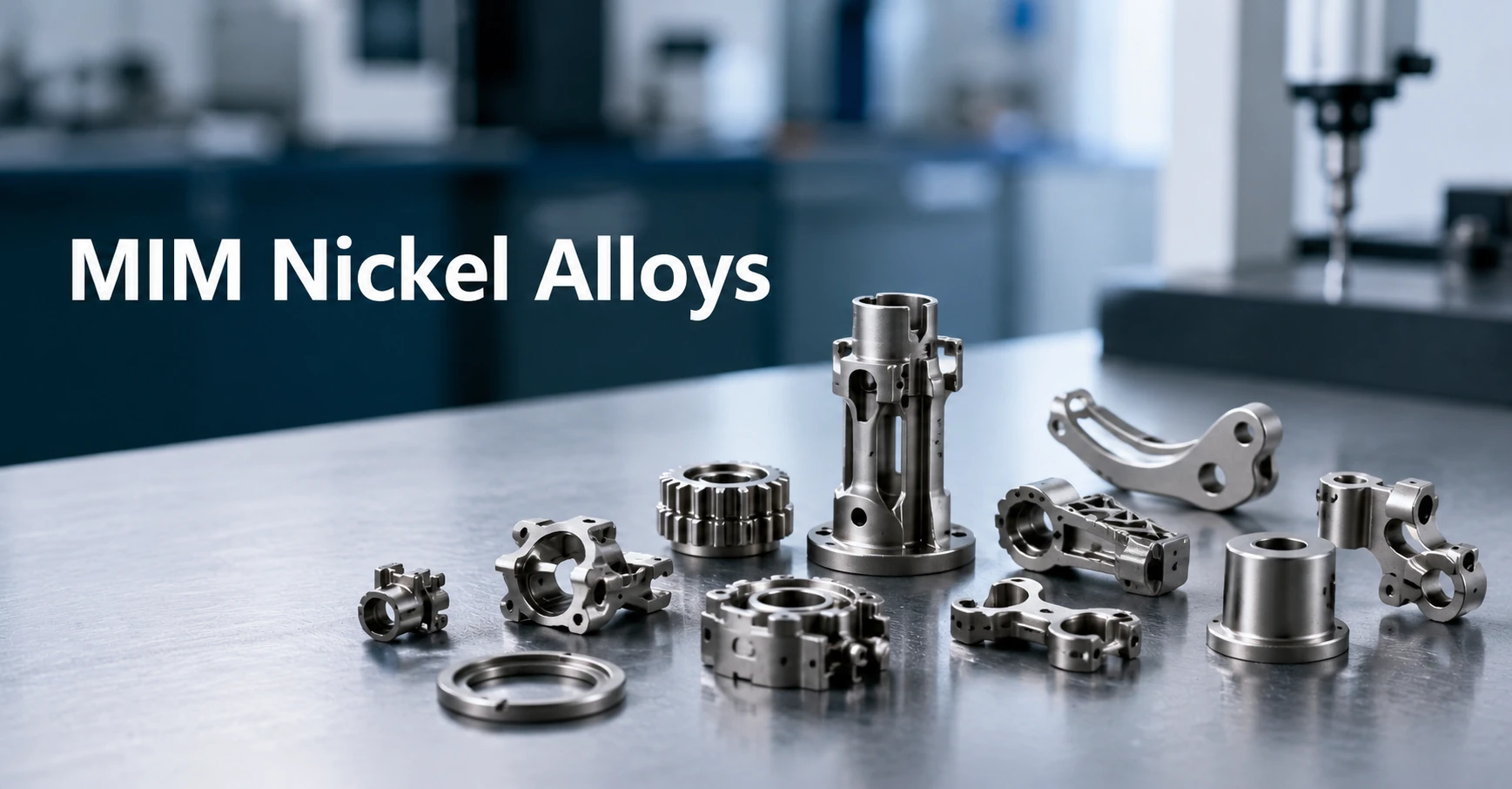
Nickel alloys are considered for metal injection molding when a small, complex metal component needs more than ordinary corrosion resistance or structural strength. The key question is not whether a nickel alloy performs well as wrought bar, plate, or cast stock; it is whether the required alloy can be sourced as fine metal powder, compounded into stable MIM feedstock, molded without defect-prone geometry, debound safely, sintered to the required density, and validated after heat treatment or secondary operations. For many precision components, 316L-Edelstahl, 17-4 PH Edelstahl, titanium, cobalt-chromium, controlled expansion alloys, or soft magnetic alloys may be more practical starting points. Nickel alloys become relevant when complex geometry combines with heat exposure, aggressive corrosion, oxidation risk, or nickel-based alloy strength requirements that common MIM stainless steels cannot satisfy.
When Nickel Alloys Make Sense for MIM
Nickel alloys should be reviewed for MIM only when the application requirement justifies both the material cost and the process development effort. In practice, this usually means the part is small, geometrically complex, difficult to machine economically, and exposed to a service environment where ordinary stainless steels may not provide enough performance.
Small complex parts with demanding environments
Nickel alloy MIM is most relevant when compact geometry, thin walls, holes, slots, bosses, or undercuts combine with heat, oxidation, corrosion, or strength requirements.
When stainless steel is not enough
For general corrosion resistance, stainless steel should usually be reviewed first. Nickel alloys become more relevant when the operating environment exceeds practical stainless steel limits.
When MIM may reduce machining complexity
MIM may become attractive when nickel alloy parts require repeated production of small, complex features that would otherwise require multiple CNC setups or excessive material removal.
A common mistake is to select nickel alloy first because the application sounds demanding. From a design review perspective, the starting point should be the real working condition: temperature, corrosive medium, load, dimensional tolerance, surface requirement, expected volume, and whether the design is suitable for high-shrinkage sintering.
| Project condition | Nickel alloy MIM suitability | Hinweis zur technischen Prüfung |
|---|---|---|
| Small complex part with high-temperature exposure | Starker Kandidat | Confirm powder, feedstock, sintering route, heat treatment, and inspection plan. |
| General corrosion resistance only | Moderate to weak | 316L-Edelstahl may be reviewed first. |
| High strength but moderate corrosion | Projektabhängig | 17-4 PH may be more practical before nickel alloy. |
| Magnetic performance is the main requirement | Nicht diese Seite | Prüfen Sie weichmagnetische MIM-Werkstoffe. |
| Thermal expansion matching is the main requirement | Nicht diese Seite | Prüfen Sie Legierungen mit kontrollierter Wärmeausdehnung. |
| Low-volume prototype | Usually weak | CNC or metal additive manufacturing may be reviewed first before MIM tooling. |
| Large simple component | Usually weak | MIM tooling, debinding, and sintering shrinkage control may not be justified. |
Where Nickel Alloys Fit in the MIM Material Matrix
Nickel alloys should sit inside the MIM material matrix as a special alloy family, not as a replacement for every corrosion-resistant, heat-resistant, or high-strength material. This distinction protects the page boundary and helps engineers avoid selecting a costly alloy family before the real requirement is defined.

Nickel alloys vs stainless steels
Stainless steels for MIM are usually reviewed first when the part needs corrosion resistance, general mechanical strength, wear resistance, or heat-treatable performance within a practical cost range. Nickel alloys should be considered when stainless steel performance may not be enough for the application environment.
Nickel alloys vs soft magnetic Fe-Ni alloys
Fe-Ni alloys such as Fe-50Ni can contain significant nickel, but their design purpose is different. They are selected for magnetic behavior, not primarily for high-temperature strength or aggressive corrosion resistance. If the core requirement is permeability, coercivity, magnetic response, or magnetic annealing, the project belongs under weichmagnetische MIM-Werkstoffe, not this nickel alloy page.
Nickel alloys vs controlled expansion alloys
Invar and Kovar also contain nickel, but their page sovereignty is controlled thermal expansion. They are selected when dimensional stability, thermal expansion matching, or sealing compatibility is the main requirement. These projects should be routed to Legierungen mit kontrollierter Wärmeausdehnung.
Nickel alloys vs cobalt-chromium and titanium alloys
Titanlegierungen are often reviewed when low density, biocompatibility requirements, or strength-to-weight ratio matter. Kobalt-Chrom-Legierungen are often reviewed for wear resistance, corrosion resistance, and specific high-performance mechanical applications. Nickel alloys should not be used as a generic substitute for these families.
Nickel Alloy Types Commonly Reviewed for MIM Projects
Nickel alloy selection for MIM should start with project requirements, not a broad list of alloy names. Some nickel-based alloys are discussed often because they are associated with high strength, corrosion resistance, or high-temperature service, but their suitability for MIM still depends on powder availability, feedstock behavior, sintering response, heat treatment condition, and final validation.
Quick grade direction table for nickel alloy MIM review
This table is a project-screening tool, not a substitute for a grade-specific datasheet or production validation. It helps engineers decide whether a nickel alloy direction is reasonable before moving into tooling review.
| Project driver | Nickel alloy direction | First alternative to compare | Key MIM review risk | Boundary note |
|---|---|---|---|---|
| High temperature plus strength | Alloy 718 / Inconel 718-type direction | 17-4 PH or heat-resistant stainless steel, depending on service condition | Powder route, heat treatment response, distortion, and chemistry control | Do not treat this family page as a full 718 datasheet. |
| Corrosion resistance plus strength | Alloy 625 / Inconel 625-type direction | 316L stainless steel or other stainless grades first for general corrosion | Powder availability, sintered density, surface condition, and validation route | Use only when stainless steel may not meet the environment. |
| Aggressive chemical exposure | Ni-Cr-Mo corrosion-resistant alloy direction | 316L, high-alloy stainless, CoCr, or another special alloy family | Feedstock route, sintering response, corrosion validation, and surface finish | Project-specific; do not assume every wrought alloy is practical for MIM. |
| Very high-temperature superalloy requirement | Project-specific nickel-base superalloy direction | Casting, CNC machining, or metal additive manufacturing for low volume | Sintering window, chemistry sensitivity, grain structure, distortion, and inspection | Requires cautious feasibility review before mold investment. |
| Electrical or special corrosion requirement | Pure nickel or commercially pure nickel-type direction | Copper alloy, stainless steel, or application-specific material review | Powder cleanliness, contamination control, density, and surface condition | Not the main search intent of this page. |
| Magnetisches Verhalten | Nicht diese Seite | Soft magnetic Fe-Ni materials | Magnetic annealing and magnetic performance belong to the soft magnetic route | Route to soft magnetic materials, not structural nickel alloys. |
| Thermal expansion matching | Nicht diese Seite | Legierungen mit kontrollierter Ausdehnung | Expansion coefficient, sealing compatibility, and dimensional stability | Route to Invar/Kovar-type controlled expansion materials. |
Alloy 718 / Inconel 718-type nickel alloys
Alloy 718-type materials are commonly discussed when strength, heat exposure, and corrosion resistance need to be balanced. For MIM, the engineering question is whether the route can meet required chemistry, density, heat treatment condition, dimensional stability, and inspection requirements.
Alloy 625 / Inconel 625-type nickel alloys
Alloy 625-type materials are usually reviewed when corrosion resistance and strength are important. For MIM, the project review should include powder route, sintering condition, surface requirements, possible secondary machining, and post-sintering inspection.
Corrosion-resistant Ni-Cr-Mo alloy families
Ni-Cr-Mo alloy families may be considered for chemically aggressive environments. In MIM, these materials should be treated as project-dependent rather than standard selectable grades.
Pure nickel and special nickel alloy directions
Pure nickel or commercially pure nickel-type materials may be reviewed for special corrosion, electrical, or application-specific requirements, but they should not dominate this page’s main search intent.
| Nickel alloy direction | Typical reason for review | Suitable depth on this page | Important boundary |
|---|---|---|---|
| Alloy 718-type | Strength, heat exposure, corrosion resistance | Mittel | Do not turn this page into a full 718 datasheet. |
| Alloy 625-type | Corrosion resistance and strength | Mittel | Confirm MIM powder, feedstock, and validation route. |
| Ni-Cr-Mo corrosion-resistant alloys | Aggressive chemical environment | Brief to medium | Project-dependent and powder-route dependent. |
| Pure nickel / nickel 200-type | Special electrical or corrosion requirement | Brief | Not the main search intent of this page. |
| Fe-Ni soft magnetic alloys | Magnetische Eigenschaften | Do not cover deeply | Route to soft magnetic materials. |
| Invar / Kovar | Kontrolle der Wärmeausdehnung | Do not cover deeply | Route to controlled expansion alloys. |
MIM Processing Considerations for Nickel-Based Alloys
Nickel alloy MIM projects require a more careful process review than standard stainless steel projects. The alloy may be technically attractive, but the manufacturing route must still control powder, binder, molding, green part handling, debinding, sintering shrinkage, chemistry, heat treatment, and final inspection.

Verfügbarkeit von Pulver und Feedstock
Not every wrought nickel alloy is automatically available as a practical MIM powder. The powder must have suitable chemistry, particle size distribution, morphology, and supply consistency. It must also be compatible with binder systems and feedstock compounding. If powder availability is uncertain, the project should remain in material feasibility review rather than moving directly to tooling.
Oxygen, carbon, and chemistry control
Nickel-based alloys can be sensitive to chemistry variation. In MIM, binder removal, furnace atmosphere, powder condition, and sintering route may affect oxygen, carbon, nitrogen, or other chemistry-related risks. These factors can influence density, strength, corrosion behavior, and heat treatment response. This is why vague requests such as “use Inconel” should be converted into a defined alloy, condition, inspection requirement, and service environment.
Debinding and sintering atmosphere
Debinding removes binder from the green part before sintering. For complex parts, poor debinding can cause cracking, internal defects, contamination, or distortion. Sintering then controls density, shrinkage, dimensional stability, and final microstructure. For nickel alloys, furnace atmosphere, support strategy, spacing, and sintering profile need careful review.
Shrinkage, distortion, and dimensional stability
MIM parts shrink significantly during sintering. Nickel alloy parts with thin walls, uneven sections, cantilever features, long slots, or asymmetric mass distribution may distort if the design does not account for shrinkage and support. The drawing should identify critical dimensions, datum strategy, functional surfaces, and areas that may allow machining or finishing after sintering.
Heat treatment, secondary machining, and inspection
Some nickel alloys require heat treatment to develop required properties. Others may need secondary machining, surface finishing, or inspection steps after sintering. These requirements should be reviewed before tooling because they can affect cost, lead time, tolerances, fixture design, and acceptance criteria.
Why nickel alloy MIM is more difficult than stainless steel MIM
Nickel alloy MIM is not automatically more difficult in every project, but it often requires a narrower engineering review window than common stainless steel MIM materials. The difference comes from alloy availability, chemistry sensitivity, sintering response, and final validation requirements.
Powder and feedstock route
Common stainless steels are usually more familiar in MIM production. Nickel alloys may require more careful confirmation of powder source, powder morphology, binder compatibility, and feedstock stability before mold investment.
Chemistry and contamination control
Binder removal, furnace atmosphere, oxygen, carbon, and other chemistry-related factors can have a stronger influence on final performance. These risks should be converted into inspection and validation requirements early.
Sintering window and distortion
Nickel alloy parts with uneven wall sections, long unsupported features, or critical sealing surfaces may require more careful sintering support, orientation, shrinkage compensation, and post-sintering dimensional review.
Heat treatment and final inspection
Some nickel alloys require heat treatment or additional verification after sintering. Hardness, density, chemistry, surface condition, critical dimensions, or material condition may need to be defined before trial production.
| Process factor | Why it matters for nickel alloys | Engineering review point |
|---|---|---|
| Powder availability | Not every alloy can be sourced as suitable MIM powder. | Confirm chemistry, particle size, morphology, and supplier route. |
| Feedstock-Stabilität | Affects molding consistency and defect risk. | Review flow behavior, feature size, gate strategy, and molding window. |
| Formfüllung | Nickel alloy feedstock must fill complex geometry reliably. | Check thin walls, long flow paths, holes, ribs, bosses, and gate location. |
| Handhabung des Grünlings | Weak green parts can crack or deform before sintering. | Review handling, ejection, trays, and feature support before tooling. |
| Entbindern | Poor binder removal may cause cracks, pores, or contamination. | Review section thickness, section changes, and debinding route. |
| Sintern | Controls density, shrinkage, and dimensional stability. | Review atmosphere, support, orientation, and furnace profile. |
| Wärmebehandlung | May be needed for final properties. | Confirm condition, distortion risk, and inspection requirement. |
| Nachbearbeitung durch Zerspanen | May be needed for critical features. | Define machining allowance and datum surfaces early. |
| Endkontrolle | Confirms drawing and performance requirements. | Define critical dimensions, surface, hardness, density, chemistry, or material checks. |
Design and Application Fit for MIM Nickel Alloy Parts
A nickel alloy may look correct on a material list, but the part design must still be suitable for MIM. From a design review perspective, the most important question is whether geometry, tolerance, material requirement, and volume work together.
Suitable part characteristics
Nickel alloy MIM parts are more suitable when they include compact size, complex geometry, repeated production demand, functional surfaces that can be controlled by tooling or secondary operations, and material requirements that justify nickel alloy selection.
Geometry risks that need DFM review
Long thin walls, deep blind holes, sharp internal corners, large section thickness changes, unsupported slender features, asymmetric mass distribution, tight tolerances across long dimensions, and sealing surfaces requiring post-machining should be reviewed early. These features are not automatically impossible, but they affect molding, debinding, sintering shrinkage, support strategy, tooling compensation, and inspection method.

Applications where nickel alloys may be considered
Nickel alloy MIM may be reviewed for small precision components exposed to heat, corrosion, oxidation, or combined mechanical and environmental demands. Possible application areas may include industrial equipment, energy-related components, chemical exposure environments, high-performance hardware, and special precision devices. The correct claim is not that every high-end application should use nickel alloy MIM; the correct claim is that these environments often create requirements where nickel alloy MIM may need evaluation.
When application requirements are not clear enough
If the user cannot provide working temperature, corrosion medium, load, critical dimensions, expected life, or inspection requirements, the material recommendation will remain uncertain. In that situation, the first step is not to choose a grade. The first step is to define the service condition and review the drawing.
Nickel Alloys vs Stainless Steel, Soft Magnetic Alloys, and Controlled Expansion Alloys
Many alloy families contain nickel or compete with nickel alloys in real projects. The correct choice depends on the primary requirement, not on nickel content alone.
| Main requirement | Better starting page | Warum |
|---|---|---|
| Allgemeine Korrosionsbeständigkeit | Edelstahl für MIM | 316L may be sufficient before nickel alloy. |
| Strength after heat treatment | 17-4 PH or nickel alloy review | Depends on temperature, corrosion condition, and required strength condition. |
| High hardness or wear resistance | 420 / 440C stainless steel or other material review | Nickel alloy may not be the first choice if wear or hardness is the main driver. |
| Magnetische Eigenschaften | Weichmagnetische Werkstoffe | Fe-Ni alloys belong there. |
| Thermal expansion matching | Legierungen mit kontrollierter Ausdehnung | Invar/Kovar are expansion-control materials. |
| High-temperature corrosion + complex geometry | Nickellegierungen | This is the core page intent. |
| Low density and strength-to-weight ratio | Titanlegierungen | Titanium may be more relevant. |
| Wear and corrosion in CoCr applications | Kobalt-Chrom-Legierungen | CoCr has separate material sovereignty. |
When Not to Choose Nickel Alloys for MIM
A trustworthy material page should explain when the material is not the right choice. Nickel alloy MIM is valuable only when the project requirement justifies the material and process complexity.
When stainless steel already meets the requirement
If 316L, 17-4 PH, 420, or 440C can meet the working condition, nickel alloy may add unnecessary cost and development complexity.
When annual volume cannot justify tooling
MIM requires tooling, feedstock preparation, process validation, and production control. For a very small prototype batch, CNC or metal additive manufacturing may be more suitable.
When the part is too large or too simple
MIM is strongest when geometry is complex and part size is suitable for injection molding and sintering. Large simple parts may not justify MIM.
When the real requirement is magnetic or thermal expansion performance
If the real requirement is magnetic behavior or controlled thermal expansion, the project should move to the correct material family instead of staying on nickel alloys.
Verbundene Fallszenarien für die technische Schulung
The following composite scenarios are not customer case studies. They summarize common review patterns seen in nickel alloy MIM feasibility discussions without using customer names, project data, or confidential production details.
Scenario 1: nickel alloy was requested too early
Scenario 2: geometry risk appeared after material selection
Project Review Checklist for MIM Nickel Alloy Parts
Nickel alloy MIM projects should be reviewed before tooling. The review should connect material selection, geometry, process route, cost, tolerance, lead time, and inspection.

| Information to provide | Warum es wichtig ist |
|---|---|
| 2D-Zeichnung | Defines dimensions, tolerances, material, surface, and inspection notes. |
| 3D-CAD-Datei | Supports geometry and tooling review. |
| Target nickel alloy or equivalent | Helps confirm powder and feedstock feasibility. |
| Service temperature | Supports material, heat treatment, and alternative alloy review. |
| Corrosion medium or working environment | Helps compare nickel alloy vs stainless steel. |
| Kritische Maße | Guides tolerance strategy, tooling compensation, and inspection plan. |
| Oberflächengüteanforderung | May require secondary finishing or machining. |
| Wärmebehandlungsanforderung | Affects final property development and distortion risk. |
| Geschätzte Jahresstückzahl | Determines whether MIM tooling and development are economically reasonable. |
| Aktueller Fertigungsprozess | Helps compare MIM with CNC, casting, or additive manufacturing. |
| Projektphase | Defines the review depth and next action. |
Request a Nickel Alloy MIM Project Review
For small, complex metal parts that may require nickel alloy performance, XTMIM can review the drawing from a material selection and MIM manufacturability perspective. Please provide 2D drawings, 3D CAD files, target nickel alloy or equivalent material, service temperature, corrosion environment, critical dimensions, tolerance requirements, surface finish, heat treatment needs, estimated annual volume, and project stage.
The review focuses on whether nickel alloy MIM is suitable, whether stainless steel or another alloy family should be reviewed first, whether the geometry creates molding or sintering risk, and whether secondary machining or inspection planning is needed before tooling or production.
Standards and Technical References for MIM Nickel Alloy Review
Standards and technical references should support material review, but they should not replace supplier-specific process validation. For nickel alloy MIM parts, the most relevant references are those that help define MIM material scope, alloy chemistry, and expected material behavior.
MPIF Standard 35-MIM: MPIF describes Standard 35-MIM as covering common materials used in metal injection molding with explanatory notes and definitions. It supports material specification discussions, but it does not guarantee that every nickel alloy can be produced by every MIM supplier. MPIF-Normen
MIMA Materials Range: MIMA lists nickel-based alloys among material groups that can be used in MIM and directs designers to MPIF Standard 35-MIM for material specification. This supports nickel alloys as part of the broader MIM material scope, while still requiring powder and process review. MIMA also recommends confirming alloy availability or substitute alloy options with the supplier, which aligns with drawing-based MIM project review rather than selecting by alloy name alone. MIMA-Werkstoffpalette
Alloy 718 and Alloy 625 technical bulletins: Special Metals technical bulletins provide useful background for Alloy 718 and Alloy 625. These sources support general alloy understanding, but they should not be used alone to approve a MIM route. INCONEL Alloy 718 bulletin / INCONEL Alloy 625 bulletin
FAQ About MIM Nickel Alloys
Können Nickellegierungen mittels Metallpulverspritzguss verarbeitet werden?
Ja, nickelbasierte Legierungen können für den Metallpulverspritzguss geprüft werden, wenn geeignete Pulver-, Feedstock-, Sinter- und Validierungswege verfügbar sind. Allerdings kann nicht jede Knet-Nickellegierung direkt in ein praktikables MIM-Projekt umgesetzt werden. Die Bauteilgeometrie, die Materialanforderungen, das Sinterverhalten und die Prüfanforderungen müssen vor dem Werkzeugbau geprüft werden.
Ist Inconel 718 für MIM geeignet?
Werkstoffe vom Typ Inconel 718 können für MIM-Projekte geprüft werden, die hohe Festigkeit, Hitzebeständigkeit und Korrosionsbeständigkeit erfordern. Die Eignung hängt von der Pulververfügbarkeit, dem Feedstock-Verhalten, dem Wärmebehandlungszustand, den Maßanforderungen und der Endprüfung ab. Die Auswahl sollte nicht allein anhand der Legierungsbezeichnung ohne projektbezogene Prüfung erfolgen.
Ist Inconel 625 für MIM geeignet?
Werkstoffe vom Typ Inconel 625 können in Betracht gezogen werden, wenn Korrosionsbeständigkeit und Festigkeit wichtig sind. Für den MIM-Prozess stellt sich die entscheidende Frage, ob die erforderliche Legierungszusammensetzung und die endgültigen Eigenschaften durch den verfügbaren Pulver-, Formgebungs-, Entbinderungs-, Sinter- und Validierungsweg erreicht werden können.
Kann MIM die CNC-Bearbeitung für kleine Inconel-Teile ersetzen?
MIM kann für kleine Inconel-ähnliche Teile in Betracht gezogen werden, wenn die Geometrie komplex ist, das jährliche Volumen den Werkzeugbau rechtfertigt und wiederholte CNC-Bearbeitung übermäßige Einrichtungen oder Materialabtrag erfordern würde. Für Prototypen, sehr geringe Stückzahlen, große einfache Teile oder Merkmale, die enge nachbearbeitete Oberflächen erfordern, sind CNC-Bearbeitung oder metallische additive Fertigung möglicherweise besser geeignet.
Warum sind MIM-Teile aus Nickellegierungen schwieriger herzustellen als MIM-Teile aus Edelstahl?
MIM-Teile aus Nickellegierungen können schwieriger sein, da die Pulververfügbarkeit, die Feedstock-Stabilität, die chemische Zusammensetzung, das Sinterverhalten, der Wärmebehandlungszustand, das Verzugsrisiko und die Anforderungen an die Endprüfung weniger tolerant sein können als bei üblichen Edelstahl-MIM-Verfahren. Die Zeichnung, die Betriebsbedingungen, das Materialziel und der Validierungsplan sollten vor dem Werkzeugbau überprüft werden.
Sollte ich für die Korrosionsbeständigkeit eine Nickellegierung oder Edelstahl 316L wählen?
Edelstahl 316L sollte bei Anforderungen an allgemeine Korrosionsbeständigkeit oft zuerst geprüft werden. Nickellegierungen werden relevanter, wenn die Umgebung höhere Temperaturen, aggressivere Korrosion, Oxidation oder kombinierte Anforderungen an Festigkeit und Korrosion umfasst, die 316L möglicherweise nicht erfüllt.
Werden Fe-Ni-weichmagnetische Legierungen als Nickellegierungen eingestuft?
Nein. Fe-Ni-weichmagnetische Legierungen können Nickel enthalten, ihr Hauptzweck ist jedoch die magnetische Leistung. Wenn das Projekt Permeabilität, niedrige Koerzitivfeldstärke oder magnetische Reaktion erfordert, sollte es unter weichmagnetischen MIM-Werkstoffen und nicht unter Nickellegierungs-Konstruktionswerkstoffen geprüft werden.
Gehören Invar und Kovar zu dieser Seite über Nickellegierungen?
Nein. Invar und Kovar enthalten Nickel, aber ihr Materialzweck ist die kontrollierte thermische Ausdehnung. Sie sollten unter kontrollierten Ausdehnungslegierungen betrachtet werden, insbesondere wenn das Projekt thermische Ausdehnungsanpassung, Abdichtung oder Dimensionsstabilität betrifft.
Welche Informationen werden für eine Projektprüfung von MIM-Teilen aus Nickellegierung benötigt?
Zu den nützlichen Projektinformationen gehören 2D-Zeichnungen, 3D-CAD-Dateien, Zielwerkstoff oder gleichwertige Güte, Einsatztemperatur, Korrosionsumgebung, kritische Maße, Toleranzanforderungen, Oberflächengüte, Wärmebehandlungsbedarf, Jahresstückzahl und aktuelles Fertigungsverfahren.