
Materiales MIM / Aleaciones Especiales
MIM Controlled Expansion Alloys for Low CTE and Thermal Matching Parts
Controlled expansion alloys are used in MIM projects when the main design problem is thermal behavior, not only strength, corrosion resistance, or part cost. For small precision components, a standard stainless steel or low alloy steel may meet mechanical requirements at room temperature but still cause alignment drift, assembly stress, or sealing mismatch after temperature cycling. This page helps engineers decide whether a compact MIM part should be reviewed as an Invar, Kovar, Alloy 42, or standard MIM alloy project. The key question is not simply whether the alloy name exists in a material list. Before tooling, the powder/feedstock route, injection molding behavior, debinding and sintering response, shrinkage compensation, critical dimensions, mating material, post-machining allowance, and inspection method must be reviewed together.
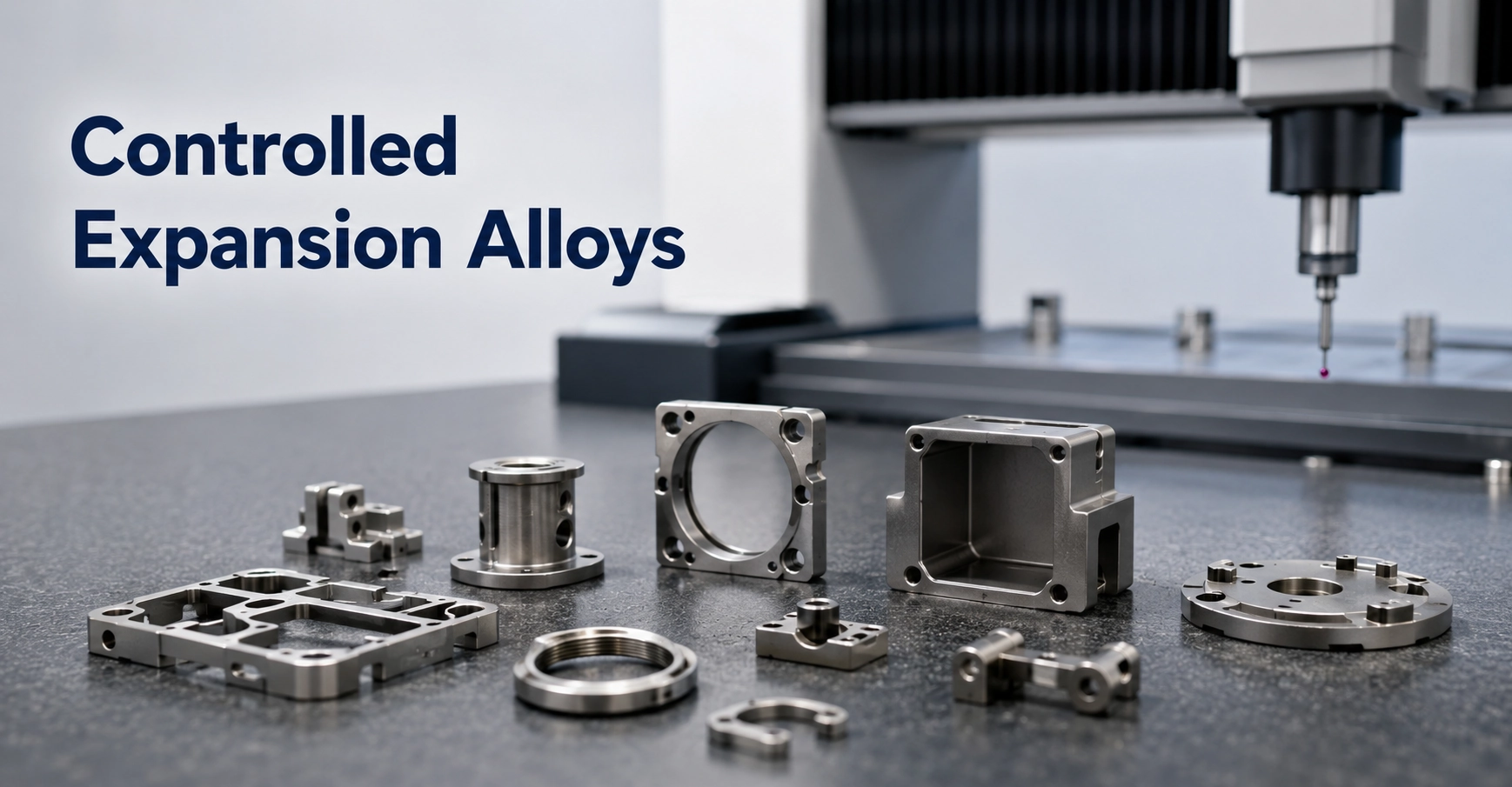
Quick Engineering Summary: When This Material Family Matters
Controlled expansion alloys should be considered when thermal expansion can change the function of the component or the assembly. They are not a universal upgrade over stainless steel. In practice, they are most useful when the part is small, geometry is complex enough to justify MIM tooling, and the drawing defines a real low-expansion or matched-expansion requirement.
Use This Page When
- A spacer, frame, housing, or interface part must remain dimensionally stable during temperature change.
- The part connects to glass, ceramic, or another material with a different expansion rate.
- MIM geometry advantages may reduce machining complexity for a small precision component.
Do Not Start Here When
- The part only needs general corrosion resistance, wear resistance, or strength.
- The component is a large simple plate, bar, ring, or low-volume prototype.
- The temperature range, mating material, or acceptance method has not been defined.
Before Tooling, Review
- Powder and feedstock availability for the target alloy.
- Sintering shrinkage, distortion risk, and post-machining allowance.
- Critical datums, sealing/interface surfaces, and inspection requirements.
Controlled Expansion Alloys in MIM: What This Page Helps You Decide
Controlled expansion alloys are used when the design must manage dimensional change caused by temperature. In a MIM project, this usually appears as low thermal expansion, thermal expansion matching, or dimensional stability in a precision assembly. The practical decision is not simply “Can this alloy be molded?” but whether the powder and feedstock route, sintering behavior, shrinkage control, inspection method, and post-processing plan can support the functional requirement.
MIMA lists controlled-expansion alloys among possible MIM alloy families, but special alloy availability should still be confirmed with the supplier before design freeze. For XTMIM projects, the first review should connect material function, geometry, annual volume, mating materials, temperature range, and inspection requirements.
| Requisito del proyecto | Starting Review Direction | Por qué es importante |
|---|---|---|
| Low expansion for positioning or spacing | Invar alloys | The main concern is dimensional stability under temperature change. |
| Glass, ceramic, or metal sealing match | Kovar alloys | The main concern is matched expansion with the sealing or interface material. |
| Electronic package or lead-frame style expansion control | Alloy 42 or project-specific alloy review | The requirement may depend on mating materials, heat cycle, and customer specification. |
| Resistencia general a la corrosión | MIM de acero inoxidable | A controlled expansion alloy may add cost without solving the main problem. |
| General strength or wear resistance | Low alloy steel, stainless steel, or another special alloy | Low CTE is not usually the primary design driver. |

When Low CTE or Thermal Expansion Matching Becomes a Real Material Requirement
A common mistake is to choose a controlled expansion alloy because it sounds more precise. In practice, these alloys should be considered only when thermal expansion affects function. If a part is only a bracket, cover, latch, or general structural component, MIM de acero inoxidable, low alloy steel MIM, or another standard MIM material may be more practical.
Controlled expansion alloys become relevant when a precision spacer must maintain distance across temperature change, an optical or sensor support must avoid alignment drift, a metal part is joined to glass or ceramic, a compact electronic package requires expansion compatibility, or a sealing/interface surface may crack, leak, or lose contact because of expansion mismatch.
The real issue is not only the coefficient of thermal expansion. The working temperature range, mating material, stress state, sealing area, surface condition, and inspection plan must be reviewed together. If a drawing references ASTM F15, ASTM F1684, ASTM F30, or another controlled expansion alloy specification, the standard should be used as a material specification reference to verify, not as a blanket claim that the finished MIM part automatically meets every application requirement.
Controlled Expansion Alloy Options for MIM Projects
This page is a material-family routing page. It should help engineers select the right direction for deeper review, without replacing dedicated Invar or Kovar pages. Each alloy direction has a different functional driver, and each one needs supplier confirmation before tooling.
Invar Alloys for Low Expansion and Dimensional Stability
Invar alloys are usually reviewed when dimensional stability is the primary requirement. Invar 36 is widely known as a nickel-iron low-expansion alloy and is commonly considered when dimensional change caused by temperature variation must be minimized.
From a MIM design review perspective, the question is whether the component geometry benefits from injection molding. Invar may be reviewed for small spacers, alignment structures, optical support frames, sensor-related supports, and miniature reference components where CNC machining would be inefficient or the geometry is too compact for a simple wrought form.
Review Invar alloys for MIMKovar Alloys for Glass, Ceramic and Metal Sealing Applications
Kovar is normally reviewed when the project needs matched expansion rather than simply the lowest possible expansion. Its typical engineering role is to reduce thermal stress between metal and glass or ceramic in sealing or package-related structures.
A Kovar material note does not automatically validate the final MIM part. Surface condition, density, machining allowance, oxidation behavior, sealing region geometry, thermal cycle, and inspection method should be defined before tooling.
Review Kovar alloys for MIMAlloy 42 and Other Project-Dependent Options
Alloy 42 and related Fe-Ni controlled expansion alloys may be relevant in certain electronic package, glass matching, or thermal expansion control applications.
On this page, Alloy 42 should remain a project-dependent option unless the feedstock route, material specification, sintering behavior, and production experience are confirmed for the specific project.
Submit project details for reviewL3 / L4 Page Boundary for Controlled Expansion Alloy Content
This Controlled Expansion Alloys page should remain a L3 material-family page. Its job is to help users decide whether the project belongs in the controlled expansion alloy family and then route the reader toward the correct alloy-specific review. It should not replace deeper L4 pages for Kovar, Invar, or other alloy-specific topics.
| Page Level | Primary Content Ownership | What Should Stay Out of This Page |
|---|---|---|
| L3 Controlled Expansion Alloys | Material-family selection, low CTE vs thermal matching logic, MIM suitability, typical part functions, process risks, RFQ inputs and routing to subpages. | Detailed grade chemistry tables, full CTE curves, complete Kovar sealing design rules, or full Invar application engineering. |
| L4 Invar Alloys | Low expansion, dimensional stability, precision spacers, optical supports, sensor alignment parts and Invar-specific MIM review. | Kovar-led glass-to-metal sealing content or general controlled expansion family comparison. |
| L4 Kovar Alloys | Glass-to-metal, ceramic-to-metal and electronic package interface review, including sealing-area geometry and project validation requirements. | General Invar low-expansion selection or broad MIM material selection guidance. |
| Future L4 Alloy 42 | Project-dependent Fe-Ni controlled expansion review for selected electronic, glass or ceramic matching requirements. | Replacing Kovar or Invar as the main explanation for all controlled expansion alloy projects. |
If the drawing already specifies Kovar, Invar, Alloy 42, a target CTE range, or a mating glass / ceramic material, send the mating material, service temperature range, sealing or alignment requirement, and critical tolerance notes together with the drawing. This helps XTMIM route the project to the right material-specific review path.
When MIM Is Suitable for Controlled Expansion Alloy Components
MIM is most suitable when the part combines material function with geometry that is difficult or expensive to machine. Controlled expansion alloys are usually more specialized than common stainless steels, so the process must provide a real manufacturing advantage. If the geometry is simple and the quantity is low, CNC machining from wrought stock may be the more practical starting point.
| MIM May Be Suitable When... | MIM May Not Be Suitable When... |
|---|---|
| La pieza es pequeña y compleja. | The part is a large simple plate, ring, or bar. |
| The part has fine features, holes, slots, steps, or compact 3D geometry. | The project only needs a few prototypes. |
| Annual volume can justify tooling and process development. | CNC machining is cheaper at the required quantity. |
| The design needs both low expansion and complex geometry. | Low CTE is not clearly defined as a functional requirement. |
| Some critical faces can be post-machined if necessary. | All dimensions require extremely tight tolerance without secondary operations. |
| The material requirement is reviewed together with the MIM process route. | The buyer expects wrought-material behavior without MIM validation. |
In production, the full route includes fine metal powder mixed with binder, feedstock preparation, injection molding, green part handling, debinding, sintering shrinkage, tooling compensation, and final inspection. Special alloys may need additional review because their sintering behavior, thermal response, contamination sensitivity, and dimensional stability can differ from common MIM stainless steels.
Related process pages: Descripción general del proceso MIM, Sinterizado MIM, y DFM para MIM.

Typical MIM Parts Made from Controlled Expansion Alloys
Controlled expansion alloys should be shown through part functions, not only material names. The parts below are typical project directions for review; they should not be presented as guaranteed stock products or universal production cases.

| Tipo de pieza | Possible Alloy Direction | Why Controlled Expansion Matters | Apto para MIM | Punto principal de revisión |
|---|---|---|---|---|
| Precision spacers | Invar | Maintains distance under temperature change | Good if small and complex | Flatness, parallelism, and datum control |
| Optical support frames | Invar | Reduces alignment drift | Good for compact frame geometry | Deformación después del sinterizado |
| Sensor housing components | Invar / Kovar | Controls interface stress and alignment | Good for miniature housings | Mating surfaces and assembly fit |
| Hermetic package bases | Kovar | Supports expansion matching with glass or ceramic | Depende del proyecto | Surface condition and sealing region |
| Ceramic-to-metal interface parts | Kovar / Alloy 42 | Reduces thermal stress mismatch | Depende del proyecto | Mating material and heat cycle |
| Low-expansion alignment brackets | Invar | Maintains reference position | Good if geometry benefits from MIM | Critical datums and post-machining allowance |
Engineering Risks Before Tooling
Controlled expansion alloy MIM projects should be reviewed before tooling because the material requirement is usually tied to assembly function. If the project only checks room-temperature dimensions after sintering but does not define thermal behavior, mating material, or acceptance requirements, the part may pass basic dimensional inspection and still fail in the final system.
| Área de Riesgo | Por qué es importante | Qué revisar antes del herramental |
|---|---|---|
| Disponibilidad de feedstock | Not every controlled expansion alloy is readily available as MIM feedstock. | Confirm powder, binder system, particle behavior, and supplier route. |
| Contracción durante el sinterizado | Shrinkage affects dimensions, flatness, and critical interfaces. | Revisar compensación por contracción, critical datums, and first-article correction strategy. |
| Thermal expansion target | CTE depends on alloy, processing condition, temperature range, and testing method. | Define operating temperature range and mating materials. |
| Densidad y porosidad residual | May affect strength, surface condition, and sealing-related performance. | Define density expectations, acceptance method, and whether functional testing is needed. |
| Condición superficial | Interface or sealing areas may need controlled surface finish. | Review machining, polishing, cleaning, coating, or finishing needs. |
| Contamination sensitivity | Some Fe-Ni or Fe-Ni-Co alloys may be sensitive to furnace atmosphere or contamination. | Review debinding and sintering environment before committing to tooling. |
| Post-sintering machining | Some critical faces may not be suitable as-sintered. | Define machining allowance and final datum scheme. |
| Método de inspección | Dimensions alone may not validate thermal or sealing function. | Define material certificate, dimensional checks, surface checks, and functional validation. |
Composite Field Scenario for Engineering Training: Low-Expansion Spacer
¿Qué problema ocurrió? A precision spacer met room-temperature dimensional inspection, but the assembly showed alignment drift after temperature cycling.
¿Por qué ocurrió? The material was selected mainly for corrosion resistance and machinability. Thermal expansion behavior was not defined as a functional requirement during early design review.
¿Cuál fue la causa real del sistema? The spacer worked inside an assembly where mating components expanded differently. The drawing did not define operating temperature range, alignment requirement, or expansion tolerance.
¿Cómo se corrigió? The project was re-reviewed around material function. Invar was considered as a starting direction, and the drawing was updated with critical datums, temperature range, and post-sintering machining needs.
Cómo prevenir la recurrencia: Before selecting a MIM material, define whether the part is controlled by strength, corrosion resistance, wear, cost, low expansion, or expansion matching.
Composite Field Scenario for Engineering Training: Kovar Interface Component
¿Qué problema ocurrió? A small interface component was specified as Kovar because the assembly included glass and metal, but the first review showed unclear sealing surfaces and acceptance requirements.
¿Por qué ocurrió? The material name was specified, but the drawing did not define glass type, thermal exposure, surface condition, or leak-related validation method.
¿Cuál fue la causa real del sistema? The project treated Kovar as a material label rather than a system requirement. In sealing-related parts, material, surface, heat cycle, and interface geometry must be reviewed together.
¿Cómo se corrigió? The sealing region was separated from non-critical geometry, machining allowance was added for critical faces, and the buyer was asked to confirm mating material and validation method.
Cómo prevenir la recurrencia: For Kovar MIM projects, provide the mating material, thermal cycle, sealing region, surface requirement, and inspection method before tooling.
Composite Field Scenario for Engineering Training: Ceramic Interface Housing
¿Qué problema ocurrió? A compact electronic housing needed a ceramic interface, but the early RFQ only included a 3D file and a material name.
¿Por qué ocurrió? The project did not define the ceramic material, operating temperature range, sealing or alignment area, and whether critical surfaces could be post-machined after sintering.
¿Cuál fue la causa real del sistema? The design requirement was not only “make this alloy by MIM.” It was a combined material, interface, tolerance, and validation problem.
¿Cómo se corrigió? The review package was updated with mating material, service temperature, critical datum surfaces, surface finish requirement, and annual volume before tooling discussion.
Cómo prevenir la recurrencia: For controlled expansion alloy MIM projects, treat the RFQ as an engineering package instead of a material-name quotation request.
Related engineering pages: tolerancias MIM, capacidad de inspección y pruebas, y compensación de contracción MIM.
How to Choose Between Invar, Kovar and Standard MIM Alloys
The selection should start from the functional driver. If the real requirement is corrosion resistance, strength, or general dimensional accuracy, a controlled expansion alloy may add cost and process complexity without solving the main problem.
| Requisito | Better Starting Point | Por qué |
|---|---|---|
| Lowest practical expansion for positioning | Invar alloys | Dimensional stability is the main driver. |
| Glass-to-metal or ceramic-to-metal sealing match | Kovar alloys | Expansion matching is more important than low expansion alone. |
| Resistencia general a la corrosión | MIM de acero inoxidable | A controlled expansion alloy may be unnecessary. |
| High strength structural loading | Acero de baja aleación or precipitation-hardening stainless steel | Strength and heat treatment may matter more than CTE. |
| High temperature oxidation or corrosion | Aleaciones de níquel | Nickel alloy selection owns this intent. |
| Comportamiento magnético | Materiales magnéticos blandos | Magnetic performance should not be mixed into this page. |
| Unknown material requirement but complex geometry | Material selection review | The project needs functional clarification first. |
How Engineers Should Specify Controlled Expansion Alloy MIM Parts
A controlled expansion alloy part should not be quoted from material name and quantity alone. The supplier needs enough information to understand how the part will function in the final assembly and which features are controlled by thermal behavior rather than ordinary dimensional tolerance.

Project Inputs to Provide
- Dibujo 2D con dimensiones críticas y tolerancias
- Archivo CAD 3D
- Target alloy or functional requirement
- Operating temperature range
- Mating material, such as glass, ceramic, stainless steel, aluminum, or another alloy
- Low CTE or thermal expansion matching requirement
- Critical datum scheme
Validation and Production Inputs
- Sealing, interface, or alignment areas
- Required surface finish
- Areas that may allow post-sintering machining
- Inspection method or acceptance requirement
- Expected annual volume and production stage
- Application background and assembly condition
Controlled expansion RFQ checklist: include the selected alloy or target CTE direction, mating glass / ceramic / metal material, service temperature range, thermal cycle if known, sealing or alignment areas, critical dimensions after thermal exposure, surface finish needs, post-machining allowance, annual volume, and whether the project is in prototype, validation, or production planning.
FAQ About MIM Controlled Expansion Alloys
Can controlled expansion alloys be processed by MIM?
Yes, some controlled expansion alloys can be reviewed for MIM projects, but availability depends on powder, feedstock route, sintering behavior, part geometry, and production requirements. Engineers should not assume that every wrought controlled expansion alloy can be directly converted into a MIM part without validation.
Can Kovar be manufactured by metal injection molding?
Kovar can be reviewed for selected MIM projects when the part is small, complex, and related to glass, ceramic, or electronic package interfaces. However, the supplier must confirm feedstock availability, sintering behavior, density expectations, surface condition, and the validation method for the sealing or interface region.
Is Invar suitable for small MIM precision parts?
Invar may be suitable when the part needs low thermal expansion, dimensional stability, and compact geometry that benefits from MIM. It should be reviewed with the service temperature range, critical datums, post-machining allowance, and inspection plan rather than selected only by alloy name.
What is the difference between Invar and Kovar in MIM projects?
Invar is usually reviewed when low thermal expansion and dimensional stability are the main requirements. Kovar is usually reviewed when expansion matching with glass, ceramic, or another material is the main requirement. The best choice depends on the mating material, operating temperature range, interface area, and inspection method.
Should I choose Invar or stainless steel for a precision MIM component?
Choose Invar only when low expansion or temperature-related dimensional stability is a real functional requirement. If the part mainly needs corrosion resistance, strength, or general precision, stainless steel MIM may be more practical and easier to validate.
Is Kovar suitable for glass-to-metal seal components made by MIM?
Kovar may be suitable for some small, complex glass-to-metal or ceramic-to-metal interface components, but the sealing region, surface condition, density, thermal cycle, and validation method must be reviewed before tooling. The alloy name alone does not guarantee sealing performance.
Can MIM guarantee the same CTE as wrought material?
No blanket guarantee should be made. CTE and functional behavior depend on alloy chemistry, powder/feedstock route, sintering condition, density, heat treatment, temperature range, and testing method. The requirement should be confirmed through project-specific material and process review.
What information is needed before quoting a controlled expansion alloy MIM part?
Provide 2D drawings, 3D CAD files, target alloy or functional requirement, operating temperature range, mating material, critical dimensions, sealing or interface areas, surface finish requirements, post-machining needs, annual volume, and application background.
Are Alloy 42 or other low expansion alloys available for MIM?
They may be reviewed as project-dependent options. Before creating a dedicated material page or quoting a project, the supplier should confirm feedstock availability, material specification, sintering route, and validation requirements.
Notas de referencia técnica y estándares
Controlled expansion alloy requirements should be reviewed against project drawings, material specifications, supplier capability, and current standards. Norma MPIF 35-MIM is relevant because it covers common materials used in metal injection molding with explanatory notes and definitions, supporting communication between designers, purchasers, and MIM manufacturers.
Rango de materiales MIMA identifies controlled-expansion alloys as part of the broader MIM material range, while also reminding users to confirm actual alloy or substitute alloy availability with the supplier. This is important for special alloy MIM projects because powder, feedstock, and sintering route availability can be more project-dependent than common stainless steels.
For Kovar-related projects, ASTM F15-04(2022) is historically relevant to iron-nickel-cobalt sealing alloy for glass-to-metal electronic applications. For Invar or Alloy 42 directions, drawings may also reference alloy-specific specifications such as ASTM F1684 or ASTM F30. These standards should support material specification review; they do not replace project-specific MIM validation, inspection planning, or functional testing.
For controlled expansion alloy selection background, recognized material producer resources such as Carpenter controlled-expansion alloy guidance can help engineers understand why temperature range and expansion behavior must be specified. Wrought material data should not be copied directly into finished MIM part guarantees without supplier-specific validation.
Request a Controlled Expansion Alloy MIM Project Review
If your part requires low thermal expansion, thermal expansion matching, stable alignment under temperature change, or a glass / ceramic / metal interface, send XTMIM your 2D drawing, 3D CAD file, target material, mating material, operating temperature range, critical dimensions, surface requirements, estimated annual volume, and application background.
Controlled Expansion RFQ Inputs to Include
- Selected alloy direction, such as Invar, Kovar, Alloy 42, or target CTE requirement
- Mating material, such as glass, ceramic, stainless steel, aluminum, or another alloy
- Service temperature range and thermal cycle if known
- Sealing, optical alignment, sensor interface, or electronic package requirement
- Critical dimensions, datum scheme, surface finish needs, and post-machining allowance
- Estimated annual volume and project stage, such as prototype, validation, or production planning
XTMIM’s engineering review can help determine whether the part should be evaluated as an Invar, Kovar, Alloy 42, stainless steel, nickel alloy, or other MIM material project. The review can also identify tooling compensation risks, sintering distortion concerns, post-machining needs, and inspection requirements before tooling or production planning.
Contacte al Equipo de Ingeniería de XTMIM