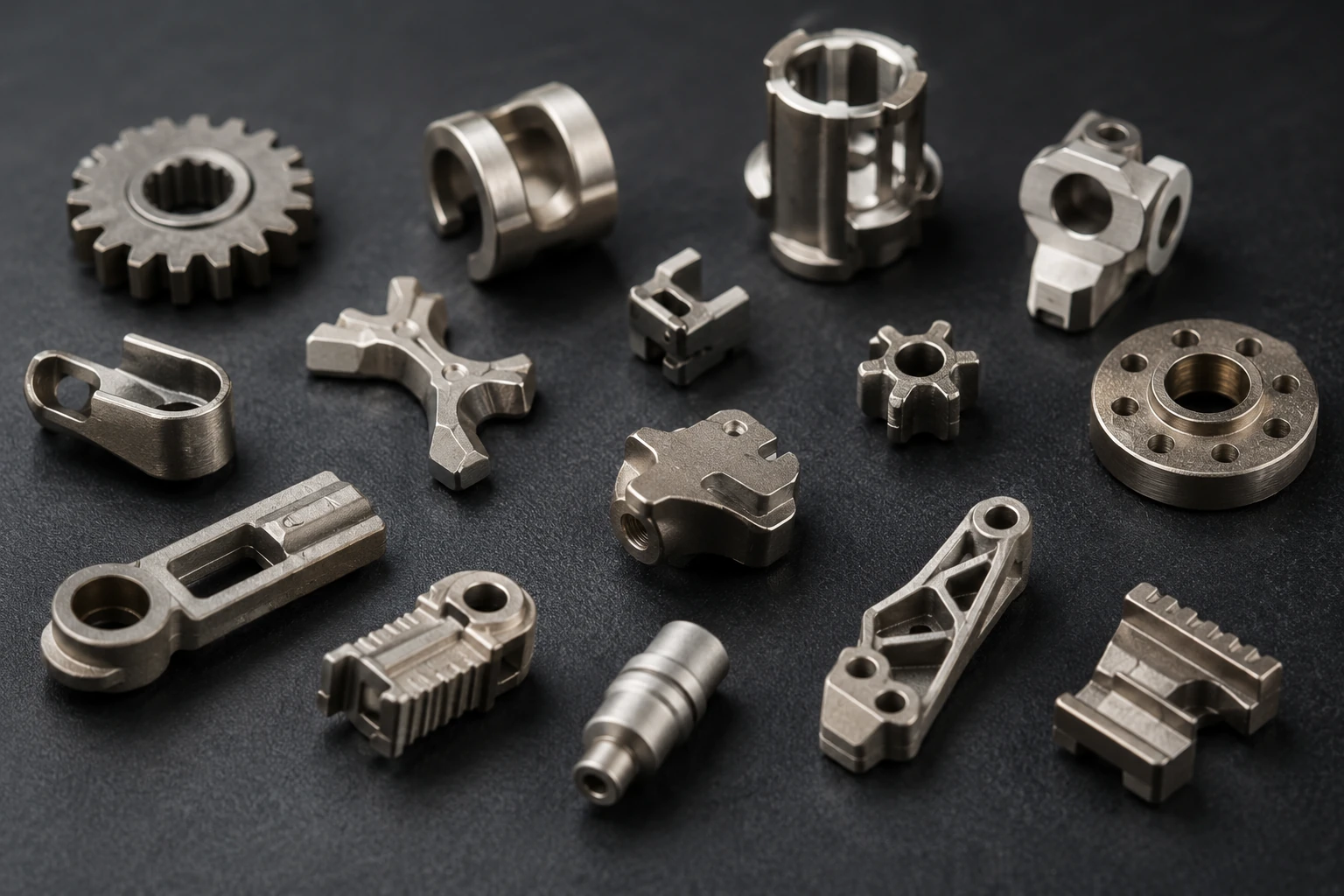
Corrosion-resistant MIM materials should be selected from the service environment, part geometry, surface condition, and acceptance requirement—not from the alloy name alone. For many small metal injection molded components, o aço inoxidável MIM 316L is the first material to review when corrosion resistance and ductility are more important than hardness. Aço inoxidável MIM 304 may fit moderate indoor or cosmetic stainless applications, while O aço inoxidável MIM 17-4 PH is usually reviewed when the part needs strength plus moderate corrosion resistance. For skin-contact, medical, dental, chemical, or higher-risk environments, titanium alloys, cobalt-chromium alloys, or selected nickel alloys may also need project-specific review. In practice, final corrosion behavior depends on sintered density, residual porosity, surface roughness, polishing access, passivation, heat treatment, cleaning process, and the test method defined before tooling.
Choose the Right Page Based on Your Decision
This page owns the material-property decision for corrosion-resistant MIM material selection. It helps engineers choose a starting material direction from exposure, surface condition, testing requirements, and MIM process feasibility. It is not intended to replace the dedicated grade pages, comparison pages, or part-family application pages.
When Should You Choose a Corrosion-Resistant MIM Material?
A corrosion-resistant MIM material should be reviewed when a small, complex metal part is exposed to humidity, sweat, cleaning agents, fluid contact, mild chemical environments, or applications where visible rust, staining, surface discoloration, or functional degradation would create a product risk. The decision is not only about preventing rust. It can also affect appearance stability, assembly reliability, sliding surfaces, sealing contact, cleaning performance, user-contact safety, inspection workload, and long-term field stability.
Do ponto de vista da revisão de projeto, materiais MIM become especially relevant when the part requires corrosion-resistant metal performance together with geometry that is difficult or inefficient to machine from bar stock. Typical MIM-friendly features include compact mechanisms, thin sections, small holes, slots, internal transitions, undercuts, and repeated production parts where tooling can be justified. If the part is large, simple, or only needed in very low volume, another process may be more practical even if the material requirement is correct.
Best-Fit Applications for Corrosion-Resistant MIM Materials
Corrosion-resistant MIM materials are often considered for wearable device clasps, hinges, frames, buttons, charging contacts, small structural hardware, precision locking elements, connector hardware, miniature industrial parts, and stainless components exposed to cleaning or hand contact. This page owns the material-selection logic. For part families, application examples, and DFM discussion, use the dedicated corrosion-resistant MIM parts and DFM review página.
When Corrosion Resistance Is Not the Only Requirement
A common mistake is to ask for the “most corrosion-resistant MIM material” without ranking the other functional requirements. Material selection changes when the part also needs hardness, wear resistance, tensile strength, magnetic response, ductility, polishing, heat treatment, dimensional stability, or biocompatibility review. In production, these requirements affect not only material choice but also feedstock control, tooling compensation, shrinkage behavior, secondary operations, inspection planning, and lead time.
Corrosion-Resistant MIM Material Selection Matrix
The following matrix helps engineers choose a starting material direction. It should not replace project-specific material validation, corrosion testing, or supplier process review. In MIM, the same alloy family can perform differently depending on powder quality, feedstock stability, injection molding conditions, debinding control, sintering density, surface condition, and post-processing.
| Service Requirement | Candidate MIM Materials | Por Que Pode Ser Adequado | Ponto-Chave de Revisão | Próxima Página Recomendada |
|---|---|---|---|---|
| General indoor humidity and clean stainless appearance | 304, 316L | 304 can fit moderate exposure; 316L provides a stronger corrosion-resistance starting point. | Confirm whether exposure is only indoor humidity or includes sweat, chloride, cleaning agents, or fluid contact. | MIM 304 / MIM 316L |
| Higher corrosion margin with ductility | 316L | Often reviewed when corrosion resistance and ductility matter more than hardness. | Surface finish, polishing access, cleaning residue, passivation requirement, and acceptance test. | o aço inoxidável MIM 316L |
| Strength plus moderate corrosion resistance | 17-4 PH | Useful when strength and heat treatment response are required together with moderate corrosion resistance. | Do not use it as a direct substitute for 316L without exposure, heat treatment, and surface review. | 316L vs 17-4 PH |
| Hardness and wear with some corrosion resistance | 420, 440C | Suitable when hardness, wear, or edge performance is more important than maximum corrosion resistance. | Review heat treatment, dimensional change, surface condition, and realistic corrosion exposure. | Materiais MIM resistentes ao desgaste |
| Skin-contact or wearable hardware | 316L, titanium alloys, selected Co-Cr | Can support corrosion and appearance requirements when the surface and finishing route are defined. | Sweat exposure, edge polishing, cleaning residue, surface roughness, and user-contact review. | MIM watch parts |
| Medical or dental material review | 316L, ligas de titânio, ligas de cobalto-cromo | May require corrosion, cleaning, biological-use, surface finish, and validation review together. | Corrosion resistance is not the same as regulatory suitability or biocompatibility. | Biocompatible MIM materials |
| Chemical cleaning or special fluid exposure | 316L, selected nickel alloys, project-specific alloy review | May be required when exposure is more aggressive than normal humidity, sweat, or indoor handling. | Define chemical type, concentration, temperature, exposure time, fluid motion, and acceptance test. | ligas de níquel MIM |

Corrosion Exposure Input Checklist Before Material Selection
A material name alone is not enough for corrosion review. Before selecting 304, 316L, 17-4 PH, titanium, cobalt-chromium, nickel alloy, or another MIM material direction, the exposure condition should be converted into clear engineering inputs.
| Input to Define | Why It Changes Material Selection | Example of Useful RFQ Detail |
|---|---|---|
| Exposure medium | Humidity, sweat, cleaning agents, salt, and process fluids can create different corrosion risks. | Indoor humidity only, repeated sweat contact, chloride splash, alcohol-based cleaning, or named fluid. |
| Chemical concentration and temperature | A material that works at room temperature or low concentration may not be suitable under warmer or stronger exposure. | Cleaning agent type, concentration range, operating temperature, and rinse condition. |
| Contact time and frequency | Occasional contact, continuous immersion, and repeated cleaning cycles should not be treated the same. | Daily handling, weekly cleaning, short splash exposure, or continuous fluid contact. |
| Requisito de acabamento superficial | Rough surfaces, blind grooves, gate areas, and difficult-to-polish regions can affect local corrosion risk. | As-sintered, polished, machined sealing face, cosmetic visible surface, or controlled roughness target. |
| Passivation or cleaning requirement | Post-processing should be defined by the application and accessible surfaces, not added as a generic claim. | Passivation required, ultrasonic cleaning required, no visible residue, or customer-defined cleaning process. |
| Test method and acceptance criteria | Salt spray, immersion, appearance inspection, and customer tests evaluate different risks. | ASTM B117 salt spray duration, immersion fluid and time, no red rust, no staining, or functional pass/fail rule. |
| Cosmetic and functional risk | A cosmetic stain and a sealing-surface failure do not have the same engineering consequence. | Visible exterior surface, internal non-visible surface, sealing area, sliding contact, or electrical contact zone. |
Why Corrosion Resistance in MIM Is Not Determined by Alloy Name Alone
The real question is not only “Is this alloy corrosion-resistant?” The better engineering question is: “Can this MIM part, with this geometry and surface condition, meet the corrosion requirement in the actual service environment?”
Metal injection molding uses fine metal powder mixed with binder to form feedstock. The feedstock is injection molded into a green part, debound to remove binder, and sintered to achieve the final density and properties. During these stages, shrinkage control, gate location, green part handling, debinding uniformity, sintering support, residual porosity, and secondary finishing can all influence final performance. A corrosion-resistant alloy name can be a good starting point, but it does not automatically define the final behavior of a molded, debound, sintered, and finished component.

Sintered Density and Residual Porosity
Residual porosity can affect both mechanical and corrosion-related performance. In corrosion-sensitive parts, the concern is not only visible rust on a flat surface. Small interconnected pores, rough surfaces, blind holes, or difficult-to-clean features may retain moisture, chloride, cleaning solution, or process residue. This can become more important for thin grooves, mating faces, fluid-contact channels, small slots, or miniature structures where inspection and cleaning access are limited.
In production, density and porosity depend on feedstock consistency, injection molding stability, debinding control, sintering atmosphere, temperature profile, part size, wall thickness, and support strategy. This is why a drawing-based material review should include geometry, tooling compensation, and sintering feasibility rather than only material grade.
Surface Roughness, Polishing Access, and Cleaning Residues
Surface finish can change the practical corrosion risk of a MIM part. A smoother, properly cleaned stainless surface is usually easier to maintain than a rough surface with sharp transitions or trapped residue. However, MIM parts are often selected because they have complex geometry. The same geometry that makes MIM valuable can also create polishing, cleaning, or passivation access limitations.
A common mistake is to specify “316L stainless steel” while ignoring recessed areas, inside corners, gate marks, tumbling limitations, or features that cannot be polished in the same way as open surfaces. If the application involves sweat, chloride, repeated cleaning, or fluid contact, these local details should be reviewed before mold design.
Heat Treatment and Surface Condition
Some MIM stainless materials are selected partly because they can be heat treated. 17-4 PH, 420, and 440C may be reviewed for strength, hardness, or wear resistance. However, heat treatment, hardness target, distortion risk, magnetic behavior, dimensional stability, and surface condition must be considered together. A higher hardness target can increase project value in wear applications, but it may also change tolerance risk, secondary finishing needs, and the corrosion-performance boundary.
Actual Exposure Environment
Corrosion resistance cannot be evaluated without the service environment. Engineers should define indoor humidity, outdoor exposure, sweat, chloride, cleaning agent type, fluid contact, operating temperature, dissimilar metal contact, surface finish, required test method, and acceptance criteria before tooling. If these factors are unknown, material selection should remain a preliminary direction rather than a validated production decision.
Common Corrosion-Resistant MIM Material Options
This section gives a practical selection overview. Detailed chemistry, mechanical data, heat treatment, density range, and grade-specific limitations should remain on the dedicated material pages to avoid confusing this performance-selection page with grade terminal pages.
Aço Inoxidável MIM 316L
o aço inoxidável MIM 316L is often the first material to review when corrosion resistance and ductility are more important than hardness. It can be suitable for small stainless components exposed to humidity, hand contact, sweat, mild cleaning, and applications where appearance stability matters. The trade-off is that 316L may not satisfy projects where high hardness, high wear resistance, or high load-bearing strength is the main requirement.
Aço Inoxidável MIM 304
Aço inoxidável MIM 304 may fit general stainless appearance parts, indoor-use hardware, and moderate exposure applications. If the part will face sweat, chloride, repeated cleaning agents, or stricter corrosion expectations, 316L should often be reviewed as a stronger starting point. A drawing that only says “stainless steel” is not specific enough for a corrosion-sensitive project.
Aço Inoxidável MIM 17-4 PH
O aço inoxidável MIM 17-4 PH is typically reviewed when the part needs a balance of strength, heat treatment response, and moderate corrosion resistance. It should not be selected only because the application mentions corrosion resistance. The project should first decide whether corrosion margin or mechanical strength is the primary risk.
MIM 420 and 440C Stainless Steel
MIM 420 e MIM 440C stainless steels are more often reviewed for hardness, wear resistance, edge performance, or sliding contact than for maximum corrosion resistance. They may fit projects where corrosion exposure is moderate and the dominant requirement is hardness or wear behavior.
MIM Titanium Alloys
MIM titanium alloys may be reviewed when the project needs corrosion resistance, low density, non-magnetic behavior, or medical-related material discussion. Titanium MIM is not a general upgrade for stainless steel. It usually requires tighter review of oxygen, carbon, nitrogen, sintering conditions, validation requirements, cost, and lead time.
MIM Cobalt-Chromium and Nickel Alloys
MIM cobalt-chromium alloys are usually considered for specialized corrosion, wear, medical, or dental-related material reviews. ligas de níquel MIM may be reviewed when the corrosion environment is more chemically demanding than normal stainless steel applications, but the medium, temperature, concentration, and test method must be defined before material commitment.
How to Match Corrosion Exposure to MIM Material Direction
For corrosion-resistant MIM projects, the exposure environment should be translated into engineering requirements before material selection. A vague statement such as “must be corrosion-resistant” is not enough for tooling, quotation, or production planning because it does not define the test condition, surface state, or acceptable result.
| Condição de Exposição | Typical User Question | Better Starting Material Direction | O Que Deve Ser Confirmado |
|---|---|---|---|
| Indoor humidity | Will this part rust during normal use? | 304 or 316L | Humidity level, cosmetic requirement, surface finish, and cleaning process. |
| Hand contact or sweat | Will the part discolor or corrode during repeated handling? | 316L, titanium, selected Co-Cr | Sweat exposure, polishing access, cleaning residue, edge condition, and user-contact risk. |
| Mild cleaning agents | Can the part survive repeated cleaning? | 316L or project-specific alloy review | Chemical type, concentration, cleaning frequency, temperature, rinse condition, and drying condition. |
| Exposição a cloretos ou sal | Can stainless MIM pass the corrosion requirement? | 316L first, then project-specific review | Test method, exposure time, acceptance criteria, surface finish, and passivation state. |
| Fluid-contact mechanism | Can the part contact liquid without functional degradation? | 316L, 17-4 PH, or nickel alloy depending on load and medium | Fluid type, sealing surface, dimensional tolerance, secondary machining, and inspection method. |
| High hardness plus corrosion | Can one material satisfy both? | 420, 440C, 17-4 PH, or alternative review | Hardness target, wear mode, corrosion environment, heat treatment, and dimensional stability. |
Humidity and Indoor Use
For indoor-use stainless parts, 304 or 316L may both be reviewed. The decision depends on appearance requirements, expected moisture, handling, cost sensitivity, and whether the part has geometry that can trap residue. If the part is visible, cosmetic, or difficult to clean after assembly, 316L may provide a safer starting direction.
Sweat and Wearable Use
Wearable parts often combine corrosion, appearance, edge comfort, and user-contact considerations. A small MIM clasp, hinge, frame, or button may have sharp transitions, small gaps, or polished surfaces. In this case, the design review should include material selection, polishing access, passivation, cleaning, edge condition, and the location of any gate marks or contact surfaces.
Medical or Dental Exposure
Medical and dental applications require more than corrosion resistance. Material selection may involve biocompatibility, cleaning, sterilization, surface finish, validation, documentation, and regulatory requirements. A general corrosion-resistant MIM material page should not claim suitability for regulated use without project-specific review.
Passivation, Polishing, and Corrosion Testing for MIM Stainless Steel
Post-processing can be important for corrosion-resistant MIM stainless steel parts, but it should be specified based on the application. Passivation, polishing, cleaning, and testing should not be treated as generic marketing claims. They should be connected to real functional requirements, accessible surfaces, and defined acceptance criteria.

When Passivation May Be Specified
Passivation may be specified for stainless steel parts when the project requires improved surface condition after manufacturing, machining, handling, or finishing. For MIM parts, the review should consider whether all important surfaces are accessible to cleaning and passivation, whether the geometry has blind holes or crevices, and whether the acceptance test is defined. Passivation is not a substitute for selecting the correct alloy or correcting a poor surface design.
Salt Spray Testing Is Not a Universal Corrosion Guarantee
Salt spray testing can be useful for specified acceptance or comparative testing, but it is often misunderstood. ASTM B117 provides a controlled salt spray / fog test environment and procedure, but it does not by itself define the correct specimen type, exposure period, acceptance criteria, or real-world service life. For MIM stainless parts, salt spray response may be affected by material grade, sintered density, surface roughness, finishing, passivation state, and residue trapped in small features.
Pitting, Crevice Corrosion, and Immersion Review
If the part may face chloride-containing environments, localized corrosion should be reviewed separately. Pitting and crevice corrosion risks can become more important in narrow gaps, assembly interfaces, holes, grooves, or rough surfaces. If the part is exposed to a real fluid, immersion testing or application-specific validation may be more relevant than a generic salt spray requirement. The test condition should define fluid composition, temperature, duration, motion, cleaning method, and result interpretation.
When a Corrosion-Resistant MIM Material May Not Be Enough
Severe Chloride Exposure Without a Defined Test Method
If the application involves salt, chloride, concentrated sweat, outdoor exposure, marine-like conditions, or cleaning chemicals, the test requirement should be defined early. Without a defined method and acceptance rule, the buyer and supplier may use the same phrase but expect different results.
Unknown Cleaning Chemistry
A part may perform well in humidity but fail in a cleaning agent, disinfectant, or process fluid. The supplier cannot evaluate this risk properly if the chemical composition, concentration, temperature, exposure duration, and cleaning frequency are not provided.
Large Simple Geometry or Very Low Volume
MIM is strongest when small complex geometry and repeatable production volume justify tooling. If the part is large, simple, or needed only in very low quantity, CNC machining, casting, stamping, or metal additive manufacturing may be more suitable.
Sealing Surfaces and Critical Contact Areas
If a part has sealing surfaces, sliding faces, or high-contact areas, corrosion resistance must be reviewed with surface finish and tolerance. Some areas may require secondary machining, polishing, or special inspection rather than relying only on the as-sintered surface.
Material Selection Examples for Corrosion-Resistant MIM Projects
The following examples are composite field scenarios for engineering training. They do not describe a specific customer project, order, factory, or test result.
Wearable Device Clasp Exposed to Sweat
- Qual problema ocorreu
- A small stainless MIM clasp was specified only as “corrosion-resistant stainless steel.” The polished exterior looked acceptable, but the inner slot and hinge transition were harder to polish and clean.
- Por que isso aconteceu
- The material requirement focused on the visible surface and ignored local geometry, sweat exposure, edge contact, polishing access, and cleaning residue.
- Qual foi a causa real do sistema
- The issue was not only material grade. It was a combined material, geometry, finishing, and acceptance-specification problem.
- Como foi corrigido
- The review shifted to a defined material and finishing plan, with 316L reviewed as a starting material direction and critical surfaces identified before tooling.
- Como evitar recorrência
- Define sweat exposure, contact surfaces, polishing requirement, edge condition, passivation requirement, and acceptance criteria before tooling.
Compact Industrial Fluid-Control Component
- Qual problema ocorreu
- An RFQ mentioned “corrosion-resistant material,” but the fluid type, operating temperature, and exposure duration were not provided.
- Por que isso aconteceu
- The customer treated corrosion resistance as a material property only, while the supplier needed fluid chemistry, temperature, exposure time, and sealing surface information.
- Qual foi a causa real do sistema
- The missing service condition prevented responsible comparison between 316L, 17-4 PH, nickel alloy, or other material directions.
- Como foi corrigido
- The project review requested fluid type, concentration, temperature, exposure duration, contact surfaces, and leakage or corrosion acceptance criteria.
- Como evitar recorrência
- Provide the actual medium, operating temperature, exposure duration, required surface finish, and any test criteria during RFQ.
Locking Component Needing Strength and Corrosion Resistance
- Qual problema ocorreu
- A small locking part required corrosion resistance and mechanical strength, but the initial material request was 316L only.
- Por que isso aconteceu
- The design requirement did not rank corrosion resistance, strength, hardness, wear, heat treatment, and dimensional stability.
- Qual foi a causa real do sistema
- The material choice was made before the dominant failure risk was identified. Corrosion margin and load-bearing strength were treated as equal without a priority decision.
- Como foi corrigido
- The review compared 316L and 17-4 PH based on load condition, corrosion exposure, heat treatment, dimensional tolerance, and production volume.
- Como evitar recorrência
- Define the primary requirement first: corrosion, strength, hardness, wear, magnetic behavior, or tolerance stability.
How XTMIM Reviews Corrosion-Resistant MIM Material Suitability Before Tooling
A corrosion-resistant MIM project should be reviewed before tooling because the mold, shrinkage compensation, gate position, debinding route, sintering support, finishing access, and inspection plan may all affect final performance. The goal is not only to choose an alloy, but to confirm whether the material, geometry, surface condition, and acceptance requirement can work together in production.

- Review the 2D drawing and 3D CAD geometry. Identify thin walls, holes, slots, undercuts, blind areas, sealing surfaces, gate-sensitive areas, and features that may affect cleaning or polishing.
- Confirm the corrosion exposure environment. Define humidity, sweat, chloride, cleaning agent, fluid contact, temperature, exposure time, and whether exposure is occasional or continuous.
- Select the candidate material family. Review stainless steel, titanium, cobalt-chromium, nickel alloy, or another material direction based on the service environment and mechanical requirements.
- Check surface finish and post-processing needs. Determine whether the part needs polishing, passivation, machining, tumbling, controlled cleaning, or special handling.
- Review tolerance and secondary machining requirements. Identify critical dimensions, sealing surfaces, mating surfaces, and features that may require post-sintering machining.
- Confirm testing or acceptance method. Review salt spray, immersion, pitting, appearance inspection, or customer-specific acceptance requirements if applicable.
- Evaluate tooling and production feasibility. Confirm whether the geometry, volume, material, finish requirement, and inspection plan justify MIM tooling.
What to Provide for a Corrosion-Resistant MIM Material Review
For a useful material suitability review, provide the following information before RFQ or tooling discussion. This helps avoid material assumptions that appear correct at quotation stage but create finishing, testing, tolerance, or lead-time problems during sampling.
| Entrada do RFQ | Por Que É Importante |
|---|---|
| Desenho 2D | Defines tolerances, critical dimensions, surface notes, datums, and acceptance requirements. |
| Arquivo CAD 3D | Helps review MIM geometry, shrinkage, tooling, gates, parting line, ejection, and sintering support. |
| Current or target material | Shows whether the project is replacing CNC, casting, stamping, PM, or another process. |
| Exposure environment | Determines whether corrosion resistance is mild, moderate, application-critical, or test-driven. |
| Chemical, sweat, salt, or fluid details | Helps identify whether stainless steel is enough or special alloy review is needed. |
| Requisito de acabamento superficial | Affects corrosion behavior, appearance, cleaning, passivation access, and secondary operations. |
| Passivation or polishing requirement | Helps define post-processing, inspection planning, cost, and lead-time expectations. |
| Strength, hardness, or wear requirement | Prevents selecting a corrosion-first material that cannot meet mechanical needs. |
| Volume anual | Determines whether MIM tooling is economically suitable compared with CNC, casting, stamping, or additive manufacturing. |
| Required test method and acceptance criteria | Prevents unclear corrosion expectations before tooling, sampling, or production approval. |
Request a Drawing-Based Material Suitability Review
Material name alone is not enough for corrosion review. If your MIM part must resist humidity, sweat, cleaning agents, chloride exposure, fluid contact, or visible surface corrosion, send XTMIM your 2D drawing, 3D CAD file, target material, corrosion exposure environment, surface finish requirement, passivation or polishing requirement, critical dimensions, annual volume, and any required corrosion test method.
XTMIM can review material direction, MIM process suitability, tooling risk, shrinkage and sintering concerns, surface condition, post-processing needs, tolerance strategy, and inspection requirements before tooling. This helps clarify material or design risks before mold investment, trial sampling, or volume production.
FAQ: Corrosion-Resistant MIM Materials
What is the best corrosion-resistant material for MIM parts?
There is no single best material for every corrosion-resistant MIM part. 316L stainless steel is often a strong starting point when corrosion resistance and ductility are more important than hardness. However, 304, 17-4 PH, titanium, cobalt-chromium, or nickel alloys may be more relevant depending on strength, surface finish, exposure environment, cleaning chemistry, geometry, and validation requirements.
Is MIM 316L always the best material for corrosion resistance?
No. MIM 316L is often reviewed first when corrosion resistance and ductility are the dominant requirements, but it is not automatically the best choice for every part. If the part also needs high strength, high hardness, wear resistance, low density, medical-related review, or chemical exposure beyond normal stainless applications, 17-4 PH, 420, 440C, titanium, cobalt-chromium, nickel alloy, or another material direction may need to be evaluated.
Is MIM 316L more corrosion-resistant than MIM 304?
316L is commonly reviewed when a project needs a higher corrosion-resistance margin than general 304 stainless steel. However, the final choice should still consider exposure environment, surface finish, passivation, part geometry, and acceptance testing. A drawing that only says “stainless steel” is not enough for reliable selection.
Can MIM 17-4 PH be used for corrosion-resistant parts?
Yes, MIM 17-4 PH can be used when the project needs strength, heat treatment response, and moderate corrosion resistance. It should not be treated as a direct replacement for 316L when corrosion resistance is the main requirement. Engineers should compare the load condition, corrosion exposure, heat treatment, surface condition, and dimensional requirements before selecting it.
Are MIM 420 and 440C good corrosion-resistant materials?
MIM 420 and 440C are usually selected for hardness, wear resistance, or edge performance rather than maximum corrosion resistance. They may fit applications where hardness is the primary requirement and corrosion exposure is moderate. If corrosion resistance is the main requirement, 316L or another material direction should usually be reviewed first.
Does passivation improve corrosion resistance of MIM stainless steel?
Passivation may help stainless steel parts achieve a better surface condition when it is properly specified and controlled. For MIM parts, the geometry, surface roughness, cleaning access, residual pores, and acceptance test should also be reviewed. Passivation should not be used as a substitute for correct alloy selection or poor surface design.
Is salt spray testing enough to approve a corrosion-resistant MIM part?
Not by itself. Salt spray testing can support comparative evaluation or customer acceptance, but it should not be treated as a direct real-world service-life guarantee. The project should define the test standard, exposure time, sample condition, passivation state, surface finish, inspection method, and acceptance criteria before using salt spray results to approve a MIM part.
How is this page different from a corrosion-resistant MIM parts page?
This page focuses on corrosion-resistant MIM material selection, including grade direction, exposure environment, surface condition, passivation, testing, and RFQ inputs. A corrosion-resistant MIM parts page should focus more on part families, application examples, geometry, DFM risks, tooling considerations, and production use cases.
What information should I provide before choosing a corrosion-resistant MIM material?
Provide a 2D drawing, 3D CAD file, target material, exposure environment, surface finish requirement, passivation or polishing requirement, strength or hardness target, annual volume, critical dimensions, and any corrosion test method or acceptance criteria. This allows the engineering team to review both material suitability and MIM process feasibility.
Nota sobre Normas e Referências Técnicas
The following references can support corrosion-resistant MIM material discussions as material-range, terminology, passivation, and corrosion-test context. They should not replace project-specific DFM review, supplier process validation, material datasheets, or customer-defined acceptance criteria. Listing a test method does not imply that every part, material, or factory process is automatically qualified to that method.
- Faixa de Materiais MIMA — useful context for common MIM alloy directions such as MIM-316L and MIM-17-4 PH.
- MPIF Standard 35-MIM Materials Standards for Metal Injection Molded Parts, 2025 Edition — relevant for standardized MIM material discussions, including updates related to MIM-17-4 PH corrosion resistance.
- ASTM B117 — relevant to salt spray / fog test environment discussion; exposure duration, specimen type, and result interpretation should still be defined by the project specification.
- ASTM A967 / A967M — relevant to chemical passivation treatment discussion for stainless steel parts.
- ASTM G31 — useful context for laboratory immersion corrosion testing factors such as solution composition, temperature, duration, specimen support, cleaning, and interpretation.
- ASTM G48 — relevant when pitting and crevice corrosion resistance in chloride environments must be reviewed for stainless steels, nickel-base, and chromium-bearing alloys.