
MIM Design Guide · Feature-Level DFM
MIM can mold many holes, slots and undercuts that would be difficult or costly to machine from solid metal. The design decision is not simply “can it be formed?” but whether the feature can be filled, ejected, debound, sintered, inspected and repeated in production. Hole direction, slot width, undercut position, core pin support, slide motion, parting line location and flash-sensitive surfaces all affect risk. A feature that looks simple in CAD may require a fragile core pin, side action, tight shutoff surface or post-sintering machining. This guide helps product engineers and sourcing teams screen holes, slots and undercuts before tooling, so high-risk features can be redesigned, relaxed or moved into a secondary operation when needed.
Mühendislik Özeti
Use this page to review whether through holes, blind holes, side holes, long slots and undercuts are suitable for direct MIM molding, require tooling review, or should be redesigned before mold manufacturing.
This is a feature-level page within the MIM Tasarım Kılavuzu. For broader design context, see MIM parça tasarımı, MIM duvar kalınlığı tasarımı, MIM kalıp tasarımı ve MIM toleransları.
Need feature-level DFM review?
Send drawings, 3D CAD files, material requirements, key tolerances and annual volume before tooling so holes, slots and undercuts can be reviewed against mold motion, flash risk and sintering stability.
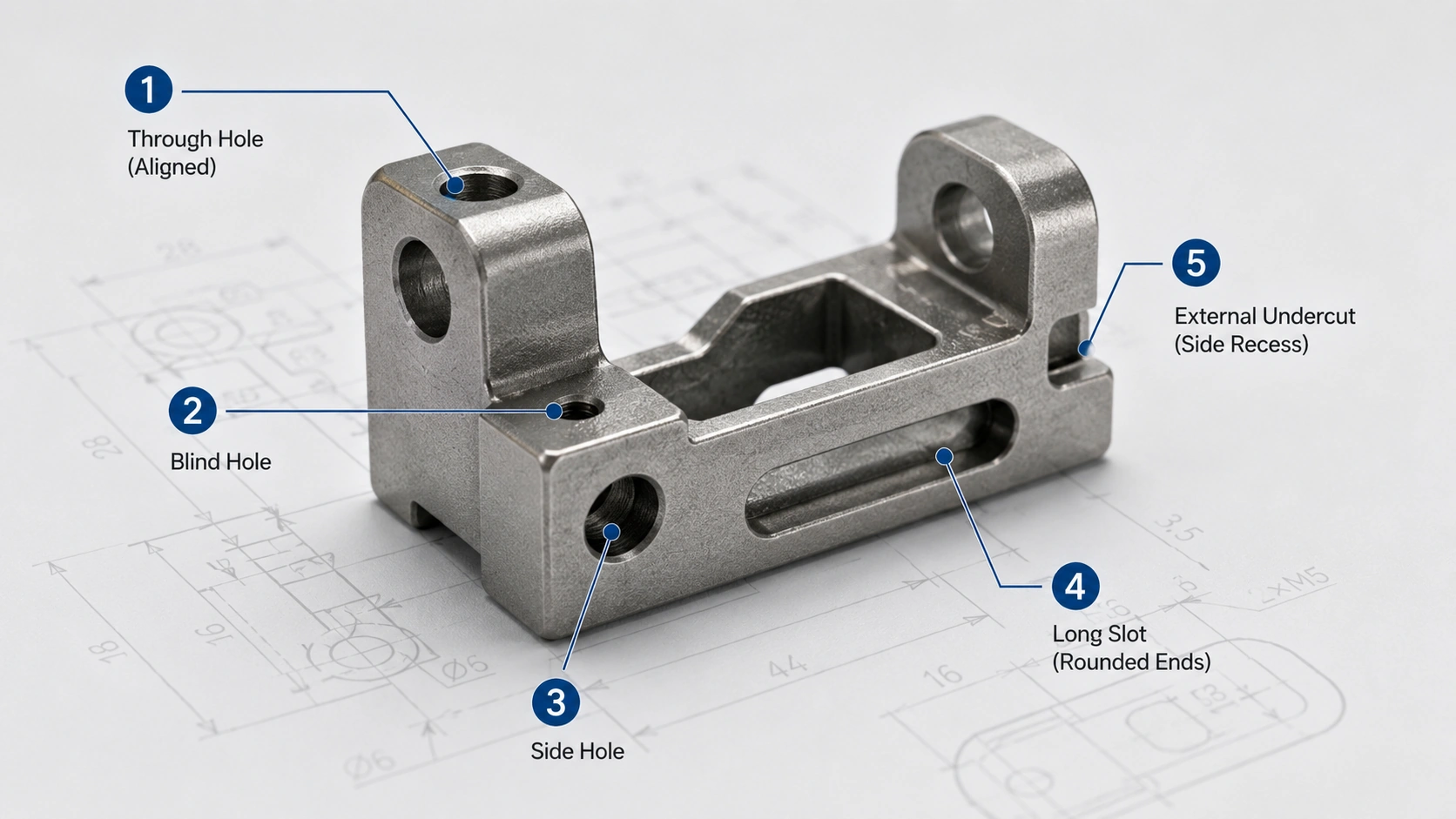
Şekil notu: A molded feature is not only a CAD shape. It creates decisions about mold motion, shutoff surfaces, shrinkage control, green part handling and inspection access.
Can MIM Produce Holes, Slots and Undercuts?
Yes, MIM can produce many holes, slots and undercuts directly in the molded green part. These features are one reason MIM is selected for small, complex precision metal parts. However, each feature must be judged by tooling motion, core pin stability, feedstock flow, ejection path, shrinkage behavior and inspection requirements.
MIMA design guidance explains that cored holes can reduce cross sections, support more uniform wall thickness and reduce or eliminate machining operations. It also notes that the preferred hole direction is parallel to mold opening and perpendicular to the parting plane, which is why feature orientation matters before tooling. See MIMA complex design guidance.
| Özellik | MIM Uygunluğu | Main Design Risk | DFM Review Focus |
|---|---|---|---|
| Through holes | Genellikle uygundur | Core pin deflection, flash, hole distortion | Hole direction, depth, diameter and tolerance |
| Blind holes | Possible but more sensitive | Unsupported core pin, trapped geometry, ejection risk | Depth-to-diameter ratio and core pin support |
| Yan delikler | Possible with tooling review | Slides, side actions, parting line flash | Mold motion and shutoff surface |
| Narrow slots | Possible with limits | Filling difficulty, flash, weak tool steel | Slot width, depth and edge condition |
| Long slots | Risk-sensitive | Sintering distortion, wall imbalance | Wall thickness, support and shrinkage path |
| External undercuts | Often possible | Slide action, parting line mark, flash | Ejection direction and split line |
| Internal undercuts | High-risk | Complex tooling, collapsible core, flash | Redesign, split feature or secondary operation |

Temel sonuç: Not every hole, slot or undercut has the same MIM risk level. Direction, depth, access, function and tolerance determine the review priority.
From a design review perspective, the safest features usually follow the mold opening direction, have enough surrounding material, avoid sharp transitions and do not create thin unsupported tool steel. The highest-risk features are deep small holes, long narrow slots and internal undercuts that block normal ejection.
How Hole Direction Affects MIM Tooling
Hole direction is one of the first checks in a MIM DFM review. A hole is not only a geometry feature; it usually implies a core pin, shutoff surface, slide or post-sintering machining decision.
Holes Aligned with the Mold Opening Direction
Holes aligned with the mold opening direction are usually easier to mold than side holes or angled holes. The core pin can be supported more directly, the mold structure is simpler and ejection is easier to manage. This does not mean every vertical hole is automatically low risk. A very small, very deep or tight-tolerance hole can still create core pin deflection, wear or dimensional variation.
In practice, a product engineer should mark which holes are functional and which are non-critical. A cosmetic vent hole, weight-reduction hole and precision assembly hole should not be treated the same way. Critical holes may require tighter inspection, secondary sizing or machining after sintering. For a deeper tolerance strategy, review MIM toleransları.
Side Holes and Cross Holes
Side holes and cross holes are possible in MIM, but they often require slides or side actions. This changes the mold from a simpler open-close tool into a more complex tool with moving elements. The additional shutoff surfaces can become flash-sensitive areas, especially when the hole is near a visible surface, sealing surface or assembly interface.
A common mistake is to treat side holes as “free complexity” because MIM can form complex geometry. In production, side holes should be reviewed for their actual function. If the hole only supports assembly clearance, it may be redesigned. If it is a critical alignment or fluid passage feature, the supplier may need to review whether direct molding, post-sintering drilling or another process sequence is more stable. Related tooling issues are covered more fully in MIM kalıp tasarımı.
Deep or Small Holes
Deep or small holes create a different risk. The core pin may become long and slender, which can lead to pin deflection, wear, breakage or hole position variation. Blind holes are usually more sensitive than through holes because the core pin may be supported from only one side.
The practical limit depends on material, feedstock behavior, hole depth, hole diameter, mold layout and tolerance requirement. Instead of applying one fixed rule to all projects, the better approach is to identify the hole function and ask whether it must be molded directly. For tight-tolerance holes, post-sintering machining may be more reliable than forcing the hole to be fully net-shaped in the mold.
Slot Design Risks in MIM Parts
Slots can reduce weight, create clearance, support assembly functions and help balance section thickness. However, a slot in a MIM part also creates tool steel, filling, flash and shrinkage questions. CAD shape alone does not show whether the matching mold steel will be strong enough for repeat production.
Open Slots vs Closed Slots
Open slots are usually easier to mold and inspect than deep enclosed slots. Feedstock has a clearer flow path, the tool structure can be more robust and ejection is often less complicated. Closed, deep or narrow slots are more sensitive because they may require thin mold steel, create flow hesitation or increase flash risk at shutoff areas.
Slot ends should avoid sharp internal corners where possible. Rounded slot ends and smooth transitions help reduce local stress concentration, improve filling behavior and reduce the risk of cracking during green part handling, debinding or sintering. Slot design should be reviewed together with MIM duvar kalınlığı tasarımı.
Narrow Slots and Weak Tool Steel Conditions
A slot in the part usually means a raised steel feature in the mold. When the slot is very narrow and deep, the corresponding tool steel may be thin and vulnerable to wear, damage or deflection. This is one of the most overlooked issues in CAD-driven design.
The question is not only whether the slot can be molded once. The real question is whether the slot can be produced consistently over the required production volume without excessive tool maintenance or dimensional variation. If a slot is narrow, deep and located near a critical surface, it should be reviewed before tooling release.
Slots Near Thin Walls or Functional Surfaces
Slots near thin walls, sealing areas, cosmetic surfaces or precision assembly features need extra attention. A slot can locally interrupt wall thickness, change feedstock flow, create uneven shrinkage or make a thin section more likely to distort during sintering.
If the slot is functional, its width, depth, end radius and inspection method should be defined clearly. If the slot is only for weight reduction or appearance, it may be safer to adjust its geometry to protect mold strength and production consistency.
Undercuts in MIM Design: Useful but Not Always Simple
Undercuts are one of the features that make MIM attractive for complex metal parts. Locking details, snap features, relief grooves, side recesses and retaining forms may be molded directly when the tooling path allows it. But undercuts are not automatically low-cost features. They must be reviewed against ejection direction, slide movement, parting line location, flash risk and production stability.
PIM International describes MIM design freedom as including blind and through holes, angled holes, undercuts, grooves, slots, external or internal threads, knurled surfaces and molded identification features. This supports the use of MIM for complex local features, but final feasibility still depends on part geometry and tooling review. Read the PIM International overview.
When Undercuts Are Suitable for MIM
Undercuts are more suitable when they are accessible, shallow, located near a practical parting line and do not require multiple complex mold movements. External undercuts are usually easier to manage than hidden internal undercuts because they can often be formed with split mold surfaces or side actions.
MIM can be a strong option when the undercut replaces multiple machining steps or reduces assembly complexity. This is especially relevant for small precision parts where CNC access is limited and the feature repeats across production volume.
When Undercuts Increase Tooling Risk
Undercuts increase risk when they block normal ejection, require complex side action, create tight shutoff surfaces or sit on a critical functional surface. These features can increase tooling cost, reduce molding speed, add maintenance points and create flash-sensitive areas.
When to Redesign an Undercut
An undercut should be redesigned or reviewed in more detail when it prevents straight ejection, requires several mold movements, creates a hidden shutoff surface, is located on a sealing or precision assembly surface, demands tight tolerance without practical inspection access, creates a fragile tool condition or can be replaced by an open groove, split feature or post-sintering machining step.
The best redesign is not always to remove the undercut. Sometimes a small change in opening direction, radius, relief angle or feature position can reduce tooling risk while keeping the part function.
Core Pins, Slides and Flash Risk Around Molded Features
Holes, slots and undercuts become production risks when they create unstable tooling conditions. Core pins, slides, inserts and parting lines are useful tools, but every added tooling element creates possible variation. This section explains the feature-level risk only; complete mold architecture belongs in the MIM kalıp tasarımı incelemenin yerini almamalıdır.
| Tooling Element | Used For | Ana Risk | DFM Question |
|---|---|---|---|
| Core pin | Through holes, blind holes, internal forms | Deflection, wear, breakage, hole shift | Is the hole too deep, too small or too critical? |
| Slide / side action | Side holes, external undercuts | Flash, maintenance, cost, timing | Can the feature be aligned with mold opening or redesigned? |
| Insert | Local slot or precision detail | Wear, mismatch, replacement risk | Is the feature critical enough to justify an insert? |
| Ayırma hattı | Split features, external forms | Witness line, flash, cosmetic mark | Is it on a functional or visible surface? |
| Shutoff surface | Side openings, undercuts, slot closures | Flash and wear | Can the shutoff be made more robust? |

Temel sonuç: The risk of a molded feature usually comes from the tooling action needed to create it, not from the feature name itself.
For a deeper quality discussion around mold-related risks, see kalıp tasarımının MIM parça kalitesine etkisi.
Composite Field Scenario for Engineering Training: Flash Around a Side Hole
- Ne sorunu oluştu
- A small MIM housing had a side hole near a cosmetic outer surface. After trial molding, flash appeared around the side opening and required extra removal.
- Neden oldu
- The side hole required a slide. The slide shutoff surface was close to a visible surface, and the local geometry gave limited support for a robust shutoff.
- Gerçek sistem nedeni
- The design placed a flash-sensitive feature in a location where tooling movement and cosmetic expectations conflicted.
- Nasıl düzeltildi
- The hole position was adjusted, the local surface was relieved, and the drawing clarified which surface was cosmetic and which surface was functional.
- Tekrar oluşması nasıl önlenir
- Side holes should be reviewed with parting line, slide direction, shutoff condition and surface classification before tooling approval.
How Holes, Slots and Undercuts Affect Filling, Debinding and Sintering
Feature design affects more than the mold. In MIM, fine metal powder and binder are formed into feedstock, the feedstock must fill the cavity, the green part must survive handling, binder must be removed during debinding, and the part must shrink during sintering without unacceptable distortion. Local features can influence each stage.
Filling and Short Shot Risk
Narrow slots, thin sections, deep pockets and complex internal geometry can interrupt feedstock flow. A feature near the end of the flow path may increase short shot or knit line risk. This does not mean the feature is impossible, but it should be reviewed with gate location and filling balance. Related flow-path decisions belong in MIM yolluk tasarımı.
Debinding and Section Change Risk
Holes and slots can help reduce thick sections and improve wall balance. This can be beneficial because thick and uneven sections can make debinding and sintering more difficult. However, a slot that creates abrupt thickness changes can also introduce local stress, cracking risk or shrinkage imbalance.
The design target is not simply “add holes to reduce mass.” The better target is controlled and gradual section balance that supports molding, green part handling, debinding and sintering stability.
Sintering Distortion Around Slots and Undercuts
Long slots, open frames, thin bridges and unsupported undercut areas may distort during sintering. The part shrinks significantly during sintering, and the geometry must be able to move predictably. Unsupported cantilever-like sections, long open slots and uneven wall sections may need MIM sintering support design incelemenin yerini almamalıdır.

Temel sonuç: A slot is not only a clearance feature; it changes wall balance, shrinkage behavior and support requirements during sintering.
Composite Field Scenario for Engineering Training: Long Slot Distortion After Sintering
- Ne sorunu oluştu
- A thin MIM part included a long narrow slot near one edge. The molded green part looked acceptable, but the sintered part showed local distortion near the slot.
- Neden oldu
- The slot created an unbalanced section. During sintering shrinkage, one side of the structure had less support and moved differently from the surrounding material.
- Gerçek sistem nedeni
- The design treated the slot as a simple clearance feature, but it changed local wall balance and sintering behavior.
- Nasıl düzeltildi
- The slot end radius was increased, the local wall transition was softened, and the part orientation during sintering was reviewed.
- Tekrar oluşması nasıl önlenir
- Long slots should be checked together with wall thickness, shrinkage path and sintering support before tooling is finalized.
For more process context, see bağlayıcı giderme ve sinterlemenin MIM parça kalitesini nasıl etkilediği.
Inspection Checks for Molded Holes, Slots and Undercuts
A feature should not be judged only by whether it appears in the sintered part. For production use, the drawing should define which holes, slots or undercuts are functional, which are cosmetic, which are clearance-only, and which require dimensional verification. The inspection plan may vary by part size, feature geometry, tolerance class and application risk.
| Feature Area | Typical Inspection Focus | Possible Check Method | Neden Önemlidir |
|---|---|---|---|
| Through holes | Diameter, position, roundness and blockage | Pin gauge, optical measurement or CMM based on tolerance requirement | Assembly pins, fasteners or shafts may fail if the hole shifts or shrinks unevenly. |
| Blind holes | Depth, bottom condition and usable entry | Depth gauge, optical inspection or section review when required | Unsupported core pins and trapped geometry can create variation or incomplete functional depth. |
| Side holes and undercuts | Flash, parting line marks, shutoff wear and opening condition | Visual inspection, magnification, go/no-go gauge or functional fit check | Slide and shutoff areas can create flash that affects assembly, sealing or appearance. |
| Long slots | Slot width, straightness, parallelism and local distortion | Optical measurement, fixture check or CMM for critical dimensions | Slots may distort during sintering even when green part molding looks acceptable. |
| Cosmetic or sealing surfaces near features | Witness lines, burrs, flash removal marks and surface interruption | Visual standard, surface comparison or application-specific inspection | Feature location can move tooling marks onto surfaces that buyers expect to remain clean. |
| Critical mating features | Functional fit, alignment and repeatability | Assembly fixture, go/no-go gauge or defined dimensional inspection | Functional dimensions should be identified before RFQ so molded and machined tolerances are not confused. |
DFM Review Matrix for Holes, Slots and Undercuts
Use this matrix as an early design screen. It does not replace project-specific DFM review, but it helps identify which features need attention before tooling.
| Tasarım Özelliği | Lower-Risk Design | Higher-Risk Design | Takım Öncesi İnceleme |
|---|---|---|---|
| Through hole | Short, aligned with mold opening | Very deep or very small | Core pin stability and hole tolerance |
| Blind hole | Shallow and accessible | Derin kör delik | Pin support, ejection and cleaning access |
| Side hole | Non-critical, low-tolerance, accessible | Tight-tolerance side hole | Slide action or secondary drilling |
| Cross hole | Simple intersection with clear access | Multiple intersecting holes | Tooling sequence and flash control |
| Long slot | Moderate width, rounded ends | Narrow, deep and long | Filling balance and sintering distortion |
| Slot near edge | Enough surrounding stock | Thin edge breakout risk | Wall balance and tool steel condition |
| External undercut | Accessible and split-line friendly | Large locking geometry | Slide action and parting line location |
| Internal undercut | Simple relief form | Hidden locking feature | Redesign, collapsible core or machining |
| Feature on cosmetic surface | Hidden or non-critical area | Visible flash-sensitive surface | Parting line and finishing plan |
| Feature with tight tolerance | Machining allowance available | Molded-only requirement | Inspection method and tolerance strategy |
Molded Feature vs Secondary Machining Decision Table
Many MIM projects combine molded geometry with selective secondary operations. The goal is not to machine every precision feature, but to decide which features are stable enough to mold directly and which features need machining, sizing, drilling, tapping or functional verification after sintering.
| Decision Option | Usually Suitable For | Use Caution When | Engineering Decision |
|---|---|---|---|
| Mold directly | Non-critical through holes, open slots, relief features and accessible external forms | The feature is deep, narrow, tight-tolerance or near a cosmetic / sealing surface | Good option when tooling is robust and inspection requirements are moderate. |
| Mold then inspect | Functional clearance holes, assembly slots and non-sealing undercuts | The feature affects fit, alignment or repeatability | Define inspection method and acceptance criteria before production approval. |
| Mold then size or calibrate | Features that need improved repeatability but do not require full machining | The geometry does not support stable post-sintering correction | Review whether sizing can reach the functional target without damaging the part. |
| Secondary drilling or reaming | Critical positioning holes, precision bores or features with tight diameter control | The hole is difficult to locate or hold after sintering | Often safer than forcing a tight-tolerance deep hole to be fully molded. |
| Secondary tapping | Internal threads, precision assembly threads or gauge-controlled thread requirements | The thread is very small, shallow or close to thin walls | Confirm thread function, gauge requirement and machining access before tooling. |
| Redesign before tooling | Hidden internal undercuts, fragile core pin conditions and long narrow slots causing distortion risk | The feature blocks ejection or creates severe shutoff / flash risk | Change feature direction, split the feature, add radius, relax tolerance or move to a secondary operation. |
This decision table should be used together with the drawing tolerance plan. A feature that is acceptable as-molded in one product may require secondary machining in another product if it controls sealing, bearing, alignment, wear, torque transfer or safety-related assembly.
When Should a Hole, Slot or Undercut Be Redesigned?
A feature should be redesigned when the geometry creates more production risk than functional value. This is especially important before tooling, because CAD changes are less expensive than mold steel changes after trial.
- A deep small hole requires a fragile core pin.
- A blind hole is too deep for stable molding.
- A side hole creates a flash-sensitive slide shutoff.
- A long narrow slot creates weak mold steel.
- A slot interrupts thin wall balance.
- An undercut blocks normal ejection.
- An internal undercut requires complex collapsible tooling.
- A feature is located on a sealing, bearing, alignment or cosmetic surface.
- A tight-tolerance feature cannot be inspected reliably.
- A molded feature would require excessive post-process flash removal.
How These Features Affect MIM Tooling and Part Cost
Holes, slots and undercuts affect cost when they change the mold structure, production stability or secondary operation plan. The cost issue is not only the presence of the feature; it is the manufacturing method required to create it.
| Maliyet Faktörü | Neden Önemlidir | Typical Design Question |
|---|---|---|
| Side actions or slides | Add tooling complexity and maintenance | Can the feature follow mold opening direction? |
| Fragile core pins | Increase wear or breakage risk | Can the hole be enlarged, shortened or machined later? |
| Thin tool steel for slots | Can reduce tool life | Can slot width, depth or radius be adjusted? |
| Flash-sensitive shutoffs | Add finishing and inspection burden | Can the parting line move away from critical surfaces? |
| İkincil işleme | Adds operation cost but may improve precision | Is the feature critical enough to machine? |
| Muayene gereksinimleri | Increase quality control workload | Which holes or slots are critical dimensions? |
| Trial mold correction | Increases project lead time | Can risk be solved during DFM instead? |
For sourcing users, this explains why two parts with similar size and material can have different tooling and part costs. A compact part with straight-through holes may be simpler than a similar part with several side holes, hidden undercuts and critical slot tolerances. Related cost factors are discussed in MIM tasarımı maliyet için.
What to Provide for a Feature DFM Review
For holes, slots and undercuts, a useful DFM review requires more than a screenshot. The engineering team needs enough information to understand function, risk and production requirements.
- 2D drawing with critical dimensions marked
- 3D CAD dosyası
- Material requirement or target mechanical properties
- Hole diameter, depth and tolerance
- Slot width, depth, end radius and function
- Undercut function and mating part information
- Cosmetic surfaces and functional surfaces
- Sealing, sliding, bearing or alignment requirements
- Beklenen yıllık hacim
- Surface finish or post-treatment requirement
- İkincil işleme payı
- Muayene gereksinimleri
- Application environment and load condition

Temel sonuç: The more clearly a buyer explains the function of holes, slots and undercuts, the more accurately the supplier can judge tooling, tolerance and production risk.
If you are still collecting design risks before RFQ, also review yaygın MIM tasarım hataları.
FAQ: MIM Holes, Slots and Undercuts
Can MIM produce small holes directly?
Yes, many small holes can be molded directly in MIM, but the practical limit depends on hole diameter, depth, direction, core pin support, material and tolerance requirement. A shallow non-critical hole is very different from a deep precision hole. Critical holes may need post-sintering machining or additional inspection.
When should a MIM hole or slot be machined after sintering instead of molded?
A hole or slot should be considered for secondary machining when it controls precision alignment, sealing, bearing fit, thread quality, tight diameter tolerance, sharp internal geometry or a critical assembly interface. Deep small holes, internal threads, narrow precision slots and functional bores may be more reliable when molded with allowance and finished after sintering.
Are blind holes suitable for MIM?
Blind holes can be suitable when they are shallow and accessible. Deep blind holes are more sensitive because the core pin may be supported from only one side. This can increase the risk of pin deflection, wear, dimensional variation or ejection problems.
Can MIM make side holes?
MIM can make side holes, but side holes often require slides or side actions in the mold. This may increase tooling complexity, flash risk and maintenance requirements. Side holes on functional or cosmetic surfaces should be reviewed carefully before tooling.
Are undercuts possible in MIM parts?
Yes, undercuts are possible in many MIM designs. External undercuts are generally easier than hidden internal undercuts. The key issue is whether the part can be ejected and whether the undercut requires slides, collapsible cores or other complex tooling.
Do slots increase distortion risk in MIM?
Slots can increase distortion risk when they are long, narrow, deep or located near thin walls. They can also affect feedstock filling and sintering shrinkage. Rounded slot ends, balanced wall sections and proper support review can reduce risk.
Should threaded holes be molded or machined after sintering?
It depends on thread type, size, precision and production volume. Some external thread-like features may be molded, but internal threads often need tapping or secondary machining when precision, assembly reliability or gauge control is important.
When should I request a DFM review for holes, slots and undercuts?
Request a DFM review when the part includes deep holes, blind holes, side holes, long narrow slots, internal undercuts, critical assembly features, cosmetic surfaces near parting lines, tight tolerances or any feature that may require slides, core pins or secondary machining.
Submit Your Drawing for Holes, Slots and Undercuts DFM Review
If your MIM part includes deep holes, side holes, narrow slots, locking undercuts, cosmetic surfaces near molded features or tight-tolerance assembly details, send your drawing for a feature-level DFM review before tooling.
Please provide 2D drawings, 3D CAD files, material requirements, key tolerances, surface requirements, estimated annual volume and application background. The XTMIM engineering team can review whether your holes, slots and undercuts are suitable for direct MIM molding, require slides or core pins, need secondary machining, or should be redesigned before tooling. This review can help identify flash risk, ejection issues, weak tool steel conditions, sintering distortion and inspection concerns before the project moves into mold manufacturing.
Standartlar ve Teknik Referans Notu
MIM design decisions for holes, slots and undercuts should be based on both general industry design guidance and project-specific supplier review. MIMA design guidance is especially relevant to this topic because it discusses cored holes, hole direction, parting plane relationship and complex MIM geometry considerations. MIMA tasarım kılavuzu.
MPIF Standard 35-MIM is relevant as a materials standard for metal injection molded parts, but it should not be treated as a direct geometry rulebook for holes, slots or undercuts. Its value for this page is mainly in supporting material and MIM industry context, while feature feasibility still depends on part geometry, tolerance requirements, inspection method and supplier-specific DFM review. MPIF standards overview.
Industry publications such as PIM International are useful for understanding common MIM design features and limitations, including holes, slots, grooves and undercuts. Final design limits should still be confirmed through project-specific review, material requirements, tolerance requirements, tooling feasibility and production inspection planning. PIM International design discussion.