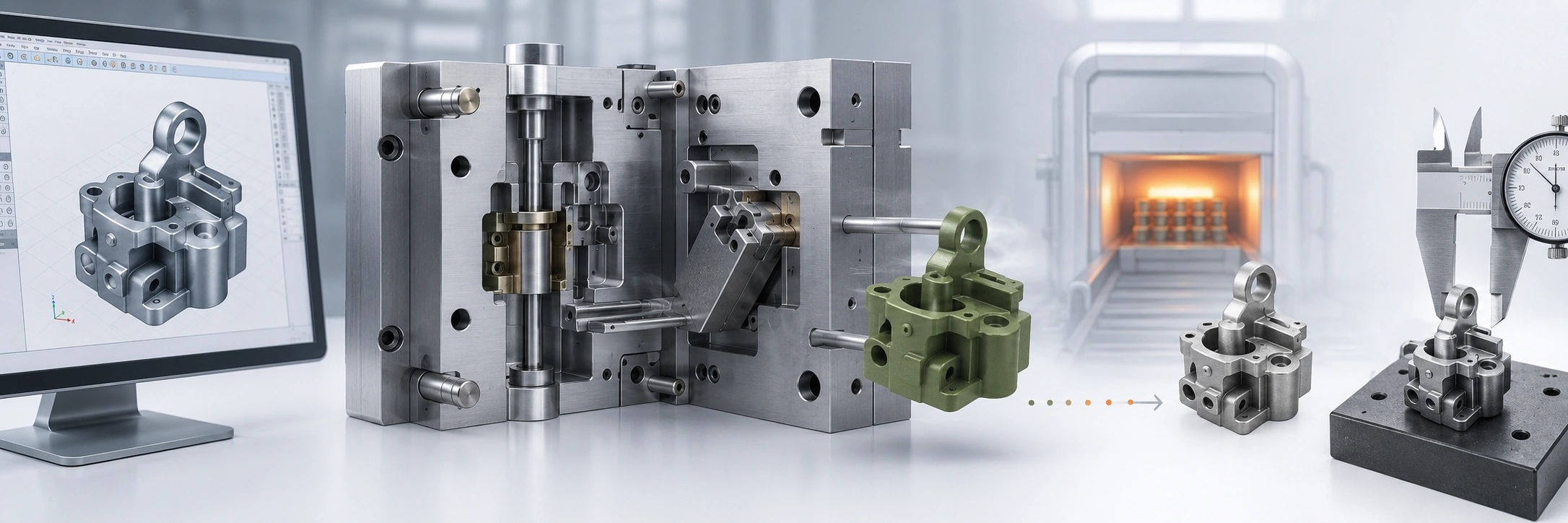
MIM mold design decides whether a complex metal part can be molded, ejected as a green part, debound, sintered, inspected, and repeated in production without avoidable tooling risk. For a design engineer, the main question is not only whether the CAD geometry looks moldable. The more important question is whether parting lines, mold opening direction, slides, inserts, core pins, ejector locations, shut-off areas, and protected surfaces can support stable MIM production. A weak tooling decision at the green-part stage can create cracks, distortion, flash, surface marks, dimensional drift, or expensive T1 mold corrections. This page focuses on the mold-design decisions that should be reviewed before tooling release, especially for parts with side holes, undercuts, deep holes, thin slots, cosmetic surfaces, sealing areas, or tight functional dimensions.
What Should MIM Mold Design Solve Before Tooling?
MIM mold design should answer four practical questions before the customer invests in tooling: can the green part release from the mold without damage, can critical surfaces avoid unwanted marks, can side features be formed with acceptable tooling complexity, and can the mold layout support final dimensional control after debinding and sintering?
Metal injection molding starts with fine metal powder mixed with binder to form feedstock. After injection molding, the molded green component is removed before binder extraction and sintering. The MPIF overview of metal injection molding describes the route from green component removal through binder extraction and sintering, which is why mold release and green-part handling are not secondary details in MIM tooling.
From a design review perspective, MIM tooling should not be treated as a plastic injection mold copied into a metal part project. MIM may use injection molding principles, but the molded part must survive debinding, high sintering shrinkage, and final dimensional inspection after binder removal. Poor tooling decisions can remain visible or measurable in the final metal component.
| İnceleme Sorusu | Neden Önemlidir | What Should Be Checked Before Tooling |
|---|---|---|
| Can the part release from the mold? | Mold release affects slides, parting line, draft, ejection, and green-part damage risk. | Mold opening direction, undercuts, side features, ejector support |
| Are protected surfaces clearly marked? | Gate marks, ejector marks, and parting lines may affect function or appearance. | Sealing surfaces, sliding surfaces, cosmetic surfaces, datum surfaces |
| Are side holes or undercuts required? | These may need slides, side cores, inserts, post-machining, or redesign. | Feature direction, hole depth, tolerance, access for tooling |
| Are critical dimensions shrinkage-sensitive? | Tooling layout and shrinkage compensation influence final dimensional control. | Datum strategy, tolerance class, machining allowance, inspection method |
| Is tooling complexity justified by production volume? | Slides and inserts can reduce secondary operations but may increase mold cost and maintenance. | Annual volume, cost target, secondary machining alternatives |
For the full drawing review workflow, see the DFM for MIM guide. This page focuses only on mold-design-related decisions before tooling.
Which Part Features Increase MIM Tooling Complexity?
Certain features are attractive because they reduce assembly, machining, or part count. In practice, the same features may increase tooling complexity if they require side action, long core pins, replaceable inserts, difficult shut-off areas, or protected surface planning.
The MIMA Design Center discussion of complex MIM designs explains that slides, cores, and other tooling elements can increase the complexity possible in MIM parts, but they usually add tooling and start-up engineering cost. Complexity is valuable when it replaces machining or assembly. It becomes a risk when the feature is not function-critical, creates avoidable flash, or makes the mold harder to maintain.

| Tooling Route or Feature Condition | Typical Mold Impact | Ana Üretim Riski | Better Design Review Action |
|---|---|---|---|
| Open-shut molded feature | Can usually be formed in the main mold opening direction with lower tooling complexity. | Lower mold mechanism risk, but parting line and ejector mark locations still need review. | Keep non-critical features aligned with the main opening direction when function allows. |
| Side hole | May require side core, slide, or post-sintering machining. | Flash, tool wear, added mold cost, and longer tooling review. | Review hole direction, tolerance, and whether the feature can be reoriented or machined after sintering. |
| Angled or cross hole | May need more complex tool motion or a secondary operation. | Higher mold complexity, alignment risk, and possible dimensional drift. | Confirm whether the angled feature is function-critical before accepting complex tooling. |
| Internal undercut | May require slide, collapsible action, insert strategy, or design simplification. | Difficult release, higher tooling cost, and local flash risk. | Evaluate redesign, split feature strategy, or secondary machining before tooling release. |
| Derin kör delik | May require a long core pin with limited support. | Core pin deflection, breakage, wear, and unstable hole geometry. | Review depth-to-diameter ratio, hole tolerance, and whether a through hole or machining allowance is safer. |
| Thin slot | May require fragile insert or tight shut-off surface. | Insert wear, blocked slot, flash, and edge damage. | Review minimum feature size, edge strength, and whether the slot should be molded or machined. |
| Protected cosmetic or functional surface | Limits gate, ejector, parting line, and slide interface options. | Visible marks, surface finishing conflict, or functional interference. | Mark protected surfaces on the drawing before RFQ and define acceptable mark zones. |
| Tight datum near molded feature | Increases mold layout, shrinkage control, and inspection demand. | Dimensional variation after debinding and sintering. | Review tolerance strategy, datum location, machining allowance, and inspection method together. |
A common mistake is to ask the mold to create every feature in one operation without checking whether a simpler geometry, post-machined hole, or tolerance adjustment would reduce risk. A feature may be moldable, but not always economical or stable for mass production. For feature-specific guidance, review holes, slots, and undercuts in MIM design.
How Parting Line Placement Affects Function, Appearance, and Flash Risk
Parting line location should be decided with the part’s function in mind, not only with mold convenience in mind. A visible witness line may be acceptable on a non-functional surface, but it may be unacceptable on a sealing face, sliding face, cosmetic area, datum surface, or assembly interface.

In MIM, parting lines also matter because the molded green part still needs debinding and sintering. A parting line or shut-off mismatch that creates flash may require removal later, and that post-processing step can damage small features or change edge conditions. The issue is not only appearance. It can affect how the part assembles, seals, slides, or is inspected.
| Surface Type | Why It Should Be Protected | Mold Design Concern |
|---|---|---|
| Sızdırmazlık yüzeyi | Flash or witness line may affect sealing performance. | Avoid parting line, ejector marks, and gate vestige. |
| Kayma yüzeyi | Raised marks may affect movement or wear. | Control parting line and polishing requirements. |
| Mating surface | Surface mismatch may affect assembly. | Confirm flatness, mark location, and datum strategy. |
| Kozmetik yüzey | Visible marks may be unacceptable. | Plan gate, ejector, and parting line on less visible areas. |
| Inspection datum | Mold marks may affect measurement repeatability. | Keep datum surface stable and clearly specified. |
| Post-machined surface | Molded condition may be less critical if machining is planned. | Coordinate machining allowance and tooling layout. |
If the drawing does not identify functional and cosmetic restrictions, the mold designer may place a gate, ejector pin, or parting line in a location that is technically moldable but unacceptable for final use. For deeper review of mark location and flow path, see MIM yolluk tasarımı ve MIM toleransları.
When Are Slides, Inserts, and Core Pins Needed in MIM Tooling?
Slides, inserts, and core pins are used when a part has features that cannot be formed by a simple two-plate mold opening. They are common in MIM projects with side holes, cross holes, undercuts, internal pockets, small slots, bosses, and local details.
The better engineering question
The question is not only “Can MIM produce this feature?” A better question is: can this feature be molded repeatedly with acceptable tooling cost, maintenance risk, flash control, and dimensional stability?
| Tooling Element | Used For | Ana Risk | Kalıp Öncesi Onaylanması Gerekenler |
|---|---|---|---|
| Core pin | Holes, internal bosses, local cavities | Pin deflection, wear, breakage, flash | Hole depth, diameter, tolerance, feature direction |
| Slide / side action | Side holes, undercuts, cross features | Cost, maintenance, flash at slide interface | Whether feature direction can be changed |
| Replaceable insert | Local detail, wear area, fragile feature | Insert fit, witness line, maintenance | Whether insert replacement is expected |
| Shut-off surface | Separating complex molded features | Flash, mismatch, wear | Shut-off angle, contact area, feature criticality |
| Post-machining alternative | Holes or tight features not ideal for molding | Extra operation cost | Whether machining is lower risk than complex tooling |
A side action may be justified when it eliminates multiple machined operations or allows several parts to be combined into one MIM component. It may not be justified if the feature is non-critical, avoidable, or easier to machine after sintering. For cost trade-offs, review MIM tasarımı maliyet için.
How Ejection Design Protects the MIM Green Part
Ejection design is especially important in MIM because the molded part is still a green part when it leaves the mold. It contains metal powder and binder, but it has not yet become the final dense metal component. The MIMA proses genel bakış explains the sequence from feedstock molding to binder removal and sintering, which is why green-part handling must be considered during tooling design.

Poor ejection can create cracks, bending, local compression, deformation, or marks that remain visible after sintering. Thin walls, bosses, ribs, long flat sections, small projections, and asymmetric geometry all require careful ejection planning. In practice, ejector layout should be reviewed together with wall thickness, draft, protected surface notes, and sintering support orientation.
| Kontrol Maddesi | Neden Önemlidir | Better Practice |
|---|---|---|
| Ejector mark location | Marks may remain on the final part or affect assembly. | Keep ejector marks away from sealing, sliding, cosmetic, and datum surfaces. |
| Thin wall support | Thin sections may deform during ejection. | Use wider support areas or modify local wall transitions. |
| Boss and rib layout | Local thick/thin transitions can concentrate ejection stress. | Review wall balance, radii, and ejector position together. |
| Flatness-sensitive surface | Ejection force can introduce bending or distortion. | Review ejector balance and sinterleme desteği together. |
| Fragile small features | Pins, tabs, hooks, and small projections can break or distort. | Add radius, adjust orientation, or review whether secondary operation is safer. |
Composite Field Scenario for Engineering Training: Ejector Marks on a Functional Surface
How Shut-Off, Venting, and Flash Control Affect Molded MIM Quality
Flash control is a mold design issue, not only a trimming issue. In MIM, flash may occur around parting lines, side actions, core pins, small holes, slots, shut-off surfaces, or worn mold interfaces. Removing flash after molding or sintering may be possible, but it can increase cost, damage small features, or change edge conditions.
Shut-off surfaces define where mold steel contacts mold steel to block feedstock flow. If the shut-off area is too fragile, too sharp, poorly supported, or located around a critical feature, it may create repeatability problems. Venting also matters because trapped air can contribute to short shots, burn marks, or incomplete filling, but this topic should remain connected to mold design rather than become a full molding parameter discussion.
| Risk Alanı | Olası Neden | Quality Impact | İnceleme Aksiyonu |
|---|---|---|---|
| Ayırma hattı | Poor alignment, wear, high local pressure | Visible witness line, flash | Review parting line location and shut-off fit. |
| Side action interface | Slide mismatch or wear | Flash around side hole or undercut | Review slide direction, contact area, and maintenance risk. |
| Core pin area | Small gap around pin | Flash inside hole or local burr | Review pin support and tolerance. |
| Thin slot | Fragile insert or poor shut-off | Blocked slot, flash, edge damage | Review whether the feature should be molded or machined. |
| Vent area | Over-venting or poor vent location | Flash, surface defect | Review vent size and placement through mold trial. |
For molding-related quality causes beyond the tooling layout, see enjeksiyon kalıplamanın MIM parça kalitesini nasıl etkilediği ve MIM'de parça kalitesini neyin etkilediği. For the specific quality-defect angle of tooling decisions, review mold-related quality risks in MIM parts.
MIM Mold Design Review Matrix Before RFQ
The most useful mold design review happens before RFQ or before tooling release. At this stage, design engineers and buyers should not only ask for a quote. They should provide enough information for the supplier to identify mold layout risk, surface restrictions, critical dimensions, and production assumptions.

| Drawing Item | Mold Design Risk | What the Supplier Should Review | Possible Action Before Tooling |
|---|---|---|---|
| Side hole | Slide or side core may be required. | Direction, access, tolerance, wall support | Redesign hole direction, use slide, or machine after sintering |
| Internal undercut | Complex tool motion may be required. | Release direction, tooling feasibility, cost impact | Simplify geometry or accept tooling complexity |
| Derin kör delik | Long core pin may deflect or wear. | Hole depth, diameter, tolerance, support | Change to through hole, reduce depth, or post-machine |
| Protected cosmetic surface | Gate, ejector, or parting mark may be unacceptable. | Mark-free zones and acceptable mark zones | Move marks to backside or non-functional area |
| Tight datum dimension | Tooling and shrinkage may affect final dimension. | Mold layout, shrinkage compensation, inspection datum | Adjust tolerance, add machining allowance, or clarify datum |
| Thin wall near boss | Ejection stress or filling imbalance may occur. | Wall transition, ejector support, radii | Add radius, adjust wall, or relocate ejector support |
| Flatness-sensitive area | Ejection and sintering support may interact. | Mold orientation, support surface, inspection method | Review with sintering support strategy |
| High annual volume | Multi-cavity tooling may be considered. | Cavity balance, repeatability, maintenance | Compare single-cavity, family mold, or multi-cavity strategy |
For a practical pre-tooling review sequence, use the MIM DFM tasarım kontrol listesi.
How Mold Complexity Affects Tooling Cost and Project Risk
Mold complexity affects cost because every additional slide, insert, side core, fragile shut-off, or precision feature adds design effort, manufacturing difficulty, trial risk, and maintenance demand. However, mold complexity is not automatically negative. It can be justified when it reduces CNC machining, eliminates assembly, improves repeatability, or supports high-volume production.
In practice, buyers should evaluate mold complexity together with expected annual volume, part function, tolerance needs, and the cost of alternative manufacturing routes. A simple mold with heavy secondary machining may not be cheaper overall, while an over-complex mold for a low-volume or non-critical feature may create unnecessary risk.
| Maliyet Faktörü | Why It Increases Risk or Cost | When It May Be Justified |
|---|---|---|
| Slide or side action | Adds moving mold mechanism and maintenance. | When it eliminates expensive machining or assembly. |
| Replaceable insert | Adds fitting and maintenance requirements. | When local detail or wear area needs controlled replacement. |
| Long core pin | May deflect, wear, or break. | When the hole is functional and cannot be redesigned. |
| Multi-cavity tooling | Requires cavity balance and higher upfront review. | When annual volume supports tooling investment. |
| Tight shut-off feature | Requires precise mold fit and maintenance. | When the molded feature is essential to function. |
| Late T1 design change | May require welding, re-cutting, or major tool modification. | Should be reduced through early DFM review. |
A practical purchasing question is not simply “Why is the mold expensive?” A better question is “Which geometry choices are creating tooling cost, and are those choices necessary for function?” For broader cost evaluation, review metal enjeksiyon kalıplama maliyeti ve MIM tasarımı maliyet için.
Common Mold Design Mistakes That Should Be Caught Before Tooling
Many mold-related problems are avoidable if the drawing is reviewed before tooling. The following mistakes are common because the part looks simple in CAD but behaves differently during mold release, green-part ejection, debinding, and sintering.
| Yaygın Hata | Production Risk | Better Action |
|---|---|---|
| No protected surface notes on drawing | Gate, ejector, or parting mark may affect function. | Mark sealing, sliding, cosmetic, and datum surfaces. |
| Side holes placed without tooling review | Slide or side core may increase cost and flash risk. | Review whether direction, tolerance, or process can be changed. |
| Deep blind holes designed as molded features | Core pin may deflect or break. | Consider through hole, reduced depth, or secondary machining. |
| Tight tolerance applied to all dimensions | Tooling and inspection cost may increase unnecessarily. | Separate critical and non-critical dimensions. |
| Shrinkage treated as a simple scale factor | Final dimensions may vary due to geometry and sintering behavior. | Review shrinkage-sensitive features and inspection datum. |
| Ejector marks ignored until T1 | Functional or cosmetic surfaces may be affected. | Confirm acceptable mark zones before tooling. |
Composite Field Scenario for Engineering Training: Avoidable Slide Increased Tooling Risk
For a broader mistake checklist, see yaygın MIM tasarım hataları.
What Should You Send for a MIM Mold Design Review?
A useful MIM mold design review requires more than a part image or basic dimensions. The supplier should understand the part’s function, critical surfaces, tolerance priorities, material expectations, production volume, and whether the project is still flexible before tooling.
| Sağlanacak Bilgi | Neden Önemlidir |
|---|---|
| 2D çizim | Shows tolerances, datums, surface notes, and inspection requirements. |
| 3D CAD dosyası | Allows mold opening direction, undercuts, and tool motion to be reviewed. |
| Kritik boyutlar | Helps identify shrinkage-sensitive and inspection-sensitive features. |
| Korunan yüzeyler | Prevents gate, ejector, and parting marks from being placed on functional areas. |
| Malzeme gereksinimi | Affects feedstock choice, sintering behavior, properties, and application suitability. |
| Surface finishing requirement | Affects allowed marks, polishing, machining, coating, or post-processing. |
| Tahmini yıllık hacim | Helps determine whether tooling complexity and multi-cavity tooling are justified. |
| Uygulama geçmişi | Helps the engineering team understand load, wear, corrosion, assembly, or appearance needs. |
| Prototype or production stage | Determines whether design changes are still practical before mold investment. |
Before RFQ, mark these areas on the drawing
To make the mold design review more accurate, identify protected cosmetic surfaces, sealing surfaces, sliding surfaces, datum surfaces, critical dimensions, side holes, undercuts, thin slots, flatness-sensitive areas, and acceptable mark zones. This helps the engineering team review parting line, gate vestige, ejector marks, slide interfaces, shrinkage-sensitive dimensions, and secondary operation needs before mold investment.
The strongest review happens before tooling release. Once the mold is built, correcting parting line, gate, ejector, slide, or shrinkage-related problems can become slower and more expensive.
Submit Your Drawing for MIM Mold Design Review
If your part includes side holes, undercuts, deep holes, thin slots, protected cosmetic areas, sealing surfaces, tight datum dimensions, or high-volume production requirements, send your project information for a mold design and DFM review before tooling release.
XTMIM can review mold opening direction, parting line placement, gate and ejector mark restrictions, slides, inserts, core pins, shut-off risk, shrinkage-sensitive dimensions, and whether any geometry should be simplified before mold investment, trial production, or repeat production.
Upload Your Drawing / Contact Engineering TeamFAQs About MIM Mold Design
MIM kalıp tasarımı nedir?
MIM kalıp tasarımı, bir parça çizimini kalıplanabilir yeşil bileşene dönüştüren takım planlama sürecidir. Boşluk düzeni, ayırma hattı yerleşimi, kalıp açma yönü, sürgüler, insertler, maça pimleri, itici sistem, kapatma yüzeyleri, havalandırma ve işaret konumunu içerir. MIM'de kalıp tasarımı ayrıca bağlayıcı giderme, sinterleme büzülmesi, nihai boyutlar ve muayene gereksinimlerini de dikkate almalıdır.
MIM kalıp tasarımı, plastik enjeksiyon kalıp tasarımından nasıl farklıdır?
MIM, enjeksiyon kalıplama prensiplerini kullanır ancak kalıplanan parça nihai ürün değildir. Metal tozu ve bağlayıcıdan oluşan bir ham parçadır. Kalıplamadan sonra bağlayıcının giderilmesi ve parçanın sinterlenerek yoğun bir metal bileşene dönüştürülmesi gerekir. Bu nedenle kalıp tasarımında ham parça mukavemeti, fırlatma hasarı, sinterleme büzülmesi, sinterleme davranışı ve nihai boyutsal kontrol dikkate alınmalıdır.
MIM'de ayırma hattı konumu neden önemlidir?
Ayırma hattı konumu, görünüm, çapak riski, montaj, sızdırmazlık, kayma fonksiyonu ve muayene üzerinde etkili olduğu için önemlidir. Görünür bir ayırma hattı, kritik olmayan bir yüzeyde kabul edilebilir olabilir, ancak genellikle sızdırmazlık yüzeylerinde, kayma yüzeylerinde, kozmetik alanlarda, referans yüzeylerinde ve sıkı geçme montaj bölgelerinde kaçınılmalıdır.
Bir MIM parçası ne zaman sürgü veya yan hareket gerektirir?
Bir MIM parçası, yan delikler, alttan kesikler, çapraz delikler veya ana kalıp açılma yönünde serbest kalamayan özellikler içerdiğinde kayıcılar veya yan hareketler gerektirebilir. Ancak kayıcılar, kalıp maliyetini, bakım ihtiyacını ve çapak riskini artırır. Tedarikçi, özelliğin işlev açısından kritik olup olmadığını veya yeniden tasarım veya ikincil işlemenin daha pratik olup olmadığını değerlendirmelidir.
MIM kalıplamada yan delikler veya alttan kesikler her zaman sürgü gerektirir mi?
Her zaman değil. Bazı yan delikler veya alttan kesikler, sinterleme sonrası yeniden tasarlanabilir, yönlendirilebilir, basitleştirilebilir veya işlenebilir. Kayıcılar veya yan çekirdekler genellikle, özellik fonksiyonel olarak kritik olduğunda ve beklenen üretim hacmi, ek kalıp maliyeti, bakım ve çapak kontrol riskini haklı çıkardığında düşünülür.
MIM ile alttan kesikler ve yan delikler üretilebilir mi?
Evet, MIM, özellikle üretim hacmi ve parça fonksiyonu kalıp karmaşıklığını haklı çıkardığında, belirli alt kesikleri ve yan delikleri üretebilir. Ancak her alt kesik kalıplanmamalıdır. Kalıp riski çok yüksekse, bazı özellikler yeniden tasarlanmak, basitleştirilmek veya sinterleme sonrası işlenmek için daha uygundur.
Nihai MIM parçalarında itici pim izleri kalır mı?
Olabilir. Yeşil parça çıkarma sırasında oluşan itici izleri, bağlayıcı giderme ve sinterleme sonrasında görünür kalabilir veya fonksiyonel yüzeyleri etkileyebilir. Bir yüzey kozmetik, sızdırmazlık, kayma veya muayene referansı olarak kullanılıyorsa, kalıp tasarımından önce korumalı olarak işaretlenmelidir.
MIM kalıp tasarım incelemesi için hangi dosyalar gereklidir?
Faydalı bir inceleme genellikle 2D çizim, 3D CAD dosyası, malzeme gereksinimi, kritik boyutlar, tolerans öncelikleri, korunacak yüzey notları, yüzey bitirme gereksinimleri, tahmini yıllık hacim ve uygulama geçmişi gerektirir. Bu girdiler, tedarikçinin kalıp açma, kalıp karmaşıklığı, itici pimler, sinterleme büzülmesine duyarlı boyutlar ve üretim fizibilitesini değerlendirmesine yardımcı olur.
Standartlar ve Teknik Referans Notu
This page references MIMA and MPIF materials only where they support MIM process understanding, tooling complexity, green-part handling, or material specification. The MIMA Tasarım Merkezi is relevant for complex MIM design and tooling considerations. The MPIF MIM process overview is relevant for understanding green component removal, binder extraction, and sintering. MPIF Standard 35-MIM is relevant for material specification, but it should not be treated as a mold design standard. Mold layout, tolerance capability, and production feasibility still require project-specific DFM review.