
MIM Sintering Supports: Design Rules for Flatness and Distortion Control
MIM sintering support is the early design review used to decide how a metal injection molding part should rest, shrink, and remain stable during debinding and sintering. A part may be easy to mold but still difficult to sinter if it has long unsupported spans, thin flat areas, cantilever arms, delicate tips, asymmetric mass, or flatness-critical surfaces. The practical question is not only “Can this part be molded?” but also “Can it be supported while it shrinks and still meet the drawing?”
Support planning should be reviewed before tooling because support face, resting direction, setter requirement, protected surfaces, and inspection datums can affect distortion, flatness, cost, and trial-loop risk.
- Review support faces before mold design, not after repeated trial issues.
- Check long spans, cantilevers, thin plates, datum faces, and protected surfaces.
- Use the simplest support method that can control distortion and protect functional surfaces.
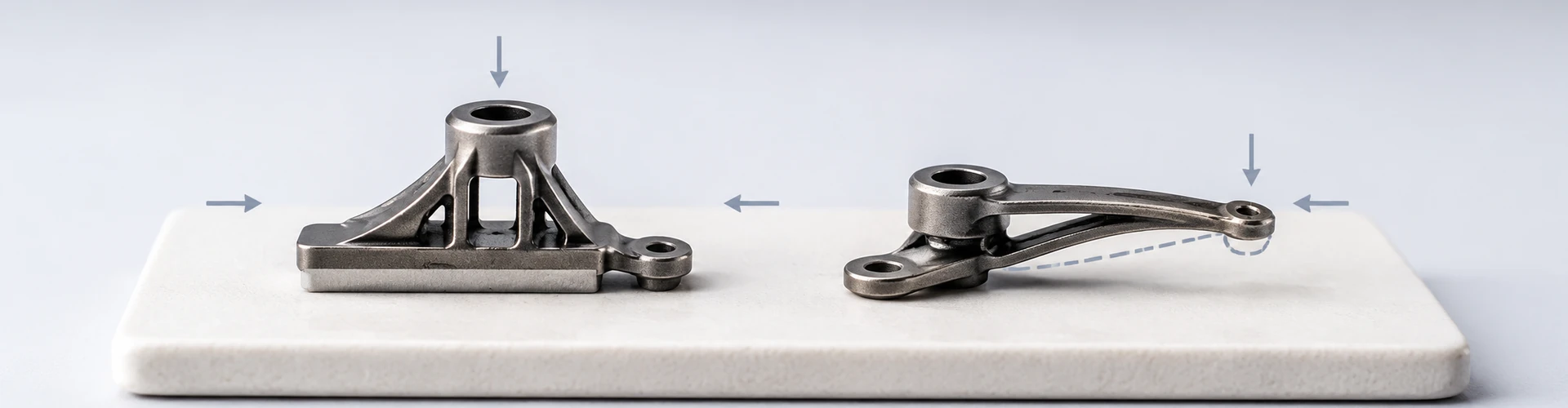
Quick Support Risk Check: Is a Standard Plate Enough, or Is a Custom Setter Likely?
MIM sintering supports are the support faces, ceramic plates, local supports, custom setters, or temporary design features used to keep parts stable while binder-removed MIM components shrink and densify. The support method should be selected from geometry risk, protected surfaces, flatness requirements, and production repeatability, not from furnace loading convenience alone.
| Part condition | Likely support direction | What to check before tooling |
|---|---|---|
| Stable non-critical flat face | Standard ceramic plate may be enough | Confirm support face, contact mark allowance, and flatness requirement |
| Long span, cantilever, or thin arm | Local support or orientation review may be needed | Check sagging risk, unsupported length, and secondary sizing allowance |
| Thin flat section with tight flatness | Support face and inspection datum must be reviewed together | Confirm realistic flatness target, support contact, and inspection method |
| Cosmetic, sealing, or sliding surface | Support contact should be avoided or controlled | Mark protected surfaces clearly in the RFQ package |
| No stable support face or asymmetric mass | Custom setter risk increases | Review cost, validation, loading discipline, and production volume before mold approval |
Why Should Sintering Support Be Reviewed Before MIM Tooling?
From a design review perspective, sintering support should be reviewed before tooling because the molded part shape does not directly equal the final stable metal part shape. MIM uses fine metal powder mixed with binder, injection molding, green part handling, debinding, and high-temperature sintering. During this route, the part changes from a molded feedstock shape into a densified metal component. Before full densification, the part is more vulnerable to support instability, gravity, contact stress, friction, and uneven shrinkage.
A common mistake is to judge a MIM part only by whether it can be injected and ejected from the mold. The real question is broader: can the part be molded, handled, debound, supported during sintering, shrink predictably, and then meet the final drawing requirements?
MIMA tasarım kılavuzu discusses support during debinding and high-temperature sintering and notes that long spans, cantilevers, and delicate points may require part-specific fixtures or setters. It also explains why large flat surfaces or several features in a common plane can help parts use standard fixtures instead of more expensive special support methods.
Why support is not only a production loading issue
If support is considered only after the tool is built, the available solutions become narrower. The supplier may need to adjust furnace loading, add ceramic strips, design a custom setter, modify the mold, accept secondary sizing, or propose machining on critical surfaces. These actions may still be practical, but they can affect quotation accuracy, validation time, inspection planning, and production repeatability.
What makes sintering support different from general fixture holding?
Sintering support is not the same as clamping a finished metal part during machining. During sintering, the part is shrinking, densifying, and changing mechanical stability. Contact areas, local friction, part weight, feature stiffness, and mass distribution can influence how the part moves. This is why a support face that looks acceptable in CAD may still create distortion or contact problems during production.
For broader process-quality context, see bağlayıcı giderme ve sinterlemenin MIM'de parça kalitesini nasıl etkilediği.
Which MIM Part Geometries Are Most Likely to Sag, Warp, or Twist During Sintering?
The highest-risk MIM geometries are not always the most visually complex. Some simple-looking shapes create serious support problems because they lack a stable resting surface, carry an unsupported feature, or combine thick and thin regions in an unbalanced way. The support review should therefore look at geometry, mass distribution, protected surfaces, and final inspection requirements together.

Long unsupported spans and cantilever arms
Long spans and cantilever-like arms are common sources of sagging. During sintering, gravity can act on the unsupported section while the part is still shrinking. If the span has no local support, the final part may show downward bend, loss of straightness, or inconsistent assembly fit. This is especially important for MIM brackets, hinge arms, latch parts, small levers, locking parts, and structural connector features.
Thin flat sections and plate-like geometries
Thin flat areas can be difficult to keep flat if they rest unevenly or shrink against unstable contact points. Flatness risk increases when the section is wide, thin, asymmetric, or connected to thicker features. The issue is not only wall thickness. The issue is whether the flat section can be supported in a way that does not introduce bending or twist. For thickness-specific geometry rules, review MIM duvar kalınlığı tasarımı.
Small feet, delicate points, and narrow contact areas
Small feet, sharp tips, thin ribs, and narrow edges are poor primary support features. They may create point contact, local drag, unstable resting, or contact deformation. If these features also act as functional surfaces, the risk becomes higher because support contact may affect assembly, surface acceptance, or inspection.
Asimetrik kütle dağılımı
A part with uneven mass distribution may shrink and rest unevenly. One side may contain a thick boss, another side a thin arm, and another side a flat datum. In such designs, the support direction should be reviewed together with the part’s mass balance and expected shrinkage behavior. Tooling compensation may help dimensional prediction, but it cannot fully correct gravity-driven sagging or poor support contact.
Flatness-critical and datum-sensitive surfaces
If a surface controls assembly, sealing, optical alignment, cosmetic appearance, or inspection datum setup, it should not be casually used as the support contact area. Support marks, drag, local distortion, or uneven shrinkage may affect the final functional requirement. For broader geometry review before tooling, see MIM parça tasarımı.
| Geometry condition | Main sintering risk | Design review focus |
|---|---|---|
| Uzun desteksiz açıklık | Sagging, bending, straightness drift | Reduce span, add local support, or review orientation |
| Cantilever arm | Downward deformation | Confirm support direction before tooling |
| Thin flat section | Warpage or flatness drift | Define support face and realistic flatness requirement |
| Small feet or delicate tips | Unstable contact or local deformation | Avoid point-contact support where possible |
| Asymmetric mass | Twist or uneven shrinkage response | Review mass balance and resting direction |
| Datum-sensitive face | Inspection inconsistency | Separate support contact from critical datum if possible |
| Kozmetik yüzey | Setter mark or contact trace | Mark protected surfaces before RFQ |
How Should Support Surfaces and Resting Direction Be Designed?
A good MIM support strategy starts with a simple question: where can the part rest during sintering without damaging functional surfaces or creating avoidable distortion? The answer depends on geometry, mass distribution, tolerance requirements, cosmetic requirements, material behavior, and production volume. The purpose is not to make every design flat or simple. The purpose is to give a complex part a controlled way to rest and shrink.

Use a stable flat surface when the part allows it
When possible, the design should include a stable support surface. A larger, flatter, more stable contact area usually reduces the need for special setters. This does not mean every part must have a large flat base. Many MIM parts are small and complex. However, if the part can include a non-critical flat area or a support-friendly face, that feature can reduce distortion risk and make production loading more repeatable.
Keep multiple support features on a common plane
If the part does not have one large support face, several support points or features may be designed on the same plane. This common-plane approach can help the part rest more predictably. It is especially useful for frames, brackets, small housings, and structural components with distributed contact features.
Avoid point contact, thin edges, and unstable resting features
A part should not depend on sharp corners, thin edges, delicate pins, or small tips as its main sintering support. These areas can become unstable during shrinkage, and they may be difficult to load consistently in production. If a narrow contact feature is unavoidable, it should be reviewed carefully with the supplier before tooling.
Protect cosmetic, sealing, and functional surfaces
Support contact should be reviewed against the drawing’s functional priorities. Cosmetic faces, sealing faces, sliding surfaces, bearing contact areas, inspection datums, and assembly interfaces should be marked before RFQ. This helps the engineering team avoid using protected surfaces as support contact areas.
Confirm support direction before final mold design
Support direction affects more than furnace loading. It may influence parting line discussion, gate location review, shrinkage compensation, flatness planning, and secondary operation allowance. For this reason, sintering support should be reviewed with MIM kalıp tasarımı ve shrinkage compensation in MIM tooling before final tool release.
When Is a Standard Ceramic Plate Enough, and When Is a Custom Setter Needed?
In production, the best support method is usually the simplest method that can control distortion and protect critical surfaces. A standard ceramic plate or flat setter is preferred when the part has a stable support face. A custom setter becomes more likely when the part has long unsupported features, irregular geometry, delicate surfaces, protected contact zones, or strict flatness requirements that cannot be controlled with a simple support setup.
PIM International notes that sintering trays and setter plates are used to optimize part arrangement and secure CIM and MIM parts in the furnace to help prevent undesirable deformation during sintering. This supports the practical role of setters, while this design guide focuses on part geometry and DFM decisions rather than treating setters as a standalone purchasing topic.

When standard flat plates are usually acceptable
A standard plate may be enough when the part has a stable flat support face, support contact does not damage functional or cosmetic surfaces, flatness requirements are realistic for the geometry, the part does not have long unsupported spans, and loading direction is repeatable in production.
When ceramic strips or local supports may be needed
Ceramic strips or local supports may be useful when only one area of the part needs additional support, such as a long arm, thin frame edge, or extended feature. This approach may reduce full custom setter complexity, but the support contact area still needs to be reviewed because local support can also create contact marks or uneven constraint.
When custom setters become difficult to avoid
Custom setters may be needed when the geometry cannot rest stably on a standard plate or when critical surfaces must be protected while unsupported features require controlled positioning. Custom setters can improve repeatability when validated, but they add design, validation, handling, cleaning, loading discipline, and production planning requirements. For low-volume or early-stage programs, the cost and validation burden should be discussed before tooling.
When molded-in support features may help
A molded-in support feature can sometimes reduce fixture complexity. This may be a temporary support rib, pad, bridge, or added mass that is later removed, machined, or accepted as non-functional geometry. This option should be reviewed carefully because it affects tooling, material use, debinding behavior, sintering behavior, and secondary operation planning.
| Support method | Best used when | Design impact | Cost / production impact |
|---|---|---|---|
| Standard ceramic plate | Part has a stable flat support face | Lowest design disruption | Lower support complexity |
| Common-plane support features | Several surfaces can rest together | Requires early geometry planning | Helps avoid custom setter |
| Ceramic strip or local support | Local span or arm needs controlled support | Requires contact-area planning | Adds handling and process control |
| Custom setter or fixture | Geometry cannot rest on standard support | Requires fixture validation | Higher support cost and loading control |
| Molded-in support feature | Temporary support can be removed or tolerated | Adds non-functional material and tooling review | May reduce custom setter dependency |
| Post-sinter sizing | Support cannot fully control distortion | Needs secondary operation allowance | Adds inspection and processing cost |
If support complexity may affect cost, lead time, or tooling decisions, review it together with MIM tasarımı maliyet için.
Need to Check Whether Your MIM Part Requires a Custom Setter?
If your part has long spans, thin flat sections, protected cosmetic surfaces, tight flatness, or assembly-critical datums, submit the 2D drawing and 3D CAD file before tooling. Please also include material requirements, tolerance requirements, protected surface notes, surface finish needs, estimated annual volume, and application background.
XTMIM can review support face options, setter risk, secondary operation needs, and manufacturability questions that should be clarified before mold design, trial production, or mass production planning.
How Do Sintering Supports Affect Flatness, Critical Dimensions, and Inspection?
Sintering support does not replace tolerance planning, but it directly affects whether flatness, straightness, datum stability, and assembly surfaces can be controlled. A tight flatness callout on a drawing is not enough. The part also needs a realistic support strategy that matches the geometry, material, inspection method, and acceptance requirement.
What support can and cannot guarantee
Support planning can reduce flatness and distortion risk, but it cannot guarantee final flatness by itself. Final dimensional capability depends on geometry, material grade, sintering behavior, support contact, tolerance target, inspection method, and supplier-specific validation. For this reason, flatness should be reviewed as a DFM and inspection topic, not only as a setter design topic.

Why flatness should be reviewed with support direction
Flatness risk is often tied to how the part rests. A thin part supported unevenly may warp. A long part supported only at one end may sag. A part with thick and thin regions may twist if one side shrinks or drags differently. Therefore, flatness requirements should be reviewed together with support face, resting direction, material, and expected secondary operations. For a broader dimensional strategy, see MIM tolerance and flatness planning.
Why datum surfaces should not be selected casually as support faces
A datum surface used for inspection may not be a good support contact surface. If the setter contact affects that surface, the measurement setup may become inconsistent. If the datum is also cosmetic or functional, contact marks can create acceptance problems. This is why drawings should clearly separate support-permitted surfaces from protected surfaces wherever possible.
How support contact may affect cosmetic and functional surfaces
Support contact can influence appearance, local surface condition, and functional fit. This does not mean every contact mark is unacceptable. It means the drawing should clearly identify protected surfaces so the supplier can plan the support method before production.
When secondary sizing or machining may be required
Some MIM parts cannot meet all requirements as-sintered, especially when flatness, sealing, alignment, or assembly faces are very demanding. In those cases, sizing, coining, restriking, machining, grinding, or other secondary operations may be required. The important point is to plan these operations before tooling and quotation, not after repeated trial problems.
| Gereksinim | Support-related risk | İnceleme eylemi |
|---|---|---|
| Düzlük | Warpage from unstable support | Define support face before tooling |
| Straightness | Sagging along long features | Add local support or redesign span |
| Parallelism | Uneven resting during shrinkage | Review common-plane support |
| Referans yüzeyi | Support contact affects measurement | Separate support face and datum if possible |
| Kozmetik yüzey | Setter mark or contact trace | Mark protected surfaces in RFQ |
| Assembly interface | Boyutsal kayma | Review sizing or machining allowance |
| Thin frame stability | Twist during sintering | Review mass balance and support direction |
For a practical review path, use the Tolerans ve Büzülme Kontrol Listesi.
What Common Design Mistakes Create Sintering Support Problems?
Many sintering support issues are not caused by the furnace alone. They often begin in the drawing, CAD model, tolerance plan, or tooling approval process. The earlier these risks are found, the easier it is to correct the geometry, change the support direction, or reserve a secondary operation allowance.
Mistake 1: Leaving no stable support face
If the part has no stable resting area, production may depend on a custom setter or unstable contact points. This can increase cost and make process control more difficult.
Mistake 2: Treating flatness as only a drawing note
A flatness requirement must be supported by geometry, support direction, inspection method, and sometimes secondary operations. If flatness is specified without support planning, the drawing may be technically clear but manufacturing risk remains high.
Mistake 3: Using cosmetic or sealing surfaces as support contact areas
A surface may look convenient for support, but if it is cosmetic, sealing, sliding, or datum-related, it may not be acceptable as a contact area.
Mistake 4: Ignoring long spans until trial production
Long unsupported features should be reviewed before mold design. After tooling is complete, correction options may require mold changes, setter design, secondary operations, or a tolerance discussion with the customer.
Mistake 5: Expecting shrinkage compensation to solve support-related distortion
Shrinkage compensation helps predict dimensional change, but it does not automatically solve gravity-driven sagging, unstable support contact, or fixture-related distortion. Support strategy and shrinkage compensation should be reviewed together, but they are not the same topic.
| Hata | Why it creates risk | Better design action |
|---|---|---|
| No stable support face | Part rests on small or unstable areas | Add flat support surface or common-plane features |
| Long span left unsupported | Gravity and shrinkage may create sagging | Shorten span or plan local support |
| Cosmetic face used as support | Contact marks may affect appearance | Mark protected surfaces before DFM |
| Flatness specified too tightly | Support method may not support the requirement | Review flatness with orientation and setter plan |
| Support reviewed after tooling | Mold changes become expensive | Confirm support before mold design |
| Relying only on shrinkage compensation | Does not solve contact instability | Review support and shrinkage together |
For a broader list of design errors, review yaygın MIM tasarım hataları.
What Should Engineers Check Before Mold Design and RFQ?
Before mold design, the customer and supplier should confirm whether the part has a realistic sintering support plan. This review does not need to solve every production detail at the first RFQ stage, but it should identify obvious support risks before tooling decisions are locked. A drawing-only quotation may miss important support questions if protected surfaces, datum strategy, flatness expectations, and annual volume are not provided.
Material grade, sintering behavior, furnace loading method, and supplier-specific validation can also affect support decisions. These details should be treated as project review inputs, not as universal assumptions.

Drawing information needed for support review
A 2D drawing should show critical dimensions, flatness requirements, datum surfaces, surface finish requirements, and inspection expectations. A 3D CAD model helps the supplier evaluate resting direction, support face options, unsupported geometry, and potential conflict between support contact and functional surfaces.
Surfaces that should be marked before quotation
The customer should mark cosmetic surfaces, sealing surfaces, sliding or wear surfaces, assembly interfaces, inspection datums, and surfaces that cannot accept setter contact.
Questions to answer before mold design
- Which face can safely contact the setter?
- Does the part have long unsupported spans?
- Are several support features on a common plane?
- Are cosmetic or functional faces protected?
- Are flatness requirements realistic for the geometry?
- Is a custom setter likely?
- Is secondary sizing or machining expected?
- Does annual volume justify custom support tooling?
| Input from customer | Neden önemli |
|---|---|
| Toleranslı 2D çizim | Identifies flatness, datum, and critical dimensions |
| 3D CAD modeli | Allows support direction and resting surface review |
| Malzeme gereksinimi | Affects shrinkage and sintering behavior |
| Kritik fonksiyonel yüzeyler | Prevents support contact on protected areas |
| Kozmetik gereksinimler | Helps avoid visible setter marks |
| Flatness / straightness requirement | Determines support and secondary operation needs |
| Tahmini yıllık hacim | Helps judge whether custom setter cost is acceptable |
| Mevcut üretim sorunu | Helps evaluate whether MIM solves or adds risk |
| Hedef üretim aşaması | Helps separate prototype risk from mass production risk |
For a broader submission checklist, use the MIM DFM tasarım kontrol listesi or submit your file through İnceleme İçin Çizim Gönder.
Mühendislik Eğitimi için Bileşik Saha Senaryoları
A Moldable Bracket That Still Distorts During Sintering
Hangi sorun oluştu: A small MIM bracket design passed the initial molding feasibility review because it had moldable features, acceptable draft direction, and no extreme undercut issue. During sintering review, however, the long side arm and thin flat section showed high sagging risk.
Neden oldu: The part had one thick boss on one side and a thin cantilever-like extension on the other. The CAD model looked compact, but the part did not have a stable common support plane.
Gerçek sistem nedeni neydi: The problem was not only wall thickness or shrinkage compensation. The root issue was the combination of asymmetric mass, unsupported span, and unclear support contact area.
Nasıl düzeltildi: The design was reviewed for a more stable support direction. A non-critical support-friendly surface was added, and the flatness requirement was reviewed against the expected support setup.
Tekrarını önlemek için: For similar parts, sintering support should be reviewed before mold approval, especially when the design includes long arms, offset bosses, thin flat sections, or assembly-critical flatness.
A Flatness Requirement That Needed Support and Inspection Planning
Hangi sorun oluştu: A thin plate-like MIM part included a flatness requirement on a functional assembly face. The RFQ drawing specified the requirement clearly, but it did not identify which surface could be used for support during sintering.
Neden oldu: The functional face appeared to be the easiest surface for support, but it also needed to remain free from contact marks and local distortion.
Gerçek sistem nedeni neydi: The issue was not simply a tight tolerance. The system problem was the conflict between support contact, protected surface requirements, flatness control, and inspection datum selection.
Nasıl düzeltildi: The support face and inspection datum were separated. The DFM review also considered whether sizing or light machining should be allowed if as-sintered flatness could not meet the requirement consistently.
Tekrarını önlemek için: Drawings should mark functional and cosmetic surfaces early. Flatness requirements should be reviewed together with support direction, setter contact, inspection setup, and secondary operation allowance.
For more dimensional-quality context, see parça boyutları nihai MIM parça kalitesini nasıl etkiler.
FAQ About MIM Sintering Supports
What are sintering supports in MIM?
Sintering supports are the surfaces, setter plates, ceramic supports, fixtures, or temporary design features used to keep a MIM part stable during debinding and sintering. They help the part shrink in a controlled way while reducing sagging, warpage, twist, flatness drift, and contact-related surface issues.
Why do MIM parts need support during sintering?
MIM parts go through binder removal and high-temperature sintering before they become fully dense metal components. During this stage, the part is shrinking and may not yet have final mechanical stability. Without proper support, long spans, cantilevers, thin plates, and asymmetric geometries may deform.
Which MIM part geometries are most likely to distort during sintering?
Long unsupported spans, cantilever arms, thin flat sections, small feet, delicate tips, asymmetric mass distribution, and flatness-critical surfaces usually need support review. These shapes may sag, warp, twist, or show inconsistent contact behavior during sintering.
Can shrinkage compensation solve sintering distortion?
Shrinkage compensation helps predict and control dimensional change, but it does not automatically solve support-related distortion. Sagging, contact instability, gravity effects, and setter interaction still need a separate support review. In practice, shrinkage compensation and sintering support should be reviewed together.
When does a MIM part need a custom setter?
A custom setter may be needed when the part cannot rest stably on a standard plate, when long spans require local support, or when protected cosmetic and functional surfaces cannot be used as contact areas. The need depends on geometry, tolerances, surface requirements, material, and production volume.
Does a custom setter increase MIM cost and lead time?
A custom setter can increase cost and lead time because it may require fixture design, validation, controlled loading, handling discipline, and production maintenance. It is usually reviewed against annual volume, flatness risk, protected surfaces, and whether a simpler support face or local support can solve the problem.
Can MIM sintering supports guarantee flatness?
No. Sintering supports can reduce flatness and distortion risk, but final flatness also depends on part geometry, material, sintering behavior, tolerance target, inspection method, and validation results. Tight flatness should be reviewed before tooling and may require sizing, machining, or tolerance adjustment.
How do sintering supports affect flatness tolerance?
Flatness depends not only on the drawing callout but also on how the part rests and shrinks during sintering. If the support face is unstable or conflicts with the datum surface, the part may show warpage, twist, or inspection inconsistency. Tight flatness should be reviewed before tooling.
What should I provide for a MIM sintering support review?
Provide a 2D drawing, 3D CAD file, material requirement, critical dimensions, flatness or straightness requirements, cosmetic and functional surface notes, surface finish requirements, estimated annual volume, and application background. These inputs help the engineering team review support direction, setter requirement, and distortion risk.
Need to Check Whether Your MIM Part Requires Sintering Support?
If your MIM part has long spans, cantilever arms, thin flat sections, strict flatness requirements, delicate contact features, protected cosmetic surfaces, or assembly-critical datums, it should be reviewed before tooling.
Please prepare your 2D drawing, 3D CAD file, material requirement, flatness or datum requirements, protected surface notes, surface finish requirements, estimated annual volume, and application background. The XTMIM engineering team can review whether the part has a stable support face, whether a standard setter may be enough, whether custom support is likely, and whether secondary sizing or machining should be considered before mold design or mass production planning.
Standartlar ve Teknik Referans Notu
Sintering support design is primarily a DFM and process-engineering review topic rather than a single mandatory standard rule. MIMA’s design guidance is relevant because it discusses MIM part support during debinding and high-temperature sintering and identifies long spans, cantilevers, delicate points, and part-specific setters as design considerations.
MPIF Standard 35-MIM is relevant when material specification or MIM material property expectations are part of the project review, but it should not be used as the main authority for setter design or support face selection.
PIM International’s information on setter plates is relevant for understanding why trays and setter plates are used to secure CIM and MIM parts in the furnace and reduce undesirable deformation during sintering. Final support design still requires part-specific DFM review.
Public design references can support early evaluation, but they do not replace supplier-specific DFM review, trial validation, material behavior review, tolerance planning, and inspection agreement for a specific part geometry.