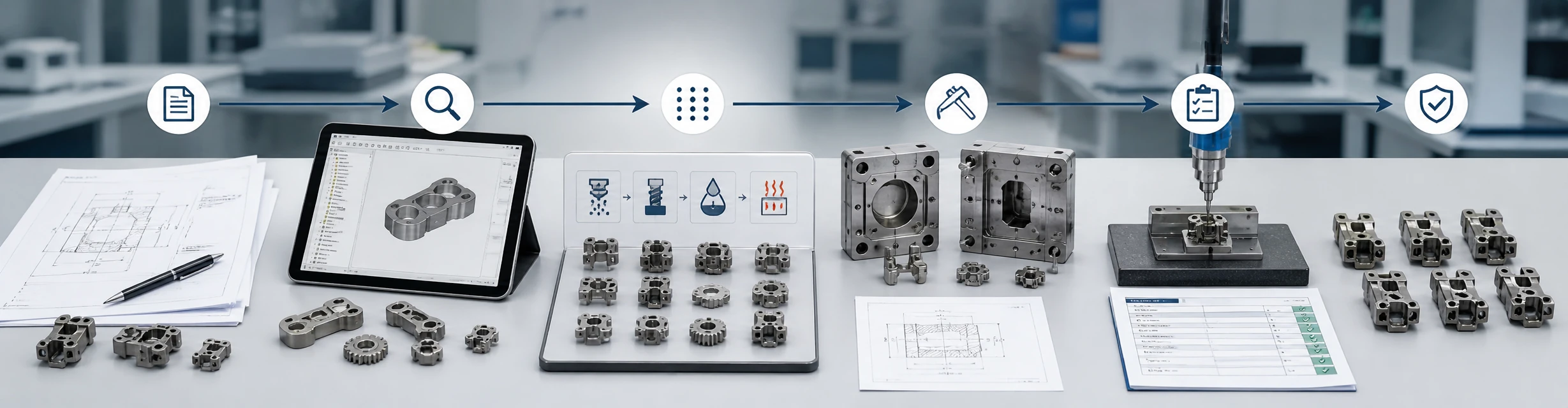
A MIM supplier evaluation checklist helps buyers decide whether a metal injection molding supplier can control the engineering, tooling, material, shrinkage, inspection, and production risks behind a real project before RFQ, tooling, sampling, or mass production. The key question is not whether a supplier can quote a small metal part, provide a low price, or show a certificate. The key question is whether the supplier can review drawings, identify MIM-specific risks, explain shrinkage compensation, separate as-sintered and post-machined tolerance expectations, support material documentation, and manage first article inspection before parts move into production.
When Should You Use a MIM Supplier Evaluation Checklist?
A MIM supplier evaluation checklist should be used before the buyer treats a quotation as technically reliable. In practice, many sourcing problems begin when buyers compare unit prices before confirming whether each supplier has evaluated the same material, tolerance, tooling, shrinkage, inspection, and production assumptions.
Before RFQ Submission
Before sending an RFQ, confirm whether the supplier can review the project beyond basic part size and annual volume. A professional MIM supplier should ask for drawings, 3D CAD files, material requirements, critical dimensions, surface finish needs, post-processing requirements, estimated annual volume, and application background.
- Did the supplier ask for 2D drawings and 3D CAD files?
- Did they ask which dimensions are functional, cosmetic, or critical-to-assembly?
- Did they ask whether dimensions are expected as-sintered or after machining?
- Did they ask about surface finish, heat treatment, passivation, coating, plating, or cleaning?
- Did they ask about annual volume, production ramp-up, and inspection expectations?
For RFQ preparation details, review the دليل إعداد طلب عرض السعر.
Before Tooling Investment
MIM tooling is not only a cavity shape. It must account for feedstock flow, parting line, gate location, ejection, as-molded compact handling, debinding, sintering shrinkage, and tooling compensation. Before tooling investment, the supplier should explain what must be confirmed before mold design begins.
A common mistake is treating MIM tooling like ordinary plastic injection molding tooling. MIM uses metal powder and binder feedstock, injection molding, debinding, and sintering. Mold review must therefore be tied to the full MIM route rather than the molding stage alone. For deeper tooling discussion, see تصميم قالب MIM.
Before Prototype or First Article Review
First samples are not only “sample parts.” They are evidence of whether tooling compensation, sintering support, inspection method, and process assumptions are working together. Before prototype or first article review, buyers should ask what inspection report will be provided, which dimensions will be measured, how datum surfaces will be used, and how out-of-tolerance features will be corrected.
When dimensional risk is the main concern, use the قائمة مراجعة تفاوتات MIM والانكماش.
Before Moving to Mass Production
A supplier who can make a few acceptable samples may still struggle with stable production. Before moving to mass production, buyers should confirm batch traceability, inspection frequency, material documentation, change control, packaging requirements, and nonconforming part handling. For MIM projects, production readiness should include both dimensional stability and process repeatability across molding, debinding, sintering, secondary operations, and final inspection.
Quick MIM Supplier Evaluation Scorecard
A practical supplier scorecard helps buyers compare suppliers on engineering capability, not only unit price. Use the scorecard during RFQ review, supplier shortlisting, project kick-off, or supplier transfer. Low scores in shrinkage control, DFM feedback, inspection planning, or traceability should be clarified before tooling.

| Evaluation Area | ما يجب التحقق منه | علامة تحذير | Score |
|---|---|---|---|
| Engineering review capability | Can the supplier review drawings, critical dimensions, functional surfaces, and DFM risks before quoting? | Supplier quotes without technical questions. | 1–5 |
| MIM process capability | Can the supplier explain feedstock behavior, injection molding, debinding, sintering, secondary operations, and inspection? | Supplier treats MIM like CNC machining or ordinary plastic injection molding. | 1–5 |
| Material and feedstock experience | Has the supplier processed the required material family before, and can they explain material-related process risks? | Supplier gives generic material answers without process implications. | 1–5 |
| Tooling and shrinkage control | Can the supplier explain mold scaling, shrinkage compensation, sample review, and first article correction? | Supplier says all dimensions are easy without reviewing geometry or datum requirements. | 1–5 |
| Tolerance and inspection capability | Can the supplier separate as-sintered and post-machined tolerances and provide suitable inspection reports? | Supplier cannot explain measurement method, datum strategy, or report format. | 1–5 |
| Quality system and traceability | Can the supplier provide quality records, material documentation, lot traceability, and corrective action support? | Certification is mentioned, but project-level documents and controls are unclear. | 1–5 |
| Communication and RFQ clarity | Does the supplier identify missing information and explain quotation assumptions? | Price-only response with no risk notes. | 1–5 |
| Production scalability | Can the supplier explain how samples move into stable production and how batch control will be maintained? | No clear plan for production ramp-up, sampling, inspection, or batch traceability. | 1–5 |
A supplier does not need to score perfectly in every category, but weak answers in shrinkage control, quality documentation, inspection, or engineering review should be treated seriously. These areas directly affect tooling cost, sample correction time, final part acceptance, and production risk.
If the main concern is part geometry or manufacturability, use the قائمة مراجعة تصميم MIM DFM.
What Evidence Should You Ask a MIM Supplier to Provide?
A supplier evaluation checklist is more useful when it connects questions to evidence. Buyers do not need confidential customer data or unrealistic guarantees, but they should ask for enough project-level information to understand whether the supplier has reviewed the part correctly.
| Evaluation Area | Evidence to Request | Good Signal | علامة تحذيرية |
|---|---|---|---|
| مراجعة DFM | Brief DFM notes on wall thickness, holes, undercuts, gate-sensitive surfaces, datum areas, and sintering support risk. | The supplier explains the main risks before tooling and separates design concerns from production assumptions. | The supplier only says “we can make it” without reviewing geometry, tolerances, or functional surfaces. |
| Material confirmation | Available MIM material family, possible grade options, heat treatment compatibility, and surface finishing limits. | The supplier discusses how material choice affects shrinkage, properties, corrosion resistance, or post-processing. | The supplier promises any material without confirming whether it is suitable for MIM processing and sintering. |
| Tooling and shrinkage | Explanation of tooling compensation, shrinkage review, first sample correction route, and critical dimension strategy. | The supplier separates mold design assumptions, sintering behavior, and first article correction logic. | The supplier does not discuss shrinkage or says all dimensions will be controlled without review. |
| Inspection and FAI | Expected first article inspection scope, datum strategy, measurement method, and report format. | The supplier can explain how critical dimensions will be measured and reviewed after first samples. | The supplier cannot explain how the parts will be inspected or which dimensions are critical. |
| Traceability and NCR/CAPA | General traceability flow, material documentation approach, nonconforming part control, and corrective action process. | The supplier can describe how material, production, inspection, and quality records are connected at project level. | The supplier mentions certificates but cannot explain project-level traceability or corrective action handling. |
| Production ramp-up | Sample approval path, correction loop, production readiness review, packaging requirements, and change control process. | The supplier explains how the project moves from RFQ to tooling, samples, approval, and stable production. | The supplier pushes immediate mass production without clarifying sample approval and production control steps. |
Can the Supplier Review MIM Design Risks Before Quoting?
A qualified MIM supplier should be able to identify design risks before quoting or tooling. This does not mean the supplier should redesign the customer’s product without context. It means the supplier should know which geometry, tolerance, material, and functional requirements require engineering review before committing to cost and lead time.

الأبعاد الحرجة والأسطح الوظيفية
The supplier should ask which dimensions control assembly, sealing, rotation, alignment, wear, press fit, magnetic performance, or other functions. MIM parts often include small features, complex profiles, internal shapes, thin walls, and multiple datum surfaces. Not every dimension should receive the same manufacturing attention.
- الأبعاد الحرجة للوظيفة
- Cosmetic or non-critical dimensions
- As-sintered dimensions
- Dimensions requiring machining or grinding
- Surfaces affected by gate marks, parting lines, or support contact
- Datum surfaces for inspection and assembly control
لمزيد من التخطيط المتقدم للتفاوتات، راجع تفاوتات MIM.
Wall Thickness and Thick-to-Thin Transitions
Wall thickness affects feedstock flow, as-molded compact strength, debinding behavior, sintering distortion, and final dimensional stability. From a supplier evaluation perspective, the question is not whether the supplier can repeat a wall thickness rule. The question is whether they can identify sudden thick-to-thin transitions, isolated heavy sections, thin unsupported areas, and features that may distort during sintering.
For detailed wall thickness guidance, see the MIM Wall Thickness Guide.
Holes, Slots, Undercuts and Ejection Risk
Holes, slots, undercuts, grooves, side features, and small windows may be strong reasons to choose MIM, but they still affect tooling complexity, core pins, ejection, green part handling, and sintering support. A supplier should explain whether the geometry requires slides, lifters, fragile core pins, special ejection strategy, support, secondary machining, or design adjustment before tooling.
For feature-specific review, see Holes, Slots and Undercuts in MIM.
Gate Position, Flow Path and Visible Surface Risk
Gate position affects feedstock filling, weld lines, trapped air, gate vestige, visible surface risk, and local density variation. The supplier should be able to explain where gate marks may appear and whether they affect functional or cosmetic surfaces. A red flag is a supplier who says gate location is not important before reviewing visible surfaces, flow length, thin features, and tolerance zones.
For a deeper explanation, see تصميم بوابة MIM.
DFM Feedback Before Tooling
A useful MIM supplier should provide DFM feedback before mold manufacturing begins. The feedback does not need to be long, but it should identify the most important geometry, tolerance, tooling, material, and quality risks. For broader design rules, review DFM لتقنية MIM.
Does the Supplier Control the Full MIM Process Chain?
A MIM supplier should be evaluated across the full process chain, not only by molding capability. In MIM, the final part is produced through feedstock preparation or selection, injection molding, debinding, sintering, possible secondary operations, and final inspection. A weakness in one stage can appear later as cracks, distortion, density variation, poor surface quality, or dimensional failure.
Feedstock and Material Preparation
Feedstock affects flow behavior, mold filling, as-molded compact strength, debinding stability, shrinkage behavior, and final properties. Buyers should ask whether the supplier has experience with the required material family and whether feedstock handling is controlled enough for repeatable production.
For further reading, see كيف تؤثر مادة التغذية على جودة الأجزاء في MIM.
Injection Molding Process Stability
MIM injection molding must fill complex cavities while avoiding short shots, flow marks, trapped air, weld lines, binder separation, gate defects, and compact damage. A supplier who only says “we can mold it” without discussing handling, debinding, and sintering may not be evaluating the whole process.
Related article: كيف يؤثر الحقن على جودة الأجزاء في MIM.
Debinding and Sintering Risk Control
Debinding removes binder before sintering. If debinding is not controlled, defects may appear as cracks, blistering, deformation, contamination, or internal weakness. Sintering creates the final dense metal part, but it also introduces shrinkage and distortion risk. This is why supplier evaluation must include shrinkage control, support strategy, furnace process stability, and dimensional verification.
For process risk details, see كيف تؤثر إزالة المادة الرابطة والتلبيد على جودة الأجزاء في MIM و دعامات التلبيد في MIM.
العمليات الثانوية والفحص النهائي
Some MIM projects require machining, tapping, grinding, polishing, heat treatment, passivation, coating, plating, cleaning, or assembly. Buyers should confirm whether the supplier can clearly separate what is achievable as-sintered and what requires secondary operation. Final inspection should match the functional risk of the part, not only the shape shown in the 3D model.
For broader quality factors, see ما الذي يؤثر على جودة الأجزاء في تقنية MIM؟.
Can the Supplier Manage Shrinkage, Tolerances and First Article Correction?
Shrinkage and dimensional control are central to MIM supplier evaluation. A supplier who cannot explain how shrinkage is handled before tooling may create cost, schedule, and acceptance problems after first samples are produced.
As-Sintered vs. Post-Machined Tolerances
A good supplier should separate dimensions expected as-sintered from dimensions requiring machining or other secondary operations. This matters because not all tolerance requirements should be solved inside the MIM process itself. Some functional holes, datum surfaces, sealing surfaces, and assembly interfaces may need machining, grinding, or dedicated measurement planning.
تعويض الانكماش قبل التصنيع
MIM tooling is built with shrinkage compensation. The supplier should explain how they review part geometry, material, expected shrinkage, sintering behavior, and critical dimensions before mold design. The buyer does not need to calculate the shrinkage factor; the buyer does need to confirm that the supplier has a controlled method for translating final part requirements into tooling and process assumptions. For deeper technical discussion, see تعويض انكماش MIM.
First Article Inspection and Correction Loop
First article inspection is not only a pass/fail activity. For MIM projects, it is often part of the correction loop between tooling, sintering, inspection, and customer approval. A supplier should be able to explain how first samples will be inspected, how out-of-tolerance features will be analyzed, and whether correction requires tooling modification, process adjustment, support change, inspection clarification, or machining.
Composite Field Scenario for Engineering Training: First Samples Failed Critical Hole Position
ما المشكلة التي حدثت: A buyer approved tooling after receiving a competitive quotation. First samples were produced, but several critical hole positions did not meet assembly requirements.
لماذا حدث ذلك: The supplier quoted the part without asking which holes were functional and which dimensions were reference dimensions. The holes were treated as normal as-sintered features even though the assembly required tighter positional control.
ما هو السبب الحقيقي للنظام: The issue was not only shrinkage. The real system cause was missing critical dimension review before tooling. Gate position, sintering support, datum planning, inspection method, and possible secondary machining were not discussed before mold design.
كيف تم تصحيحه: The project team separated critical and non-critical dimensions, revised the inspection plan, reviewed support strategy, and evaluated whether tooling adjustment or secondary machining was required for the functional holes.
كيفية منع التكرار: Before tooling, the buyer should mark critical dimensions on the drawing, confirm datum requirements, request a supplier DFM review, and ask how shrinkage and inspection will be managed. Related article: كيف تؤثر أبعاد الجزء على جودة الجزء النهائي في MIM.
Does the Supplier Have Relevant Material and Feedstock Experience?
Material experience matters because MIM material selection affects sintering behavior, shrinkage stability, mechanical properties, corrosion resistance, magnetic response, heat treatment, surface finishing, and inspection requirements. The buyer should ask whether the supplier has relevant experience with the material family and application requirements, not only whether the supplier can name a material grade.
Material Family Experience
The supplier should be able to discuss experience with the target material family, such as stainless steel, low alloy steel, soft magnetic alloy, tungsten alloy, or other MIM-suitable metals. The supplier does not need to disclose confidential customer projects, but they should be able to explain process considerations for the material family.
Sintered Density and Mechanical Properties
For functional parts, material evaluation should include expected density, mechanical property requirements, heat treatment needs, and application environment. Final properties depend on material, sintering, post-treatment, and inspection requirements, so buyers should avoid accepting generic material statements without project-specific confirmation.
Heat Treatment and Surface Finishing Compatibility
Some MIM parts require heat treatment, passivation, coating, polishing, grinding, plating, or cleaning. These operations can affect dimensions, surface condition, corrosion resistance, magnetic properties, and cost. The supplier should clarify whether these requirements are included in the quotation and whether they change inspection requirements.
For material-specific project review, use the قائمة اختيار مواد MIM. For more background, read كيف يؤثر اختيار المواد على جودة أجزاء MIM.
How Should Buyers Check Quality Systems, Inspection and Traceability?
A quality certificate can support supplier evaluation, but it should not replace project-level review. For MIM buyers, the practical question is whether the supplier can translate quality systems into project-specific inspection, traceability, nonconforming part control, and corrective action.
ISO 9001, ISO 13485 or IATF 16949 Requirements
The buyer should ask whether the supplier’s quality system matches the project’s industry requirements. A general industrial component may require a different documentation level from a medical, automotive, aerospace-related, or safety-related application. Certification can support supplier qualification, but it does not prove that a supplier has reviewed a specific MIM part’s shrinkage, tolerance, material, and inspection risks.
First Article Inspection
FAI should confirm whether the first samples meet the agreed drawing, tolerance, material, and functional requirements. For MIM projects, FAI should also help determine whether shrinkage compensation, tooling design, sintering support, and inspection method are working as expected.
Lot Traceability and Material Documentation
Traceability allows the buyer and supplier to connect delivered parts to material lots, production batches, inspection records, and process history. The needed traceability level depends on project risk, industry requirements, and customer specification. Buyers should define documentation expectations before sample approval, not after production shipments begin.
Nonconforming Part Control and Corrective Action
Buyers should ask how the supplier controls nonconforming parts, who decides disposition, whether rework is allowed, how rework is inspected, and how recurrence is prevented. For MIM, changes to feedstock, molding conditions, debinding, sintering, tooling, secondary operations, or inspection method can affect final quality.
Can the Supplier Communicate Clearly During RFQ and Project Review?
Supplier communication is part of risk control. A professional MIM supplier should not only respond quickly; they should ask the right questions, identify missing information, and explain technical assumptions behind the quotation.
Engineering Questions Before Quotation
- What material is required?
- Which dimensions are critical?
- Which surfaces are functional or cosmetic?
- Is machining allowed for critical features?
- Are special inspection documents required?
Transparent Quotation Assumptions
- Tooling cost and mold assumptions
- Sample cost and approval scope
- Unit price assumptions
- العمليات الثانوية
- Inspection and documentation scope
A price-only quotation makes it difficult to compare suppliers fairly because different suppliers may be assuming different technical scopes. When the project is ready for engineering review, you can تقديم الرسومات للمراجعة.
How Should Buyers Compare Two MIM Supplier Quotes?
Two MIM quotations can look similar while covering very different technical scopes. Before choosing a supplier, buyers should compare what is included in the engineering review, tooling plan, material assumption, inspection scope, and correction process. A lower unit price may become more expensive if the quotation excludes secondary operations, sample correction, documentation, or realistic tolerance control.
| Quote Item | What to Compare | لماذا هو مهم |
|---|---|---|
| DFM review scope | Whether the supplier reviewed geometry, wall thickness, gate-sensitive areas, critical dimensions, and sintering support risk. | A quotation without DFM review may hide tooling changes or sample correction cost. |
| Material assumption | Exact material family, grade option, heat treatment, surface treatment, and whether alternatives are being assumed. | Material choice affects shrinkage, density, mechanical properties, corrosion resistance, finishing, and price. |
| Tooling and shrinkage plan | Tooling compensation, sample iteration expectation, and how first article deviations will be corrected. | MIM tooling decisions affect final dimensional control and correction lead time. |
| Tolerance and secondary operations | Which dimensions are quoted as-sintered and which require machining, grinding, or other secondary processing. | A quote that ignores secondary operations may appear cheaper but fail functional requirements. |
| Inspection and documents | FAI report, measurement method, material documentation, traceability level, and quality record expectations. | Sample approval and production acceptance depend on agreed inspection evidence. |
| Production readiness | How the supplier moves from sample approval to production batches, packaging, change control, and nonconforming part handling. | Stable sample production does not automatically prove stable mass production. |
What Red Flags Show That a MIM Supplier May Not Be Suitable?
Red flags do not always mean the supplier is incapable, but they do mean the buyer should pause and ask for clarification before tooling, sampling, or production. In MIM projects, the most serious risk is often not a high price; it is an unclear technical responsibility before tooling begins.

| علامة تحذيرية | لماذا هو مهم | What the Buyer Should Ask |
|---|---|---|
| Supplier quotes without drawings or CAD | Price may be based on assumptions instead of geometry, tolerance, and material review. | What assumptions were used for material, tolerance, tooling, and inspection? |
| No discussion of shrinkage | MIM dimensions depend on shrinkage compensation, sintering support, and process control. | How will shrinkage be reviewed before tooling? |
| Supplier promises all tight tolerances | Not all tolerances are suitable as-sintered, especially on functional holes, datum areas, or sealing surfaces. | Which dimensions require machining or special inspection? |
| No DFM feedback | Design risks may be discovered after mold build, when correction is slower and more expensive. | Can you provide a brief DFM review before tooling? |
| No FAI or inspection plan | Sample approval becomes unclear if measurement method, datum, and report format are not defined. | What inspection report will be provided with first samples? |
| No material documentation | Quality and traceability risk increases, especially for regulated or performance-sensitive parts. | What material certificate or conformity document can be supplied? |
| Treating MIM like CNC, PM or plastic injection molding | Process-specific risks may be missed, including feedstock behavior, debinding, sintering shrinkage, and tooling compensation. | How will feedstock, debinding, sintering, shrinkage, and inspection be controlled? |
When supplier review reveals avoidable design risks, the أخطاء تصميم MIM الشائعة guide can help identify issues that should be clarified before tooling.
What Information Should You Send Before Evaluating a MIM Supplier?
The quality of supplier evaluation depends on the quality of information sent by the buyer. A complete RFQ package helps the supplier identify risks early and quote the project with fewer hidden assumptions.
| مدخلات طلب عرض الأسعار (RFQ) | Why It Matters for Supplier Evaluation |
|---|---|
| الرسم ثنائي الأبعاد | Defines tolerances, datum, material notes, surface finish, and inspection expectations. |
| ملف CAD ثلاثي الأبعاد | Supports tooling, geometry, flow path, ejection, and feature review. |
| متطلبات المواد | Affects feedstock, sintering, mechanical properties, cost, and post-processing. |
| الأبعاد الحرجة | Helps identify tolerance, datum, tooling compensation, and inspection priorities. |
| الأسطح الوظيفية | Helps avoid gate marks, parting lines, support marks, distortion, or finishing issues on important areas. |
| متطلبات تشطيب السطح | Affects secondary operations, visual acceptance, cleaning, corrosion resistance, and cost. |
| الكمية السنوية | Affects MIM suitability, tooling economics, production planning, and sampling strategy. |
| خلفية التطبيق | Helps the supplier understand load, wear, corrosion, temperature, magnetic function, or regulatory context. |
| متطلبات الفحص | Determines report format, measurement method, sampling level, and approval process. |
MIM Supplier Evaluation Checklist by Buyer Role
For Product Engineers
Focus on whether the supplier can identify design, geometry, material, tolerance, and functional risks. The supplier should provide practical DFM feedback and explain where design changes, secondary operations, or tolerance clarification may be needed.
Related guide: تصميم أجزاء MIM.
For Purchasing Teams
Compare quotations only after technical assumptions are clear. A lower unit price may not be better if it excludes secondary operations, inspection, documentation, packaging requirements, or realistic tooling correction.
For Quality Engineers and SQE
Focus on documentation, traceability, inspection, nonconforming part control, and corrective action. For regulated or safety-related applications, quality expectations should be defined before samples are ordered.
For Project Managers
Evaluate whether the supplier can support the full development path from RFQ to tooling, samples, correction, approval, production ramp-up, and change control.
Need a MIM Supplier Evaluation Before RFQ or Tooling?
If you are evaluating a MIM supplier for a new or transferred project, send your 2D drawings, 3D CAD files, material requirements, critical tolerances, surface finish notes, estimated annual volume, and application background to XTMIM for engineering review.
XTMIM can help review whether the part is suitable for MIM, which design features may require DFM attention, whether the material and tolerance expectations are realistic, where shrinkage or sintering distortion risks may appear, and what should be clarified before tooling, first article inspection, or production approval.
- الرسومات ثنائية الأبعاد وملفات CAD ثلاثية الأبعاد
- Material requirements or target material family
- Critical tolerances, datum notes, and functional surfaces
- Surface finish, heat treatment, coating, or cleaning requirements
- الكمية السنوية المقدرة وخلفية التطبيق
- Current supplier problem, sample failure, or production transfer concern if available
ملاحظة المعايير والمراجع الفنية
Supplier evaluation for MIM projects should combine project-specific engineering review with relevant industry references. Standards and associations can support material, process, and quality discussions, but they should not replace supplier-specific DFM, tooling, shrinkage, material, and inspection review. Project requirements should be confirmed against the buyer’s drawings, material specifications, customer requirements, and formal standard documents.
- MIMA Process Overview for Metal Injection Molding: useful for understanding the MIM process route and why supplier evaluation must consider injection molding, debinding, sintering, shrinkage, and dimensional control together.
- نطاق مواد MIMA: useful for understanding why MIM material availability and substitute options should be confirmed with the actual supplier.
- MPIF Standard 35 reference information: useful for material and property context in powder metallurgy and MIM-related specifications.
- ASTM B883: relevant for ferrous metal injection molded material specification context where applicable to the project.
- نظرة عامة على القولبة بالحقن المعدني من EPMA: useful for distinguishing MIM from other powder metallurgy routes and understanding when MIM is appropriate for complex high-volume metal components.
FAQ About MIM Supplier Evaluation
ما هي قائمة التحقق لتقييم مورد MIM؟
قائمة تقييم مورد MIM هي أداة منظمة تُستخدم لمراجعة ما إذا كان مورد القولبة بالحقن المعدني يمتلك القدرات الهندسية والعملية وأدوات التصنيع والجودة والفحص والتواصل المطلوبة لمشروع معين. تساعد هذه القائمة المشترين على تجنب اختيار مورد بناءً على السعر فقط. يجب أن تغطي القائمة المفيدة مراجعة DFM، والخبرة في المواد، والتحكم في انكماش التلبيد، واستراتيجية التفاوتات، وفحص القطعة الأولى، وإمكانية التتبع، والتوثيق، والجاهزية للإنتاج.
متى يجب عليّ تقييم مورد MIM؟
يجب تقييم مورد MIM قبل تقديم طلب عرض السعر، الاستثمار في القوالب، الموافقة على العينة الأولى، نقل الإنتاج، أو تغيير المورد. كلما تم التقييم مبكرًا، كان من الأسهل تحديد الرسومات المفقودة، التفاوتات غير الواضحة، مخاطر المواد، متطلبات التشطيب السطحي، احتياجات الفحص، والافتراضات التكلفية. يكون تقييم المورد مهمًا بشكل خاص عندما يحتوي الجزء على أبعاد وظيفية ضيقة، هندسة معقدة، متطلبات مواد خاصة، أو توقعات جودة منظمة.
هل شهادة ISO كافية لاختيار مورد MIM؟
لا، شهادة ISO يمكن أن تدعم تقييم المورد، لكنها لا تحل محل المراجعة الهندسية الخاصة بالمشروع. لا يزال المشترون بحاجة إلى التأكد مما إذا كان المورد قادرًا على مراجعة مخاطر تصميم MIM، وإدارة تعويض انكماش التلبيد، وتوفير فحص القطعة الأولى، والحفاظ على تتبع المواد، والتحكم في الأجزاء غير المطابقة، ودعم الوثائق المطلوبة. بالنسبة لمشاريع الأجهزة الطبية أو السيارات، قد تنطبق توقعات إضافية لنظام الجودة اعتمادًا على متطلبات العميل.
ما الأدلة التي يجب أن أطلبها من مورد MIM؟
اطلب أدلة على مستوى المشروع تدعم الافتراضات الفنية للمورد، مثل ملاحظات DFM، تأكيد المواد، مراجعة القالب وانكماش التلبيد، نطاق فحص القطعة الأولى، طريقة القياس، نهج التتبع، وعملية التحكم في الأجزاء غير المطابقة. لا يحتاج المورد إلى الكشف عن معلومات سرية للعملاء، ولكن يجب أن يكون قادرًا على شرح كيفية مراجعة قطعتك قبل القولبة، وأخذ العينات، والإنتاج.
هل يجب أن أختار أقل عرض سعر لتقنية MIM إذا أكد المورد أن التفاوتات المسموح بها قابلة للتحقيق؟
ليس دون التحقق من نطاق عرض السعر. قد يستبعد عرض سعر MIM المنخفض التشغيل الميكانيكي الثانوي، الفحص الخاص، تصحيح العينة، توثيق المواد، متطلبات التعبئة والتغليف، أو تعويض القالب الواقعي. قبل اختيار أقل سعر، قارن ما إذا كان كل مورد قد راجع الأبعاد الحرجة، التفاوتات المسموحة بعد التلبيد مقابل التفاوتات بعد التشغيل الميكانيكي، التحكم في انكماش التلبيد، متطلبات تقرير الفحص الأولي (FAI)، والجاهزية للإنتاج.
ما الأسئلة التي يجب أن أطرحها قبل إرسال طلب عرض أسعار MIM؟
قبل إرسال طلب عرض أسعار MIM، اسأل ما إذا كان المورد يحتاج إلى رسومات ثنائية الأبعاد، ملفات CAD ثلاثية الأبعاد، متطلبات المواد، الأبعاد الحرجة، توقعات تشطيب السطح، الحجم السنوي، متطلبات المعالجة اللاحقة، وخلفية التطبيق. يجب على المورد القادر أيضًا أن يسأل عن الأبعاد الوظيفية، وما إذا كان التصنيع الآلي مسموحًا به، وما هي مستندات الفحص المطلوبة، وما إذا كان المشروع لديه متطلبات جودة تنظيمية أو خاصة بالصناعة.
كيف يمكنني معرفة ما إذا كان المورّد يفهم انكماش التلبيد والتسامحات في تقنية MIM؟
يجب أن يكون المورد الذي يفهم انكماش التلبيد والتفاوتات في MIM قادرًا على شرح كيفية مراجعة تعويض القالب، والأبعاد التي يمكن التحكم بها كما هي بعد التلبيد، والميزات التي قد تتطلب التشغيل الآلي، وكيفية فحص الأبعاد الحرجة، وكيفية معالجة تصحيحات القطعة الأولى. من العلامات التحذيرية أن يعد المورد بجميع التفاوتات الضيقة دون مراجعة الهندسة، والمادة، وسلوك التلبيد، ومتطلبات المرجع، وطرق الفحص.
ما هي أكبر العلامات التحذيرية عند اختيار مصنع MIM؟
تشمل العلامات التحذيرية الكبرى تقديم عروض أسعار بدون رسومات، وتجاهل مناقشة انكماش التلبيد، وعدم تقديم ملاحظات DFM، والمبالغة في الوعد بتفاوتات ضيقة، والفشل في شرح تصحيح القطعة الأولى، وعدم وجود وثائق فحص، وعدم وضوح تتبع المواد، ومعاملة MIM مثل التصنيع باستخدام الحاسب الآلي أو تعدين المساحيق التقليدي أو القولبة بالحقن البلاستيكي. لا تعني هذه العلامات بالضرورة أن المورد غير قادر، ولكنها تستدعي مراجعة فنية أعمق قبل البدء في القولبة أو الإنتاج.
ما الذي يجب أن أرسله إلى XTMIM لتقييم المورد أو مراجعة طلب عرض الأسعار (RFQ)؟
أرسل الرسومات ثنائية الأبعاد، ملفات CAD ثلاثية الأبعاد، متطلبات المواد، التفاوتات الحرجة، الأسطح الوظيفية، متطلبات تشطيب السطح، الحجم السنوي المقدر، خلفية التطبيق، وأي مشاكل تصنيع حالية. تساعد هذه التفاصيل فريق الهندسة في مراجعة ملاءمة تقنية MIM، مخاطر DFM، مخاوف الانكماش والتفاوتات، جدوى المواد، متطلبات الفحص، وجدوى الإنتاج قبل اتخاذ قرارات القالب.