Cobalt-chromium alloys are reviewed for metal injection molding when a small, complex metal part needs a stronger balance of wear resistance, corrosion resistance, surface stability, and mechanical performance than common stainless steel can provide. In CoCr MIM or CoCrMo MIM projects, the material name alone is not enough for production approval. Engineers must confirm whether the powder/feedstock route, injection molding behavior, debinding, sintering shrinkage, contact surfaces, inspection method, and annual volume can support stable manufacturing. This page explains when cobalt chrome metal injection molding may be practical, when another material or process may be safer, and what to review before tooling.
The key question is not simply whether cobalt-chromium can be molded. The real question is whether the grade, powder/feedstock route, sintering behavior, surface requirement, critical dimensions, and application environment can be controlled consistently enough for production. If your part has sliding contact, body-contact review requirements, dental-related features, surgical instrument surfaces, or high-value CNC replacement potential, CoCr MIM should be reviewed before tooling rather than specified only by material name.
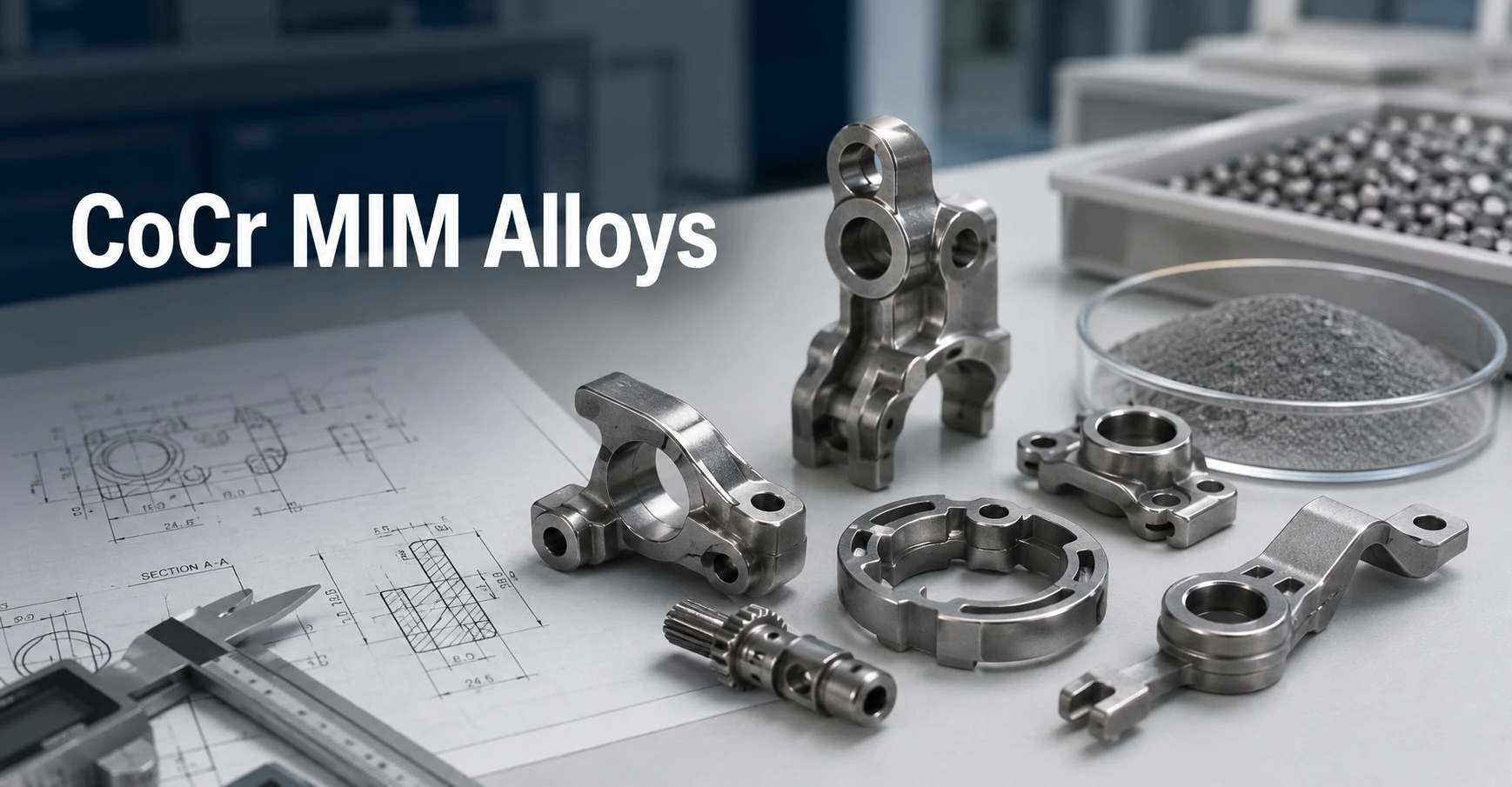
This page belongs under MIM special alloys. It focuses on cobalt-chromium alloy suitability for MIM parts, not general material selection, medical approval, or full design-rule development.
Quick Decision Table for CoCr MIM Parts
Use this table as an early screening tool before requesting a quotation. It does not replace drawing review, but it helps determine whether cobalt-chromium should remain in the material discussion or whether another MIM material may be more practical.
| If Your Part Requires | CoCr MIM May Fit When | Review Before RFQ |
|---|---|---|
| مقاومة التآكل | The part has sliding, repeated contact, or functional wear surfaces. | Mating material, contact pressure, hardness target, surface finish, and inspection method. |
| مقاومة التآكل | 316L stainless steel may not provide enough performance for the service environment. | Exposure medium, cleaning condition, passivation or polishing need, and customer specification. |
| Medical-related material review | The customer specification requires a CoCr or CoCrMo material direction. | Material reference, intended use boundary, validation route, traceability, and finished-part acceptance criteria. |
| هندسة معقدة وصغيرة الحجم | CNC machining creates excessive material waste, complex tool paths, or high repeat-production cost. | Wall thickness, holes, slots, undercuts, gate position, shrinkage, sintering support, and annual volume. |
When Cobalt-Chromium Alloys Make Sense for MIM Parts
Cobalt-chromium alloys are usually reviewed for MIM when three conditions appear together: the part is small and geometrically complex, the application requires a higher-performance alloy, and the project volume or functional value justifies tooling and process validation.
MIM is relevant when the part has fine features, internal profiles, holes, slots, small bosses, curved surfaces, or forms that would be expensive to machine from bar stock. The MIM route uses fine metal powder mixed with binder, injection molding, debinding, and sintering to form a dense metal component. For cobalt-chromium projects, shrinkage and densification behavior matter because the material is often selected for functional surfaces, not appearance alone.
Small Complex Parts Where Stainless Steel May Not Be Enough
316L stainless steel for MIM is often a more practical starting point for general corrosion resistance. 17-4 PH stainless steel for MIM may be more practical for high-strength stainless MIM parts. Cobalt-chromium enters the discussion when the part needs a more demanding combination of wear resistance, corrosion resistance, strength, and surface stability.
- Sliding or repeated-contact areas where surface wear affects service life.
- Small functional parts exposed to cleaning, fluids, or corrosive environments.
- Medical-device-related or dental-related hardware where material review is more demanding.
- Compact components where CNC machining creates high material waste or complex tool paths.
- Precision parts where mechanical strength and controlled surface condition are both important.
Applications That May Justify CoCr Review
Cobalt-chromium MIM should be discussed as a project-specific material option, not as a universal upgrade. The useful engineering question is whether the part function depends on material behavior that ordinary stainless steel cannot reliably provide.
| Part Direction | Why CoCr May Be Considered | ما يجب مراجعته |
|---|---|---|
| مكونات الأدوات الجراحية | Wear, corrosion resistance, repeated handling | Edge condition, polishing, passivation route, critical dimensions |
| Dental-related precision parts | Strength, corrosion resistance, surface control | Fit, surface finish, cleaning requirement, customer standard |
| Wear contact components | Sliding or repeated contact | Mating material, contact pressure, hardness target, wear surface |
| Compact precision hardware | Strength and corrosion in small geometry | Shrinkage, flatness, datum strategy, secondary machining |
| High-value CNC replacement parts | Complex geometry and repeat production | Tooling economics, volume, tolerance strategy, post-processing |
| Medical-device-related hardware | Material review and controlled surface condition | Customer specification, inspection plan, regulatory boundary |
When CoCr May Be Over-Specified or Risky
A common mistake is to specify cobalt-chromium because it sounds more advanced than stainless steel or titanium. That can make the project more expensive, slower to validate, and harder to quote without improving the finished part. In a MIM project, material choice should follow the part function, surface requirement, geometry, production volume, and inspection method.

When Another Material or Process May Be More Practical
| المتطلب | Often More Practical First Review | السبب |
|---|---|---|
| مقاومة عامة للتآكل | الفولاذ المقاوم للصدأ 316L | More common material route, often easier to source and validate |
| High-strength stainless structure | فولاذ مقاوم للصدأ 17-4 PH | Common high-strength MIM option after heat treatment review |
| Lightweight corrosion-resistant part | سبائك التيتانيوم لتقنية MIM | Better fit when weight reduction is central |
| Extreme abrasive wear or cutting edge | Cemented carbides for MIM | Higher hardness-focused material family |
| High-temperature oxidation or chemical exposure | Nickel alloys for MIM | Stronger fit for high-temperature or severe corrosion environments |
| Unclear prototype-only requirement | CNC machining or metal 3D printing | Avoids special alloy tooling cost before design validation |
CoCr MIM becomes risky when the drawing does not clearly define the function of the part. If the application environment, mating surface, inspection standard, surface finish, and critical dimensions are unclear, the supplier can only guess which characteristics matter.
Low-volume projects also require caution. MIM tooling, feedstock preparation, sintering validation, and first article correction cycles can be difficult to justify if the part is still in early concept testing. For early prototypes, CNC machining, additive manufacturing, or soft tooling routes may be more practical until the geometry and performance requirements become stable.
للحصول على طريقة أوسع لاختيار المواد، استخدم دليل اختيار مواد MIM.
CoCr, CoCrMo and ASTM F75-Type Material Directions
CoCr is a broad material family. In many engineering searches, users are actually thinking about CoCrMo, cobalt chrome, or ASTM F75-type material directions. These terms should be handled carefully because a standard reference does not automatically define the finished MIM part.
ASTM and ISO references can support material discussion, but they should not be treated as automatic finished-part approval. Finished MIM part acceptance must be defined by the customer drawing, material specification, inspection method, surface condition, intended use, and project validation plan.
| Term or Reference | ما يعنيه عادةً | How It Affects MIM Review | What Must Be Confirmed |
|---|---|---|---|
| CoCr | A broad cobalt-chromium alloy family, not one single grade. | Useful as an early material direction for wear, corrosion, and surface-contact discussion. | Exact chemistry, powder/feedstock route, part function, and customer specification. |
| CoCrMo | A cobalt-chromium-molybdenum direction often discussed for medical-related or wear-resistant parts. | May require closer review of sintering atmosphere, carbon/nitrogen control, density, hardness, and surface condition. | Target grade, acceptance criteria, surface finish, testing method, and intended use boundary. |
| ASTM F75-Type | A common reference direction associated with cobalt-28 chromium-6 molybdenum alloy castings and casting alloy for surgical implant manufacture. | Can guide material discussion but should not be used as a blanket claim for finished MIM part approval. | Whether the customer requires this reference, how the finished part will be tested, and who owns regulatory validation. |
| ISO 5832-4 | An international reference for cobalt-chromium-molybdenum casting alloy used in surgical implant manufacture. | Useful for understanding material context, but finished-product sample properties may differ from values in the document. | Customer drawing, final part acceptance, mechanical testing, traceability, and regulatory boundary. |
ASTM F75-23 covers cobalt-28 chromium-6 molybdenum alloy castings and casting alloy for surgical implants, but its own scope is not a blanket approval for completed finished parts. ISO 5832-4:2024 specifies characteristics and test methods for cobalt-chromium-molybdenum casting alloy used in surgical implant manufacture and notes that mechanical properties from a finished product sample can differ from those given in the document.
- CoCrMo and ASTM F75-type requirements can guide material discussion.
- Finished MIM part acceptance must be defined by the customer drawing and specification.
- Medical-related or body-contact applications require project-specific review.
- A material name alone should not be treated as proof of finished-part compliance.
This section remains a material direction overview. If future search data shows strong demand for “CoCrMo ASTM F75 MIM,” that topic can become a separate L4 page.
Cobalt-Chromium MIM Part Types and Engineering Fit
The best CoCr MIM projects are usually not simple blocks or large parts. They are small components where material performance and shape complexity both matter. From a design review perspective, a strong candidate usually has functional surfaces, compact geometry, repeat production demand, and enough value to justify tooling and process development.

| نوع الجزء | Why CoCr May Fit | محور مراجعة MIM | الخطر المحتمل |
|---|---|---|---|
| Small surgical instrument components | Wear and corrosion resistance with detailed geometry | Edge definition, polishing, surface finish | Overclaiming medical compliance without specification |
| Dental-related components | Strength, corrosion resistance, controlled surfaces | Fit, burr control, finishing route | Surface requirement may exceed as-sintered capability |
| Wear contact parts | Repeated sliding or contact | Mating material, wear area, hardness target | Wrong material if abrasive wear is extreme |
| Corrosion-resistant precision hardware | Exposure to fluids, cleaning, or harsh service | Material confirmation, passivation, surface finish | 316L may be enough if wear is not severe |
| Compact precision brackets | Strength and geometry in a small package | Flatness, datum, shrinkage compensation | Distortion if wall sections are unbalanced |
| CNC replacement parts | Complex geometry and repeat volume | Tooling cost, annual volume, secondary operations | MIM may not be economical for low-volume projects |
If only one condition exists—special alloy, complex geometry, or repeat volume—the project needs more careful comparison before tooling. A cobalt-chromium material name cannot compensate for an unstable design, unclear contact surface, or unrealistic tolerance requirement.
How CoCr MIM Differs from Stainless Steel, Titanium, Nickel Alloys and Cemented Carbides
Material comparison is often where project decisions become clearer. CoCr should not be positioned as “better” than other MIM materials in general. It should be positioned as a specialized option for a specific balance of properties. For a broader comparison path, review مقارنات مواد MIM و خصائص مواد MIM.
| عائلة المواد | أفضل عندما | CoCr May Be Better When | Risk If Misused |
|---|---|---|---|
| الفولاذ المقاوم للصدأ 316L | General corrosion resistance and cost-sensitive projects | Wear, strength, and surface contact are more demanding | Using CoCr when 316L would meet the requirement |
| فولاذ مقاوم للصدأ 17-4 PH | High-strength stainless MIM parts | Wear and corrosion balance is more important than strength alone | Choosing 17-4 PH without checking corrosion or contact wear |
| سبائك التيتانيوم | Lightweight and corrosion resistance are central | Wear resistance, stiffness, or contact behavior matters more | Treating titanium or CoCr as automatically medical approved |
| سبائك النيكل | High-temperature or severe corrosion service | Small precision parts need wear + corrosion + strength balance | Misplacing high-temperature intent onto CoCr |
| Cemented carbides | Extreme hardness and abrasion resistance dominate | Tougher structural behavior and corrosion resistance matter more | Choosing CoCr for applications that need carbide-level hardness |
A useful material review does not ask, “Which material is strongest?” It asks which material best matches the part function, geometry, surface requirement, inspection method, production volume, and cost target.
Manufacturing Risks in Cobalt-Chromium MIM
CoCr MIM requires more engineering review than common stainless steel MIM because the material is often selected for functional surfaces and demanding environments. The manufacturing risk is not only whether the part can be molded. It is whether the complete route can deliver stable material behavior, dimensions, and surface condition.

The official MPIF PIM tutorial covers materials and binders, injection molding, debinding, sintering, part design, cost, and facilities. The نظرة عامة على عملية MIMA also identifies feedstock mixing, molding, first-stage binder removal, and second-stage binder removal and sintering as core MIM process steps.
Powder and Feedstock Availability
The first review point is whether a suitable cobalt-chromium powder and feedstock can be sourced or prepared consistently. Powder size distribution, morphology, oxygen level, and batch stability can affect molding behavior, debinding, sintering, density, and final surface condition.
For common stainless steels, the supply chain is usually easier to evaluate. For CoCr, the project should confirm material availability before finalizing tooling. This is especially important if the customer requires a specific grade, chemistry range, or standard reference.
التحكم في إزالة المادة الرابطة والتلبيد
Debinding removes binder from the molded green part before high-temperature sintering. If binder removal, part support, or sintering behavior is not controlled, defects may appear as cracks, distortion, poor density, or dimensional instability.
CoCr parts should not be treated as if they can automatically use the same route as common stainless steel. Sintering atmosphere, thermal profile, part loading, support strategy, and shrinkage behavior must be reviewed for the part geometry and material target. For deeper process context, see إزالة المادة الرابطة في MIM و تلبيد MIM.
Carbon, Oxygen and Nitrogen Control
Carbon, oxygen, and nitrogen control may influence microstructure, corrosion behavior, mechanical response, and acceptance risk. CoCrMo projects may also require closer review of sintering atmosphere, density, hardness, surface condition, and chemistry stability. This does not mean every web page should publish fixed values. Those limits should come from the material specification, customer requirement, supplier process capability, and validated inspection plan.
- Is the required chemistry defined by the customer or by a reference standard?
- Are any elements especially critical for the application?
- Will the supplier confirm chemistry by appropriate inspection?
- Is the requirement realistic for the selected MIM route?
Density, Surface Finish and Polishing
CoCr applications often involve surfaces that are functionally important. The part may require polishing, machining, passivation, cleaning, or additional inspection. If the drawing only says “cobalt chrome” but does not define surface finish or contact areas, the supplier cannot know which surfaces are functional.
As-sintered surfaces may be acceptable for some non-contact features. Contact areas, sealing surfaces, dental-related fit surfaces, or repeated-handling surfaces may need post-processing. This should be discussed before tooling because secondary operations can change cost, dimensions, and delivery planning.
Dimensional Stability and Secondary Operations
CoCr MIM still involves shrinkage during sintering. Critical dimensions, flatness, hole location, and thin features should be reviewed with the same discipline used for other MIM materials, but with additional attention to special alloy behavior and post-processing. For deeper design topics, review تعويض انكماش MIM و تفاوتات MIM.
DFM Review Points Before Tooling a CoCr MIM Part
Before tooling, CoCr MIM parts should go through material and DFM review together. Separating the material decision from the geometry decision is a common source of cost and quality problems. For general design guidance, use DFM لتقنية MIM, تصميم أجزاء MIM, سمك جدار MIM, ، و الثقوب، الفتحات، والنتوءات السفلية في MIM.
| عنصر المراجعة | Why It Matters for CoCr MIM | ما يجب تأكيده قبل القولبة |
|---|---|---|
| الأبعاد الحرجة | Shrinkage and distortion affect fit | Datum, tolerance, inspection method |
| Thin walls and small features | Filling, debinding, and sintering can be sensitive | Minimum wall, transitions, local mass |
| الثقوب والفتحات | Location and roundness may shift after sintering | Size, location, post-machining need |
| أسطح التلامس | Wear and surface finish drive function | Mating material, finish, polishing route |
| حواف حادة | Burrs, chipping, or polishing variation may occur | Radius, functional edge requirement |
| Flatness and long spans | Distortion can affect assembly | Support, wall balance, datum strategy |
| تشطيب السطح | Often part of functional acceptance | As-sintered, polished, machined, or coated |
| الكمية السنوية | Special alloy tooling economics must make sense | Prototype, pilot run, production plan |
Composite Field Scenario for Engineering Training: Undefined Contact Surface
- ما المشكلة التي حدثت
- A small CoCr part was reviewed for wear resistance, but the drawing did not define which surface was the functional contact surface.
- لماذا حدث ذلك
- The material was specified, but the surface finish, mating material, and contact area were not clearly marked.
- ما هو السبب الحقيقي للنظام
- The project treated material selection as a substitute for functional surface definition.
- كيف تم التصحيح
- The drawing was updated to identify the contact surface, surface finish target, critical dimensions, and inspection method before tooling.
- كيفية منع التكرار
- For CoCr MIM projects, mark functional surfaces, contact zones, critical dimensions, and surface requirements before quotation.
Inspection and Validation Questions for CoCr MIM Projects
Inspection for CoCr MIM should be based on the part function, not on a generic checklist. Some projects may need dimensional inspection and surface review only. Others may require chemistry confirmation, density review, hardness testing, surface finish inspection, or customer-defined validation.
Material and Chemistry Confirmation
If the project refers to CoCrMo, ASTM F75-type material, or a customer standard, the supplier should confirm which requirement controls the project. A standard name in an email is not enough. The drawing or technical specification should define the expected material direction and acceptance method.
Density, Mechanical and Surface Requirements
The user should clarify whether the project requires material chemistry confirmation, density or porosity review, hardness or mechanical testing, surface roughness inspection, visual acceptance criteria, burr and edge condition review, post-processing verification, critical dimension inspection, or customer-specific quality documentation. For supplier evaluation, see قدرة الفحص والاختبار و مراقبة الجودة.
Medical-Related or Body-Contact Review Boundaries
For medical-related, dental-related, or body-contact applications, material review must be more careful. A supplier page can explain manufacturing feasibility, but it should not imply that the finished part is automatically approved for medical use.
The customer’s specification, intended use, regulatory pathway, finishing process, cleaning requirement, and inspection plan determine the actual acceptance boundary. A material reference can support discussion; it does not replace project validation.
Composite Field Scenario for Engineering Training: Standard Name Without Finished-Part Criteria
- ما المشكلة التي حدثت
- A CoCrMo inquiry referenced an ASTM F75-type material direction but did not include finished-part acceptance criteria.
- لماذا حدث ذلك
- The buyer assumed that naming the material direction was enough for quotation and production planning.
- ما هو السبب الحقيقي للنظام
- The project had not separated material reference, manufacturing route, surface finish, dimensional acceptance, and final application requirements.
- كيف تم التصحيح
- The customer clarified the drawing revision, required material reference, inspection expectations, surface condition, and whether third-party or customer-specific validation was needed.
- كيفية منع التكرار
- When a CoCr MIM inquiry includes ASTM or ISO references, the RFQ package should also include the application environment, critical dimensions, surface finish, inspection requirements, and intended use boundary.
What to Provide for a CoCr MIM Material and Drawing Review
A CoCr MIM review should start before tooling. The goal is to identify material, geometry, surface, and inspection risks while changes are still practical.

| المعلومات المطلوب توفيرها | لماذا هو مهم |
|---|---|
| الرسم ثنائي الأبعاد | Defines dimensions, tolerances, datums, surface finish, and notes |
| ملف CAD ثلاثي الأبعاد | Helps review geometry, wall transitions, holes, undercuts, and tooling direction |
| Target material or reference grade | Allows feedstock and process feasibility review |
| بيئة التطبيق | Clarifies wear, corrosion, cleaning, temperature, or contact conditions |
| المادة المتلامسة | Helps evaluate contact wear and surface requirements |
| الأبعاد الحرجة | Identifies dimensions that may need tighter process control or secondary machining |
| متطلبات تشطيب السطح | Determines whether as-sintered, polished, machined, or treated surfaces are needed |
| الكمية السنوية | Helps judge tooling economics and production planning |
| مرحلة النموذج الأولي أو الإنتاج | Determines whether MIM tooling is appropriate now |
| Inspection or customer standard | Defines acceptance method before production assumptions are made |
Before RFQ: What to Confirm for CoCr MIM Parts
| Confirm Before Sending RFQ | Why It Improves Engineering Review |
|---|---|
| Material direction and any standard reference | Prevents confusion between general CoCr, CoCrMo, ASTM F75-type references, and finished-part acceptance. |
| Functional surfaces and contact zones | Helps determine polishing, machining, surface finish, burr control, and inspection requirements. |
| الأبعاد الحرجة وفئة التفاوت | Supports shrinkage review, tooling compensation, datum planning, and possible secondary machining decisions. |
| Application environment and mating material | Clarifies wear, corrosion, cleaning, temperature, contact pressure, and surface interaction risk. |
| Prototype, pilot run, and annual volume | Helps decide whether CoCr MIM tooling is economical now or whether another route should be used first. |
The most useful RFQ is not the shortest one. It is the one that gives enough engineering context for the supplier to identify risk before cost is locked into the tooling route.
Request a CoCr MIM Material and Drawing Review
If your project involves a small complex part requiring wear resistance, corrosion resistance, strength, controlled surface finish, dental-related review, surgical instrument use, or medical-device-related material evaluation, send XTMIM your drawings for an early engineering review.
Please provide 2D drawings, 3D CAD files, target material or standard, critical dimensions, tolerance requirements, surface finish needs, application background, mating materials, estimated annual volume, prototype or production stage, and inspection requirements. Our engineering team can review material suitability, MIM manufacturability, tooling risk, sintering and shrinkage concerns, secondary operation needs, inspection requirements, and RFQ feasibility before tooling, trial production, or production planning.
اتصل بـ XTMIM إرسال الرسم للمراجعة طلب عرض سعرFAQ About Cobalt-Chromium MIM Alloys
Can cobalt-chromium alloys be processed by MIM?
Yes, cobalt-chromium alloys can be reviewed for MIM processing, especially when the part is small, complex, and requires wear resistance, corrosion resistance, strength, or controlled surface performance. The real feasibility depends on powder and feedstock availability, injection molding behavior, debinding, sintering, shrinkage control, surface finish, and inspection requirements.
Is CoCr MIM the same as ASTM F75 finished implant manufacturing?
No. ASTM F75-type references may guide material discussion, but they should not be treated as automatic approval for finished MIM implants or finished medical components. Finished-part acceptance depends on the customer specification, manufacturing route, surface condition, inspection plan, and project validation. Medical-related applications require careful review before tooling.
Does ASTM F75 automatically mean the finished MIM part is approved for medical use?
No. ASTM F75 can be a useful material reference for cobalt-chromium-molybdenum alloy discussion, but it does not automatically approve a finished MIM part for medical use. Finished-part suitability depends on the customer drawing, intended use, manufacturing route, surface condition, testing method, traceability, and applicable regulatory or customer validation requirements.
When should I choose CoCr instead of 316L stainless steel?
CoCr may be worth reviewing when 316L stainless steel does not provide enough wear resistance, strength, surface stability, or application-specific performance. If the part only needs general corrosion resistance, 316L may be more practical and cost-effective. The decision should be based on function, surface requirements, geometry, production volume, and inspection needs.
Is cobalt-chromium better than titanium for MIM parts?
Not always. Titanium alloys are often considered when lightweight design and corrosion resistance are central. Cobalt-chromium is more often reviewed when wear resistance, strength, surface contact, and corrosion resistance need to be balanced. For medical-related applications, neither material should be selected by name alone; the application, standard, surface, and validation requirements must be reviewed.
What are the main risks in CoCr MIM parts?
The main risks include feedstock availability, sintering behavior, carbon / oxygen / nitrogen control, density, surface finish, polishing requirement, dimensional shrinkage, distortion, and inspection definition. These risks become more important when the part has contact surfaces, tight tolerances, body-contact review requirements, or customer-specific material standards.
What information is needed for a CoCr MIM quotation?
A useful quotation package should include a 2D drawing, 3D CAD file, material requirement, application environment, mating material, critical dimensions, surface finish requirement, annual volume, prototype or production stage, and inspection requirements. This allows the engineering team to review material suitability, DFM risk, tooling feasibility, and production planning.
ملاحظة المعايير والمراجع الفنية
Cobalt-chromium material references should be used carefully. ASTM F75-23 is relevant because it covers cobalt-28 chromium-6 molybdenum alloy castings and casting alloy for surgical implants, while the standard scope should not be interpreted as automatic finished-part approval. ISO 5832-4:2024 is relevant because it specifies characteristics and test methods for cobalt-chromium-molybdenum casting alloy used in surgical implant manufacture and notes that properties from finished-product samples can differ from values in the document.
For MIM process context, MPIF و MIMA resources are useful for understanding powder injection molding materials, binders, molding, debinding, sintering, design, cost, and process stages. Final material selection, finished-part acceptance, testing requirements, and medical-related suitability must be confirmed through the customer specification, formal standards, supplier-specific process review, and project validation plan.