
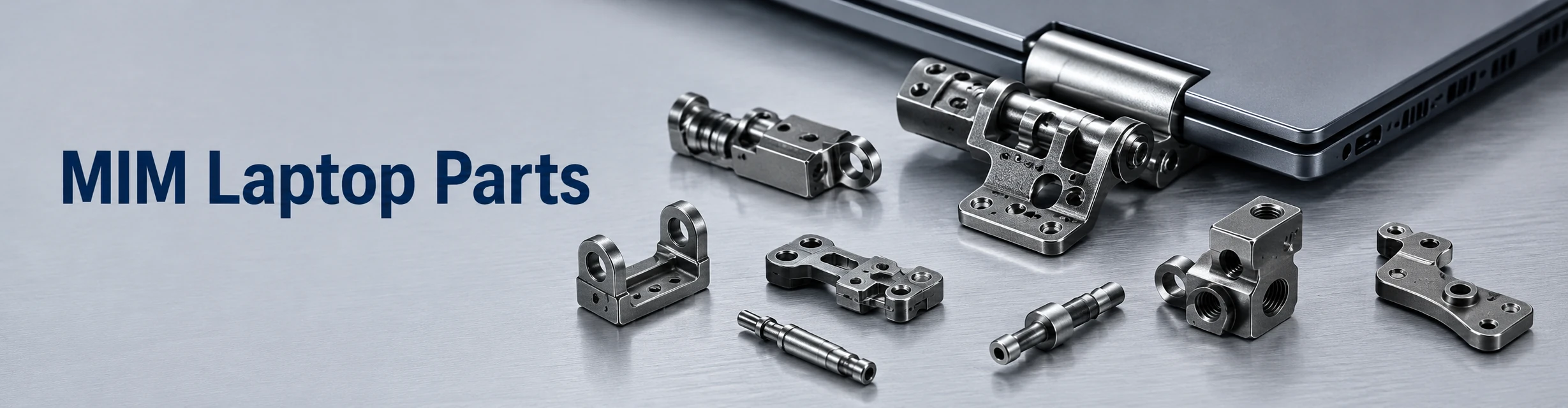
This page focuses on engineering MIM components for laptop assemblies, not consumer repair parts, replacement hinges, plastic covers or generic spare parts.
MIM Parts · Consumer Electronics · Laptop Components
MIM Laptop Parts for Hinges, Brackets and Compact Mechanisms
MIM is suitable for selected laptop metal components, not every metal part inside a laptop. It is most relevant when a component is small, geometrically complex, difficult to machine efficiently, and produced in repeatable volumes. In laptop assemblies, this often includes hinge-related parts, compact retainers, internal support brackets, hooks, latches, shafts, pins, pivots, and structural connector support hardware. The real decision is not whether a part belongs to a laptop, but whether its geometry, material requirement, tolerance strategy, wear condition, surface expectation, and annual volume make MIM a better route than CNC machining, stamping, die casting, or screw machining. From a design review perspective, laptop MIM parts require early attention to pivot holes, mating surfaces, wall transitions, sintering distortion, gate location, and possible secondary operations before tooling begins.
Engineering Summary: When Does a Laptop Part Fit MIM?
A laptop part is a stronger MIM candidate when it combines compact metal geometry, local strength, multiple functional features, controlled assembly fit, and repeat production volume. MIM is less suitable when the part is a large cosmetic housing, a simple flat stamped plate, a pure electrical terminal, or a low-volume prototype that can be validated faster by machining.
From a process perspective, MIM starts with fine metal powder and binder feedstock, forms a green part by injection molding, removes binder through debinding, and reaches final density and dimensions after sintering shrinkage. This route can form complex features efficiently, but it also requires early review of tooling compensation, gate location, sintering support, critical dimensions, secondary operations, and final inspection strategy.
| Laptop Part Type | MIM 적합 | Better Alternative to Review First | RFQ / Drawing Review Priority |
|---|---|---|---|
| Hinge links / pivot housings | High when geometry is compact, multi-featured and repeated in volume. | CNC machining for early prototypes or very low-volume validation. | High: send drawings early, especially if pivot holes or mating shafts are critical. |
| Compact retainers / latches | Medium-high when hooks, slots, ribs or local load-bearing features are integrated. | Stamping if the part is mostly flat sheet metal with simple bends. | High: review hook load, edge distance, wall transition and mating plastic parts. |
| Internal support brackets | Medium-high when the bracket has 3D bosses, screw features and controlled fit. | Stamping or CNC if geometry is simple, flat or low volume. | Medium: identify functional datums, hole position and flatness requirements. |
| Small shafts, pins and pivots | Medium when cylindrical geometry includes flats, holes, grooves or locking features. | Screw machining if the part is a simple round pin. | Medium-high: review diameter, wear surface, finishing and secondary operation needs. |
| 단순 평판 | Low unless they include complex 3D features. | Stamping. | Low: review MIM only if stamping cannot meet the functional geometry. |
| Large covers / housings | Low for typical laptop exterior structures. | Die casting, CNC machining, stamping or plastic injection molding. | Low: usually outside the best-fit MIM scope. |
Which Laptop Parts Are Good Candidates for MIM?
MIM works best when the part combines small size, metal strength, three-dimensional geometry, and repeat production demand. This is why laptop projects should not be evaluated only by part name. A “bracket” may be better stamped if it is flat and thin, but it may become a MIM candidate if it has bosses, hooks, ribs, multi-directional holes, compact mounting features, and tight assembly relationships.
Industry design guidance from MIMA describes MIM design freedom for features such as cross holes, angle holes, grooves, undercuts, irregular shapes, complex contours, and cantilevered features. MPIF also describes MIM as a process using fine metal powders and binder feedstock to produce complex metal shapes in quantity. These references support the application logic for selected compact laptop hardware rather than large housings or low-complexity sheet-metal parts.
Good-fit laptop MIM candidates
- Compact three-dimensional metal geometry.
- Holes, slots, bosses, hooks, ribs, pivots, local undercuts or integrated functional details.
- Repeated assembly, rotation, locking or movement requirements.
- Strength or wear requirements beyond plastic or thin sheet metal.
- Geometry that would require multiple CNC setups or difficult fixturing.
- Production volumes that justify tooling, shrinkage compensation and process development.
- Controlled fit with shafts, plastic housings, die-cast frames, stamped parts or fasteners.
Laptop parts usually not ideal for MIM
- Large laptop housings, covers or wide cosmetic shells.
- Flat sheet-metal plates with simple bends and no integrated 3D features.
- Stamped conductive terminals, spring contacts or thin electrical contacts.
- Simple turned pins with no complex ends, flats, holes or locking features.
- Very low-volume prototype parts where CNC validation is faster and cheaper.
- Large cosmetic parts where die casting, CNC, stamping or plastic injection molding is more practical.
Engineering decision point: The key question is whether MIM reduces manufacturing complexity while preserving functional performance. If the component can be produced more simply by stamping, screw machining, CNC machining or die casting, MIM may not be the right first choice. Before tooling, the part should be reviewed for geometry complexity, material need, critical dimensions, surface requirements, assembly fit and annual volume.
Common MIM Laptop Parts and Their Engineering Functions
The following part families are common candidates for MIM review in laptop assemblies. These are not universal recommendations. Each part still requires project-specific DFM review based on drawing, material, tolerance, mating parts, surface requirements and expected production volume.

Part type alone does not decide whether MIM is suitable. The same bracket or retainer may be stamped, machined or molded depending on geometry, thickness, functional surfaces and volume.
| Laptop MIM Part Type | Function in Laptop Assembly | MIM이 적합한 이유 | Key Engineering Review Point |
|---|---|---|---|
| Hinge arms / hinge links | Connect and support opening movement. | Compact geometry, local strength and multi-feature design. | Pivot alignment, flatness, sintering distortion and mating fit. |
| Hinge barrels / pivot housings | Support rotating or friction-related hinge features. | Small metal geometry with critical holes and functional surfaces. | Hole accuracy, wear surface and possible secondary machining. |
| Retainers / locking plates | Hold internal components or maintain assembly position. | Small features, slots, hooks and compact fastening details. | Thin sections, edge distance, local load direction and screw hole strength. |
| Internal support brackets | Position and support modules, frames or mechanisms. | Three-dimensional structure more complex than simple stamping. | Flatness, hole position, wall transition and assembly datum strategy. |
| Small shafts, pins and pivots | Enable rotation, location or guided motion. | May combine cylindrical and non-round features. | Diameter control, surface finish, wear condition and secondary finishing need. |
| Hooks, latches and locking parts | Provide locking, retention or snap-fit metal function. | Undercuts and local load-bearing features may favor MIM. | Sharp corners, stress concentration, edge strength and mating-part load. |
| Structural connector support hardware | Support connector alignment or mechanical retention. | Small precision support geometry. | Must not be confused with stamped conductive contacts or spring terminals. |
| Cable retainers / compact holders | Route or hold cables inside tight laptop spaces. | Small, repeatable, shaped metal components. | Burr control, edge condition, cable clearance and assembly interference. |
In practice, laptop MIM parts are often selected because the part is too complex for low-cost machining, too three-dimensional for stamping, too small or strong for plastic, and too functionally demanding for a loose-tolerance process. However, MIM tooling, shrinkage compensation, sintering support and inspection planning must be considered before the design is released.
Why Laptop Hinge-Related Parts Need Careful MIM Review
Laptop hinge-related components deserve special attention because they combine compact geometry with repeated movement, alignment, torque feel, wear and assembly fit. PIM International’s article on MIM in consumer electronics hinge mechanisms identifies laptop hinge design as one of the device areas where MIM has supported compact, durable and complex components.
That does not mean every hinge component should automatically be made by MIM. A laptop hinge system usually includes multiple parts and interfaces. The final opening force, torque stability and perceived quality depend on the full assembly, not on the MIM part alone.

Laptop hinge performance depends on assembly fit, wear surfaces, geometry balance and inspection strategy—not only material choice.
Pivot hole accuracy and mating fit
Pivot holes and rotating interfaces are often critical. If a hole controls movement, alignment or friction, the engineer should decide early whether it can remain as-sintered or requires secondary machining, sizing, reaming, grinding or polishing. Over-tightening every dimension is not the right approach. The review should separate functional dimensions from non-critical geometry.
Torque stability and repeated opening movement
A common mistake is to treat hinge torque as a material property. In reality, torque depends on shaft geometry, friction pair, surface condition, washer or spring structure, assembly preload, lubrication, wear behavior and tolerance stack-up. MIM can provide a compact metal component, but the hinge system must be reviewed as an assembly.
Wear risk around rotating surfaces
If the MIM part contacts a shaft or another friction surface, material selection, surface finish, heat treatment and possible coating must be reviewed. For wear-sensitive laptop hinge parts, stainless steel, precipitation-hardening stainless steel or low alloy steel may all be possible, but the final choice depends on load, movement frequency, corrosion exposure, cosmetic requirement and cost target.
Sintering distortion in long or asymmetric hinge features
Long, thin or asymmetric hinge links may distort during debinding and sintering if the geometry is not balanced or properly supported. This matters because hinge components often have multiple functional areas that must remain aligned after shrinkage. Sintering support strategy and tooling compensation should be reviewed before mold release.
| Hinge Validation Checkpoint | 중요성 | Review Direction Before Tooling |
|---|---|---|
| Pivot fit and alignment | Controls opening movement, hinge axis consistency and assembly position. | Confirm datum strategy, mating shaft size, hole tolerance and whether secondary finishing is needed. |
| Torque feel | Depends on the complete hinge system, not only the MIM part material. | Review shaft geometry, friction surfaces, preload, washers, lubrication and tolerance stack-up together. |
| Wear surface stability | Affects long-term movement, looseness and perceived quality. | Review material, hardness target, surface finish, coating or polishing need based on contact condition. |
| Repeated opening cycle risk | Hinge-related parts may face repeated motion and local stress concentration. | Confirm customer-defined validation condition, critical surfaces and inspection features before production release. |
Material Selection for Laptop MIM Parts
Material selection for laptop MIM parts should start from function, not from a generic material list. The question is whether the part needs strength, corrosion resistance, wear resistance, surface appearance, heat treatment response, magnetic behavior or cost control. A visible hinge cover and an internal pivot support may both be laptop parts, but they may not need the same material.

Material review for laptop components should start from hinge load, corrosion exposure, visible surface requirements, mating fit and expected production volume, not from a generic material list.
| 재료군 | Typical Laptop Part Use | Strength / Wear / Corrosion Logic | Boundary |
|---|---|---|---|
| MIM 스테인리스강 | Visible or semi-visible structural parts, retainers and compact brackets. | Good corrosion resistance and clean surface potential. | Not every stainless grade is suitable for high-load hinge use. |
| MIM 17-4 PH 스테인리스강은 | Stronger hinge-related parts and compact structural components. | Useful where higher strength is required after proper processing. | Heat treatment and final properties must be confirmed by project. |
| MIM 316L 스테인리스강은 | Corrosion-focused components and appearance-sensitive hardware. | Good corrosion resistance and surface stability. | Not usually the first choice for high-load wear surfaces. |
| MIM 저합금강 | Internal strength or wear-sensitive hardware. | Can support strength and cost-sensitive internal parts. | Corrosion protection and finishing may be needed. |
| Specialty MIM materials | Application-specific functional requirements. | May support special strength, corrosion, magnetic or thermal needs. | Requires material availability, feedstock support and project-specific validation. |
The material section of a laptop parts page should not become a full materials handbook. Final selection still depends on drawing, part geometry, sintering behavior, surface requirement, heat treatment and acceptance criteria. If the part has a rotating interface, locking feature or visible surface, material selection should be reviewed together with tolerance, finishing and inspection requirements.
Tolerance, Fit and Surface Requirements in Laptop MIM Components
Laptop MIM parts often fail not because the general shape is difficult, but because the functional interfaces are not separated from non-critical dimensions. From a design review perspective, engineers should identify which features control assembly, movement, retention, appearance and inspection before the mold design is frozen.
| 요구 사항 | Why It Matters in Laptop Assembly | 일반적인 검토 방향 |
|---|---|---|
| Pivot diameter or hole size | Affects movement, wear, torque feel and fit. | Decide as-sintered versus secondary machining. |
| Hole position | Affects assembly alignment and tolerance stack-up. | Define functional datum and inspection method. |
| 평탄도 | Affects bracket seating and frame alignment. | Review sintering support and part geometry. |
| Mating surface condition | Affects friction, feel, wear and assembly consistency. | Review finishing, polishing, coating or machining. |
| 모서리 상태 | Affects cable routing, plastic mating parts and assembly safety. | Review deburring and surface finishing. |
| 외관면 | Affects visible or semi-visible hardware. | Define realistic appearance requirement before tooling. |
As-sintered tolerance versus secondary operation
Some features can be controlled through MIM tooling compensation and sintering process control. Other features, especially functional holes, bearing-like surfaces or tight mating features, may need secondary operations. The decision should be made before tooling because post-processing affects cost, lead time, datum strategy and inspection planning.
Surface requirements for visible and internal parts
A visible laptop component may require a different finishing route from a hidden internal bracket. Surface requirements should not be copied from cosmetic plastic or machined metal parts without considering MIM’s process route. Gate witness, parting line, polishing direction, coating adhesion and inspection criteria should be agreed early.
For deeper tolerance and inspection planning, review 고정밀 MIM 부품, MIM 공차 및 Inspection & Testing Capability.
When MIM Is Better Than CNC, Stamping or Die Casting for Laptop Parts
MIM is not automatically better than other manufacturing processes. It is better when the laptop component is small, complex, repeatable and functionally metal. EPMA describes MIM as a technology for producing complex shape parts in high quantities and notes that if a part can be made by a simpler route, MIM may be too expensive.
| 공정 | 더 적합한 경우 | Limitation for Laptop Components | When to Consider MIM Instead |
|---|---|---|---|
| CNC 가공 | Low volume, prototype, tight local features or simple metal blocks. | Cost rises with complex multi-face geometry and production volume. | Complex small parts with repeated production and stable geometry. |
| 스탬핑 | Flat or bent sheet-metal parts. | Limited three-dimensional geometry, bosses, thick features and complex local shapes. | Compact 3D brackets, retainers, hooks and multi-feature parts. |
| 다이캐스팅 | Larger housings or frame-like metal parts. | Less suitable for very small high-detail steel parts. | Small precision steel components with high feature density. |
| Screw machining | Round shafts, pins and turned parts. | Less efficient for non-round features or multi-directional geometry. | Pins or pivots with complex ends, flats, holes or locking features. |
| 플라스틱 사출 성형 | Non-metal structures and insulated parts. | Limited strength, wear, temperature or metal assembly function. | Small metal structures requiring strength or wear resistance. |
Practical selection rule: Use MIM when the part is too complex for efficient CNC, too three-dimensional for stamping, too small or steel-specific for die casting, too non-round for screw machining, and too strong or wear-sensitive for plastic. If the same function can be achieved by a simpler process with stable cost, tolerance and lead time, that alternative should remain part of the review.
DFM Review Checklist Before Tooling Laptop MIM Parts
Before tooling begins, a laptop MIM part should be reviewed as a functional component inside an assembly, not as an isolated drawing. This review should connect part geometry with feedstock selection, molding feasibility, green part handling, debinding stability, sintering shrinkage, secondary operations and final inspection.

A useful RFQ for laptop MIM parts should include more than a part name. Drawings, CAD files, critical dimensions, mating parts and annual volume help evaluate whether MIM is technically and commercially suitable.
| 검토 항목 | 제공할 사항 | 중요성 |
|---|---|---|
| 2D 도면 | Dimensions, tolerances, datums and notes. | Defines acceptance criteria and inspection strategy. |
| 3D CAD 파일 | Full geometry and assembly relationship. | Supports shrinkage, tooling, gate and ejection review. |
| 재료 요구사항 | Preferred grade or functional requirement. | Prevents wrong material selection based on part name. |
| 중요 치수 | Pivot holes, mating surfaces, screw holes and alignment features. | Separates functional tolerances from general geometry. |
| 표면 요구 사항 | Cosmetic, friction, coating, polishing or deburring needs. | Affects finishing route and quality inspection. |
| 조립 조건 | Mating parts, shafts, plastic housings and die-cast frames. | Controls fit, stack-up, wear and functional risk. |
| 연간 물량 | Expected production quantity. | Determines whether MIM tooling is justified. |
| 적용 환경 | Wear, corrosion, temperature and repeated motion. | Supports material and surface selection. |
| 프로토타입 또는 양산 단계 | Concept, validation, trial or mass production stage. | Affects review depth and process recommendation. |
In production, many problems can be prevented if the project team identifies critical features before mold design. If the part has a hinge function, sliding fit, locking feature or visible surface, those areas should be reviewed before the tooling layout is finalized. For inspection planning, review Inspection & Testing Capability together with the customer drawing, functional datums and agreed acceptance criteria.
Common Design Risks in Laptop MIM Parts
Laptop components often combine thin sections, small holes, compact bosses, sharp hooks and assembly constraints. These features can be good candidates for MIM, but they also create specific risks. The review should focus on what can distort, crack, wear, interfere or become expensive to inspect after sintering.
| 설계 리스크 | 가능한 원인 | Manufacturing Impact | 검토 방향 |
|---|---|---|---|
| Thin section connected to thick boss | Uneven wall transition. | Shrinkage variation, distortion or local shape change. | Balance wall thickness and review local geometry. |
| Long asymmetric hinge arm | Unbalanced shape during sintering. | Warpage or poor pivot alignment. | Review sintering support and geometry compensation. |
| Sharp internal corner around hook | Stress concentration. | Cracking or weak edge under load. | 기능이 허용하는 곳에 라운드 추가. |
| Small hole near edge | Insufficient material around hole. | Breakage, distortion or poor strength. | Review edge distance and loading direction. |
| Over-tight non-critical tolerance | Drawing copied from machining practice. | Higher cost without functional benefit. | 중요 치수와 비중요 치수를 구분하십시오. |
| Cosmetic requirement on functional surface | Surface specification not aligned with process route. | Rework, polishing cost or rejection risk. | Define realistic visual and functional criteria. |
For more detailed design guidance, review the MIM 설계 가이드, MIM DFM 및 MIM 소결 지지대.
Composite field scenario for engineering training: hinge link distortion
- 발생한 문제
- A laptop hinge-related link showed inconsistent alignment after sintering. The overall part shape was acceptable, but the pivot relationship did not match the assembly requirement.
- 발생 원인
- The part had a long asymmetric arm and several local thick sections near the pivot area. The drawing focused on final dimensions but did not clearly separate functional pivot features from non-critical surfaces.
- 실제 시스템 원인
- The issue was not only a tolerance problem. It was a combination of geometry imbalance, sintering support strategy, datum definition and unclear functional priorities.
- 수정된 내용
- The team reviewed the CAD model, adjusted local transitions, clarified critical datum features and evaluated whether the pivot hole should receive secondary finishing.
- 재발 방지 방법
- For laptop hinge-related parts, pivot features, long arms and asymmetric sections should be reviewed before tooling. Critical dimensions should be identified early, and the inspection plan should match the assembly function.
Composite field scenario for engineering training: retainer edge cracking
- 발생한 문제
- A compact laptop retainer had small hook features near thin edges. During assembly testing, the hook area became a concern because it carried more local load than expected.
- 발생 원인
- The original design treated the hook as a simple retention feature, but the mating plastic part applied concentrated force during insertion.
- 실제 시스템 원인
- The issue came from the interaction between MIM geometry, local stress, edge distance and assembly force—not from material selection alone.
- 수정된 내용
- The hook corner radius, local wall support and assembly direction were reviewed. The team also checked whether the part required a stronger material or local design adjustment.
- 재발 방지 방법
- Hooks, latches and retainers should be reviewed with mating parts and assembly motion, not only as individual metal components.
FAQ About MIM Laptop Parts
Which laptop parts are most suitable for MIM?
MIM is most suitable for selected small metal laptop components with complex geometry, repeat production demand and functional requirements. Typical candidates include hinge-related components, retainers, compact brackets, hooks, latches, shafts, pins, pivots and structural connector support hardware. Large housings, simple stamped plates and conductive terminals are usually better reviewed under other manufacturing processes.
Are laptop hinges made by metal injection molding?
Some laptop hinge-related parts can be made by metal injection molding, especially compact links, pivot housings, barrels, arms and structural parts with complex features. However, a laptop hinge is an assembly system. Torque feel, opening force and durability depend on shaft design, friction surfaces, washers, lubrication, preload, material, surface finish and tolerance stack-up, so drawing-level DFM review is recommended before tooling.
Is MIM suitable for laptop housings or large covers?
Usually not as the first choice. Large laptop housings, covers and shells are more commonly evaluated for die casting, CNC machining, stamping or plastic injection molding, depending on material and design requirements. MIM is better suited to small, complex, high-feature-density metal components.
Which materials are commonly reviewed for laptop MIM parts?
Common material families include stainless steel, 17-4 PH stainless steel, 316L stainless steel and low alloy steel. The right material depends on strength, wear, corrosion resistance, surface requirement, heat treatment, cost and whether the part is visible or internal. Final selection should be confirmed through project-specific material and DFM review.
Do laptop MIM parts require secondary machining?
Some features may remain as-sintered, while functional holes, pivot surfaces, tight mating features or friction surfaces may require secondary machining, sizing, polishing, grinding or coating. The decision should be made before tooling because it affects part cost, datum strategy, inspection planning and lead time.
What information should I provide for a laptop MIM parts quotation?
Provide 2D drawings, 3D CAD files, material requirements, tolerance notes, critical dimensions, surface finish requirements, mating part information, annual volume, application background and whether the part is in prototype, validation or production stage. This helps the engineering team evaluate MIM suitability before quoting.
When should I choose MIM instead of CNC machining or stamping?
Choose MIM when the part is small, metal, geometrically complex and needed in repeat production volume. CNC may be better for low-volume prototypes or highly localized precision features. Stamping may be better for flat sheet-metal parts. MIM becomes more attractive when the part has 3D features, holes, hooks, bosses, pivots and compact functional geometry that would be costly to machine or stamp.
Request an Engineering Review for Laptop MIM Parts
If your laptop component includes compact metal geometry, hinge-related movement, pivot holes, hooks, retainers, small brackets, shafts, pins or tight assembly interfaces, it is worth reviewing before tooling. XTMIM can evaluate the part from a MIM manufacturing perspective, including material suitability, tolerance strategy, sintering distortion risk, gate location, surface finishing, secondary operations and inspection requirements.
For a useful review, send the 2D drawing, 3D CAD file, material preference, critical dimensions, surface finish requirement, mating part information, hinge function or mating shaft details, estimated annual volume and application background. The goal is not only to quote the part, but to identify manufacturing risks before mold design, trial production or production ramp-up.
XTMIM 엔지니어링 팀에 문의 검토용 도면 제출Useful RFQ inputs
- 2D drawing and 3D CAD file.
- Material preference or functional requirement.
- Critical dimensions and tolerance requirements.
- Surface finish or coating requirement.
- Mating part, hinge function or shaft interface information.
- 예상 연간 생산량.
- Project stage and application background.
표준 및 기술 참고 사항
This page uses industry references to support process selection and design review logic. These references can guide evaluation, but they should not replace supplier-specific DFM review, material validation, tolerance planning or inspection confirmation.
- MIMA – MIM 설계 가이드: relevant for understanding complex MIM design features such as holes, grooves, undercuts, irregular shapes and complex contours.
- MPIF – Metal Injection Molding: relevant for the process foundation of fine metal powder, binder feedstock, injection molding and complex shapes in quantity.
- EPMA – Metal Injection Moulding: relevant for the boundary between MIM and simpler manufacturing routes when part geometry or volume does not justify MIM.
- PIM International – MIM in Consumer Electronics Hinge Mechanisms: relevant for consumer electronics hinge mechanisms and laptop hinge-related application context.
- ASTM B883 – Standard Specification for Metal Injection Molded Materials: relevant as a reference for MIM material specification discussion. It should not be treated as a replacement for customer drawings, agreed material data sheets, project acceptance criteria or supplier-specific validation.
Project-specific decisions should still be confirmed through drawing review, material selection, sintering support evaluation, tolerance strategy and inspection planning. Material values, acceptance criteria and test methods should follow the customer drawing, agreed material data sheet and applicable project standards.