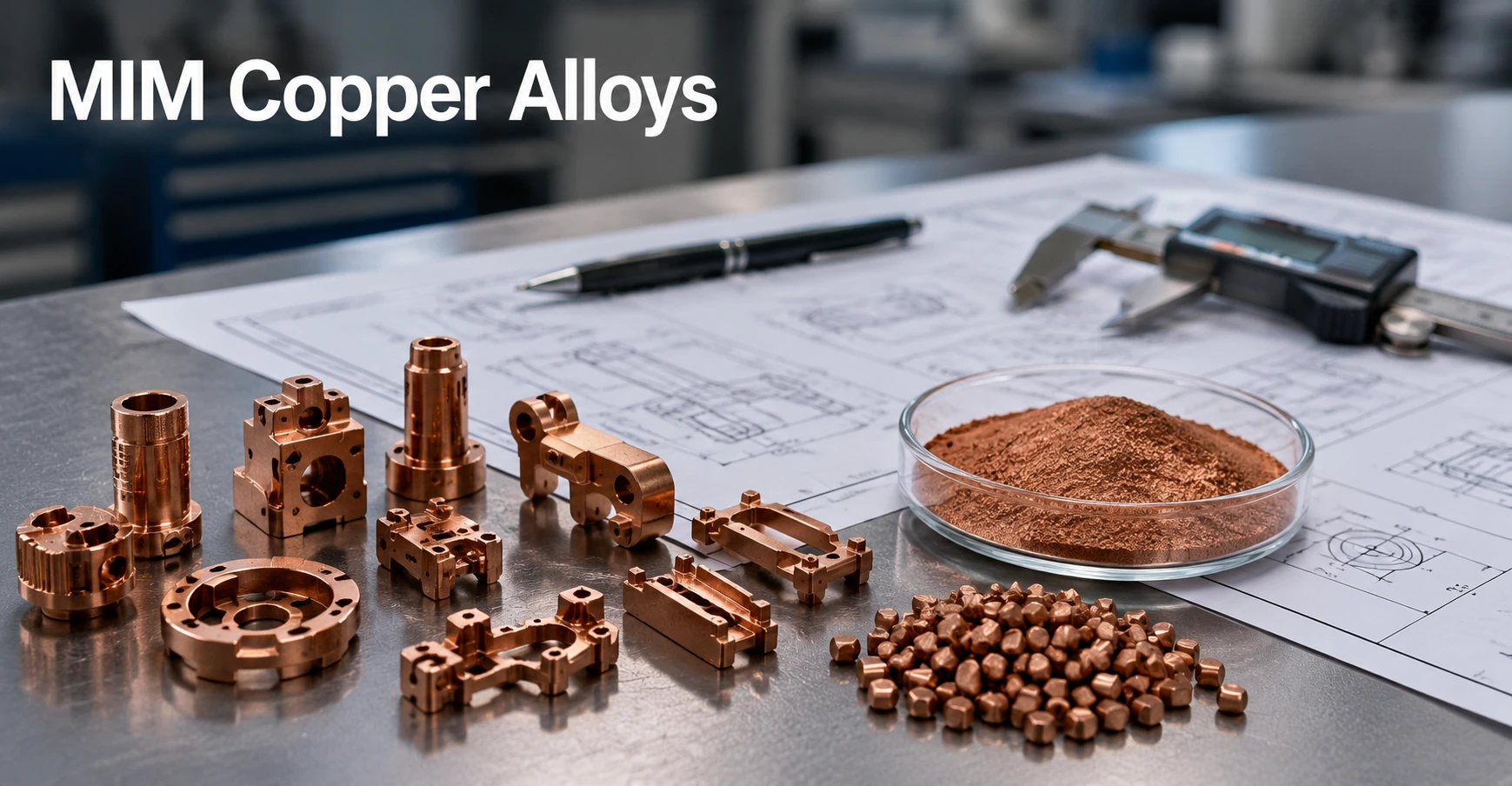
Copper alloys can be used for metal injection molding when the project requires small, complex, conductive or thermally functional metal parts, but the material must be confirmed through powder availability, MIM feedstock stability, debinding behavior, sintering response and final inspection before tooling. This is different from selecting a PM bronze bushing material, a wrought brass bar, a stamped copper strip or a cast bronze alloy. A copper alloy name alone does not prove MIM suitability. The part must fit the MIM route: fine metal powder mixed with binder, injection molded green parts, controlled debinding, high-shrinkage sintering, dimensional compensation and performance verification.
For XTMIM project review, copper alloy selection is treated as a combined material, geometry and process feasibility decision. The goal is to confirm whether the part belongs in the MIM route, or whether PM bronze, CNC machining, stamping, casting or wrought copper/brass stock is a better manufacturing choice.
This page belongs under MIM 재료 및 MIM용 특수 합금. It should not be treated as a general copper alloy encyclopedia, PM bronze bearing guide, brass stock material page or casting alloy catalog. For broader cross-material decisions, see the MIM 재료 선정 가이드.
Can Copper Alloys Be Used for Metal Injection Molding?
Yes, selected copper and copper alloy systems can be processed by MIM, but they require more careful review than common stainless steel MIM grades. Stainless steels such as 316L or 17-4 PH are widely used in MIM with mature feedstock systems and established production experience. Copper-based materials are more sensitive to powder oxygen content, impurity control, sintering atmosphere, residual carbon, porosity and final conductivity.
From a design review perspective, copper MIM is usually considered when the part has a three-dimensional shape that is not suitable for simple stamping, when CNC machining would remove too much material, or when a compact conductive or thermal component needs repeatable production. The value is not only the copper alloy itself. The value is the combination of material function and MIM geometry freedom.
A common mistake is to assume that any copper alloy used in machining, casting or PM can be moved directly into MIM. In practice, the nominal alloy name is only the starting point. The manufacturability depends on fine powder availability, binder compatibility, molding behavior, debinding control, sintering response and inspection requirements.
Where Copper Alloy MIM Makes Engineering Sense
Copper alloy MIM is most relevant when the part needs both material function 및 shape complexity. If the part is a flat terminal, stamping may be the better choice. If it is a simple round copper pin, bar stock machining may be more practical at low volumes. If it is a large bronze bushing, PM or casting is usually closer to the correct manufacturing route.
Copper MIM becomes more attractive when several of the following conditions are present:
| Project condition | Why MIM may be considered | What must be reviewed |
|---|---|---|
| Small three-dimensional conductive part | MIM can form compact geometry with features that are difficult to stamp. | Feedstock flow, gate position, sintering shrinkage and final conductivity. |
| Complex heat dissipation structure | MIM may form compact thermal geometry closer to net shape. | Density, porosity, thermal conductivity and surface condition. |
| Miniature connector or contact hardware | MIM can integrate small three-dimensional features into one part. | Contact surface, plating strategy, dimensional repeatability and burr control. |
| RF or sensor-related hardware | MIM may support compact shielding, mounting or conductive features. | Material stability, surface finish, assembly tolerance and electrical path. |
| Conductive mechanical part with internal geometry | MIM may reduce secondary machining when geometry is complex enough. | Debinding risk, sintering distortion, datum strategy and critical dimensions. |
In production, copper MIM is usually not selected only because copper is conductive. It is selected when conductive or thermal performance must be combined with a shape that benefits from injection molding and sintering-based near-net-shape production.
MIM-Suitable Copper Alloy Families
The safest way to plan copper alloy MIM content is to discuss material families and project review status, not to overpromise individual copper alloy grades. Public MIM standards and supplier capability reviews can support material discussion, but they do not mean every supplier can process every listed copper alloy. A copper material family should be treated as a candidate for engineering review, not as a guaranteed stock feedstock.

| Copper alloy family | Example naming | MIM review status | 엔지니어링 참고 사항 |
|---|---|---|---|
| High-conductivity copper | HC Cu / 99.9% Cu | Core MIM review candidate | Useful for conductive or thermal parts, but final performance depends on sintered density, oxygen, impurities and porosity. |
| Oxygen-free copper | OFHC Cu | Core MIM review candidate | Strong fit for low-oxygen and conductivity-oriented discussions; powder and feedstock availability must be confirmed before tooling. |
| Copper-aluminum alloy | Cu10Al | Project-dependent candidate | Can be considered as a MIM-evaluable copper alloy family; avoid expanding it into a general aluminum bronze encyclopedia. |
| Copper-tin alloy system | Cu-Sn | Project-dependent candidate | Discuss as a Cu-Sn MIM system only; do not directly equate it with SAE 660 or SAE 620 bearing bronze. |
| Copper-nickel alloy system | Cu-Ni | Project-dependent candidate | Relevant for corrosion-resistance and stable performance discussions; powder availability, feedstock stability and final property targets require project-level review. |
This matters because material names used in different industries do not always mean the same thing for MIM. A copper alloy that is common as a casting, strip, bar or PM bushing material may not be available as a stable MIM feedstock. Even when the chemistry is possible, the part must still pass molding, debinding, sintering, dimensional and performance validation.
For non-standard copper alloy requests, review the project through 맞춤형 MIM 재료 rather than assuming that a machining or casting grade can be transferred directly into the MIM route.
Not Every Copper Alloy Grade Is a MIM Material
This is the most important boundary for copper alloy content. A copper alloy grade should not be treated as a MIM material unless the full MIM route can be confirmed: fine powder, binder/feedstock, injection molding, debinding, sintering, shrinkage control, density, final properties and inspection.

MIM Candidate Copper Alloy Families
The copper alloy families most appropriate for this page are HC Cu, OFHC Cu, Cu10Al, Cu-Sn and Cu-Ni. These should be presented as MIM-evaluable material families, not as guaranteed stock feedstocks or universal production options.
PM, Bearing Bronze and Casting-Dominant Materials
SAE 660 / C93200 and SAE 620 / C90300 should be handled carefully. These names are strongly associated with bearing bronze, casting and bushing-related applications. That does not mean the alloy names should be banned from discussion, but they should not be placed in the main MIM copper alloy table unless powder, feedstock, debinding, sintering and final property validation are confirmed for the specific project.
In practice, a request for SAE 660 or SAE 620 often needs a process route check before a material quotation. If the part is a regular sleeve, bushing, bearing or porous component, PM, casting or machining may fit the project better than MIM. If the part has small complex features that genuinely need injection molding geometry freedom, then the copper-tin family can be reviewed as a MIM feasibility topic rather than copied directly from a bearing bronze datasheet.
Wrought Brass and Machining Brass Materials
H62, H63, C26000, C36000, brass strip, brass tube and brass bar should not become the main focus of this MIM copper alloy page. These materials are usually associated with wrought, stamping, tube, bar, strip or machining contexts rather than MIM feedstock. Brass MIM would require separate review of zinc behavior, powder availability, feedstock stability, debinding, sintering atmosphere, dimensional control and final properties.
MIM Copper vs PM Copper / Bronze Boundary
This page should not absorb PM copper, PM bronze or bearing bronze search intent. MIM and PM both use metal powder, but they use different forming logic, different design rules and different part families. Copper alloy MIM starts from fine powder and binder feedstock for injection molding. PM copper or bronze usually relies on powder compaction into a green compact, followed by sintering and possible sizing, oil impregnation or porosity control.
| Material or part request | Primary manufacturing logic | How this MIM page should handle it |
|---|---|---|
| HC Cu / OFHC Cu miniature conductive parts | MIM review candidate when geometry is small and complex. | Keep as a core copper MIM topic, with powder, feedstock, sintering and inspection review. |
| Cu-Sn copper-tin alloy family | Can be reviewed for MIM only when powder/feedstock route and part geometry support it. | Discuss as a project-dependent MIM material family, not as a direct SAE 660 / SAE 620 replacement. |
| SAE 660 / C93200 bronze bushing | Usually bearing bronze, casting, PM or machining context. | Use as a boundary example only. Do not present it as a standard MIM copper alloy grade. |
| SAE 620 / C90300 bronze component | Usually casting or bearing bronze context. | Use as a boundary example only unless a project-specific MIM route is confirmed. |
| Oil-impregnated bronze bearing | PM route with porosity and oil impregnation logic. | Keep out of the MIM main material list. This belongs to PM or bearing material discussion. |
| Porous bronze filter or porous copper part | PM porous material route. | Do not treat as a copper MIM target. Porosity is usually a PM design feature, not a MIM advantage. |
Copper MIM vs PM Copper, CNC, Stamping and Casting
Copper MIM is one manufacturing route among several. The right choice depends on geometry, quantity, material function, tolerance, secondary operations and cost structure.

| Manufacturing route | 적합 | 적합하지 않은 경우 | Key decision point |
|---|---|---|---|
| MIM copper alloys | Small, complex, three-dimensional conductive or thermal parts. | Large simple parts, flat strip parts and very low-volume prototypes. | Best when geometry complexity and material function both matter. |
| PM copper / bronze | Bushings, bearings, porous parts, oil-impregnated parts and relatively regular shapes. | Thin-wall undercuts, micro-features and complex 3D geometry. | Strong for cost-sensitive regular shapes, but not the same as MIM. |
| CNC 가공 | Low-volume parts, prototypes and local precision features. | High-volume complex parts with high material waste. | Good for validation, low-volume production or secondary machining. |
| 스탬핑 | Flat terminals, contacts, spring features and shielding sheets. | Thick 3D structures or enclosed complex features. | Best for sheet-metal geometry. |
| 주조 | Larger bronze or copper alloy components, pump and valve bodies. | Small precision MIM-like geometries. | Better for larger section parts and casting-friendly shapes. |
The boundary is important for SEO and for engineering accuracy. A page about MIM copper alloys should not absorb PM bronze bushing, oil-impregnated bronze, porous bronze filter or brass stock search intent as its main purpose.
For the general manufacturing route, see the MIM 공정 개요. For the material preparation stage, see MIM 피드스톡.
Key Process Risks in Copper Alloy MIM
Copper alloy MIM is not only a material selection question. It is a process control question. A material that looks suitable on a chemistry sheet can still fail at the project level if the feedstock cannot fill the geometry, the binder removal creates defects, the sintering response is unstable, or the final part does not meet conductivity and dimensional requirements.

Powder Oxygen and Impurity Control
Copper’s electrical and thermal performance can be affected by oxygen, impurities and porosity. For high-conductivity copper or OFHC copper projects, engineers should not rely only on nominal alloy naming. They should confirm powder quality, supplier process capability and final inspection requirements.
Feedstock Flow and Molding Stability
The fine copper powder must be compounded with binder into a stable feedstock. During molding, the feedstock must fill small features without short shots, flow lines, severe separation or gate-related defects. Thin walls, ribs, blind holes and miniature conductive features should be checked before tooling.
Debinding Residue and Carbon Control
Debinding must remove the binder without leaving residue that harms sintering or final properties. For copper and copper alloys, residual carbon or contamination can affect density, surface condition and performance. Debinding problems may also lead to cracking, blistering or internal defects that become visible only after sintering.
관련 페이지: MIM 탈지
Sintering Atmosphere and Densification
Sintering must develop density while controlling shrinkage and distortion. Copper alloy parts may require careful atmosphere selection and thermal profile control. A part that looks acceptable after molding can still fail after sintering if densification is uneven or the geometry is not well supported.
관련 페이지: MIM 소결
Porosity and Conductivity Loss
For conductive and thermal applications, porosity is not only a mechanical issue. It can reduce conductivity, affect heat flow and create variability between lots. If the application depends on conductivity, the requirement should be stated in the RFQ instead of assumed from the copper alloy name.
Dimensional Shrinkage and Distortion
MIM parts shrink during sintering. Copper alloy materials require part-specific review of wall thickness, section transitions, flatness, hole position, gate location and support strategy. This is especially important for miniature connectors, thin ribs and conductive parts that must assemble with plastic housings, springs, pins or PCB-related components.
관련 페이지: MIM 공차
Brass and Bronze in MIM: What Should Be Reviewed Carefully
Brass and bronze are not automatically excluded from engineering discussion, but they must be handled carefully. The page should separate copper alloy chemistry from manufacturing-route suitability. This is especially important because many copper alloy names are more common in casting, wrought stock, bearing bronze or PM contexts than in MIM feedstock supply.
For bronze, the safest content strategy is to discuss Cu-Sn as a copper-tin alloy system that may be reviewed for MIM. Do not directly promote SAE 660 / C93200 or SAE 620 / C90300 as MIM grades. Those names carry strong bearing bronze, casting and PM associations. They can create the wrong search intent and the wrong manufacturing expectation.
For brass, the issue is different. Cu-Zn alloys such as H62 and H63 are common in strip, tube, bar, plate and wire forms. That is useful material knowledge, but it does not prove MIM suitability. Brass MIM would require separate review of zinc behavior, powder availability, feedstock stability, debinding, sintering atmosphere, dimensional control and final properties.
| Material term | How to handle it on this MIM page |
|---|---|
| HC Cu / OFHC Cu | Main MIM copper candidates. |
| Cu10Al / Cu-Sn / Cu-Ni | Candidate MIM copper alloy families that require project-level review. |
| SAE 660 / C93200 | Mention only as PM/casting/bearing bronze boundary unless MIM feasibility is confirmed. |
| SAE 620 / C90300 | Mention only as casting/bearing bronze boundary unless MIM feasibility is confirmed. |
| H62 / H63 brass | Mention only as case-by-case Cu-Zn feasibility review. |
| Oil-impregnated bronze | Keep out of MIM main content; belongs to PM context. |
| Sintered bronze bushing | Avoid as a main keyword; PM/bearing intent. |
| Porous bronze filter | Avoid as a main keyword; PM/porous material intent. |
Typical Applications for MIM Copper Alloy Parts
Copper alloy MIM should be discussed through the lens of part geometry and functional requirements. Suitable application directions may include:
| Application direction | Why copper MIM may be reviewed | Key engineering concern |
|---|---|---|
| Electrical contact hardware | Conductive material plus compact geometry. | Contact surface, plating, dimensional repeatability and wear condition. |
| Miniature connectors | Small features and integrated geometry. | Thin walls, pin alignment, gate mark location and assembly fit. |
| RF or shielding components | Compact conductive features. | Surface condition, assembly fit and material stability. |
| 센서 하드웨어 | Small structural-conductive components. | Dimensional control and interface features. |
| Heat dissipation components | Copper thermal function with shaped geometry. | Density, porosity, thermal path and surface area. |
| Conductive mechanical parts | Combined mechanical and electrical role. | Strength, conductivity, wear and secondary operations. |
The application list should remain focused. Do not expand this section into all copper alloy uses. If a part is a large pump body, valve body, bronze sleeve or oil-impregnated bearing, that is usually not the primary MIM copper use case.
Design and RFQ Review Points Before Tooling
Copper alloy MIM projects should be reviewed before tooling. A material name alone is not enough for quotation, process planning or quality control. A useful RFQ package should connect the geometry, material target, functional requirement, tolerance strategy and production volume. For geometry-focused review, see DFM review for MIM parts.

Drawing and Geometry Checklist
- 2D drawing with critical dimensions and tolerances.
- 3D CAD file for geometry, wall thickness and feature review.
- Critical assembly interfaces and datum expectations.
- Thin walls, ribs, holes, slots, undercuts and sharp transitions.
- Expected gate mark restrictions.
- Flatness, concentricity, hole position or datum requirements.
- Any secondary machining or finishing surfaces.
Material and Performance Checklist
- Target copper alloy family or reference material.
- Electrical conductivity or thermal performance requirement, if applicable.
- Corrosion or operating environment.
- Required surface finish, contact surface or plating requirement.
- Mechanical load, wear or contact condition.
- Application temperature range.
- Whether the part must match wrought copper properties or only meet functional project targets.
Production and Purchasing Checklist
- Estimated annual volume.
- Prototype or sample expectations.
- Target production timeline.
- Inspection requirements.
- Packaging or handling requirements for delicate conductive surfaces.
- Existing process comparison, such as CNC, stamping, PM or casting.
Inspection and Acceptance Checks for Copper MIM Parts
Inspection planning should be defined before production. Copper alloy MIM parts may need both dimensional and functional checks. If conductivity, thermal performance or plating quality is part of the product function, those requirements should be stated before tooling instead of being assumed from the alloy family name.
| Inspection area | 중요한 이유 |
|---|---|
| Dimensional inspection | Confirms shrinkage compensation, datum strategy and assembly fit. |
| Density review | Helps evaluate sintering quality and possible porosity. |
| Surface inspection | Important for contact areas, plating, appearance and assembly. |
| Conductivity or thermal validation | Required if electrical or heat-transfer performance is part of the function. |
| Microstructure review | Useful when density, porosity or abnormal defects must be investigated. |
| Oxygen / impurity confirmation | Relevant for high-conductivity or oxygen-sensitive copper projects. |
| 2차 공정 관리 | Needed when machining, plating, polishing or heat treatment affects final use. |
MPIF Standard 35-MIM is relevant because it covers common materials used in metal injection molding with explanatory notes and definitions. For copper alloy projects, this type of reference can support MIM material discussion, but it does not replace supplier-specific feedstock review, production trials or drawing-based inspection planning.
When Copper Alloy MIM May Not Be the Best Choice
Copper MIM is not the right answer for every copper part. It may not be the best route when:
- The part is a flat stamped terminal or spring contact.
- The part is a simple pin, rod, ring or spacer that can be machined economically.
- The part is a large bronze bushing, sleeve or bearing.
- The required material is a PM oil-impregnated bronze.
- The part needs a porous bronze structure.
- The required conductivity must closely match wrought copper and cannot tolerate MIM-related variability.
- The selected alloy powder or feedstock is not commercially practical.
- 연간 물량이 금형 비용을 정당화하기에 너무 적은 경우.
- Critical tolerances require extensive post-machining anyway.
The correct question is not whether copper is a valuable material. The correct question is whether the geometry, performance target, quantity and manufacturing route fit MIM.
Composite Field Scenario for Engineering Training: Conductive Connector Housing
발생한 문제: A compact conductive connector housing was initially specified as a generic brass alloy because the previous prototype was machined from brass bar stock.
발생 원인: The design team focused on material familiarity and did not separate prototype material from mass-production manufacturing route.
실제 시스템적 원인: The part had small ribs, internal features and assembly interfaces that made MIM attractive, but the specified brass grade had not been confirmed for powder availability, feedstock stability, zinc behavior or sintering response.
수정 방법: The project was moved from a “brass grade replacement” discussion to a copper alloy MIM feasibility review. The engineering review compared HC Cu, OFHC Cu and a Cu-based alloy family against the part’s conductivity target, plating needs, wall thickness and annual volume.
재발 방지 방법: For copper-based MIM projects, do not copy the CNC prototype material into the production drawing without reviewing powder/feedstock availability, sintering risk, final conductivity and inspection requirements.
Composite Field Scenario for Engineering Training: Bronze Bushing Misclassified as MIM
발생한 문제: A buyer requested a MIM quote for a bronze sleeve bushing and referenced SAE 660 as the material.
발생 원인: The buyer associated “powder metal” with all copper-based parts and did not distinguish MIM from PM or casting routes.
실제 시스템적 원인: The part geometry was a regular cylindrical bushing, and the key performance need was friction and wear behavior. That belongs more naturally to bearing bronze, PM, casting or machining evaluation than to MIM.
수정 방법: The review separated the material and process intent. MIM was not treated as the default route. The project was redirected toward a manufacturing route better suited to bronze bearing geometry and performance.
재발 방지 방법: Before requesting copper alloy MIM, confirm whether the part truly needs MIM geometry freedom. If it is a regular bushing, oil-impregnated bearing, porous sleeve or large cast bronze component, MIM may not be the correct process.
Copper Alloy MIM Project Review by XTMIM
Contact XTMIM when your copper-based part requires small complex geometry, conductive or thermal function, tight assembly interfaces, or a production route comparison between MIM, PM, CNC, stamping and casting.
For copper alloy MIM projects, please provide 2D drawings, 3D CAD files, target material or reference alloy, electrical or thermal performance requirements, surface finish or plating needs, tolerance expectations, estimated annual volume and application background. XTMIM reviews whether the copper alloy family is realistic for MIM, whether the geometry is suitable for molding and sintering, whether critical dimensions require secondary machining, and whether another manufacturing route may reduce project risk before tooling begins.
FAQ: Copper Alloys for MIM
Can copper alloys be used in metal injection molding?
Yes, selected copper and copper alloy families can be considered for MIM, including high-conductivity copper, OFHC copper, copper-aluminum, copper-tin and copper-nickel systems. However, suitability depends on powder availability, feedstock stability, debinding behavior, sintering response, density, conductivity and the final part geometry.
Which copper alloys are most relevant for MIM review?
The most relevant copper alloy families for MIM discussion include HC Cu, OFHC Cu, Cu10Al, Cu-Sn and Cu-Ni. These should be treated as material families for engineering review rather than universal stock feedstocks. Final selection should be confirmed through drawing-based material and process review.
Is OFHC copper suitable for MIM parts?
OFHC copper can be considered when the application needs low oxygen content and high conductivity potential. The key issue is not only the alloy name. Engineers must confirm powder quality, feedstock availability, sintered density, impurity control and whether the final part can meet the project’s electrical or thermal requirements.
Can brass be processed by MIM?
Some Cu-Zn brass systems may be discussed during material feasibility review, but brass should not be assumed to be a standard MIM material. Zinc behavior, powder availability, feedstock stability, debinding, sintering atmosphere and final properties must be confirmed before using brass for MIM production.
Is SAE 660 bronze suitable for MIM copper alloy projects?
SAE 660 / C93200 should not be promoted as a standard MIM copper alloy grade without project-specific confirmation. It is strongly associated with bearing bronze, casting, PM, bushings and wear-related applications. If a buyer requests SAE 660, the first step is to confirm whether the part truly needs MIM geometry freedom or whether PM, casting or machining is the better process route.
Can SAE 620 bronze be used for MIM?
SAE 620 / C90300 should be handled as a bronze or casting-related boundary term unless powder availability, feedstock stability, debinding behavior, sintering response and final properties are confirmed for the specific MIM project. It should not be placed in the main MIM copper alloy list as a default material option.
What is the difference between MIM copper and PM bronze?
MIM copper uses fine metal powder mixed with binder to create feedstock for injection molding, followed by debinding and sintering. PM bronze usually refers to powder compaction and sintering routes, often used for bushings, bearings, porous parts or oil-impregnated components. The two processes use different design rules, cost logic and part geometry assumptions.
What information is needed for a copper alloy MIM RFQ?
A useful RFQ package should include 2D drawings, 3D CAD files, target material or reference alloy, electrical conductivity or thermal requirements, surface finish or plating needs, tolerance requirements, estimated annual volume and application background. This allows the engineering team to judge material suitability, tooling risk, sintering behavior, inspection needs and whether MIM is the right process.
엔지니어링 검토 노트
검토자: XTMIM 엔지니어링 팀
This article was reviewed from the perspective of MIM material suitability, copper alloy selection, feedstock feasibility, debinding and sintering risk, dimensional control, inspection requirements and production feasibility. The purpose is to help engineers and sourcing teams distinguish MIM copper alloy candidates from PM bronze, cast bronze and wrought brass materials before requesting tooling or production quotation.
표준 및 기술 참고 자료
MIMA / MPIF Standard 35-MIM: relevant for MIM material terminology and specification review. Use it as a materials standard reference, not as a replacement for supplier-specific feedstock review, drawing-based DFM review and production validation. External references: MIMA Standard 35-MIM page 및 MPIF 표준 자료.
Copper Development Association resources: useful for understanding why C93200 / SAE 660 and C90300 / SAE 620 carry strong bearing bronze, casting or copper alloy material contexts. These references help prevent PM or casting alloy terms from being presented as standard MIM feedstock options without project validation. External references: bronze bearing materials, C93200 alloy data 및 C90300 alloy data.
경계 참고: MIM material standards and PM or bronze material resources serve different purposes. MIM references support MIM material terminology and process review. PM, bearing bronze or copper casting resources should be used only to clarify manufacturing-route boundaries, not to prove that a copper or bronze grade is automatically suitable for MIM.