Cemented carbide injection molding, often discussed as CCIM, is a powder injection molding route for small complex hardmetal parts made from carbide powder and a metallic binder system. Cemented carbides should be considered for MIM or CCIM when a small, complex component needs high wear resistance, abrasive-contact durability, or hard sliding surfaces that stainless steel, tool steel, or tungsten heavy alloy cannot provide. The key decision is not simply whether carbide is harder. The practical question is whether injection molding can create enough value over conventional carbide pressing, sintering, grinding, EDM, or CNC finishing. This page is most useful when an engineer is reviewing a small wear part with holes, slots, flow features, thin edges, critical contact surfaces, or high-volume demand. Before tooling, the project should be checked for material system, feedstock behavior, debinding path, sintering shrinkage, edge chipping, finishing allowance, inspection datums, tolerance strategy, and annual volume.
In practice, cemented carbide MIM / CCIM is a feasibility decision, not a generic material upgrade. A design can fail the review if the geometry is too simple to justify tooling, if most surfaces still need heavy grinding, or if the working condition creates impact damage that the selected binder and edge design cannot tolerate.
For review, send 2D drawings, 3D CAD files, material preference, wear condition, tolerance requirements, surface finish needs, estimated annual volume, and application background.
Mejor ajuste
Small complex wear components where near-net-shape molding can reduce hard finishing after sintering.
Requiere revisión
Thin edges, high impact loads, tight datums, internal passages, or surfaces requiring grinding or lapping.
Generalmente no es ideal
Simple rods, plates, standard blanks, commodity inserts, and low-volume parts with heavy final grinding.
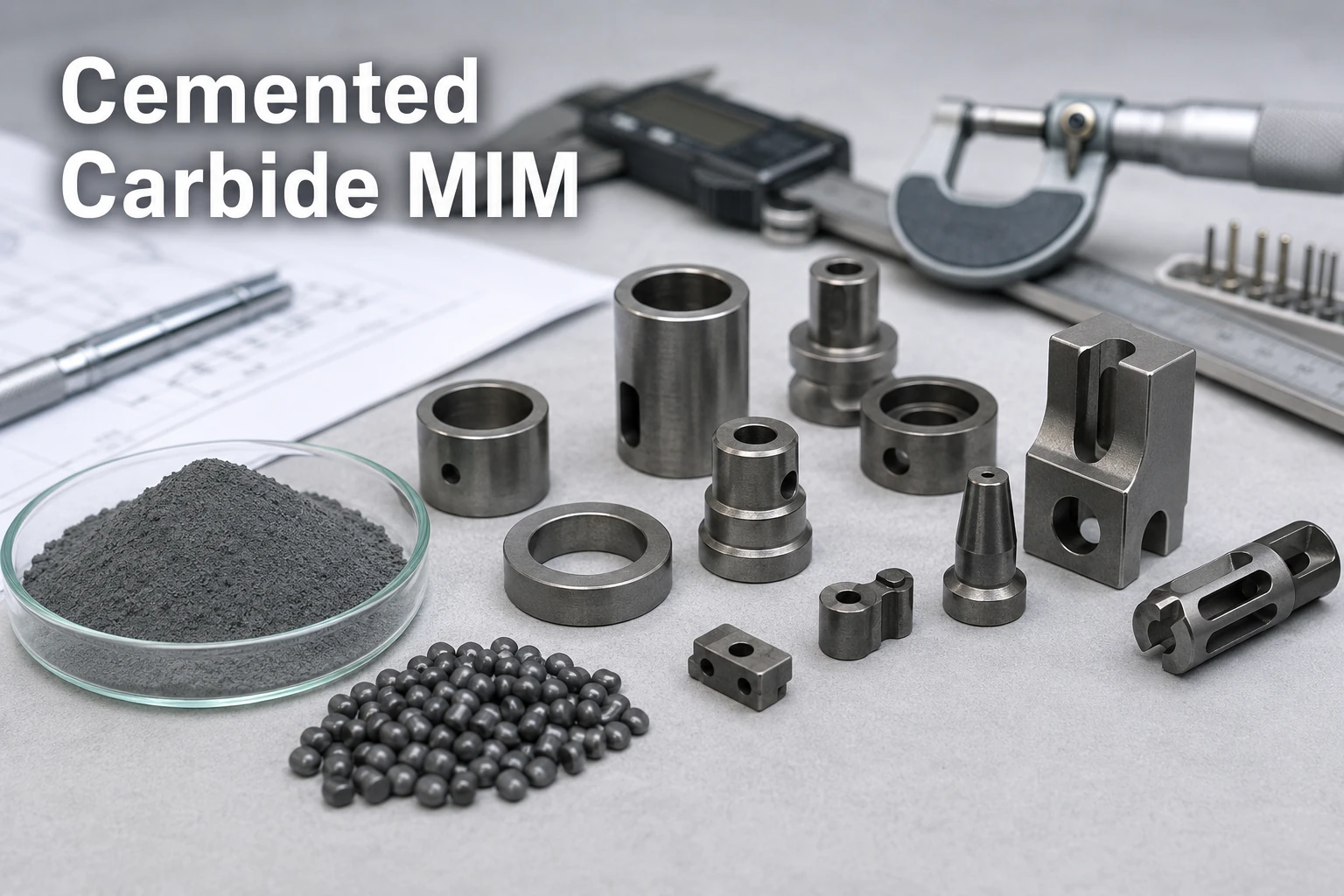
The material should be reviewed together with wear mode, geometry, finishing allowance, inspection requirements, and production volume before tooling.
When Cemented Carbide Is Worth Considering for MIM
Cemented carbide should be considered when the part’s failure mode is mainly wear, abrasion, erosion, or hard contact, and when the geometry makes conventional carbide manufacturing inefficient. A simple carbide rod, flat plate, or standard ring may be better produced by traditional pressing, sintering, and grinding. A small part with internal features, non-round surfaces, micro slots, flow passages, thin contact lips, or multiple wear surfaces may justify an injection-molded approach if the volume and tolerance strategy are suitable.
From a design review perspective, the material decision should start with the working condition, not the material name. A part that mainly needs corrosion resistance may be better suited for stainless steel MIM. A part that needs density or counterweight performance may belong to tungsten heavy alloy MIM. Cemented carbide becomes more relevant when wear resistance is the primary driver and the component geometry is too costly or restrictive for conventional hardmetal machining.
Small Complex Wear Parts That Are Difficult to Machine After Sintering
Cemented carbide is difficult and costly to machine after sintering compared with many steel materials. This is one reason near-net-shape forming matters. If a part requires small cross holes, slots, shaped flow paths, stepped surfaces, or repeated micro features, MIM / CCIM may reduce the amount of hard finishing needed after sintering.
The part still needs a realistic tolerance plan. Not every surface should be treated as a precision-ground surface. A common mistake is to request tight tolerances on every feature, even when only one sealing surface, sliding interface, or datum feature controls performance. Early revisión DFM should separate functional surfaces from non-critical molded surfaces before tooling cost is committed.
Abrasive, Sliding, and Contact Wear Conditions
Cemented carbide is often considered when the part contacts abrasive media, sliding components, particles, high-pressure flow, or repeated local contact. Typical review questions include:
- Is the wear caused by abrasion, erosion, adhesive wear, impact, or corrosion-assisted wear?
- Is the contact surface loaded continuously or intermittently?
- Is the mating component steel, ceramic, carbide, polymer, or another material?
- Will the part experience impact, vibration, or misalignment?
- Does the application require a sharp edge, a rounded wear edge, or a finished sealing surface?
These questions matter because cemented carbide is not selected only by hardness. Binder system, microstructure, geometry, edge condition, and finishing method can influence whether the part survives in service.
When MIM Geometry Adds More Value Than Standard Carbide Blanks
MIM / CCIM should not be used just because a part is made of carbide. It should be considered when the geometry and production route create value. The strongest cases usually include a combination of small part size, complex geometry, repeatable high-volume demand, difficult post-sinter machining, multiple functional features, wear-critical surfaces, reasonable tolerance zones, and clear inspection datums.
MPIF describes metal injection molding as a process that uses fine metal powders custom formulated with binder into feedstock and injected into mold cavities. MPIF’s MIM conference scope also recognizes CCIM, cemented carbide injection molding, alongside MIM and CIM, which supports CCIM as a recognized powder injection molding topic rather than a generic carbide marketing term.
| Condición de la pieza | Suitability for Cemented Carbide MIM / CCIM | Razón de ingeniería |
|---|---|---|
| Small complex wear part | Alto | Injection molding may reduce hard machining after sintering. |
| Simple rod, plate, blank, or standard insert | Bajo | Conventional pressing and grinding may be more economical. |
| Thin wall with sharp edge | Requiere revisión | Edge chipping and sintering distortion may control feasibility. |
| Internal flow path or small nozzle geometry | Potentially suitable | Near-net forming may reduce EDM or grinding operations. |
| High impact load | Requiere revisión | Binder phase, toughness, edge design, and support geometry must be evaluated. |
| Severe abrasive sliding contact | Potentially suitable | Cemented carbide may offer better wear behavior than common steel MIM materials. |
| Solo prototipo de bajo volumen | Often low | Tooling and process development may not be justified. |
What Cemented Carbide Means in a MIM / CCIM Project
Cemented carbide is not a single alloy in the same sense as 316L stainless steel or 17-4 PH stainless steel. It is a hardmetal material system made from hard carbide particles and a metallic binder phase. In many industrial applications, tungsten carbide with cobalt binder is a common cemented carbide system, but project requirements may also involve nickel binder, mixed carbide systems, or application-specific compositions.
For a MIM / CCIM project, this matters because the material is a composite system. The carbide phase, binder phase, powder characteristics, feedstock formulation, debinding route, sintering behavior, and final microstructure all influence performance. A normal “choose the grade and mold the part” mindset is not enough.
Hard Carbide Phase and Metallic Binder Phase
The carbide phase provides hardness and wear resistance. The metallic binder phase helps hold carbide particles together and contributes to toughness, sintering behavior, and service performance. If the binder system is wrong for the application, the part may not fail by simple wear; it may fail by edge cracking, corrosion-assisted degradation, fracture, or contact damage.
This is why engineering review should include the working environment, not only the drawing. A carbide part used in dry abrasive contact may need a different material discussion from a carbide part exposed to fluid, corrosion, impact, or cyclic loading.
WC-Co, WC-Ni, and Mixed Carbide Systems
WC-Co is one of the best-known cemented carbide systems, but it should not be treated as the only option or as a universal answer. WC-Ni may be considered in some corrosion-related discussions, while mixed carbide systems may be used for specific wear, heat, or chemical environments. The final choice should be confirmed through project-specific material review, expected failure mode, available feedstock, sintering response, and inspection requirements.
This page introduces these systems at a material-family level. Detailed tungsten carbide grade selection should be handled only if a future L4 page is created for tungsten carbide MIM parts, so this page does not compete with a future grade-specific or application-specific page. Not every carbide system is automatically suitable for production by MIM / CCIM; feasibility should be confirmed based on feedstock availability, sintering route, finishing requirements, inspection criteria, and project volume.
Cemented Carbide Injection Molding vs Conventional Carbide Pressing
Conventional cemented carbide manufacturing is strong for simple blanks, rods, plates, rings, and forms that can be pressed, sintered, and ground efficiently. Cemented carbide injection molding becomes more attractive when the part geometry is too complex for simple pressing or would require expensive hard machining after sintering.
The process decision should compare total project cost, not only unit price. Tooling, development trials, finishing allowance, inspection, scrap risk, and annual volume all affect whether MIM / CCIM is reasonable.
Cemented Carbide vs Tungsten Alloy, Tool Steel, and Stainless Steel MIM
This comparison is necessary because “tungsten carbide” and “tungsten alloy” are often confused in early sourcing discussions. They are not the same material family and they do not serve the same design purpose.
Cemented carbide is mainly selected for wear resistance and hard contact surfaces. Tungsten heavy alloy is selected when high density, weight concentration, shielding, inertia, or mass in a small volume matters. Tool steel MIM may be considered when toughness and heat-treatable hardness are more important than extreme abrasive wear. Stainless steel MIM is usually selected for corrosion resistance, general mechanical performance, and broad component use.

The correct material family depends on wear, density, toughness, corrosion resistance, finishing requirements, and production economics.
| Familia de Materiales | Primary Design Driver | Mejor para | No es ideal para |
|---|---|---|---|
| Cemented carbide | Wear resistance, hard contact, abrasion resistance | Nozzles, wear sleeves, valve seats, guide parts, micro wear components | High-impact parts without toughness review, low-volume simple blanks |
| Tungsten heavy alloy | High density, mass concentration, shielding, balance | Counterweights, inertial components, shielding parts | Severe abrasive wear as a carbide substitute |
| Tool steel MIM | Heat-treatable hardness and toughness | Mechanical components needing strength and wear improvement | Extreme abrasive media contact where carbide is required |
| Stainless steel MIM | Corrosion resistance and general mechanical performance | Medical, consumer, industrial, and general precision parts | Severe abrasive wear or erosion where steel wears too quickly |
How to Decide Based on Wear, Density, Toughness, and Corrosion Needs
- If the part wears out because particles, flow, or sliding contact remove material, cemented carbide may be worth reviewing.
- If the part needs compact mass, counterweight function, or shielding, tungsten heavy alloy is usually the correct material family.
- If the part needs heat-treated strength and moderate wear resistance, tool steel or low-alloy steel MIM may be more practical.
- If the part needs corrosion resistance and general precision performance, stainless steel MIM may be better.
This decision should be made before tooling. Material confusion at the RFQ stage can lead to the wrong process route, wrong cost expectation, and wrong inspection plan.
Suitable Cemented Carbide MIM Part Types
This section helps engineers recognize possible applications without turning the page into a carbide product catalog. The part examples below are not automatic recommendations. Each one needs review of geometry, wear mode, finishing allowance, and production volume.
Wear Sleeves and Bushings
Wear sleeves and bushings may be considered when the working surface is exposed to abrasive sliding, rotating contact, or particle-loaded movement. Cemented carbide may help when steel sleeves wear too quickly, but MIM / CCIM is most useful when the sleeve includes complex grooves, external features, flats, small flow channels, or non-simple geometry.
Simple round sleeves with large grinding allowance may still be better made by conventional carbide methods.
Nozzles and Flow-Control Wear Components
Small nozzles and flow-control parts may be suitable when the internal passage, outlet geometry, or external mounting shape is difficult to machine economically in hard carbide. The key review points are internal passage quality, erosion direction, edge condition, and finishing feasibility.
A common mistake is to focus only on the orifice diameter while ignoring the surrounding geometry, gate location, debinding path, and post-sinter cleaning or finishing requirements.
Valve Seats and Small Contact Components
Valve seats and contact components may require hard surfaces, stable dimensions, and controlled sealing geometry. Cemented carbide can be attractive where steel loses material too quickly under abrasive or high-contact conditions. However, the sealing surface may still require post-sinter finishing. The drawing should define which surfaces are functional and which can remain as-sintered.
Guide Parts, Micro Wear Parts, and Abrasive Media Components
Small guide parts and micro wear components can be good candidates if their geometry benefits from molding and the expected volume supports tooling. The smallest features need careful review because carbide feedstock flow, debinding, and sintering can affect edge quality, internal defects, and dimensional stability.
| Tipo de pieza | Why It May Fit Cemented Carbide MIM | Riesgo principal de revisión | Boundary |
|---|---|---|---|
| Wear sleeve | Abrasive sliding contact with shaped features | Grinding allowance and roundness | Simple sleeves may fit conventional carbide better. |
| Nozzle | Small flow geometry and erosion resistance | Internal passage quality and edge chipping | Do not treat all nozzles as MIM candidates. |
| Valve seat | Hard sealing or contact surface | Finished sealing face requirement | May need post-sinter finishing. |
| Guide component | Repeated contact and wear resistance | Datum and mating-surface control | Geometry must justify molding. |
| Micro wear component | Small size and complex features | Debinding, distortion, inspection | Needs early DFM review. |
Process Factors That Affect Cemented Carbide MIM Feasibility
Cemented carbide MIM / CCIM feasibility depends on more than whether the material can be sintered. The complete route includes powder and binder preparation, injection molding, green part handling, debinding, sintering, possible finishing, and inspection. Each stage can create risks that may not be visible in the initial drawing.

The material decision must be reviewed together with the full MIM / CCIM process route, rather than treated as a simple material substitution.
Feedstock Uniformity and Powder Loading
Feedstock quality affects molding behavior, dimensional consistency, density, and defect risk. In cemented carbide systems, the powder-binder mixture must be suitable for the small features and flow path of the part. Poor feedstock uniformity can lead to segregation, unstable flow, inconsistent shrinkage, or hidden defects that only become clear after debinding or sintering.
From a project review perspective, engineers should check wall transitions, flow length, gate location, thin sections, and areas where powder-binder separation could create local weakness.
Debinding Sensitivity and Internal Defect Risk
Desaglutinado removes binder from the molded part before final sintering. If the part geometry traps binder or creates long removal paths, internal defects may occur. Cemented carbide parts can be especially sensitive because the final component may be hard and wear-resistant, but hidden debinding defects can still weaken edges, corners, or thin sections.
The drawing should be reviewed for thick-to-thin transitions, blind holes, enclosed pockets, sharp internal corners, and areas where binder removal may be slow or uneven.
Sintering Shrinkage, Density, and Distortion
Sinterizado causes shrinkage and densification. For MIM and CCIM parts, the tooling must account for shrinkage, and the part may need sintering support or geometry adjustment. The issue is not only final size; it is also shape stability, flatness, roundness, hole position, and relationship between critical datums.
If a carbide part has long unsupported sections, thin lips, sharp edges, or asymmetric mass distribution, sintering distortion should be reviewed before tooling.
Carbon Balance, Grain Growth, and Binder Behavior
For cemented carbides, carbon balance, grain growth, and binder behavior can affect final microstructure and performance. These are not decorative metallurgical details. They influence whether the part behaves as intended under wear, contact, or load.
The supplier and customer should agree on which material properties or inspection indicators are necessary for the application. General material names are not enough for high-risk wear applications.
Post-Sinter Finishing and Grinding Allowance
Many carbide parts still require some finishing after sintering, especially for sealing faces, sliding surfaces, bearing surfaces, or critical datums. The goal is not to eliminate all secondary operations. The goal is to avoid unnecessary hard machining and reserve finishing for surfaces that truly control function.
A practical drawing review should mark as-sintered surfaces, surfaces needing grinding or lapping, datum surfaces, sealing surfaces, sharp edges to be broken or protected, and dimensions requiring inspection after finishing.
| Área de Riesgo | Por qué es importante | Qué revisar antes del herramental |
|---|---|---|
| Feedstock uniformity | Affects flow, density, and shrinkage consistency | Wall transitions, gate location, flow path, thin features |
| Desaglutinado | Internal defects may appear after thermal processing | Thick sections, blind holes, enclosed pockets, trapped binder paths |
| Contracción durante el sinterizado | Controls dimensional stability and shape accuracy | Critical dimensions, datums, support strategy, asymmetric geometry |
| Grain growth / carbon balance | Affects wear behavior and material performance | Material system, sintering route, required inspection indicators |
| Astillamiento de bordes | Hard brittle material risk | Sharp lips, thin edges, impact surfaces, handling surfaces |
| Post-processing | Drives cost and lead time | Grinding allowance, surface finish, functional faces, inspection plan |
DFM Review Points Before Tooling
Cemented carbide MIM projects should be reviewed before tooling because late changes are expensive. The DFM review should not only ask whether the part can be molded. It should ask whether the part can be molded, debound, sintered, finished, inspected, and used reliably in the real working environment.

Geometry risk and tolerance strategy should be reviewed before tooling, not after sintering.
Geometry That Needs Early Feasibility Review
High-risk geometry usually includes very thin walls, sharp unsupported lips, deep blind holes, long narrow slots, sudden wall thickness changes, undercuts, small internal passages, unsupported long sections, asymmetrical mass distribution, and features that require post-sinter grinding.
The problem is not that these features are impossible. The problem is that they can control cost, tooling correction, sintering stability, inspection difficulty, and final yield.
Wear Direction, Contact Stress, and Impact Load
A carbide material may perform well under abrasion but poorly if the design creates impact loading at a sharp corner. Engineers should define how the part contacts the mating component, where the wear surface is located, whether the load is sliding, rotating, vibrating, or impacting, and whether the part sees shock or misalignment.
This information often changes the recommended edge radius, binder discussion, surface finishing plan, and inspection method.
Datum Strategy and Critical Dimensions
Not every dimension should be treated as a critical dimension. A strong drawing separates functional datums, wear surfaces, sealing surfaces, assembly dimensions, non-critical external surfaces, and cosmetic or non-functional features.
For cemented carbide parts, this separation matters because unnecessary tight tolerances can increase grinding cost and inspection complexity. A better strategy is to define which features control function and which features can follow normal process capability after sintering.
| Elemento de revisión | Por qué es importante | Information Needed From Customer |
|---|---|---|
| Wear mode | Material choice depends on actual failure mechanism | Abrasion, erosion, sliding, impact, corrosion, temperature |
| Superficies críticas | Controls finishing and inspection cost | Mark sealing, sliding, datum, and wear surfaces |
| Thin walls and sharp edges | Risk of chipping, distortion, or handling damage | Minimum wall, edge radius, contact condition |
| Holes, slots, and passages | Affect molding, debinding, and inspection | Diameter, depth, flow function, cleaning requirement |
| Estrategia de tolerancias | Prevents over-specification | Which dimensions are critical and why |
| Acabado superficial | Puede requerir rectificado o lapeado | Required finish and functional purpose |
| Volumen de producción | Determines tooling and process economics | Volumen anual y etapa del proyecto |
| Current failure issue | Helps select material and design direction | Existing material, wear pattern, failure photos if available |
When Conventional Carbide Manufacturing May Be Better
A trustworthy material page must explain when not to use the process. Cemented carbide MIM / CCIM is not the best choice for every carbide part.
Conventional carbide manufacturing may be better when the part is a simple rod, plate, blank, ring, disc, or standard insert. It may also be better when most functional surfaces require heavy final grinding anyway. If the final component is mostly created by grinding after sintering, the value of injection molding becomes weaker.
Low-volume prototypes can also be difficult to justify. MIM / CCIM normally needs tooling and development work. For one-off validation, EDM, grinding from a carbide blank, or another route may be more practical.
Practical “Do Not Force MIM” Cases
- The part is a simple solid blank.
- The part is a standard cutting insert geometry.
- The project volume is too low for tooling.
- Nearly all functional surfaces require final grinding.
- The main requirement is high density, not wear resistance.
- The part experiences heavy impact and has sharp unsupported edges.
- The drawing has unrealistic tolerance requirements on all surfaces.
Project Review Scenarios for Cemented Carbide MIM Parts
Scenario 1: Edge Chipping on a Small Wear Seat
- ¿Qué problema ocurrió?
- A small wear seat was specified in cemented carbide because the previous steel part wore quickly. The drawing included a sharp sealing edge and a thin unsupported lip.
- Por qué ocurrió
- The material selection focused on wear resistance, but the design did not account for edge chipping risk during handling, assembly, and service contact.
- Causa del sistema
- The issue was not only material hardness. The real cause was the combination of sharp geometry, contact stress, insufficient edge support, and unclear finishing requirements on the sealing surface.
- Corrección
- The edge was reviewed for a controlled radius or chamfer, the functional sealing surface was separated from non-critical surfaces, and post-sinter finishing allowance was defined only where necessary.
- Prevención
- Before tooling, mark contact surfaces, wear direction, sealing faces, mating material, and impact conditions. The supplier should review edge geometry, binder system, sintering support, and inspection datums together.
Scenario 2: Overspecified Tolerances Increased Grinding Cost
- ¿Qué problema ocurrió?
- A carbide wear sleeve drawing specified tight tolerances on nearly every external and internal feature, even though only one bore and one end face controlled assembly and wear performance.
- Por qué ocurrió
- The drawing was converted from a machined steel version without separating functional dimensions from non-critical molded surfaces.
- Causa del sistema
- The project did not have a tolerance strategy. The supplier quoted unnecessary post-sinter grinding because the drawing treated all dimensions as critical.
- Corrección
- The customer and supplier identified the functional bore, datum face, wear surface, and non-critical surfaces. Only the functional surfaces retained tight requirements; the remaining surfaces were reviewed for as-sintered feasibility.
- Prevención
- Before RFQ, mark critical-to-function dimensions, assembly datums, and finished surfaces. Do not apply machining-style tolerances to every surface of a sintered carbide MIM part.
Quality and Inspection Considerations for Cemented Carbide MIM Parts
Quality control for cemented carbide MIM parts should focus on the features that affect service performance. A generic “strict inspection” statement is not enough. The inspection plan should match the part’s function, material system, and failure risk.
Relevant review areas may include density-related behavior, microstructure, binder distribution, surface cracks, apparent porosity, grain size, hardness, chipping, critical dimensions, and finished surface condition. ASTM maintains a B09.06 subcommittee for cemented carbides, with standards covering topics such as apparent porosity, hardness testing, transverse rupture strength, metallographic identification, coercivity, and other cemented carbide evaluation methods.
Density, Microstructure, and Binder Distribution
For wear-critical parts, microstructure matters because it can influence service behavior. If the part is used in abrasive media, particle flow, sealing contact, or repeated sliding contact, the acceptance plan should go beyond external dimensions.
Surface Condition, Edge Chipping, and Cracks
Hard materials can still fail at edges, corners, and thin sections. Visual inspection, magnified inspection, and application-specific edge checks may be needed where chipping would affect function. If the part includes a sealing surface or sliding interface, the finished surface should be clearly defined on the drawing.
Dimensional Inspection After Sintering and Finishing
Dimensional inspection should be tied to the tolerance strategy. Some dimensions may be controlled as-sintered. Others may require grinding, lapping, or other finishing. The drawing should not treat all dimensions equally.
Inspection Decision Table for Cemented Carbide MIM Parts
The inspection plan should be selected from the actual application risk. A simple guide component may not need the same inspection package as a high-risk sealing, erosion, or contact-wear component.
| Elemento de inspección | Por qué es importante | When to Request It | Nota de Ingeniería |
|---|---|---|---|
| Inspección dimensional | Confirms critical datums, holes, contact surfaces, and finished dimensions. | All production parts with assembly or functional dimensions. | Separate as-sintered dimensions from ground or lapped dimensions. |
| Visual and magnified surface inspection | Checks chips, cracks, edge damage, and visible surface defects. | Thin edges, sealing faces, sharp lips, or impact-contact parts. | Define which surfaces are function-critical before inspection planning. |
| Hardness review | Supports material and wear-performance discussion. | Wear-critical parts or replacement projects with known performance targets. | Hardness alone does not prove suitability under impact or corrosion-assisted wear. |
| Revisión de microestructura | Helps evaluate binder distribution, apparent porosity, grain condition, and material consistency. | High-risk wear parts, new material systems, or parts replacing failed components. | Acceptance criteria should be agreed before production, not after defects appear. |
| Finished surface verification | Confirms sealing, sliding, or mating surfaces after grinding, lapping, or polishing. | Valve seats, nozzles, sleeves, and contact surfaces with defined surface finish. | Do not specify tight finish requirements on non-functional surfaces. |
| Application-specific checks | Aligns inspection with actual wear mode, mating material, fluid, particles, or impact condition. | When the part has a known failure history or severe service environment. | Use failure photos, wear pattern, and mating-part information to guide review. |
Standards and Test Methods to Discuss During Project Review
Standards and test methods should support project discussions, but they do not replace drawing-based engineering review or agreed acceptance criteria. The correct inspection plan depends on the material system, geometry, surface requirements, working environment, and supplier process capability.
| Reference Area | Por qué es importante | How to Use It in Project Review |
|---|---|---|
| MPIF MIM process reference | Supports the powder + binder + feedstock + injection molding foundation of the process route. | Use it to clarify that the project is being reviewed as a powder injection molding route, not as ordinary machining or casting. |
| MPIF MIM / CIM / CCIM conference scope | Supports CCIM as a recognized powder injection molding topic. | Use it for terminology alignment when discussing cemented carbide injection molding with engineering and sourcing teams. |
| ASTM B09.06 cemented carbide references | Provides a relevant standards family for cemented carbide testing discussions. | Use it as a discussion reference for hardness, apparent porosity, microstructure, and related cemented carbide evaluation methods, not as an automatic one-size-fits-all acceptance plan. |
- MPIF — Descripción general del proceso de Moldeo por Inyección de Metal: useful for understanding the powder + binder + feedstock + injection molding foundation.
- MPIF MIM2026: identifies MIM, CIM, and CCIM as powder injection molding topics.
- ASTM B09.06 on Cemented Carbides: lists cemented carbide-related test methods and standards.
RFQ Checklist for Cemented Carbide MIM Feasibility Review
A useful RFQ for cemented carbide MIM should include more than a 3D model. The engineering team needs enough information to judge material suitability, process risk, tooling strategy, finishing allowance, inspection needs, and production economics.

Better RFQ inputs lead to more accurate material review, DFM feedback, finishing planning, and inspection strategy.
| Entrada de RFQ | Por qué es importante |
|---|---|
| Plano 2D | Defines dimensions, tolerances, datums, surface finish, and notes. |
| Archivo CAD 3D | Helps review geometry, moldability, shrinkage, and feature relationships. |
| Material preference | Clarifies whether the request is WC-Co, WC-Ni, cemented carbide, tungsten alloy, or another material family. |
| Condición de desgaste | Helps determine whether cemented carbide is actually needed. |
| Material de acoplamiento | Affects contact behavior, wear mode, and edge risk. |
| Requisitos de acabado superficial | Determines whether grinding, lapping, or polishing may be required. |
| Dimensiones críticas | Prevents unnecessary finishing on non-functional features. |
| Entorno de aplicación | Temperature, corrosion, fluid, particles, impact, or vibration can change material review. |
| Volumen anual estimado | Determines whether tooling and process development are economical. |
| Current failure problem | Helps identify whether the issue is material wear, geometry, surface finish, assembly, or loading. |
Request a Cemented Carbide MIM Feasibility Review
If your part requires high wear resistance, abrasive-contact durability, or hard sliding surfaces, XTMIM can review whether cemented carbide injection molding is a suitable route before tooling. Please send your 2D drawing, 3D CAD file, material preference, tolerance requirements, surface finish needs, estimated annual volume, wear condition, mating material, and application background.
Our engineering review can help clarify whether the part is suitable for cemented carbide MIM / CCIM, whether another MIM material is more practical, which surfaces may need finishing, which dimensions should be treated as critical, and which geometry risks should be corrected before tooling or production planning.
Frequently Asked Questions About Cemented Carbide MIM
Is cemented carbide the same as tungsten carbide?
Not exactly. Tungsten carbide is a major hard phase used in many cemented carbide systems, but cemented carbide usually refers to a composite hardmetal material made from hard carbide particles and a metallic binder phase. In sourcing discussions, “tungsten carbide” is often used broadly, but engineers should confirm the actual material system, binder, wear condition, and inspection requirements before tooling.
Can cemented carbide parts be made by MIM?
Yes, cemented carbide parts can be made by powder injection molding routes often discussed as cemented carbide injection molding or CCIM. However, feasibility depends on geometry, feedstock behavior, debinding, sintering shrinkage, binder system, finishing allowance, and inspection requirements. It should not be treated as a simple replacement for conventional carbide pressing and grinding.
When is cemented carbide MIM better than conventional carbide pressing?
Cemented carbide MIM may be better when the part is small, complex, high-volume, and difficult to machine after sintering. Examples include small wear components with shaped surfaces, grooves, internal features, or multiple functional surfaces. Conventional pressing and grinding may still be better for simple rods, plates, blanks, rings, or standard inserts.
Is tungsten heavy alloy the same as cemented carbide?
No. Tungsten heavy alloy is usually selected for high density, counterweight function, shielding, or mass concentration. Cemented carbide is selected mainly for wear resistance, hard contact, and abrasive environments. Confusing these two material families can lead to the wrong RFQ, wrong cost expectation, and wrong manufacturing route.
What is the difference between cemented carbide MIM and tungsten heavy alloy MIM?
Cemented carbide MIM is used when the main engineering driver is wear resistance, abrasion resistance, or hard contact performance. Tungsten heavy alloy MIM is used when the main driver is high density, counterweight function, shielding, balance, or compact mass. They both may contain tungsten-related terminology, but they solve different design problems and should not be quoted as the same material family.
What information is needed for a cemented carbide MIM quotation?
A useful RFQ should include a 2D drawing, 3D CAD file, material preference, wear condition, mating material, tolerance requirements, surface finish requirements, estimated annual volume, and application environment. If the project is replacing a failed steel or carbide part, photos or failure descriptions can help the engineering team understand the real wear mechanism.
Can cemented carbide MIM parts be machined after sintering?
Some post-sinter finishing may be possible, but hard carbide materials are more difficult and costly to machine than many steel MIM materials. The best strategy is to define which surfaces truly need grinding, lapping, or finishing, and which surfaces can remain as-sintered. This should be reviewed before tooling.
What are the main risks in cemented carbide injection molding?
Main risks include feedstock non-uniformity, debinding defects, sintering distortion, carbon balance issues, grain growth, edge chipping, unrealistic tolerances, and excessive finishing requirements. These risks do not mean the process is unsuitable, but they must be reviewed early with the drawing, working condition, and inspection plan.