
MIM Design Guide · Gate Location · DFM Review
MIM gate design decides where metal powder-binder feedstock enters the mold cavity, how it fills thin walls and internal features, and where a gate vestige may remain after degating. For a product engineer, the main question is not only which gate type will be used. The more important question is whether the gate location protects cosmetic surfaces, sealing faces, sliding areas, inspection datums, critical dimensions, and fragile small features before tooling is built. A poor gate decision can increase weld-line risk, short-shot sensitivity, local surface defects, manual trimming cost, or late tooling changes. This page is for projects where the part has visible surfaces, holes, slots, thin sections, tight assembly requirements, or no-gate areas that must be reviewed during MIM DFM incelemesi before mold manufacturing.
Feedstock entry, filling path, gate vestige, degating access and surface risk.
Visible gate marks, weld lines, air traps, short shots or damage during gate removal.
2D drawings, 3D CAD, no-gate zones, critical dimensions, material, finish and volume.
Gate Design Rules at a Glance
For most MIM projects, gate design should be judged by filling stability, surface protection, degating feasibility, and whether the customer’s drawing clearly identifies functional restrictions. The table below summarizes the practical review logic before tooling.
| Engineering Question | Practical Review Rule | Neden Önemlidir |
|---|---|---|
| Where should the gate be placed? | Usually review a stable or thicker feeding area, but avoid critical surfaces. | Good filling direction is not enough if the gate damages function or appearance. |
| Which surfaces should be protected? | Mark cosmetic, sealing, sliding, contact, datum, and inspection surfaces as no-gate zones when needed. | Gate vestige can affect assembly, sealing, friction, measurement, or visible quality. |
| What defects are linked to poor gate location? | Review short shot, weld-line risk, air traps, visible gate marks, and degating damage. | These risks often appear when flow path, feature layout, and gate access are not reviewed together. |
| What should the customer provide? | Provide 2D drawing, 3D CAD, no-gate zones, tolerance, finish, material, and estimated volume. | The MIM supplier can only optimize the gate if functional restrictions are visible before tooling. |
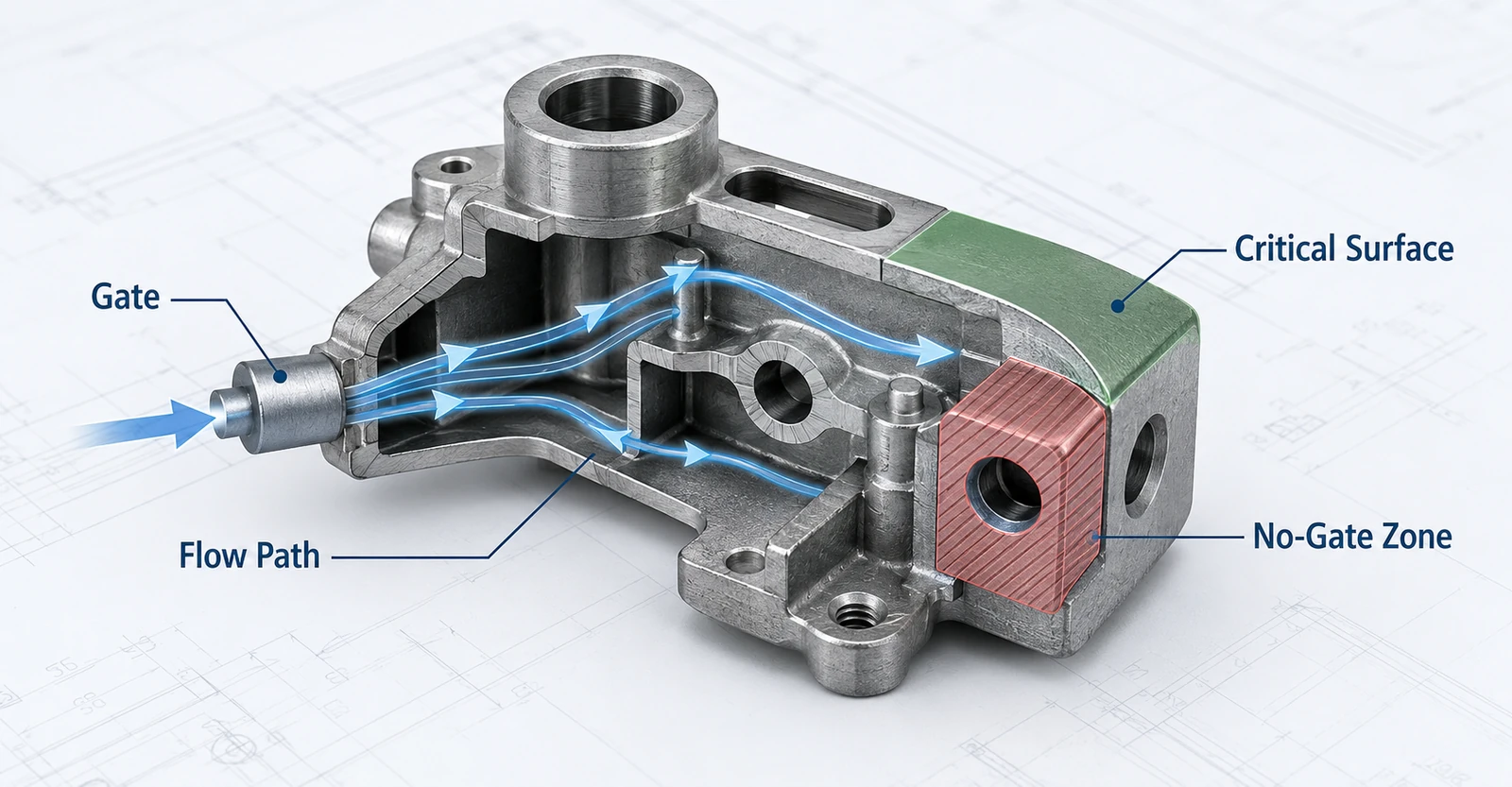
Gate design should be reviewed before tooling because one gate location can affect filling behavior, visible marks, functional surfaces and later degating.
- Gate design rules at a glance
- Why review gate design before tooling?
- Where should the gate be placed?
- How does gate location affect flow path?
- Which critical surfaces must be protected?
- Which gate types are common in MIM?
- What risks appear in thin-wall and complex parts?
- How does gate design connect with other DFM topics?
- What should be reviewed before tooling?
- What gate design mistakes should be avoided?
- FAQ about MIM gate design
Why Gate Design Must Be Reviewed Before MIM Tooling
Gate design is often treated as a tooling detail, but in MIM it affects part quality, surface restrictions, degating, finishing, and sometimes dimensional stability. Once the mold layout is fixed, changing the gate position may require tool modification, new validation, or design compromise. This is why gate location should be discussed before mold manufacturing begins, especially when the part has cosmetic surfaces, sealing areas, thin walls, holes, slots, or tight inspection requirements.
From a design review perspective, the gate controls three practical questions:
- Can the MIM feedstock fill the cavity predictably? Fine metal powder mixed with binder does not behave exactly like a simple plastic melt. The flow path must account for part thickness, feature interruption, core pins, slots, ribs, and small details.
- Will the gate vestige affect the final part? Gate removal can leave a small mark or require secondary finishing. If this mark appears on a cosmetic surface, sealing surface, sliding surface, or assembly datum, it may become a functional or appearance problem.
- Can the gate be removed without damaging the part? Small MIM parts often include thin ribs, miniature bosses, narrow slots, or fragile features. A gate placed too close to a delicate area can increase degating damage risk.
Mühendislik notu: A common mistake is to choose a gate only because it is easy for the mold. In practice, the gate must also match the part’s function, visible surfaces, dimensional requirements, degating method, and post-processing plan. For broader tooling structure topics, review MIM kalıp tasarımı.
What should be confirmed before tooling?
- Preferred gate side or restricted no-gate surfaces;
- Cosmetic, sealing, sliding, or contact surfaces;
- Critical dimensions and inspection datums;
- Thin-wall regions and long flow paths;
- Small holes, slots, ribs, or core-pin areas;
- Required surface finish after sintering;
- Whether gate vestige can be removed by machining, polishing, or finishing;
- Estimated production volume and degating strategy.
This does not mean the customer must fully design the gate. In most projects, the customer defines functional restrictions, while the MIM manufacturer evaluates manufacturable gate locations, runner access, filling behavior, and degating feasibility.
Where Should the Gate Be Placed on a MIM Part?
The best gate location depends on part geometry, wall thickness, surface requirements, and tooling access. In many MIM designs, the preferred direction is to allow feedstock to flow from a thicker or more stable region toward thinner sections. The EPMA overview of metal injection moulding also explains MIM as a process using powder-binder feedstock, green parts, binder removal, sintering shrinkage, and controlled dimensional change.
However, “place the gate at the thickest area” is not a universal rule. A thick area may also be a sealing face, visible face, datum surface, or precision contact zone. In that case, gate placement must be balanced against function, surface requirements, tooling access, and any secondary operation that may remove the gate vestige.

A gate location is acceptable only when it supports filling and does not damage cosmetic, sealing, datum or assembly-critical surfaces.
Gate Placement Decision Matrix
| İnceleme Alanı | Preferred Decision | Göz Ardı Edilirse Risk |
|---|---|---|
| Thick section | Consider feeding from a thicker or more stable area when the surface is not functionally restricted | Short shot, poor filling balance, local flow instability |
| Kozmetik yüzey | Usually avoid gate placement unless later finishing can reliably remove the vestige | Visible gate vestige or added finishing cost |
| Sızdırmazlık yüzeyi | Avoid gate placement | Contact failure, leakage risk, or uneven sealing |
| Assembly datum | Avoid gate placement and protect the inspection reference | Fit variation or inspection inconsistency |
| İnce cidar | Review flow length, pressure loss, and fill direction | Incomplete filling, flow marks, weak local filling |
| Hidden recessed surface | Often preferred if accessible and safe for degating | Easier to hide or control gate mark |
| Machined-after-sintering surface | Possible if material removal is already planned | Added cost but better final surface control |
| Small holes / pins | Avoid uncontrolled flow splitting around core-pin features | Weld-line or air-trap risk |
How should no-gate zones be marked?
For RFQ and DFM review, the drawing should not only show dimensions. It should also identify visible surfaces where gate vestige is not acceptable, sealing or contact faces, sliding or wear surfaces, inspection datums, areas requiring polishing or coating, and areas where a small gate mark is acceptable.
This information helps the MIM supplier avoid making a tooling decision that later conflicts with the part’s function or appearance. For wall and section-thickness decisions that affect filling behavior, review MIM duvar kalınlığı tasarımı.
How Gate Location Affects MIM Feedstock Flow Path
MIM feedstock contains fine metal powder and binder. Its flow behavior is affected by wall thickness, feature geometry, mold filling pressure, flow length, and changes in section thickness. Gate location influences how the feedstock front moves through the cavity, where flow fronts meet, and whether certain features are filled predictably.
The MIMA Tasarım Merkezi notes that MIM gates must balance manufacturability, function, dimensional control, and appearance. It also discusses gate placement near the parting line, thick-to-thin flow, gate vestige, and balanced filling for multi-cavity tools.

Poor gate location can force feedstock through long or interrupted flow paths, increasing local filling and weld-line risk.
Flow risks that should be reviewed
| Flow Risk | Tipik Neden | Gate Design Review Action |
|---|---|---|
| Eksik dolum | Long, thin, or restricted flow path | Review gate side, wall thickness, fill direction, and feature spacing |
| Weld line | Flow splits around holes, core pins, or slots | Review gate position and where flow fronts meet |
| Flow line | Thin-to-thick flow or unstable filling route | Review gate location and section transitions |
| Air trap | Dead-end pocket or poor venting area | Review flow direction, cavity layout, and venting strategy |
| Local surface defect | High shear or poor filling near gate area | Review gate size, gate type, and surface restriction |
| Unbalanced filling | Asymmetric gate location or multi-cavity imbalance | Review mold layout, runner balance, and cavity-to-cavity consistency |
Why holes, slots, and core pins matter
Holes, slots, and core-pin features can split the flow front. When the separated flow fronts meet again, weld lines or local weakness may appear depending on material, geometry, and molding conditions. This does not mean holes or slots should be avoided in MIM. It means they should be reviewed together with gate position, wall thickness, venting path, and final surface requirements.
For parts with several holes, long slots, deep pockets, or narrow bridges, the gate should be placed so filling remains as predictable as possible. If the gate forces feedstock to travel around multiple interruptions before filling thin areas, the design may need adjustment before tooling. For more feature-specific design review, see MIM'de delikler, yuvalar ve alttan kesikler. For process-quality context, review enjeksiyon kalıplamanın MIM parça kalitesini nasıl etkilediği ve besleme stoğunun MIM parça kalitesini nasıl etkilediği.
Gate Marks and Critical Surfaces: What Must Be Protected?
A gate mark is not only a cosmetic issue. It can become a functional issue if it is located on a sealing surface, sliding contact, inspection datum, assembly face, or high-tolerance area. In MIM, the gate vestige may be removed, reduced, hidden, or finished depending on gate type, material, geometry, and post-processing. But it should not be assumed that every gate mark can be removed without cost, dimensional impact, or surface risk.
The practical design question is: which surfaces must remain free from visible or functional gate vestige?

Gate mark control is not only cosmetic; it can affect assembly, sealing, inspection and functional contact.
Gate Mark Risk by Surface Type
| Surface Type | Gate Placement Recommendation | Neden Önemlidir |
|---|---|---|
| Görünür kozmetik yüzey | Usually avoid | Gate vestige may remain visible after finishing |
| Sızdırmazlık yüzeyi | Avoid | Surface interruption may affect sealing contact |
| Kayma yüzeyi | Avoid or review carefully | Gate mark may affect friction, wear, or smooth movement |
| Assembly datum | Avoid | May affect fit, location, or inspection repeatability |
| Inspection datum | Avoid | Measurement reference should remain stable |
| Hidden recessed area | Often preferred when feasible | Easier to hide or control gate vestige |
| Machined-after-sintering area | Mümkün | Gate vestige may be removed during machining |
| Non-functional side face | Possible after review | Often acceptable if appearance and assembly allow |
When can a gate mark be acceptable?
A small gate vestige may be acceptable when it is on a hidden side face, outside the sealing or contact area, away from inspection datums, and not located near a fragile feature that can be damaged during trimming. It may also be acceptable when the surface will be machined, polished, tumbled, or otherwise finished after sintering. The decision should still be documented before tooling because changing a gate after mold fabrication is usually more expensive than marking surface restrictions during RFQ.
Can gate marks be completely removed?
Sometimes they can be reduced or removed through machining, polishing, tumbling, blasting, or other finishing processes. But removal depends on material hardness after sintering or heat treatment, gate size and gate position, local geometry and access, surface finish requirement, whether dimensional stock is available for removal, and production cost.
A safer engineering approach is to define no-gate areas early instead of relying on late-stage finishing to solve a gate placement problem. When gate location may affect a datum or critical dimension, review the related MIM toleransları requirements before tooling.
Which Gate Types Are Commonly Used in MIM Parts?
Gate type selection depends on part geometry, surface restrictions, production volume, and the practical degating method. This section is not a complete mold design manual. Its purpose is to help product engineers understand why a MIM manufacturer may recommend one gate type instead of another and what trade-offs should be discussed during DFM.
| Gate Type | Tipik Kullanım | Advantage | Ana Risk |
|---|---|---|---|
| Edge / Tab Gate | Accessible side face or thicker region | Stable filling and simpler tooling | Larger gate vestige; trimming may be needed |
| Tunnel / Sub-gate | Hidden or less visible area | Smaller visible mark; possible automatic separation | More tooling complexity and review needed |
| Jump / Drop Gate | Restricted geometry or special access condition | Can solve difficult feeding access | Must review gate vestige and degating risk |
| Direct Gate | Special cases with short flow path | Simple and direct filling route | Higher visible mark or local surface risk |
| Multiple Gates | Larger or complex geometry | Shorter flow length in some layouts | Weld-line location and balance must be reviewed |
How should engineers use this table?
The table is not a substitute for mold-flow review or supplier DFM. It is a practical way to understand trade-offs. If a part has a hidden side face, a sub-gate or tunnel gate may be reviewed. If filling stability is more important than appearance, a tab gate may be acceptable. If a part has a strict cosmetic surface, gate type and gate position must be selected together. If the gate must be removed manually, the surrounding features should be strong enough to avoid damage.
Gate Design Risks in Thin-Wall, Small and Complex MIM Parts
MIM is often selected for small, complex metal parts, but complex geometry makes gate design more important. Thin walls, narrow bridges, undercuts, slots, holes, and micro features can all influence flow path and gate removal. The real risk is not usually one feature by itself. The risk is the combination of gate location, feedstock path, local wall thickness, tooling access, and final surface requirements.
| Sorun | Neden Oluşur | Kalıplama Öncesi İncelenmesi Gerekenler |
|---|---|---|
| Thin-wall short shot | Flow path is too long or wall is too thin for stable filling | Gate side, wall thickness, material, injection path |
| Weld line near hole | Flow splits around core pin or hole feature | Gate location, hole layout, flow meeting point |
| Gate removal damage | Gate is too close to delicate feature | Degating method, gate access, local feature strength |
| Visible gate mark | Gate placed on cosmetic surface | No-gate zone, hidden surface option, finishing plan |
| Local dimensional variation | Unbalanced flow or poor filling path | Gate symmetry, critical dimension location, mold layout |
| Air trap in pocket | Flow enters a dead-end cavity area | Gate direction, venting path, pocket geometry |
Composite field scenario for engineering training: thin-wall short shot near a side slot
Hangi sorun oluştu: A small MIM component showed incomplete filling near a thin side slot during early molding trials.
Neden oldu: The gate forced feedstock through a long, narrow path before reaching the slot area.
Gerçek sistem nedeni neydi: The issue was not only injection pressure. The gate location, wall thickness transition, and slot position created a high-risk flow path.
Nasıl düzeltildi: The team reviewed the gate side, adjusted local wall transition geometry, and rechecked the filling path before finalizing tooling changes.
Tekrarını önlemek için: During DFM, review thin-wall areas, slots, and flow length together instead of treating the gate as a separate tooling decision.
Composite field scenario for engineering training: gate vestige on an assembly face
Hangi sorun oluştu: A gate mark appeared on a surface later used as an assembly contact face.
Neden oldu: The drawing did not identify the face as functionally restricted, so the tooling plan treated it as an acceptable gate area.
Gerçek sistem nedeni neydi: The problem was a communication gap between product function and tooling design.
Nasıl düzeltildi: The surface was reclassified as a no-gate zone, and the gate location was reviewed for a less critical side face.
Tekrarını önlemek için: Mark cosmetic, sealing, datum, and assembly-contact faces clearly in the 2D drawing before RFQ or tooling review.
For broader part geometry review, see MIM parça tasarımı. For dimensional risk context, review how part dimensions affect final MIM quality.
MIM Gate Design Checklist Before Tooling
Before tooling, the customer and MIM supplier should review gate-related requirements using the drawing and 3D model. This checklist helps avoid late changes after mold manufacturing and reduces the risk of discovering surface restrictions only after first molded samples are produced.

Gate location review becomes more reliable when the customer provides functional surfaces, tolerance requirements and project background before tooling.
Gate Design DFM Review Checklist
| Sağlanacak Bilgi | Neden Önemlidir |
|---|---|
| 2D çizim | Identifies critical dimensions, datums, and restricted surfaces |
| 3D CAD modeli | Allows review of flow path, hidden features, and mold access |
| Cosmetic surface marking | Helps avoid visible gate vestige |
| Sealing / contact surface marking | Helps protect functional surfaces |
| Assembly datum or inspection datum | Prevents gate placement on measurement or fit references |
| Malzeme gereksinimi | Supports review of feedstock behavior and processing risk |
| Tolerance requirement | Helps protect high-risk dimensions |
| Yüzey kalitesi gereksinimi | Determines whether gate vestige can be removed or hidden |
| Heat treatment or secondary process | May change hardness, finishing feasibility, or distortion risk |
| Tahmini yıllık hacim | Supports gate type, degating method, and tooling strategy |
| Uygulama geçmişi | Helps identify surfaces that may not be obvious from geometry alone |
What should be marked on the drawing?
- No-gate surfaces;
- Cosmetic or visible faces;
- Sealing faces;
- Sliding or contact surfaces;
- Datums and inspection references;
- Critical dimensions;
- Surfaces that will be machined after sintering;
- Areas where minor gate vestige is acceptable.
What should be checked after first molding trials?
During trial review, the engineering team should confirm that the gate vestige is located in the approved area, degating does not damage thin features, no-gate surfaces remain protected, short-shot or weld-line risks are not appearing near critical features, and key dimensions are not affected by trimming or finishing. If a gate change is needed after trial, the cause should be linked back to surface restrictions, flow path, tooling access, or missing drawing information rather than treated as an isolated cosmetic issue.
First Trial Review: Gate-Related Acceptance Checks
| Kontrol Maddesi | What to Inspect | Neden Önemlidir |
|---|---|---|
| Gate vestige location | Confirm the gate mark appears only in the approved area. | Prevents unexpected marks on cosmetic, sealing, datum, or contact surfaces. |
| Degating damage | Check nearby ribs, thin walls, small bosses, slots, and fragile features after gate removal. | Small MIM features can be damaged if the gate is too close or trimming access is poor. |
| Weld-line or flow-line risk | Inspect areas where flow fronts meet around holes, slots, or core-pin features. | Helps confirm whether the selected gate location creates visible or functional flow defects. |
| Short-shot sensitive zones | Review thin walls, long flow paths, narrow bridges, and remote pockets. | Confirms whether the feedstock reaches high-risk features consistently during molding. |
| Critical dimensions near gate area | Measure dimensions affected by gate vestige, trimming, local finishing, or datum interference. | Ensures gate removal and surface cleanup do not compromise inspection or assembly requirements. |
For a broader preparation tool, use the MIM DFM tasarım kontrol listesi before sending drawings for review.
Common Gate Design Mistakes to Avoid
Placing the gate on a cosmetic surface
A visible gate mark may require extra finishing or may still remain visible after finishing. If the surface is customer-facing or decorative, it should usually be marked as a no-gate area.
Ignoring sealing or contact surfaces
A small gate vestige can become a major issue if it interferes with sealing, sliding, wear behavior, or assembly contact. These surfaces should be identified before tooling.
Feeding from thin sections into thicker areas without review
Thin-to-thick flow can increase filling and surface risk. This is why thick-to-thin flow is commonly preferred where geometry and function allow it.
Ignoring holes, slots, or core pins in the flow path
Features that split flow fronts can create weld-line or air-trap risk. Gate placement should be reviewed together with hole and slot layout.
Choosing a gate only for easy tooling
A gate that is easy to machine into the mold may not be acceptable for the final product. Tooling convenience must be balanced against part function, appearance, and inspection requirements.
Forgetting degating and finishing cost
Gate removal is part of the production plan. If gate trimming requires manual work, special fixtures, or additional finishing, it can affect cost and consistency. For a wider list of design risks, see yaygın MIM tasarım hataları.
Request a Gate Location and DFM Review Before Tooling
If your MIM part has cosmetic surfaces, sealing faces, thin walls, holes, slots, tight assembly requirements, or surfaces that cannot accept gate marks, request a gate location and DFM review before tooling. Send XTMIM your 2D drawings, 3D CAD files, material requirements, critical tolerances, surface finish requirements, annual volume estimate, and application background.
The engineering team can review gate location, feedstock flow path, gate vestige risk, no-gate zones, degating feasibility, critical surface protection, and related tooling risks before mold manufacturing or production planning.
Çiziminizi Gönderin Teklif İsteFAQ About MIM Gate Design
Metal enjeksiyon kalıplamada (MIM) kapı tasarımı nedir?
Kapı tasarımı, MIM besleme stoğunun kalıp boşluğuna nereden ve nasıl girdiğini tanımlar. Doldurma yönünü, akış yolunu, kapı izini, kapı çıkarmayı, yüzey durumunu ve kritik yüzeylerin kalıplamadan önce korunup korunmadığını etkiler.
MIM parçasında kapı (gate) nereye yerleştirilmelidir?
Kesici ağız genellikle daha kalın veya daha kararlı bir besleme alanına yakın olacak şekilde incelenir, böylece besleme stoğu daha ince kesitlere akabilir, ancak bu, kozmetik yüzeyler, sızdırmazlık alanları, montaj referans noktaları ve kritik boyutlarla dengelenmelidir. Nihai kesici ağız konumu, projeye özel DFM incelemesi ile onaylanmalıdır.
MIM'de yolluk konumu kaynak hatlarını etkiler mi?
Evet. Kapı konumu, MIM besleme stoğu akış cephesinin delikler, yuvalar, maça pimleri veya ince cidarlı özellikler etrafında nerede ayrılıp tekrar birleştiğini etkiler. Akış cepheleri işlevsel veya görünür bir alanda buluşuyorsa, kalıplama öncesinde kaynak hattı riski incelenmelidir.
Kapı, deliklerin veya yuvaların yakınına yerleştirilebilir mi?
Mümkün olabilir, ancak besleme ağzı konumu dikkatlice incelenmelidir. Delikler, yuvalar ve maça pimi özellikleri akış yolunu bölebilir, hava sıkışması riski oluşturabilir veya kaynak hatlarını kritik alanların yakınına yerleştirebilir. Nihai karar geometriye, et kalınlığına, işleve, havalandırmaya ve besleme ağzı çıkarma erişimine bağlıdır.
MIM kapı izleri tamamen giderilebilir mi?
Bazen kalıp giriş izleri, talaşlı imalat, parlatma, tamburlama, kumlama veya başka bir bitirme işlemi ile azaltılabilir veya giderilebilir. Ancak giderme işlemi malzeme, geometri, kalıp giriş boyutu, yüzey gereksinimi ve maliyete bağlıdır. Kalıp yapımından önce kalıp girişi olmayan alanların tanımlanması daha güvenlidir.
Kapı her zaman en kalın kesite mi yerleştirilmelidir?
Her zaman değil. Dolum açısından genellikle kalından inceye akış tercih edilir, ancak en kalın kesit aynı zamanda kozmetik, işlevsel veya boyutsal olarak kritik olabilir. Yolluk konumu, akış davranışı ile nihai parça işlevi arasında denge kurmalıdır.
Kapı konumu MIM parça kalitesini nasıl etkiler?
Kapı konumu, besleme stoğu akış yolunu, kaynak hattı riskini, kısa dolum hassasiyetini, yerel yüzey durumunu, kapı izini ve kapı çıkarma riskini etkiler. Bazı geometrilerde, kötü kapı konumu boyutsal varyasyona veya son işlem sorunlarına da katkıda bulunabilir.
Çizimimde kapı olmayan alanlar belirtebilir miyim?
Evet. MIM DFM incelemesi için, kozmetik yüzeylerin, sızdırmazlık yüzeylerinin, temas yüzeylerinin, montaj referanslarının, muayene referanslarının ve besleme ağzı izinin kabul edilemez olduğu alanların işaretlenmesi önerilir.
Nihai besleme ağzı konumuna kim karar verir, müşteri mi yoksa MIM üreticisi mi?
Müşteri, kapı konulamayacak yüzeyler, kozmetik yüzeyler, referans noktaları, sızdırmazlık alanları ve kritik boyutlar gibi fonksiyonel kısıtlamaları tanımlamalıdır. MIM üreticisi daha sonra akış yolu, kalıp erişimi, kapı çıkarma, malzeme davranışı ve üretim gereksinimlerine dayanarak üretilebilir kapı konumunu değerlendirir.
Bir MIM kapı tasarımı incelemesi için hangi bilgilere ihtiyaç vardır?
2D çizimi, 3D CAD modelini, malzeme gereksinimini, tolerans gereksinimini, yüzey kalitesi gereksinimini, uygulama geçmişini, tahmini yıllık hacmi ve girişsiz yüzey kısıtlamalarını gönderin.
Standartlar ve Teknik Referans Notu
MIM gate design is not usually determined by a single universal standard value. It is an engineering review topic that depends on geometry, material, feedstock behavior, mold layout, surface requirements, and production volume.
The EPMA Metal Enjeksiyon Kalıplamaya Genel Bakış is relevant because it explains MIM feedstock, green part formation, debinding, sintering shrinkage, and process control considerations. The MIMA Tasarım Merkezi is relevant because it discusses gate placement, parting line considerations, gate vestige, thick-to-thin flow, and balanced filling. These references support design judgment, but they should not replace project-specific DFM review.
Material standards and material data sheets can support material specification, mechanical property expectations, and quality agreement during a MIM project, but they do not define a universal gate location for every part. Gate design still needs project-specific tooling and DFM review based on geometry, surfaces, tolerances, feedstock flow, and production requirements.