XTMIM’s inspection and testing capability supports MIM part validation from drawing review to shipment release. For supplier quality engineers, product engineers, and technical buyers, the key question is not whether a factory claims “quality control,” but whether it can define critical dimensions, choose suitable measurement methods, verify material-related requirements, identify process-related risks, and document inspection evidence before sample approval or production release. XTMIM supports dimensional, mechanical, material-related, surface, reliability-related, and shipment inspection planning for MIM projects.
In MIM production, final part quality is affected by feedstock behavior, injection molding stability, green part handling, debinding, sintering shrinkage, tooling compensation, post-sintering sizing, surface finishing, and final inspection. The inspection plan is project-dependent and should be confirmed according to the drawing, critical dimensions, material grade, surface finish, application environment, customer acceptance criteria, and reporting requirements. Not every project requires every test.
Inspection dimensionnelleSupport aux tests de matériauxSurface & Reliability ChecksInspection ReportsProduction Release Review
Inspection and Testing Capability for MIM Supplier Evaluation
Inspection for MIM parts should be planned around the part drawing, not around a fixed checklist. A small stainless steel hinge component, a soft magnetic part, a low alloy steel locking component, and a cosmetic wearable part may all require different inspection priorities. Some projects focus on datum-based dimensions and mating surfaces. Others require hardness verification, material-related testing, roughness checks, corrosion-related testing, or appearance review.
XTMIM’s inspection support covers dimensional, mechanical, material, surface, and reliability-related testing resources, including CMMs, optical measuring machines, 3D scanning, hardness testers, tensile testers, metallographic equipment, roughness testers, salt spray testers, and environmental test chambers. The exact inspection plan should be confirmed according to the drawing, critical dimensions, material grade, surface requirement, application environment, customer acceptance criteria, and report format.
Sintering, heat treatment, material grade, and secondary processing can affect hardness and mechanical response.
Hardness, tensile-related checks, material verification, heat-treatment condition, and customer specification
Which reports or records are needed?
SQE and OEM teams often need objective evidence before sample approval, trial production release, or shipment.
Dimensional reports, first article inspection, outgoing inspection records, special test reports, and shipment records
Current Inspection Resource Summary
The equipment list below should be used as a capability reference, not as a universal inspection promise for every part. Actual inspection scope still depends on drawing requirements, critical features, material route, surface condition, customer reporting format, and project risk.
Inspection Category
Current Resource Reference
Manufacturing / Quality Value
Important Boundary
Dimensional measurement
CMM 7; OMM 21; 3D scanner 1; electronic altimeter 7
Supports critical dimensions, hole position, profile review, sintered dimension change, and sizing result confirmation.
Measurement method should be selected by drawing geometry and datum strategy.
Supports metallographic preparation, structure observation, and material or element screening.
XRF is useful for screening but does not replace all formal chemical analysis or third-party certification.
Surface and reliability-related testing
Roughness tester 2; salt spray tester 3; constant temperature and humidity test chamber 2; thermal shock test chamber 2; abrasion-related testing resources
Supports surface, corrosion, coating, cosmetic, and environmental requirement review for selected projects.
These tests are project-dependent and should be defined before quotation or sample approval.
How Inspection Methods Support Project Decisions
For supplier evaluation, the important question is not only which equipment exists, but which project risk the equipment helps control. The table below connects common MIM project risks with practical inspection support and the decision value for engineering teams.
Project Risk
Recommended Inspection Support
Decision Value
Tight hole position, datum tolerance, or assembly alignment
CMM, OMM, height measurement, or project-specific gauge review
Confirms whether sintered and post-sized dimensions match functional assembly requirements.
Small holes, thin profiles, slots, or optical contour features
OMM and visual dimensional review
Helps verify small features that may be difficult to measure consistently by contact methods alone.
Complex curved surfaces or early shape deviation
3D scanning combined with drawing-based measurement
Supports sample comparison and tooling or sintering feedback without replacing final critical dimension inspection.
Material grade or alloy-family confirmation
XRF screening, material certificate review, and project-defined material verification
Reduces material mismatch risk and identifies whether further material confirmation is needed.
Heat-treated, wear-related, or hardness-sensitive features
Rockwell or Vickers hardness testing according to project requirement
Checks heat treatment response, material condition, or wear-related acceptance criteria.
Cosmetic surface, coating durability, or corrosion exposure
Roughness testing, visual review, abrasion-related checks, salt spray or environmental tests when specified
Supports appearance, surface treatment, and reliability-related decisions before production release.
What Should Be Inspected Before Sample Approval or Production Release?
Before a MIM part is approved for production release, the inspection scope should be defined according to part function. In practice, not every dimension on a drawing carries the same risk. A cosmetic surface, a mounting hole, a sliding interface, a latch feature, and a datum surface may need different inspection methods and acceptance rules.
Dimensions and Critical Tolerances
Dimensional inspection usually focuses on features that affect assembly, function, or downstream processing. For MIM parts, critical dimensions may include length, diameter, hole position, slot width, step height, flatness, profile, wall-related features, thread-related areas, and mating surfaces.
Surface Condition and Visual Defects
Surface inspection should consider both appearance and process-related risk. A surface issue may be cosmetic, or it may indicate green part handling damage, debinding stress, sintering distortion, contamination, or finishing-related damage.
Material, Hardness and Mechanical Requirements
Material-related inspection depends on the selected material grade and the application requirement. Hardness, tensile-related testing, metallographic review, and material verification should be defined according to customer specification and agreed inspection plans.
Surface, Corrosion and Reliability-Related Checks
Cosmetic parts, wearable components, consumer electronics parts, and surface-treated parts may require roughness testing, abrasion checks, salt spray testing, temperature and humidity testing, or thermal shock testing.
Note d'ingénierie : A quality engineer should not only ask whether the part can be measured, but whether the measurement plan matches the real functional risk. Critical dimensions, datum references, surface requirements, and inspection methods should be aligned before sample approval.
Typical dimensional review items include datum structure and measurement reference, critical-to-function dimensions, assembly-related holes, slots, ribs, bosses and mating faces, flatness and positional relationships, features affected by sintering support or post-sintering sizing, and dimensions that may require secondary machining or gauge inspection. For tolerance strategy, see MIM tolerances and dimensional strategy.
Dimensional Inspection Equipment for Critical MIM Features
Dimensional inspection is a core part of MIM validation because MIM parts are formed oversized and then shrink during sintering. The inspection plan must confirm whether the final sintered or post-processed part meets functional requirements. XTMIM’s dimensional inspection resources include CMM, OMM, 3D scanning, and electronic height measurement equipment.
CMM
Best suited for datum-based relationships, hole position, profile, mating faces, and functional 3D dimensions where the drawing defines clear measurement references.
OMM
Useful for small holes, slots, thin edges, 2D profiles, optical contours, and small precision features that may be sensitive to contact measurement.
3D Scanning
Helpful for complex geometry comparison, early sample deviation review, and tooling or sintering feedback, but it does not replace all final drawing-based inspection.
CMM and optical measurement for critical MIM dimensions.
CMM and optical measurement help verify datum-based dimensions, small holes, slots, and profiles in precision MIM parts. CMM is suitable for datum-based relationships, while OMM is useful for small holes, slots, thin profiles, and contour features.
CMM Inspection for Datum-Based Dimensions
CMM inspection is useful when the part requires controlled relationships between datums, holes, mounting faces, profiles, or position-related dimensions. For MIM parts, this is especially important when the part will be assembled into a device, mechanism, housing, latch, hinge, connector, or precision module.
CMM inspection can support review of datum-based features, hole position and spacing, critical mating faces, profile and shape-related dimensions, flatness or height relationships, and production approval dimensions. In practice, CMM inspection should be used where the drawing defines meaningful datums and tolerance relationships. If the drawing lacks clear datum references, the engineering team may need to review how the part should be measured before sample approval.
Optical Measurement for Small Features and Profiles
Optical measuring machines are useful for small MIM features, thin profiles, slots, holes, edges, and contour-related dimensions. Many MIM parts are small and geometrically complex, so optical measurement can be more practical than contact measurement for certain features.
OMM inspection may support small hole and slot review, thin edge or profile measurement, contour comparison, micro feature inspection, and visual dimensional review for small precision parts. For small MIM components, optical measurement can help identify deviations that may affect assembly even when the part looks acceptable by visual inspection alone.
3D Scanning for Complex Geometry Review
3D scanning may be useful for complex geometry review, early sample comparison, shape deviation analysis, and tooling or sintering feedback. It can help visualize how a complex part deviates from the intended shape, especially when the part includes curved surfaces, asymmetric features, or multiple geometry transitions.
However, 3D scanning should not be presented as a replacement for all precision measurement. It is best used as part of a broader inspection strategy together with drawing-based measurement, CMM inspection, optical measurement, gauge checks, and engineering review.
Hardness, Mechanical and Material-Related Testing
Hardness, tensile-related testing, and material-related verification help confirm whether a MIM part meets functional requirements beyond geometry. These methods should be applied according to project requirements and agreed test methods rather than treated as universal default testing for every part.
Hardness and mechanical testing support for MIM components.
Hardness testing may be used for heat-treated, wear-related, or material-sensitive MIM components when required by the project. Tensile testing should be confirmed according to specimen preparation, test method, customer specification, and reporting requirements.
Hardness Testing for Heat-Treated or Wear-Related Parts
Hardness testing is often relevant when the part is heat-treated, wear-related, load-bearing, or specified with a hardness requirement. For example, low alloy steel MIM parts may require heat treatment depending on the application, while stainless steel or soft magnetic parts may require different verification priorities.
Hardness review can support heat treatment confirmation, wear-related application review, batch acceptance for material-sensitive parts, comparison between sample and production lots, and failure analysis when hardness deviation is suspected. The hardness requirement should be defined before production because material selection, sintering condition, heat treatment, and surface finishing can all affect the final result.
Tensile and Mechanical Testing When Required by the Project
Tensile or mechanical testing may be required when the customer specification, material standard, or application risk calls for mechanical property verification. The test method, sample type, acceptance criteria, and reporting format should be confirmed before the project moves into production planning.
A common mistake is to assume that the finished MIM part itself can always be used directly as a tensile specimen. In reality, tensile testing for sintered metal materials depends on specimen geometry, preparation method, material condition, and applicable standards. ISO 2740:2023 is relevant when defining tensile test piece requirements for sintered metal materials, including MIM-related sintering applications.
Metallographic and XRF Analysis Support
Material-related inspection may require more than checking a supplier’s material name. For selected projects, metallographic preparation, microscopy, and XRF analysis can support material verification, process review, and defect analysis.
Metallographic and XRF analysis support for MIM parts.
Metallographic preparation, microscopy, and XRF analysis can support material-related review and defect investigation when required by the project. XRF can support alloy element screening, but it should not be described as a complete replacement for all formal chemical composition certification.
Metallographic Preparation and Microscopy
Metallographic support can help evaluate selected material or process-related questions. In MIM projects, it may be used to support review of sintering-related structure, defect investigation, material condition, or special customer requirements.
Metallographic review may be considered when a part has unusual cracking or fracture behavior, sintering-related material condition needs investigation, a customer requires structure-related evidence, a production issue suggests material or process variation, or engineering review needs more evidence than dimensional inspection alone. This type of testing should be tied to a real project question. It should not be added only to make the inspection process look more complex.
XRF Material Verification Support
XRF analysis can support material-related verification and alloy element screening. It may help confirm whether the material condition is aligned with the expected material family or whether further material review is needed.
However, XRF analysis should not be described as a complete replacement for all chemical composition certification or third-party laboratory testing. Final material acceptance should follow the customer specification, applicable material standard, and confirmed inspection plan.
Surface, Abrasion and Reliability-Related Testing
Surface and reliability-related testing becomes important when the MIM part has cosmetic requirements, surface treatment, corrosion exposure, environmental exposure, or contact-wear requirements. These tests are project-dependent and should be confirmed before quotation or sample approval when surface or environmental performance is important.
Surface and reliability testing for surface-sensitive MIM parts.
Surface and reliability tests may be used for corrosion-sensitive, coated, cosmetic, or customer-specified MIM components. They are not default requirements for every MIM part and should be defined according to application environment and customer acceptance criteria.
Surface Roughness and Cosmetic Surface Review
Surface roughness testing may be required when the part has a mating surface, sliding surface, sealing-related surface, or cosmetic appearance requirement. For MIM parts, the final surface condition can be influenced by feedstock quality, mold surface, injection condition, sintering, polishing, tumbling, sandblasting, passivation, coating, or other finishing processes.
Surface review should define which surface matters, whether the requirement is cosmetic or functional, whether roughness should be measured, whether finishing may affect dimensions, and whether appearance samples should be approved before production.
Salt Spray and Environmental Testing Support
Salt spray testing, temperature and humidity testing, and thermal shock testing may be relevant for parts exposed to corrosion, humidity, temperature cycling, or customer-defined environmental conditions. These tests are not default requirements for every MIM project. They should be specified when the application environment or customer acceptance criteria require them.
This is especially important for plated, passivated, polished, or surface-treated MIM components. If the surface treatment is supplied by an external process or customer-approved route, the inspection plan should also clarify responsibility, acceptance method, and reporting requirements.
Abrasion and Coating-Related Checks for Surface-Sensitive Parts
Abrasion and coating-related checks are useful for parts that are touched, rubbed, worn, cleaned, assembled repeatedly, or exposed as visible components. These tests may apply to wearable devices, consumer electronics, watch-related parts, buttons, covers, decorative components, and similar surface-sensitive applications.
The important engineering question is not whether abrasion testing exists, but whether the test method matches the actual use condition. A decorative part, a contact surface, and a functional sliding part may need different acceptance logic.
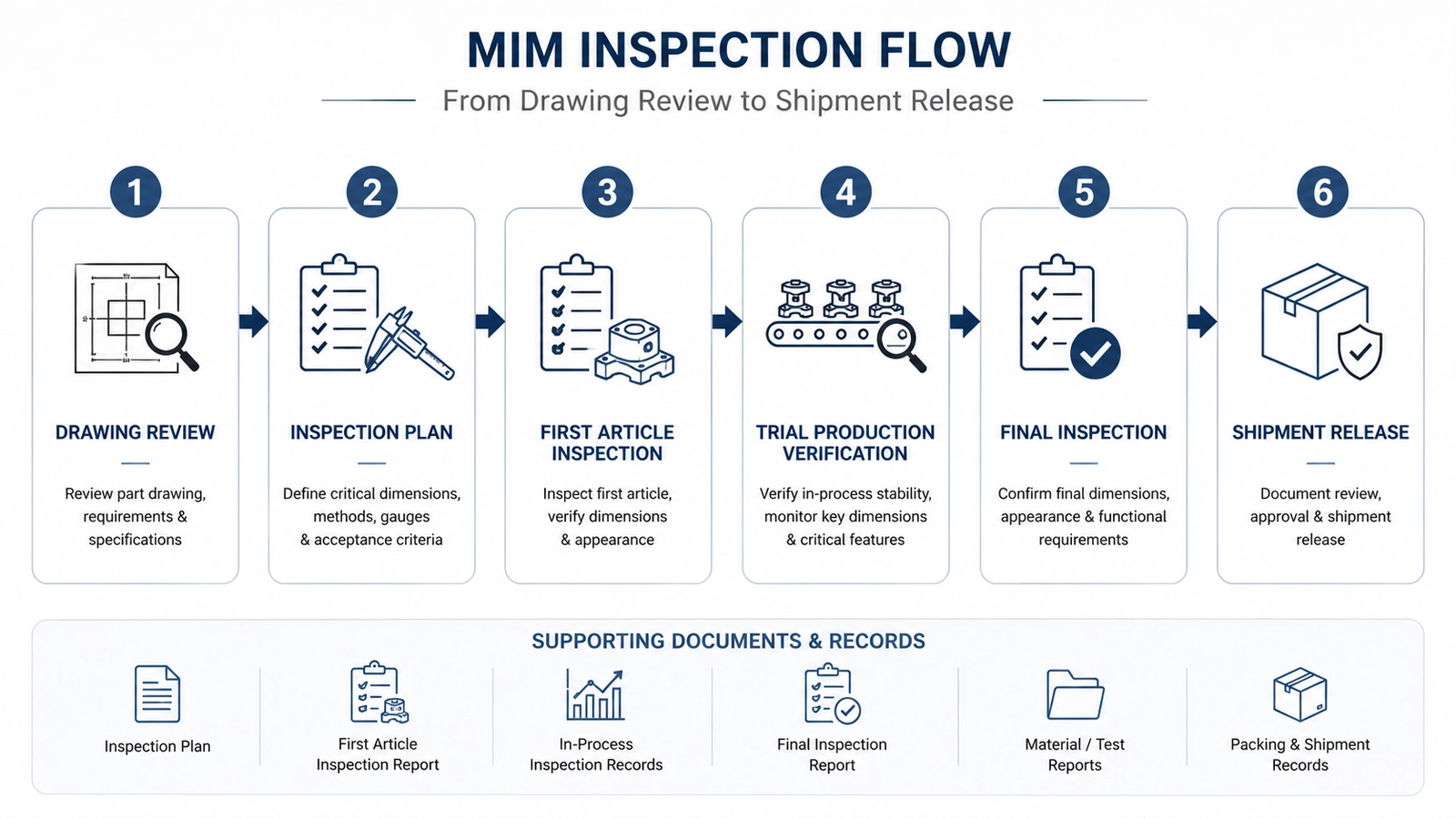
Inspection Flow from Drawing Review to Shipment Release
Inspection should begin before production, not after parts are already finished. For MIM projects, the inspection flow should connect engineering review, tooling feedback, sample inspection, trial production verification, production inspection, and shipment release.
MIM inspection flow from drawing review to shipment release.
MIM inspection should start with drawing and critical dimension review, then continue through sample approval, trial production, final inspection, and shipment release. This prevents the misunderstanding that inspection begins only after parts are finished.
Étape
Point d'inspection
Engineering Purpose
Drawing and specification review
Critical dimensions, datums, material, surface, and testing requirements
Define what must be inspected before tooling or sample approval
Sample / first article inspection
Initial dimensions, surface condition, and functional features
Identify tooling, shrinkage, or sintering correction needs
Trial production verification
Repeatability, variation, fixture suitability, and gauge suitability
Confirm whether the process can support stable production
In-process inspection
Key process checks, semi-finished part review, and gauge checks
Detect variation before final shipment
Inspection finale
Dimensions, appearance, function-related features, and reports
Confirm shipment readiness
Shipment records
Inspection report, batch record, packaging records, and shipping records
Support traceability and customer review
Drawing and Critical Dimension Review
The drawing review stage should define which dimensions are critical and how they should be measured. This includes datum references, tolerance requirements, functional surfaces, assembly features, surface requirements, material grade, and testing requirements. If the drawing is incomplete, the inspection plan may be unclear. For example, a part may have a tight hole position requirement but no clear datum structure. In that case, the supplier and customer should align on the measurement method before first article inspection.
Sample inspection is used to identify whether the part meets drawing requirements and whether the process needs adjustment before trial or production. For MIM parts, sample inspection may reveal tooling compensation issues, sintering distortion, gate-related marks, surface defects, or post-sintering sizing needs.
The purpose of first article inspection is not only to approve or reject parts. It should also create feedback for mold correction, shrinkage compensation, sintering support, debinding or sintering condition review, post-sintering sizing or machining strategy, and inspection method confirmation. For more context, see project development and production handoff.
Production and Final Inspection
During production, inspection should confirm that the process remains stable enough for the agreed acceptance criteria. Depending on the part and project requirement, production inspection may include in-process checks, gauge inspection, optical inspection, CMM measurement, surface review, hardness checks, and final outgoing inspection.
This section connects with XTMIM’s quality control process, where SOPs, process checks, in-process inspection, quality records, and production control logic are explained in more detail.
What Inspection Can Reveal in MIM Production
Inspection results should not be treated only as pass/fail data. For MIM parts, inspection findings often reveal where the real process risk is located. A dimensional deviation may be related to tooling compensation, sintering support, geometry imbalance, or post-sintering sizing. A surface crack may be related to green part handling, debinding stress, or local geometry transitions. A hardness issue may point to material, sintering, or heat treatment conditions.
MIM inspection feedback from finding to cause and engineering response.
High-value inspection does more than judge pass or fail. It helps the engineering team identify whether a problem may come from shrinkage, tooling compensation, debinding stress, material route, sintering condition, heat treatment, or acceptance criteria.
Review mold compensation, critical dimension strategy, and sintering support
Flatness or warpage issue
Geometry imbalance, sintering stress, poor support condition
Review setter design, part orientation, and post-sintering sizing
Hole or slot deviation
Core pin design, shrinkage direction, sintering movement
Review core design, machining allowance, and gauge requirement
Surface crack
Green part handling, debinding stress, sharp transition
Review wall transition, debinding route, and handling method
Hardness deviation
Material condition, sintering, heat treatment variation
Review material route, heat treatment condition, and acceptance criteria
Rough surface
Molding, sintering, finishing, or surface treatment variation
Review surface requirement and finishing process
Scénario de champ composite pour la formation en ingénierie
Quel problème s'est produit : A small MIM component passed general visual inspection, but a functional hole position showed inconsistent results during sample review.
Pourquoi cela s'est produit : The drawing defined a tight positional requirement, but the datum interpretation and inspection method were not aligned early enough. The feature was also sensitive to sintering movement and local geometry balance.
Quelle était la véritable cause système : The issue was not only a measurement problem. It involved drawing interpretation, tooling compensation, sintering support, and first article feedback.
Comment cela a été corrigé : The inspection method was aligned with the functional datum, critical dimensions were reviewed again, and tooling or process correction was evaluated based on repeated sample data.
Comment éviter la récurrence : Before tooling or sample approval, critical dimensions should be identified, datum strategy should be agreed, and the inspection method should be confirmed together with the engineering review.
Inspection Records, Reports and Traceability
Inspection evidence is important for supplier evaluation because it shows how a factory controls acceptance, not only how it manufactures parts. For MIM projects, documentation may include dimensional inspection reports, first article inspection records, in-process inspection records, outgoing inspection records, material-related records, surface or reliability test reports, and shipment records.
Inspection reports and traceability records for MIM production.
Inspection records, report folders, sample trays, and measuring tools help document sample approval, production inspection, and shipment release. Customer names, part numbers, drawing numbers, measured values, and project data should be protected or desensitized before being shown publicly.
Inspection Reports for Samples and Production Lots
Depending on customer requirements, inspection reports may include first article inspection reports, dimensional inspection reports, CMM or OMM measurement data, hardness or material-related test reports, surface or reliability test reports, outgoing inspection reports, and customer-specific report formats when agreed before production.
A report should not only list measurements. It should connect the measurement method to the drawing requirement, critical dimension, tolerance, and acceptance criteria.
Process Records and Shipment Records
Production records help connect final inspection to the actual process. These may include SOPs, parameter check records, in-process inspection records, gauge inspection records, packaging records, warehousing records, and shipment records.
For quality engineers, traceability helps answer which lot was inspected, which dimensions were checked, which acceptance criteria were used, whether the inspection was linked to the drawing, whether special tests were required, and whether the shipment was released after inspection.
Documentation boundary: Customer-specific documentation requirements should be discussed during project review. If PPAP, APQP, industry-specific forms, or special approval documents are required, they should be confirmed before quotation or project launch rather than assumed as standard for every MIM project.
When Special Inspection Requirements Should Be Defined Early
Special inspection requirements should be defined before tooling, sampling, or production planning. If a customer only provides a 3D model without critical dimensions, material grade, or testing requirements, the supplier may not know which features require special control.
Requirement to Define
Pourquoi c'est important
Dimensions critiques
Helps define what must be measured first and what requires tighter process feedback.
Datum references
Prevents inconsistent measurement interpretation between customer, supplier, and inspection team.
Niveau de tolérance
Affects process route, tooling review, inspection method, sample correction effort, and cost.
Surfaces fonctionnelles
Identifies surfaces that affect assembly, sliding, sealing, appearance, or downstream finishing.
Nuance de matériau
Determines material-related inspection, hardness review, heat treatment, and test requirements.
Exigence de dureté
Influences heat treatment planning and hardness verification method.
Exigence de finition de surface
Affects polishing, blasting, coating, roughness checks, appearance samples, and dimensional risk after finishing.
Corrosion or environmental requirement
Determines whether salt spray, humidity, thermal shock, or other reliability-related testing is needed.
Cosmetic acceptance criteria
Prevents late disputes on visible surface quality, color difference, gate mark visibility, or finishing condition.
Inspection requirement or acceptance standard
Clarifies whether the project requires CMM report, hardness report, material verification, reliability test, customer format, or other agreed evidence.
Report format
Helps align documentation before shipment and avoids late changes to inspection evidence requirements.
Volume annuel estimé
Supports inspection frequency, gauge planning, production control strategy, and project cost review.
Environnement d'application
Helps decide whether special testing is necessary instead of adding unnecessary tests to every project.
Before quotation, customers should provide 2D drawings with tolerances, 3D CAD files when available, material grade or performance requirement, critical dimensions and functional surfaces, surface finish and appearance requirements, inspection requirements or acceptance criteria, estimated annual volume, application background, and special testing or report requirements. Before production, both sides should confirm the final drawing revision, approved material route, critical dimension list, inspection method, acceptance criteria, sample approval process, surface standard, report format, packaging requirements, traceability requirements, and shipment release criteria.
For MIM parts with critical dimensions, functional surfaces, surface treatment requirements, hardness requirements, inspection requirements, acceptance criteria, or special testing needs, send your drawing package to XTMIM for inspection planning and production review. Please include 2D drawings, 3D CAD files if available, material grade, critical dimensions, tolerance requirements, surface finish, cosmetic criteria, inspection standards or acceptance criteria, estimated annual volume, and application environment.
XTMIM’s engineering and quality team can review whether the part requires CMM inspection, optical measurement, hardness testing, material verification, surface testing, reliability-related checks, customer-specific inspection reports, or production release controls before tooling, sampling, or production release.
Inspection and testing should be understood together with engineering review, manufacturing, project development, and quality control. These pages help users evaluate XTMIM’s broader project support capability.
Relevant standards and technical references can support material, testing, and inspection discussions, but they should not replace project-specific drawing review, customer specifications, or supplier-specific process evaluation.
Project-specific rule: Final inspection scope, critical dimensions, reporting format, applicable standards, and acceptance criteria must be confirmed according to the customer drawing, material requirement, application environment, and agreed inspection plan.
FAQ
What inspection methods does XTMIM use for MIM parts?
XTMIM supports MIM part inspection through drawing-based dimensional measurement, optical measurement, CMM inspection, 3D scanning support, visual inspection, hardness testing, tensile-related testing when required, metallographic review, XRF analysis, roughness testing, and selected reliability-related tests. The actual inspection plan depends on the drawing, critical dimensions, material grade, surface requirements, and customer acceptance criteria.
Can XTMIM inspect critical dimensions based on customer drawings?
Yes. Critical dimensions can be reviewed from the customer’s 2D drawing and inspection requirements. For MIM parts, critical dimensions should be clearly linked to datums, functional surfaces, assembly features, tolerance levels, and application risk. If the drawing does not define measurement references clearly, the inspection method should be aligned before sample approval.
Are CMM and OMM inspection available for small MIM parts?
Yes. XTMIM’s dimensional inspection resources include CMM and OMM equipment. CMM inspection is suitable for datum-based dimensions, position, profile, and functional relationships. OMM inspection is useful for small holes, slots, edges, contours, and small precision features. The best inspection method should be selected according to part geometry and drawing requirements.
Can hardness, tensile, or metallographic testing be arranged?
Hardness testing, tensile-related testing, and metallographic review may be used when the material, heat treatment, customer specification, or application risk requires them. These tests should be defined before production because specimen preparation, test method, acceptance criteria, and reporting format may vary by project.
Do all MIM projects require full mechanical or reliability testing?
No. Full mechanical testing, salt spray testing, environmental testing, abrasion testing, or metallographic review is not required for every MIM project. Testing scope should be defined according to the drawing, material grade, functional risk, surface requirement, application environment, customer standard, and agreed acceptance criteria.
Are salt spray and environmental tests required for every MIM part?
No. Salt spray, constant temperature and humidity testing, thermal shock testing, abrasion testing, and coating-related checks are project-dependent. They are more relevant for corrosion-sensitive parts, surface-treated components, cosmetic parts, wearable devices, consumer electronics parts, or customer-defined reliability requirements.
Can XTMIM provide inspection reports before shipment?
Inspection reports can be prepared according to the agreed inspection plan and customer requirements. Reports may include dimensional inspection, first article inspection, outgoing inspection, hardness or material-related checks, surface testing, or reliability-related test results when required. The report format should be confirmed before production.
What information should customers provide for inspection planning?
Customers should provide 2D drawings, 3D CAD files when available, material grade, critical dimensions, datum requirements, tolerance levels, surface finish requirements, cosmetic criteria, special testing standards, estimated annual volume, and application background. This helps the engineering and quality teams define a practical inspection plan before tooling or production.
How does inspection feedback help improve MIM tooling or sintering control?
Inspection feedback can show whether a dimensional, surface, hardness, or flatness issue is related to tooling compensation, shrinkage direction, sintering support, debinding stress, heat treatment, or finishing conditions. This helps the engineering team adjust the process instead of treating inspection as a simple pass/fail step.
This page was prepared and reviewed from the perspective of MIM manufacturing, quality inspection, material verification, tooling feedback, sintering risk, dimensional control, and production feasibility. The review focus includes process suitability, material selection, DFM, tooling and shrinkage compensation risk, sintering-related deformation, tolerance and inspection requirements, surface or reliability testing needs, and production handoff requirements.
Inspection recommendations should be confirmed according to the customer’s drawing, material grade, application environment, critical dimensions, inspection requirements, and agreed acceptance criteria.