
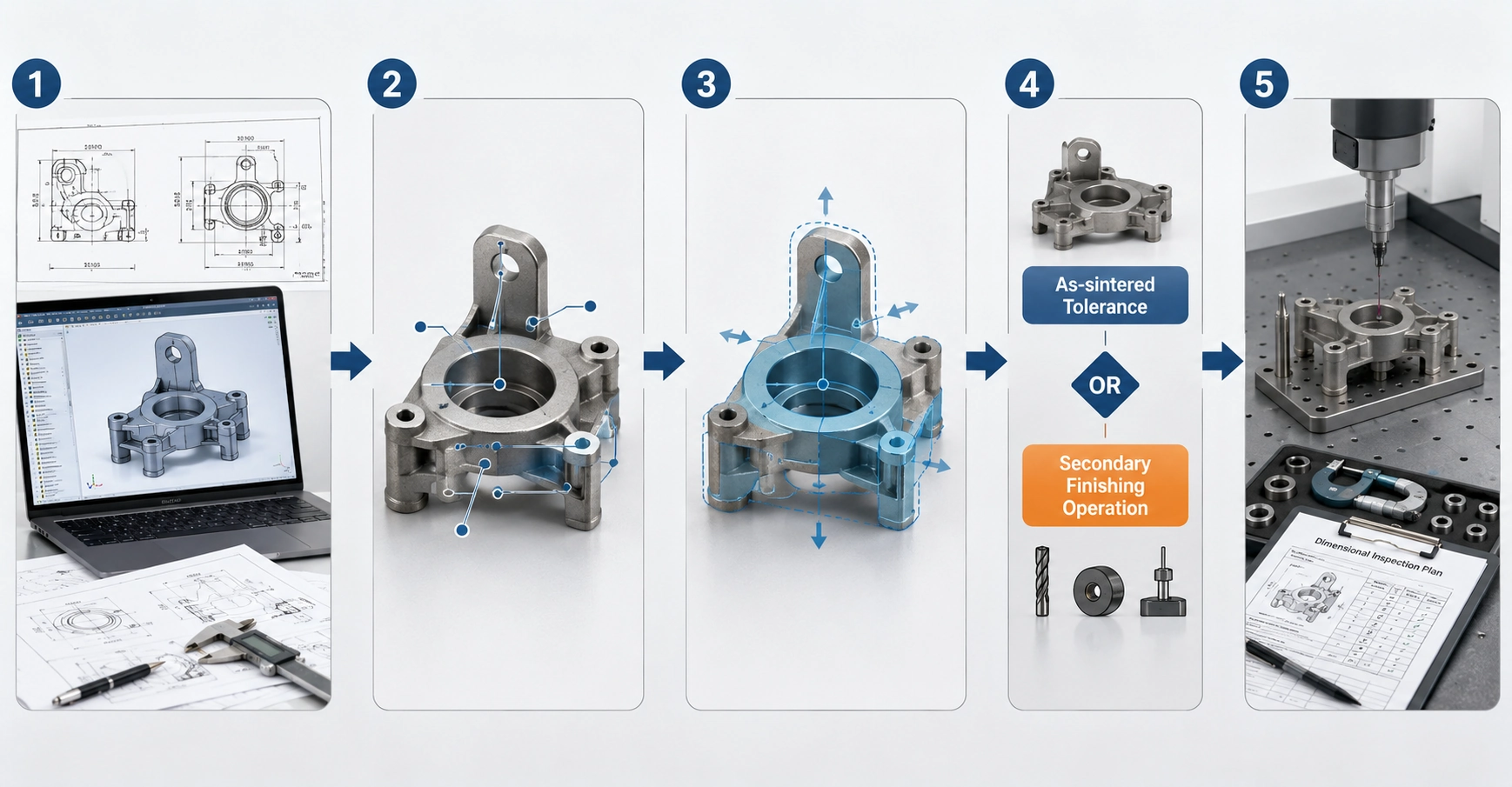
A MIM tolerance and shrinkage checklist is a pre-RFQ and pre-tooling review tool for drawings that contain CTQ dimensions, tight fits, flatness requirements, sealing faces, datum controls, or shrinkage-sensitive geometry. In metal injection molding, fine metal powder and binder are injection molded into a green part, then debound and sintered to reach a dense metal condition. Final dimensions are affected by feedstock flow, green part handling, tooling compensation, debinding support, sintering shrinkage, part geometry, and inspection method. For engineers and sourcing teams, the key question is not only “What tolerance can MIM hold?” but “Which dimensions must be controlled tightly, which features can remain as-sintered, and which areas may need design adjustment or post-sintering finishing?” Use this checklist before RFQ, mold release, or first-article approval when dimensional risk could affect assembly, cost, lead time, or production acceptance.
Quick Checklist Summary Before RFQ or Tooling
Before sending a MIM drawing for quotation or mold review, mark the functional dimensions and dimensional risks that must be checked by the supplier. This summary helps engineering, sourcing, and quality teams avoid treating every drawing dimension equally.
| レビュー項目 | What to Mark on the Drawing | 重要性 | Next Action Before RFQ |
|---|---|---|---|
| CTQ寸法 | Fit, sealing, sliding, alignment, rotation, or safety-related dimensions. | These features determine whether the part functions after sintering and assembly. | Ask the supplier to confirm as-sintered feasibility or secondary finishing need. |
| Shrinkage-sensitive features | Thin walls, long spans, flat faces, asymmetric sections, and thick-to-thin transitions. | These areas are more likely to show distortion, local dimensional drift, or support-related variation. | Request geometry, support, and shrinkage-risk review before tooling. |
| Datum and GD&T | Primary datum surfaces, position controls, flatness, perpendicularity, and concentricity. | Buyer and supplier may measure differently if datum strategy is unclear. | Confirm inspection method, datum stability, and first-article reporting format. |
| As-sintered vs finishing route | Features that require tighter tolerance, better flatness, smoother surface, or controlled diameter. | Some dimensions can remain as-sintered, while others may need machining, sizing, grinding, or coining. | Separate general dimensions from features that need a defined tolerance route. |
| RFQ input package | 2D drawing, 3D CAD, material, CTQ list, tolerance notes, surface finish, volume, and application background. | A complete package reduces quotation uncertainty and avoids late cost or lead-time changes. | Prepare the project information before requesting tooling or production review. |
When Should You Use a MIM Tolerance & Shrinkage Checklist?
Use this checklist when the part has moved beyond general process research and the drawing needs engineering review. In practice, this usually happens before RFQ, before tooling approval, during MIMのDFM, or before approving first-article samples. It is especially useful when the drawing includes functional dimensions that cannot be judged from nominal geometry alone.
You should use this checklist when:
- the drawing includes tight tolerances on multiple dimensions;
- assembly fit, sealing, sliding, rotation, or alignment depends on specific CTQ dimensions;
- the part has long, flat, thin, asymmetric, or unsupported geometry;
- feature position, channel width, concentricity, perpendicularity, or flatness is critical;
- the part was originally designed for CNC machining, die casting, stamping, or investment casting;
- the buyer expects final dimensions without knowing which features may need post-sintering finishing;
- the project team wants to reduce tooling correction risk before mold manufacturing.
A common mistake is treating MIM tolerance review as a final inspection topic. In reality, dimensional stability starts earlier: part geometry, wall thickness, feedstock flow, green part handling, debinding support, sintering shrinkage, and inspection datum all influence whether the final part can meet the drawing consistently.
When not to use this page as the only reference: if your project requires a detailed tolerance capability study, mold compensation strategy, material-specific shrinkage data, or formal inspection plan, this checklist should be used as the starting point. The detailed engineering review should continue through the relevant design guide, RFQ review, and supplier confirmation process.
If your part has already shown design risk, also review the MIM設計におけるよくあるミス that often create avoidable tooling correction and sample approval issues. For the broader checklist library, visit MIMプロジェクトチェックリスト.
What Drawing Information Should Be Prepared Before Tolerance Review?
A supplier cannot accurately review tolerance and shrinkage risk from a 3D model alone. A 3D CAD model shows geometry, but the 2D drawing defines what must be controlled, measured, accepted, or rejected. For MIM projects, the most useful RFQ package separates functional requirements from general dimensions and explains why selected features matter to the assembly.
Tolerance Review Input Checklist
| Input to Provide | 重要性 | What to Clarify Before RFQ |
|---|---|---|
| 2D図面 | Defines tolerances, datum, GD&T, surface finish, and inspection requirements. | Confirm the latest revision and mark CTQ dimensions. |
| 3D CADモデル | Helps evaluate geometry, wall thickness, moldability, and shrinkage-sensitive areas. | Provide STEP, Parasolid, or another neutral format when possible. |
| CTQ寸法 | Prevents over-controlling non-functional surfaces and missing true assembly risks. | Identify fit, sealing, sliding, alignment, or safety-related dimensions. |
| Datum structure | Controls how dimensions are measured and compared between buyer and supplier. | Confirm stable datum features before tooling. |
| 材料要件 | Material affects sintering behavior, strength, hardness, corrosion resistance, and post-processing options. | Clarify required alloy, heat treatment expectations, and performance targets. |
| 表面仕上げ | Surface requirements can influence gate location, polishing, finishing, or inspection. | Mark cosmetic and functional surfaces separately. |
| 推定年間数量 | Helps determine whether MIM tooling and secondary operations are economically reasonable. | Provide prototype, pilot, and production volume expectations. |
| 現在の製造方法 | Helps evaluate whether the drawing was over-toleranced for MIM or copied from a machining route. | State whether the part is converted from CNC, casting, stamping, or assembly. |
From a design review perspective, the most important input is not only nominal geometry. It is the relationship between function, tolerance, datum, material, surface condition, and inspection method. When this information is missing, the supplier may still quote the part, but the quotation may not reflect the real dimensional risk, secondary operation cost, or first-sample correction work.
For RFQ preparation, provide the drawing package through 図面レビューを提出 or follow the RFQ準備ガイド before sending a project inquiry.
Which Dimensions Are Truly Critical to Function?
Not every dimension on a MIM drawing should receive the same tolerance level. The first review step is to separate CTQ dimensions from general dimensions. This matters because unnecessary tight tolerances can increase tooling correction cycles, inspection burden, secondary finishing cost, and rejection risk without improving real part performance.

CTQ Dimension Review Table
| 寸法タイプ | Typical Risk in MIM | レビューアクション |
|---|---|---|
| Assembly internal diameter | Roundness, diameter, and position may affect fit. | Confirm whether as-sintered tolerance is acceptable or post-sintering finishing is needed. |
| Tight-fit feature | Excessive interference may cause cracking, deformation, or assembly failure. | Review tolerance, material strength, wall thickness, and assembly method. |
| Functional sealing face | Flatness or surface condition may not be acceptable as-sintered. | Confirm whether precision finishing, grinding, lapping, or coining is required. |
| Thin channel or narrow opening | Shrinkage variation, tool fragility, or incomplete filling may occur. | Review width, depth, wall support, gate influence, and inspection method. |
| Circular feature near thin wall | Ligament weakness and distortion risk increase. | Review wall thickness around the feature and sintering support condition. |
| Concentric feature | Datum selection and shrinkage uniformity become critical. | Confirm measurement datum and possible post-sintering finishing route. |
| 外観面 | Gate mark, parting line, or ejector mark may be unacceptable. | Coordinate with MIMゲート設計 and mold design review. |
| Non-functional outside profile | Often does not require the tightest tolerance. | Keep general tolerance unless function requires tighter control. |
CTQ Risk Classification Before Supplier Review
After CTQ dimensions are identified, classify them by project risk. This helps engineering and purchasing teams decide which dimensions need supplier confirmation, which may require design adjustment, and which can remain under general drawing tolerance.
| Risk Level | Typical Drawing Condition | Supplier Review Needed? | 推奨対応 |
|---|---|---|---|
| 低 | Non-functional outside profiles, cosmetic-neutral surfaces, or dimensions with generous tolerance. | Usually limited review. | Keep as general tolerance unless assembly or inspection requires tighter control. |
| 中 | Functional surfaces with moderate tolerance, minor flatness requirements, or features near thin walls. | Yes, before RFQ confirmation. | Ask the supplier to confirm as-sintered feasibility, inspection datum, and possible local distortion risk. |
| 高 | Tight internal diameters, sealing faces, sliding surfaces, strict concentricity, or precision feature position. | Yes, before tooling release. | Define whether the feature is as-sintered, machined, sized, ground, coined, or controlled by another secondary route. |
| Supplier Review Required | Dimensions affected by long unsupported spans, asymmetric shrinkage, unstable datum, or unclear GD&T. | Yes, with drawing and 3D CAD. | Request DFM feedback, shrinkage-risk review, and first-article inspection planning before mold manufacturing. |
| Design Change Candidate | Features with unrealistic tolerance for the geometry, weak ligaments, unsupported flatness, or conflicting datum references. | Yes, before quotation finalization. | Review geometry modification, tolerance relaxation, secondary operation planning, or datum redesign before tooling cost is locked. |
The real question is not whether MIM is precise. The real question is which dimensions must be precise for function. If a drawing applies tight tolerance to every surface, the supplier may need to add finishing or inspection steps to features that do not affect performance. That can raise cost and lengthen sample approval without improving the part.
This checklist identifies which dimensions require review before RFQ or tooling. For detailed tolerance capability, datum planning, GD&T interpretation, and inspection strategy, review the dedicated MIM公差 ガイドをご参照ください。.
Which Features Are Most Sensitive to MIM Shrinkage and Distortion?
MIM shrinkage is not only a percentage applied to the entire part. In production, dimensional stability depends on geometry, feedstock flow, wall thickness balance, green part strength, support during debinding and sintering, and how the part sits on the setter. This is why shrinkage-sensitive features should be reviewed before tooling, not only after inspection.

Shrinkage-Sensitive Geometry Checklist
| Feature or Geometry Condition | 重要性 | レビューの方向性 |
|---|---|---|
| 厚肉から薄肉への移行部 | Different section masses may shrink and cool differently. | Smooth transitions where possible and review local distortion risk. |
| 長い無支持スパン | Flatness and straightness can drift during debinding or sintering. | Review support strategy and allowable flatness. |
| Large flat surfaces | Setter contact and sintering support can affect final flatness. | Confirm support surface and inspection datum. |
| Thin walls near functional features | Weak sections may deform, crack, or shift dimensionally. | Review minimum wall, ligament width, and feature depth. |
| 非対称な質量分布 | Uneven shrinkage can shift CTQ dimensions. | Review orientation, gate position, and mold compensation. |
| Critical features near free edges | Edge distortion may affect feature location. | Consider geometry modification, support adjustment, or post-sintering finishing. |
| Deep closed-end features or narrow pockets | Powder-binder flow, tooling, and debinding may become difficult. | Review moldability, debinding path, and inspection feasibility. |
| Gate area near functional surface | Local flow, gate vestige, or density variation may affect function. | Coordinate with gate design and cosmetic requirements. |
In a checklist page, these risks should be identified, not fully solved. Detailed design decisions should be handled through dedicated reviews for MIM肉厚, holes, slots and undercuts, 焼結支持, ,および MIM焼結収縮補正.
Which Dimensions Can Remain As-Sintered and Which May Need Secondary Finishing?
Many MIM components are designed as near-net-shape or net-shape parts, but this does not mean every feature should be expected to meet the tightest tolerance as-sintered. The practical review question is: which dimensions can be controlled through MIM tooling and sintering, and which dimensions require a secondary tolerance route?

As-Sintered vs Secondary-Finished Tolerance Decision Table
| 特徴・寸法 | As-Sintered Candidate? | Secondary Route Risk | Review Note |
|---|---|---|---|
| General external profile | 多くの場合可能です | Low, unless profile controls assembly. | Avoid over-tolerancing non-functional outside surfaces. |
| Non-critical wall or rib | 多くの場合可能です | Low to medium. | Review wall balance and distortion risk. |
| Assembly internal diameter | Depends on fit requirement | Medium to high. | Precision internal features may require post-sintering finishing or sizing. |
| Fastening feature | 慎重に確認 | Medium to high. | Functional fastening areas often need post-processing confirmation. |
| Flat sealing face | Depends on sealing requirement | Medium to high. | Precision finishing, lapping, coining, or grinding may be required. |
| 摺動面 | Depends on friction and wear requirement | Medium. | Review surface finish, hardness, and dimensional stability. |
| Concentric feature | Depends on datum and tolerance | Medium to high. | May require finishing from a stable datum. |
| 外観面 | Depends on visible requirements | Medium. | Gate, parting line, and polishing strategy should be reviewed. |
In practice, secondary finishing is not a failure of MIM. It is a tolerance strategy. The problem occurs when it is discovered too late, after the buyer has expected a fully as-sintered part and the supplier has quoted without identifying the critical dimensions. That late discovery can change cost, lead time, inspection scope, and sample approval expectations.
For cost impact, compare tolerance route decisions with コストを考慮したMIM設計 before finalizing the drawing and RFQ package.
How Should Datum, GD&T, and Inspection Methods Be Reviewed?
Tolerance review is incomplete without inspection review. A dimension may appear acceptable on the drawing, but if the datum is unstable or the inspection method is unclear, the supplier and buyer may not measure the part the same way. This can create approval disputes even when the process is stable.
Datum and Inspection Review Checklist
| レビューポイント | 重要性 | Practical Check |
|---|---|---|
| Datum feature stability | Distorted or small datum surfaces can create measurement variation. | Choose datum features that remain stable after sintering. |
| GD&T interpretation | Position, flatness, perpendicularity, and concentricity require clear reference. | Confirm how each GD&T callout will be measured. |
| 検査方法 | CMM, optical inspection, plug gauge, fixture, and functional gauge may give different practical results. | Define the method for CTQ dimensions before first article. |
| Sampling plan | Not all dimensions need the same inspection frequency. | Separate CTQ inspection from general dimensional checks. |
| First-article report | Shows whether deviation is local, systematic, or measurement-related. | Require CTQ dimensions to be clearly reported. |
| Buyer-supplier measurement agreement | Prevents disputes after sample delivery. | Align datum, fixture, and acceptance criteria before tooling. |
A common mistake is treating GD&T as only a drawing language. For MIM parts, GD&T must be connected to real geometry stability, sintering behavior, support condition, and inspection access. If a critical datum is located on a surface that may warp, receive a gate mark, or contact a setter, measurement disagreement can occur even when the part appears visually acceptable.
For broader dimensional quality background, review 部品寸法が最終的なMIM部品品質に与える影響 および MIMにおける部品品質に影響を与える要因.
境界注記: this checklist should flag datum, GD&T, and measurement agreement risks. Detailed tolerance capability, statistical inspection planning, and project-specific acceptance criteria should be confirmed through the dedicated tolerance review and first-article inspection process.
How Should First-Article Results Be Used to Correct Shrinkage or Tooling Risk?
First-article inspection should not be treated as a simple pass/fail step. For MIM parts, first-article data can reveal whether dimensional variation comes from tooling compensation, local geometry, sintering support, material behavior, measurement method, or process settings. The review should classify the deviation before corrective action is selected.

First-Article Dimensional Review Steps
- Compare CTQ dimensions separately from general dimensions. Critical dimensions should be reviewed first because they affect assembly, sealing, fit, or function.
- Identify whether deviation is local or systematic. A systematic deviation may suggest tooling compensation or shrinkage factor adjustment. A local deviation may suggest wall thickness imbalance, gate effect, support condition, or feature geometry risk.
- Check whether the measurement datum is stable. Before modifying tooling, confirm that the inspection method and datum are valid.
- Separate process adjustment from mold correction. Some dimensional issues may be improved through process control. Others may require mold correction. These should not be confused.
- Confirm correction before production ramp-up. Production should not proceed until CTQ dimensions, inspection method, and correction direction are aligned.
If first-article results show shrinkage or support-related dimensional risk, the next engineering step is usually a deeper shrinkage compensation review combined with sintering, inspection, and tooling feedback. For related process effects, see how debinding and sintering affect MIM part quality.
エンジニアリングトレーニングのための複合シナリオ
Tight Functional Opening Tolerance Found Too Late
This composite field scenario illustrates why CTQ identification matters before quotation and tooling.
Flatness Drift on a Long Thin MIM Part
This composite field scenario shows why shrinkage-sensitive geometry should be reviewed before tooling.
What Should Buyers Include in an RFQ for Tolerance and Shrinkage Review?
A tolerance-focused RFQ should give the supplier enough information to judge manufacturability, not just quote a part number. For MIM, the supplier needs to understand which dimensions are functional, which surfaces are cosmetic, which features are shrinkage-sensitive, and which dimensions may need post-sintering control.
RFQ Input Package for Tolerance and Shrinkage Review
| RFQ入力項目 | Why It Helps the Review |
|---|---|
| 2D drawing with revision | Confirms tolerances, datum, GD&T, surface finish, and inspection requirements. |
| 3D CADファイル | Supports geometry, tooling, flow, and shrinkage review. |
| CTQ dimension list | 機能寸法と一般寸法を区別するのに役立ちます。. |
| Assembly or application background | Explains why certain dimensions matter. |
| 材料要件 | Affects sintering behavior, mechanical performance, and post-processing options. |
| Surface finish and cosmetic areas | Helps review gate marks, parting lines, polishing, and finishing needs. |
| 推定年間数量 | Helps judge tooling and secondary operation economics. |
| Current or target manufacturing process | Helps identify whether the drawing carries CNC-style over-tolerancing. |
| Inspection expectations | Helps align CMM, gauge, fixture, or functional inspection methods. |
| Known failure concerns | Helps focus the review on actual project risk. |
If the RFQ includes only a 3D model and a general tolerance note, the supplier may not identify the real project risk. A stronger RFQ makes the tolerance route visible before tooling: as-sintered, tool correction, secondary finishing, or design adjustment.
Request a MIM Tolerance and Shrinkage Review Before Tooling
If your MIM drawing includes tight tolerances, CTQ dimensions, shrinkage-sensitive geometry, flatness requirements, precision internal features, sealing faces, or features that may require post-sintering finishing, send your project details for engineering review before tooling.
Please provide 2D drawings, 3D CAD files, material requirements, CTQ dimensions, datum and GD&T requirements, surface finish expectations, estimated annual volume, and application background. If possible, mark CTQ dimensions, tolerance-critical features, datum surfaces, cosmetic surfaces, and any known assembly or inspection concerns before submission. The XTMIM engineering team can review tolerance route, shrinkage-sensitive geometry, as-sintered vs secondary-finished features, inspection requirements, and tooling risks before mold manufacturing or production planning.
FAQ: MIM Tolerance and Shrinkage Checklist
MIMの公差と収縮チェックリストとは何ですか?
MIMの公差と収縮に関するチェックリストは、RFQ、金型製作、初回品承認の前に使用するプロジェクトレビューツールです。エンジニアがCTQ寸法、収縮に敏感な形状、データム要件、検査方法、および焼結後の仕上げが必要となる可能性のある特徴を特定するのに役立ちます。焼結状態の寸法のみに依存するのではなく、これらの要素を考慮します。.
なぜ収縮がMIMの公差計画に影響するのですか?
MIM部品は金属粉末とバインダーから成形され、脱脂・焼結を経て最終的な緻密な金属状態に達します。最終寸法は金型の補正、焼結収縮、形状、肉厚、支持方法に依存するため、公差計画は最終検査時だけでなく、金型製作前にレビューする必要があります。.
すべてのMIM寸法を焼結ままの状態で維持できますか?
いいえ、多くのMIM寸法は焼結ままでも適切な場合がありますが、厳しい内径、シール面、精密な平面度、締結部品、摺動面、または厳格な同心度が必要な場合は、焼結後の仕上げ加工、サイジング、研削、コイニング、またはその他の二次加工が必要になることがあります。適切な工程は、機能、材料、形状、および検査要件によって異なります。.
RFQ前にどの寸法をCTQとして指定すべきですか?
組立、嵌合、シール、摺動、位置合わせ、安全性、または製品性能に影響を与える寸法をマークします。代表的なCTQ特徴には、精密内径、密嵌合部、シール面、重要特徴位置、機能流路、基準面、ならびに可動部品や相手部品に関連する特徴が含まれます。.
MIM公差レビューのためにどのようなファイルを送ればよいですか?
Send a 2D drawing, 3D CAD file, material requirement, CTQ dimension list, datum and GD&T requirements, surface finish expectations, application background, estimated annual volume, and any known failure or assembly concerns. A 3D model alone is usually not enough for tolerance review.
このチェックリストはMIM公差ガイドとどのように異なりますか?
This checklist is used to identify drawing review risks before RFQ, tooling, or first-article approval. A MIM tolerance guide explains tolerance capability, datum strategy, GD&T interpretation, as-sintered limits, and inspection planning in more detail. Use this page as a project screening tool, then review the detailed tolerance guide when a specific dimensional risk is found.
初品検査はどのように焼結収縮リスクの是正に役立ちますか?
初品検査は、寸法偏差が局所的、系統的、測定関連、工程関連、または金型関連のいずれに起因するかを判断するのに役立ちます。これにより、金型補正、工程調整、検査方法の整合、焼結サポート、または設計変更のいずれに修正の焦点を当てるべきかを決定できます。.
MIMの公差と焼結収縮のレビューはいつ依頼すべきですか?
厳しい公差、CTQ寸法、長く薄い形状、平面度要件、重要な内部形状、シール面、またはCNCスタイルの図面から変換された寸法がある部品は、金型製作前にレビューを依頼してください。.
規格および技術参考に関する注記
MIM tolerance and shrinkage review should be based on project-specific drawing requirements, material selection, part geometry, tooling design, sintering behavior, secondary operation needs, and inspection method. Industry references can support technical communication, but they should not replace supplier-specific DFM, tolerance analysis, first-article inspection, or buyer-supplier measurement agreement.
- MIMAプロセス概要:MIM — relevant because it explains the MIM process sequence from feedstock molding to debinding and sintering, supporting the need for early shrinkage and tolerance review.
- MIM二次加工 — relevant because it explains why selected features may require post-sintering operations when tighter functional requirements apply.
- MPIF規格 — relevant for material specification and technical communication in powder metallurgy and MIM projects. MPIF material standards help define material expectations, but dimensional acceptance still depends on the drawing, GD&T, supplier capability, inspection method, and first-article data.