
MIM Design for Cost: Reduce Part Cost Before Tooling
MIM design for cost means reviewing a metal injection molded part before tooling to remove unnecessary cost drivers without weakening the part, changing its function, or creating production risk. This page is not a general MIM cost guide and not a request to choose the lowest quotation. It focuses on how part design decisions affect tooling actions, gate and parting line restrictions, wall thickness, tolerance strategy, sintering support, secondary machining, inspection workload, and yield risk. In MIM, cost is not controlled only by material price or supplier negotiation. A part may look simple on a drawing but become expensive if it requires multiple mold actions, difficult support during sintering, tight tolerances on non-functional dimensions, or post-machining on many features. The goal is to make the design cost-efficient for MIM production while protecting functional faces, critical dimensions, assembly requirements, and application performance.
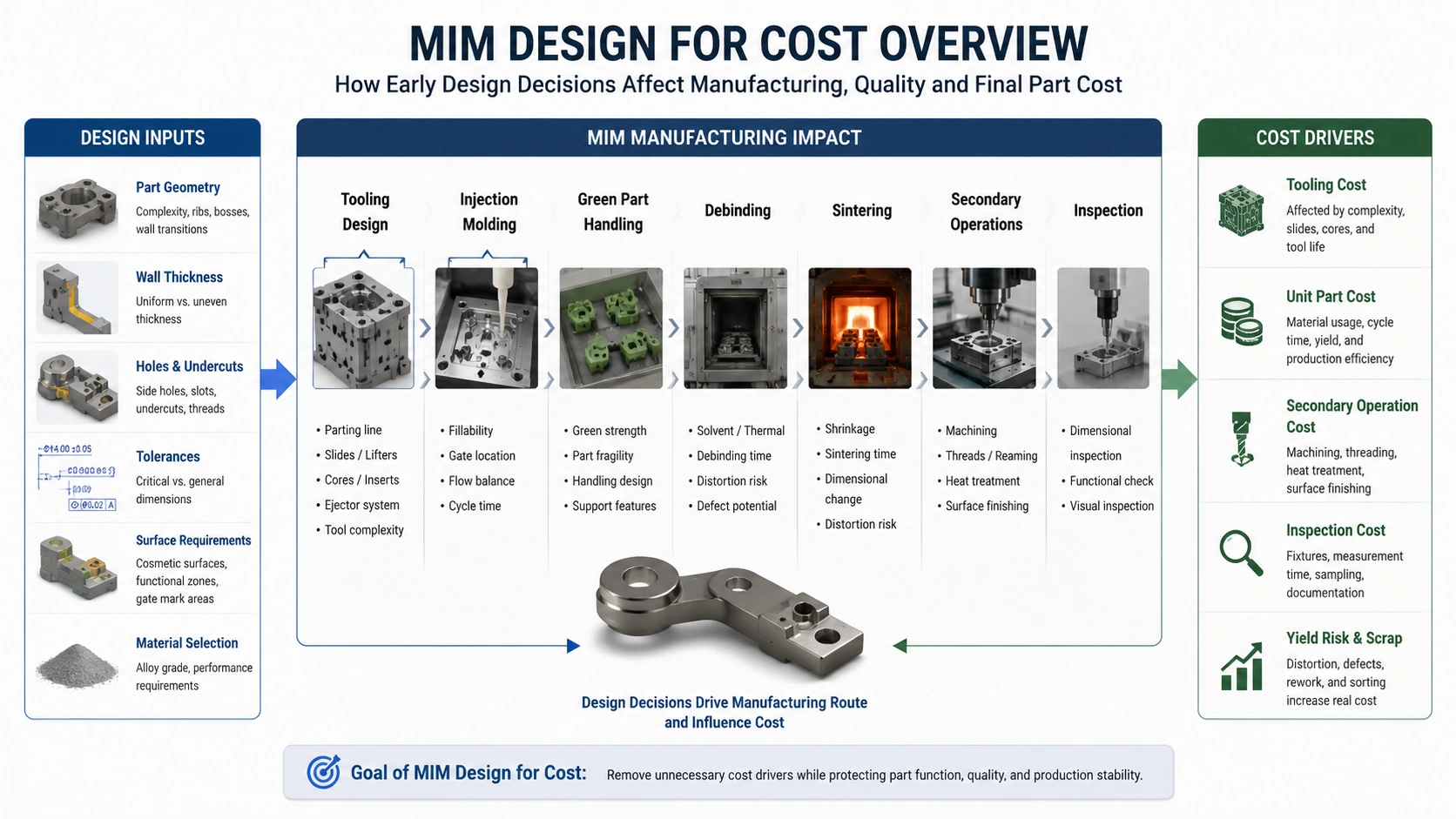
What Design for Cost Means in MIM
Design for cost is not the same as asking for a lower quote
A common mistake is to treat MIM cost reduction as a purchasing negotiation. From an engineering perspective, the larger opportunity is usually found before the quotation is finalized. If the drawing already includes unnecessary tight tolerances, avoidable tool actions, undefined visible surface areas, difficult-to-support spans, and features that require machining after sintering, the supplier has limited room to reduce cost without increasing production risk.
Design for cost in MIM should start with a structured review of part geometry, functional requirements, critical dimensions, material needs, surface requirements, and expected production volume. This page belongs to the MIM設計ガイド and focuses on how design decisions affect cost before tooling. For a broader project-level cost breakdown, review the metal injection molding cost guide.
In MIM, cost is often locked before tooling starts
MIM uses fine metal powder mixed with binder to create feedstock, followed by injection molding, green part handling, debinding, sintering shrinkage, and final inspection. Because the mold must be designed with shrinkage compensation and because the sintered part may still require secondary operations, many cost decisions are locked into the project before the first production part is made.
For example, if a side feature is perpendicular to the mold opening direction, the mold may need a slide or core mechanism. If a visible face is not clearly defined, the mold designer may need to avoid gate marks, parting lines, and ejector marks across too many areas. If every dimension is marked as critical, the inspection burden increases and the supplier may need to quote machining, sizing, or special inspection fixtures that would not otherwise be required.
The right target is cost-efficient manufacturability, not minimum specification
Cost-efficient MIM design does not mean removing all complex features. MIM is often selected because it can form small, complex, high-density metal parts that would otherwise require CNC machining, assembly, welding, or multiple forming steps. A feature that looks complex may be economically justified if it eliminates a secondary operation or reduces assembly parts.
The correct target is to remove unnecessary cost, not necessary function. A good design-for-cost review protects load-bearing areas, precision contact faces, locating features, threaded interfaces, wear surfaces, and assembly-critical dimensions. It also identifies non-critical areas where geometry, tolerance, surface finish, or inspection requirements can be simplified without changing the functional intent.
Which Design Choices Usually Increase MIM Part Cost?
Thick solid sections and uneven wall transitions
Thick solid sections can increase cost in several ways. They use more material, may require longer debinding and sintering control, and can increase the risk of shrinkage variation or distortion. The issue is not only the amount of metal powder. The real cost risk is process instability during binder removal, high-temperature sintering, and final dimensional control.
In a MIM part, the feedstock must fill the cavity, the binder must be removed, and the part must shrink during sintering in a controlled way. When one area is much thicker than another, the process window becomes more difficult. Thick sections may also require coring, section reduction, or geometry changes to improve uniformity. For deeper geometry rules, see MIM肉厚設計.
Side holes, slots, and reverse-pull features
Side holes, slots, internal profiles, and reverse-pull features are not automatically bad. They are often the reason a designer considers MIM in the first place. However, they may increase tooling cost if they require slides, core pins, lifters, inserts, or special parting line arrangements.
From a design review perspective, the first question should be whether the feature direction can be aligned with the mold opening direction. If not, the cost impact should be justified by function. A side action that replaces CNC drilling or assembly may be worthwhile. A side action added only for a minor non-functional detail should be reviewed. For feature-level guidance, review holes, slots, and reverse-pull features in MIM design.
Visible surfaces that restrict gate, parting line, or ejector layout
Undefined visible-surface requirements can quietly increase MIM cost. If the supplier does not know which faces are visible, functional, or customer-facing, the mold designer may need to avoid gate, ejector, and parting line marks across too many areas. This can make the gate location less efficient, increase mold complexity, or push marks into less visible but more functional areas.
A better approach is to define visible surface areas clearly. The drawing or 3D model should identify visible faces, contact faces, hidden faces, acceptable gate mark areas, acceptable parting line areas, and faces allowed for ejector contact. If gate location is a major concern, review MIMゲート設計.
Tight tolerances applied to non-critical dimensions
Tight tolerance is one of the most common hidden cost drivers in MIM. Some dimensions are critical to assembly, alignment, motion, or contact performance. These should be clearly controlled. But when tight tolerances are applied to every dimension, the project may require extra inspection, higher scrap control, machining allowance, sizing, or secondary correction.
A cost-efficient drawing separates critical-to-function dimensions from general dimensions. The supplier can then focus process control and inspection on the dimensions that truly affect performance. For tolerance strategy and process capability boundaries, see MIM公差.
Threads, precision bores, and precision contact faces
Some features are better designed as post-machined features from the beginning. Internal threads, precision bores, bearing seats, contact faces, and very tight fits may not be economical as fully as-sintered features. If the need for machining is discovered only after sampling, the project may face redesign, additional fixtures, extra lead time, and cost changes.
Low annual volume with a complex mold structure
MIM usually becomes more attractive when the part is small, complex, and produced in meaningful volume. If annual volume is too low, a complex mold may not be economically justified. In that case, CNC machining, metal additive manufacturing, casting, or another route may be more appropriate for early-stage development or low-volume production.
MIM Design Cost Driver Matrix
The following matrix can be used during early drawing review. It does not replace supplier-specific DFM review, but it helps engineers identify which design decisions are likely to affect tooling cost, unit cost, secondary operations, inspection workload, or yield risk before RFQ.
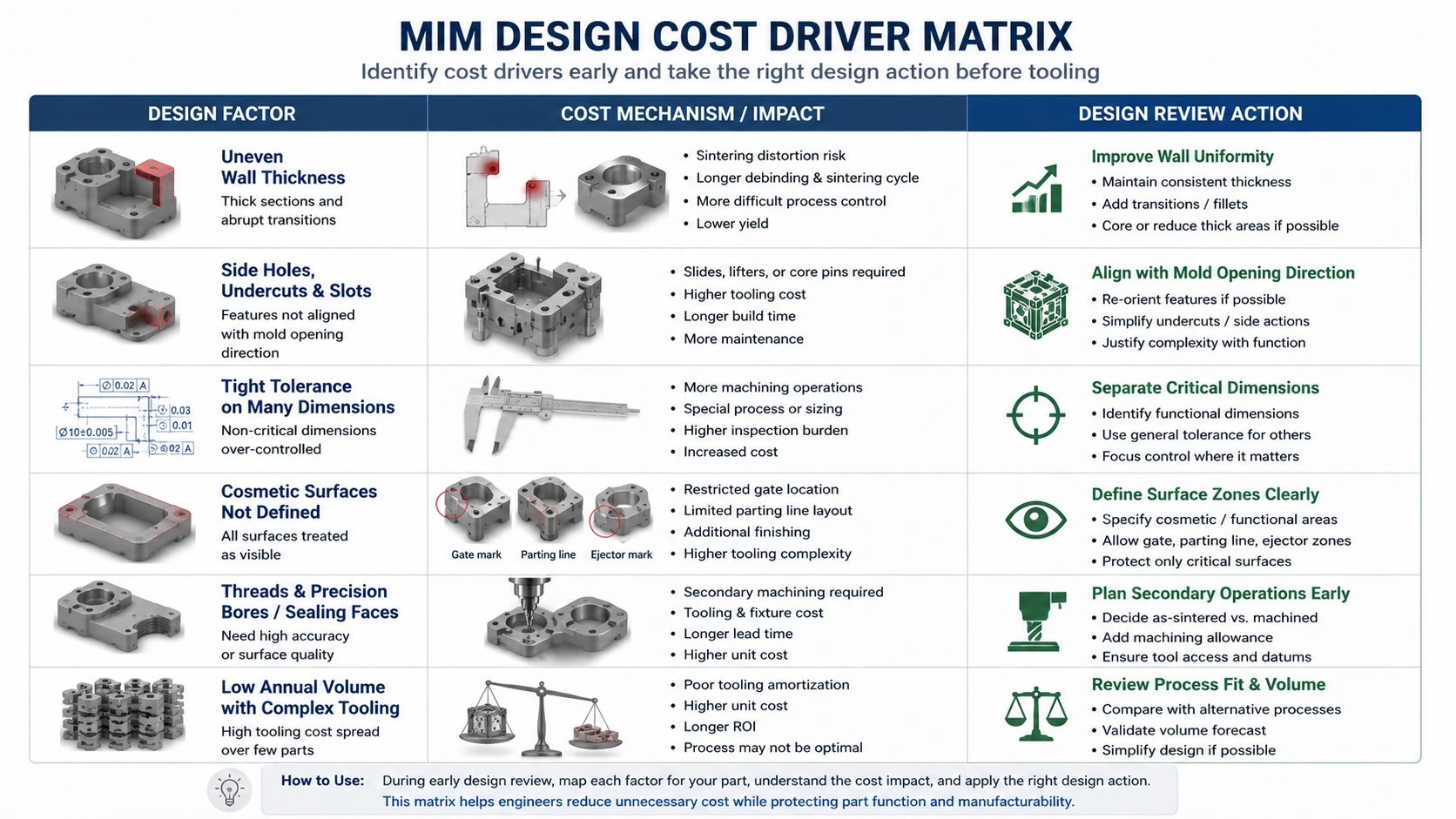
| コスト要因 | Design decision | Cost risk | Related guide | 確認事項 |
|---|---|---|---|---|
| 不均一な肉厚 | Uniform sections, smooth transitions, and coring of thick areas where function allows. | Filling, debinding, sintering, and shrinkage control become less stable. | 肉厚設計 | Improve wall uniformity or review thick areas before tooling. |
| Thick solid section | Use ribs, pockets, or internal reduction only where strength and load path remain valid. | Higher material use, longer process control, shrinkage variation, and distortion risk. | 肉厚設計 | Add coring or section reduction only after reviewing mechanical function. |
| Side holes or reverse-pull features | Align holes, slots, and reverse-pull details with mold opening direction where possible. | Slides, inserts, core mechanisms, flash control, and mold maintenance may increase cost. | 穴、スロット、アンダーカット | Keep side actions only when they replace machining, assembly, or essential function. |
| Mold complexity | Review parting line, inserts, ejection area, slides, and protected surfaces before mold design. | Tooling cost, trial correction, maintenance, and lead time may increase. | MIM金型設計 | Simplify non-functional details and confirm functional tooling requirements early. |
| Restricted visible surfaces | Define visible, functional, hidden, and acceptable mark zones. | Gate, parting line, and ejector layout become limited and may cause rework or finishing cost. | ゲート設計 | Protect only the surfaces that truly affect function, appearance, or customer requirements. |
| Tight tolerance on many dimensions | Separate critical-to-function dimensions from general dimensions. | Machining, inspection fixtures, sorting, sizing, and secondary correction may increase cost. | MIM公差 | Reserve tight tolerances for assembly, motion, contact, or datum-related dimensions. |
| Precision threads, bores, and contact faces | Decide as-sintered versus post-machined features before tooling. | Late machining decisions can cause fixture changes, redesign, and added lead time. | MIMのDFM | Plan machining allowance, access, datum strategy, and inspection method in the RFQ stage. |
| Unsupported flat areas | Review flatness, support surfaces, sintering orientation, and setter contact before tooling. | Sintering distortion, support fixture cost, sorting, and rework may increase. | 焼結サポート | Add support surfaces or adjust geometry where flatness and dimensional stability require it. |
| Shrinkage-sensitive critical dimensions | Identify critical dimensions that depend on tooling compensation and sintering stability. | Tool correction, sample iteration, and dimensional rework may increase. | 収縮補正 | Confirm critical datum, measurement basis, and correction strategy before mold release. |
| High-cost material selected too early | Match alloy choice to load, wear, corrosion, temperature, magnetic, or customer requirements. | Feedstock cost, sintering behavior, heat treatment, surface treatment, and inspection may change. | Material Selection and MIM Quality | Use the lowest-risk material that meets functional and customer requirements. |
| Low volume with complex tooling | Compare expected annual volume with tooling complexity and production life. | Mold cost may be spread over too few parts, making MIM less economical. | MIM Cost Guide | Confirm whether MIM, CNC, casting, or another process is more suitable before tooling. |
How to Reduce MIM Cost Without Weakening the Part

Keep complex features where they replace machining or assembly
A complex MIM feature can be cost-effective if it replaces a more expensive process step. For example, an integrated rib, hook, slot, boss, or internal profile may reduce CNC machining, welding, or assembly. Removing that feature may reduce tooling complexity, but it may increase total product cost if the feature must be added later by another process.
The design review should identify which complex features create value. These features should be protected. The cost-reduction effort should focus on unnecessary complexity, not on the features that justify MIM.
Remove only unnecessary complexity, not functional geometry
Not all features have the same value. A locating boss may be critical. A decorative internal corner may not. A precision contact face may need strict control. A hidden non-contact face may not. A design-for-cost review should classify features by function before making changes.
Protect these features
- Critical functional features
- Assembly and alignment features
- Load-bearing features
- Precision contact faces
- 摩耗面
Review these cost drivers
- Non-critical bulk geometry
- Unnecessary side actions
- Excessive visible-surface restrictions
- Over-tight general dimensions
- Unplanned post-machining features
Use coring to reduce thick sections when function allows
Coring can reduce material use, improve wall uniformity, and reduce thick-section process risk. However, it should not be applied blindly. Removing material from load-bearing areas, precision contact faces, thread support areas, or high-stress transitions may create mechanical risk. The correct approach is to review the load path, assembly function, and sintering stability together.
Simplify mold actions where feature direction can be adjusted
Some expensive tooling actions can be avoided by adjusting feature direction, changing a hole to a slot, modifying a recess, or redesigning a non-functional reverse-pull feature. This does not mean every side feature should be removed. It means every side action should have a reason. For tooling-specific evaluation, see MIM金型設計.
Separate critical dimensions from general dimensions
A drawing that marks too many dimensions as critical can lead to unnecessary inspection and secondary operations. A cost-efficient MIM drawing should identify dimensions that control assembly, motion, precision contact, strength, appearance, and general fit. This helps the supplier quote the correct process route and prevents the project from paying for precision where precision does not improve function.
Design more features as as-sintered when the application allows
As-sintered features are often more cost-efficient than post-machined features, but only when the required tolerance, surface condition, and functional performance are realistic for the geometry and material. Features that require bearing contact, tight sliding fit, controlled thread engagement, or precision datums may still need machining.
Tolerance, Machining, and Inspection: Where Cost Escalates Quickly

As-sintered tolerance is not the same as machined tolerance
MIM can produce high-density, complex metal parts, but the process includes debinding and sintering shrinkage. Because shrinkage compensation, material behavior, geometry, support, and furnace control all affect final dimensions, as-sintered tolerance should be treated differently from machined tolerance.
A common mistake is to apply CNC-style expectations to all MIM dimensions. This can make the quotation unnecessarily expensive or technically unrealistic. Critical dimensions should be discussed early so the supplier can decide whether they should be controlled by tooling compensation, sintering support, sizing, machining, or inspection strategy.
Tight tolerance should be reserved for functional dimensions
Tight tolerance is valuable when it protects function. It becomes wasteful when it is applied to non-functional surfaces or reference dimensions. Examples of dimensions that may justify tighter control include assembly interface dimensions, bearing or pivot features, locating datums, motion control features, and surfaces that contact mating parts.
Inspection cost rises when every dimension becomes critical
Inspection is not free. If every dimension is treated as critical, the supplier may need more fixtures, more measurement time, more documentation, or more sorting. This increases cost and may slow delivery. A clear inspection plan should focus on the features that affect function, assembly, or quality risk. For more detail, review 部品寸法が最終的なMIM部品品質に与える影響.
Secondary machining should be planned, not discovered after sampling
Secondary operations are not a problem when they are planned correctly. They become a cost problem when they are discovered late. If a bore, thread, flatness requirement, precision contact face, or precision datum requires machining, the part should include enough design allowance and access for the operation.
Material and Surface Requirements Can Change the Real Cost
Material should be selected by function, not by maximum strength alone
Material selection affects more than material price. In MIM, the selected alloy can influence feedstock availability, sintering behavior, heat treatment, corrosion resistance, hardness, magnetic response, surface finishing, and inspection requirements. Choosing a higher-grade material than the application requires may increase cost without improving product value.
The correct material review starts with application conditions: load, wear, corrosion exposure, temperature exposure, magnetic requirement, visible surface requirement, post-treatment requirement, and customer material requirement. For material-focused quality implications, review material selection and MIM part quality.
Surface finish requirements can limit gate, parting line, and post-processing choices
Surface requirements should be defined early. If a drawing requires a high visual standard across all surfaces, the mold designer may have fewer options for gate placement, ejector location, and parting line layout. Additional finishing may also be required.
A better approach is to define surface zones: functional face, visible face, hidden face, allowed gate mark area, allowed ejector mark area, allowed parting line area, and surfaces requiring polishing, coating, plating, or machining. This gives the tooling team enough freedom to protect the faces that matter without over-processing the entire part.

Composite Field Scenario 1: Tight Tolerances Applied Too Broadly
発生した問題
A small MIM mechanical part was quoted with unexpectedly high unit cost. The drawing marked many external dimensions, internal pockets, and non-contact surfaces with tight tolerances. Only two dimensions were actually critical for assembly.
発生理由
The design team had reused a CNC-machined drawing format. The tolerances were applied as a default drawing habit rather than based on MIM function, assembly, or inspection needs.
実際のシステム原因は何だったのか
The problem was not only tolerance value. The real system cause was missing tolerance classification. The supplier had to assume many dimensions were critical, which increased inspection effort and made secondary machining more likely.
修正方法
The drawing was reviewed feature by feature. Assembly-critical dimensions were kept tight. Non-contact and hidden surfaces were relaxed to more appropriate general requirements. The inspection plan was simplified to focus on functional dimensions.
再発防止方法
Before RFQ, classify every tight tolerance as functional, assembly-related, visible-surface-related, inspection-related, or non-critical. If the reason for the tolerance cannot be explained, it should be reviewed.
Composite Field Scenario 2: Side Feature Added Without Tooling Review
発生した問題
A side feature was added to a compact MIM part during late design revision. The quotation increased because the feature required a side action in the mold. The project team expected only a small cost change because the feature looked simple.
発生理由
The feature direction was not reviewed against the mold opening direction. The design team focused on the feature shape but not on how the feature would be formed.
実際のシステム原因は何だったのか
The real issue was tool action, not feature size. A side feature can add slides, core pins, maintenance requirements, flash control concerns, and mold design complexity.
修正方法
The feature function was reviewed. A revised geometry aligned the feature with a more favorable tooling direction. Where the side feature could not be eliminated, the cost was justified because it replaced a separate machining operation.
再発防止方法
During early design review, check whether each hole, slot, and reverse-pull feature can be formed in the mold opening direction. If not, decide whether the added tooling cost is justified by function or by eliminating a secondary operation. For related quality risks, review how mold design affects MIM quality.
When Cost Reduction Becomes a Manufacturing or Functional Risk
Cost reduction should never be separated from function. Some cost-saving ideas create higher risk than the cost they remove. Before accepting a design change, review the part function, mating parts, material behavior, tolerance stack-up, inspection method, and production volume.
| Cost reduction idea | Why it may be risky | What to review first |
|---|---|---|
| Loosen all tolerances | Assembly, precision contact, or motion may fail. | 機能上重要な寸法 |
| Remove material from thick areas | Strength or stiffness may be reduced. | Load path and stress concentration |
| Avoid all secondary machining | Threads, bores, or precision contact faces may not meet function. | Functional surfaces and mating parts |
| Change to a lower-cost material | Corrosion, wear, heat, or magnetic performance may fail. | 使用環境 |
| Move gate only for appearance | Filling balance or weld line risk may increase. | ゲート位置と流動経路 |
| Remove sintering support features | Flatness or distortion may become unstable. | Sintering orientation and support surfaces |
| Reduce inspection requirements too much | Defects may reach assembly or customer use. | Critical inspection points |
Design-for-Cost Checklist Before RFQ
Before sending a MIM RFQ, prepare enough information for the supplier to evaluate both manufacturability and cost drivers. A useful design-for-cost review usually needs more than a 3D model, because geometry alone does not explain material requirements, inspection priorities, annual volume, surface expectations, or the reason behind tight dimensions.

What engineers should review before releasing drawings
- Have functional and non-functional dimensions been separated?
- Are critical surfaces clearly identified?
- Are visible surfaces defined only where needed?
- Are thick sections, sharp transitions, and unsupported spans reviewed?
- Are side holes, slots, and reverse-pull features reviewed against mold opening direction?
- Are threads, bores, precision faces, and fits planned for as-sintered or machined production?
- Are material requirements based on real application conditions?
- Are surface finishing requirements clearly defined?
- Are inspection points linked to actual function?
What purchasing teams should send for a useful quotation
- 2D図面
- 3D CADファイル
- Material requirement or application environment
- Critical dimensions and tolerance notes
- Surface finish and visible-surface requirements
- 想定年間数量
- Target production life
- Mating part or assembly information
- Post-treatment requirements
- 検査要件
- Current process, if converting from CNC, casting, stamping, or another route
A MIM supplier should review whether the part can be molded, handled as a green part, debound, sintered, supported, inspected, and produced consistently. The review should also identify where cost can be reduced without changing function. For more structured preparation, use the MIM DFM設計チェックリスト および MIM公差と収縮チェックリスト.
FAQs About MIM Design for Cost
金属射出成形における設計コストとは?
MIMにおけるコスト設計とは、金型投資前に部品形状、公差、材料、表面要件、金型の複雑さ、二次加工、検査要件をレビューするプロセスです。目的は、部品の機能、組立性、品質、生産安定性を維持しながら、不必要なコスト要因を排除することです。.
このページは一般的なMIMコストガイドと同じですか?
いいえ。このページでは、金型製作前にコストに影響を与える設計上の判断に焦点を当てています。具体的には、肉厚、金型アクション、公差戦略、焼結サポート、機械加工、検査、歩留まりリスクなどです。一般的なMIMコストガイドは、通常、より広範な価格構造、金型償却、生産量、材料費、プロセス比較を扱います。.
どのような設計上の特徴が通常、MIM部品のコストを増加させますか?
一般的なコスト要因としては、厚肉部、不均一な壁厚変化、サイドホール、逆抜き形状、非重要寸法への厳しい公差、未定義の外観面、精密ねじ、精密穴、および後加工が必要な形状が挙げられます。これらの形状は必要な場合もありますが、金型製作前にレビューを行う必要があります。.
複雑なMIM部品は必ずコストが高くなるのですか?
必ずしもそうとは限りません。MIMは複雑な金属部品を量産時に経済的に成形できるため、選ばれることが多いです。複雑な形状は、CNC加工、溶接、組立を代替することで総コストを削減できる場合があります。重要なのは、その複雑さが機能的な価値を追加するのか、それとも金型やプロセスのリスクを増大させるだけなのかという点です。.
厳しい公差はMIMコストを増加させる可能性がありますか?
はい。厳しい公差は、機械加工、サイジング、追加検査、特殊治具、または厳格な工程管理を必要とする場合にコストを増加させる可能性があります。コスト効率の高いMIM図面では、機能上重要な寸法と一般寸法を分離する必要があります。.
MIM部品の二次加工はいつ計画すべきですか?
ねじ切り、精密ボア、精密接触面、ベアリング面、厳しい基準面などの形状を焼結状態で経済的に管理できない場合は、二次加工を計画する必要があります。これらの工程を金型製作前に計画することで、後での再設計や予期せぬコスト変動を回避できます。.
MIMのコスト設計レビューにはどのような情報を送ればよいですか?
2D図面、3D CADファイル、材料要件、用途背景、重要寸法、表面仕上げ要件、年間予想数量、検査要件、後処理の必要性、現在のコストや製造上の懸念事項をお送りください。.
MIMサプライヤーは部品機能を変えずにコストを削減できますか?
多くの場合、可能です。コスト削減は、重要な寸法の明確化、外観面の定義、非機能部の簡素化、必要な箇所のみへの機械加工の計画、肉厚の均一化などによって実現できます。最終的な変更は、プロジェクト固有のDFMレビューを通じて必ず確認する必要があります。.
Submit Your Drawing for Design-for-Cost Review
If your MIM part has complex geometry, tight tolerances, side features, visible surface requirements, secondary machining needs, sintering distortion risk, or cost pressure before tooling, XTMIM can review the design from a cost and manufacturability perspective.
Please send 2D drawings, 3D CAD files, material requirements, tolerance requirements, surface finish needs, estimated annual volume, application background, required secondary operations, and inspection requirements.
Our engineering team will review which design features may affect tooling cost, unit part cost, yield risk, secondary operations, inspection workload, and dimensional stability before mold release, sample trials, or production planning.
Submit Your Drawing for Design-for-Cost ReviewXTMIMエンジニアリングチームによるエンジニアリングレビュー
This article was prepared and reviewed from a metal injection molding engineering perspective. The review focuses on process suitability, material selection, DFM logic, tooling risk, sintering shrinkage behavior, secondary operation planning, tolerance strategy, inspection requirements, and production feasibility.
Final cost, tolerance capability, material suitability, and production feasibility should always be confirmed through project-specific drawing review, material review, and supplier DFM evaluation. This page does not provide fixed pricing, guaranteed tolerance values, or universal cost-reduction percentages.
規格と技術参考資料
Design-for-cost review should not rely on standards alone, but relevant technical references can support material selection, process-fit evaluation, and design discussions. These references support general design, material, and process suitability discussions; they should not be treated as fixed cost standards. Final requirements should follow the project drawing, customer specification, approved material data, and applicable formal standards.
- MIMA — Complex Designs with MIM: relevant to slides, cores, tooling complexity, and design review with a MIM parts fabricator.
- MPIF Standard 35-MIM — 金属射出成形部品の材料規格: relevant to material designation and material category review, not as a substitute for project-specific cost review.
- EPMA — 金属射出成形の概要: relevant to process-fit discussion for complex-shaped parts in quantity.
- PIM International — MIM & CIM guide for designers and end-users: relevant to cost factors including material, component size, tooling complexity, cycle time, debinding, and sintering.