Home / Blogs / What to Send for a MIM RFQ Before Asking for Price A useful MIM RFQ should be sent as an engineering review package, not only as a price request. Before asking for unit price, provide the 2D drawing, 3D CAD file, material requirement or application environment, critical tolerances, estimated annual volume, …

A useful MIM RFQ should be sent as an engineering review package, not only as a price request. Before asking for unit price, provide the 2D drawing, 3D CAD file, material requirement or application environment, critical tolerances, estimated annual volume, first order quantity, surface finish requirements, secondary operations, inspection needs, and current project stage. These inputs affect how the supplier reviews moldability, feedstock suitability, green part handling, debinding, sintering shrinkage, tooling compensation, dimensional control, post-processing, and inspection workload. If the supplier receives only a photo, part name, or rough size, the quotation may be based on assumptions that later change during DFM review. This page helps sourcing managers, project managers, and design engineers prepare a clearer MIM RFQ before tooling discussion, supplier comparison, or cost review.
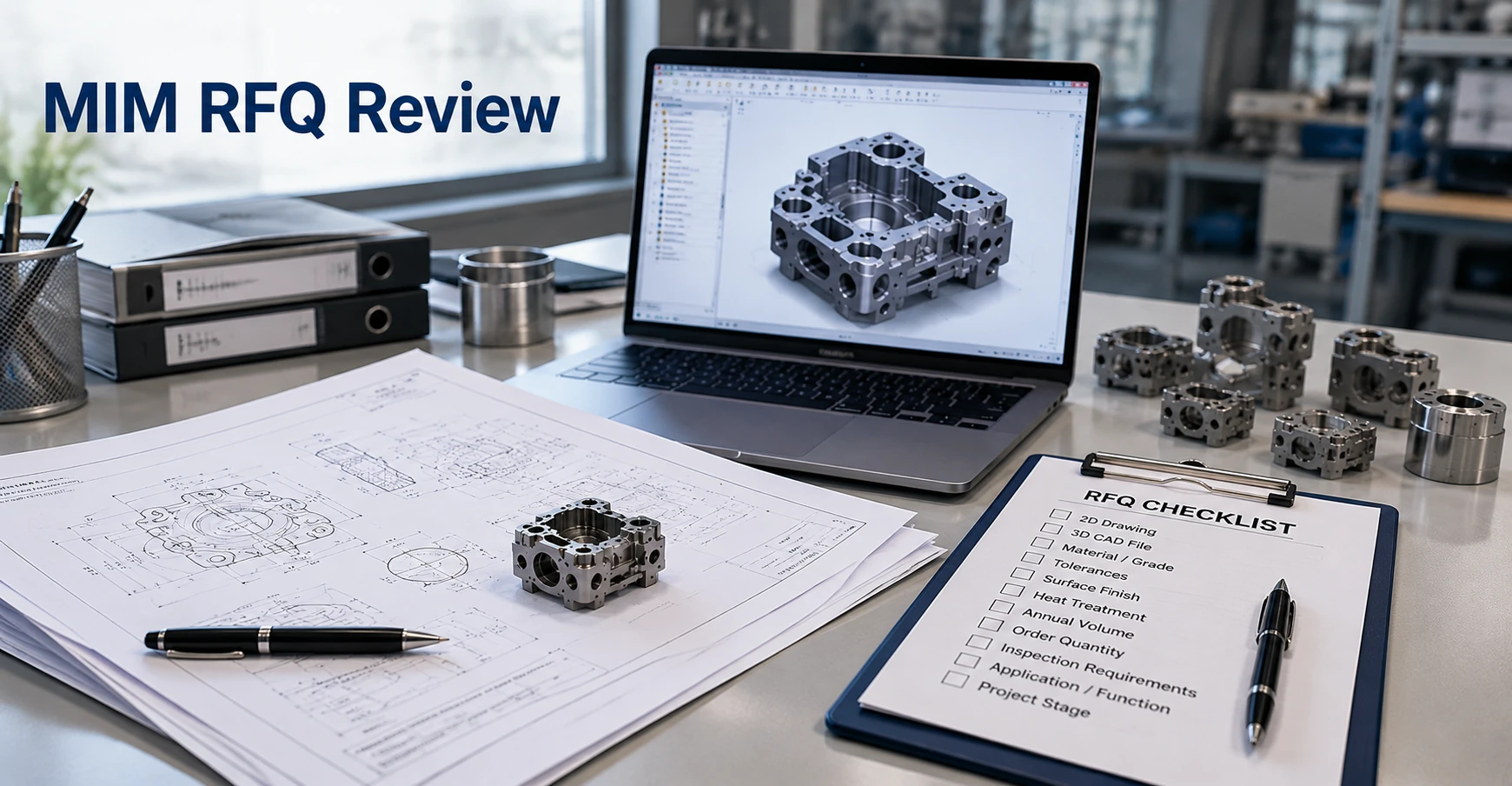
The purpose of an RFQ package is to move the discussion from rough price guessing to engineering review. For the broader preparation path, see the Guía de preparación de RFQ para MIM.
Engineering Summary: What Should You Send Before Asking for a MIM Price?
A MIM quotation becomes more reliable when the supplier can review both the component design and the project conditions behind it. The first RFQ does not need to contain every production document, but it should include enough information to judge whether the part can be molded, debound, sintered, inspected, and produced repeatedly at the expected volume.
Minimum Information for an Initial MIM Quote
- 2D drawing with revision level
- 3D CAD file, preferably STEP format
- Material objetivo o material actual
- Volumen anual estimado
- First order quantity or pilot quantity
- Critical tolerance requirements
- Requisitos de acabado superficial o recubrimiento
- Heat treatment requirements, if applicable
- Inspection or documentation needs
- Antecedentes de la aplicación
- Current manufacturing process, if the part is being converted from CNC, casting, stamping, die casting, or another process
Information That Makes the Quote More Stable
- Dimensiones críticas para la función
- Superficies funcionales
- Assembly relationship with mating parts
- Wear, load, corrosion, temperature, or cosmetic requirements
- Current cost or production problem, if available
- Expected production life
- Target launch stage: prototype, pilot run, or mass production
- Required inspection reports, first article inspection, or project documentation
- Packaging, cleanliness, or handling requirements, if relevant
The practical question is not only whether the part can be made by MIM. The more important question is whether the design, material, tolerance, volume, and inspection requirements fit the MIM process route before tooling investment begins.
| Información para RFQ | Por qué es importante para la revisión MIM | Risk If Missing |
|---|---|---|
| Plano 2D | Defines tolerances, datum structure, critical dimensions, surface notes, and inspection requirements. | Supplier may quote based on incomplete tolerance assumptions. |
| Archivo CAD 3D | Supports moldability, wall thickness, undercut, ejection, tooling, and shrinkage review. | Tooling risk and geometry problems may be missed. |
| Requisito de material | Affects feedstock, sintering route, heat treatment, corrosion resistance, strength, and availability. | Wrong material or over-specified alloy may be quoted. |
| Volumen anual | Affects tooling amortization, cavity strategy, production planning, and unit price discussion. | Unit price may be misleading or not scalable. |
| Acabado superficial | Affects polishing, passivation, coating, plating, deburring, and cosmetic review. | Secondary operation cost may be excluded. |
| Inspection needs | Affects CMM inspection, FAI, sampling, documentation, and quality workload. | Quality cost may be underestimated. |
| Antecedentes de la aplicación | Helps the supplier judge material, tolerance, surface, and failure risk. | Supplier may miss real functional requirements. |
What Happens If Key RFQ Information Is Missing?
Missing RFQ information usually does not only delay communication. It changes the assumptions behind the quotation. For MIM projects, those assumptions can affect tooling design, material selection, shrinkage compensation, inspection workload, and whether selected features should remain as-sintered or be machined after sintering.
| Missing Input | Typical Quotation Assumption | Possible Engineering or Cost Impact | Better Way to Send It |
|---|---|---|---|
| No 2D drawing | Supplier may treat dimensions as general reference only. | Critical tolerance, datum, surface, and inspection requirements may be missed. | Send drawing with revision, critical dimensions, material notes, and inspection notes. |
| No 3D CAD file | Supplier can only estimate geometry from drawing views or images. | Undercuts, wall thickness transitions, gate options, ejection risk, and tooling difficulty may be underestimated. | Send STEP or another neutral CAD file with the latest geometry. |
| No annual volume | Supplier may quote based on a one-time batch or a rough default quantity. | Tooling amortization, cavity strategy, unit cost, and production planning may not match the real project. | Send first order quantity, pilot quantity, and expected annual volume range. |
| No material or application background | Supplier may quote a common material family without understanding performance needs. | Corrosion, wear, hardness, strength, magnetic, or heat requirements may be misjudged. | Send target material, current material, or performance environment. |
| No surface or secondary operation requirement | Supplier may quote the as-sintered part only. | Polishing, passivation, heat treatment, machining, coating, or inspection cost may be added later. | State whether the quote should cover as-sintered, semi-finished, or fully finished parts. |
When this checklist is enough: It is usually enough for an initial feasibility review or rough quotation direction. When it is not enough: formal tooling quotation, production approval, customer PPAP, regulated applications, and tight functional tolerances may require more complete drawings, inspection plans, material specifications, and approval requirements.
Practical next step: If you already have a drawing package, you can envíe su dibujo para revisión so the RFQ can be checked for MIM suitability before formal pricing. For broader project preparation, you can also review the Listas de verificación de proyectos MIM.
Why a MIM Price Cannot Be Reliable From a Photo Alone
A photo can start a conversation, but it cannot define the information that controls a MIM quotation. It does not show complete geometry, internal features, wall thickness distribution, tolerance requirements, datum references, material grade, surface finish, inspection method, or production volume.
From a design review perspective, MIM pricing depends on more than shape. The supplier must understand whether the part can be injection molded with suitable gate placement, whether the green part can be handled without damage, whether debinding and sintering may create deformation, and whether shrinkage can be compensated through tooling. MIMA describes the MIM route as a process involving feedstock preparation, injection molding, green parts, debinding, and sintering, which is why pricing cannot be separated from process review. Descripción general del proceso MIM
| Buyer Sends Only a Photo | Buyer Sends Drawing + CAD + Requirements |
|---|---|
| Supplier can only estimate appearance and approximate size. | Supplier can review geometry, dimensions, tolerances, and application needs. |
| No tolerance basis. | Critical dimensions can be reviewed. |
| No material confirmation. | Feedstock, sintering, and heat treatment can be discussed. |
| No annual volume. | Tooling and production strategy can be judged more realistically. |
| Higher risk of later price revision. | More stable quotation basis. |
| Useful only for early discussion. | Suitable for engineering review and formal quotation. |
In practice, a photo-only RFQ is best treated as a screening request. It may help the supplier say whether MIM is worth exploring, but it should not be used as the basis for a final price, tooling decision, or supplier comparison.
2D Drawing vs 3D CAD: Why Both Are Needed for a MIM RFQ
Many buyers send a 3D CAD file and ask for price immediately. This is useful, but it is not always enough. A 3D model explains geometry. A 2D drawing explains the engineering requirements attached to that geometry. For MIM quotation, both are important.

A complete RFQ package usually includes both files because geometry alone does not define quality requirements, and drawing notes alone may not provide enough tooling and shrinkage review information.
What the 2D Drawing Tells the Supplier
A 2D drawing helps the supplier understand:
- Dimensiones generales
- Dimensiones críticas
- Estructura de referencia
- Geometric tolerances, if specified
- Thread, hole, slot, and groove requirements
- Flatness, concentricity, perpendicularity, or parallelism requirements
- Surface roughness notes
- Heat treatment notes
- Especificación del material
- Revision level
- Requisitos de inspección
- Functional or cosmetic zones
In production, the 2D drawing often decides whether a part can be quoted as as-sintered, whether selected features need secondary machining, or whether the tolerance strategy should be reviewed before tooling.
What the 3D CAD File Tells the Supplier
A 3D CAD file helps the supplier review:
- Complete geometry
- Wall thickness distribution
- Thin sections
- Contrasalidas
- Internal features
- Parting line options
- Gate position possibilities
- Ejection risk
- Sintering support needs
- Tooling compensation reference
- Interference with mating components, if assembly files are provided
MIMA’s design guidance explains that MIM justification is often based on the intersection of shape complexity, material performance, production quantity, and component cost. This is why the supplier needs enough design information to judge both geometry and economics, not only part appearance. guía 'Diseñando con MIM' de MIMA
When One File Is Not Enough
A 3D file without a 2D drawing may show shape but not tolerance. A 2D drawing without 3D CAD may show dimensions but not the full geometry. A photo without either file may only support a rough feasibility conversation.
| Question During RFQ Review | Best Source of Truth | Por qué es importante |
|---|---|---|
| What is the latest geometry? | Archivo CAD 3D | Tooling, gate, ejection, wall thickness, and shrinkage review depend on complete geometry. |
| Which dimensions are functionally important? | Plano 2D | Critical tolerances, datums, and inspection requirements are usually controlled by drawing notes. |
| Which surfaces must be cosmetic or functional? | 2D drawing plus application notes | Surface finish, polishing, coating, or secondary operation requirements can change quote scope. |
| Can the part remain as-sintered? | 2D drawing plus CAD review | Some dimensions may be suitable as-sintered, while selected features may require machining after sintering. |
| Does the design need DFM clarification before tooling? | 2D drawing, CAD, and project background together | MIM manufacturability depends on geometry, tolerance, material, volume, and inspection requirements together. |
For a formal RFQ, the strongest package is: 2D drawing for tolerances and requirements, 3D CAD file for geometry and tooling review, and RFQ notes for volume, application, surface finish, inspection, and project stage.
If the design is still being refined, the Guía de diseño MIM can help your team review geometry, wall thickness, holes, undercuts, shrinkage, and tolerance strategy before tooling discussion.
Material, Application, and Performance Requirements to Include
Material information should be included in the RFQ, but buyers do not always need to know the final MIM material grade at the first inquiry. If the grade is already confirmed, send it. If the material is still under evaluation, send the application conditions and performance requirements instead.
If the Material Grade Is Confirmed
Send the grade or material family, such as:
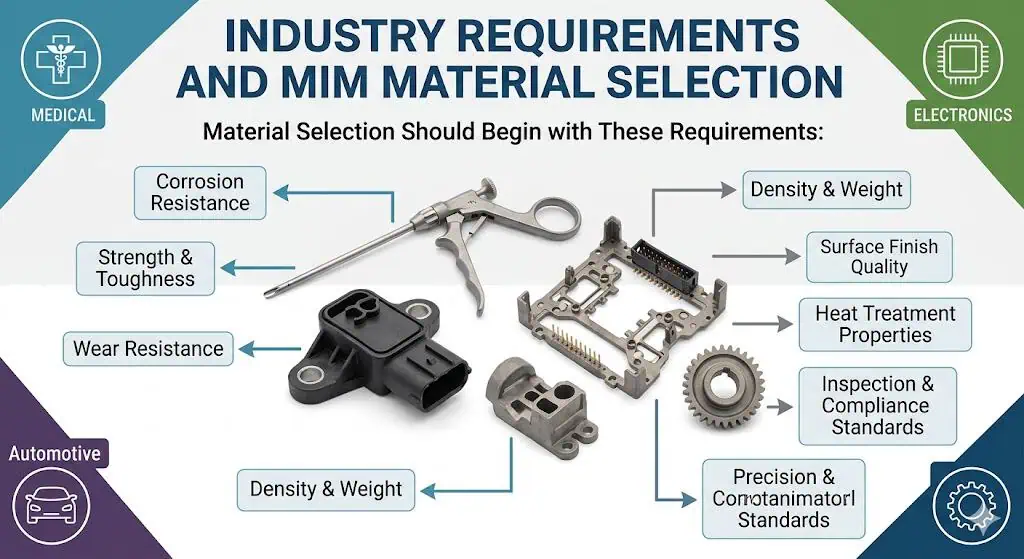
Acero inoxidable Acero de baja aleación Acero para herramientas Aleación de tungsteno Aleación de titanio Aleación de cobalto-cromo Magnetic alloy Nickel alloy
If the part is being converted from CNC or casting, also send the current material. This helps the supplier judge whether a MIM equivalent is practical or whether the selected grade may require adjustment.
If the Material Is Not Confirmed
Send the functional requirements:
- Resistencia a la corrosión
- Resistencia al desgaste
- Resistencia
- Dureza
- Respuesta magnética
- Resistencia al calor
- Biocompatibility requirement, if applicable
- Cosmetic surface requirement
- Chemical exposure
- Contact load or friction condition
This matters because material choice affects feedstock availability, sintering behavior, heat treatment, surface treatment, and cost. MIMA notes that MIM powders vary by chemistry, particle size, and particle shape, and powder availability affects which engineering materials can be produced by MIM. Rango de materiales MIMA
Avoid Over-Specifying Material Without Application Context
A common RFQ mistake is to specify a high-performance alloy without explaining the load, corrosion, wear, magnetic, temperature, or cosmetic requirement behind it. In some projects, the selected alloy is necessary. In others, the buyer may be carrying over a CNC material grade that is not the most practical MIM option. Application background helps the supplier review whether the material direction is realistic before tooling.
For broader material options, see the los materiales MIM página.
Tolerance, Critical Dimensions, and Inspection Requirements
Tolerance information is one of the most important parts of a MIM RFQ. It affects tooling review, sintering risk, secondary operations, inspection method, and quote accuracy.

If critical dimensions are not marked early, the supplier may not know which features require tighter process control, secondary machining, functional gauging, or inspection reporting.
Mark Critical Dimensions Instead of Tightening Every Dimension
A common quoting problem is that every dimension on the drawing is given a tight tolerance. This may make the part look more controlled, but it often creates confusion during RFQ review. Not every dimension affects function. If all dimensions are treated as critical, the supplier may assume extra inspection, tooling correction, or secondary machining is required.
A better RFQ separates:
- Dimensiones críticas para la función
- Assembly dimensions
- Dimensiones cosméticas
- Non-critical reference dimensions
- Features that may remain as-sintered
- Features that may require secondary machining
From a MIM process perspective, the important issue is not only whether a tolerance can be measured. The key question is whether it can be controlled through molding, debinding, sintering, support, tooling compensation, and inspection without creating unnecessary cost or yield risk.
Inspection Requirements That Should Be Sent With the RFQ
Send inspection requirements if they are known:
- CMM inspection requirement
- First article inspection requirement
- Visual inspection criteria
- Requisito de acabado superficial
- Requisito de dureza
- Density or mechanical property requirement, if relevant
- Critical dimension report
- Sampling requirement
- Material certificate or compliance documentation, if required by the project
Why Inspection Requirements Affect Quote Accuracy
Inspection is not only a quality activity after production. It affects quote preparation. If the part requires CMM reports for many features, functional gauge design, 100% visual inspection, special documentation, or post-treatment verification, those requirements should be known before quotation.
If inspection requirements are not shared early, the quoted unit price may exclude work that becomes mandatory later.
Annual Volume, First Order Quantity, and Project Stage
Annual volume is one of the most important inputs in a MIM RFQ. MIM usually involves tooling and engineering setup, so the supplier needs to know whether the project is a prototype test, a pilot run, or a repeat production program.
Why Annual Volume Matters More Than One-Time Quantity
A first order quantity may be small, but the annual volume may be large. Or a buyer may request a small batch without explaining that the project is still in validation. These are different situations.
Annual volume affects:
- Amortización del herramental
- Number of mold cavities
- Production scheduling
- Planificación de inspección
- Material purchasing
- Planificación de operaciones secundarias
- Long-term cost discussion
- Whether MIM is economically reasonable
MIMA’s design guidance also connects MIM suitability with production quantity and component cost, which supports the need to send volume information during RFQ preparation. guía 'Diseñando con MIM' de MIMA
What to Send If the Project Is Still Early
If the annual volume is not final, send a range:
- Cantidad de prototipos
- Pilot quantity
- Estimated annual volume range
- Expected product life
- Fecha de lanzamiento objetivo
- Proceso actual
- Main reason for considering MIM
Example RFQ note: “We are currently evaluating MIM for this part. The first trial quantity may be small, but expected annual demand may reach medium-volume production after validation. Please review whether MIM is suitable before formal tooling discussion.”
This gives the supplier enough context to avoid quoting the project as a one-time small batch. For a more complete cost discussion, see costo de moldeo por inyección de metal.
Surface Finish, Heat Treatment, and Secondary Operations
MIM can often produce near-net-shape parts, but many projects still require secondary operations. These should be mentioned in the RFQ because they can affect cost, lead time, inspection, and production planning.
Secondary Operations to Mention
Send requirements for:
- Pulido
- Pasivación
- Plating
- Recubrimiento
- Tratamiento térmico
- Machining of critical features
- Thread tapping
- Drilling
- Rectificado
- Desbarbado
- Marcado láser
- Ensamblaje
- Joining
- Cleaning
- Control de superficie cosmética
MIMA notes that MIM components can use secondary operations such as machining, tapping, drilling, grinding, heat treatment, joining, and surface treatments, and that these operations can increase component cost. MIMA Secondary Operations
Why These Requirements Should Be Sent Before Pricing
If a buyer requests price for the sintered part only, but later requires polishing, passivation, heat treatment, or machining, the final cost and lead time may change. In RFQ review, the supplier needs to know whether the quote should cover:
- As-sintered part only
- As-sintered part plus selected secondary machining
- Fully finished part
- Finished part with inspection report
- Finished part ready for assembly
The more clearly this is stated, the less likely the quote will need major revision later.
Common RFQ Mistakes That Lead to Wrong or Delayed MIM Quotes
A delayed quotation is often not caused by slow sales response. In many cases, the supplier cannot quote responsibly because key engineering information is missing.
| RFQ Mistake | Why It Causes Quote Risk | Better RFQ Input |
|---|---|---|
| Sending only a photo | Geometry, tolerance, material, and volume cannot be verified. | Send 2D drawing, 3D CAD, material, and quantity. |
| Sending 3D CAD without 2D tolerances | The supplier sees shape but not functional requirements. | Add drawing notes and critical dimensions. |
| Tight tolerance on every dimension | Quote may include unnecessary inspection or machining. | Mark critical dimensions and use reasonable general tolerances. |
| No annual volume | Tooling amortization and cavity strategy cannot be judged. | Provide annual demand or expected range. |
| No material background | Material may be over-specified or unsuitable for MIM. | Send material grade or application environment. |
| No surface finish requirement | Polishing, plating, passivation, or coating may be excluded. | State final surface condition. |
| No inspection requirement | Quality workload may be underestimated. | State CMM, FAI, visual, or documentation needs. |
| Comparing MIM with CNC price only | MIM economics depend on tooling and production volume. | Explain current process and production target. |
Composite Field Scenario for Engineering Training: Photo-Only RFQ
¿Qué problema ocurrió? A buyer requested a MIM price using only a photo of a small metal bracket and an approximate size.
¿Por qué ocurrió? The photo showed the part shape, but not the tolerance requirements, material, wall thickness, functional surfaces, or annual volume.
¿Cuál fue la causa real del sistema? The RFQ was treated as a price request before it was treated as a manufacturing review. The supplier could not judge whether the part was suitable for MIM, whether the geometry needed tooling changes, or whether any features required secondary machining.
¿Cómo se corrigió? The buyer later provided a 2D drawing, STEP file, material requirement, estimated annual volume, and marked critical dimensions. The supplier could then review MIM suitability and clarify whether selected features should remain as-sintered or be machined after sintering.
Cómo prevenir la recurrencia: Before asking for price, send the drawing package and project background. A photo can start a conversation, but it should not be the basis for a formal MIM quotation.
Minimum RFQ Package vs Production-Ready RFQ Package
Not every buyer has complete information at the first inquiry. That is normal. The key is to identify what stage the project is in and send the right level of information.

Buyers do not need perfect documentation at the first conversation, but they should make the project stage clear. A more complete RFQ package helps the supplier review tooling, tolerance, material, inspection, and production feasibility more accurately.
| RFQ Stage | Adecuado para | Qué enviar | What the Supplier Can Review |
|---|---|---|---|
| Minimum RFQ Package | Early feasibility and rough quote direction | 2D drawing, 3D CAD, material idea, estimated quantity | Basic MIM suitability, rough cost direction, obvious geometry risks |
| Engineering Review Package | Before tooling discussion | Critical dimensions, application, surface finish, inspection needs, current process | DFM risk, material fit, tolerance risk, secondary operation needs |
| Production-Ready RFQ Package | Formal supplier comparison or sourcing | Full drawing package, CAD, material specification, annual volume, inspection plan, approval process, packaging notes | Quotation, tooling strategy, quality planning, production feasibility |
What Package Should You Send?
- Use a minimum RFQ package if you are asking: “Is MIM worth considering for this part?”
- Use an engineering review package if you are asking: “What design, material, tolerance, or tooling risks should be reviewed before tooling?”
- Use a production-ready RFQ package if you are asking: “Can this supplier provide a formal quotation for supplier comparison or production planning?”
How XTMIM Reviews a MIM RFQ Before Quotation
A useful RFQ review should not begin with unit price alone. For MIM parts, the engineering team should first check whether the part is suitable for the process and whether any assumptions need clarification before quotation.

Missing material, tolerance, volume, or surface information often causes quote revisions. A simple review workflow helps buyers see where their RFQ inputs fit into the supplier’s engineering process.
A typical MIM RFQ review includes:
- Drawing and CAD completeness check
- MIM process suitability review
- Revisión del material y la aplicación
- Wall thickness, undercut, hole, slot, and feature risk review
- Tolerance and shrinkage risk review
- Tooling, gate, parting line, and ejection feasibility review
- Debinding and sintering deformation risk review
- Secondary operation and surface finish review
- Inspection and documentation review
- RFQ clarification before pricing
This process helps identify questions that should be answered before tooling, such as:
- Is the selected material practical for MIM?
- Are critical dimensions realistic as-sintered?
- Are any features better machined after sintering?
- Does the annual volume justify MIM tooling?
- Is the current design likely to deform during debinding or sintering?
- Are surface or inspection requirements missing from the RFQ?
For more details about supplier-side project review, visit XTMIM engineering review capability.
Simple MIM RFQ Email Template
Use the following structure when sending a MIM RFQ. The purpose is not to force a long email, but to give the supplier enough engineering context to review the part before pricing.
Subject: RFQ for MIM Part – Drawing and CAD Attached

Hello XTMIM Engineering Team,

We are evaluating metal injection molding for the attached part. Please review whether this design is suitable for MIM before quotation.

Attached files:
- 2D drawing with revision level
- 3D CAD file
- Any available sample photos or assembly references

Project information:
- Target material: [insert grade or material family]
- Application environment: [insert load, wear, corrosion, temperature, cosmetic, or assembly requirements]
- Estimated annual volume: [insert range or quantity]
- First order or trial quantity: [insert quantity]
- Critical dimensions: [mark on drawing or describe]
- Surface finish / coating / heat treatment: [insert requirement]
- Inspection or documentation needs: [insert requirement]
- Current process, if applicable: [CNC / casting / stamping / die casting / other]
- Main project goal: [cost review / miniaturization / assembly reduction / material performance / production scale-up]

Please review MIM feasibility, material suitability, tolerance risk, tooling considerations, secondary operation needs, and any questions that should be clarified before pricing.

Best regards,
[Name / Company]
Engineering Note: Tight Tolerances on Every Dimension
¿Qué problema ocurrió? A buyer sent a complete drawing but applied tight tolerances across almost every dimension.
¿Por qué ocurrió? The buyer wanted to avoid quality risk, but did not separate functional dimensions from non-critical dimensions.
¿Cuál fue la causa real del sistema? The drawing did not communicate which dimensions controlled assembly or performance. During RFQ review, the supplier had to assume that many features might require additional inspection or secondary machining.
¿Cómo se corrigió? The buyer marked critical dimensions, clarified mating surfaces, and allowed reasonable general tolerance for non-critical features. The supplier could then separate as-sintered dimensions from features that might require post-sintering machining or tighter inspection.
Cómo prevenir la recurrencia: Before RFQ, mark critical-to-function dimensions and explain the assembly relationship. Tight tolerance should be used where it protects function, not as a default setting for every feature.
RFQ Readiness Checklist Before You Contact XTMIM
Before sending a MIM RFQ, check whether your package gives the supplier enough information to separate feasibility review, cost discussion, tooling planning, and production risk. If some items are not yet available, state that clearly instead of leaving the supplier to assume.
Design Files
- 2D drawing with revision level
- 3D CAD file, preferably STEP
- Marked critical dimensions
- Assembly reference if available
Requisitos de ingeniería
- Target material or performance need
- Requisito de acabado superficial o recubrimiento
- Heat treatment or hardness requirement
- Inspection and documentation needs
Commercial Context
- Prototype or pilot quantity
- Volumen anual estimado
- Project stage and launch timing
- Current manufacturing process, if converting to MIM
Best practice: If the project is still early, send the available files and explain what is still undecided. A clear “unknown” is better than leaving material, tolerance, volume, or surface finish requirements unstated.
FAQ: Sending Information for a MIM RFQ
¿Puedo solicitar una cotización MIM sin un dibujo 2D?
Sí, pero solo para una discusión temprana de viabilidad. Una cotización confiable de MIM generalmente requiere un dibujo 2D porque el proveedor debe revisar tolerancias, referencias de datum, dimensiones críticas, notas de material, requisitos de superficie y necesidades de inspección. Sin un dibujo, el precio puede basarse en suposiciones que luego cambian durante la revisión de ingeniería.
¿Es suficiente un archivo CAD 3D para una cotización de MIM?
Un archivo CAD 3D es muy útil para revisar geometría, espesor de pared, socavados, viabilidad del herramental y compensación por contracción. Sin embargo, generalmente no define todos los requisitos de tolerancia, inspección, acabado superficial, material y funcionales. Para una solicitud de cotización más sólida, envíe tanto el CAD 3D como el dibujo 2D.
¿Por qué es importante el volumen anual para el precio del MIM?
El MIM generalmente requiere herramental y configuración de ingeniería. El volumen anual afecta la amortización del herramental, la estrategia de cavidades, la compra de materiales, la planificación de producción, la carga de inspección y la discusión del precio unitario. Un pedido inicial pequeño puede ser razonable si el volumen anual esperado justifica la producción MIM.
¿Qué pasa si el material aún no está confirmado?
Si el material final no está confirmado, envíe el entorno de aplicación y los requisitos de rendimiento. Por ejemplo, explique si la pieza necesita resistencia a la corrosión, resistencia al desgaste, resistencia mecánica, dureza, respuesta magnética, resistencia al calor o calidad de superficie cosmética. El proveedor podrá entonces revisar las posibles direcciones de material MIM.
¿Debo enviar información de costos actuales de CNC o fundición?
Si el proyecto se está convirtiendo desde CNC, fundición, fundición a presión, estampado u otro proceso, los costos actuales y los problemas de producción pueden ayudar al proveedor a comprender el objetivo del proyecto. Sin embargo, el precio de MIM debe evaluarse según la geometría, el material, la tolerancia, el volumen, el herramental, las operaciones secundarias y los requisitos de inspección.
¿Qué información ayuda a evitar demoras en la cotización?
Envíe un paquete completo de RFQ: plano 2D, archivo CAD 3D, requisitos de material o aplicación, tolerancias críticas, volumen anual, cantidad del primer pedido, acabado superficial, tratamiento térmico, necesidades de inspección y etapa del proyecto. La falta de información suele provocar aclaraciones repetidas antes de la cotización.
¿Puedo enviar solo un paquete mínimo de RFQ para una revisión de factibilidad temprana?
Sí. Si el proyecto aún está en etapa temprana, un paquete mínimo de RFQ puede ser suficiente para una evaluación de factibilidad. Envíe el plano 2D disponible, el archivo CAD 3D, la idea del material, la cantidad estimada y las notas de aplicación. También indique qué requisitos aún no están definidos para que el proveedor no trate las suposiciones como insumos finales de cotización.
¿Puede XTMIM revisar la manufacturabilidad antes de cotizar?
Sí. Para proyectos MIM, la revisión de manufacturabilidad debe realizarse antes de la cotización formal cuando la pieza presente riesgos en geometría, tolerancia, material o volumen de producción. Envíe planos, archivos CAD, requisitos de material, tolerancias, acabado superficial, necesidades de inspección, volumen anual y antecedentes de la aplicación para su revisión.
Prepare Your MIM RFQ for Engineering Review
If you are preparing a MIM RFQ, send your 2D drawing, 3D CAD file, target material or application environment, critical tolerances, annual volume, surface finish requirements, secondary operation needs, inspection requirements, and project stage.
XTMIM can review whether your part is suitable for MIM, whether the geometry has tooling or sintering risks, whether the selected material is practical, whether critical dimensions may require secondary machining, and what information should be clarified before tooling, pilot production, or repeat production.
Enviar Plano para Revisión Contactar a XTMIMNota sobre normas y referencias técnicas
MIM RFQ preparation should be based on project-specific drawings, CAD data, material requirements, tolerance needs, production volume, and supplier process capability. Industry references can support the discussion, but they should not replace engineering review or the formal requirements stated on a drawing, material specification, purchase specification, or customer quality document.
- Descripción general del proceso MIMA: MIM — relevant because it explains the MIM process route, including feedstock preparation, injection molding, green parts, debinding, and sintering.
- guía 'Diseñando con MIM' de MIMA — relevant because it connects MIM suitability with shape complexity, material performance, production quantity, and component cost.
- Normas MPIF — relevant for powder metallurgy and metal injection molding material specification communication. Project-specific requirements should still be confirmed against the applicable standard edition and customer drawing.
- MIMA Secondary Operations — relevant because operations such as machining, tapping, drilling, heat treatment, joining, and surface treatments may affect MIM component cost.