First MIM inquiry | RFQ documents and requirements What should you send for a MIM RFQ? Send the latest 2D drawing and a matching 3D CAD file (STEP preferred). Include the material specification or operating conditions, function-critical dimensions and tolerances, initial order and estimated annual quantities, surface finishing and secondary operations, inspection requirements, and project …
First MIM inquiry | RFQ documents and requirements
What should you send for a MIM RFQ? Send the latest 2D drawing and a matching 3D CAD file (STEP preferred). Include the material specification or operating conditions, function-critical dimensions and tolerances, initial order and estimated annual quantities, surface finishing and secondary operations, inspection requirements, and project stage. Tell the supplier whether you need an initial feasibility review, budgetary pricing, or a quotation for a defined production and delivery scope.
The supplier needs to know what the part must do and exactly what the quoted deliverable includes. You can begin a feasibility discussion before every requirement is final; mark unresolved items as open for review rather than leaving the supplier to guess.
Early feasibility or budget discussion
Send your best available drawing, model, application, material direction, and estimated volume. Identify missing details and ask which issues must be reviewed first.
Defined-scope quotation
Send controlled revisions and clear tolerance, material, finishing, quantity, inspection, and acceptance requirements. Request a written record of exclusions and assumptions.
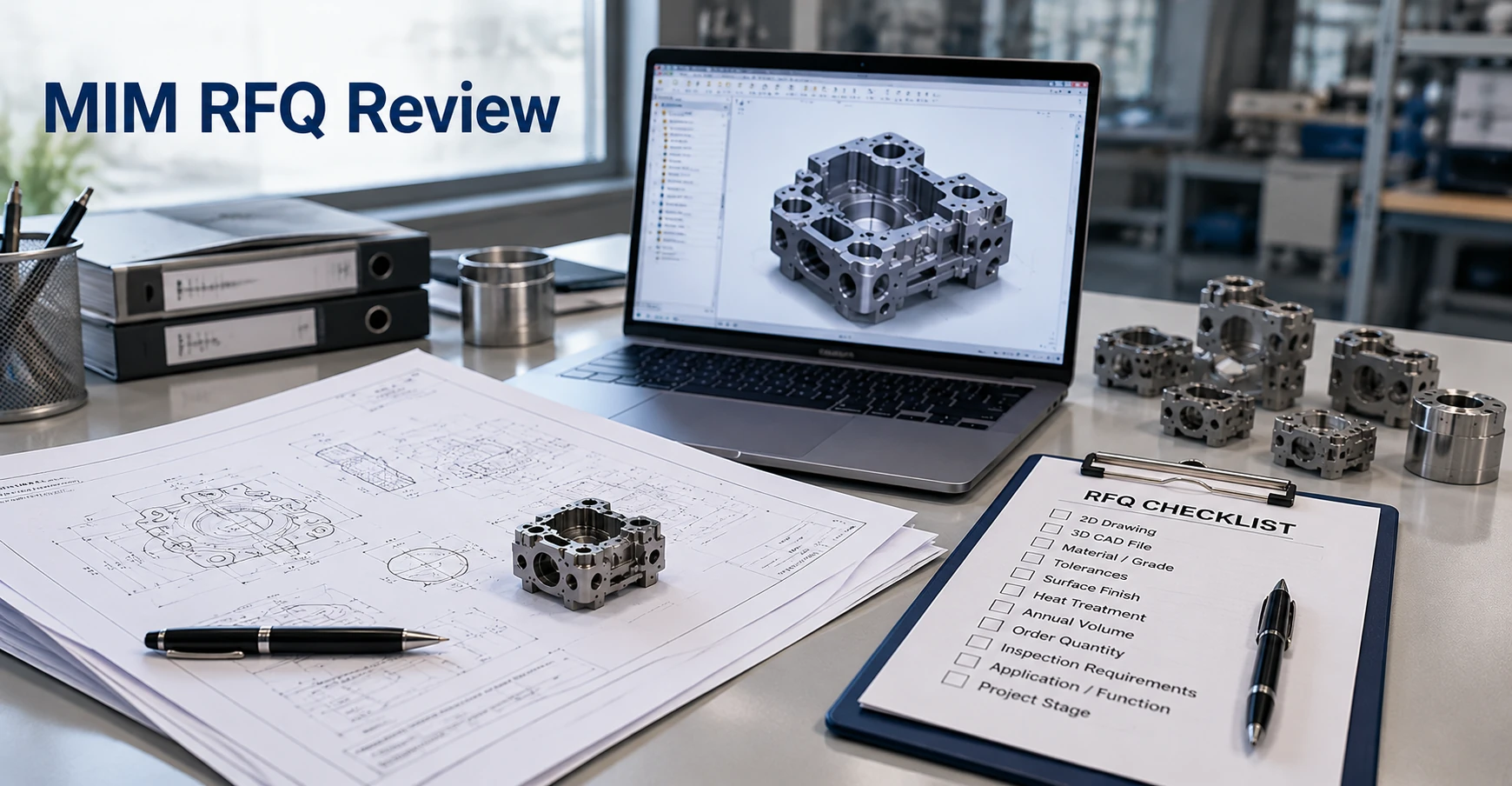
Which Design Files Should You Send with a MIM RFQ?
Send a readable 2D technical drawing and, where available, a matching 3D CAD model. The drawing defines dimensions, tolerances, and acceptance requirements. The model provides the geometry needed to assess injection molding, debinding, and sintering. Both files should carry an unambiguous part number and revision.
2D Drawing: Dimensions, Tolerances, and Revision Control
The controlled 2D PDF should show the part number, revision, and measurement units. Include overall and function-critical dimensions, relevant datums and geometric tolerances, thread and hole details, material specifications, finishing or heat-treatment notes, and inspection or reporting requirements where applicable. If a requirement applies only to a particular version, identify that version on the drawing.
On a small support bracket, a locating pin hole may control assembly fit while other dimensions define the outer profile. Identifying the hole and its mating feature lets the supplier assess whether it can meet the required tolerance as-sintered or whether machining and measurement after sintering should be included. The drawing must still specify the acceptance requirements for all features.
3D CAD File: Geometry and Matching Design Revision
Include a STEP file or another CAD format the supplier can open. It allows review of wall thickness transitions, undercuts, hidden features, mold parting, ejection constraints, and sintering-sensitive geometry. For a CNC-to-MIM or casting-to-MIM conversion, also identify any threads, precision bores, or reference surfaces expected to remain machined after sintering.
Match the model and drawing revisions and units. If the model has changed since the drawing was issued, list the differences and identify which file governs the quotation. Clear filenames help: BRK-014_RevB_Drawing.pdf and BRK-014_RevB_Model.step.
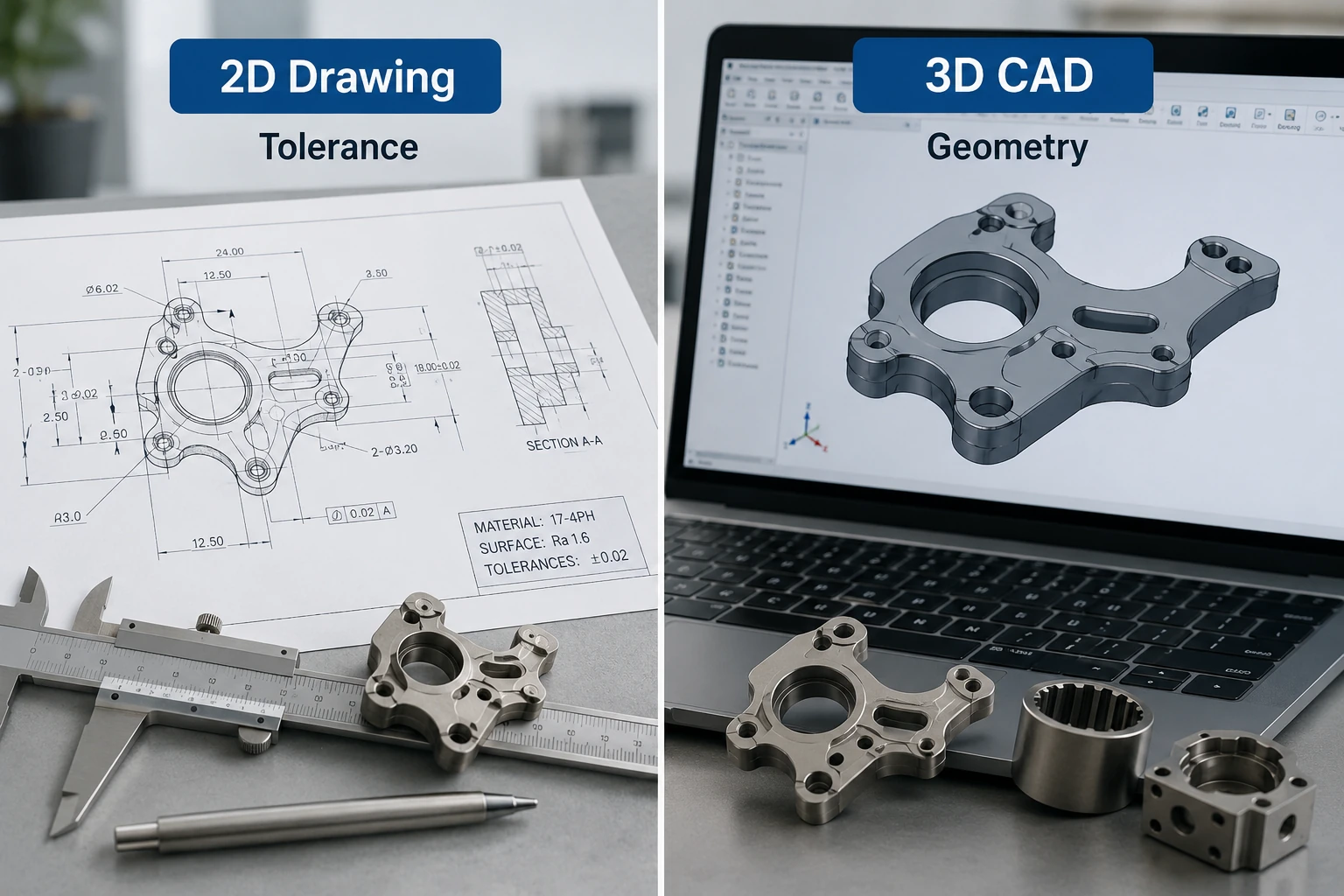
Only have a photograph, sample, or draft model? Send what you have and ask for an initial screening. A photograph cannot reliably communicate hidden geometry, tolerances, materials, or final surface condition. A supplier may be able to identify the next required documents, but a firm tooling or production quotation will normally require further definition.
What Part and Project Requirements Should Accompany the Files?
The drawing defines the part; the RFQ summary defines the conditions under which it will be made and supplied. Include the material or performance requirement, critical functions, delivered condition, inspection scope, and anticipated production demand so the supplier can price the intended scope rather than an assumed one.
Material Grade or Functional Performance Requirements
If a material has been approved, give its exact grade, applicable standard, required condition, and any customer specification. For example, 316L, 17-4 PH, and 420 are different stainless-steel requests; writing only "stainless steel" leaves key requirements unclear. Even an exact grade does not confirm feedstock availability or suitability for the intended service. When converting from CNC or casting, identify the existing grade and whether substitution is permitted.
If the grade is not yet approved, describe the service conditions: corrosion exposure, contact load, wear, hardness, temperature, magnetic behavior, cosmetic appearance, and assembly environment as relevant. Distinguish mandatory performance requirements from preferred material options. The supplier may evaluate an alternative, but an approved grade or specification should not change without engineering authorization. The MIM materials overview provides further context on material families.
Critical Dimensions, Functional Surfaces, and Tolerances
Highlight the features that control fit, alignment, sealing, motion, load transfer, or assembly. These may include a close-fit hole, a locating face, a thread, a flat mating surface, or an angular relationship. Where possible, supply the relevant datums, mating-part context, and the tolerance actually required by the function.
MIM dimensional capability depends on geometry, material, tooling, debinding, sintering, and any later operations. One feature may meet its tolerance as-sintered; another may need machining, sizing, or additional inspection. General MIM tolerance ranges are not guarantees for a specific feature. Critical features should be assessed against the drawing and proposed process route, and no specified tolerance should be relaxed without customer engineering approval.

Delivered Condition, Secondary Operations, and Inspection Scope
Specify the required condition at delivery: as-sintered, with selected post-sintering operations, or fully finished and ready for assembly. Identify any required machining, drilling, tapping, heat treatment, polishing, passivation, plating, PVD or other coating, marking, cleaning, or special handling. On visible, sealing, or mating surfaces, mark restrictions on gate vestiges, parting lines, contact marks, and finish variation.
State which acceptance checks and records are required, such as CMM or dimensional reports, first article inspection, visual criteria, hardness or material verification, functional gauges, sampling plans, and customer documentation. These items affect inspection work and should be included in the quoted scope when required. As described in MIMA's secondary-operations guidance, machining, heat treatment, and surface treatment can also add cost after sintering.
First Order Quantity, Annual Demand, and Project Stage
Provide distinct figures for any prototype or pilot request, the expected first production order, and the anticipated annual volume. If known, add program life, delivery pattern, target launch stage, and whether the design is new or a conversion from CNC, stamping, or casting. If demand is uncertain, use a labeled estimate or range rather than leaving the field empty.
MIM normally requires dedicated tooling and process setup. A small pilot for a recurring production program should not be evaluated in the same way as a genuine one-off order. Expected repeat demand affects the discussion of tooling investment and unit economics. MIMA's design guidance likewise considers production quantity alongside shape complexity, material performance, and component cost.
For a part currently made by CNC, casting, stamping, or another process, explain the existing route and the problem you want to solve—such as repeated machining, assembly complexity, cost pressure, or production scale-up. If you can share the current cost target or an existing production limitation, label it as context, not a substitute for an independent MIM feasibility and cost review.
How Do Missing RFQ Details Change MIM Quotation Assumptions?
Two suppliers may quote the same CAD model but include different manufacturing and acceptance work. One may price the as-sintered component; another may include machining, finishing, and inspection. When the following RFQ details are missing, compare the assumed work before comparing unit prices.
Swipe the table sideways to see all columns.
| Missing input | Possible quotation assumption | Why the quotations differ | What the buyer should clarify |
|---|---|---|---|
| Critical hole or surface tolerance | The feature is priced as-sintered. | Another offer may include post-machining and additional measurement. | Mark the functional dimension, datum, tolerance, and acceptance method. |
| Final surface or delivery condition | Only a sintered component is included. | A finished-part quote may include polishing, passivation, coating, or cleaning. | State the required finished condition and which operations are in scope. |
| Annual volume and ordering pattern | Pricing is based on one batch or an assumed production scale. | Tooling strategy, set-up, and unit economics are not aligned. | Separate trial, initial production, and annual demand; label estimates. |
| Inspection and reporting requirement | Standard shop checks are assumed. | Another quote may include dimensional reports, FAI, gauging, or other documentation. | Specify critical inspection outputs and any customer approval requirements. |
| Material condition or performance need | A conventional available grade is assumed. | The intended alloy, heat treatment, or verification may have a different cost or feasibility. | State the exact approved requirement or flag the material for review. |
These are possible assumptions; the actual scope must be confirmed in each supplier's offer.
Example: one bracket, two quotation scopes (illustrative)
A buyer sends the CAD model of a small stainless-steel bracket but omits the tolerance and inspection requirements for its locating pin hole. Supplier A might price the hole as-sintered. Supplier B might allow for finishing and a dimensional report. Both could be responding to the same file while quoting different deliverables.
To compare the offers, the buyer needs to mark the pin hole as function-critical, specify its datum and tolerance, and ask both suppliers to confirm whether post-machining and inspection are included. The example is hypothetical, not a customer project or measured result.
Before comparing quotations: check whether tooling is quoted separately, which drawing revision and material are assumed, whether secondary finishing is included, which inspection outputs are included, and what remains excluded or conditional. For a purchasing comparison, also clarify the quoted currency and delivery basis where relevant. A lower unit price is meaningful only after the scope is aligned.
What If Some MIM RFQ Requirements Are Not Yet Confirmed?
You can request a feasibility review before the design is fully released. That discussion may uncover material, tolerance, or moldability concerns before tooling begins. Separate confirmed requirements, estimates, and open decisions so preliminary assumptions do not become unintended specifications.
Swipe the table sideways to see all columns.
| Status | How to write it | Example in a first MIM RFQ |
|---|---|---|
| Confirmed | Give the controlled requirement and revision. | “Drawing Rev B applies; the indicated pin-hole tolerance is required for assembly.” |
| Estimated | Identify the number as a working assumption or range. | “Expected annual demand is approximately [range], subject to program validation.” |
| Open / To be reviewed | Describe the unresolved requirement and the decision needed. | “Final material condition is open. Please review the stated corrosion and strength requirements before confirming a grade.” |
If the supplier can only perform a feasibility screen, ask it to identify the missing inputs and any preliminary assumptions instead of presenting a conditional indication as a firm production price. If a critical tolerance, material specification, or finish is still undecided, the quote may need explicit exclusions or a revision after engineering review. Do not invent a default tolerance, approve an alternative material, or label a tentative requirement as confirmed merely to obtain a faster price.
Early-stage RFQ note: “We are evaluating MIM for this design. The attached model is preliminary, annual volume is estimated, and the final finish is not yet confirmed. Please identify feasibility concerns and the information needed before a formal tooling and production quotation.”
How Should You Package and Send Your First MIM RFQ?
Attach a one-page project summary to the drawing package. It should bring together the quantities, delivered condition, acceptance requirements, and open questions that may otherwise be scattered across emails or drawing notes. The accompanying message can then state exactly what response you need from the supplier.
Build a One-Page MIM RFQ Project Summary
Prepare one summary for each part or clearly defined part family. Identify the controlled files, the required finished condition, expected production quantities, and unresolved decisions. Replace the bracketed fields below with your project data; use "Open" for a decision that has not yet been made.
Copy-and-fill project summary
PART / REVISION: [part name or part number] / [drawing revision]
APPLICATION: [what the part does; critical fit or environment]
FILES: [2D PDF revision] + [3D STEP revision]
CURRENT PROCESS (if applicable): [CNC / casting / stamping / new part]
MATERIAL: [confirmed grade and specification OR performance requirement]
FUNCTION-CRITICAL FEATURES: [dimensions, surfaces, datums; see drawing]
DELIVERED CONDITION: [as-sintered / machined features / fully finished]
SECONDARY OPERATIONS: [heat treatment, coating, passivation, marking, etc.]
INSPECTION / DOCUMENTATION: [critical report, FAI, visual, etc.]
VOLUME: [trial] / [first order] / [estimated annual demand]
PROJECT STAGE / TARGET: [feasibility / pilot / production; target date]
OPEN ITEMS: [requirements still awaiting a decision]
SUPPLIER RESPONSE REQUESTED: [feasibility / clarifications / scope-based quote]
Example project summary: stainless-steel bracket (illustrative)
- Part and files: BRK-014, Rev B; matching Rev B drawing and STEP model.
- Function: a bracket with a locating pin hole and a mating face; both features are identified on the drawing.
- Material: stainless steel; exact grade and condition are open pending application review.
- Delivery and volume: final surface treatment and annual demand are not yet approved.
- Requested response: check MIM feasibility, flag missing technical requirements, and identify whether pin-hole machining and inspection should be included in a later quotation.
Illustrative project data, not a customer specification or manufacturing result.
Attach Your Files and Write a Clear RFQ Email
Name the files using the part number and revision, attach the matching drawing and model, and include the summary in the email or as a separate document. Check the units and revisions before sending. Mark any older file reference only and identify the current controlling version. For confidential designs, agree on an NDA or secure-transfer method before sharing the engineering files.
Email template — first MIM RFQ
Subject: MIM RFQ - [Part Number] - Drawing Rev [X]

Hello XTMIM Team,

We are evaluating metal injection molding for the attached component.
Please review the files and project information below.

Attachments:
- 2D drawing: [filename / revision]
- 3D CAD: [filename / revision]
- Project summary: [filename, if attached]

The intended application is [brief description].
Target material or required properties: [details / status].
Critical features: [marked on drawing / awaiting review].
Required delivered condition: [as-sintered / finished / open].
Trial / initial quantity: [quantity or status].
Estimated annual demand: [range or status].
Inspection and documents: [requirements / open].

Please advise whether this design appears suitable for MIM, identify
missing or conflicting requirements, and clarify any features that may
need secondary machining or special inspection.

If the information is sufficient, please quote tooling separately from
unit pricing for the stated quantity and delivery scope, and list any
assumptions or exclusions. Otherwise, please tell us what to confirm
before a formal quotation.

Best regards,
[Name / Company]
Final check before sending
- Do the drawing and 3D model show the intended units and revision, or are differences explained?
- Are critical requirements distinguished from estimates and open questions?
- Is it clear whether the requested price covers as-sintered or fully finished parts and what inspection is required?
- Have you told the supplier what response you need next: screening, clarification, or a scope-based quote?