The metal injection molding process converts fine metal powder and binder into precision metal parts through feedstock preparation, injection molding, green part handling, debinding, sintering, post-sintering sizing, secondary operations, and final inspection. A simple MIM process overview is often described in four basic steps, but real factory control requires a more detailed process flow because each stage can affect shrinkage, density, surface quality, dimensional stability, and repeat production risk.
Metal Injection Molding Process Steps: Four Basic Stages and Factory Control
Most buyers first search for the MIM process because they want a clear view of the process steps: how fine metal powder and binder move from feedstock and injection molding into debinding, sintering, finishing, and inspection. This four-stage explanation is useful for basic understanding, but a real MIM process flow also needs to show green part handling, post-sintering sizing, secondary operations, and inspection control because these stages influence dimensional risk, cosmetic defects, and repeat production stability.
If your main question is whether a specific part application is suitable for MIM before tooling, review the metal injection molding applications guide. It connects the process route with suitable part types, material requirements, tolerance planning, manufacturing risks, and RFQ review factors. To see examples of gears, hinges, brackets, shafts, pins, and other typical MIM parts shaped by this process, use the MIM Parts Hub.
If you are deciding when MIM is suitable for a part, review the advantages, limitations, tooling cost, shrinkage, material, tolerance, and production volume conditions before moving a drawing into tooling.
Basic Search Intent Answer
MIM uses a moldable feedstock made from fine metal powder and binder. The feedstock is injection molded into a green part, debound into a fragile brown part, and sintered into a dense metal component. Depending on tolerance, flatness, surface, hardness, and assembly needs, additional sizing, machining, heat treatment, polishing, or coating may follow.
If you need a simpler definition before reviewing each process stage, start with our guide on what is metal injection molding.
Factory Reality
In actual production, several control steps sit between the basic stages. Green parts must be degated, trimmed, protected, and loaded correctly before debinding. After sintering, precision parts may need post-sintering sizing to correct controlled dimensional deviation caused by shrinkage and distortion.
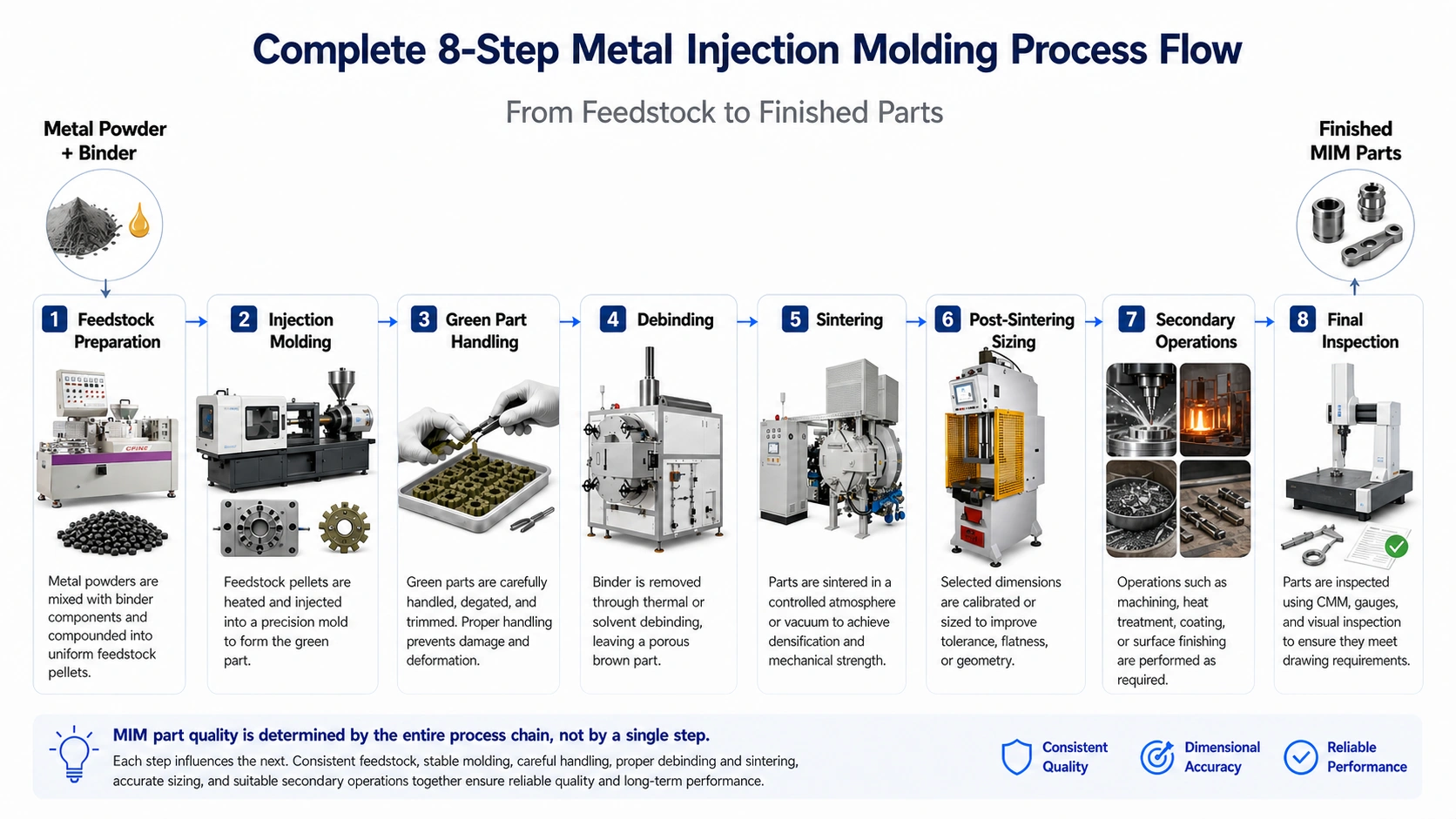
Core conclusion: The four-step explanation is good for basic understanding, but the 8-step flow is more useful for engineering communication, quotation review, tooling risk control, and quality planning.
8-Step Factory Control Flow for Precision MIM Parts
For B2B manufacturing projects, the MIM process should be viewed as a controlled production chain, not as isolated molding and sintering operations. Each stage affects final dimensions, density, surface condition, defect risk, and production stability.
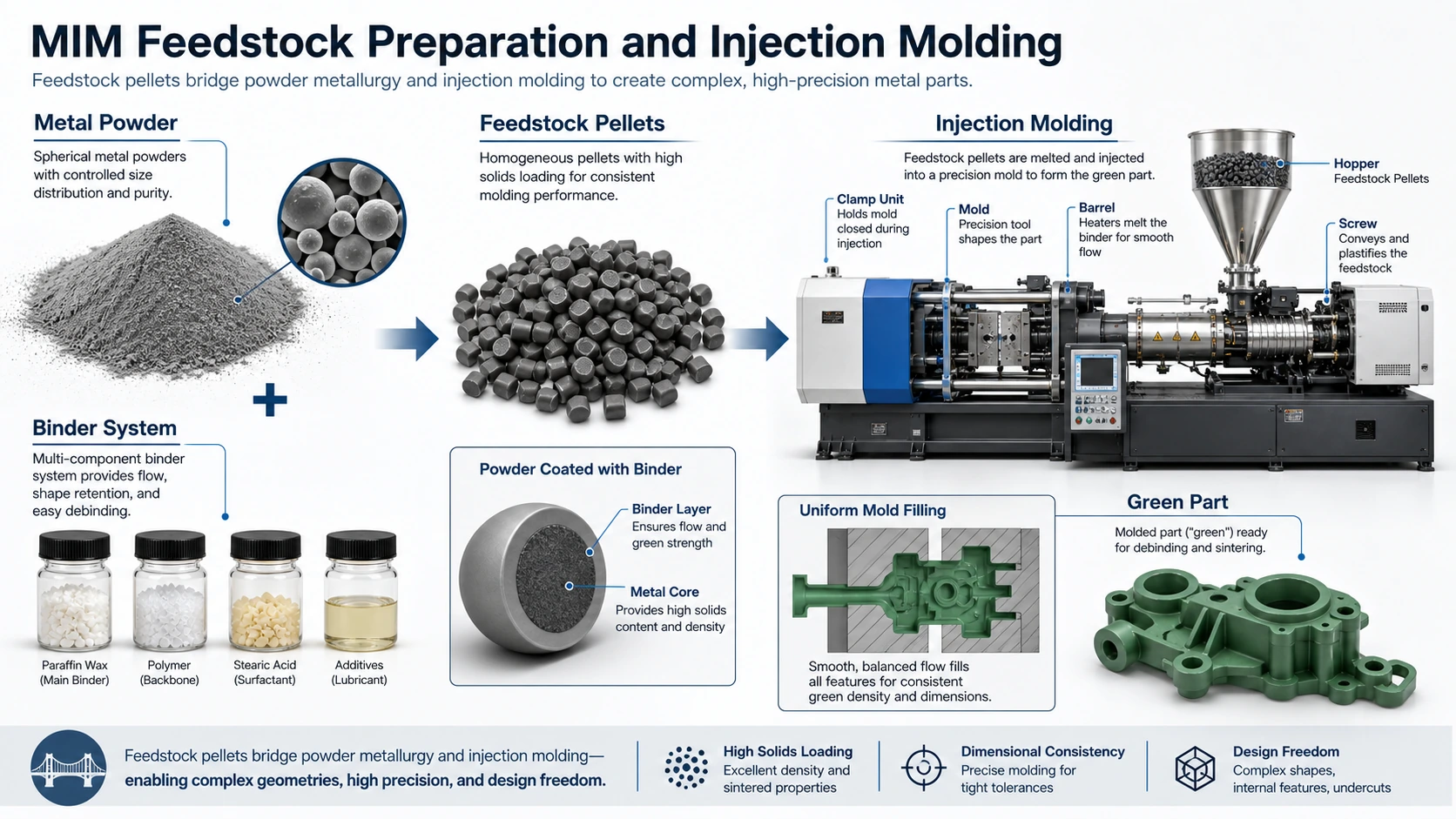
Feedstock Preparation
Metal powder and binder are compounded into a moldable feedstock. Powder chemistry, particle size, binder system, solid loading, and feedstock consistency influence injection stability, shrinkage behavior, debinding performance, and final density.
Learn more about MIM feedstock preparation and how material selection connects with MIM materials.
Injection Molding
The feedstock is injected into a precision mold cavity to form a green part. Gate location, flow balance, packing, cooling, parting line design, and ejection method can affect weld lines, short shots, sink marks, deformation, and surface defects.
See the detailed process page for MIM injection molding and the design-side considerations in our MIM design guide.
Green Part Handling
Green part handling is often underestimated. After molding, green parts are still weak because they contain binder and have not been densified. The parts may require degating, trimming, flash removal, visual checking, and careful tray loading before debinding.
Real defect risks during green part handling
- Cracks: caused by excessive trimming force, poor support, or rough manual handling.
- Chipped corners: common on thin walls, small ribs, sharp edges, and exposed features.
- Gate marks: caused by poor degating method or insufficient gate design review.
- Tray loading dents: caused by point contact, excessive stacking pressure, or unstable part orientation.
- Debinding support problems: caused by poor loading posture, uneven support, or parts touching each other during binder removal.
This stage does not usually appear in simple MIM process diagrams, but it directly affects yield, cosmetic quality, and dimensional consistency for small precision parts.

Core conclusion: For precision MIM projects, green part handling should be treated as a controlled process step, not as simple manual cleanup.
Debinding
Debinding removes a major portion of the binder while maintaining part shape. Depending on the binder system, solvent debinding, catalytic debinding, thermal debinding, or a combined route may be used. Incorrect debinding can cause cracking, blistering, slumping, contamination, or incomplete binder removal.
Read more about MIM debinding.
Sintering
Sintering densifies the brown part at high temperature under controlled atmosphere or vacuum. The part shrinks significantly and approaches final material density and mechanical properties. Sintering control affects dimensional change, distortion, density, hardness, strength, corrosion resistance, and surface condition.
Read more about MIM sintering.

Post-Sintering Sizing
Post-sintering sizing is a key dimensional correction step in many precision MIM projects. It is used when sintered parts need controlled shape correction, better flatness, improved roundness, closer local dimensions, or more stable assembly fit. It should not be described as an absolutely required step for every MIM part, but it is important when the drawing tolerance and functional geometry demand additional correction after shrinkage.
This is different from general secondary operations. Sizing is mainly a dimensional calibration and shape correction process, while secondary operations usually refer to processes such as machining, heat treatment, surface finishing, plating, polishing, tapping, or laser marking.

Core conclusion: Sizing is best understood as a precision correction step for selected MIM projects, not as a generic finishing operation.
Secondary Operations
Secondary operations are selected according to drawing requirements and functional needs. Common options include CNC machining of critical surfaces, tapping, reaming, heat treatment, passivation, polishing, coating, plating, tumbling, and laser marking.
See MIM secondary operations for a more detailed overview.
Final Inspection and Traceability
Final inspection verifies dimensions, appearance, density, hardness, mechanical performance, surface condition, and special customer requirements. For production projects, inspection data and process traceability help confirm whether the part is stable enough for repeat orders.
Review XTMIM’s MIM manufacturing capability if you need engineering review, production support, and inspection planning for a custom project.
4-Step vs 8-Step MIM Process Explanation
Both explanations are useful, but they serve different users. A four-step process helps first-time visitors understand MIM quickly. An 8-step factory control flow helps engineers and buyers evaluate real production risk.
| Comparison Point | 4-Step MIM Process | 8-Step Factory Control Flow | Best Use Case |
|---|---|---|---|
| Main purpose | Explains the basic process quickly. | Shows how real production risk is controlled. | Use both on a hub page. |
| Typical stages | Molding, debinding, sintering, finishing. | Feedstock, molding, green handling, debinding, sintering, sizing, secondary operations, inspection. | 8-step flow is stronger for B2B project review. |
| Engineering depth | Limited. | Stronger connection to defects, tolerance, shrinkage, and quality control. | Better for SEO authority and buyer trust. |
| Risk visibility | May hide green part handling and sizing risks. | Makes handling, loading, sintering distortion, and post-sintering correction visible. | Useful for custom precision parts. |
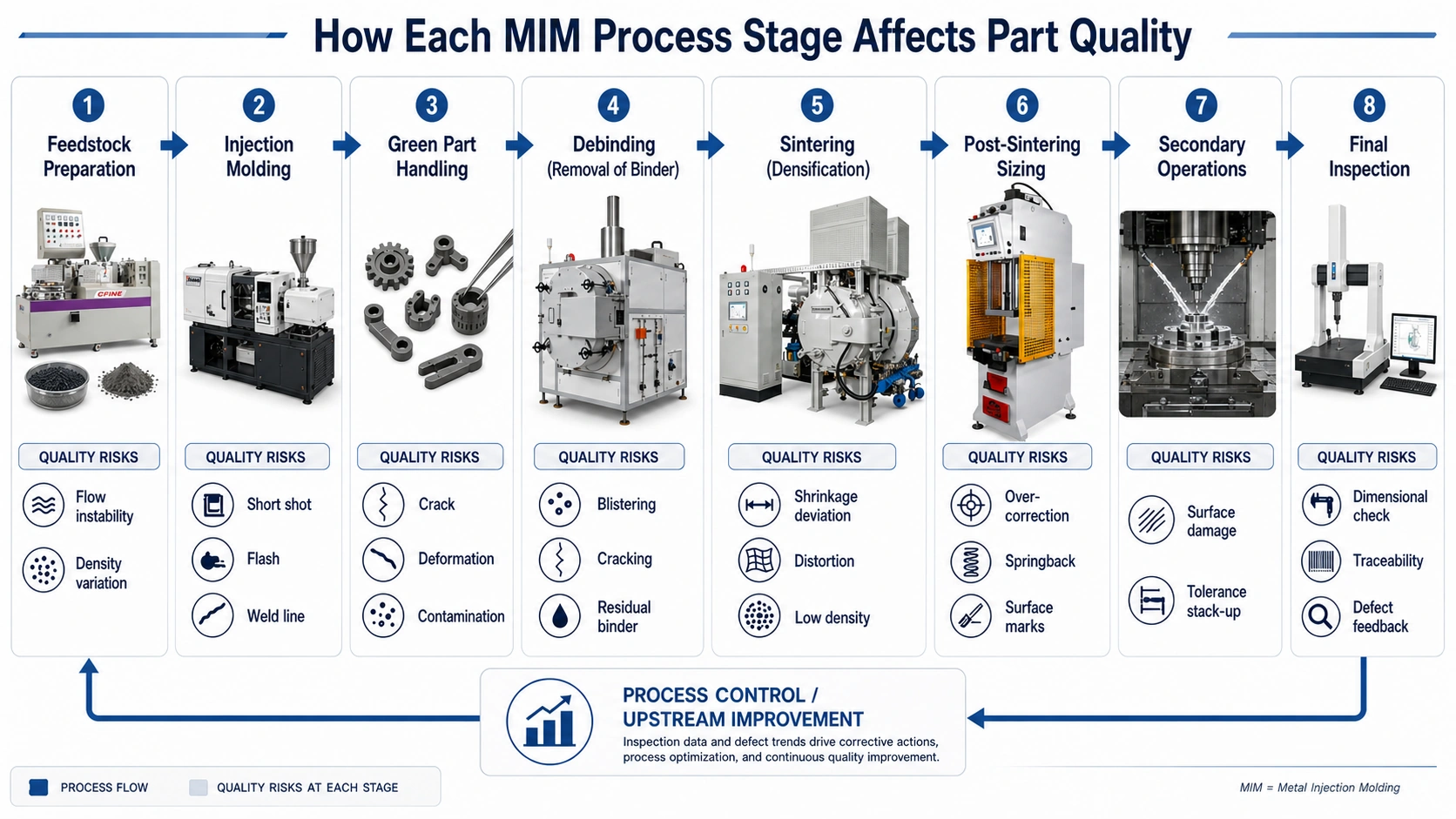
Process Control Points That Affect MIM Part Quality
A MIM supplier should not only describe the process. It should also understand what must be controlled at each stage. The table below summarizes the control points that most often influence dimensional accuracy, defect rate, and production repeatability.
| Process Stage | Key Control Points | Common Risk if Poorly Controlled | Engineering Review Focus |
|---|---|---|---|
| Feedstock preparation | Powder chemistry, particle size, binder system, solid loading, homogeneity. | Unstable flow, inconsistent shrinkage, density variation. | Material choice, feedstock stability, supplier experience. |
| Injection molding | Gate position, filling balance, packing pressure, ejection, mold temperature. | Short shot, weld line, sink mark, internal stress, deformation. | DFM review, gate strategy, mold design. |
| Green part handling | Degating method, trimming force, fixture support, tray loading direction. | Cracks, chipped corners, gate marks, tray dents, support marks. | Handling method, green strength, part protection. |
| Debinding | Debinding route, temperature profile, solvent or catalytic control, part support. | Cracking, blistering, slumping, incomplete binder removal. | Binder system compatibility and furnace loading. |
| Sintering | Atmosphere, temperature curve, shrinkage control, support design, batch loading. | Distortion, poor density, abnormal shrinkage, surface contamination. | Sintering fixture, shrinkage compensation, tolerance strategy. |
| Post-sintering sizing | Correction tool design, sizing allowance, press force, datum selection. | Over-correction, surface marks, local stress, unstable dimensions. | Critical dimensions, flatness, roundness, assembly fit. |
| Secondary operations | Machining allowance, heat treatment, coating, polishing, tapping, cleaning. | Cost increase, tolerance shift, surface damage, delayed delivery. | Whether the drawing really requires the operation. |
| Final inspection | Dimensional inspection, appearance, density, hardness, functional checks. | Hidden quality variation and repeatability problems. | Inspection plan, reporting, traceability. |
Engineering Case Example: Why Green Handling and Sizing Matter
Project Situation
A small stainless steel MIM bracket had thin edges, two small holes, and a flat assembly surface. The basic mold trial looked acceptable, but early samples showed chipped corners, slight tray marks, and unstable flatness after sintering.
Root Cause
The issue was not only mold design. Green parts were too exposed during degating, and the tray loading direction created local pressure marks before debinding. During sintering, the unsupported flat surface also showed small but repeatable distortion.
Engineering Correction
The process was adjusted by changing the degating method, improving tray support, separating contact-sensitive areas, and adding a post-sintering sizing step for the assembly surface. The goal was not to “force” the part into shape, but to apply controlled correction where the drawing required a more stable fit.
This type of review is why process planning should be discussed before tooling confirmation. For a new project, XTMIM reviews part geometry, tolerance targets, material choice, expected shrinkage, handling risk, and likely post-sintering correction requirements before recommending a production route.
Not Sure Whether Your Part Is Suitable for the MIM Process?
Send us your drawing, 3D file, material requirement, annual volume, tolerance target, and application condition. Our engineering team can review whether MIM is suitable, which process stages carry the highest risk, and whether post-sintering sizing or secondary operations should be considered during quotation.
Related MIM Process and Engineering Pages
MIM Feedstock
Understand powder, binder, feedstock consistency, and how material behavior affects molding and sintering.
MIM Debinding
Learn why binder removal is a critical transition from green part to brown part before sintering.
MIM Sintering
Review shrinkage, densification, furnace atmosphere, and distortion control during sintering.
Typical MIM Parts
Move from process understanding to part-type examples such as gears, hinges, brackets, shafts, pins, connectors, and compact structural components.
MIM Design Guide
Check wall thickness, holes, ribs, undercuts, tolerances, and DFM risks before tooling.
MIM Materials
Compare stainless steel, low alloy steel, soft magnetic alloys, titanium alloys, and other MIM material families.
MIM vs Other Processes
Compare MIM with CNC machining, die casting, investment casting, powder metallurgy, and metal 3D printing.
FAQ About the Metal Injection Molding Process
What are the basic steps of the metal injection molding process?
The basic MIM process includes feedstock preparation and injection molding, debinding, sintering, and final finishing or inspection. For real factory control, XTMIM uses a more detailed 8-step explanation that also includes green part handling, post-sintering sizing, secondary operations, and final traceability.
Why does this page show an 8-step MIM process instead of only four steps?
A four-step process is useful for basic understanding, but it hides several important production risks. Green part handling can create cracks, chipped corners, gate marks, tray dents, and debinding support problems. Post-sintering sizing may also be needed for precision projects where flatness, roundness, or assembly fit must be corrected after shrinkage.
Is post-sintering sizing required for every MIM part?
No. Post-sintering sizing should not be described as absolutely required for every MIM part. It is a key dimensional correction step in many precision MIM projects, especially when the drawing requires tighter control of flatness, roundness, local dimensions, or assembly fit after sintering.
When should I send a drawing for MIM process review?
You should send a drawing when the part is small, complex, difficult to machine economically, or expected to move into repeated production. A useful inquiry should include a 2D drawing, 3D model if available, material requirement, tolerance targets, annual quantity, surface or heat treatment needs, and application environment.
What kind of MIM projects are suitable for inquiry?
Suitable inquiries usually involve small or medium-sized metal parts with complex geometry, thin features, internal details, undercuts, high-volume demand, or high machining cost by CNC. If the part only has a simple shape, very low quantity, loose tolerance, or can be stamped, cast, or machined cheaply, MIM may not be the best process.
Can XTMIM review whether MIM, CNC, casting, or powder metallurgy is better for my part?
Yes. For early-stage projects, XTMIM can review the part geometry, target material, tolerance, volume, cost expectations, and functional requirements. In some cases, MIM is the best option. In other cases, CNC machining, investment casting, die casting, or conventional powder metallurgy may be more practical.
Author, Engineering Review and Reference Standards
Prepared by
This page was prepared by the XTMIM content and engineering team for OEM buyers, product engineers, sourcing teams, and manufacturing project managers evaluating the metal injection molding process for custom metal parts.
Engineering review focus
The technical review focuses on MIM process flow, green part handling, debinding and sintering risk, post-sintering sizing, secondary operations, and inspection planning for B2B precision part projects.
External Standards and Industry References
The following industry references are included to support process terminology, material standard awareness, and technical credibility. Final material selection, tolerance review, and acceptance criteria should still be confirmed against the customer drawing, project specification, and applicable purchase standard.