Get a Quote

Fill the form below to receive a personalized consultancy by our expert team.
  • +86 136 0300 9837
  • tony@xtmim.com

Metal Injection Molding Services for High-Volume Precision Parts

XT MIM develops and manufactures metal injection molded components for programs that need stable geometry, controlled shrinkage, and scalable production. This page is built for engineers and sourcing teams evaluating whether a part is a practical MIM candidate based on geometry, annual volume, material system, tolerance focus, and downstream finishing requirements. The process route can include feedstock preparation, tooling, injection molding, debinding, sintering, heat treatment, coining, grinding, polishing, sandblasting, plating, PVD, laser marking, and limited machining where required. The goal is not to push every complex part into MIM, but to identify where MIM is technically and commercially workable before tooling begins.

  • Typical MIM feedstock uses fine metal powders, often below 20 μm, to support molding of small and intricate features.
  • Sintering shrinkage is usually designed into the mold and is commonly in the 18%–22% range, depending on material system and binder loading.
  • Well-controlled MIM can often reach about 96%–99% of theoretical density, but part geometry and process stability still determine final suitability.

Start Your MIM Part Review

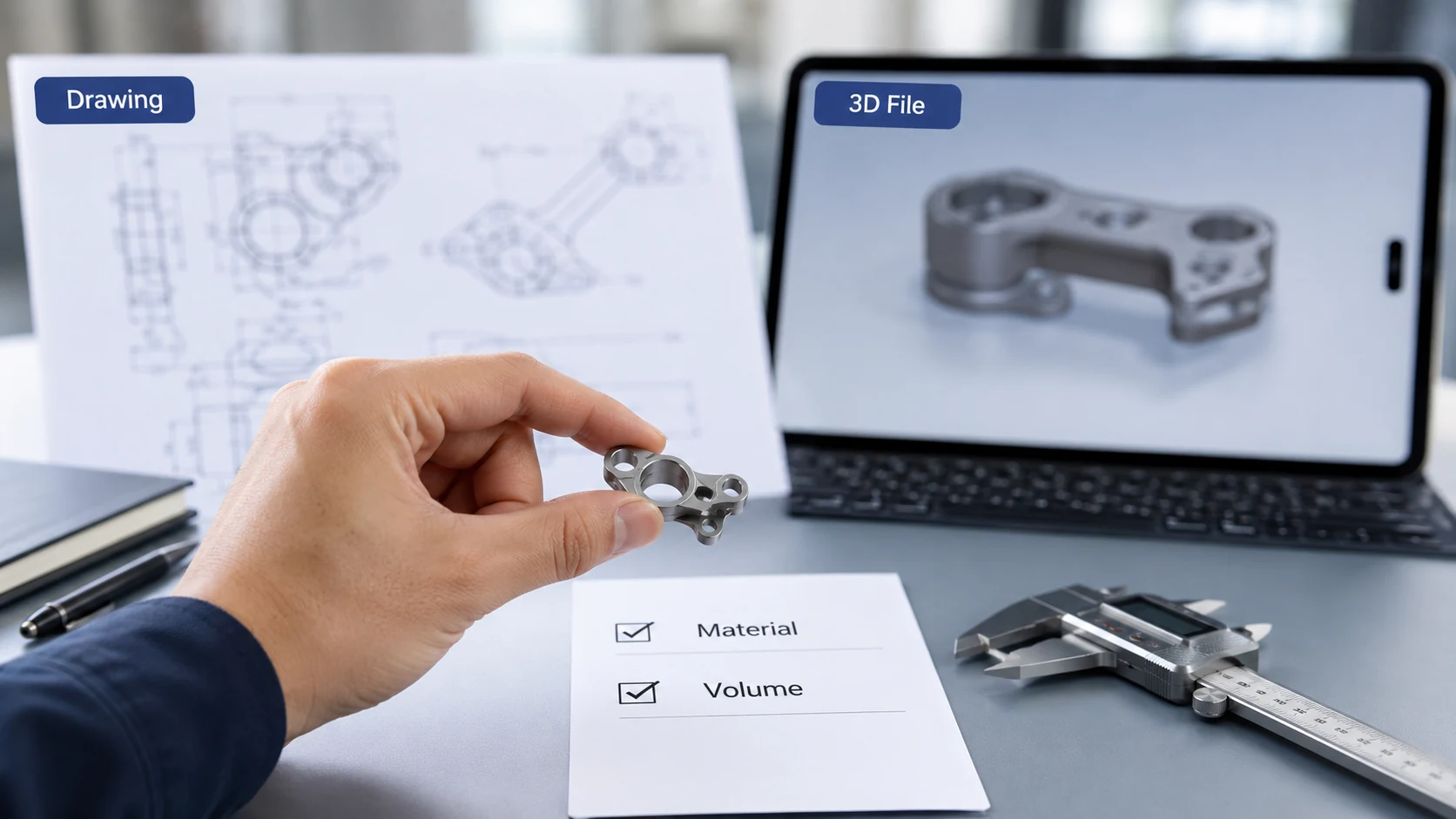
Upload the drawing or share the target part function, material, annual volume, tolerance focus, surface requirement, and any secondary operations. This is usually enough to decide whether the part should stay in MIM, move to machining, or be split into a hybrid route.

WHERE MIM FITS

Use MIM When Geometry and Volume Support a Stable Production Route

MIM is not the right answer for every metal part. It works best when the design combines enough geometric complexity, enough annual volume, and enough feature integration to justify tooling, process development, and sintering control. It is especially useful when a part would otherwise require multiple machining steps, small cutting tools, secondary joining, or excessive manual handling. The real decision point is not whether the part looks complex, but whether the geometry, shrinkage behavior, and production volume can be managed in a repeatable MIM process.

Part Screening

Where MIM Fits — and Where It Usually Does Not

MIM works best when geometry, annual volume, and process stability support a repeatable production route. Use this screen to separate parts that are technically suitable for MIM from parts that usually create unnecessary tooling, distortion, or cost risk.

Usually a Good MIM Candidate

  • Small to medium parts with integrated geometry
  • Parts combining holes, slots, ribs, bosses, or threads in one body
  • Programs with stable annual demand and a clear production ramp
  • Components where near-net shape reduces machining time
  • Parts that still need finishing, but not full-shape re-machining

Usually a Poor MIM Candidate

  • Large or heavy parts with limited annual volume
  • Long thin sections that are hard to keep stable in sintering
  • Geometry with sharp wall changes and little room for shrinkage control
  • Parts requiring bar-stock level straightness without correction
  • Projects too small to justify tooling and process development
Engineering note: screen the part before tool kickoff, not after first samples fail dimensional review.

MIM MATERIAL OPTIONS

Material Selection Should Follow Function, Environment, and Post-Processing Route

MIM material selection should start from service condition, not from a default alloy preference. Corrosion exposure, hardness target, wear mode, magnetic behavior, heat-treatment response, plating route, cosmetic requirement, and assembly interface all affect whether a material system is practical in production. Common MIM material families include stainless steels, low-alloy steels, tool steels, soft magnetic alloys, and selected specialty systems, but the right choice depends on how the part will actually be used after sintering and finishing.

SHRINKAGE AND DISTORTION CONTROL

Most MIM Problems Start Before Sintering, Then Show Up After It

Shrinkage in MIM should be treated as a design input, not as a downstream correction step. Mold dimensions, gate layout, wall-thickness balance, support strategy, and sintering setup all need to be decided with final geometry in mind. Parts with uneven mass distribution, abrupt section changes, unsupported long features, or cosmetic surfaces close to functional datums usually need tighter DFM control and, in some cases, post-sinter correction.

SECONDARY OPERATIONS

As-Sintered Is Rarely the Final Condition

A sintered part is often only the starting point. Final acceptance may still depend on heat treatment for hardness, coining for local dimensional correction, grinding for datum or sealing faces, and polishing, blasting, plating, or PVD for surface and cosmetic requirements. Limited machining may also be necessary where threads, bores, or assembly interfaces need tighter control than the as-sintered condition can hold.

QUALITY AND VALIDATION

Inspection Should Follow Failure Risk, Not Just the Drawing

For MIM parts, inspection should be defined around what can actually fail in production or in use. That usually means looking beyond nominal dimensions and checking four areas first: density and porosity, dimensional movement after sintering, property consistency after heat treatment, and surface or coating stability after finishing. A drawing may define size, but validation has to confirm whether the part will still hold fit, function, and appearance after the full process route is complete.

XT MIM CAPABILITY

Scale-Up Risk Starts After Sampling

A sample can prove feasibility, but it does not prove production stability. In MIM, scale-up usually depends on whether tooling changes, feedstock consistency, molding windows, debinding capacity, sintering load control, and secondary operations can all stay aligned once volume increases. That is why factory capacity matters after the first approved sample, not just before it.

PROCESS CHAIN

From Feedstock to Finished Part, Each Step Changes the Risk Profile

In MIM, problems do not begin at the end of the line. Feedstock consistency, molding stability, debinding support, sintering behavior, and secondary operations all affect whether the final part will meet dimensional, mechanical, and cosmetic targets in production.

01

Tooling and Feedstock Preparation

The mold must already account for shrinkage, gate balance, venting, wall-thickness transitions, and expected post-sinter geometry. Feedstock consistency matters because powder loading and binder uniformity directly affect molding stability and later distortion.

02

Injection Molding

This stage controls fill behavior, knit lines, flash tendency, and green-part handling risk. A molded part that looks acceptable at this stage can still fail later if the process window is unstable.

03

Debinding

Debinding removes most of the binder while trying to preserve the geometry of a fragile porous body. At this stage, support, handling, and part geometry all matter because distortion or damage introduced here often carries forward into sintering.

04

Sintering

Sintering drives densification, shrinkage, and much of the final dimensional movement. This is where early design and molding decisions are often exposed, especially in parts with uneven mass, poor support logic, or weak datum planning.

05

Secondary Operations

Heat treatment, coining, grinding, polishing, blasting, plating, PVD, and selected machining are used when the as-sintered part cannot by itself meet final dimensional, cosmetic, or functional requirements.

XT MIMMT MIM logo
  • Wall thickness balance and feature integration
  • Part size, weight, and section transitions
  • Internal geometry, holes, slots, ribs, or threads
  • Geometry that can tolerate sintering shrinkage logic
  • Corrosion resistance, hardness, or wear requirement
  • Magnetic behavior or heat-treatment response
  • Density and mechanical property expectation
  • Whether the alloy is practical in MIM production
  • Forecasted annual demand and ramp plan
  • Whether tooling cost can be justified by volume
  • Multi-cavity potential and output stability
  • Whether the program is sample-only or built for launch
  • Grinding, coining, polishing, plating, or PVD needs
  • Threads, bores, and fit-critical surfaces
  • Cosmetic zones and coating stability
  • Assembly interfaces that may still need machining

SELECTION INPUTS

What Usually Determines MIM Feasibility

A MIM decision is usually made from process fit, not from part appearance alone. Engineering teams normally narrow the right direction by checking four groups of inputs first: part geometry, production volume, material and property target, and the finishing or assembly work required after sintering. These factors have more impact on feasibility than a generic request for a “complex metal part.”

PHOTO GALLERY

Inside XT MIM Manufacturing

PROGRAM FEEDBACK

What Teams Needed Before Committing to MIM

5/5

“We were not looking for a generic MIM introduction. We needed to know whether the part geometry, wall balance, and post-sinter machining plan could hold up once the project moved beyond samples. The review was useful because it focused on production risk, not just process theory.”

Mechanical Engineer, Consumer Electronics Program
5/5

“Our main concern was dimensional movement after sintering. The discussion around shrinkage allowance, datum strategy, and finishing sequence helped us understand where the real risks were before we released the tool.”

Project Engineer, Industrial Components Supplier
5/5

“We had already seen one supplier treat MIM as a shortcut for a difficult part. What we needed instead was a realistic review of tooling logic, expected deformation, and where secondary operations would still be necessary. That made the decision process much clearer.”

Procurement Manager, Precision Hardware Company
5/5

“The most useful part of the discussion was not the quotation. It was the early feedback on whether the part should stay in MIM at all, or whether some critical features would still need machining after sintering. That saved us time before sampling.”

Technical Buyer, Industrial Assembly Program

FAQ

Common Questions Before Starting a MIM Program

Choose MIM when the part is small to medium, geometrically complex, and repeated in enough volume to justify tooling. Choose CNC when annual volume is low, the part is simple, or the design is likely to change repeatedly during the early program stage.

Typical sintering shrinkage is often in the 18%–22% range, depending on material system and binder loading, so it must be built into mold design rather than corrected after the fact.

Under controlled sintering, MIM commonly reaches about 96%–99% of theoretical density. Final performance still depends on alloy, part geometry, porosity distribution, and post-sinter processing.

No. MIM can reduce machining significantly, but threads, sealing surfaces, datums, tight bores, and assembly interfaces often still need secondary work.

Common causes include poor wall-thickness balance, shrinkage misprediction, unstable molding windows, unsupported sintering geometry, insufficient allowance for finishing, and unrealistic tolerance expectations carried over from machining logic.

Ready to Review a MIM Part for Production?

Send the drawing, target material, annual volume, critical dimensions, surface requirement, and any known assembly or failure issues. The first question is not whether the part looks complex. The first question is whether the process route is technically stable, dimensionally controllable, and commercially realistic for production.

  • Part suitability screening before tool commitment
  • DFM review around shrinkage, distortion, and finishing
  • Support for sampling, validation, and production launch