Custom MIM Material Development Starts with Feasibility Review Before Tooling
XTMIM can assist customers with custom MIM material development when standard MIM-grade alloys cannot meet a clearly defined part requirement. These projects are uncommon and require coordinated work between the customer, XTMIM engineers, and a specialist powder or feedstock supplier. They are not a routine material-selection service or XTMIM’s main manufacturing business.
The specialist supplier prepares the required powder-binder formulation and supplies ready-to-mold pelletized MIM feedstock. XTMIM then evaluates the downstream manufacturing route through in-house injection molding, debinding, sintering, dimensional review, and project-specific validation before tooling decisions are locked. For most projects, the better first step is still to compare proven MIM materials.
- Standard MIM materials cannot meet a clearly defined performance target.
- The project has target properties, tolerance needs, and application conditions.
- The production volume or part value can justify material validation before tooling.
Quick Answer
Custom MIM material development is a rare, project-specific route rather than XTMIM’s core business. XTMIM first reviews the drawing, application environment, target properties, tolerances, surface needs, and production volume. If standard or established special alloys cannot meet the requirement, we can help define the material target, coordinate with a specialist supplier that prepares the powder-binder formulation and pelletized feedstock, and evaluate whether the supplied material can be molded, debound, sintered, dimensionally controlled, and validated for the part.
Standard MIM materials should be reviewed first. Custom material development is considered only when a measurable performance gap remains and the project can support specialist supplier development plus downstream production validation.
What Custom MIM Materials Really Mean
A common mistake is to treat “custom MIM material” as if it only means choosing a different metal grade. In real MIM production, the material route affects the entire process chain: feedstock preparation, injection molding behavior, green part handling, binder removal, sintering shrinkage, distortion risk, density, mechanical properties, and final inspection.
From a design review perspective, custom MIM materials can usually be divided into four practical levels:
| Type | What It Means | Practical Difficulty |
|---|---|---|
| Standard MIM material selection | Choosing from existing MIM-grade alloys already suitable for metal injection molding | Low |
| Modified material route | Adjusting heat treatment, surface finishing, or performance route around a known material | Medium |
| Custom powder blend or feedstock | Using a specialist-supplier-prepared powder mixture and pelletized feedstock for a defined performance requirement | High |
| New alloy development | Collaboratively developing a new alloy route with specialist material suppliers, followed by MIM production and validation | Very high |
For most OEM and ODM projects, the practical goal is not to invent a new alloy. The real goal is to find the most stable MIM-compatible material route that meets the part’s function, cost target, tolerance requirement, and production risk level.
A true custom feedstock route should only be considered after standard materials and established special MIM alloys have been reviewed.
For copper-based requirements, review copper alloys for MIM before treating the project as a custom material-development request. High-conductivity copper, OFHC copper, Cu10Al, Cu-Sn and Cu-Ni should be evaluated as project-dependent material directions, not assumed stock feedstocks or routine production options.
XTMIM can support rare custom material development projects by translating part requirements into a MIM manufacturing route and coordinating with specialist powder or feedstock suppliers. Powder-binder compounding is not a routine in-house workshop operation at XTMIM; suppliers deliver ready-to-mold pelletized MIM feedstock for molding and downstream process evaluation.

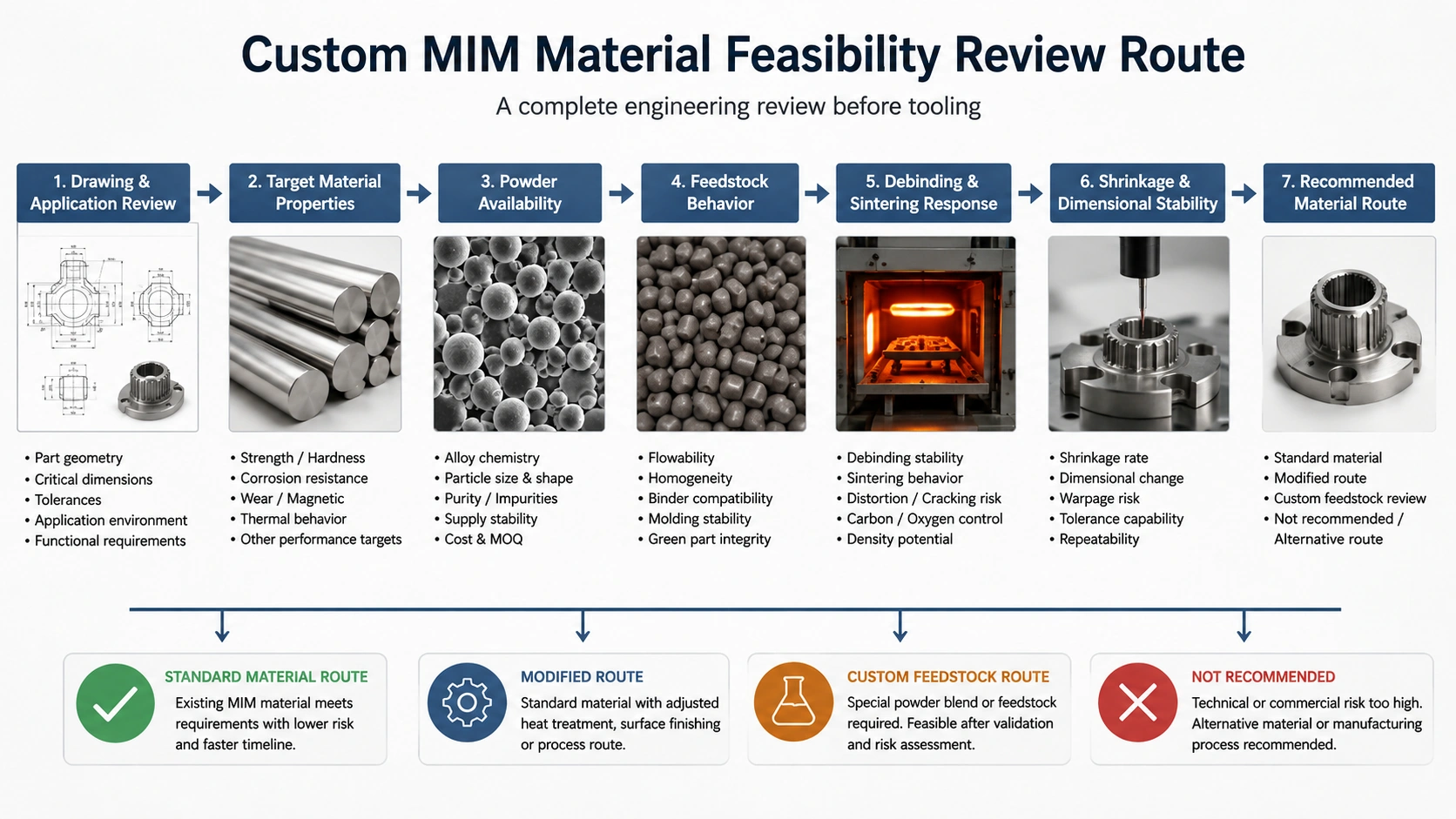
When a Custom MIM Material Request Makes Sense
Custom material review can make sense when the part has a clear performance requirement that cannot be met by a standard MIM material route. The requirement should be tied to function, environment, inspection criteria, or service risk, not only to a preferred alloy name.
Functional Requirements That May Justify Review
- A stainless steel option does not provide enough corrosion resistance, strength, hardness, or magnetic behavior.
- A low alloy steel option cannot meet the mechanical requirement after heat treatment.
- The part needs a specific magnetic response rather than general structural strength.
- The material must control thermal expansion when assembled with glass, ceramic, or another metal.
- Wear resistance is more important than general tensile strength.
- The part operates in a high-temperature, corrosive, abrasive, or medically sensitive environment.
Commercial Conditions Matter
In production, this usually depends on the balance between function, validation cost, and volume. A custom material route may be technically possible, but it is not always commercially reasonable.
If a part only needs better corrosion resistance, reviewing 316L stainless steel, selected stainless steel grades, or surface finishing may be more practical than starting with a new custom alloy. If a part needs controlled expansion, established Kovar or Invar-type routes should be reviewed before considering a new material system.
When Custom MIM Materials Are Usually Not Recommended
Custom MIM materials are not suitable for every project. In many cases, using an established MIM material is more stable, faster to quote, easier to validate, and less risky for tooling.
Custom material development is usually not recommended when:
- The project is only a very low-volume prototype.
- The customer does not have a clear material requirement.
- The request is only described as “stronger,” “better,” or “more durable.”
- There is no application environment information.
- No target mechanical, magnetic, thermal, corrosion, or wear requirement is defined.
- The project has no budget or time for feedstock, debinding, sintering, and property validation.
- The part geometry itself has not been reviewed for MIM feasibility.
- The customer expects the same cost and lead time as a standard MIM material.
This matters because custom material uncertainty can affect tooling compensation. If the shrinkage behavior is not stable, the risk is not limited to material performance; it can also affect dimensions, warpage, density, surface condition, and repeatability.
In many projects, the better engineering decision is to first adjust material selection, heat treatment, surface finishing, or part design before moving toward a custom feedstock route.
Illustrative Material Review Scenario
Starting request: A project team asks for a “stronger and more corrosion-resistant custom MIM alloy,” but the drawing does not define target hardness, corrosion environment, critical dimensions, or expected annual volume.
Correct review path: The team should first convert the general request into measurable property, application, inspection, geometry, and volume requirements. Standard stainless steel, heat-treatable stainless steel, low alloy steel, surface finishing, and wear-resistant alternatives should then be compared before a custom route is considered.
Decision rule: If a verified performance gap remains, XTMIM can help define the MIM requirements and coordinate with a specialist supplier for suitable pelletized feedstock, followed by molding, debinding, sintering, dimensional, and property validation. This is an illustrative decision example, not a customer case or a claim of a specific project result.
What Must Be Checked Before Custom Feedstock or Material Development
Before a custom MIM material route is considered, the project should be reviewed from both material and process perspectives. A material that looks reasonable by chemistry can still fail as a MIM route if it cannot be molded, debound, sintered, or inspected consistently.
Application Environment
The first question is not “Can this alloy be molded?” The first question is “What problem does this material need to solve?” The review should clarify corrosion, sliding wear, heat, magnetic field requirements, medical contact, fluid contact, impact loading, or assembly stress.
Target Material Properties
The customer should define strength, hardness, density, elongation, corrosion resistance, magnetic response, thermal expansion, or wear behavior. If exact targets are not available, the current material, failure mode, or application requirement should be provided.
Powder Availability
MIM depends on fine metal powders with suitable chemistry, particle size, shape, purity, and supply stability. For a custom route, XTMIM reviews these requirements with the customer and a specialist material supplier; a material may exist as a wrought or casting alloy without being practical as supplier-prepared MIM feedstock.
Feedstock Flow and Binder Compatibility
A specialist supplier compounds the powder with a binder system and delivers ready-to-mold pelletized MIM feedstock. XTMIM evaluates how the supplied pellets fill thin walls, small features, holes, ribs, and complex geometry, and whether the route creates separation, short shots, cracks, gate-related defects, or excessive molding variation.
Debinding and Sintering Response
A custom material must survive binder removal and sintering without unacceptable deformation, cracking, blistering, carbon imbalance, oxidation, or unstable shrinkage. The debinding method and sintering atmosphere may also need to be evaluated.
Shrinkage and Dimensional Stability
MIM parts shrink significantly during sintering. If the material route changes, shrinkage behavior may also change. This affects tooling compensation, fixture strategy, tolerance planning, and inspection control.
A custom material should not be approved only because the alloy chemistry looks suitable. It must also be reviewed as a complete MIM process route.
Why Custom MIM Materials Increase Cost and Lead Time
Custom MIM materials usually increase cost and lead time because they introduce more unknowns before stable production can begin. The cost driver is not only the powder price. It is the additional work needed to confirm whether the material route can produce repeatable parts within the drawing and inspection requirements.
| Cost or Timing Driver | Why It Matters |
|---|---|
| Powder sourcing or custom powder preparation | Special powder chemistry, particle shape, particle size, or supply stability may need to be confirmed before production planning. |
| Minimum order quantity for powder or feedstock | Custom material work may not be commercially reasonable for very low-volume projects. |
| Supplier feedstock preparation and XTMIM trial molding | A specialist supplier prepares the powder-binder formulation and pelletized feedstock; XTMIM evaluates flow, filling, green strength, and molding stability after the material is received. |
| Debinding and sintering profile validation | The material must be assessed for binder removal behavior, shrinkage, distortion, cracking, carbon or oxygen sensitivity, and density potential. |
| Mechanical or physical property testing | Strength, hardness, corrosion resistance, magnetic response, or other property targets may need project-specific confirmation. |
| Longer communication before tooling approval | Tooling compensation should not be finalized before the material route and shrinkage behavior are reasonably understood. |
From a project management perspective, the biggest risk is starting tooling before the material route is confirmed. If the selected feedstock later shows different shrinkage, unstable sintering behavior, or unexpected dimensional movement, tooling compensation may need to be adjusted.
This is why XTMIM recommends reviewing custom material feasibility before mold design is finalized. The earlier the material route is clarified, the lower the risk of avoidable design changes, tooling revisions, or production delays.
Standard Material Alternatives Should Be Reviewed First
In most MIM projects, standard or established materials should be reviewed before custom material development. This does not reduce engineering quality. In many cases, it improves project stability because powder behavior, molding response, sintering behavior, and inspection expectations are easier to discuss before tooling.
| Requirement | Review Before Custom Material |
|---|---|
| Corrosion resistance | Stainless steel MIM materials, including 316L stainless steel or other stainless options |
| High strength | 17-4 PH stainless steel, low alloy steel MIM materials, and heat treatment routes |
| High hardness | 420 stainless steel, 440C stainless steel, heat treatment, or suitable coating routes |
| Wear resistance | Hardened stainless steel, carbide route, coating, or surface finishing review |
| Magnetic response | Soft magnetic MIM materials, including Fe-Ni, Fe-Si, or Fe-Co options |
| Controlled expansion | Kovar, Invar-type material routes, or controlled expansion alloy review |
| Biocompatibility | Titanium, Co-Cr, stainless options, and project-specific standards review |
| Heat resistance | Nickel alloys, selected stainless steels, or special alloy routes |
A standard material may not sound as impressive as a custom alloy, but it is often easier to validate, easier to quote, and safer for production.
The right question is not “Can we create a custom material?” The right question is “Which material route can meet the requirement with the lowest production risk?”

How XTMIM Supports Rare Custom MIM Material Development Projects
XTMIM can assist with custom MIM material development, but these projects are uncommon and are not our main manufacturing business. The work requires a strong engineering team and clear division of responsibility: the customer defines the functional need, XTMIM translates the part requirement into a MIM manufacturing and validation plan, and a specialist supplier prepares the powder-binder formulation as ready-to-mold pelletized feedstock.
Who Handles Each Stage
| Development Stage | Primary Responsibility | What Is Reviewed |
|---|---|---|
| Part function and target properties | Customer + XTMIM | Application environment, measurable properties, drawing, critical dimensions, inspection needs, and project volume |
| Powder chemistry and binder formulation | Specialist powder or feedstock supplier | Powder availability, chemistry, particle characteristics, binder system, pellet preparation, and supply feasibility |
| Ready-to-mold pelletized feedstock | Specialist supplier | Supplier-prepared pellets are delivered to XTMIM; routine powder-binder compounding is not performed in the XTMIM production workshop |
| Injection molding evaluation | XTMIM in-house | Filling behavior, green strength, molding window, feature replication, and visible molding defects |
| Debinding and sintering evaluation | XTMIM in-house | Binder removal response, cracking, distortion, sintering behavior, shrinkage, density potential, and surface condition |
| Part and property validation | XTMIM + customer-approved validation route | Dimensions, agreed material properties, functional requirements, inspection method, and acceptance criteria |
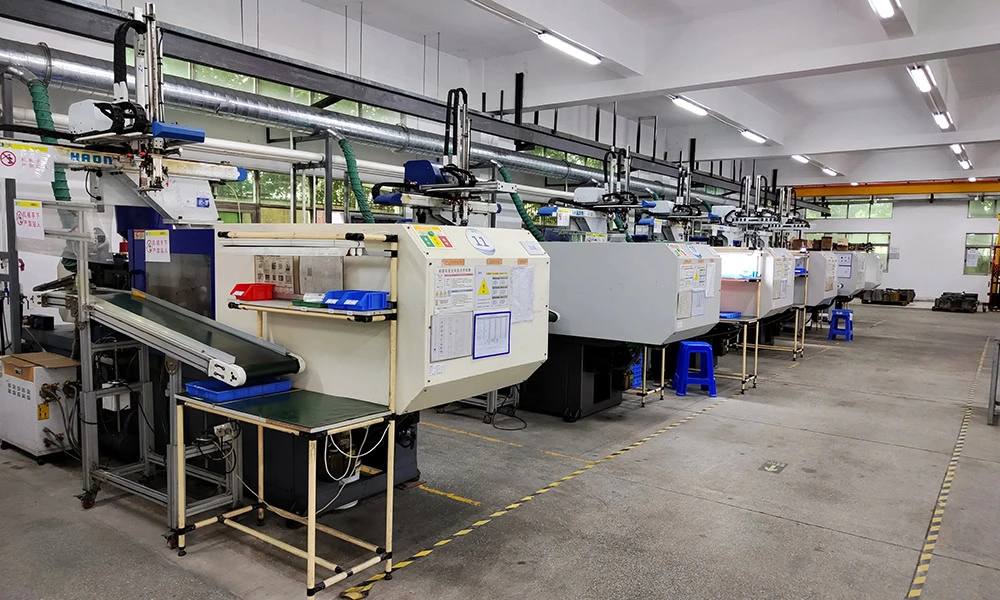
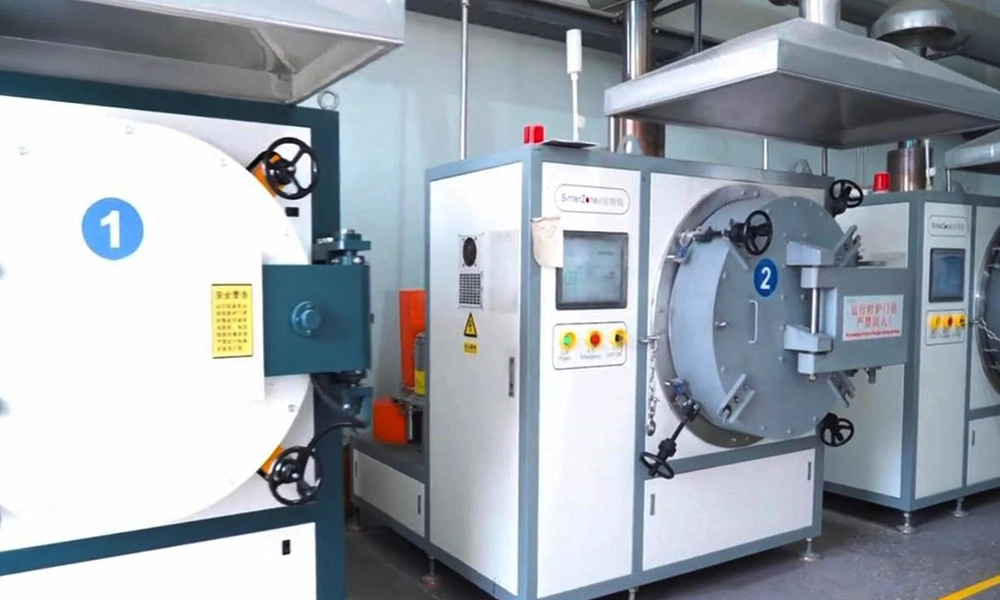
Evidence boundary: These photographs show XTMIM’s real downstream MIM production capability. They do not claim that powder atomization or powder-binder compounding is performed in the XTMIM workshop, and they are not presented as images from a specific customer material-development project.
Review Part Drawing and Application
We first review the 2D drawing, 3D model, part size, wall thickness, critical dimensions, tolerance requirements, and functional surfaces. Material feasibility cannot be separated from part geometry.
Clarify Material and Performance Targets
We confirm whether the requirement is based on strength, hardness, corrosion resistance, magnetic behavior, heat resistance, wear resistance, controlled expansion, biocompatibility, or another functional target.
Compare Standard MIM-Grade Alternatives
Before recommending custom development, we compare the request against standard stainless steels, low alloy steels, soft magnetic materials, special alloys, and relevant post-treatment options.
Coordinate Supplier Feedstock Feasibility
If standard routes are not suitable, we discuss powder and feedstock requirements with a specialist supplier. The supplier prepares the powder-binder formulation and pelletized feedstock; XTMIM then reviews whether the supplied material is practical for molding, debinding, sintering, dimensional control, and final property validation.
Recommend a Standard, Modified, or Custom Route
The final recommendation may be a standard material, a modified route using heat treatment or surface finishing, an established special alloy, or a supplier-supported custom material development route. If the custom route is not technically or commercially reasonable, we will explain the limitation clearly.
Possible Review Outcomes
| Outcome | When It Applies |
|---|---|
| Use standard MIM material | An existing MIM-grade material can meet the functional requirement with lower process and tooling risk. |
| Use modified material route | Heat treatment, surface finishing, sizing, machining, or another post-processing route can solve the requirement without custom feedstock. |
| Review established special alloy | A known titanium, cobalt-chromium, Kovar, Invar, tungsten alloy, soft magnetic alloy, or other special alloy route is more stable than new material development. |
| Supplier-supported custom material development | Standard routes cannot meet a measurable performance target, and the project can justify specialist supplier formulation plus XTMIM molding, debinding, sintering, dimensional, and property validation. |
| Not recommended for MIM | The material, geometry, tolerance, volume, or validation uncertainty creates excessive production risk compared with alternative manufacturing routes. |
Before Tooling, the Material Route Should Be Clear Enough to Review
| Review Item | Why It Should Be Confirmed Before Tooling |
|---|---|
| Target material route | The selected route affects shrinkage, sintering support, mold compensation, and potential secondary operations. |
| Critical dimensions and tolerance class | Tight dimensions may require additional review of shrinkage variation, sizing, machining, or inspection method. |
| Functional surfaces | Sealing, sliding, magnetic, contact, or assembly surfaces may require specific material, surface, or post-processing decisions. |
| Validation requirement | Mechanical, corrosion, magnetic, thermal, or wear targets should be discussed before sample approval expectations are set. |
Information to Prepare Before Requesting Custom MIM Material Review
To make the review useful, please prepare as much project information as possible. A material review without drawings and application information is usually incomplete. For MIM, material, geometry, tolerance, shrinkage, and sintering behavior must be reviewed together.
- 2D drawing
- 3D CAD file
- Current material or target material
- Required strength, hardness, corrosion resistance, magnetic performance, thermal behavior, or wear resistance
- Application environment
- Critical dimensions and tolerances
- Surface finish requirement
- Heat treatment or coating requirement
- Assembly condition
- Estimated annual volume
- Prototype or mass production plan
- Existing failure problem, if the part is being redesigned

Request a Custom MIM Material Feasibility Review
If your project requires a non-standard MIM material, supplier-supported material development, special alloy selection, or material replacement from CNC, casting, or another process, send us your drawing and application requirements.
XTMIM can review the part geometry, target properties, tolerances, surface requirements, production volume, and standard alternatives before tooling. For the small number of projects that genuinely require a custom route, we can help define the MIM requirements, coordinate with a specialist powder or feedstock supplier, and evaluate the delivered pelletized material through in-house molding, debinding, sintering, and dimensional review.
Contact XTMIM for Material ReviewFAQ About Custom MIM Materials
Can any metal be used in MIM?
No. A metal may be available as a wrought, cast, or machined alloy, but that does not mean it is practical for MIM. MIM feasibility depends on powder availability, particle characteristics, binder compatibility, feedstock behavior, debinding response, sintering stability, shrinkage control, and final property validation.
What is the difference between custom MIM materials and custom MIM feedstock?
Custom MIM materials usually refer to the material requirement or alloy route for the finished part. Custom MIM feedstock refers to the powder-binder formulation used before molding. A custom feedstock route may affect molding behavior, debinding, sintering shrinkage, dimensional stability, and final properties, so it requires more validation than selecting an existing MIM-grade material.
Does XTMIM prepare custom MIM feedstock in-house?
Not as a routine workshop operation. For rare custom material projects, XTMIM can help define the part and process requirements and coordinate with a specialist supplier. The supplier prepares the powder-binder formulation and delivers ready-to-mold pelletized MIM feedstock. XTMIM then evaluates the supplied material through in-house injection molding, debinding, sintering, dimensional review, and the agreed validation route.
Is custom MIM feedstock suitable for small-volume projects?
Usually not. Supplier-supported custom feedstock work is more suitable when the project has clear performance requirements, sufficient production value, and enough budget and time for formulation and downstream validation. For small-volume prototype projects, standard MIM materials or alternative manufacturing routes may be more practical.
Should we choose a custom material before checking standard MIM materials?
Usually no. Standard MIM materials should be reviewed first because they are more stable, faster to evaluate, easier to quote, and easier to validate. Custom material review is more appropriate when standard options cannot meet a clearly defined requirement.
What information is needed for custom MIM material review?
Useful information includes the drawing, 3D file, current or target material, application environment, required properties, critical dimensions, tolerance requirements, surface finish needs, heat treatment or coating requirements, and estimated annual volume.
Does custom material affect tooling and shrinkage?
Yes. Different powder and feedstock routes can change molding behavior, debinding response, sintering shrinkage, distortion risk, and final dimensions. For this reason, material feasibility should be reviewed before tooling compensation is finalized.
Can XTMIM recommend alternatives if a custom material is not practical?
Yes. If a custom feedstock route is too risky or not commercially reasonable, XTMIM can review standard MIM materials, heat treatment, surface finishing, special alloy options, or alternative manufacturing routes based on the drawing and application requirement.
Standards and Technical References
MIM material selection should be reviewed with reference to established material standards, available material data, and project-specific validation. MPIF Standard 35-MIM can be used as one reference for common MIM material specification and engineering discussion, but final material acceptance should be based on the customer drawing, agreed specification, application conditions, inspection requirements, and project-level validation.
For custom feedstock or non-standard material routes, the material should not be judged by alloy chemistry alone. The MIMA metal injection molding process overview describes feedstock preparation, molding, binder removal, and sintering as connected process stages. In XTMIM’s workflow, a specialist supplier prepares the pelletized feedstock while XTMIM evaluates the downstream MIM process. Feedstock consistency is important because variation can contribute to molding defects and sintering distortion, as discussed in PIM International’s feedstock systems overview.
Final acceptance should be based on the customer drawing, application conditions, agreed material specification, inspection requirements, and project-level validation plan.
Related internal resources: MIM material properties, MIM material selection guide, and MIM feedstock process.