MIM feedstock is a ready-to-mold pellet material made from fine metal powder, a temporary binder system, and selected processing aids. XTMIM normally uses qualified, commercially prepared feedstock pellets rather than compounding metal powder and binder in-house. Our production control starts with material-grade and supplier-batch verification, then follows storage, trial molding, debinding compatibility, sintering shrinkage, and final dimensional consistency through the metal injection molding process.
Quick Answer: What Buyers Need to Know About MIM Feedstock
Feedstock quality affects mold filling, green-part strength, binder removal, sintering shrinkage, and final dimensions. XTMIM controls the production entry and downstream response of qualified purchased feedstock; upstream powder-binder compounding and pelletizing are performed by the commercial feedstock supplier.
What Is MIM Feedstock?
MIM feedstock is an engineered molding compound supplied as pellets. It combines fine metal powder with a binder system that allows the material to flow through an injection molding machine. The binder is temporary: it supports molding and green-part handling, then is removed before the metal powder is densified during sintering.
XTMIM normally purchases qualified, commercially prepared feedstock rather than manufacturing metal powder, mixing powder and binder, or pelletizing feedstock in-house. For production, feedstock is treated as a controlled process input. Supplier batch, packaging condition, storage, molding response, debinding behavior, shrinkage, and final inspection results must remain traceable.
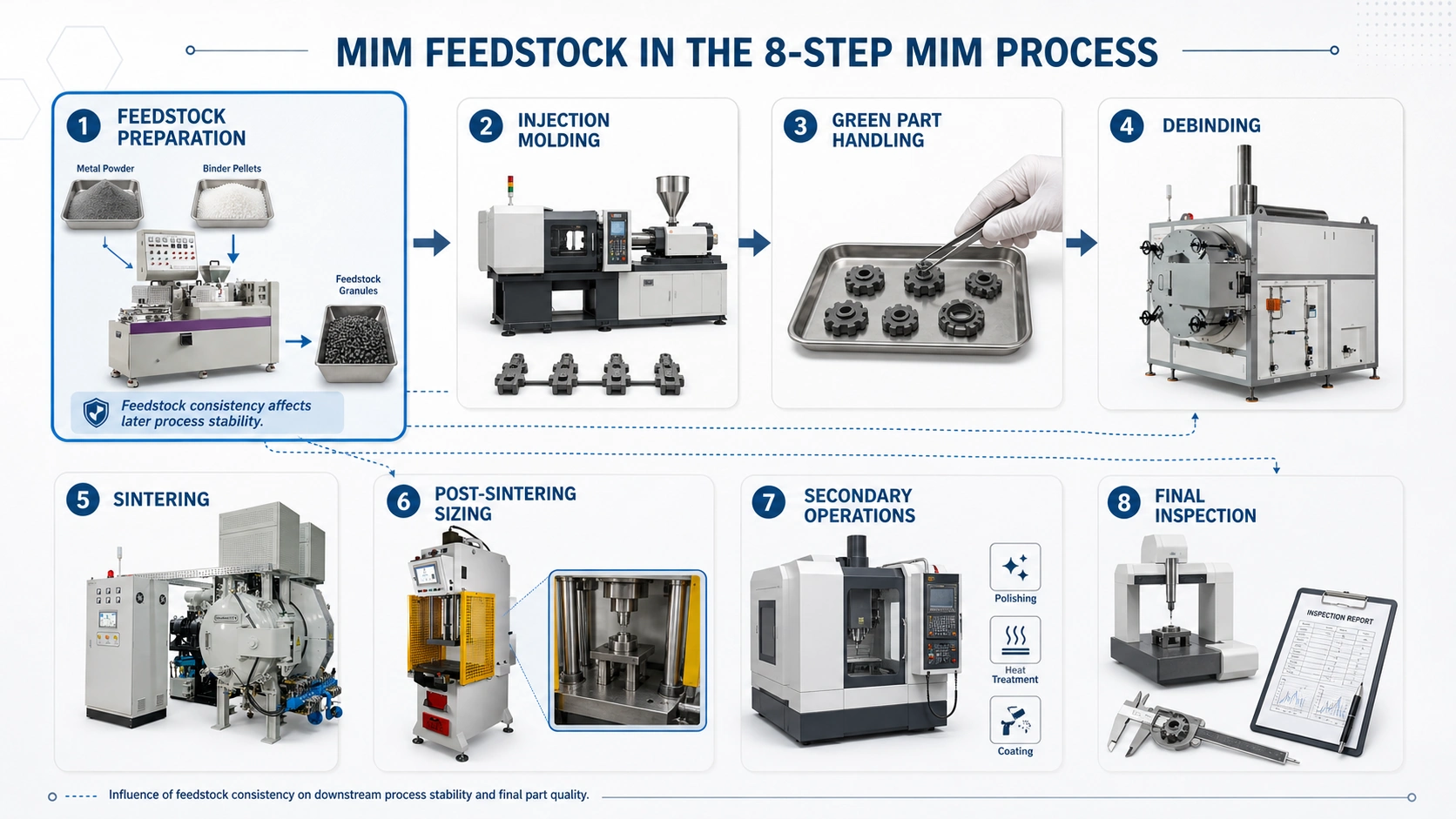
Factory scope: this diagram explains the upstream feedstock route; it does not represent in-house powder production, compounding, or pelletizing at XTMIM.
XTMIM control: material and supplier-batch verification, protected storage, trial molding response, debinding compatibility, sintering shrinkage, and final dimensional consistency.
Where Feedstock Fits in the MIM Process
Feedstock is the first material input in the MIM route. XTMIM production normally begins with incoming verification of qualified pellets, followed by injection molding, green-part handling, debinding, sintering, secondary operations when required, and final inspection.

Process principle: a feedstock-related variation may first appear as a molding defect, debinding crack, sintering distortion, or dimensional shift. Diagnosis must trace the complete process chain rather than repeatedly adjusting one machine parameter.
| Later MIM Step | How Feedstock Preparation Can Affect It | Possible Final Result |
|---|---|---|
| MIM injection molding | Flow behavior, filling stability, powder-binder uniformity, and moisture condition. | Short shot, flash, weld line weakness, flow marks, gate marks, or unstable molding window. |
| Green part handling | Green strength, demolding response, trimming resistance, and edge stability. | Cracks, corner chipping, gate scars, tray loading dents, or handling deformation. |
| MIM debinding process | Binder system, part thickness compatibility, binder removal rate, and residue risk. | Blistering, cracking, weak-section collapse, slumping, or incomplete binder removal. |
| MIM sintering shrinkage | Powder packing behavior, chemistry control, green density, and residual contamination. | Shrinkage variation, warpage, density variation, grain growth risk, or dimensional drift. |
| Final inspection | Batch consistency and process traceability from feedstock to sintered part. | More stable dimensions, density, hardness, surface condition, and material confirmation. |
What Is MIM Feedstock Made From?
MIM feedstock is not ordinary plastic granules, and it is not loose metal powder. It is an engineered molding compound. Its practical control points are metal powder, binder, powder-binder distribution, pellet condition, and storage stability. The powder-to-binder volume balance is evaluated as MIM solid loading, which affects feedstock viscosity, mold filling, green part stability, debinding behavior, sintering shrinkage, and dimensional repeatability.

Core conclusion: the same material grade can produce different results if feedstock consistency is poor.
Engineering explanation: binder-rich areas may flow differently from powder-rich areas. This can create local density differences in the green part. After debinding and sintering, those differences may become hole movement, flatness change, local warpage, or dimensional drift.
Fine Metal Powder
Metal powder defines the final material family, such as MIM stainless steel, low alloy steel, soft magnetic alloy, copper alloy, cobalt-chromium alloy, or other qualified alloy systems. Powder chemistry, particle size, purity, oxygen and carbon control, and sintering activity influence final density, strength, corrosion resistance, magnetic behavior, and dimensional stability.
Binder System
Binder gives the powder moldability. It helps the feedstock fill the mold cavity and gives the green part enough strength for demolding, trimming, handling, and loading. The binder is temporary. It must be removed during debinding without creating unacceptable cracks, blisters, collapse, or harmful residue.
Processing Aids and Pellet Condition
Small amounts of additives may be used to improve powder dispersion, lubrication, mixing stability, or molding response. Pellet condition, cleanliness, moisture protection, and batch traceability also matter because they affect how consistently the material enters the molding process.
A common mistake: treating feedstock as only a material name. In real projects, the same material family can behave differently when powder characteristics, binder route, storage condition, molding window, wall thickness, or sintering requirement changes.
How Commercial MIM Feedstock Is Prepared—and What XTMIM Controls
Commercial feedstock preparation normally includes powder selection, binder-system design, controlled mixing or compounding, and pelletizing. These upstream operations are performed by the feedstock supplier. XTMIM normally receives ready-to-mold pellets and controls whether each material batch is suitable for the actual part and production route.

Scope clarification: powder selection, binder formulation, mixing, and pelletizing describe commercial feedstock manufacture, not XTMIM in-house operations.
Commercial Feedstock Supplier
The supplier selects the metal powder and binder route, controls powder-binder distribution, compounds the material, pelletizes it, and provides batch and processing data. Consistency at this stage affects flow, green strength, debinding, and shrinkage behavior.
XTMIM Incoming Verification
XTMIM confirms material grade, supplier batch, packaging condition, shelf-life information, storage requirements, and available material documentation before the pellets enter trial molding or production.
Part-Specific Process Verification
Trial molding checks filling behavior, flash, weld lines, surface condition, green-part strength, and process-window stability for the actual geometry, gate design, and tolerance requirements.
Downstream Traceability
Feedstock batch records are connected with molding, debinding, sintering, density, dimensional inspection, and other project-specific results so repeat orders can be compared against the approved production route.
How Feedstock Affects Injection Molding and Green-Part Handling
Injection molding is the first stage where feedstock problems usually become visible. If the feedstock does not flow well, the mold may not fill completely. If flow is unstable, the process may show flash, weld line weakness, jetting, gate marks, flow marks, or a narrow operating window. If the material has moisture or contamination, gas marks, voids, or surface defects may appear.
The issue is not simply whether the machine can push material into the mold. The real process question is whether the feedstock, part design, mold design, gate location, and molding parameters can work together within a stable window.

Core conclusion: feedstock-related problems often appear before sintering.
Engineering explanation: when short shot, flash, weld line weakness, or green density variation repeats after normal molding adjustments, the review should include feedstock condition, moisture control, pellet batch, gate design, and part flow length—not only injection pressure or temperature.
| Feedstock Condition | Injection Molding Behavior | Possible Production Risk |
|---|---|---|
| Insufficient flowability | Difficult filling, higher pressure demand, unstable cavity filling. | Short shot, incomplete features, weld weakness, or scrap increase. |
| Unstable flow response | Narrow molding window and inconsistent filling response. | Flash, jetting, local separation, dimensional variation, or repeated process adjustment. |
| Poor mixing uniformity | Uneven flow behavior and local density difference. | Flow marks, black lines, surface defects, shrinkage inconsistency, or density variation. |
| Moisture or contamination | Gas generation, unstable melt behavior, surface instability. | Voids, gas marks, surface defects, debinding risk, or sintering contamination. |
| Batch-to-batch variation | Previous injection settings may no longer remain stable. | Trial instability, dimensional drift, or repeated tuning before approval. |
Engineering reminder: not every molding defect is caused by feedstock. Mold design, gate position, injection pressure, barrel temperature, mold temperature, cooling, and ejection method must also be reviewed. But when feedstock is unstable, later process adjustment becomes less reliable.
Green-Part Strength
After molding, the part still contains binder and is weaker than the final metal component. Feedstock condition and the molding window affect whether thin walls, holes, edges, and gate areas survive demolding, trimming, handling, and tray loading.
Handling Risk
Small green-part cracks, corner chipping, dents, or handling deformation may open during debinding or become permanent after sintering. These defects should be tracked before furnace processing begins.
How Feedstock Affects Debinding Stability
Debinding removes binder from the molded green part while preserving the weak powder structure. The binder route built into the selected commercial feedstock directly affects the debinding method, removal speed, support requirement, and defect risk. Depending on feedstock type and process design, the manufacturer may use solvent debinding, catalytic debinding, thermal debinding, or a combined route.
Debinding risk increases when the part is thick, has sudden wall thickness changes, includes weak sections, or has areas where binder removal is slower. Poor support or aggressive binder removal can cause blistering, cracking, binder residue, slumping, or collapse before sintering.
A common mistake is to treat debinding defects as furnace problems only. In real defect review, the feedstock, binder route, part geometry, wall thickness, green part condition, and loading method must be checked together. For the next process stage, see the MIM debinding process.
How Feedstock Affects Sintering Shrinkage and Final Dimensions
During sintering, the debound part densifies at high temperature and shrinks significantly. This shrinkage is normal in metal injection molding. The mold must be designed with a suitable oversize factor, and the manufacturer must understand how the selected feedstock behaves through the full process.
If the powder-binder mixture is inconsistent, the part may not shrink uniformly during sintering. The result can be dimensional drift, hole position movement, flatness change, warpage, local density variation, grain growth risk, or inconsistent mechanical performance.
Practical point: feedstock preparation does not replace sintering control. Furnace atmosphere, loading support, setters, sintering temperature, holding time, material chemistry, and part geometry still matter. Feedstock provides the starting condition for predictable densification; it does not control the furnace by itself.
| Feedstock-Related Factor | Sintering Effect | Final Part Risk |
|---|---|---|
| Powder characteristics | Affect densification behavior and sintering response. | Density, strength, surface condition, corrosion response, or magnetic performance variation. |
| Powder-binder consistency | Affects whether shrinkage is uniform across the part. | Dimensional drift, hole movement, flatness change, or local deformation. |
| Binder residue risk | May affect carbon, oxygen, or contamination control. | Hardness variation, brittleness, corrosion risk, or abnormal surface condition. |
| Batch consistency | Affects whether the same tooling and process window remain stable. | Different shrinkage behavior between trial and production batches. |
For more details about densification, shrinkage, furnace atmosphere, and distortion control, see MIM sintering shrinkage and process control.
How XTMIM Controls Feedstock Before and During Production
Because XTMIM normally uses commercially prepared pellets, factory control focuses on correct material entry, protected handling, project-specific molding response, downstream compatibility, and traceability to final inspection.
| Control Stage | XTMIM Control | Main Risk | Typical Verification |
|---|---|---|---|
| Incoming material | Confirm material grade, supplier batch, packaging, shelf-life information, storage requirement, and available certificates. | Wrong material route, damaged packaging, contamination, or unsuitable stock condition. | Label and document review, incoming record, packaging check, and batch registration. |
| Storage and handling | Protect pellets from moisture, contamination, uncontrolled mixing, and loss of batch identity. | Gas marks, unstable flow, surface defects, or loss of traceability. | Storage log, sealed handling, material segregation, and conditioning when specified. |
| Trial molding and green parts | Evaluate filling, flash, weld lines, gate behavior, surface condition, part weight, demolding, trimming, and green-part damage. | Short shot, unstable process window, cracks, chipping, dents, or green-density variation. | Trial-shot record, visual inspection, short-shot study, weight trend, and handling review. |
| Debinding and sintering response | Confirm binder-removal compatibility, support method, shrinkage trend, density, hardness, dimensions, and furnace-batch response. | Blistering, cracking, residue, slumping, warpage, density variation, or dimensional drift. | Debinding and furnace records, brown-part checks, dimensional measurement, density and hardness testing as required. |
| Final traceability | Connect feedstock batch with molding, debinding, sintering, secondary-operation, and inspection records. | Unexplained variation between trials, production batches, or repeat orders. | Batch traveler, inspection report, gauge or CMM results, and approved process records. |
Basic Feedstock Data That Matters for MIM Projects
Supplier data provides starting references for tooling, molding, debinding, sintering, storage, and traceability. Final settings and shrinkage must still be verified on the actual part geometry.
| Feedstock Data Item | What It Means | Why It Matters in a MIM Project |
|---|---|---|
| Material grade | The target alloy system after sintering. | Affects strength, hardness, corrosion resistance, magnetic behavior, heat treatment response, or conductivity. |
| Oversize factor | A reference factor used for tooling enlargement and shrinkage compensation. | Important for mold design and dimensional planning, but final shrinkage should be verified with actual parts. |
| MFI or flow reference | A reference indicator of feedstock flow behavior under defined test conditions. | Useful for process comparison, but it does not replace molding trials on the actual part geometry. |
| Recommended injection temperature | Suggested barrel or nozzle temperature range for molding. | Affects flow, filling, separation risk, surface condition, and green part stability. |
| Mold temperature | Recommended tool temperature range during injection molding. | Affects filling, surface quality, cooling behavior, and dimensional stability. |
| Green density range | Reference density of the molded green part before debinding and sintering. | Useful for checking process stability and predicting shrinkage consistency. |
| Debinding requirement | Binder removal method, temperature, time, or removal target. | Affects cracking, blistering, residue, and brown part stability. |
| Sintering atmosphere | Vacuum, argon, hydrogen, nitrogen-hydrogen, or other controlled atmosphere. | Affects densification, carbon and oxygen control, mechanical properties, corrosion resistance, and surface condition. |
| Shelf life and storage | Recommended storage period and moisture protection requirement. | Helps prevent moisture-related molding instability and batch variation. |
Engineering note: data sheet values are reference points, not final production guarantees. Final tolerance capability, shrinkage behavior, and inspection plan should be confirmed through project-specific DFM review, trial molding, debinding, sintering, and dimensional measurement.
Common Production Problems That May Involve Feedstock
Feedstock should not be blamed for every defect. Review it when a problem repeats after normal checks of part geometry, mold and gate design, molding parameters, debinding, furnace support, and inspection data.
| Observed Problem | Possible Feedstock-Related Factor | Also Check |
|---|---|---|
| Short shot or flash | Flow response, moisture, contamination, or batch variation. | Gate design, venting, temperatures, pressure, speed, and clamping. |
| Weld weakness, jetting, or flow marks | Flow balance or local powder-binder distribution. | Flow length, gate position, injection profile, and cavity balance. |
| Green-part cracks or chipping | Green strength or molding response. | Demolding, trimming, handling force, tray design, and thin features. |
| Blistering or debinding cracks | Binder-removal compatibility or residue risk. | Wall thickness, debinding profile, loading, and support. |
| Warpage or dimensional drift | Green-density or batch-to-batch shrinkage variation. | Furnace profile, setters, loading orientation, geometry, and sizing plan. |
| Density, hardness, or surface variation | Powder characteristics, contamination, or unstable material response. | Debinding completion, atmosphere, temperature, heat treatment, and inspection method. |
Representative Engineering Scenario: Feedstock Stability and Part Variation
Scenario disclosure: this is a representative engineering scenario for explaining failure-tracing logic, not a named customer case or guaranteed result.
Consider a stainless steel MIM bracket with thin walls, two small holes, and a controlled assembly surface. Acceptable-looking green parts can still show filling, handling, or shrinkage variation after inspection.
Observed Pattern
- Local cavity-filling instability.
- Edge damage during trimming.
- Hole-distance and flatness drift after sintering.
Review Logic
The correct review connects feedstock batch response with the molding window, trimming support, debinding loading, and sintering support. A variation that begins before molding may only become measurable after sintering, so one machine parameter should not be treated as the sole cause.
Information Needed for Feedstock and Process Review
Customers do not need to specify a feedstock formulation. Send enough project data for XTMIM to review the commercial material route and the complete manufacturing process.
| Information | Review Purpose |
|---|---|
| 2D drawing and 3D file | Geometry, tooling, gate, wall-thickness, and tolerance review. |
| Target material and application environment | Alloy route, corrosion, wear, heat, magnetic, strength, or other performance requirements. |
| Critical dimensions and surface requirements | Shrinkage, sizing, machining, finishing, and inspection planning. |
| Annual volume | Tooling economics, cavity planning, and production-control requirements. |
| Previous manufacturing problems | Focuses DFM and process-risk review on known failure modes. |
FAQ About MIM Feedstock
What is MIM feedstock?
MIM feedstock is a moldable material made from fine metal powder, binder, and selected processing aids. It is used in the injection molding stage of metal injection molding. After molding, the binder is removed during debinding, and the metal powder is densified during sintering.
Does XTMIM manufacture or compound MIM feedstock in-house?
XTMIM normally uses qualified, commercially prepared feedstock pellets. Upstream powder production, powder-binder compounding, and pelletizing are not presented as XTMIM in-house capabilities. XTMIM controls incoming material verification, storage, trial molding, debinding and sintering response, final inspection, and batch traceability.
Is MIM feedstock the same as metal powder?
No. Metal powder is one major component of MIM feedstock, but feedstock also contains binder and processing aids. Loose metal powder cannot normally be injected into a mold like thermoplastic material. The binder system gives the feedstock moldability and supports the green part before debinding.
Why is binder used in MIM feedstock?
Binder allows metal powder to flow through an injection molding machine and fill the mold cavity. It also gives the molded green part enough strength for demolding, trimming, handling, and loading before debinding. The binder is temporary and must be removed before final sintering.
Can feedstock cause MIM part defects?
Yes. Feedstock can contribute to short shot, flash, weld line weakness, flow marks, green part cracks, debinding defects, warpage, density variation, and dimensional drift. However, defects should not be assigned to feedstock alone. Part design, mold design, gate location, injection parameters, debinding route, sintering support, and inspection data must also be reviewed.
How does feedstock affect MIM shrinkage?
Feedstock affects shrinkage through powder characteristics, powder-binder consistency, green density, binder removal behavior, and sintering response. If the powder-binder mixture is inconsistent, the part may not shrink uniformly during sintering, which can lead to dimensional drift, warpage, or local density variation.
Does every MIM material use the same feedstock?
No. Stainless steel, low alloy steel, copper alloy, soft magnetic alloy, cobalt-chromium alloy, and other MIM material systems may require different powder characteristics, binder routes, molding windows, debinding conditions, and sintering atmospheres. Material selection and feedstock behavior should be reviewed together.
When should a feedstock issue be reviewed by the factory?
A feedstock review is useful when short shot, flash, flow marks, green cracks, debinding blistering, warpage, shrinkage variation, or final dimensional drift repeats after normal process adjustment. The review should include feedstock batch, molding window, part geometry, debinding route, sintering support, and inspection data.
What information should I send for MIM feedstock and process review?
A useful inquiry should include a 2D drawing, 3D file if available, target material, tolerance requirements, surface requirements, annual volume, application environment, and any previous manufacturing problems. This helps the supplier evaluate material route, molding strategy, debinding risk, sintering shrinkage, and inspection needs.
Need to Check Whether Your Part Fits MIM?
Send your drawing, target material, tolerance requirement, and annual volume. XTMIM can review whether the selected material route, available commercial feedstock, molding process, debinding plan, and sintering strategy are suitable for your custom metal part.