Respuesta Rápida: ¿Cómo se prepara el Feedstock MIM?
La preparación del feedstock MIM comercial comienza seleccionando un polvo metálico adecuado, un sistema aglutinante y una carga de polvo. Los ingredientes se dosifican, premezclan cuando es apropiado, se componen bajo condiciones controladas para dispersar el polvo en todo el aglutinante, y se enfrían y generalmente se peletizan para el moldeo por inyección. La preparación debe entregar más que pellets de apariencia uniforme: el compuesto necesita una composición y comportamiento de flujo consistentes, una ruta de eliminación de aglutinante compatible y un rendimiento repetible en la pieza real. Los datos del proveedor respaldan la primera evaluación; las pruebas a través del moldeo, desaglutinado y sinterizado establecen la idoneidad específica del proyecto.
¿Qué es el Feedstock MIM y por qué necesita preparación?
feedstock MIM es un compuesto moldeable fabricado al dispersar polvo metálico fino en un sistema aglutinante temporal. Difiere del polvo metálico suelto y las pastillas de plástico ordinarias: contiene una alta proporción de polvo metálico, mientras que su aglutinante permite que la mezcla fluya a través de una máquina de moldeo por inyección y conserve su forma como un pieza en verde.
La preparación es necesaria porque el polvo metálico por sí solo no puede fluir y llenar de manera confiable un molde MIM convencional como un material inyectable coherente. El aglutinante debe humedecer y transportar el polvo durante el moldeo, y luego ser eliminado a través de un proceso de desaglutinado compatible antes de que el polvo se densifique mediante sinterizado. Por lo tanto, un feedstock adecuado debe cumplir con requisitos conectados: distribución uniforme, flujo utilizable en condiciones de moldeo, integridad adecuada de la pieza en verde y una ruta factible de eliminación y sinterizado posterior.
Distinción principal: los gránulos que parecen uniformes o que se pueden inyectar una vez no están necesariamente calificados para la producción repetible. La preparación del feedstock proporciona el material de partida; la verificación del proceso específico del proyecto establece si funciona para la pieza final.
¿Qué Contiene el Feedstock MIM?
El feedstock MIM comercial generalmente se diseña como un sistema de polvo-aglutinante en lugar de seleccionarse únicamente por el nombre de la aleación. El polvo determina la composición metálica prevista después del sinterizado; el aglutinante hace posible el moldeo y el manejo de la pieza en verde; y su proporción afecta el comportamiento del procesamiento y el cambio de volumen durante el sinterizado.
Características del Polvo Metálico
La química del polvo, la distribución del tamaño de partícula, la forma, la condición de la superficie y los límites de contaminación influyen en cómo se empaquetan las partículas, cuánto aglutinante se necesita y cómo se comporta el material durante el moldeo y el sinterizado. El polvo fino puede ayudar a la actividad de sinterizado, pero también puede aumentar el área superficial del polvo y la demanda de aglutinante. Las formas de las partículas y las distribuciones de tamaño también cambian el empaquetamiento y la viscosidad. Estos factores deben considerarse juntos en lugar de clasificar una propiedad del polvo como universalmente la mejor.
Una designación de aleación coincidente no garantiza un comportamiento idéntico del feedstock. Dos fuentes comerciales para la misma aleación nominal pueden usar diferentes características de polvo o rutas de aglutinante y pueden requerir diferentes condiciones de procesamiento validadas.
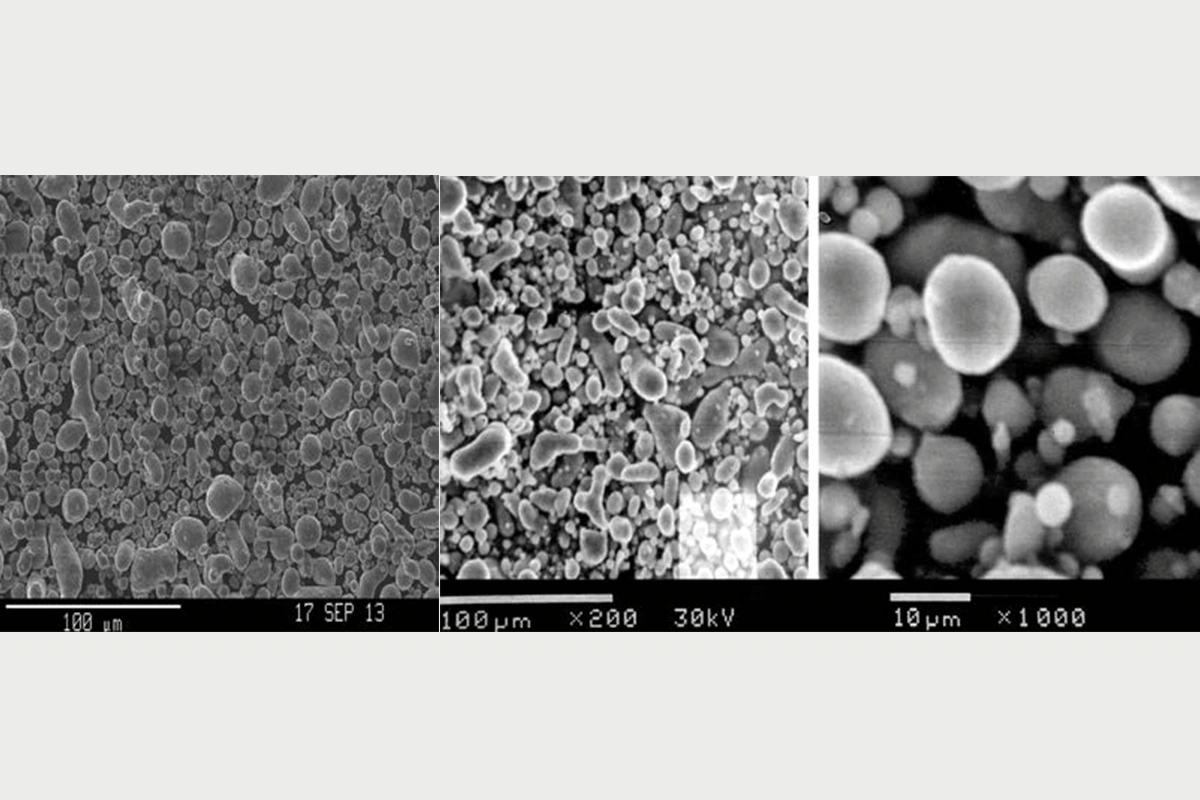
La morfología del polvo cambia las condiciones de compuesto. Las formas de las partículas visibles en microscopía electrónica de barrido influyen en el empaquetamiento del polvo y la cantidad de superficie de partícula que el aglutinante debe humectar. La distribución del tamaño de partícula y la morfología también afectan el equilibrio entre la carga de metal y el flujo moldeable.
Estas imágenes documentan dos muestras de polvo MIM de aluminio publicadas. Ilustran características observables del polvo; no establecen la formulación del aglutinante, la carga sólida ni la idoneidad para un molde de inyección en particular.
Para un proyecto real: evalúe las características del polvo especificadas por el proveedor junto con su ruta de aglutinante y los datos de moldeo validados, en lugar de seleccionar el feedstock solo por el nombre de la aleación.
Sistema Aglutinante y Sus Funciones
Un sistema aglutinante típicamente realiza varias funciones: ayuda a que la mezcla de polvo fluya bajo condiciones de moldeo, mantiene unida la pieza verde moldeada y permite una eliminación controlada antes del sinterizado. Las formulaciones pueden combinar diferentes constituyentes del aglutinante, como una fase de soporte de flujo, una estructura de soporte y aditivos de procesamiento opcionales; la química exacta y la secuencia de eliminación dependen del sistema del proveedor.
La pregunta crucial es si el aglutinante es compatible con la geometría del componente y la ruta de desaglutinado prevista, no si una formulación genérica es siempre superior. Para una explicación técnica separada, consulte Sistemas aglutinantes MIM.
Carga Sólida y el Equilibrio Polvo-Aglutinante
Carga sólida es la fracción de volumen de polvo metálico del feedstock. Muy poco polvo significa que se debe eliminar una mayor fracción de aglutinante y generalmente aumenta la contracción necesaria para alcanzar la densidad metálica final. Una carga de polvo demasiado alta, especialmente cerca o más allá del límite práctico de empaquetamiento de la formulación, puede hacer que la viscosidad sea excesiva y dificultar el llenado completo del molde. Los riesgos de segregación también deben considerarse cuando la formulación polvo-aglutinante y las condiciones de flujo no coinciden. El equilibrio apropiado depende del empaquetamiento de partículas, la química del aglutinante, la geometría de la pieza y el equipo de moldeo.
Un porcentaje de una formulación de material no debe copiarse a otra como un objetivo universal. La lógica de selección detallada pertenece a la guía dedicada Guía de Carga Sólida MIM.
Conclusión técnica: la calidad del polvo, la selección del aglutinante y la carga sólida actúan como un solo sistema. Mejorar una variable de forma aislada puede hacer que otro paso —moldeo, desaglutinado o sinterizado— sea menos estable.
¿Cómo se prepara el feedstock MIM comercial?
Comercial preparación del feedstock generally follows a controlled sequence, although suppliers may use different mixing equipment, cooling methods and pelletizing routes. The sequence below describes industry practice, not in-house feedstock manufacturing at XTMIM.
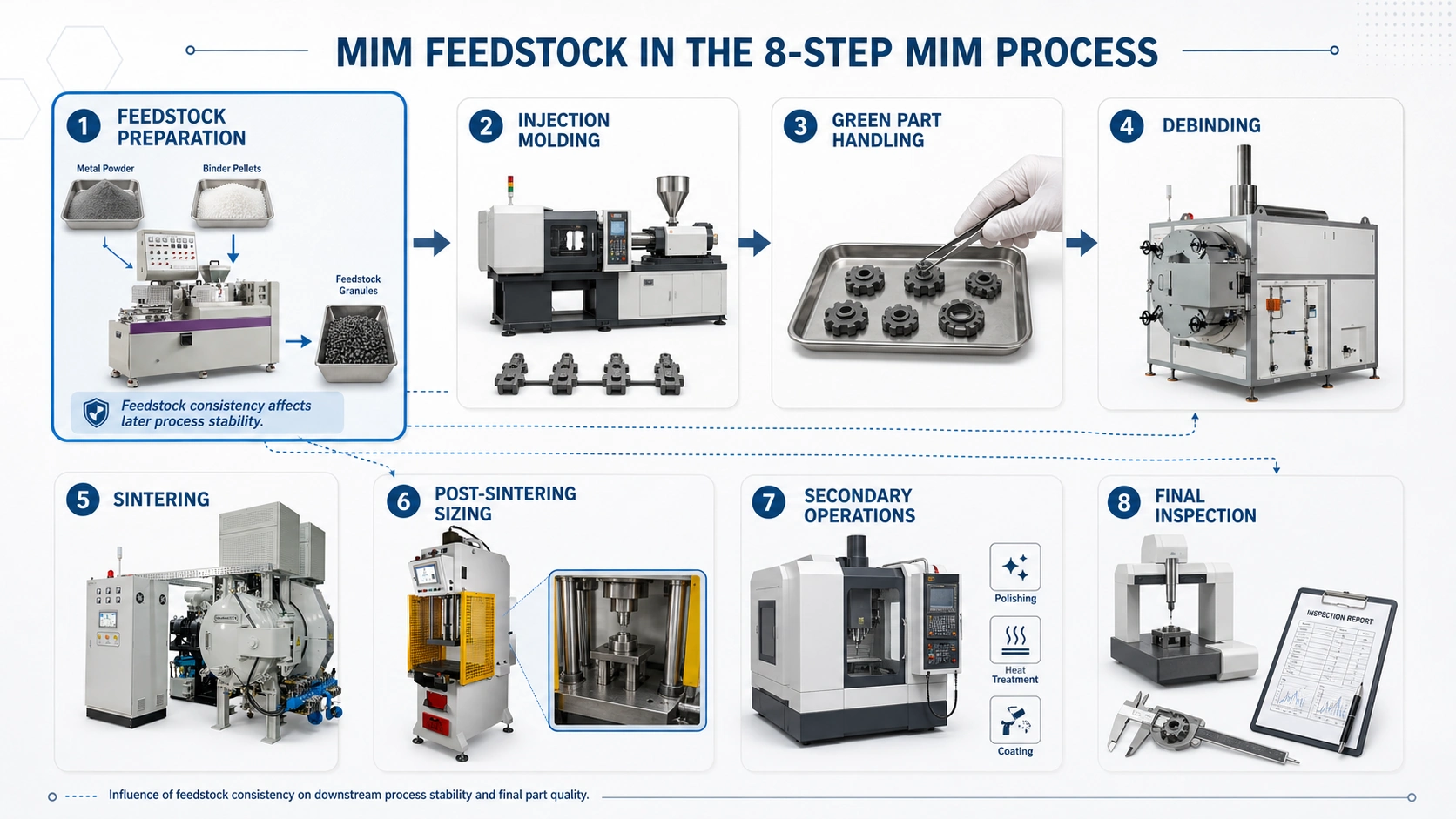
Material and Formulation Selection
The commercial feedstock supplier starts with the target metal alloy and powder characteristics suited to the intended sintering route. The binder system is selected for powder compatibility, desired flow behavior, green-part integrity and an available debinding route. The formulation also needs a workable powder volume fraction. A supplier should establish this for the intended material family and molding requirements rather than assume that one formulation fits every alloy or geometry.
Proportioning and Premixing
Metal powder and binder constituents are weighed or metered to the intended formulation. Some commercial routes use dry or low-temperature premixing; others introduce ingredients directly during controlled compounding. Where premixing is used, it helps distribute the starting components before the binder is processed. The practical control objective is the same in either route: correct powder-to-binder proportion, consistent raw-material identity and minimal contamination before the main mixing stage.
Compounding and Powder Dispersion
During compounding, the binder is brought to a processable state and mixed with the powder under controlled thermal and mechanical conditions. The objective is to wet and distribute the particles sufficiently evenly while avoiding unwanted binder degradation or segregation. Depending on the formulation, a commercial supplier may use specialized mixers or extrusion-based compounding. No single temperature, mixing time or machine configuration can be specified for every MIM feedstock.
Compounding is the central conversion step: a batch should behave as a coherent powder–binder suspension rather than as separate powder-rich and binder-rich portions. The control questions are therefore whether the mixing conditions suit the binder system and whether the resulting material is uniform enough for consistent molding.
Cooling, Pelletizing, and Batch Identification
After compounding, the material is conditioned or cooled as required by the selected equipment and commonly converted into pellets or granules for handling, metering and injection-molding supply. Pellet size and geometry should suit the material-handling and molding setup, while storage and packaging follow the specific supplier's recommendations. Batch identification links the delivered material to its preparation record and applicable processing information.
Factory-scope clarification: these are typical upstream commercial feedstock manufacturing operations. XTMIM normally purchases qualified ready-to-mold feedstock; it does not represent powder production, binder formulation, compounding or pelletizing as its in-house manufacturing scope.
Which Preparation Controls Determine Feedstock Consistency?
Knowing the sequence is not enough to judge a preparation process. The important outcome is whether different portions of the compound and successive pellets have sufficiently consistent powder content and processing behavior for the intended part. Uniform color or appearance alone cannot establish this.
Mixing Temperature, Shear, and Time
Compounding temperature affects binder softening and viscosity; mixing shear and residence time influence how powder is incorporated and dispersed. Conditions that are too mild may leave incomplete powder wetting or uneven distribution. Conditions that are unsuitable for the binder can cause degradation or unwanted changes in viscosity. The useful processing window must therefore come from the formulation and the supplier's process development, not a generic recipe.
Powder–Binder Homogeneity and Pellet Consistency
A feedstock that separates into powder-rich and binder-rich regions can fill a mold unevenly and create nonuniform green density. Differences may persist into debinding or sintering, where they can contribute to uneven shrinkage. Batch-to-batch changes may also shift the molding window even when the alloy label remains unchanged.
How can this be checked? Depending on the commercial formulation, suppliers may compare samples from different locations in a batch using validated binder-content measurements, density or composition checks, and rheological flow curves at defined temperatures and shear rates. Thermogravimetric analysis can be useful for certain binder-content evaluations when its method is validated for that particular system. These are possible characterization methods, not a claim that every supplier or XTMIM performs each test. A uniform-looking cross-section or a single flow number cannot, by itself, prove batch homogeneity or finished-part suitability.
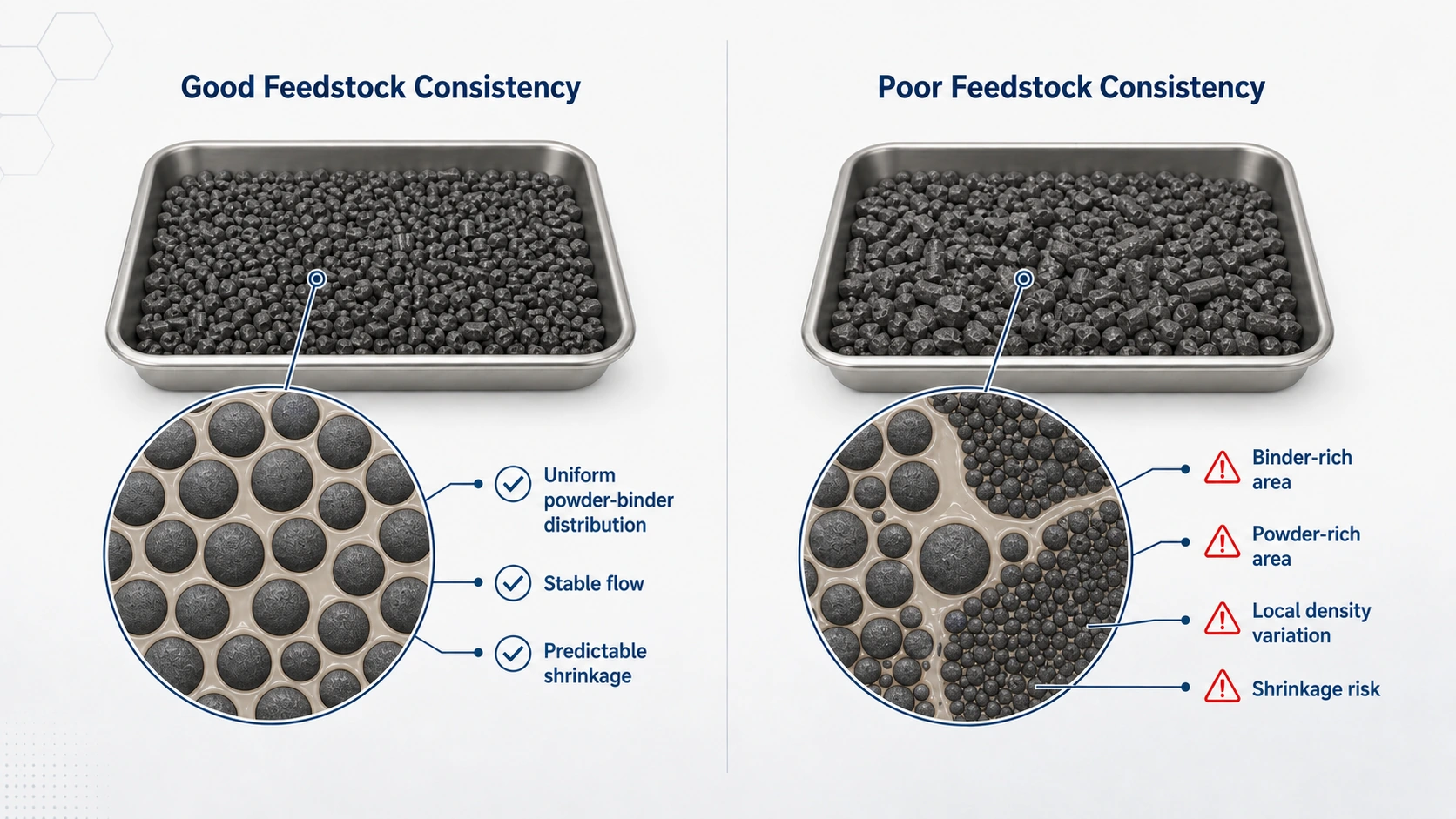
Uniform dispersion is a manufacturing control target. In a consistent compound, metal powder is distributed throughout the binder so different pellets and local melt regions behave similarly under validated molding conditions.
Powder-rich and binder-rich regions can respond differently during filling, binder removal and densification. Resulting variation may be observed in green density or final dimensions, although the same symptoms can also arise from tooling or furnace conditions.
Evidence required: use comparable, formulation-appropriate tests and repeated molding results. This conceptual image is not a measured batch comparison.
| Preparation control | What it is intended to protect | What a mismatch can change |
|---|---|---|
| Powder and binder ratio | Target volume balance and processing window | Viscosity, binder-removal load and shrinkage behavior |
| Mixing conditions | Powder wetting and dispersion without binder damage | Local composition and flow differences |
| Homogeneity | Consistent powder distribution throughout the feedstock | Green density and local sintering response |
| Consistencia del pellet y del lote | Repeatable material feeding and identifiable production lots | Changes between qualification and repeat production |
Practical interpretation: if the compound is not homogeneous, changing injection pressure alone cannot reliably correct the upstream material variation. Conversely, a molding defect is not proof of poor feedstock; mold design, setup and handling also require review.
How Is Prepared MIM Feedstock Checked Before Use?
Feedstock checks should establish what material was supplied, what its relevant properties are and whether the supplier's processing route is compatible with the planned MIM operation. The available data and tests differ by commercial formulation; the list below is a review framework, not a claim that every value is supplied or every test is performed in-house by XTMIM.
Supplier Batch Information and Material Identification
Start with the material designation, supplier, lot or batch identity, packaging condition, and relevant technical data or certificates when available. A general technical data sheet describes a material grade or processing recommendations; a lot-specific certificate or inspection record, where supplied, relates to a particular delivery. Review storage and handling instructions and confirm that the received lot matches the feedstock route approved for trial. Batch identity is essential when later molding and finished-part results must be compared.
Feedstock Flow Behavior and Relevant Material Data
Rheological information can indicate how a feedstock responds to temperature and shear; it may be more informative for a complex mold than one melt-flow reference value. Suppliers may also document solid-loading information, recommended barrel or mold temperature ranges, green-density guidance, binder-removal conditions, sintering-atmosphere guidance or a preliminary tooling oversize factor, depending on the product and what the supplier discloses. Data availability, test conditions and units must be checked before values are compared. An oversize factor or recommended machine setting is a starting reference—not a tolerance or shrinkage guarantee.
| Information to review | Por qué es importante | Limitación importante |
|---|---|---|
| Alloy / supplier / batch | Confirms material identity and lot traceability | Same alloy name does not prove equivalent feedstock |
| Powder–binder route and applicable data | Supports molding and debinding planning | Exact formulation may be proprietary or not provided |
| Flow or rheology reference | Helps anticipate processing behavior | Test temperature and shear conditions must be comparable |
| Recommended barrel and mold conditions | Offers starting temperatures and handling conditions for trial molding | Final settings depend on machine, mold, binder system and geometry |
| Debinding and sintering guidance | Helps check binder-removal method, furnace route and atmosphere compatibility | Must be verified against the actual part geometry, equipment and loading |
| Reference oversize / shrinkage factor | Supports preliminary tool and dimensional planning | Not a fixed shrinkage value for every feature |
| Green-part reference density, if provided | Provides context for comparing trial batches and estimating shrinkage | Test method and formulation must match; not a finished-part guarantee |
| Storage / shelf-life requirements | Helps prevent compromised or untraceable incoming stock | Requirements vary by formulation and packaging |
Regla de decisión: use supplier information to approve the material for trial, not automatically to approve the part for mass production.
How Is Feedstock Qualified for a Specific MIM Part?
A commercial feedstock can meet its supplier's specification yet perform differently in a long flow path, thin-walled bracket, small hole or difficult gate arrangement. Qualification should therefore connect the incoming batch to the actual part design, mold, debinding route and finished-part measurements.
Trial Molding and Green-Part Evaluation
Trial molding examines filling, surface condition, gate response, flash, weld-line behavior and demolding stability under a controlled operating window. Green parts are checked for damage or distortion during ejection, trimming and handling. For complex features, the most useful observation is whether acceptable parts can be produced repeatably—not whether one sample looks complete.
If molding behavior changes after a feedstock batch switch, compare the lot information and material condition with the mold, gate, barrel and mold temperatures, pressure profile and cycle parameters. The cause should be determined from evidence rather than assigned to the feedstock automatically.

Trial molding tests the material in the intended geometry. A useful trial checks repeated filling, gate behavior, surface condition and green-part handling within a documented machine and mold window—not just one acceptable shot.
If the molded part exhibits a short shot, flash or handling damage, compare the feedstock lot and process data with gate design, venting, temperature, pressure and ejection conditions before assigning the cause to the material.
The image illustrates these potential observations. It is not an XTMIM inspection record or quantitative proof of a feedstock defect.
Debinding, Sintering, and Dimensional Verification
The selected binder route must be compatible with the project's debinding equipment and process. After binder removal, the powder skeleton must retain sufficient integrity to proceed to sintering. The sintered components are then evaluated against the approved drawing and project criteria: critical dimensions, distortion, density and other material properties as required. Feedstock-specific oversize references need verification against the actual tooling and processing conditions.
For example, a representative thin-walled stainless-steel bracket with two small holes may mold without visible short shots but later show variation in hole spacing or flatness. A useful investigation compares feedstock lots, green-part measurements, handling, debinding supports and furnace loading before changing the mold or declaring the feedstock defective. This example illustrates a diagnostic sequence; it is not a documented XTMIM customer case, a measured test result or a claimed production improvement.
| Decision stage | Evidencia a buscar | What it can confirm |
|---|---|---|
| Supplier data review | Material identity and specified processing information | Suitability for a controlled molding trial |
| Moldeo de prueba | Repeatable filling, appearance and green-part handling | Fit with the actual mold and injection window |
| Debinding trial | Stable part condition after binder removal | Compatibility of binder route, geometry and supports |
| Sintered inspection | Dimensional and material results against project requirements | Feasibility of a repeatable finished-part process |
Qualification decision: acceptance should depend on repeatable trial results meeting the agreed part criteria—not on one good sample or a generic feedstock data sheet. If molding is stable but the debound or sintered part fails, continue the investigation before approving the route for production.
How Can Feedstock Variations Affect Later MIM Processes?
Feedstock preparation sets the starting conditions for molding, binder removal and sintering. Variations may become visible at different stages, but the final defect does not uniquely identify its cause. The table shows why feedstock is reviewed as part of the complete MIM process, not as a substitute for downstream process control.
| Downstream stage | Feedstock-related mechanism | Other factors that must be reviewed |
|---|---|---|
| Injection molding and green parts | Viscosity, distribution and green strength influence filling and handling behavior | Gate and mold design, process settings, ejection and handling |
| Desaglutinado | Binder system and its distribution affect removal compatibility and the integrity of the powder skeleton | Wall thickness, removal profile, supports and green-part condition |
| Sintering and final dimensions | Powder characteristics and nonuniform green density can influence shrinkage and dimensional consistency | Furnace atmosphere, support, thermal profile, geometry and inspection method |
For detailed failure mechanisms and systematic troubleshooting, read Cómo el Feedstock Afecta la Calidad de las Piezas en MIM. This page focuses on preparation and qualification rather than a full catalog of downstream defects.
How Does XTMIM Manage Commercial Feedstock in Production?
The feedstock supplier and the MIM part manufacturer control different parts of the process. This distinction helps OEM teams evaluate manufacturing capability accurately.
Feedstock Supplier and MIM Manufacturer Responsibilities
Commercial feedstock supplier
Selects the powder and binder route, manages formulation and controlled compounding, makes the delivery form, and supplies applicable batch or technical information. Specific tests and processing details depend on the supplier.
XTMIM MIM manufacturing
Normally purchases qualified feedstock pellets and evaluates their use for a particular component. The manufacturing route includes incoming verification, injection molding, debinding, sintering and final part inspection, with additional operations where required.
Incoming Material Control, Storage, and Batch Traceability
Before a material lot enters an approved production route, relevant checks include the alloy or feedstock grade, supplier lot identity, packaging condition and applicable storage instructions or documentation; the exact checks depend on the project control plan. Proper material segregation and handling can reduce contamination, moisture exposure where applicable, or accidental mixing of lots. Relevant lot information should be available when trial or production results are reviewed.
For project-specific production, the important feedback loop is to relate material identity to the molding run, debinding and sintering route, and final inspection outcomes. The exact inspection frequency and records depend on the approved project control plan. This does not imply that XTMIM independently manufactures the feedstock or performs every possible laboratory characterization test on every lot.
Manufacturing boundary: XTMIM controls how qualified commercial feedstock is introduced and processed for custom MIM parts. The upstream mixing recipe and pellet-production operation remain with the commercial supplier.
What Should OEM Teams Provide for Feedstock and MIM Process Review?
OEM buyers usually do not need to develop or specify a proprietary feedstock formulation. A more useful starting point is a complete description of the required metal part, its working conditions and its target manufacturing volume. This gives the manufacturer enough context to assess whether a qualified commercial feedstock and a practical processing route are available.
| Project information | What it helps the engineer determine |
|---|---|
| 2D drawing and available 3D model | Geometry, wall thickness, gates, tool concept and DFM concerns |
| Target alloy or functional performance | Available qualified material routes and any compatibility limits |
| Dimensiones críticas y tolerancias | Trial validation, shrinkage planning and required secondary machining |
| Surface and application requirements | Finishing, inspection and end-use performance expectations |
| Annual quantity and expected launch plan | Whether tooling and qualification effort are economically justified |
| Known production issues or test requirements | Where additional process verification should focus |
Final decision: choose a feedstock route only after confirming both commercial material availability and compatibility with the actual mold, debinding process, sintering route and finished-part requirements. A feedstock data sheet alone is not a finished-part approval.
For the wider manufacturing sequence, see Proceso de Moldeo por Inyección de Metal. If you already have a drawing, proceed to submit your part for engineering review.
Need a Feedstock and MIM Process Review for Your Part?
Send your drawing, target material, critical tolerances and planned quantity. XTMIM can review the available commercial feedstock route and the downstream molding, debinding and sintering considerations for your project.