
Centro de materiales MIM
Materiales MIM para Moldeo por Inyección de Metal
Los materiales MIM para moldeo por inyección de metal deben elegirse por la función de la pieza y su manufacturabilidad, no solo por el nombre de la aleación. Esta página ayuda a ingenieros y equipos de compras a dirigir un proyecto hacia la familia de materiales correcta antes de la selección detallada del grado. Se pueden considerar aceros inoxidables, aceros de baja aleación, aceros para herramientas, aleaciones magnéticas blandas, titanio, cobre, tungsteno, níquel, cobalto-cromo y aleaciones de expansión controlada, pero cada opción debe pasar las mismas verificaciones de producción: estabilidad del feedstock, moldeo de la pieza en verde, seguridad del desaglutinado, contracción del sinterizado, densidad, condición superficial, necesidades de tratamiento térmico o acabado, e inspección final. Utilice este centro para decidir si su proyecto debe dirigirse hacia rutas de materiales de acero inoxidable, acero de baja aleación, resistentes al desgaste, magnéticos, ligeros, de alta densidad o de expansión controlada, y luego continúe a la página de grado correcta, guía de propiedades de materiales, página de comparación o ruta de revisión de planos antes del herramental.
Esta página es la ruta de materiales de primer nivel para moldeo por inyección de metal. Debe guiar la selección de la familia de materiales; los datos detallados del grado, los valores de la hoja de datos, el comportamiento del tratamiento térmico y la validación de la aplicación deben permanecer en las páginas secundarias o en la revisión específica del proyecto. Para comprender cómo el comportamiento del material avanza a través del feedstock, el moldeo por inyección, el desaglutinado, el sinterizado, las operaciones secundarias y la inspección, revise el ruta completa del proceso MIM antes de la confirmación final del material.
Si está seleccionando el material a partir de un componente terminado en lugar de una lista de aleaciones, revise Piezas MIM por material y requisito de rendimiento para conectar la resistencia a la corrosión, la resistencia, la resistencia al desgaste, la función magnética y los requisitos de precisión con categorías de piezas reales.
Respuesta rápida
Elija primero la familia de materiales. Los materiales MIM deben evaluarse según la función requerida de la pieza: resistencia a la corrosión, resistencia, resistencia al desgaste, comportamiento magnético, bajo peso, alta densidad, conductividad o expansión térmica controlada.
Luego, verifique la ruta del proceso MIM. Un material que parece correcto en una hoja de datos aún puede crear riesgos en el flujo del feedstock, la resistencia en verde, el desaglutinado, la contracción del sinterizado, el movimiento del tratamiento térmico, el acabado o la inspección final.
Use este centro para la orientación. Debe guiar a los usuarios hacia la familia de materiales correcta, la guía de propiedades, la página de comparación o la ruta de revisión de planos, no reemplazar las hojas de datos a nivel de grado o la revisión DFM específica del proyecto.
Decisión Rápida
¿Con Qué Familia de Materiales MIM Debería Empezar?
Una revisión práctica de materiales MIM comienza con el requisito de trabajo de la pieza: resistencia a la corrosión, resistencia, resistencia al desgaste, respuesta magnética, demanda de bajo peso, alta densidad, conductividad o expansión térmica controlada. No comience copiando un grado CNC familiar en la solicitud de cotización. En el moldeo por inyección de metal, la misma dirección de aleación también debe verificarse a través de la disponibilidad de polvo, el sistema aglutinante, el flujo del feedstock, la resistencia en verde, la ruta de desaglutinado, la atmósfera de sinterizado, la compensación de contracción y el movimiento post-tratamiento.
Utilice el mapa a continuación solo como un primer filtro. La selección final debe confirmar la familia del material, el grado objetivo, las dimensiones críticas para la tolerancia, el requisito de superficie, el método de inspección y si la geometría de la pieza puede permanecer estable a través del desaglutinado, el sinterizado, el tratamiento térmico, el acabado y la inspección de producción.
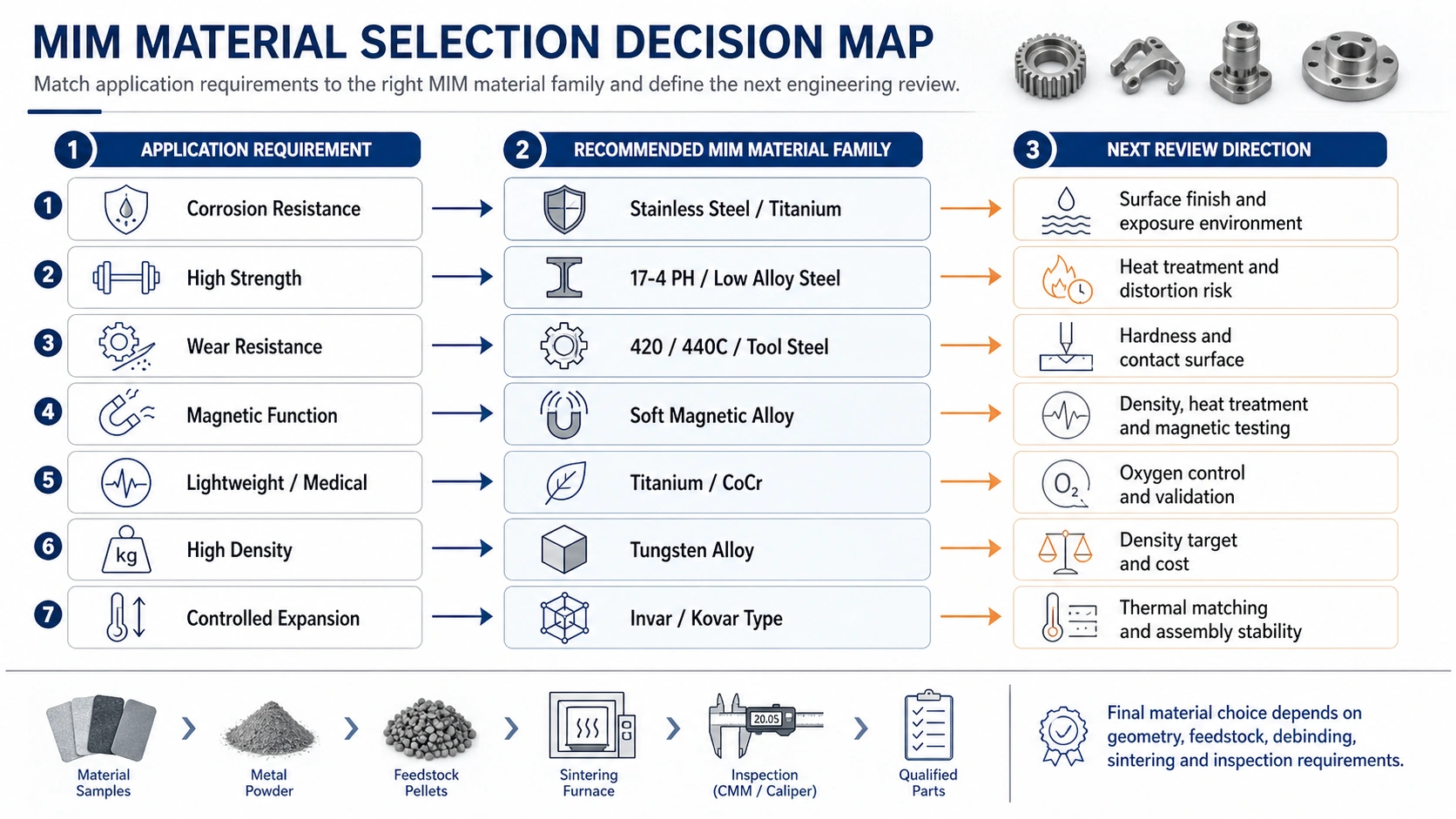
Conclusión principal: Comience con el requisito de rendimiento, no con el nombre del grado del material.
Para proyectos MIM, la familia de materiales es solo el primer filtro. La confirmación final aún depende de la estabilidad del feedstock, el desaglutinado, la contracción por sinterizado, el tratamiento térmico, el acabado superficial, el método de inspección y si la geometría de la pieza puede mantener la tolerancia requerida después de la contracción y el postratamiento.
| Si Su Pieza Requiere... | Comience Revisando... | Dirección de Material Típica | Siguiente revisión de ingeniería |
|---|---|---|---|
| Resistencia a la corrosión | Acero inoxidable o titanio | 316L, 304, aleaciones de titanio seleccionadas | Entorno de exposición, pasivación, pulido y acabado superficial |
| Mayor resistencia | Acero inoxidable tratable térmicamente o acero de baja aleación | 17-4 PH, 4605, 4140, 4340 | Tratamiento térmico, riesgo de distorsión y control de tolerancias |
| Dureza o resistencia al desgaste | Acero inoxidable martensítico, acero para herramientas, dirección de carburo | 420, 440C, aceros para herramientas, carburos cementados | Superficie de contacto, material de acoplamiento, lubricación y acabado |
| Función magnética | Aleaciones magnéticas blandas | Sistemas Fe-Ni, Fe-Co, Fe-Si | Densidad, tratamiento térmico y método de prueba magnética |
| Uso relacionado con aplicaciones ligeras o médicas | Aleaciones de titanio o cromo-cobalto | Titanio CP, Ti-6Al-4V, aleaciones CoCr | Control de oxígeno, ruta de validación y estándar de aplicación |
| Alta densidad | Dirección de aleaciones de tungsteno | Materiales base tungsteno | Objetivo de densidad, tamaño de pieza, costo de producción y viabilidad de sinterizado |
| Expansión térmica controlada | Aleaciones de expansión controlada | Aleaciones Invar y tipo Kovar | Entorno de ensamble, coincidencia térmica y estabilidad dimensional |
Rutas de familias de materiales
Familias de Materiales MIM: Para qué se usa cada ruta
En un centro de materiales MIM, las familias de materiales deben funcionar como rutas de navegación, no como un catálogo de aleaciones crudas. Las páginas de acero inoxidable, acero de baja aleación, acero para herramientas, magnéticos blandos, titanio, cobre, tungsteno, níquel, cobalto-cromo y aleaciones de expansión controlada responden a una pregunta de ingeniería diferente. Este centro debe ayudar a los usuarios a decidir a dónde ir a continuación: páginas de nivel de grado para química y propiedades, páginas de propiedades para requisitos de corrosión, resistencia, desgaste o magnéticos, y la guía de selección cuando el requisito funcional aún no está claro.
Antes de elegir una familia, verifique si la pieza tiene agujeros ciegos profundos, nervaduras delgadas, transiciones agudas, áreas largas sin soporte, superficies cosméticas o características críticas de tolerancia cerca de los puntos de inyección o secciones de grueso a delgado. Estos riesgos geométricos pueden hacer que un material que parece adecuado en papel sea difícil de moldear, desaglutinar, sinterizar, acabar o inspeccionar.

Conclusión principal: La página central debe dirigir a los usuarios por familia de materiales antes de enviarlos a páginas de nivel de grado.
La selección de materiales MIM generalmente comienza a nivel de familia. Los aceros inoxidables, aceros de baja aleación, aceros para herramientas, aleaciones de titanio, aleaciones magnéticas blandas, aleaciones de tungsteno, aleaciones de cobre, aleaciones de níquel, aleaciones de cobalto-cromo y aleaciones de expansión controlada resuelven diferentes problemas de ingeniería. La química a nivel de grado, las propiedades mecánicas y los detalles del tratamiento térmico deben manejarse en páginas secundarias.
Materiales MIM de acero inoxidable
Los aceros inoxidables se encuentran entre las familias de materiales MIM más comunes porque ofrecen un equilibrio práctico entre resistencia a la corrosión, condición superficial, disponibilidad y rendimiento mecánico. Las opciones típicas de acero inoxidable incluyen MIM de acero inoxidable 316L, 304, 420, 440C, y MIM de acero inoxidable 17-4 PH.
Úselo cuando: se requiera resistencia a la corrosión, acabado superficial, rendimiento mecánico general o resistencia tratable térmicamente.
Revise cuidadosamente cuando: la pieza tenga contacto deslizante, alta demanda de dureza, requisitos de pulido cosmético o tolerancias ajustadas después del tratamiento térmico.
Materiales MIM de acero de baja aleación
Los aceros de baja aleación se seleccionan a menudo cuando la pieza necesita resistencia mecánica, respuesta al tratamiento térmico y un mejor control de costos que muchas aleaciones especiales. Las direcciones comunes de acero de baja aleación MIM incluyen acero de baja aleación 4605 MIM, 4140, 4340, y sistemas de aleación Fe-Ni.
Úselo cuando: el proyecto necesita rendimiento estructural, respuesta al tratamiento térmico y producción sensible a los costos.
Revise cuidadosamente cuando: se requiere exposición a corrosión, galvanizado, recubrimiento, óxido negro o protección superficial a largo plazo.
Materiales MIM resistentes al desgaste y aceros para herramientas
Los aceros para herramientas, aceros inoxidables martensíticos, 420, 440C y direcciones de carburo cementado se consideran cuando la dureza, retención de filo, contacto deslizante, desgaste o tensión de contacto localizada se vuelven más importantes que la resistencia general a la corrosión.
Úselo cuando: el dibujo define una superficie de desgaste real, carga de contacto, objetivo de dureza o condición del material de acoplamiento.
Revise cuidadosamente cuando: las características afiladas, las transiciones de grueso a delgado, las áreas de contacto sin soporte o el tratamiento térmico post-sinterizado pueden crear distorsión.
Materiales MIM Magnéticos Blandos
Los materiales MIM magnéticos blandos se utilizan cuando la pieza necesita una forma compacta y un comportamiento magnético controlado. Las direcciones típicas incluyen sistemas Fe-Ni, Fe-Co y Fe-Si.
Úselo cuando: la función magnética importa tanto como la geometría, como en núcleos magnéticos compactos, componentes relacionados con sensores o piezas de actuadores.
Revise cuidadosamente cuando: el rendimiento magnético, la densidad, la atmósfera de sinterizado, el tratamiento térmico o las condiciones de prueba magnética aún no están definidos.
Aleaciones MIM especiales
Las aleaciones MIM especiales se revisan cuando el acero inoxidable estándar o el acero de baja aleación no pueden cumplir con el requisito de la aplicación. Esta ruta puede incluir aleaciones de titanio para MIM, aleaciones de cobalto-cromo, aleaciones de cobre, aleaciones de níquel, aleaciones de tungsteno y aleaciones de expansión controlada.
Úselo cuando: el rendimiento ligero, la alta densidad, el control de expansión térmica, la conductividad, la resistencia a la corrosión o los requisitos relacionados con el ámbito médico justifican el esfuerzo adicional de revisión.
Revise cuidadosamente cuando: la disponibilidad de polvo, el control de oxígeno o carbono, la ruta de sinterizado, el costo de validación o la aceptación de inspección son inciertos.
Si las rutas estándar y de aleaciones especiales establecidas aún no cumplen el requisito, continúe con una revisión de factibilidad de material MIM personalizado antes de finalizar las suposiciones de herramental.
Guía de selección de materiales
Si la familia de materiales aún no está clara, navegue desde esta página central a la guía de selección de materiales. Esa página debe utilizarse para revisar el entorno de la aplicación, las prioridades de rendimiento, la viabilidad del proceso, el postratamiento, el riesgo de tolerancia y la dirección de costos antes de confirmar el grado final.
Úselo cuando: La solicitud de cotización solo menciona un nombre de grado, pero no explica la exposición a la corrosión, la carga, el desgaste, la función magnética, el acabado superficial ni el método de inspección.
Comparación Inicial
Compare Materiales MIM por Requisito de Ingeniería, No por “Mejor Grado”
La comparación temprana de materiales MIM debe responder una pregunta: ¿qué familia de materiales se adapta mejor a la función de la pieza y al mismo tiempo es práctica a través de la ruta del proceso MIM? No debe clasificar todos los materiales de mejor a peor. Un acero de baja aleación puede ser más resistente y rentable para un componente mecánico; el 316L puede ser adecuado para la exposición a la corrosión; el 17-4 PH puede ser adecuado para la resistencia tratada térmicamente; y las aleaciones magnéticas blandas, titanio, tungsteno, cobre, níquel, cobalto-cromo o aleaciones de expansión controlada solo deben revisarse cuando se requiera su función.
Use esta sección solo para comparación a nivel de familia. La resistencia a la tracción detallada, el alargamiento, la dureza, la densidad, la respuesta al tratamiento térmico y los estándares deben confirmarse en las páginas de grado, la sección de comparación de materiales, las hojas de datos del proveedor y la revisión específica del proyecto.

Conclusión principal: Los materiales MIM se seleccionan por su idoneidad, no por un grado universalmente mejor.
Un grado de acero inoxidable puede ser útil para la resistencia a la corrosión, mientras que un acero de baja aleación puede ser más adecuado para piezas mecánicas que requieren resistencia y son sensibles al costo. El titanio, tungsteno, cobre, aleaciones magnéticas y aleaciones de expansión controlada deben revisarse solo cuando el requisito de la aplicación justifique su riesgo de procesamiento y costo.
| Familia de Materiales | Razón Principal para Considerarlo | Fortaleza Clave de Ingeniería | Riesgo principal a revisar | Dirección común del proyecto |
|---|---|---|---|---|
| 304 / acero inoxidable 316L | Resistencia a la corrosión y rendimiento general del acero inoxidable | Buena resistencia a la corrosión y rango de aplicación estable | Puede no ser adecuado para alta dureza o desgaste severo | Médico, consumo, electrónico, ferretería de precisión |
| Acero inoxidable 17-4 PH | Mayor resistencia después del tratamiento térmico | Resistencia y respuesta al tratamiento térmico | Distorsión por tratamiento térmico y control de tolerancia | Piezas estructurales pequeñas, soportes, palancas, piezas mecánicas |
| 420 / acero inoxidable 440C | Dirección de dureza y desgaste | Mayor dureza que los aceros inoxidables austeníticos | Corrosión, calidad de borde y distorsión requieren revisión | Superficies de desgaste, piezas de contacto, componentes funcionales pequeños |
| Acero de baja aleación | Uso mecánico sensible a la resistencia y al costo | Respuesta al tratamiento térmico y rendimiento estructural | Puede requerir protección contra la corrosión | Automotriz, industrial, ensambles mecánicos |
| Aleaciones magnéticas blandas | Función magnética | Rendimiento magnético en geometría compacta | Densidad, tratamiento térmico y pruebas magnéticas | Sensores, actuadores, componentes electromagnéticos |
| Aleaciones de titanio | Dirección ligera y resistente a la corrosión | Reducción de peso y uso médico selectivo | Control de oxígeno, costo y requisitos de validación | Piezas de precisión ligeras, componentes médicos |
| Aleaciones de tungsteno | Función de alta densidad | Densidad en piezas pequeñas y complejas | Costo de material y dificultad de procesamiento | Contrapeso, blindaje, piezas funcionales densas |
| Aleaciones de expansión controlada | Control de expansión térmica | Estabilidad dimensional en ensambles | Coincidencia de material y confirmación de proceso | Piezas para electrónica, sellado y ensambles de precisión |
Los valores de propiedades de materiales son valores de referencia, no garantías automáticas del proyecto
Las propiedades de materiales MIM publicadas deben tratarse como rangos de referencia para la revisión de ingeniería temprana. La aceptación final debe confirmarse mediante los datos del material del proveedor, el objetivo de densidad, la condición de tratamiento térmico, la ruta de sinterizado, el método de inspección, la especificación del cliente y la geometría real de la pieza.
Un grado de material puede parecer adecuado en papel, pero la pieza terminada aún puede verse afectada por las características del polvo, la formulación del feedstock, la estabilidad del desaglutinado, la contracción durante el sinterizado, la porosidad, el tratamiento superficial y el control dimensional posterior al sinterizado.
Para comparaciones entre grados, utilice la Comparación de materiales MIM sección en lugar de sobrecargar esta página central con datos detallados de resistencia a la tracción, elongación, dureza, densidad y tratamiento térmico. Esto mantiene la página central enfocada en la ruta del material y evita conflictos con páginas secundarias específicas de cada grado.
Ejemplo de Ficha Técnica por Grado
Cómo Leer una Ficha Técnica de Material MIM Antes del Herramental
Una familia de materiales MIM es solo la primera capa de selección. Antes del herramental, los ingenieros también deben revisar la ficha técnica del feedstock a nivel de grado, el factor de sobredimensión, el índice de fluidez en fundido, la densidad sinterizada, las propiedades mecánicas, la ventana de inyección, la temperatura del molde y las notas del proceso. Estos valores ayudan a determinar si un material puede procesarse de manera confiable para una geometría de pieza específica.
El siguiente ejemplo utiliza una ficha técnica de feedstock MIM de acero inoxidable 304H para mostrar cómo deben revisarse los datos del material. Estos valores son datos de referencia para discusión técnica y no deben tratarse como garantías de procesamiento fijas para cada diseño de pieza MIM.
| Elemento de la Ficha Técnica | Ejemplo de Referencia 304H MIM | Por qué es importante antes del herramental |
|---|---|---|
| Material / Producto | Feedstock MIM de acero inoxidable 304H | Define la dirección del grado inicial, pero el material aún debe verificarse contra la geometría, tolerancia, acabado superficial y requisitos de aplicación. |
| Factor de sobredimensión | Mín. 1.162 / Prom. 1.165 / Máx. 1.168 | Muestra el rango de compensación por contracción utilizado para el diseño del molde y la planificación dimensional. Un factor de sobredimensión incorrecto puede provocar que las dimensiones finales no cumplan con los requisitos del plano. |
| Índice de fluidez / MFI | 800–1600 g/10 min, promedio 1200 g/10 min, medido bajo condiciones de referencia DIN EN ISO 1133 | Indica el comportamiento de flujo del feedstock. Esto es importante para paredes delgadas, orificios pequeños, microcaracterísticas, trayectorias de flujo largas y piezas con condiciones de llenado difíciles. |
| Composición típica después del sinterizado | Balance de Fe con sistema de acero inoxidable Cr-Ni; rango de referencia típico incluye Cr 18.0–20.0%, Ni 8.0–11.0%, C ≤0.08%, Mn ≤2.0%, Si ≤1.0%, S ≤0.03%, P ≤0.035% | La composición final después del sinterizado es importante porque las piezas MIM pasan por desaglutinado y sinterizado, no solo por preparación de materia prima. La composición debe revisarse contra la norma requerida y la especificación del cliente. |
| Densidad típica sinterizada | >7.75 g/cm³ | La densidad sinterizada afecta la resistencia, el comportamiento frente a la corrosión, la calidad superficial, la estabilidad dimensional y la aceptación en inspección. La densidad debe revisarse junto con la geometría de la pieza y el soporte de sinterizado. |
| Resistencia a la tracción típica | >480 MPa después de la condición de referencia de sinterizado | Proporciona una referencia mecánica temprana, pero el rendimiento final aún depende de la condición de sinterizado, la densidad, la forma de la pieza y cualquier requisito de postratamiento. |
| Dureza típica | 150–200 HV10 | La dureza ayuda a evaluar el desgaste, el comportamiento de la superficie de contacto y el rendimiento funcional. No debe usarse sola para decidir si el material es adecuado para una aplicación de deslizamiento o desgaste abrasivo. |
| Otras propiedades típicas | Límite elástico >160 MPa, elongación A10 >40%, prueba de referencia de niebla salina 36 h | Estos valores ayudan en la selección inicial de materiales, pero la aceptación real debe confirmarse mediante el plan de inspección, la condición superficial y el entorno de aplicación. |
| Temperatura de inyección de referencia | Ejemplo de zonas del barril: Zona 1 alrededor de 185°C, Zona 2 alrededor de 185°C, Zona 3 alrededor de 175°C, Zona 4 alrededor de 150°C, boquilla alrededor de 190°C | Muestra que el feedstock MIM requiere una ventana de moldeo controlada. Los ajustes reales pueden variar según el tamaño de la pieza, el espesor de pared, el diseño de compuerta, el estado de la máquina y los requisitos de producción. |
| Temperatura de molde recomendada | 90–125°C | La temperatura del molde afecta la densidad de la pieza en verde, la calidad superficial, la consistencia de llenado, el comportamiento de desmoldeo y la estabilidad dimensional final después del sinterizado. |
| Intervalo de densidad en verde de referencia | 5.35–5.41 g/cm³ | La densidad en verde es útil para monitorear la consistencia del moldeo antes del desaglutinado y sinterizado. Un control deficiente de la densidad en verde puede provocar variación dimensional o defectos internos. |
| Nota del proceso | Los parámetros de moldeo por inyección se ven afectados por la forma y los requisitos de la pieza, y su configuración puede influir en la densidad de la pieza en verde y en el tamaño del producto final. | Por eso las hojas de datos de materiales deben revisarse junto con el dibujo 2D, el modelo 3D, las dimensiones críticas de tolerancia, el requisito de superficie y el contexto de aplicación. |
Interpretación técnica
Una hoja de datos de material MIM no es solo una lista de propiedades químicas y mecánicas. También indica a los ingenieros si el feedstock tiene una ventana de moldeo razonable, si el rango de compensación por contracción es lo suficientemente estable para el herramental, y si la densidad y propiedades mecánicas esperadas son adecuadas para la función de la pieza.
Por ejemplo, el factor de sobredimensión del 304H ayuda a los diseñadores de moldes a planificar la compensación por contracción, mientras que el MFI y la ventana de temperatura de inyección ayudan a los ingenieros de moldeo a evaluar la estabilidad del llenado. La densidad sinterizada, la resistencia a la tracción, el alargamiento y la dureza ayudan al equipo del proyecto a verificar si la dirección del material es adecuada antes de comprometerse con el herramental.
Sin embargo, estos valores deben tratarse como datos de referencia. El rendimiento final depende de la geometría de la pieza, la posición del punto de inyección, el espesor de pared, el manejo de la pieza en verde, la ruta de desaglutinado, el soporte de sinterizado, el tratamiento térmico, el acabado superficial y el método de inspección.
Riesgo de ingeniería
Errores comunes al elegir materiales MIM
Los errores en la selección de materiales suelen aparecer antes de iniciar el herramental. Si el dibujo, el grado de material, la tolerancia, el acabado superficial y el entorno de aplicación no se revisan en conjunto, el proyecto puede superar la primera etapa de cotización, pero fallar durante la producción de prueba o la validación de producción.

Conclusión principal: Los errores de material generalmente ocurren antes del herramental, no después de que comienza la producción.
Si el equipo del proyecto selecciona un material solo por el nombre del grado, la resistencia a la tracción o la experiencia en CNC, la pieza puede enfrentar posteriormente distorsión, bajo rendimiento superficial, movimiento por tratamiento térmico, desajuste de desgaste o incertidumbre en la inspección. Una revisión temprana del material previene muchos problemas evitables en la producción de prueba.
Error 1: Elegir solo por resistencia a la tracción
Una alta resistencia a la tracción no es el único requisito para una pieza MIM estable. Un material puede cumplir con las expectativas de resistencia pero aún así crear problemas en la distorsión por sinterizado, movimiento por tratamiento térmico o control de tolerancias. Esto importa especialmente para brazos delgados, características largas sin soporte, superficies de sellado planas y agujeros ubicados cerca de transiciones de espesor grueso a delgado.
Error 2: Copiar un grado de CNC directamente a MIM
Un grado de material de CNC puede ser familiar para el equipo de ingeniería, pero MIM no es maquinado de barra. MIM comienza con polvo metálico fino y aglutinante, forma una pieza verde mediante moldeo por inyección, elimina el aglutinante mediante desaglutinado y alcanza las propiedades finales mediante sinterizado y posible postratamiento. Utilice la MIM vs mecanizado CNC comparación para revisar cuándo es razonable la transferencia de material.
Error 3: Ignorar la atmósfera de sinterizado y el control de química
La química del material está estrechamente relacionada con la atmósfera de sinterizado. El acero inoxidable, el acero de baja aleación, el titanio, las aleaciones magnéticas y las aleaciones especiales pueden requerir diferente control de atmósfera y prevención de contaminación. Esto es especialmente importante cuando el carbono, el oxígeno o la condición de la superficie pueden afectar el rendimiento final.
Error 4: Usar un grado resistente a la corrosión para un problema de desgaste
La resistencia a la corrosión y la resistencia al desgaste son requisitos de ingeniería diferentes. El 316L puede ser adecuado para muchas aplicaciones relacionadas con la corrosión, pero no es automáticamente la opción correcta para contacto deslizante, desgaste abrasivo o superficies de contacto de alta dureza.
Conexión del proceso
Por qué la elección del material afecta el feedstock, el desaglutinado y el sinterizado
En MIM, la selección del material afecta toda la cadena de proceso. La aleación no se funde y vierte simplemente en un molde. Debe prepararse como un feedstock compuesto de polvo metálico fino y aglutinante, inyectarse en un molde como pieza en verde, desaglutinarse para eliminar el aglutinante y sinterizarse para lograr la densidad y geometría requeridas.
Diferentes materiales pueden cambiar cómo fluye el feedstock, cómo se maneja la pieza en verde, cómo se elimina el aglutinante, cómo se contrae la pieza durante el sinterizado y cómo se logra la densidad o dureza final. Por eso, la selección del material debe revisarse junto con el dibujo, no después de que el dibujo ya esté congelado.

Conclusión principal: Un material MIM debe ser estable en el proceso antes de convertirse en una pieza de producción estable.
La elección del material cambia cómo fluye el feedstock, cómo se maneja la pieza en verde, cómo se elimina el aglutinante, cómo se contrae la pieza durante el sinterizado y cómo se logra la densidad o dureza final. Por eso, la revisión del material debe realizarse antes del herramental, no después de que el molde ya esté liberado.
| Etapa del Proceso | Por qué la elección del material es importante | Qué debe revisarse |
|---|---|---|
| Feedstock MIM | Las características del polvo y la compatibilidad del aglutinante afectan la estabilidad del moldeo. | Tipo de polvo, consistencia del feedstock, carga sólida y comportamiento de flujo |
| Moldeo por inyección | El material y la geometría influyen en el llenado, las líneas de soldadura, las marcas de compuerta y la resistencia en verde. | Espesor de pared, ubicación de compuerta, características delgadas, socavados y riesgo de manejo |
| Desaglutinado MIM | La eliminación del aglutinante puede generar tensión interna o defectos si la geometría es difícil. | Espesor de sección, agujeros ciegos, transiciones de grueso a delgado y trayectoria de desaglutinado |
| Sinterizado MIM | El material afecta la contracción, densidad, atmósfera y distorsión. | Comportamiento de contracción, estrategia de soporte, atmósfera de sinterizado y densidad final |
| Tratamiento térmico | Los materiales tratables térmicamente pueden moverse después del tratamiento. | Riesgo de distorsión, objetivo de dureza y dimensiones críticas de tolerancia |
| Tratamiento superficial | Algunos materiales requieren pasivación, recubrimiento, pulido, revestimiento o maquinado. | Exposición a corrosión, requisito de apariencia y superficie funcional |
| Inspección final | El material y la aplicación definen lo que debe verificarse. | Densidad, dureza, dimensiones, superficie y rendimiento funcional |
Para riesgos de manufacturabilidad a nivel de dibujo, utilice la lista de verificación de diseño DFM para MIM antes de liberar el herramental. Esto es especialmente importante para paredes delgadas, socavados, microcaracterísticas, secciones largas sin soporte, posiciones de agujeros con tolerancia estrecha o superficies cosméticas que puedan moverse durante el sinterizado o tratamiento térmico.
Enrutamiento de Aplicaciones
Seleccione materiales MIM según el entorno de aplicación
El entorno de aplicación ayuda a definir la dirección del material. Un material que funciona bien en un dispositivo de consumo puede no ser adecuado para un componente médico, un ensamble magnético, una pieza de alto desgaste por contacto o una pieza industrial expuesta a corrosión. Al mismo tiempo, sobrespecificar una aleación costosa puede aumentar el costo sin mejorar la función real de la pieza.
Cuando la selección de materiales está impulsada por requisitos específicos del sector, revise el industrias MIM centro para comprender cómo las industrias que utilizan moldeo por inyección de metal (MIM) pueden afectar la resistencia a la corrosión, las expectativas de validación, el acabado superficial, la planificación de tolerancias, el rendimiento magnético y la revisión de materiales basada en planos.

Conclusión principal: La misma familia de materiales puede comportarse de manera diferente según el entorno de aplicación y los requisitos de aceptación.
Una pieza de electrónica de consumo, un componente relacionado con el sector médico, una pieza pequeña automotriz, un dispositivo magnético, una superficie de desgaste o un componente de alta densidad pueden requerir una lógica de material diferente. El contexto de la aplicación ayuda al equipo de ingeniería a evaluar la corrosión, el desgaste, la función magnética, el tratamiento térmico, el acabado superficial, la densidad, la validación y el método de inspección.
| Dirección de la aplicación | Dirección común de materiales | Punto principal de revisión |
|---|---|---|
| Piezas pequeñas relacionadas con el sector médico | 316L, aleaciones de titanio, aleaciones de cobalto-cromo según la aplicación | Requisitos de biocompatibilidad, acabado superficial, especificación del cliente y ruta de validación |
| Componentes de electrónica de consumo | Aceros inoxidables, aleaciones magnéticas blandas, aleaciones especiales seleccionadas | Apariencia, resistencia a la corrosión, función magnética o estructural |
| Piezas automotrices e industriales | Aceros de baja aleación, 17-4 PH, aceros inoxidables resistentes al desgaste | Resistencia, tratamiento térmico, costo y estabilidad de producción |
| Piezas pequeñas resistentes al desgaste | 420, 440C, acero para herramientas, dirección de carburo | Superficie de contacto, dureza, material de acoplamiento y acabado |
| Componentes resistentes a la corrosión | 316L, 304, titanio, aceros inoxidables adecuados | Entorno de exposición, pasivación y condición superficial |
| Componentes magnéticos | Sistemas Fe-Ni, Fe-Co, Fe-Si | Rendimiento magnético, densidad, tratamiento térmico y método de prueba |
| Piezas de alta densidad | Dirección de aleaciones de tungsteno | Objetivo de densidad, tamaño de pieza, costo y viabilidad de sinterizado |
| Piezas de precisión para ensamblaje | Aleaciones de expansión controlada | Comportamiento de expansión térmica y compatibilidad de ensamblaje |
Para una ruta de aplicación más amplia, visite Piezas MIM por material y requisito de rendimiento. Un enfoque útil de abastecimiento es proporcionar el contexto de la aplicación junto con el dibujo, para que el riesgo del material pueda revisarse antes del herramental.
Antes del Herramental
Cómo XTMIM Revisa la Selección de Material Antes del Herramental
Antes del herramental, XTMIM revisa el dibujo de la pieza, el requisito del material, el riesgo geométrico, las dimensiones críticas de tolerancia, el entorno de aplicación, la necesidad de postratamiento, el volumen anual y los requisitos de inspección. El propósito no solo es confirmar si un material existe, sino confirmar si el material puede procesarse de manera confiable para la pieza específica.

Conclusión principal: El mejor momento para corregir el riesgo del material es antes de que comience el diseño del molde.
Una revisión del material MIM debe verificar más que la aleación solicitada. Debe confirmar la función de la pieza, la geometría, las transiciones de pared, las características críticas de tolerancia, el soporte de sinterizado, el tratamiento térmico, el acabado superficial y el método de inspección. Esto reduce el riesgo de desajuste de material, mecanizado secundario evitable, falla en el tratamiento superficial y retrasos en la producción de prueba.
| Elemento de revisión | Por qué es importante |
|---|---|
| Función requerida | Evita seleccionar un material que resuelva el problema equivocado. |
| Entorno de aplicación | Define la dirección de corrosión, desgaste, temperatura, propiedades magnéticas o biocompatibilidad. |
| Dibujo y geometría | Identifica riesgos de espesor de pared, socavado, agujero ciego, distorsión y moldeo. |
| Dimensiones críticas de tolerancia | Determina si la contracción y el postratamiento pueden controlarse. |
| Requisito de acabado superficial | Afecta el plan de pulido, pasivación, chapado, recubrimiento o mecanizado. |
| Necesidad de tratamiento térmico | Puede mejorar la resistencia o dureza, pero puede agregar riesgo de distorsión. |
| Método de inspección | Confirma cómo se aceptarán el material, la densidad, la dureza, la superficie y las dimensiones. |
| Volumen de producción | Ayuda a evaluar la inversión en herramental y la idoneidad del material/proceso. |
Escenario de campo compuesto para capacitación en ingeniería
¿Qué problema ocurrió? Una pieza MIM de acero inoxidable fue revisada principalmente por grado y precio unitario, mientras que el dibujo incluía un brazo funcional delgado, un orificio pequeño cerca de un espesor grueso y un requisito de superficie cosmética.
¿Por qué ocurrió? La RFQ inicial no definía claramente qué superficies eran funcionales, qué dimensiones eran críticas en tolerancia y si se requeriría pulido o tratamiento superficial después del sinterizado.
¿Cuál fue la causa real del sistema? El problema no fue solo la elección del acero inoxidable. El riesgo real provino de revisar el material, la ubicación de la compuerta, la dirección de contracción, el soporte de sinterizado, la superficie cosmética y el método de inspección como temas separados en lugar de una sola cadena de proceso.
¿Cómo se corrigió? La dirección del material se mantuvo como candidata, pero la revisión del herramental agregó la posición de la compuerta, el soporte de sinterizado, la protección de la superficie cosmética y las prioridades de inspección postsinterizado antes del diseño del molde.
Cómo prevenir la recurrencia: Antes del herramental, proporcione tolerancias 2D, datos CAD 3D, expectativa de material, acabado superficial, volumen anual y antecedentes de aplicación. Esto permite que el equipo de ingeniería revise el material, la geometría, la contracción, el postratamiento y la inspección en conjunto.
Normas y Referencias
Notas de Referencia Técnica para la Selección de Material MIM
La selección de material MIM debe estar respaldada por normas de material reconocidas y referencias de la industria, pero las normas no deben reemplazar la revisión de ingeniería específica del proyecto. La viabilidad real aún depende de la geometría, el feedstock, el desaglutinado, el sinterizado, el postratamiento, la tolerancia y el método de inspección. Los requisitos de material específicos del proyecto deben confirmarse con la versión oficial más reciente de la norma, la especificación del cliente y los datos del material del proveedor antes de la liberación de producción.
Norma MPIF 35-MIM
Norma MPIF 35-MIM es relevante para las especificaciones comunes de materiales para piezas moldeadas por inyección de metal. Ayuda a los ingenieros de diseño y a los proveedores de MIM a comunicar las expectativas de material con mayor claridad, pero debe usarse junto con los requisitos del dibujo y la revisión del proceso del proveedor.
Rango de Materiales MIMA
La Rango de materiales de la Asociación de Moldeo por Inyección de Metal es útil para comprender las familias generales de materiales MIM, incluidos aceros inoxidables, aceros de baja aleación, aleaciones de cobre, aleaciones de níquel, aleaciones de titanio, aleaciones magnéticas y aleaciones de expansión controlada.
ASTM F2885
ASTM F2885 es relevante al discutir componentes MIM de Ti-6Al-4V para aplicaciones de implantes quirúrgicos. Solo debe usarse cuando la aplicación sea realmente médica o relacionada con implantes, y no debe tratarse como un estándar general de titanio MIM para todas las piezas comerciales.
ISO 22068
ISO 22068 proporciona contexto de especificación para materiales sinterizados moldeados por inyección de metal. La viabilidad geométrica, la capacidad de tolerancia, la condición de la superficie y los controles de producción aún requieren revisión a nivel de proveedor.
Preparación de RFQ
Lista de verificación de revisión de materiales antes de enviar un dibujo
Una RFQ clara ayuda al equipo de ingeniería a revisar la selección de material, el riesgo del proceso, la estrategia de herramental, la contracción por sinterizado, el postratamiento y los requisitos de inspección más rápido. Si la información está incompleta, la cotización puede basarse en suposiciones en lugar de la condición real de trabajo de la pieza.
Envíe estos detalles para una revisión de material MIM más precisa
- Plano 2D con tolerancias y dimensiones críticas
- Archivo CAD 3D para revisión de geometría y herramental
- Grado de material objetivo o rendimiento requerido
- Entorno de aplicación y condición de trabajo
- Requisito de acabado superficial, recubrimiento, pasivación o pulido
- Requisito de tratamiento térmico, dureza, resistencia o propiedades magnéticas
- Volumen anual, cantidad de prueba y expectativa de producción
- Método de inspección, estándar de aceptación o especificación del cliente
Por qué esta lista de verificación es importante
Para proyectos de MIM, la misma familia de materiales puede comportarse de manera diferente según la geometría, el espesor de pared, la ubicación del punto de inyección, la ruta de desaglutinado, el soporte de sinterizado, el tratamiento térmico y el tratamiento superficial. Un plano más las condiciones de trabajo son más útiles que solo el nombre del material.
Revisión del proyecto
Envíe su plano para revisión de material y proceso MIM
Si su pieza requiere resistencia a la corrosión, alta resistencia, resistencia al desgaste, función magnética, rendimiento ligero, expansión controlada, alta densidad o una aleación especial, envíe el plano para una revisión de idoneidad del material y proceso antes del herramental. Esto es especialmente útil cuando el plano incluye paredes delgadas, socavados, orificios pequeños, superficies cosméticas, tratamiento térmico, zonas de tolerancia estrechas o requisitos de acabado postsinterizado.
Por favor proporcione
Plano 2D con tolerancias, archivo CAD 3D, material preferido o rendimiento requerido, requisito de acabado superficial, requisito de tratamiento térmico o recubrimiento, entorno de aplicación, estimación de volumen anual y requisitos funcionales o de inspección.
Lo que XTMIM revisa
XTMIM revisará si la familia de materiales se ajusta a la geometría de la pieza, si el proceso MIM puede soportar las características requeridas, qué riesgos de herramental o sinterizado deben considerarse, y si algún plan de postratamiento o inspección debe confirmarse antes de la liberación del molde.
Preguntas Frecuentes
Preguntas frecuentes sobre materiales MIM
¿Qué materiales se pueden utilizar en el moldeo por inyección de metal?
Las familias comunes de materiales MIM incluyen aceros inoxidables, aceros de baja aleación, aceros para herramientas, aleaciones magnéticas blandas, aleaciones de titanio, aleaciones de cobalto-cromo, aleaciones de cobre, aleaciones de níquel, aleaciones de tungsteno, aleaciones de expansión controlada y algunas aleaciones especiales seleccionadas. La elección práctica depende de la disponibilidad del polvo, la estabilidad del feedstock, el desaglutinado, el comportamiento durante el sinterizado, el postratamiento y los requisitos de inspección final.
¿Cómo debo elegir entre 316L y 17-4 PH para piezas MIM?
Generalmente se considera 316L cuando la resistencia a la corrosión y la ductilidad son más importantes que la alta resistencia. Se considera 17-4 PH cuando se necesita mayor resistencia después del tratamiento térmico. La elección final debe considerar la carga, la exposición a la corrosión, el tratamiento térmico, la estabilidad dimensional, el acabado superficial y los requisitos de inspección.
¿Puedo usar el mismo material que en mi pieza mecanizada por CNC?
A veces, pero no automáticamente. El MIM utiliza polvo metálico fino, aglutinante, moldeo por inyección, desaglutinado y sinterizado. Un grado para CNC puede requerir una revisión del material MIM equivalente porque las propiedades finales, la densidad, la contracción, la condición superficial y el comportamiento dimensional dependen de la ruta del proceso MIM.
¿Qué material MIM es adecuado para resistencia al desgaste?
La resistencia al desgaste depende de la carga de contacto, el material de acoplamiento, la lubricación, el acabado superficial, la dureza y el entorno operativo. Se pueden considerar los aceros 420, 440C, direcciones de aceros para herramientas y materiales relacionados con carburos para aplicaciones de desgaste, pero la elección adecuada debe confirmarse con el dibujo y los requisitos funcionales de la superficie.
¿Son adecuadas las aleaciones de titanio para MIM?
El titanio y el Ti-6Al-4V se pueden usar en MIM para aplicaciones seleccionadas, pero requieren una revisión cuidadosa del control de oxígeno, la ruta de sinterizado, el riesgo de contaminación, el costo, los requisitos de validación y las normas de aplicación. El titanio no debe seleccionarse solo por ser liviano.
¿Qué información debo proporcionar para la revisión de materiales MIM?
Proporcione planos 2D con tolerancias, archivos CAD 3D, el material preferido o el requisito de rendimiento, el acabado superficial, la necesidad de tratamiento térmico, el entorno de aplicación, el volumen anual y cualquier requisito de prueba funcional. Esto permite que el equipo de ingeniería revise la idoneidad del material junto con la geometría, la contracción, el herramental y el riesgo de inspección.
¿Puede XTMIM sugerir un material alternativo?
Sí. Si el material solicitado genera problemas de costo, procesamiento, tolerancia o rendimiento, XTMIM puede revisar direcciones de materiales alternativos, opciones de tratamiento térmico, rutas de tratamiento superficial o requisitos de mecanizado secundario antes del herramental.