
¿Qué Función Magnética Requiere Su Pieza?
Los materiales MIM magnéticos se seleccionan para piezas que requieren una respuesta magnética definida. La atracción simple a un imán, el comportamiento magnético blando de baja coercitividad y la retención de imán permanente son requisitos diferentes. Para componentes pequeños y complejos, el material también debe estar disponible en un feedstock MIM adecuado y ser capaz de cumplir la función magnética especificada después del sinterizado, cualquier tratamiento térmico y el ensamblaje final.
Antes de solicitar una aleación MIM magnética, describa lo que el componente debe hacer en su ensamblaje real. Un pequeño inserto de pestillo, un inducido de solenoide y un elemento de circuito magnético pueden ser atraídos por un imán, pero pueden requerir un comportamiento magnético muy diferente. La lista de materiales preseleccionados será engañosa si esas funciones se tratan como intercambiables.
Atracción Magnética vs. Comportamiento Magnético Blando Funcional
La pregunta: ¿La pieza solo necesita responder a un imán permanente externo?
Implicación de selección: La resistencia mecánica, la corrosión, el desgaste y el costo pueden seguir siendo dominantes. Una simple verificación de atracción es solo una indicación inicial; defina cualquier fuerza de sujeción requerida o función dependiente de la geometría por separado.
La pregunta: ¿Debe la pieza transportar repetidamente flujo magnético, responder a un campo cambiante o magnetizarse y desmagnetizarse de manera predecible?
Implicación de selección: La permeabilidad, la coercitividad, la densidad de flujo, las condiciones de operación y el estado de tratamiento térmico pueden convertirse en requisitos controlados.
La pregunta: ¿Debe el material retener un campo magnético útil después de retirar el campo de magnetización?
Implicación de selección: Esto sigue una ruta diferente de material magnético duro y magnetización. No asuma que las aleaciones magnéticas blandas discutidas aquí proporcionarán un comportamiento de imán permanente.
Un imán que se adhiere a una muestra de acero no confirma ni baja coercitividad ni una respuesta B-H adecuada. El resultado de una prueba de material tampoco puede probar la fuerza o el tiempo de respuesta de un mecanismo ensamblado sin considerar el circuito magnético. Describa primero la función operativa: atracción a un imán externo, transporte de flujo, conmutación, detección o magnetización retenida. Luego, indique cómo se juzgará el éxito de la operación.
Cuando la magnetización y desmagnetización repetidas son esenciales, especifique el rendimiento magnético blando. Cuando el magnetismo es solo incidental al trabajo de la pieza, priorice los requisitos mecánicos y ambientales y defina cualquier fuerza de atracción requerida. Una pieza que debe retener un campo magnético necesita una evaluación separada del material de imán permanente.
¿Qué propiedades magnéticas se deben especificar?
Una declaración como “la pieza debe ser magnética” no identifica un grado de material ni una condición de aprobación/rechazo. Una especificación útil conecta la función requerida con la propiedad magnética, la condición de prueba y el método de aceptación.
| Propiedad / requisito | Por qué el diseño puede necesitarlo | Qué debe definir el proyecto |
|---|---|---|
| Permeabilidad | Qué tan fácilmente un material soporta el flujo magnético bajo condiciones de campo definidas. | Métrica de permeabilidad requerida, campo aplicado o punto de operación, y condición de prueba; “alta permeabilidad” por sí sola es insuficiente. |
| Coercitividad (Hc) | Qué tan fácilmente un material magnético blando se desimanta después de la magnetización. | Coercitividad máxima aceptable y el procedimiento de magnetización/prueba. |
| Densidad de flujo / comportamiento de saturación | Si el material puede transportar el flujo requerido sin saturación inaceptable en el circuito magnético de trabajo. | Condición B-H relevante, nivel de campo magnético, o requisito de flujo/fuerza a nivel de componente. |
| Remanencia (Br) | La magnetización residual puede ser importante para el comportamiento de conmutación, adherencia, liberación o del sensor. | Si la magnetización retenida es útil, aceptable o un riesgo funcional. |
| Pérdida AC y respuesta dinámica | Cambiar los campos puede introducir pérdidas por histéresis y corrientes parásitas, calentamiento o limitaciones de respuesta. | Frecuencia, forma de onda, nivel de flujo operativo, temperatura y pérdida admisible o respuesta funcional. |
| Función de ensamble | Un circuito magnético terminado depende de las entrehierros, la forma, el posicionamiento y las piezas de acoplamiento, no solo de las propiedades del material a granel. | Fuerza de sujeción requerida, comportamiento de actuación, flujo magnético u otra salida medible de uso final. |
¿Qué condiciones operativas afectan la selección de materiales magnéticos?
Para un circuito magnético en gran medida estático o de CC, la principal preocupación puede ser la curva de magnetización, la permeabilidad en el punto de trabajo, la coercitividad y el margen de saturación. En un campo alterno o conmutado frecuentemente, la pérdida dependiente de la frecuencia, la respuesta y el calentamiento pueden ser igual de importantes. Una pieza MIM metálica densa no puede asumir reemplazar acero eléctrico laminado o un compuesto de núcleo blando en una aplicación de alta frecuencia simplemente porque la aleación es magnética.
Registre también la temperatura, la exposición a la corrosión, el ciclo de trabajo, el entrehierro de trabajo, el estrés mecánico y si el requisito se aplica a una probeta de material o a un componente ensamblado. Especifique si la permeabilidad significa un valor inicial, máximo o de punto operativo cuando esa distinción afecta la selección. Si aún no existen límites magnéticos precisos, describa una función medible, por ejemplo, la fuerza de sujeción en un entrehierro definido o el comportamiento de liberación bajo una condición de excitación indicada, y acuerde cómo se evaluará un prototipo. No invente una permeabilidad nominal o un límite de coercitividad simplemente para completar una solicitud de cotización (RFQ).
Antes de preseleccionar aleaciones, registre la función magnética requerida, las condiciones operativas de CC o CA, la temperatura de trabajo, cualquier objetivo de entrehierro o fuerza, y si la prueba de aceptación se aplica a una muestra de material o a la pieza ensamblada. Estos detalles determinan qué familia de materiales MIM magnéticos debe investigarse.
¿Qué familia de materiales MIM magnéticos se adapta a sus requisitos?
Elija una familia de materiales solo después de que el comportamiento magnético y las condiciones operativas estén claros. Las opciones a continuación son rutas de selección, no especificaciones garantizadas ni una afirmación de que cada aleación esté disponible para producción calificada en XTMIM.
Rutas de materiales magnéticos blandos para un rendimiento magnético funcional
Las aleaciones de hierro-silicio (Fe-Si), hierro-níquel (Fe-Ni) y hierro-cobalto (Fe-Co) son familias de materiales establecidas para investigar diferentes prioridades de diseño de imanes blandos. El Fe-Si puede considerarse donde un equilibrio adecuado de comportamiento magnético y resistividad eléctrica sea relevante; las rutas de Fe-Ni a menudo se estudian donde la permeabilidad es una preocupación clave; y las rutas de Fe-Co pueden investigarse cuando la alta densidad de flujo magnético es un impulsor de diseño principal. Las propiedades reales varían con la composición, la densidad, la microestructura, la condición del campo y el tratamiento térmico, por lo que ninguna de estas afirmaciones debe tratarse como una clasificación garantizada de piezas MIM terminadas.
Para comparaciones detalladas de Fe-3%Si, Fe-50Ni y Fe-50Co, utilice la guía dedicada y sus páginas individuales de aleaciones. Seleccione una familia de materiales según la función magnética requerida y la evidencia disponible para esa ruta de fabricación. materiales MIM magnéticos blandos guía y sus páginas individuales de aleaciones. Seleccione una familia de materiales según la función magnética requerida y la evidencia disponible para esa ruta de fabricación.
When Magnetic Response Is a Secondary Requirement
When attraction to an external magnet is useful but low coercivity or a controlled B-H curve is not specified, certain aceros de baja aleación MIM may be candidates if strength, wear, or cost drives the design. Ferritic or martensitic stainless grades may offer magnetic response with a different corrosion and mechanical-property trade-off. Austenitic grades cannot be treated as equivalent magnetic substitutes; their response depends on grade and condition. A structural grade should replace a specified soft-magnetic alloy only after the actual magnetic function is demonstrated.
| What the part must achieve | Material direction to screen | Evidencia necesaria antes de la selección |
|---|---|---|
| Defined soft-magnetic performance, such as a controlled B-H curve, coercivity, or repeatable switching response. | Qualified Fe-Si, Fe-Ni, Fe-Co, or another applicable soft-magnetic material family. | Relevant operating point, frequency where applicable, test method, sintered and heat-treated condition, plus candidate feedstock availability. |
| Attraction to an external magnet, while strength or wear is the primary requirement. | Applicable ferromagnetic low-alloy steel. | Required attraction or holding function, mechanical property, final geometry, and environmental suitability. |
| Some magnetic response together with corrosion resistance. | Candidate magnetic stainless family, subject to exact grade and final condition. | Corrosion exposure, grade-specific magnetic behavior, mechanical requirements, and the finished-part functional result. |
| Permanent magnetic field retention after magnetization. | Separate hard-magnetic material and manufacturing route; do not assume a soft-magnetic MIM grade fits. | Retained field, stability requirements, magnetization process, and supplier-specific feasibility. |
A published alloy or a third-party MIM application does not establish that a particular factory can produce it reliably. Check three separate facts before tooling: whether suitable feedstock is available; whether the supplier has a practical molding, debinding, sintering, and heat-treatment route; and whether magnetic tests exist for material processed in the proposed final condition. The Fe-3%Si and Fe-50%Ni cases below demonstrate published manufacturing applications, not automatic qualification of XTMIM's equipment, yield, or inspection capability.
For the broader property hierarchy, return to centro de propiedades de materiales MIM or the overall Materiales MIM descripción general.
When Is MIM a Practical Choice for Magnetic Components?
Even a suitable magnetic alloy is not sufficient reason to use MIM. The component must also fit the technology's geometry, sintering, tolerance, and production-economics limits.
MIM is worth reviewing for relatively small, geometrically complex metal components where combining features into one near-net-shape part can reduce repeated machining or assembly. Features such as pockets, bosses, and three-dimensional profiles can create value when the expected production volume supports tooling. At the same time, large mass differences, slender unsupported features, tight mating gaps, or critical as-sintered surfaces may create shrinkage, distortion, or secondary-machining risks. A magnetic circuit with a narrow working air gap must consider both material properties and dimensional variation.
| Condición del proyecto | MIM evaluation | Recommended next decision |
|---|---|---|
| Small part, complex 3D features, repeat production | Potentially good technical and economic fit, subject to material and tooling review. | Request DFM, volume, and qualified feedstock confirmation. |
| Critical air gap, long slender feature, or demanding tolerance | Possible but higher risk of distortion or machining after sintering. | Mark critical dimensions and test the final assembled function. |
| Simple geometry or low-volume trial build | Tooling may be hard to justify compared with direct machining or a standard formed part. | Compare total project cost and lead-time assumptions. |
| Unqualified magnetic alloy or unavailable MIM feedstock | Material-route uncertainty may dominate the project. | Confirm supply and process feasibility before mold investment. |
| Electrical/magnetic duty requires a laminated or insulated core route | A solid metallic MIM body may not meet AC-loss or thermal constraints. | Evaluate alternative magnetic architectures and test at operating frequency. |
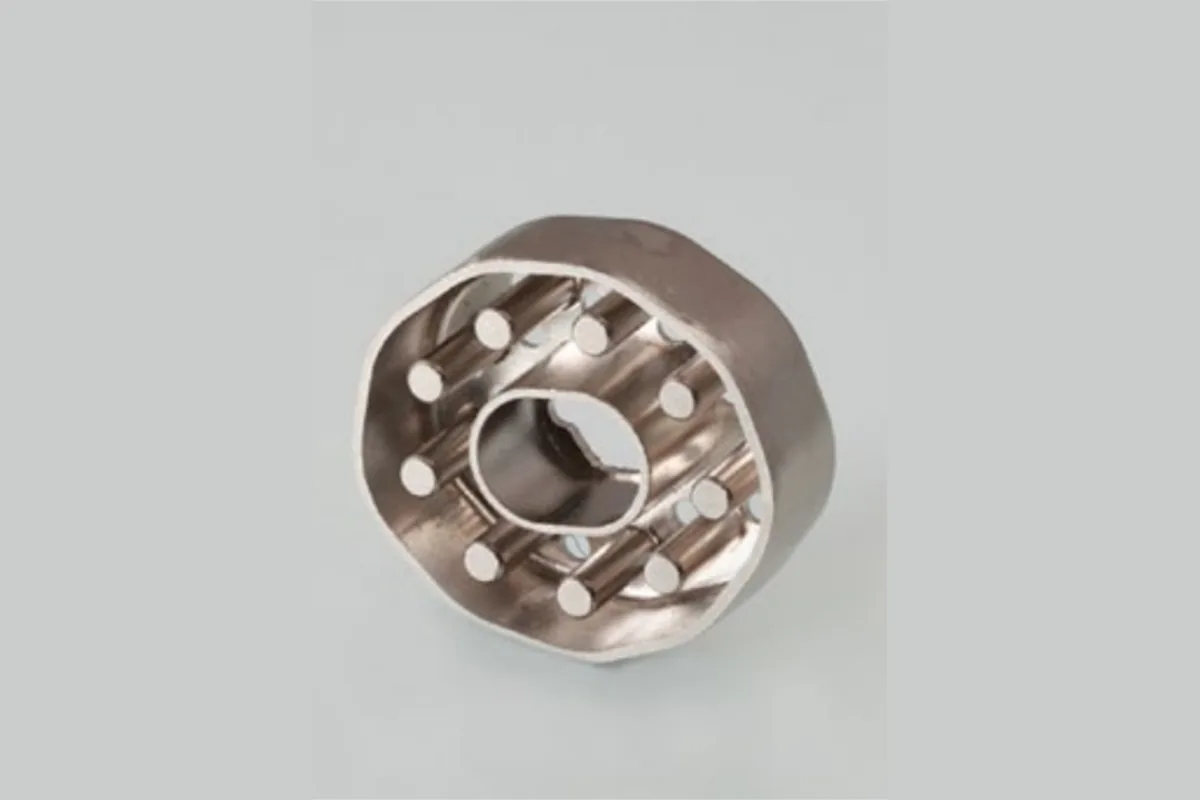
Fe-3%Si solenoid base — removing welded pin assembly (INDO-MIM). A documented soft-magnetic solenoid base measured 10 × 28 × 31 mm and weighed 17 g. The previous manufacturing concept required a stamped base, nine separately attached magnetic pins, and finishing operations. Welding made the perpendicularity of the nine pins difficult to control. INDO-MIM used MIM to form the pin features within the part, avoiding those joining steps and creating a manufacturable route for repeat production. Source: PIM International, June 2013, Fig. 15.
The value of MIM in this example was the elimination of difficult joining operations and improved control of pin-to-base geometry, not magnetism alone. A similar design needs a defined perpendicularity tolerance, final surface condition, and magnetic acceptance test before replacing a multi-piece assembly. The published dimensions and weight apply to this specific component.
When Another Manufacturing Process May Be More Suitable
For one-off prototypes or simple parts, CNC machining can provide a faster starting point without hard tooling. Traditional powder metallurgy may be suitable when the design works with compacting directions and its final density is acceptable. Stamping and laminated constructions are often relevant to thin magnetic circuits where reducing eddy-current loss is an important part of the design. The right comparison is not “Which process is more advanced?” but “Which route meets the functional, geometric, inspection, and total-cost requirements?”
MIM tooling decision: Move toward MIM tooling only when a suitable material and feedstock route are credible, the part can be molded and sintered to a workable geometry, expected volume supports tooling, and a feasible magnetic acceptance method exists. Otherwise resolve the largest unknown first or compare a different process. Identify magnetic working surfaces separately from cosmetic surfaces and critical assembly dimensions; these may need different inspection or machining controls. For more detail, use the Guía de Diseño MIM or the application-focused piezas MIM magnéticas blandas página.
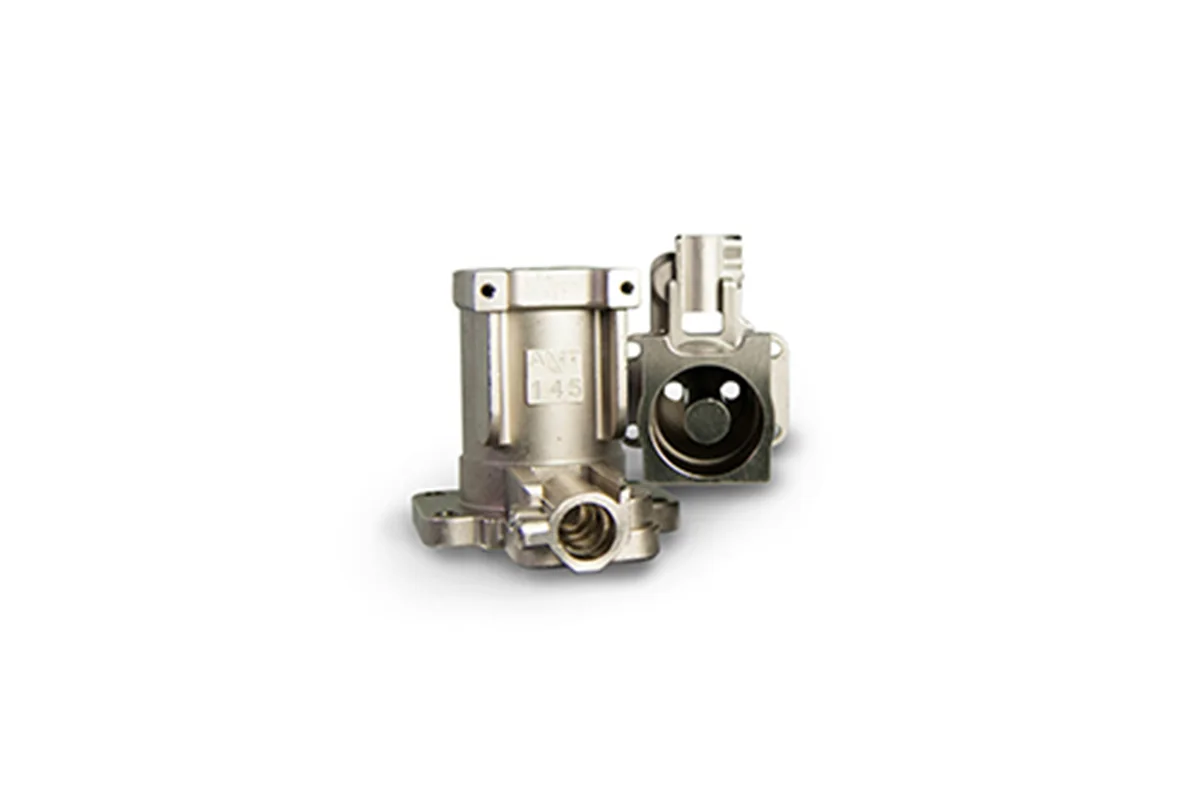
Alloy 52 magnetic valve body — integrating four components (AMT). A process-control valve originally used four separate components, including conventional PM and machined elements. Advanced Materials Technologies (AMT) redesigned the magnetic valve body as one integrated MIM component. The material was reported as Alloy 52 (approximately 50%Ni–Fe). Eliminating joined interfaces simplified assembly and improved the magnetic flux path; PIM International reported a 30% cost saving for this historical design. Source: AMT industrial case study y PIM International, junio de 2013, Fig. 19.
Compare the assembled magnetic circuit, not the molding cost alone. Each mechanical interface can influence magnetic reluctance and assembly tolerance. A new one-piece valve body still requires a review of flux path, finishing allowance, fit and functional acceptance. The cited 30% saving belongs to this historical design; it is not a forecast for a different part or an XTMIM quotation.
How Can MIM Processing Affect Final Magnetic Properties?
MIM feedstock preparation, injection, debinding, sintering, heat treatment, and secondary operations transform the starting powder into a finished metal component. A published property for a nominal alloy is not necessarily the property that the completed part will deliver.
Density, Porosity, Composition, and Sintered Microstructure
Debinding residues and the sintering atmosphere can affect carbon and oxygen levels, while densification controls how much porosity remains. Porosity, inclusions, chemistry, and grain structure may influence permeability, coercivity, saturation behavior, or their repeatability—but not always in the same direction or to the same degree. For example, a high final density is relevant to many magnetic property goals, yet density alone does not establish a specified coercivity or AC-loss value. The required property must be tested in the agreed material condition.
When comparing potential MIM suppliers, discuss powder/feedstock traceability, sensitivity to oxygen or carbon, sintering atmosphere, achieved material condition, and whether the proposed route has been tested for the required magnetic function. General process background is available in cómo el desaglutinado y el sinterizado afectan la calidad de las piezas MIM.
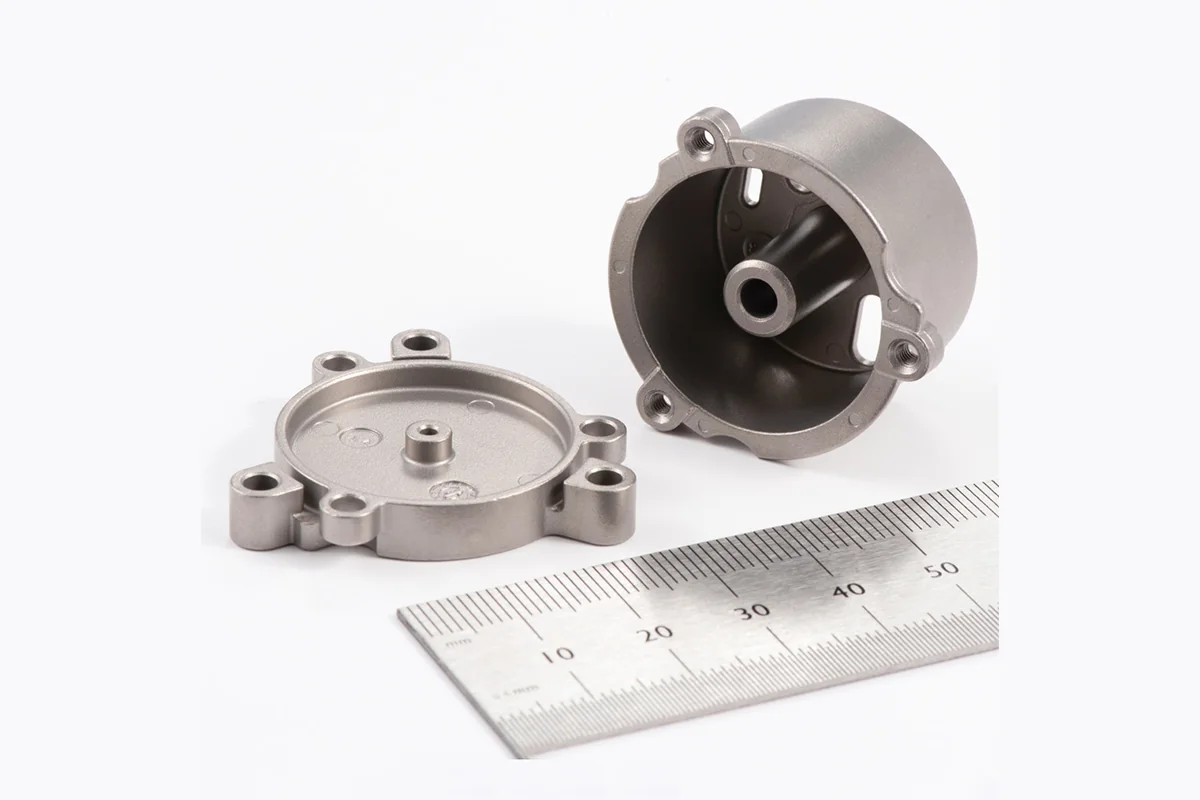
Fe-50%Ni gas-flow sensor parts — magnetic performance and sintering stability (INDO-MIM). The Metal Injection Molding Association (MIMA) documents two MIM components for an industrial gas-flow sensor whose application required high permeability and low coercive field. The recorded material is MIM-Fe50%Ni with a reported density of 7.6 g/cm³. Both components were produced using four-cavity tooling; the case describes controlled molding and deliberate sintering placement to limit distortion in thin walls and varying cross-sections. Source: MIMA, Casing & Ground, 2021 award case.
The sensor required high permeability and low coercivity; the reported density and four-cavity tooling describe manufacturing conditions, not magnetic acceptance limits. For a comparable thin-walled component, define the magnetic test and dimensional requirements, plan sintering support to limit distortion, and validate both representative processed material and the assembled sensor. The reported result is from INDO-MIM, not an XTMIM production or performance claim.
Heat Treatment, Geometry, and Post-Processing Effects
Some soft-magnetic routes rely on an appropriate final thermal condition, while machining or sizing can introduce local stresses that need to be considered. Any proposed stress-relief or magnetic anneal must be compatible with dimensional targets, other material properties, and available equipment. Surface finishing, coating, or PVD may also affect corrosion resistance, dimensional clearance, or assembly fit; it should not be assumed to improve the alloy's intrinsic magnetic properties.
Component geometry changes the effective magnetic circuit as well. Thin sections, sharp transitions, interfaces, and air gaps can alter the local flux distribution, so a perfect material coupon does not automatically mean a finished part meets a specified holding force or actuation target.
| Factor de fabricación | Potential risk to magnetic function | Qué verificar |
|---|---|---|
| Powder/feedstock chemistry | Incorrect composition, impurities, or unwanted carbon/oxygen may alter magnetic and mechanical behavior. | Qualified material route, feedstock history, and agreed chemistry limits where relevant. |
| Desaglutinado y sinterizado | Residual porosity, microstructure, dimensional distortion, or inconsistent material condition. | Final density/structure as applicable, critical dimensions, magnetic test result. |
| Condición de tratamiento térmico | Different stress state or microstructure from the specified magnetic condition. | Documented treatment route and measured performance after processing. |
| Machining, sizing, and finishing | Stress, altered dimensions, contact surfaces, or air-gap changes affecting function. | Final drawing, process sequence, and testing after relevant operations. |
| Assembly geometry | Air gap, alignment, and mating components can change flux, force, or switching response. | Functional acceptance on the finished part or assembly under realistic conditions. |
How Should Magnetic MIM Performance Be Verified?
Verification should follow the requirement defined earlier: the test object, measuring method, operating condition, and acceptance limit must all be agreed. A magnet-attraction demonstration or an unrelated datasheet is not a substitute for a controlled magnetic test or an assembly-level functional check.
Material Test Specimens vs. Finished-Part Performance
Representative material test specimens can characterize an alloy in a defined sintered and heat-treated condition. Ring specimens are frequently used to measure magnetization and hysteresis properties under a prescribed method, but they are not the same test object as an irregular finished MIM component. Geometry, density distribution, local machining stress, and demagnetizing effects can make finished-part behavior different. Record whether the specimen was made from the same feedstock and process lot and processed in the same final condition; even then, coupon conformance must not be treated as proof of assembly-level function.
| Validation level | What it answers | What it does not prove by itself |
|---|---|---|
| Material / test coupon | Whether a defined material and process condition meet selected magnetic metrics under a specified test method. | Performance of every final geometry, surface, and assembly. |
| Finished MIM component | Whether the actual part meets dimensional, condition, and applicable magnetic requirements after all processing. | Performance under every assembly condition without a relevant functional test. |
| End-use assembly | Whether the complete magnetic circuit meets force, switching, sensing, flux, or thermal requirements in operation. | Independent material conformance unless material requirements are also checked. |
Applicable test methods: IEC 60404-4 describes DC testing of iron and steel using ring and permeameter methods. IEC 60404-6 defines ring-specimen AC methods for specified soft-magnetic metallic and powder materials from 20 Hz to 100 kHz and expressly includes metal injection moulded materials in its scope. ASTM A596/A596M provides a DC point-by-point method using suitable closed-path test specimens. These methods characterize eligible test specimens; they do not automatically validate a geometrically different finished component or imply that XTMIM owns the relevant testing equipment. Confirm the applicable standard and test service before making it an acceptance requirement.
Defining Acceptance Criteria Before Tooling and Production
Before mold investment, agree whether acceptance means a material property, a measurement on the finished part, a functional assembly result, or a combination. Define the test specimen or fixture, field strength or frequency, working temperature, final heat-treatment and machining state, acceptance limit, lot sampling, and who performs the measurement. Agree which requirements must pass in prototype approval and which will be checked in production. If no suitable direct test exists for an irregular geometry, use an agreed material-characterization method plus an application-relevant functional test rather than claiming a standard ring test covers the finished part.
If the specification requires low coercivity, agree on a suitable magnetic measurement on representative processed material. If the application specifies holding force or release time, test the assembled part at the defined gap, load, temperature and drive condition. When both material and functional requirements matter, both tests are needed. Density, attraction to a hand magnet and an unqualified powder certificate cannot replace them. For repeat production, specify sampling and the approved final-processing condition.
Illustrative engineering scenario (not a customer case): A compact actuator armature passes a magnet-attraction check, but the assembly releases too slowly. The useful next step is not to request a “stronger magnetic steel” immediately. First examine coercivity/remanence, the working air gap, mechanical friction, and the specified finished-part condition. The acceptance test should target the actual switching or release requirement as well as any necessary material property.
What Information Is Needed for a Magnetic MIM Material Feasibility Review?
A useful magnetic MIM feasibility review needs enough information to establish a material route, realistic manufacturing limits and an acceptance test. A material name alone is not sufficient for a reliable tooling or production decision.
- Magnetic function: attraction, soft-magnetic flux path, switching, sensing, or another defined behavior.
- Required magnetic property or functional acceptance result, including test conditions if available.
- Preferred alloy or material family, if already selected; otherwise describe the target function.
- Temperature, corrosion, frequency, duty cycle, and other operating conditions.
- 2D drawing and 3D model, including magnetic working surfaces, air gaps, and mating features.
- Critical dimensions, tolerances, structural loads, and appearance or corrosion requirements.
- Expected prototype quantity, annual volume, and project stage.
- Required machining, sizing, heat treatment, coating, inspection, and final assembly conditions.
The supplier review should produce one of three outcomes: (1) proceed to a scoped MIM development study when material availability, geometry, and verification are plausible; (2) close a defined evidence gap first, such as an unconfirmed feedstock, unknown magnetic limit, or missing test method; or (3) choose a different material or process if functional requirements or economics do not fit MIM. If no magnetic pass/fail requirement has yet been defined, the proper outcome is a technical clarification or functional trial plan—not an unconditional production quote. These are evaluation decisions, not guarantees of production readiness.
Ask the supplier: “Can this candidate material be processed to the required final condition, and what evidence will show that the finished part meets its magnetic function?” This identifies the technical information missing from an RFQ that only says “magnetic steel parts.”
If the general RFQ package is not ready, use the Guía de preparación para solicitud de cotización to clarify the missing drawing, volume, processing, and inspection inputs before requesting pricing.
Preguntas adicionales de ingeniería
¿Puede el acero inoxidable magnético reemplazar al Fe-Ni en un sensor?
No solo por atracción magnética. Compare la permeabilidad especificada, la coercitividad, las condiciones de campo y las necesidades ambientales, luego pruebe un candidato en su condición final procesada. Un acero inoxidable magnético resistente a la corrosión podría no reproducir la respuesta magnética suave requerida por un circuito sensor de Fe-Ni.
¿Una densidad reportada de 7.6 g/cm³ demuestra un rendimiento magnético suave?
No. El reporte publicado del sensor de flujo de gas de Fe-50%Ni indica la densidad para su propio componente, pero la densidad no es un límite de aceptación para la coercitividad, permeabilidad o respuesta de ensamblaje. Especifique la medición magnética y las condiciones de operación de forma independiente.
¿Se debe verificar el rendimiento antes o después del mecanizado y tratamiento térmico?
La caracterización del material se puede realizar en una probeta procesada representativa, pero la aceptación de la pieza final o del ensamblaje debe reflejar el estado terminado acordado. Si el mecanizado, la liberación de tensiones o el recocido magnético cambian ese estado, acuerde si es necesaria una segunda prueba o una verificación funcional final antes de la aprobación de la producción.
A magnetic MIM material is suitable when the required magnetic function, available material, practical process route and agreed finished-part or assembly tests fit together. If any of these is unresolved, the next step is targeted testing or a different material/process—not immediate tooling approval.
Revise su Requisito de Material MIM Magnético Antes del Herramental
Share the drawing, intended magnetic function, candidate material, expected production quantity, and any existing performance or test requirements. The next step is an engineering feasibility assessment—not an assumption that every magnetic alloy can be manufactured or verified on the same process route.