El moldeo por inyección de metal (MIM) de aleaciones de níquel es digno de evaluación cuando una pieza pequeña y compleja necesita una combinación definida de resistencia a temperaturas elevadas, resistencia a la corrosión, resistencia a la oxidación o durabilidad que una aleación más convencional no puede proporcionar. La idoneidad del material y la idoneidad del proceso MIM son decisiones de ingeniería separadas. Entre los materiales MIM, las aleaciones a base de níquel requieren una alineación cuidadosa del grado del material, la ruta de polvo/feedstock, el desaglutinado y sinterizado, la geometría de la pieza, la condición final del material y los requisitos de inspección.
¿Cuándo se deben considerar las aleaciones a base de níquel para piezas MIM?
Las aleaciones a base de níquel merecen consideración cuando las condiciones de operación especificadas exceden la capacidad de una ruta de material más establecida. Se deben evaluar el calor, la corrosión, la oxidación y la carga mecánica combinados en su severidad real antes de seleccionar la aleación o el proceso.
Condiciones de servicio que pueden requerir aleaciones a base de níquel
Un proyecto potencial de MIM con aleación de níquel generalmente combina geometría pequeña e intrincada con una condición de servicio que desafía a los aceros inoxidables comunes. Las entradas decisivas son la temperatura sostenida o cíclica; el medio corrosivo exacto, la concentración y la duración de la exposición; las cargas y las demandas de fatiga; el entorno de oxidación; y la vida útil objetivo. Por ejemplo, "resistente a la corrosión" no es información suficiente para seleccionar la Aleación 625. Se deben conocer el medio y la temperatura, y la aceptación de la corrosión debe definirse para la pieza terminada.
Definir las condiciones de servicio: distinguir la temperatura continua de los picos cortos y el ciclo térmico; identificar el fluido o gas real (incluyendo concentración, contaminantes y presión); especificar si la pieza soporta carga estática, estrés alterno o vibración; y describir qué significaría la falla para el ensamblaje. Una frase como “resistencia a altas temperaturas y corrosión” no identifica una aleación ni una prueba. Esta información también es necesaria para determinar si el MIM es relevante en absoluto, en lugar de simplemente elegir una aleación más costosa.
La aleación puede ser adecuada incluso cuando el MIM no lo es. El mecanizado CNC u otro proceso de fabricación puede seguir siendo la opción de menor riesgo para la geometría, cantidad o ruta de certificación requerida.
Cuándo el acero inoxidable puede ser suficiente
Si la resistencia general a la corrosión es predominante, primero verifique si acero inoxidable 316L para MIM satisface los requisitos de medio, temperatura e inspección. Si la resistencia mecánica es más importante, examine 17-4 PH en su condición tratada térmicamente especificada. Ninguna comparación es una sustitución universal: el comportamiento a la corrosión a nivel de grado, la resistencia y las condiciones de tratamiento térmico deben coincidir con la aplicación real.
Ejemplo de selección de material: Un conector compacto expuesto a limpieza industrial rutinaria puede requerir solo una revisión de 316L en lugar de la Aleación 625. Una pieza sometida a carga cíclica a temperatura elevada necesita una evaluación diferente: defina los requisitos de resistencia y fatiga a la temperatura de servicio, luego compare las condiciones de material aplicables de 17-4 PH y la Aleación 718. Estas son situaciones ilustrativas de selección, no casos de producción documentados ni sustituciones directas de material.
| Requisito dominante | Primera dirección de material a revisar | Decisión necesaria antes de elegir aleación de níquel MIM |
|---|---|---|
| Corrosión general en condiciones moderadas | 316L u otro acero inoxidable adecuado | ¿Qué ambiente químico o temperatura medidos excede la opción de acero inoxidable? |
| Alta resistencia cuando la temperatura y el tiempo bajo carga son importantes | Verifique un acero adecuado solo dentro de sus límites aplicables de temperatura y condición del material; de lo contrario, evalúe la Aleación 718 u otra aleación resistente al calor. | ¿Qué rendimiento de resistencia, fluencia o fatiga se requiere a la temperatura de servicio real y a la duración de la exposición? |
| Corrosión severa o exposición combinada a oxidación y calor | Aleación 625, otra aleación de níquel adecuada o una alternativa calificada | ¿Qué medios, temperaturas, métodos de prueba y vida útil se especifican? |
| Permeabilidad magnética o baja coercitividad | Materiales MIM magnéticos blandos | Las aleaciones Fe-Ni se seleccionan por propiedades magnéticas como la permeabilidad y la coercitividad, no por los mismos criterios que las aleaciones estructurales a base de níquel. |
| Expansión térmica controlada o coincidencia de sellado | Aleaciones de expansión controlada | Invar y Kovar deben especificarse por su comportamiento de expansión y sellado, no agruparse con superaleaciones estructurales a base de níquel. |
¿Qué aleaciones a base de níquel son relevantes para proyectos MIM?
La aleación 718 se evalúa comúnmente por su resistencia a altas temperaturas; la aleación 625 se considera a menudo para servicio resistente a la corrosión. El entorno de servicio y required finished material condition determine the candidate grade. That grade can proceed to MIM evaluation only after its feedstock and manufacturing route have been checked. Wrought-material datasheets do not qualify sintered MIM components.
| Aleación candidata | Why an engineer may consider it | Grade-specific question | MIM qualification question |
|---|---|---|---|
| Alloy 718 / INCONEL 718 UNS N07718 | High strength, including demanding thermal and fatigue service, with precipitation-hardening potential. | What heat-treatment condition and mechanical properties are required? | Can the powder route, chemistry, final aging/HIP route if specified, and part tests meet the drawing? |
| Alloy 625 / INCONEL 625 UNS N06625 | Corrosion resistance with solid-solution-strengthened mechanical performance in suitable environments. | Which medium and temperature actually require this grade? | Can the sintered material's density, surface state, and corrosion performance be demonstrated? |
| Ni-Cr-Mo alloys e.g., C22 or C276 | Specialized corrosive chemical exposures that require grade-specific evaluation. | What is the exact chemical environment and required acceptance test? | Is an appropriate powder/feedstock and qualified processing route available? |
| Monel 400 / other nickel-base directions | Application-specific corrosion or other functional requirements. | Why this chemistry instead of a more established route? | What feedstock and final-property evidence supports this exact application? |
Alloy 718: When High Strength and Temperature Resistance Matter
Alloy 718 is a nickel-chromium precipitation-hardening alloy, and the finished strength depends strongly on its material condition. A drawing requesting "718" without saying which final condition, test direction, loading, or acceptance specification applies can be incomplete. Special Metals' Alloy 718 bulletin explains its alloy behavior and heat-treatment background; its wrought-product data must not be treated as guaranteed values for a sintered MIM part.
For load-bearing MIM parts: Specify the final heat-treated condition and the specified tensile, fatigue or creep performance at the operating temperature. Those properties must be demonstrated on representative specimens and, where necessary, actual parts from the proposed manufacturing route. Wrought 718 certification and powder availability alone do not establish the performance of an as-sintered or aged MIM part.
Alloy 625: When Corrosion Resistance Is a Key Requirement
Alloy 625 is a nickel-chromium-molybdenum-niobium alloy whose strength is principally associated with solid-solution strengthening rather than the same precipitation-hardening approach used for 718. It is considered when corrosion resistance is central to the operating duty. The key question is not whether a generic data sheet lists corrosion resistance: it is whether the specified environment and the actual MIM final surface and density have been assessed. See the Alloy 625 technical bulletin for grade-level background.
For fluid-contact MIM components: Alloy 625 is not immune to every medium, temperature or crevice condition. Assess connected porosity, machined sealing surfaces, any specified cleaning or passivation process, and corrosion or leak acceptance in the actual service environment. Alloy 625 pipes, valves and springs described in conventional alloy literature do not, by themselves, demonstrate MIM-part performance.
Other Nickel-Based Alloys Requiring Special Evaluation
MIMA's materials list also identifies nickel-base options such as Hastelloy C/C22/C276, Hastelloy X, Monel 400, and other compositions. Their inclusion demonstrates a known MIM-material direction, not universal inventory or manufacturing readiness. Commercially pure nickel is a separate material chemistry, not a synonym for Alloy 718 or 625. If an RFQ specifies pure nickel or a custom nickel-based alloy, start by documenting the actual function, permissible composition, powder/feedstock availability, and verification requirements; do not imply that an off-the-shelf feedstock exists. Soft-magnetic Fe-Ni and controlled-expansion Invar/Kovar require separate magnetic or thermal-expansion specifications.
For a material RFQ: specify the composition and required performance rather than requesting an undefined “custom nickel alloy.” For Ni-Cr-Mo grades, define the relevant corrosive medium and temperature; for nickel-copper systems, explain the chemical/electrical need; for commercially pure nickel, state the purity, conductivity or other required property. Each direction requires its own powder and final-property confirmation before a MIM quote can be treated as production-ready.
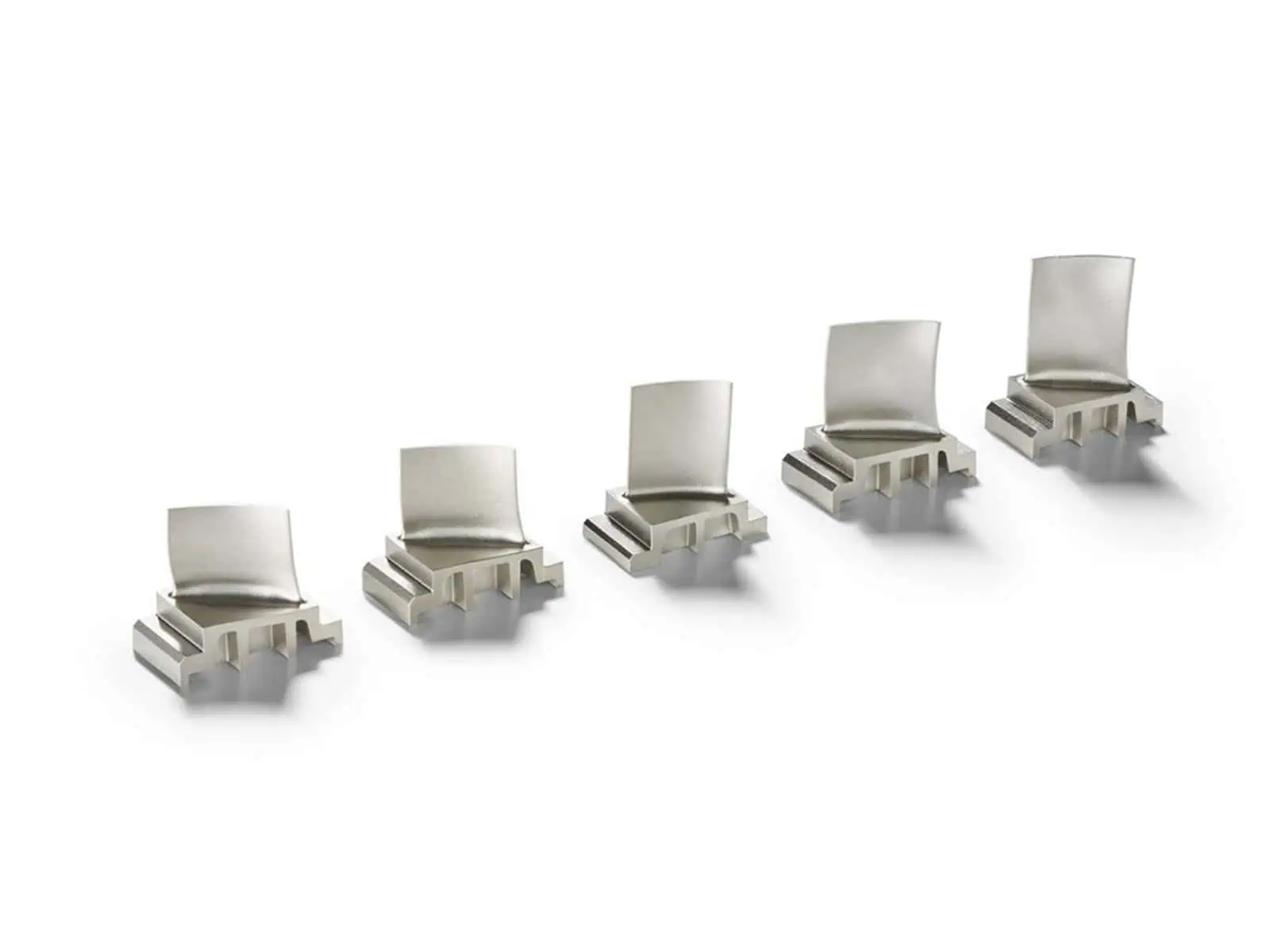
IN713LC compressor stator vanes for the Rolls-Royce Pearl 15
Material and function: Schunk produced five designs of nickel-based IN713LC MIM stator vanes for stages 5–9 of the Rolls-Royce Pearl 15 high-pressure compressor. These stationary airfoils guide compressed airflow in stages reported to reach approximately 700°C.
Manufacturing status: Schunk reports commercial production beginning in 2018. Its published development history describes dedicated sintering qualification for the aluminium-containing alloy rather than treating conventional MIM settings as transferable.
Relevancia de ingeniería: A commercially produced IN713LC vane establishes a documented application of that specific alloy and process route. It does not certify Alloy 718, Alloy 625, or XTMIM's production capability. Read the Schunk case.
Can the Required Nickel Alloy Be Manufactured by MIM?
A nickel alloy designation alone does not define an available manufacturing process. A workable route needs powder of the correct chemistry, suitable feedstock, stable molding and debinding behavior, controlled sintering, any necessary secondary treatment, and an agreed method of verifying the resulting part.
Disponibilidad de Polvo y Feedstock
Confirm whether the exact grade is supplied as MIM-suitable powder or established feedstock. Consider particle characteristics, composition limits, contamination sensitivity, binder compatibility, supply consistency, and order scale. Availability of powder for additive manufacturing does not automatically establish an injection-molding feedstock or a successful debinding and sintering route.
Powder supply and MIM feedstock qualification are different checkpoints. Powder evidence should identify the required chemistry, particle characteristics and limits for relevant oxygen, carbon and other contaminants. Feedstock evidence should cover binder compatibility, solids loading, molding flow and debinding behavior. An atomized powder quotation does not confirm that a usable feedstock exists. For repeat production, also confirm minimum orders, replenishment lead time and lot-to-lot consistency.
Debinding and Sintering Feasibility
After molding, the binder must be removed without damaging the brown part. During sintering, the chemistry, atmosphere, support strategy, shrinkage response, densification, and distortion must remain compatible with the final requirements. Nickel-based superalloys may need material-specific process development and chemistry control; routine iron-based furnace settings should not be assumed transferable.
Typical failure mechanisms: binder removal can produce cracks, slumping or residues even if the green part fills the mold correctly. Sintering must subsequently deliver the necessary density and dimensional behavior without unacceptable contamination or deformation. The validation plan should define furnace atmosphere and cleanliness, temperature/profile control, support orientation, process-lot traceability and how critical dimensions are measured after sintering. Vacuum or a named furnace type, by itself, is not evidence that an alloy has been qualified.
A process review should explicitly identify risks such as undesirable oxygen or carbon pickup, inconsistent shrinkage, residual porosity, local distortion, and changes to microstructure. The appropriate responses depend on the exact grade and part, rather than a one-size-fits-all sintering temperature or density promise.
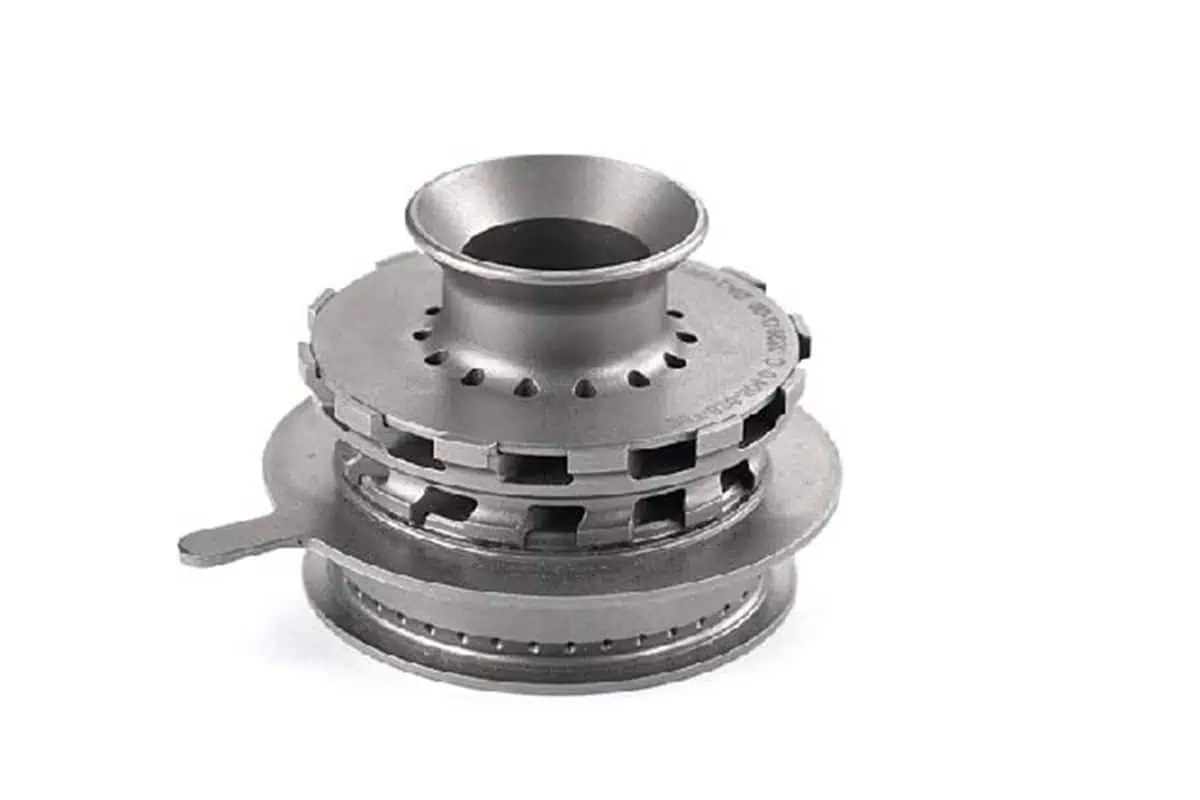
Hastelloy X aerospace fuel nozzle / swirler (Safran and Alliance-MIM)
Material and function: Hastelloy X, a nickel-based high-temperature alloy. This approximately 47 mm fuel-nozzle/swirl assembly was developed for an aero-engine combustion system, with internal passages and holes intended to manage fuel delivery and flow.
Why MIM was investigated: Four subcomponents were injection molded, green-machined as needed, assembled, debound and diffusion-bonded during co-sintering. This route addressed features that had previously required separate machining and joining.
Verification and status: The published development program reports checks of dimensions, joint integrity, permeability and function for prototype parts. It is no evidence of serial engine production or XTMIM manufacturing. Co-sintered joints and functional flow must be qualified for each design. See the Safran/Alliance-MIM report.
Supplier Process Capability and Validation Requirements
Ask the supplier to classify the project as (1) an established material-and-part production route, (2) a material/feedstock route that still needs part-specific molding, sintering, and property trials, or (3) an unverified material request that cannot yet support tooling commitments. Where relevant, confirm access to post-sinter treatment such as heat treatment or hot isostatic pressing (HIP), and whether those operations are required by the chosen acceptance specification. These are scope-dependent process requirements, not automatic features of every nickel-alloy MIM project.
Supplier readiness status: established means the supplier can identify the specific alloy route and relevant past qualification basis; trial required means technical risks, test pieces, success criteria and cost ownership still need agreement; not confirmed means no dependable process commitment is yet possible. A catalog listing is not evidence of qualified, repeatable production.
| Potential failure / symptom | Possible engineering cause | Evidence or corrective review needed |
|---|---|---|
| Cracks or distortion after debinding | Binder-removal profile, unsupported geometry, large section transitions or handling damage | Examine brown-part handling, staged debinding trials, geometry balance and supports |
| Unexpected chemistry or weak fatigue response | Powder oxygen/contamination, furnace interaction, residual porosity or unsuitable final condition | Compare incoming and finished chemistry, microstructure, porosity and application-relevant coupons |
| Variable sintered dimensions | Feedstock variation, nonuniform shrinkage, orientation, setter contact or furnace conditions | Map dimensions across trial pieces and positions; adjust DFM, supports and process controls |
| Leaks or poor corrosion performance | Connected porosity, unsuitable surface finish, crevices or unmatched alloy/environment | Define integrity and corrosion/leak acceptance specific to pressure, medium, temperature and finished condition |
| Readiness checkpoint | Evidencia a solicitar | If the evidence is absent |
|---|---|---|
| Exact grade and powder/feedstock | Material designation, powder/feedstock source, relevant chemistry controls | Do not assume the catalog alloy is actually available for this project |
| Desaglutinado y sinterizado | Documented process capability, furnace route, shrinkage and contamination controls | Classify as requiring validation before tooling |
| Secondary material condition | Required heat treatment, HIP when specified, machining/finishing plan | Do not promise the properties of another material condition |
| Verificación de pieza terminada | Agreed chemistry, density, dimensions, and function-specific tests | Do not treat a molded sample as a qualified production component |
Disponibilidad de material: MIMA's materials range includes nickel-base alloys but explicitly recommends confirming exact alloy or substitute availability with the supplier. The selected process must also hold the part's critical geometry and dimensions after debinding and sintering.
Is the Part Design Suitable for Nickel Alloy MIM?
MIM can form complicated near-net shapes, but high-shrinkage sintering can distort an otherwise moldable design. A part should be reviewed for structural balance, critical features, support orientation, dimensional acceptance, and the value of consolidating repeated machining or assembly steps.
Geometry, Shrinkage, and Sintering Distortion Risks
Thin unsupported arms, sharp section transitions, asymmetrical mass distribution, deep features, long slender walls, and extensive flat surfaces can change shape during binder removal or sintering. Such features are not automatically impossible. They require assessment of feedstock flow, tooling compensation, support contact, shrinkage direction, and possible part redesign. A small complex part is often more promising than a large simple block, but there is no universally safe size or tolerance without part-specific review.
Before releasing tooling: check whether every critical face is accessible in the intended molding orientation; review parting lines and gating near functional surfaces, demolding of undercuts, green-part support and whether section thickness changes will amplify distortion. A supplier should identify which dimensions will be controlled in the mold, which are measured after sintering, and which need machining allowance. Do not assign a blanket MIM tolerance to an unfamiliar nickel-alloy part without process evidence.
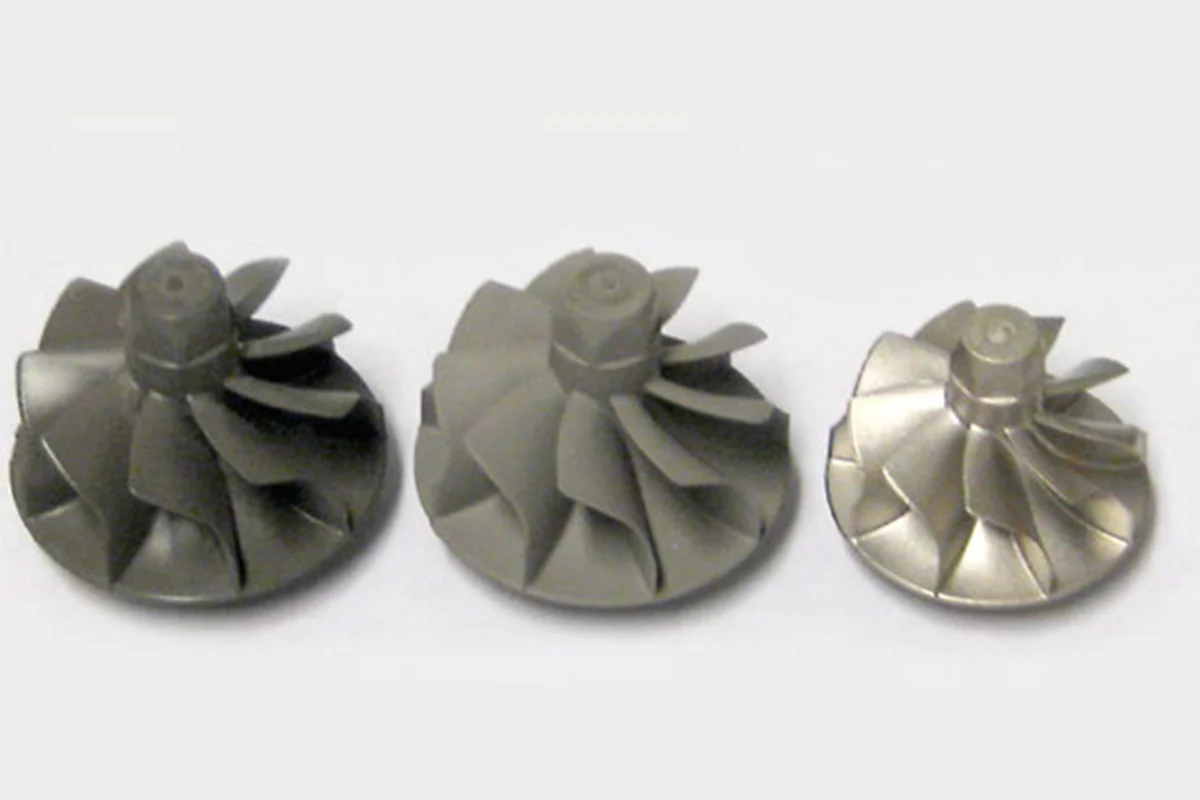
IN713LC turbocharger turbine wheel prototypes (Schunk)
Material and intended use: IN713LC nickel-based superalloy. A turbocharger turbine wheel is driven by engine exhaust gas to turn the turbocharger shaft; it needs adequate high-temperature and oxidation performance.
What the photograph proves: The three actual prototype wheels are shown at the green (left), debound/brown (center), and sintered (right) stages. They illustrate that part geometry and dimensions must be managed through the entire MIM sequence, not just checked after injection.
Límite de calificación: Schunk's photograph documents prototype manufacture, not verified automotive serial production, service life or a universally approved sintering process. Any similar design still needs distortion, material-property and application-specific testing. See the original study, Fig. 11.
Critical Features, Tolerances, and Secondary Machining
Flag sealing surfaces, mating datums, bearing fits, threaded holes, precision bores, and other function-critical features on the drawing. Where the as-sintered tolerance or surface condition cannot meet the requirement consistently, allocate local CNC finishing or another qualified secondary operation. Evaluate inspection accessibility at the same time; a feature is not production-ready merely because it is possible to mold.
Illustrative DFM case: a compact corrosion-resistant valve insert could use MIM for ribs and internal passages while retaining machining allowance on its sealing land and precision bore. The design review would need to confirm machining access, datums, connected porosity and any required leak test. This is a hypothetical design example, not an identified nickel-alloy MIM production part; the alloy and manufacturing route would still require validation.
| Característica de la pieza | Principal riesgo de ingeniería | Revisión antes del herramental |
|---|---|---|
| Thin arm attached to a thick boss | Uneven shrinkage, support-dependent distortion | Section balance, support direction, alternate geometry, datum plan |
| Precision bore, thread, or sealing land | Functional fit changes after sintering | As-sintered capability, machining allowance, inspection method |
| Deep blind hole or inaccessible feature | Mold/tooling access and cleaning issues | Tooling concept, split line, feature redesign where needed |
| Large and simple part | Higher molding/sintering exposure without enough shape benefit | Compare CNC, casting, or another appropriate route |
Documented Alloy 718 MIM prototype: high-pressure compressor vane (IHI Engineering Review, 2014)
Component and function: A high-pressure compressor vane in an aircraft gas-turbine engine helps define and guide the airflow passages through the compressor. Its thin three-dimensional profile makes machining and dimensional control important engineering issues.
Material and process: IHI reported trials using Alloy 718 powder in a MIM route and examined the effect of its binder system on part shape during debinding and sintering. The paper also describes material testing on MIM specimens and dimensional evaluation of prototype vanes.
Reported test findings: the researchers compared gas-atomized and water-atomized Alloy 718 powders and reported that the higher-oxygen powder route adversely affected fatigue performance in their tests. They also compared prototype vanes made with conventional binder and a shape-retaining binder; the conventional route produced substantial deformation, while the revised binder and debinding/sintering approach reduced it. The practical lesson is to validate powder chemistry y shape retention, not merely confirm that a sintered metal shape was obtained.
Alcance de la evidencia: A named component, its real function, the Alloy 718 material, and a documented MIM development program. It does no establish serial-production qualification, universal part-size capability, or XTMIM manufacturing experience with this alloy.
DFM implications: The value of molding an intricate, difficult-to-machine shape must be weighed against shrinkage, distortion, fatigue-related requirements, and the validation needed for the final use. Read the IHI technical paper.
How Should Finished Nickel Alloy MIM Parts Be Qualified?
A sintered part with the correct silhouette is not yet a qualified production component. The drawing, service environment, applicable standard, and manufacturing route must agree on the material condition and the tests used to accept finished parts.
Final Material Condition and Required Properties
Confirm the finished alloy chemistry, relevant contamination limits, density or porosity requirement, microstructure where functionally necessary, and heat-treatment condition. For Alloy 718, the specified solution and age treatment can be essential to the strength requirement; for Alloy 625, chemical exposure and final surface condition may deserve particular attention. Neither wrought nor cast alloy data should be copied into a MIM acceptance specification without evidence that the corresponding MIM condition meets it.
Qualification requires three types of evidence: (1) the grade specification describes intended composition and material condition; (2) trial coupons or specimens measure what the selected manufacturing route can deliver; and (3) checks on actual parts confirm geometry, surface integrity and any function that specimens cannot represent. Where fatigue, sealing or corrosion is critical, a general density figure cannot substitute for the application-specific acceptance test.
Inspection Requirements and Acceptance Criteria
Acceptance should be linked to actual failure modes: inspect critical dimensions and datums, density or internal integrity where relevant, hardness or strength when required, surface condition, and application-specific corrosion, fatigue, or temperature performance. Agree on methods, sampling, and acceptance thresholds before tooling or trials, rather than requesting every available test regardless of the part's function.
For an elevated-temperature loaded component, the buyer may need tensile, creep or fatigue evidence relevant to the service state. For a valve, fluid-contact fitting or enclosure component, the priority may instead be surface condition, internal integrity and a specified leakage or corrosion response. Inspection tools such as metallography, dimensional metrology, computed tomography or leak testing should be chosen because of the failure mode; none is a mandatory universal checklist item for all nickel-alloy MIM parts. Agree on destructive test specimens, actual-part checks and lot frequency separately.
Applicable Standards and Qualification Boundaries
SAE AMS5917 specifically covers nickel-based Alloy 718 MIM parts that are hot-isostatically pressed, solutioned, and aged (reaffirmed June 19, 2026). Its scope cannot be extended to as-sintered 718, Alloy 625, or another nickel-based grade without a separately applicable specification. MPIF's standards portal y Guía de materiales MIMA provide broader material-specification context; the applicable current document and contractual requirements must still be checked by the project team.
| Elemento de Calificación | Por qué es importante | What the RFQ must define |
|---|---|---|
| Grade chemistry and process contaminants | Prevents a grade or processing mismatch | Required alloy designation, chemistry limits, and relevant method |
| Final heat-treated / HIP condition, if applicable | Changes material structure and properties | Process condition and governing specification, not a generic grade name |
| Density, defects, and microstructure | May influence loading, sealing, corrosion, or fatigue | Functional requirement, method, and acceptance criteria |
| Strength, hardness, fatigue, or corrosion | Confirms performance under the intended duty | Only tests justified by the design and intended service |
| Dimensiones y superficies críticas | Determines assembly fit and operation | Drawing datums, inspection method, finishing stage, tolerance limits |
Acceptance criteria must reflect the specific part, final material condition and operating duty. Published alloy data support material selection, while process-trial results and agreed acceptance tests establish whether the manufactured part is suitable.
- Antes del herramental: agree the grade, final condition, relevant standard, critical features and measurable acceptance criteria.
- At material and first-part trials: document feedstock and furnace route, examine specimen/part results, and record any DFM or heat-treatment changes.
- Before repeat orders: approve an inspection and traceability plan linked to stable production lots; do not assume one successful research specimen proves repeatability.
When Does Nickel Alloy MIM Make Practical and Economic Sense?
Technical feasibility does not guarantee favorable production economics. Compare the whole production route—including feedstock, tooling, trials, heat treatment, machining, inspection, and expected yield—with the current or proposed alternatives.
Production Volume, Tooling, and Alloy-Related Costs
MIM becomes easier to justify when a stable small-part design requires repeated production, complex features are created near-net shape, and machining or multi-part assembly can be reduced. Nickel-based feedstock sourcing, development trials, atmosphere-sensitive sintering, heat treatment, and inspection can offset those benefits. No single annual-quantity threshold applies to every alloy or part; evaluate tooling amortization against expected demand and the actual cost of the validated route.
The correct comparison is not simply the raw nickel alloy price versus steel price. It is the delivered, accepted component cost at a realistic annual volume, including secondary operations, inspection, scrap and validation. When the material route has not been verified, any unit-cost estimate should be identified as preliminary rather than presented as a firm repeat-production price. A broader breakdown appears in Costo del Moldeo por Inyección de Metal; nickel alloys also require confirmation of feedstock and qualification costs for the proposed route.
Cost basis: comparar total cost per accepted part, not just quoted molding cycle cost. A useful review separates one-time tooling and qualification charges (amortized over a realistic production quantity), powder/feedstock and molding costs, debinding/sintering and treatment, finish machining, inspection and the cost of nonconforming parts. A lower theoretical piece price is not meaningful if the route requires unbudgeted alloy trials or has an unproven production yield. Ask suppliers to identify which cost assumptions are confirmed and which still depend on trial results.
When Another Material or Manufacturing Process Makes More Sense
For a small prototype batch, changing design, simple block, or large component, CNC machining or an appropriate alternative may involve less technical and tooling risk. If the required function is met by 316L or 17-4 PH, changing to a more established material route can reduce uncertainty. If MIM remains suitable but one bore or sealing face needs precision, near-net-shape MIM plus local machining may be more practical than insisting on every feature as-sintered.
Compare equivalent deliverables: a CNC quotation made from certified wrought 625 and a proposed MIM 625 quotation are not comparable until they specify the same finished geometry, material condition, inspection level and performance evidence. For short-run validation, machining may answer the design question earlier; for stable repeat volumes, MIM could become attractive only if alloy and process feasibility are established. Any claimed savings should be calculated against parts accepted to equivalent specifications.
| Project finding | Dirección recomendada | Decision gate |
|---|---|---|
| Material need, supplier route, geometry, and volume appear aligned | Proceder a revisión de ingeniería | Confirm the drawings, proposed route, tests, and production assumptions |
| Candidate alloy is plausible but powder, sintering, or final properties are unverified | Validate before tooling | Obtain feedstock/process evidence or run an agreed feasibility trial |
| Performance is over-specified or design contains preventable sintering risks | Revise material or part design | Recheck stainless alternatives, structure, and functional tolerances |
| Very low volume, simple geometry, large size, or no realistic supplier route | Evaluate another process | Compare CNC, another forming route, or additive manufacturing as appropriate |
What Is Needed for a Nickel Alloy MIM Feasibility Review?
A nickel-alloy MIM RFQ needs both the functional requirement and the finished-part acceptance criteria. Drawings and CAD models should be accompanied by the intended material, operating conditions, annual volume and critical features.
Drawings, Material Requirements, and Operating Conditions
Submit drawings identifying part dimensions, datums, critical tolerances, assembly interfaces, threads, sealing or bearing surfaces, surface finish, and the intended alloy or permitted alternatives. Provide service temperature, corrosion medium, mechanical load, expected life, and any special performance constraints. When the grade is not fixed, describe the requisito funcional so the engineering review can consider appropriate alternatives instead of assuming a custom grade is available.
Identify confirmed requirements and open questions. If only “Inconel” appears on the drawing, clarify whether 718, 625 or another UNS grade is mandated. If the alloy is flexible, supply the actual strength-at-temperature or corrosion requirement and state whether substitutions are permitted. Highlight a sealing datum, fatigue-critical section or surface condition on the drawing rather than writing “high precision” without a measurable limit.
Production Requirements and Validation Plan
State prototype or pilot quantities, anticipated annual demand, expected design stability, current manufacturing method, required material condition, and any applicable tests. Explain whether the goal is a first feasibility screen, prototype development, or repeatable production. If a critical material or process step remains unverified, that uncertainty should be identified before commercial commitments or tooling.
Before a production quotation: an initial screen should identify the proposed candidate grade, source of powder/feedstock, process readiness, probable DFM changes and the tests needed to close the main uncertainty. Only after these are understood should tooling, first article acceptance, prototype iterations and repeat-production pricing be committed. For an unverified alloy, a preliminary feasibility finding is more reliable than a firm production quotation.
| Supplier response item | Useful answer for the buyer | If it remains open |
|---|---|---|
| Material and feedstock route | Exact candidate grade, feedstock status and permitted substitutions | Request material availability or a specific validation plan |
| Ruta de fabricación | Whether the alloy has established trials, the necessary furnace/post-treatment steps and limitations | Do not release production tooling on an unverified assumption |
| Part design and finish | Identified distortion risks, proposed machining allowance and critical datum approach | Revise drawing or run geometry trials |
| Quality and commercial basis | Applicable tests, sample acceptance, volume assumptions and preliminary-versus-confirmed pricing | Resolve acceptance and trial cost before finalizing project commitment |
A supplier's feasibility response should state whether nickel-alloy performance is required, which grade and feedstock route are proposed, where DFM or dimensional risks remain, what validation is needed before tooling, and whether another material or process offers a better fit. Alloy-specific production capability must be confirmed rather than assumed from the material list.
Request a Nickel Alloy MIM Drawing Review
Send the available drawing, 3D model, target performance, critical dimensions, and annual demand. Include any required tests and acceptance limits so tooling, validation trials and quotation scope can be assessed against the same specification.
Referencias técnicas
MIM material range: MIMA — Gama de Materiales identifies nickel-base MIM materials and recommends checking supplier availability. It does not certify an individual factory's equipment or production status.
Grade-level material behavior: Special Metals — INCONEL Alloy 718 y INCONEL Alloy 625. Their typical data describe material grades and conditions, not guaranteed properties for an unqualified MIM part.
Documented MIM development: IHI Engineering Review (2014) — Development of Metal Injection Molding Process for Aircraft Engine Part Production, a reported Alloy 718 MIM prototype research project, not an XTMIM production case.
Specification boundaries: SAE AMS5917 — MIM Alloy 718 parts in the specified HIP, solutioned and aged condition; MPIF — Standards Portal. Applicability and access to full specifications require project-specific confirmation.
MIM design and economics: MIMA — Diseñando con MIM identifies material performance, shape complexity, volume and cost as the interdependent decision factors. Nickel-alloy-specific cost assumptions still require supplier confirmation.
Nickel Alloy MIM: Common RFQ Questions
Si mi dibujo solo dice "Inconel" o "aleación de níquel", ¿es eso suficiente para una cotización MIM?
No es para una cotización de producción confiable. Identifique la designación exacta de la aleación o el número UNS y especifique el entorno de servicio, la condición de acabado requerida, las dimensiones críticas, el volumen y los criterios de aceptación. Si el grado no está fijo, indique los objetivos funcionales y las alternativas permitidas para la revisión del material.
¿Se puede usar directamente el polvo vendido para impresión 3D de metales como feedstock MIM de aleación de níquel?
No automáticamente. La idoneidad del polvo para la fabricación aditiva basada en láser no establece las características de las partículas, la compatibilidad del aglutinante, la carga de sólidos, el comportamiento de flujo, el desaglutinado o la respuesta de sinterizado necesarios para un feedstock MIM estable. La ruta de moldeo por inyección debe calificarse por separado.
¿SAE AMS5917 cubre la aleación 718 como sinterizada o la aleación MIM 625?
La norma AMS5917 cubre la condición de la pieza MIM de la Aleación 718 especificada después del prensado isostático en caliente, tratamiento de solución y envejecimiento. Otras calidades de material o condiciones de procesamiento requieren sus propios requisitos aplicables y evidencia de calificación acordada.
¿Se puede aceptar una pieza MIM de aleación de níquel para una aplicación de fluido corrosivo o de sellado sin pruebas?
No asuma que la designación de la aleación por sí sola demuestra el rendimiento. La aplicación puede requerir un criterio de densidad o integridad acordado, requisitos de superficie terminada, inspección dimensional y una prueba de corrosión o fuga apropiada para el medio, presión, temperatura y diseño reales. El alcance de la prueba debe establecerse según el riesgo funcional, no aplicarse automáticamente a cada pieza.