
MIM Drone Parts for Civilian UAV Components
MIM drone parts are suitable for small precision metal components used in civilian and commercial UAV assemblies, not complete drones or retail accessories. Good candidates include gimbal brackets, folding hinge parts, latch components, micro gears, shafts, pins, sensor brackets, payload mounts, compact structural inserts, and small locking mechanisms. MIM should be considered when the part is metal, geometrically complex, dimensionally sensitive, stable enough for tooling, and needed in repeatable production volume.
This page does not cover propellers, batteries, flight controllers, large frames, consumer repair parts, or defense / weapon-related UAV applications. For early prototypes or designs that still change frequently, CNC machining, polymer 3D printing, metal 3D printing, FDM, or MJF may be more practical before MIM tooling is reviewed.
For broader industry-level screening—including when MIM fits commercial drone assemblies, where it does not fit, and what should be confirmed before tooling—review our MIM applications for commercial drone components guide.
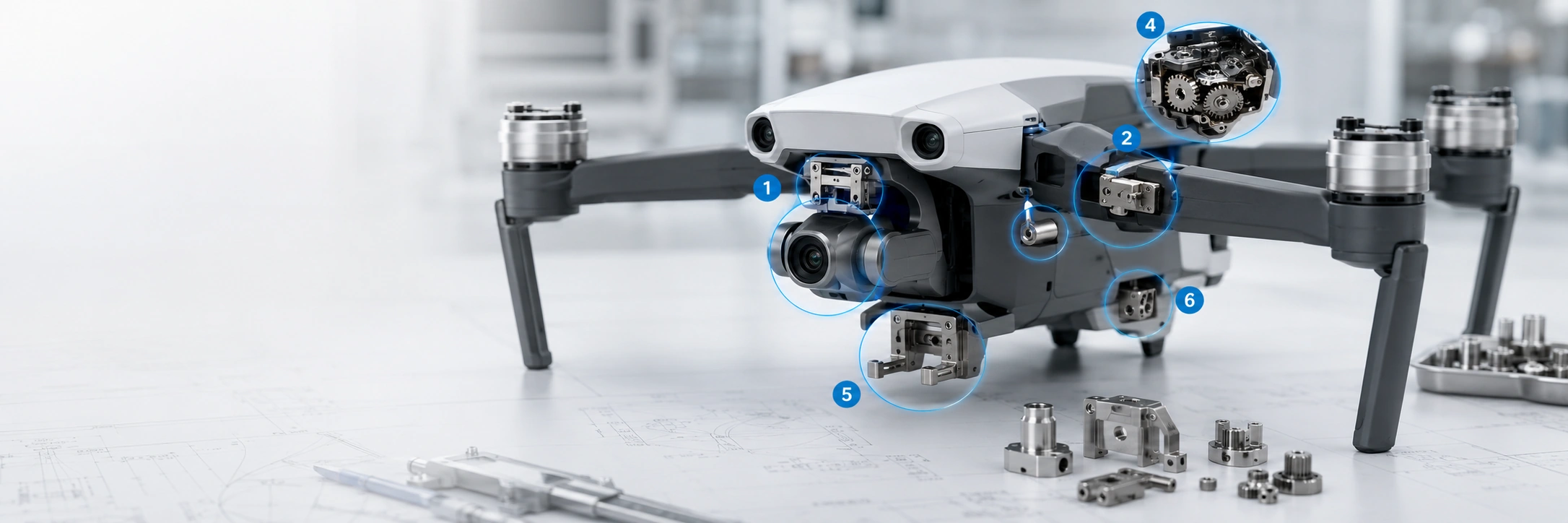
When a Civilian Drone Metal Part Is a Real MIM Candidate
MIM becomes worth evaluating when a drone metal part combines several engineering conditions at the same time: small size, complex three-dimensional geometry, repeatable production volume, material strength or wear requirement, tight assembly relationship, and high machining cost if produced by CNC.
In practice, many UAV projects start with CNC machining, metal 3D printing, or prototype fabrication. That is normal. MIM usually becomes more attractive after the design is stable and the project needs repeatable production of a small complex metal part. If your team is still comparing manufacturing routes, review the broader metal injection molding process before locking the tooling strategy.
The part is small, complex, metal, repeatable, difficult to machine efficiently, and ready for production tooling.
The design is still changing, volume is low, or the part needs rapid prototype validation before tooling.
Check wall thickness, critical holes, load direction, sintering shrinkage, wear surfaces, material, and inspection needs.
| Suitable for MIM | Usually Not Ideal for MIM |
|---|---|
| Small gimbal brackets and compact mounting blocks | Large carbon fiber frames or long lightweight arms |
| Folding hinge parts, latch hooks, and locking pawls | Propellers, batteries, flight controller boards, and ESC modules |
| Micro gears, pinions, shafts, pins, and pivot parts | Complete camera modules, sensor modules, or electronic assemblies |
| Sensor brackets, payload mounts, reinforcement inserts, and connector supports | Very low-volume prototypes or parts with frequent design changes |
MIM-Suitable Drone Part Categories
Civilian and commercial drones contain many systems, but only some metal components are realistic MIM candidates. The following categories should be understood as engineering review categories, not as a claim that every part in the category must be made by MIM.

Drone MIM Part Suitability Matrix
The fastest way to screen a drone part is to match the part category with its function, MIM fit, and review risk. This matrix does not replace drawing review, but it helps engineers and sourcing teams decide whether a part is worth submitting for MIM feasibility evaluation.
| Part Category | Example Parts | MIM Fit | Key Review Risk | Better Alternative When |
|---|---|---|---|---|
| Gimbal and camera mounting parts | Gimbal brackets, bearing seats, compact yoke parts, sensor mounting blocks | Strong fit when small and complex | Hole position, bearing seat fit, flatness, vibration, secondary machining zones | The part is large, mostly flat, or still changing during prototype validation |
| Folding hinge and locking parts | Hinge knuckles, pivot arms, latch hooks, pawls, rotation stops | Strong fit after DFM review | Pivot clearance, latch contact wear, repeated movement, wall thickness balance | The design requires frequent iteration or very tight functional holes without secondary operations |
| Small transmission and actuation parts | Micro gears, pinions, sector gears, cams, actuator connector parts | Good fit for repeatable complex geometry | Tooth profile, wear surface, heat treatment, mating gear material, dimensional control | Prototype quantity is low or gear precision requires a different production route |
| Payload and sensor mounting parts | Payload brackets, quick-release mounts, retaining clips, rail clamps, connector supports | Good fit when compact and metal | Load path, screw boss strength, corrosion exposure, mating plastic or composite parts | A sheet-metal bracket or machined aluminum part provides simpler weight and cost control |
| Motor and propulsion interface inserts | Shaft collars, retainers, clamping rings, positioning sleeves, compact fixing blocks | Project-specific review needed | Balance, rotating interface, fatigue, fit with bearings or shafts, local stress | The part is large, high-speed rotating, weight-critical, or better handled by CNC turning |
| Landing gear and structural connector parts | Landing gear latches, lock blocks, shock link pins, standoffs, compact brackets | Suitable only for small metal subcomponents | Impact load, deformation risk, sintering support, assembly clearance, corrosion exposure | The complete landing gear is better made from plastic, aluminum, composite, or carbon fiber structures |
Gimbal and Camera Mounting Parts
Gimbal and camera mounting assemblies are among the most relevant areas for MIM evaluation because they often contain small metal components with multiple positioning surfaces, bearing seats, rotational interfaces, screw bosses, and compact load paths.
Possible candidates include gimbal brackets, camera mounting frames, bearing seats, small yoke parts, payload locking clips, quick-release latches, sensor mounting brackets, miniature positioning blocks, and anti-vibration metal inserts. If the part is primarily a mounting or support feature, review the deeper page for MIM brackets.
Folding Arm, Hinge and Locking Mechanism Parts
Folding civilian drones often rely on compact hinge and locking structures. These parts may include pivot holes, latch faces, hook geometry, spring seats, rotation stops, and local load-bearing features.
Possible candidates include folding hinge parts, hinge knuckles, pivot arms, lock hooks, latch levers, detent parts, small locking pawls, rotation limit stops, and hinge reinforcement inserts. If the main risk is pivot fit or repeated movement, see MIM hinges and MIM shafts and pins.
Motor and Propulsion Interface Metal Parts
MIM is usually not the first choice for large drone motor mounts, long arms, or complete propulsion structures. However, it may be relevant for small metal interface parts inside or around propulsion assemblies.
Possible candidates include small motor retaining parts, bearing retainers, shaft collars, rotor hub inserts, motor bracket inserts, compact clamping rings, miniature fixing blocks, positioning sleeves, and small balancing components when justified by design.
Small Transmission and Actuation Parts
Small transmission and actuation parts are good candidates when they require compact geometry, repeatable profile features, and metal performance in a small envelope.
Possible candidates include micro gears, pinions, sector gears, small cams, miniature linkages, actuator connector parts, sliding blocks, and wear-resistant moving parts. Gear-specific geometry and wear questions should be handled on the MIM gears page.
Payload, Sensor and Module Mounting Parts
Civilian and commercial UAVs used for inspection, mapping, agriculture, security monitoring, logistics trials, and imaging often carry payload modules or sensor assemblies.
MIM may be suitable for payload mounting brackets, sensor brackets, module retaining clips, quick-release mounts, rail clamps, cable protection metal clips, positioning tabs, compact mounting plates, anti-loosening metal parts, and connector supports.
Landing Gear and Structural Connector Parts
Landing gear systems may include plastic, carbon fiber, aluminum, rubber, or composite structures. MIM is usually more suitable for the small metal connection or locking parts inside the mechanism rather than the complete landing gear structure.
Practical examples include landing gear hinge parts, folding latches, lock blocks, shock link pins, pivot parts, retaining pins, compact brackets, standoffs, threaded inserts, clamp parts, alignment features, and connector support frames.
Drone Parts That Are Usually Not Good MIM Candidates
This page focuses on small metal components for civilian and commercial UAV production. Propellers, batteries, flight controllers, complete camera modules, retail replacement parts, and large structural frames generally fall outside the scope of MIM part production.
| Drone Part Type | Why It Is Usually Not a MIM Fit |
|---|---|
| Propellers | Usually plastic, carbon fiber, or composite materials; weight, aerodynamic profile, and balance dominate the design. |
| Large drone frames and long arms | Weight and structural efficiency often favor carbon fiber, aluminum, composite structures, CNC machining, or other processes. |
| Batteries, flight controllers, and ESC modules | Electrical systems and PCB assemblies are outside MIM manufacturing scope. |
| Complete cameras and sensors | Complete modules are not MIM parts; only brackets, housings, or mounting features may be relevant. |
| Retail replacement parts | Usually repair or e-commerce intent, not B2B MIM production intent. |
| Early prototypes | CNC machining or 3D printing is often more practical before the design is stable enough for MIM tooling. |
MIM vs CNC, 3D Printing and Die Casting for Drone Metal Components
Many drone projects compare several manufacturing processes before selecting MIM. The right choice depends on design maturity, part size, complexity, material, production volume, tolerance requirements, and acceptable tooling investment. MIM is usually strongest after the design is mature enough for tooling.

| Process | Better For | Limitations for Drone Metal Parts |
|---|---|---|
| MIM | Small complex metal parts, stable production, repeatability, integrated features, and multi-feature geometry. | Requires tooling investment; not ideal for very low volume, large parts, or unstable designs. |
| CNC Machining | Prototypes, low-volume production, simple metal parts, tight machined surfaces, and late-stage design changes. | Can become costly for complex geometry, multiple setups, small features, and high-volume small parts. |
| Metal 3D Printing | Complex prototypes, low-volume development, design exploration, and rapid design iteration. | Surface finish, cost, batch consistency, dimensional repeatability, and post-processing require review. |
| Die Casting | Larger aluminum or zinc parts, higher-volume housings, and certain structural parts. | Not ideal for very small precision steel parts, fine features, or high-density stainless and alloy steel parts. |
| Stamping / Sheet Metal | Flat or bent sheet structures, shields, covers, and simple support plates. | Limited three-dimensional complexity and less suitable for compact integrated features. |
CNC and 3D printing often support early-stage prototype validation. Die casting may be better for larger aluminum or zinc components. Stamping may be suitable for sheet structures. MIM should be evaluated when a small metal drone part needs complexity, repeatability, and production efficiency after design validation.
If cost is the main concern, the useful question is not “Is MIM cheaper than CNC?” but “At the expected annual volume, does MIM reduce repeated machining, fixture setup, material waste, assembly labor, or dimensional variation enough to justify tooling?” For quotation preparation, see the RFQ preparation guide.
Material Options for MIM Drone Parts
Material selection for drone MIM parts should start from the function of the component, not from a generic material list. The same UAV assembly may include parts that need corrosion resistance, strength, wear resistance, magnetic response, or post-processing compatibility. For broader material planning, visit the MIM materials page.
Stainless Steel
Useful for exposed brackets, payload mounts, sensor brackets, clips, and small housings where corrosion resistance matters more than minimum weight.
Low Alloy Steel
Relevant for lock hooks, hinge parts, pivot parts, high-strength brackets, and reinforcement inserts where load transfer is important.
Wear-Resistant Options
Required for pins, pivots, latch faces, micro gears, and repeated-motion interfaces when friction changes clearance or locking consistency.
Soft Magnetic Materials
Only relevant for specific electromagnetic or sensor-related functions. Magnetic properties should be defined before tooling.
Function-Based Material Review
| Part Function | Material Direction | Review Notes Before Tooling |
|---|---|---|
| Outdoor bracket, exposed mount, or sensor support | Stainless steel or other corrosion-resistant direction | Confirm corrosion exposure, surface finish, passivation or coating needs, and mating material compatibility. |
| Lock hook, hinge arm, reinforced insert, or load-transfer feature | Low alloy steel or strength-focused alloy direction | Review load direction, section thickness, fillet radius, heat treatment possibility, and critical stress zones. |
| Pivot, latch face, small gear, cam, or repeated-contact feature | Wear-resistant material or surface treatment direction | Review contact stress, mating material, lubrication, hardness target, finishing method, and inspection method. |
| Sensor or electromagnetic interface component | Soft magnetic material only when the function requires it | Define magnetic performance requirements, geometry limits, heat treatment needs, and project-specific validation method. |
Engineering Requirements That Affect Drone Part Feasibility
Drone metal components are usually evaluated as part of an assembly, not as isolated shapes. MIM feasibility depends on how the part functions in the UAV system, how it will shrink during sintering, and which surfaces control assembly performance.

Weight and Strength Balance
Drone parts cannot be evaluated only by strength. Weight, density, wall thickness, section design, and function integration all matter. A stronger metal part may still be unsuitable if it increases weight in the wrong area of the aircraft.
Tolerance and Assembly Fit
Critical dimensions may include pivot holes, bearing seats, screw locations, alignment faces, latch contact faces, and mating surfaces. For deeper tolerance planning, see high precision MIM parts.
Wear and Repeated Movement
Hinges, latches, pivots, gears, and quick-release structures should be reviewed for repeated movement, mating material, surface finish, heat treatment, lubrication possibility, and expected cycles.
Sintering Shrinkage and Distortion Risk
MIM parts undergo injection molding, green part handling, debinding, and sintering. Flat thin sections, uneven wall thickness, long unsupported features, thick-to-thin transitions, and asymmetric geometry may increase distortion risk.
Quality and Inspection Review for Drone MIM Parts
For civilian UAV metal components, manufacturability review should continue into inspection planning. The important question is not only whether the part can be molded and sintered, but also which dimensions, surfaces, and functional relationships must be verified before stable production.
Dimensional Inspection
Critical dimensions may include pivot hole position, bearing seats, screw hole locations, slot width, flatness, and mating faces. These should be identified on the drawing before tooling.
Functional Fit
Hinges, latches, payload locks, and quick-release mounts should be checked against the actual assembly relationship, not only as isolated metal parts.
Material and Surface Condition
Hardness, heat treatment direction, surface finish, burr risk, coating compatibility, corrosion exposure, and contact wear should be reviewed according to part function.
Production Consistency
Sintering support, secondary operations, fixture strategy, batch inspection, and critical feature monitoring should be planned before moving from samples to repeat production.
| Inspection Focus | Typical Drone Part Examples | Why It Matters |
|---|---|---|
| Critical hole position and diameter | Hinge parts, pivot arms, bearing seats, locating pins | Small changes can create tight rotation, looseness, vibration, or assembly failure. |
| Latch engagement and contact face | Payload locks, folding arm locks, quick-release mechanisms | Contact wear or wrong engagement depth can reduce locking consistency after repeated use. |
| Flatness and distortion | Sensor brackets, mounting blocks, compact connector supports | Distortion after sintering can shift the sensor, module, or mating assembly position. |
| Surface finish and burr control | Sliding blocks, clips, rail clamps, latch hooks | Surface condition can affect wear, assembly feel, coating adhesion, and repeatable movement. |
| Material and heat treatment verification | Wear parts, high-strength locks, corrosion-exposed brackets | The selected material must match the part function, mating material, and operating environment. |
Representative Engineering Scenarios for Drone MIM Parts
These representative scenarios illustrate common manufacturability risks that can appear in small UAV MIM components. They are not descriptions of specific customer projects.
Scenario 1: Folding Hinge Part with Pivot Hole Misalignment
What problem occurred: A small folding hinge part for a civilian UAV arm showed inconsistent rotation after trial production. Some parts assembled tightly, while others had excessive clearance.
Why it happened: The pivot hole was treated as a normal molded feature rather than a critical functional dimension. The surrounding wall thickness was uneven, and the hole area was close to a thicker reinforced section.
What the real system cause was: The issue was not only a tolerance problem. It came from uneven shrinkage, insufficient definition of the critical hole requirement, and missing review for secondary machining or sizing.
How it was corrected: The drawing was revised to identify the pivot hole as a critical dimension, the hinge area was adjusted for better wall balance, and the functional hole was reviewed for controlled secondary operation.
How to prevent recurrence: Pivot holes, latch faces, rotation stops, and mating surfaces should be marked before tooling. The supplier should review which dimensions can remain as-sintered and which require secondary operations or dedicated inspection.
Scenario 2: Payload Latch with Local Wear
What problem occurred: A payload locking latch initially passed assembly checks but showed visible wear and reduced locking consistency after repeated engagement.
Why it happened: The design focused on external geometry and locking shape, but did not define wear requirements, mating material, contact stress, or surface finish expectations.
What the real system cause was: The issue came from system-level contact conditions. The latch was not failing because MIM was unsuitable; it was failing because material, surface condition, and repeated contact behavior were not reviewed early enough.
How it was corrected: The latch contact surface, material direction, and mating surface were reviewed. Surface treatment or secondary finishing was considered depending on the final application requirement.
How to prevent recurrence: Drone latch and quick-release parts should be reviewed for contact area, load direction, mating material, wear surface, corrosion exposure, and inspection method before tooling.
DFM Review Checklist Before Tooling Drone Parts
Before tooling a drone MIM component, the project team should review whether the part is suitable for MIM as a production process, not just whether the shape can be molded. A drawing-based review should happen before tooling because late changes to wall thickness, holes, latch geometry, gate location, or critical dimensions can increase cost and delay validation.
| Review Item | What to Check Before Tooling |
|---|---|
| Part size | Is the part small enough for economical MIM production and stable sintering support? |
| Wall thickness | Are thick and thin sections balanced to reduce molding, debinding, and sintering distortion risk? |
| Holes and slots | Are small holes, blind holes, deep slots, or intersecting features manufacturable without excessive risk? |
| Critical dimensions | Which dimensions need inspection, post-sintering sizing, machining, or dedicated control? |
| Load direction | Does the design have enough cross-section and radius support at hinge, lock, and mounting areas? |
| Moving interface | Is wear resistance required for pivots, latches, gear teeth, or repeated-contact surfaces? |
| Material | Should the part use stainless steel, low alloy steel, magnetic material, or another alloy based on function? |
| Surface finish | Is the expected finish as-sintered, polished, plated, passivated, coated, machined, or locally finished? |
| Annual volume | Is the expected volume enough to justify MIM tooling compared with CNC or 3D printing? |
| Application environment | Will the part face outdoor exposure, vibration, moisture, temperature change, dust, or repeated movement? |
| Assembly relationship | Does the part fit with plastic, carbon fiber, aluminum, fasteners, bearings, or electronic modules? |
If you already have a 2D drawing or 3D model, submit it through the drawing review page so the part can be evaluated for MIM feasibility, material direction, tolerance strategy, tooling risk, shrinkage control, and secondary operation needs.
Civilian Drone Part Project Review and RFQ Information
XTMIM focuses this page on civilian and commercial UAV metal components. Relevant projects may include small precision parts for camera drones, inspection drones, mapping drones, agricultural drones, payload module assemblies, industrial monitoring drones, and compact mechanical subassemblies.

Design Inputs
- 2D drawings
- 3D CAD files
- Critical dimensions
- Assembly position
Engineering Requirements
- Material requirements
- Tolerance notes
- Surface finish expectations
- Load or motion conditions
Production Information
- Estimated annual volume
- Application environment
- Current manufacturing process
- Sample photos if available
Need a MIM Feasibility Review for a Civilian Drone Metal Part?
Send drawings, CAD files, material requirements, tolerance notes, surface finish expectations, annual volume, assembly position, and application background. XTMIM can review MIM suitability, tooling risk, sintering shrinkage concerns, secondary operation needs, inspection requirements, and production feasibility before tooling.
FAQ About MIM Drone Parts
Can MIM be used for drone parts?
Yes, but mainly for small, complex metal components used in civilian drones or commercial UAV assemblies. MIM is more suitable for parts such as gimbal brackets, hinges, latches, micro gears, shafts, pins, payload mounts, and small structural inserts. It is usually not suitable for propellers, batteries, flight controllers, long arms, or large frames.
Which drone parts are suitable for MIM?
Common MIM candidates include gimbal brackets, camera mounting parts, folding hinge parts, latch components, micro gears, pinions, shafts, pins, sensor brackets, payload mounting brackets, lock blocks, and compact connector-type metal parts. Final suitability depends on geometry, material, tolerance, load, annual volume, and assembly requirements.
Is MIM suitable for drone frames or arms?
Usually not. Large drone frames and long arms often require lightweight structural efficiency and are commonly better suited to carbon fiber, aluminum, composites, CNC machining, die casting, or other manufacturing routes. MIM is more appropriate for small metal components inside the drone assembly.
Is MIM better than CNC for drone metal parts?
It depends on the project stage and part design. CNC machining is often better for prototypes, low-volume parts, and simple machined features. MIM becomes more attractive when the part is small, complex, stable in design, required in repeatable volume, and expensive to machine repeatedly.
Can MIM make lightweight drone parts?
MIM can support compact part integration and reduce multiple small components into one metal part, which may help with assembly efficiency. However, lightweight design must consider material density, wall thickness, geometry, strength, and production cost. MIM is not automatically lighter than aluminum, plastic, or composite solutions.
What materials are used for MIM drone parts?
Possible material directions include stainless steel for corrosion resistance, low alloy steel for strength-critical parts, wear-resistant material options for moving interfaces, and soft magnetic materials for special electromagnetic functions. Final material selection should be confirmed through project-specific review.
How are drone MIM parts inspected before production?
Inspection planning should focus on the part function. Common review items include critical hole position, pivot fit, latch engagement, bearing seat geometry, flatness, surface condition, hardness or heat treatment direction when required, and functional assembly fit.
Do you make military drone parts?
This page focuses on civilian and commercial UAV metal components. Controlled, defense-related, weapon-related, or export-regulated applications require separate compliance review and should not be assumed from this page.
What should I send for a drone MIM part quotation?
Useful RFQ information includes 2D drawings, 3D CAD files, material requirements, tolerance notes, surface finish requirements, estimated annual volume, assembly position, load or motion requirements, application environment, and current manufacturing process.
Standards and Technical References
MIMA resources are useful for understanding MIM process capability, complex part production, net-shape manufacturing, multi-cavity tooling, and dimensional control considerations. View MIMA process overview
EPMA’s MIM overview is relevant because it explains MIM as a route for complex shapes and helps clarify when MIM should be considered instead of other powder-based or conventional manufacturing processes. View EPMA MIM overview
MPIF Standard 35-MIM is relevant for material specification and evaluation of common materials used in metal injection molding. Project-specific material data and supplier process capability should still be confirmed before tooling. View MPIF standards page