Metal Injection Molding Applications
Suitable Parts, Materials, Industries, and Engineering Review Factors
Metal injection molding applications are best suited for small, complex metal parts that need repeatable production, difficult geometry, and functional metal properties such as strength, wear resistance, corrosion resistance, or magnetic response. For design engineers, the key question is not only whether a part can be molded, but whether its geometry, material requirement, tolerance plan, annual volume, and inspection method fit the MIM process route. This matters before tooling because a part may look suitable in CAD but still create risk during green part handling, debinding, sintering shrinkage, support design, secondary machining, or final inspection. Use the criteria below to judge whether a specific metal component is a good MIM candidate before DFM review, sampling, or RFQ preparation.
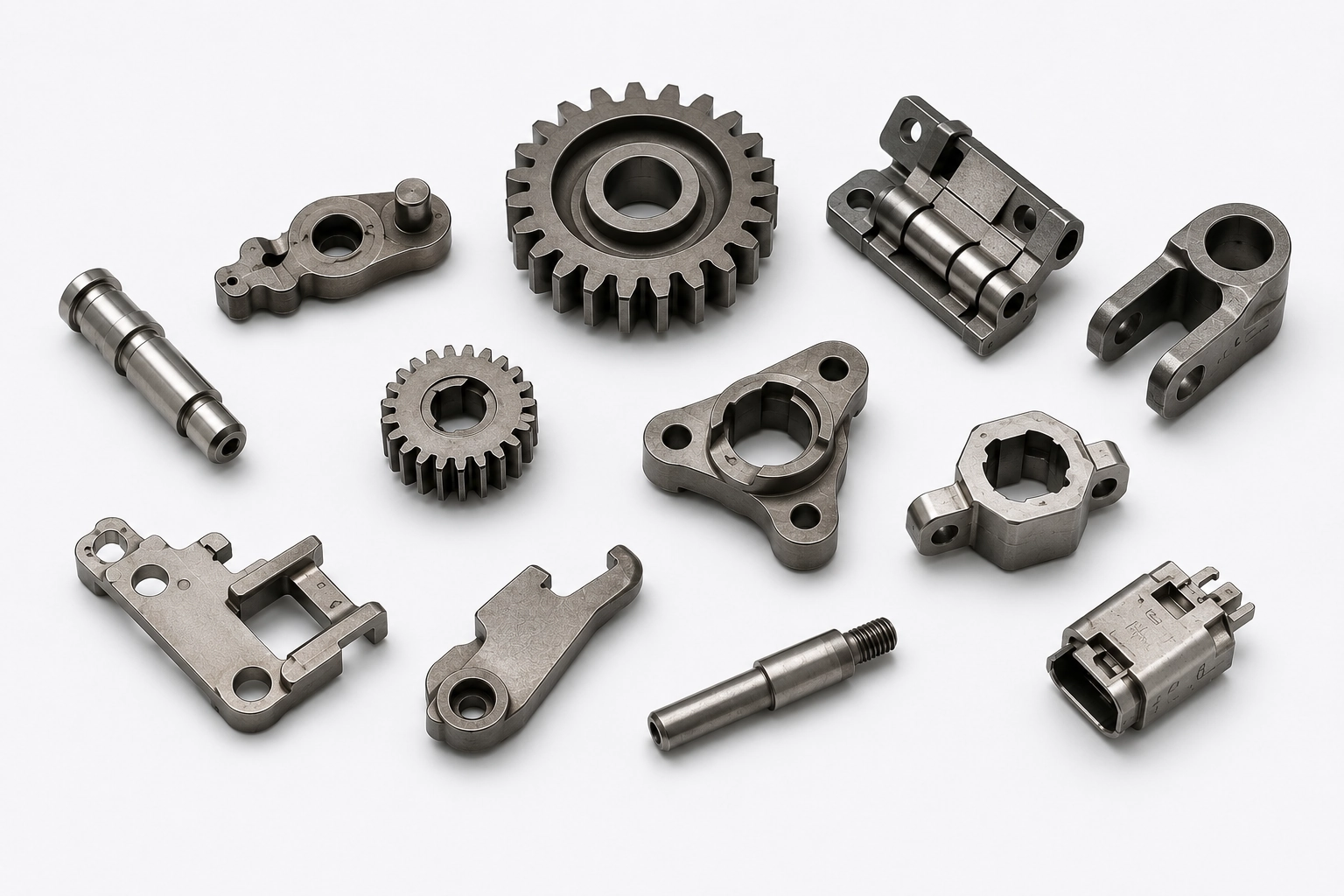
Metal injection molding is strongest for small, complex metal parts that combine difficult geometry, repeat production, functional material requirements, and a realistic tolerance plan. Typical applications include miniature gears, hinges, brackets, shafts, pins, locking parts, connector hardware, sensor components, surgical or dental instrument parts, and compact structural components. MIM is worth reviewing when machining, stamping, casting, or multi-piece assembly becomes inefficient at production volume, but suitability should be screened before tooling for geometry, material route, annual volume, sintering risk, secondary operations, and inspection requirements.
What Applications Are Best for Metal Injection Molding?
Metal injection molding applications are strongest when a project involves small, complex metal parts that need repeatable production, functional material performance, and a realistic tolerance and inspection plan. Common MIM applications include miniature gears, hinges, brackets, shafts, pins, locking parts, connector hardware, sensor housings, surgical or dental instrument components, and compact structural metal parts. For component-specific examples, see MIM parts by application and part type. MIM is usually worth reviewing when CNC machining, stamping, casting, or multi-piece assembly becomes inefficient at production volume, but the part must still pass DFM review for wall thickness, green handling, debinding, sintering shrinkage, secondary machining, and final inspection. The strongest applications usually meet several conditions at the same time:
- Small complex metal parts with thin walls, holes, ribs, bosses, undercuts, fine teeth, or integrated functional features.
- Parts that are difficult or costly to CNC machine, stamp, cast, or assemble from multiple small components.
- Applications requiring metal strength, wear resistance, corrosion resistance, heat treatment response, or magnetic performance.
- Components with stable design, realistic tolerance strategy, and inspection requirements that can be confirmed before tooling.
- Repeat production projects where tooling and process development costs can be justified by annual volume.
- Parts where MIM can form the main geometry while secondary machining is reserved only for selected critical features.
MIM Application Fit Matrix
A strong MIM candidate is not only a small part. It should align geometry, production economics, material performance, and quality control requirements. The matrix below helps engineering and sourcing teams screen applications before tooling and prevents the common mistake of choosing MIM only because a part looks “complex” in a CAD model.

| Application Requirement | Why MIM Can Fit | Engineering Risk | What to Review Before Tooling |
|---|---|---|---|
| Small complex geometry | Injection molding can form details that are costly to machine. | Mold filling imbalance, gate marks, flash, feature damage. | Gate location, parting line, wall thickness, ejection strategy. |
| Thin-wall or miniature metal parts | Fine powder feedstock can support compact precision geometry. | Green part fragility, debinding stress, sintering deformation. | Handling method, support design, wall transitions. |
| High-volume repeat production | Tooling can support repeatable production after validation. | Upfront tooling and process development cost. | Annual volume, design freeze, sampling plan. |
| Wear-resistant or high-strength parts | MIM materials and heat treatment may support functional performance. | Distortion after sintering or heat treatment. | Material route, heat treatment, critical dimensions. |
| Corrosion-resistant applications | Stainless steel MIM materials may support corrosion-related requirements. | Surface condition, passivation, environment mismatch. | Application environment, cleaning method, finishing requirement. |
| Small moving components | Complex functional shapes can be molded near-net-shape. | Friction surface, tolerance stack-up, wear at contact points. | Motion interface, datum scheme, secondary machining need. |
| Electrical, sensor, or magnetic hardware | MIM can support small functional metal parts. | Material property variation, plating or magnetic response uncertainty. | Material family, coating, inspection method. |
| Assembly consolidation | Multiple parts may become one molded component. | Thick sections, hidden shrinkage risk, difficult inspection. | Load path, wall balance, functional surfaces. |
What Makes an Application Suitable for Metal Injection Molding?
MIM applications are not defined by industry name alone. Automotive, medical, electronics, industrial tools, robotics, aerospace, new energy, and wearable devices can all use MIM, but the real suitability comes from the part itself. A good MIM application normally combines geometry difficulty, production repeatability, material performance, and a realistic tolerance strategy. For the manufacturing sequence from molding through debinding and sintering, see the metal injection molding process.
Small Complex Metal Parts
MIM is most valuable when the part is small enough for efficient molding and sintering, but too geometrically complex to machine economically at scale. Examples include miniature gears, locking parts, surgical instrument components, hinges, brackets, shafts, connector parts, sensor hardware, and small structural components.
The complexity should be useful, not decorative. Features such as small holes, undercuts, ribs, bosses, fine teeth, thin walls, curved surfaces, internal forms, and integrated functional shapes can support a MIM decision if they reduce machining, assembly, or material waste.
High-Volume Parts with Stable Design
MIM requires tooling, process development, debinding control, and sintering validation. For that reason, it is usually more suitable when the design is stable and the production volume is high enough to spread tooling and qualification costs across many parts.
A common mistake is using MIM too early when the design is still changing every few weeks. Early feasibility review is useful, but production tooling should normally wait until the assembly interface, functional surfaces, material direction, and critical tolerances are reasonably stable.
Difficult-to-Machine Geometry
MIM becomes attractive when CNC machining would require many setups, small tools, difficult internal features, significant material removal, or long cycle time. It can also help when an assembly made from several machined or stamped parts can be redesigned into one molded and sintered component.
This does not mean MIM eliminates machining completely. Secondary machining may still be used for critical holes, threads, datum surfaces, sealing areas, or very tight tolerance features. Before tooling, the key question is which surfaces can be molded and which surfaces should be reserved for secondary operations.
Material Performance Needs
MIM is considered when plastic is not strong enough and conventional metal forming routes are not efficient for the required geometry. Application requirements may include corrosion resistance, wear resistance, mechanical strength, heat treatment response, magnetic performance, or medical-grade material direction.
Material selection should not be treated as a catalog decision. The application environment, load condition, surface requirement, heat treatment plan, corrosion exposure, cleaning requirement, and inspection method all affect whether a material is suitable for a specific MIM project.
Typical Metal Injection Molding Part Applications
Many MIM applications are easier to evaluate by component type than by industry name. For component-specific examples such as gears, brackets, shafts, hinges, and locking parts, see MIM parts and part families.

Small Gears and Motion Components
Small gears, micro gears, sector gears, ratchet parts, and motion transmission components are common candidates when geometry is compact and tooth forms are difficult or costly to machine at volume. MIM can support complex gear-like geometry, but tooth accuracy, wear surface, heat treatment response, and post-sintering dimensional control must be reviewed.
Hinges, Brackets, and Structural Parts
MIM can be useful for compact hinges, small brackets, support arms, and structural parts that combine holes, bosses, curved surfaces, ribs, and load-bearing features. These parts are often found in consumer electronics, wearable devices, automotive hardware, industrial mechanisms, and compact assemblies.
Shafts, Pins, and Locking Parts
Small shafts, pins, latches, cams, levers, and locking components can be suitable for MIM when they require complex shapes, wear resistance, corrosion resistance, or stable production at scale. The review should focus on contact wear, strength, surface finish, dimensional datums, and secondary operation needs.
Connectors, Sensor Parts, and Miniature Housings
MIM can support small connector hardware, sensor housings, shielding components, miniature metal frames, and compact structural parts for electronics or industrial devices. These applications often require miniaturization, stable geometry, corrosion resistance, plating compatibility, or magnetic response.
Surgical, Dental, and Medical Instrument Components
MIM may be considered for selected surgical, dental, and medical instrument components where small geometry, corrosion resistance, strength, or functional precision is required. Medical-related applications require cautious material selection, cleaning requirements, surface finishing, traceability, and validation planning.
Soft Magnetic and Functional Metal Components
Some MIM applications require functional material behavior, such as soft magnetic response, controlled expansion, wear resistance, or corrosion resistance. These are material-performance projects, not only shape-driven projects. Sintering atmosphere, density, carbon control, heat treatment, and inspection method may influence final performance.
When MIM Is Not the Right Application Choice
MIM is not a universal replacement for CNC machining, die casting, stamping, investment casting, or PM. It is strongest when the application fits both the geometry and the production economics. A responsible MIM manufacturer should be able to say “not suitable” when the part does not fit the process.
- The part is too large for efficient molding and sintering.
- The production volume is too low to justify tooling.
- The geometry is simple and can be stamped, turned, milled, or pressed more economically.
- The design is still unstable and major geometry changes are expected.
- The tolerance requirement is extremely tight but no secondary operation is allowed.
- The wall thickness variation is too large and creates high sintering distortion risk.
- The material requirement does not match a practical MIM feedstock and sintering route.
- The cosmetic surface requirement cannot be achieved without a realistic finishing plan.
- The application requires certification, testing, or traceability that has not been defined by the buyer.
- The part is more suitable for PM because the geometry is pressable and cost-sensitive.
- The part is more suitable for CIM because the required material properties are ceramic rather than metallic.
- The main goal is only “replace CNC” without geometry, volume, or cost justification.
When to Choose MIM Instead of PM, CNC, Casting, Stamping, or CIM
If a part is not suitable for MIM, the next step is not to force the project into MIM tooling. The better decision is to compare the geometry, material, volume, tolerance, and cost structure against other manufacturing routes.
| Manufacturing Route | Best Fit | Typical Reason to Choose It Instead of MIM |
|---|---|---|
| MIM | Small complex metal parts with high repeatability needs and functional material requirements. | Choose MIM when complex geometry, high-volume production, and near-net-shape metal performance justify tooling. |
| PM | Relatively regular, pressable, cost-sensitive sintered metal parts. | Choose PM when the geometry can be compacted vertically and cost efficiency is more important than complex 3D features. |
| CNC Machining | Low-volume parts, prototypes, large parts, or features requiring very tight machined tolerances. | Choose CNC when design changes are frequent, tooling is not justified, or critical dimensions require direct machining. |
| Casting | Larger metal parts or shapes where casting economics are stronger than MIM. | Choose casting when part size, wall section, or production economics do not fit MIM molding and sintering. |
| Stamping | Thin sheet-metal parts with flat or formed geometry. | Choose stamping when the part is sheet-based and does not require MIM-style 3D complex molded geometry. |
| CIM | Small complex ceramic parts requiring ceramic material properties. | Choose CIM when the required function is electrical insulation, ceramic hardness, high-temperature ceramic behavior, or other ceramic-specific performance. |
Industries Where These MIM Applications Commonly Appear
MIM applications commonly appear in industries that need compact metal parts with complex geometry and repeatable production. Industry context can change material, validation, surface, inspection, and traceability requirements, so sector-specific projects should also be checked against the relevant MIM industry guidance.
Automotive
Automotive MIM applications often involve small metal parts used in locks, sensors, fuel systems, control systems, safety hardware, and compact mechanical assemblies.
Main review: strength, wear, corrosion resistance, production volume, and dimensional repeatability.
Automotive MIM applications →Medical Devices
Medical device MIM applications may include small surgical, dental, orthopedic, or instrument-related components.
Main review: material selection, corrosion resistance, cleaning, finishing, validation requirements, and traceability expectations.
Medical device MIM applications →Consumer Electronics
Consumer electronics applications often focus on miniaturized structural parts, hinges, brackets, connector hardware, small housings, and cosmetic metal components.
Main review: thin-wall geometry, surface finish, dimensional stability, and high-volume repeatability.
Consumer electronics MIM applications →Industrial Tools
Industrial tool applications may use MIM for small wear-resistant parts, tool mechanisms, locking elements, brackets, and precision hardware.
Main review: hardness, wear resistance, heat treatment planning, and functional surface control.
Industrial tool MIM applications →Robotics
Robotics applications may involve compact joints, gripper parts, small gears, sensor housings, brackets, and miniature mechanical elements.
Main review: load path, motion interface, dimensional repeatability, and assembly precision.
Robotics MIM applications →Aerospace
Aerospace-related MIM applications should be discussed carefully because validation, material traceability, and customer requirements are usually more demanding.
Main review: material requirement, traceability, inspection method, and customer qualification expectations.
Aerospace MIM applications →New Energy
New energy applications may involve small sensor parts, connector hardware, valve-related parts, thermal or corrosion-resistant components, and compact metal structures.
Main review: application environment, corrosion exposure, heat, electrical or magnetic function, and inspection requirements.
New energy MIM applications →Wearable Devices
Wearable device applications often involve small metal housings, hinges, watch components, connector parts, decorative-functional metal components, and compact structural pieces.
Main review: surface finish, corrosion resistance, skin-contact material requirements, and dimensional consistency.
Wearable device MIM applications →How Material Requirements Affect MIM Applications
Material selection changes the entire application review. Two parts may have the same shape but require different MIM strategies if one needs corrosion resistance, another needs wear resistance, and another needs magnetic response. For alloy families and property-based selection, review MIM Materials.

| Application Need | Possible MIM Material Direction | Review Concern |
|---|---|---|
| Corrosion resistance | Stainless steel direction, such as 316L or 17-4PH depending on strength and environment. | Corrosion environment, surface finish, passivation, cleaning method. |
| Strength and hardness | Low alloy steel, precipitation-hardening stainless steel, or heat-treatable material direction. | Heat treatment distortion, critical dimensions, hardness requirement. |
| Wear resistance | Stainless steel, tool steel, or other wear-focused material direction. | Contact surface, friction condition, lubrication, finishing. |
| Medical or dental direction | Medical stainless steel or titanium direction where applicable. | Customer specification, regulatory expectation, cleaning, traceability. |
| Magnetic response | Soft magnetic material direction. | Magnetic performance target, sintering atmosphere, inspection method. |
| Heat or chemical exposure | Stainless steel, nickel alloy, or special alloy direction where feasible. | Actual service environment, oxidation, corrosion, temperature exposure. |
| Cosmetic metal part | Stainless steel or other finish-compatible material direction. | Polishing, plating, color consistency, visible surface defects. |
Application Risk Screen Before MIM Tooling
A part can look suitable in CAD and still be a poor production candidate if molding, green-part handling, debinding, sintering, secondary operations, or inspection create uncontrolled risk. These checks are useful before tooling; detailed geometry, wall, datum, and tolerance decisions can then be worked through in the MIM Design Guide.

Mold Filling and Gate Location
Gate location affects filling balance, weld lines, gate marks, surface appearance, and dimensional stability. For cosmetic or functional surfaces, the gate position should be reviewed before mold design. Poor gate decisions may create visible marks or uneven filling that cannot be corrected by inspection alone.
Thin Walls and Wall Transitions
Thin walls can be possible in MIM, but sudden changes between thick and thin sections increase the risk of molding defects, debinding stress, and sintering distortion. Uniform wall design is usually more stable than heavy local mass concentration.
Green Part Handling
After injection molding, the green part still contains binder and is not a finished metal part. Small thin features, long arms, and delicate edges should be reviewed for handling, trimming, tray loading, and transfer before debinding.
Debinding Path
Binder removal must be stable. If a part has thick sections, blind internal areas, or difficult binder escape paths, debinding defects may occur. The part design should allow binder removal without internal pressure or cracking risk.
Sintering Shrinkage and Support
MIM parts shrink substantially during sintering. Tooling compensation can account for expected shrinkage, but uneven wall thickness, unsupported spans, asymmetric mass, and poor setter support can still cause distortion.
Tolerance and Secondary Machining
MIM can achieve repeatable near-net-shape geometry, but not every feature should be expected to meet tight machining-level tolerance directly from sintering. Critical holes, threads, sealing surfaces, bearing areas, or precision datums may need secondary machining or sizing.
Example: Thin-Arm Bracket Distortion During Sintering
This representative engineering example shows why geometry, sintering support, and tolerance strategy should be reviewed together before tooling.
A small bracket with two thin arms looked suitable for MIM, but the first trial showed arm distortion after sintering and unstable hole position.
The part had uneven wall thickness, a long unsupported span, and a critical hole located near a thin transition area.
The design, sintering support, and tolerance strategy were not reviewed together before tooling. The drawing treated all dimensions as equally critical.
The design was adjusted for smoother transitions, the setter support was revised, and selected critical holes were reserved for secondary machining.
Review load path, wall balance, support direction, datum scheme, and secondary operation plan before mold release.
Application Review Checklist Before RFQ
Before requesting a quotation, prepare enough information for a real MIM suitability review. A drawing alone is useful, but the application context often determines whether the process route is appropriate. The goal is to confirm feasibility, risk, cost drivers, tolerance strategy, and inspection method before mold design or sample production.

Recommended Information to Send
| Information | Why It Matters |
|---|---|
| 2D drawing | Defines dimensions, tolerances, surfaces, and inspection requirements. |
| 3D CAD file | Helps evaluate geometry, wall thickness, undercuts, moldability, and shrinkage compensation. |
| Material requirement | Determines feedstock direction, sintering route, heat treatment, and finishing plan. |
| Critical dimensions | Helps separate molded dimensions from secondary-machined features. |
| Annual volume estimate | Determines whether tooling and process development are economically reasonable. |
| Application environment | Clarifies corrosion, wear, heat, load, magnetic, or cleaning requirements. |
| Surface finish requirement | Affects polishing, tumbling, plating, passivation, or cosmetic review. |
| Heat treatment requirement | Influences material choice, distortion risk, and hardness strategy. |
| Assembly function | Helps review tolerance stack-up and mating surfaces. |
| Existing manufacturing issue | Helps compare MIM against CNC, casting, stamping, PM, or assembly-based production. |
What XTMIM Engineers Should Review
- Whether the geometry fits MIM molding and sintering.
- Whether wall thickness is balanced enough for stable production.
- Whether critical features need secondary machining.
- Whether the material requirement is realistic for MIM.
- Whether the estimated volume supports tooling.
- Whether surface finishing is compatible with the application.
- Whether inspection requirements are clearly defined.
- Whether another process, such as PM or CIM, may be more suitable.
Next Steps After the MIM Application Screen
Once the part passes the initial application screen, follow the topic that matches the remaining engineering question. This keeps the review focused without treating every MIM project as the same.
- Need to understand the manufacturing route? Review the metal injection molding process.
- Need comparable examples? Browse MIM Parts or MIM Industries.
- Need to confirm alloy direction or service-environment fit? Review MIM Materials.
- Need geometry, wall, datum, or tolerance guidance? Continue to the MIM Design Guide.
- Ready for project-specific review? Submit drawings for review or request a quote with material, tolerance, surface, and annual-volume requirements.
Need to Check Whether Your Application Fits MIM?
Send your 2D drawing, 3D CAD file, material requirement, critical dimensions, surface requirements, application environment, and estimated annual volume. XTMIM can review whether the part is suitable for MIM, whether secondary operations are needed, and which risks should be confirmed before tooling, sampling, or production release.
FAQ: Metal Injection Molding Applications
What are the main applications of metal injection molding?
Metal injection molding is mainly used for small complex metal parts that need repeatable production and functional material performance. Common applications include small gears, hinges, brackets, shafts, pins, locking parts, connector hardware, sensor components, surgical instrument parts, dental components, and compact structural metal parts.
When should MIM be considered instead of CNC machining?
MIM should be considered instead of CNC machining when the part is small, complex, needed in repeat production volume, and costly to machine because of multiple setups, fine tools, material waste, or difficult internal features. CNC may still be better for prototypes, low-volume parts, large parts, or features requiring very tight machined tolerances.
When should I not choose MIM for an application?
MIM may not be suitable for very large parts, very low-volume parts, simple geometries, unstable designs, parts with extreme tolerances but no secondary machining allowance, or materials that do not match a practical MIM process route. PM, CNC machining, die casting, stamping, investment casting, or CIM may be better depending on the application.
How do I know whether my part is suitable for MIM?
The most reliable method is a drawing-based DFM review. Send a 2D drawing, 3D model, material requirement, critical tolerances, surface finish needs, annual volume, and application environment. The engineering team can then evaluate moldability, debinding risk, sintering shrinkage, secondary machining needs, and process suitability.
Is MIM suitable for medical device components?
MIM may be suitable for selected medical, dental, and surgical instrument components, especially small complex metal parts. However, medical-related applications require careful review of material requirements, surface finish, cleaning, traceability, validation, and customer specifications. Suitability should be confirmed project by project.
What should I provide for a MIM application review?
Provide a 2D drawing, 3D CAD file, material requirement, tolerance requirements, annual volume, surface finish needs, heat treatment requirement if applicable, and a short explanation of the application environment. If the part currently has manufacturing problems, include those details as well.
Standards and Technical Reference Note
MIM application decisions should be based on part drawings, customer specifications, material requirements, and verified process capability. General MIM design and material references can support early evaluation, but they should not replace project-level DFM review.
- MIMA overview of metal injection molding for general MIM process and application understanding.
- MIMA process overview for molding, debinding, sintering, and MIM process context.
- EPMA technical overview of metal injection moulding for process context and application-sector background.
- MPIF Standard 35-MIM materials standards information for common MIM material specifications and reference data.
Material values, tolerance expectations, test methods, and acceptance criteria should be confirmed against the latest official standards, customer drawings, material data, and supplier process capability.