
MIM Materials Engineering Guide
Choose MIM Materials by Required Performance, Not Only Alloy Name
MIM material selection should start with what the part must do in service, not only with a familiar alloy name. A small gear, medical instrument component, magnetic actuator part, watch hardware, electronic connector, or locking mechanism may all be suitable for metal injection molding, but each application places different demands on corrosion resistance, strength, hardness, wear behavior, magnetic response, heat exposure, dimensional stability, or biocompatibility.
In MIM, final material properties are shaped by the material grade and the manufacturing route together. Powder quality, feedstock consistency, debinding, sintering density, residual porosity, heat treatment, surface condition, and inspection method can all affect part performance. Engineers and sourcing teams should compare material properties against the application requirement, narrow the candidate material family, and identify which conditions must be confirmed before tooling.
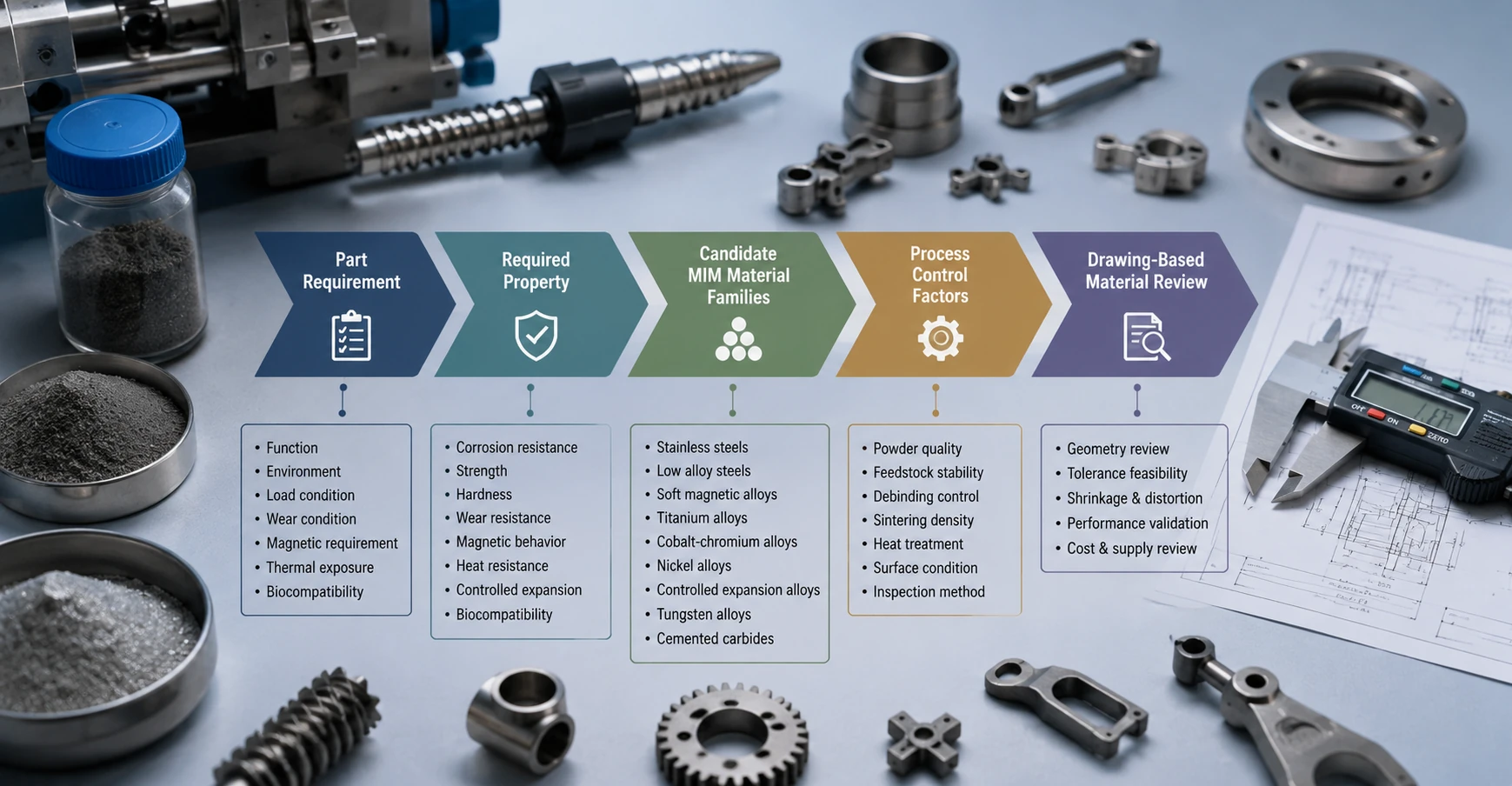
Start with the functional requirement, then narrow the candidate material family and confirm the process and validation conditions that can affect final part performance.
What Are MIM Material Properties?
MIM material properties are the measurable performance characteristics of metal injection molded parts, including sintered density, tensile strength, yield strength, elongation, hardness, wear resistance, corrosion resistance, magnetic behavior, thermal expansion, heat resistance, and heat treatment response. These properties are not determined by alloy name alone.
For metal injection molding, final properties depend on the material grade, fine metal powder, binder system, feedstock consistency, debinding control, sintering density, residual porosity, heat treatment, surface condition, part geometry, and inspection method. For tooling decisions, the safest approach is to confirm the target property together with the drawing, service environment, critical dimensions, surface requirements, and expected production volume.
Engineering Summary
When material screening is needed
Material screening is useful when the drawing defines a performance requirement but the grade has not yet been confirmed, especially before tooling, during RFQ preparation, or when converting a part from CNC, casting, stamping, die casting, or conventional PM. If two candidate grades are already under review, compare them side by side using the MIM material comparison guide.
When a material table is not enough
Do not approve a MIM material from a web table alone if the part has tight tolerances, high load, wear contact, corrosion exposure, magnetic requirements, heat treatment, medical contact, or regulatory requirements.
Main engineering risk
The same nominal alloy can perform differently if sintered density, residual porosity, carbon/oxygen control, heat treatment, surface finish, or inspection method is not aligned with the application.
What to confirm before tooling
Confirm material suitability through drawing-based review, including geometry, critical dimensions, application environment, target properties, post-processing, inspection method, and estimated production volume.
Three Inputs for MIM Material Selection
A common mistake in early MIM project discussions is starting with a familiar alloy name and assuming the result will match machined bar stock, casting, or wrought material. In practice, the alloy grade is only the starting point.
1. Material family
Stainless steel, low alloy steel, soft magnetic alloy, titanium alloy, cobalt-chromium alloy, nickel alloy, controlled expansion alloy, tungsten alloy, or cemented carbide.
2. Required part performance
Corrosion resistance, tensile strength, hardness, wear resistance, magnetic response, heat resistance, thermal expansion control, or biocompatibility.
3. MIM process condition
Sintered density, heat treatment, surface finishing, dimensional tolerance, critical features, and inspection requirements.
This matters because two parts made from the same nominal material may not behave the same if one requires high density, post-sintering heat treatment, tight flatness, passivation, magnetic performance, or controlled surface finish. Material properties should therefore be reviewed together with the drawing, application environment, critical dimensions, and functional requirements.
MIMA’s material range shows that MIM can cover many alloy families, including stainless steels, low alloy steels, magnetic alloys, nickel alloys, titanium alloys, controlled expansion alloys, and other special materials. However, alloy availability and final suitability still need supplier-level confirmation through project review.
Typical MIM Property Data Engineers Usually Verify
For early material screening, engineers usually compare the following property data before narrowing the project to a candidate material. Exact values should come from the applicable material standard, supplier datasheet, test report, and project-specific validation rather than from a generic web table alone.
| Property Data to Verify | Why It Matters | Common Material Direction | Project Review Caution |
|---|---|---|---|
| Sintered density | Density influences strength, corrosion behavior, magnetic response, sealing performance, and dimensional stability. | All MIM material families | Confirm density requirement and whether porosity affects function, corrosion, wear, or sealing. |
| Tensile strength and yield strength | These values help screen load-bearing parts, brackets, levers, gears, and locking components. | 17-4 PH, 4605, 4140, 4340, Fe-Ni alloys | Review geometry, stress concentration, heat treatment, and load direction before tooling. |
| Elongation and toughness | These properties affect crack resistance, assembly safety, impact risk, and tolerance to local stress. | Stainless steels, low alloy steels, titanium alloys | Very high hardness or strength may reduce ductility; thin sections and sharp corners need DFM review. |
| Hardness | Hardness helps screen wear edges, locking surfaces, indentation resistance, and contact features. | 420, 440C, 17-4 PH, tool steels, cemented carbides | Hardness alone does not define wear resistance; surface finish, contact load, and counterface matter. |
| Corrosion resistance | Corrosion behavior affects humid, sweat-exposed, chemically exposed, medical, and outdoor applications. | 316L, 304, 17-4 PH, titanium alloys, cobalt-chromium alloys, nickel alloys | Review surface roughness, residual porosity, passivation, cleaning, and actual exposure condition. |
| Magnetic behavior | Magnetic properties affect sensors, actuators, shielding features, magnetic cores, and electromechanical assemblies. | Fe-3Si, Fe-50Ni, Fe-50Co, selected magnetic stainless steels | Density, heat treatment, section thickness, and geometry may affect magnetic response. |
| Thermal expansion or heat resistance | Thermal behavior matters for electronic packages, glass-to-metal sealing, hot environments, and thermal cycling. | Invar, Kovar, nickel alloys, cobalt alloys, heat-resistant stainless steels | Controlled expansion and heat resistance are different requirements; define service temperature and assembly condition. |
| Heat treatment response | Heat treatment can improve strength or hardness after sintering. | 17-4 PH, 420, 440C, 4605, 4140, 4340 | Heat treatment can also affect dimensions, flatness, distortion, and inspection results. |
| Surface finish and post-processing condition | Surface condition affects friction, corrosion, appearance, cleaning, coating adhesion, and user-contact performance. | All MIM material families | Define whether the part is as-sintered, polished, passivated, coated, machined, or heat treated before acceptance. |
MIM Material Property Selection Matrix
The table below gives an engineering starting point for selecting MIM materials by performance requirement. It should not replace a project datasheet, formal standard, or application-specific validation.

Use this matrix as a screening tool. Final material selection should be confirmed by drawing review, application environment, process capability, and inspection requirements.
| Performance Requirement | Materials to Evaluate First | Typical MIM Applications | Engineering Caution | Suggested Next Step |
|---|---|---|---|---|
| Corrosion resistance | 316L, 304, 17-4 PH, titanium alloys, cobalt-chromium alloys, nickel alloys | Medical instruments, consumer electronics, watch parts, humid or sweat-exposed components | Corrosion resistance depends on material grade, surface condition, passivation, sintering quality, and service environment. | Review corrosion requirement and compare with MIM 316L, MIM 304, and special alloys. |
| High strength | 17-4 PH, 4605, 4140, 4340, Fe-Ni alloys | Gears, brackets, levers, locking parts, small load-bearing components | Strength is affected by density, heat treatment, section thickness, and stress concentration. | Evaluate MIM 17-4 PH or MIM 4605 depending on corrosion and strength priorities. |
| High hardness | 420, 440C, tool steels, cemented carbides | Lock parts, wear edges, cutting or contact features, precision mechanical parts | Hardness may reduce ductility and increase cracking or brittleness risk. | Compare MIM 420 and MIM 440C with the real contact condition. |
| Wear resistance | 420, 440C, tool steels, cemented carbides, cobalt-chromium alloys | Small gears, sliding parts, friction contact parts, latch components | Wear resistance is not only hardness; load, counterface, lubrication, and surface finish matter. | Define the wear mode before choosing a grade or post-treatment. |
| Magnetic behavior | Fe-3Si, Fe-50Ni, Fe-50Co, 430L and other magnetic alloys | Sensors, actuators, magnetic cores, shielding parts, electronic mechanisms | Magnetic performance can be affected by density, heat treatment, chemistry, and geometry. | Review the soft magnetic MIM materials family. |
| Controlled expansion | Invar, Kovar and related controlled expansion alloys | Glass-to-metal sealing, electronics, optical and precision assemblies | CTE matching and service temperature are more important than strength alone. | Review controlled expansion MIM alloys. |
| Biocompatibility | 316L, titanium alloys, cobalt-chromium alloys | Surgical tools, dental parts, medical instrument components, wearable contact parts | Do not assume implant suitability without formal material, regulatory, cleaning, surface, and application validation. | Review standards, cleaning, surface condition, and application risk before tooling. |
| Heat resistance | Heat-resistant stainless steels, nickel alloys, cobalt alloys | Hot environment components, thermal cycling parts, oxidation-exposed parts | Heat resistance is different from heat treatability; service temperature must be reviewed. | Confirm actual operating temperature, oxidation exposure, and thermal cycling condition. |
| Heat treatability | 17-4 PH, 420, 440C, 4605, 4140, 4340 | Strength or hardness tuning after sintering | Heat treatment can change dimensions, hardness, strength, and distortion risk. | Review tolerance risk together with MIM sintering and post-sintering operations. |
How Key MIM Material Properties Affect Part Performance
Corrosion Resistance
Corrosion resistance is often associated with stainless steel, but it should be reviewed as an application requirement rather than a material label. For example, 316L is commonly evaluated for corrosion resistance, 17-4 PH may be selected when strength is also important, and titanium or cobalt-chromium alloys may be considered for selected medical or high-performance environments.
From a design review perspective, corrosion resistance depends on more than chromium or alloy content. Surface roughness, residual porosity, passivation, cleaning process, sintering atmosphere, and actual exposure conditions may all affect performance. A part exposed to sweat, cleaning chemicals, humidity, salt spray, sterilization, or body-contact conditions should not be approved only by looking at a general material table.
For MIM stainless steel and other corrosion-resistant MIM materials, the as-sintered surface, polishing level, passivation route, trapped contamination, and post-treatment condition should be reviewed because surface condition can change the practical corrosion result even when the nominal alloy grade is unchanged.
Strength and Load Capacity
High-strength MIM materials are usually considered for small parts that must carry load, resist deformation, or maintain function under repeated mechanical stress. Common candidates include precipitation-hardening stainless steels such as 17-4 PH and low alloy steels such as 4605, 4140, or 4340, depending on the required strength, hardness, toughness, and heat treatment condition.
The real engineering issue is not only tensile strength. The drawing should also be checked for wall thickness, sharp corners, holes near loaded areas, thin arms, impact risk, stress concentration, gate position, sintering support, and post-sintering distortion. If the part is a gear, lever, bracket, latch, or load-bearing mechanism, the material selection should be reviewed together with geometry and expected load direction.
Hardness and Edge Stability
High-hardness MIM materials may be required for contact surfaces, locking features, edges, sliding interfaces, or small mechanical parts that must resist indentation. MIM materials such as 420, 440C, tool steels, or cemented carbides may be evaluated depending on the application.
However, hardness alone does not make a part suitable. Very high hardness can reduce ductility, increase brittleness risk, and make dimensional correction or secondary machining more difficult. If a part contains thin sections, sharp transitions, small holes, or impact-loaded features, the hardness target should be reviewed before tooling.
Wear Resistance Under Sliding or Contact Load
Wear resistance should not be treated as the same thing as hardness. A hard material may still fail if the contact load, counterface material, lubrication, surface finish, or operating environment is not suitable.
For MIM parts, wear resistance is especially relevant for small gears, sliding links, latch parts, rotating features, small shafts, mechanical locking elements, and precision contact surfaces. Wear-resistant MIM materials may include martensitic stainless steels, tool steels, cobalt-based alloys, or cemented carbides, but the final recommendation should depend on the wear mode.
- Is the wear abrasive, adhesive, sliding, impact, or rolling contact?
- Is lubrication available?
- What is the counterface material?
- Is corrosion also present?
- Is the contact surface as-sintered, polished, coated, or machined?
- Is hardness more important than toughness?
Magnetic Performance
Magnetic MIM materials are selected for parts that require controlled magnetic response, such as actuator components, sensor parts, magnetic cores, shielding features, or small electromechanical mechanisms. Soft magnetic alloys such as Fe-3Si, Fe-50Ni, and Fe-50Co may be considered when magnetic performance is the main functional requirement.
For magnetic MIM parts, material selection should be based on the required magnetic function, not only the alloy family. Density, chemistry, heat treatment, section thickness, final geometry, and the magnetic path can all influence permeability, coercivity, saturation behavior, and functional response.
Controlled Thermal Expansion
Controlled expansion alloys such as Invar and Kovar are not selected because they are general-purpose strong materials. They are selected when dimensional behavior under temperature change is critical.
Typical use cases include electronic packages, sealing components, optical assemblies, glass-to-metal or ceramic-to-metal interfaces, and precision parts where coefficient of thermal expansion matters. The key review point is not only whether the alloy can be MIM processed, but whether the final part can meet the thermal expansion requirement after sintering, heat treatment, and finishing.
Biocompatibility and Medical Contact
Biocompatible MIM materials may be considered for selected medical instruments, dental components, surgical tools, wearable contact parts, and other regulated applications. Common material candidates may include 316L, titanium alloys, and cobalt-chromium alloys, depending on the required mechanical, corrosion, surface, and regulatory conditions.
Medical-contact material selection should include surface chemistry, cleaning route, residual contamination risk, surface roughness, passivation or finishing condition, and the intended regulatory pathway. A material name alone is not enough to define medical suitability.
Heat Resistance
Heat-resistant MIM materials should be evaluated when the part operates in elevated temperature, thermal cycling, oxidation exposure, or other hot service conditions. Depending on the application, candidates may include heat-resistant stainless steels, nickel alloys, or cobalt alloys.
Heat resistance should not be confused with heat treatability. A heat-resistant material is selected for service performance under temperature exposure. A heat-treatable material is selected because its properties can be modified after sintering.
Heat Treatment Response
Heat-treatable MIM materials are often selected when strength, hardness, or mechanical performance must be adjusted after sintering. Examples include 17-4 PH, 420, 440C, 4605, 4140, and 4340.
The engineering concern is that heat treatment may also affect dimensions, flatness, hardness distribution, and distortion risk. For parts with tight tolerances, thin walls, long arms, or critical mating surfaces, the heat treatment plan should be reviewed before tooling rather than after the first production run.
Common MIM Material Families and Their Property Strengths
Stainless Steels
MIM stainless steels are widely used because they provide a useful balance of corrosion resistance, strength, hardness options, and appearance. Austenitic grades such as 304 and 316L are often considered for corrosion resistance. Martensitic grades such as 420 and 440C are usually considered when hardness and wear resistance are more important. Precipitation-hardening stainless steels such as 17-4 PH are often evaluated when strength and corrosion resistance are both required.
Low Alloy Steels
Low alloy steels are often evaluated when high strength, heat treatment response, and cost-effective mechanical performance are important. MIM 4605, 4140, 4340, Fe-2Ni, Fe-4Ni, and Fe-8Ni may be relevant depending on strength, toughness, hardness, and application requirements. These materials are generally not selected as the first option for corrosion resistance unless surface protection or post-treatment is part of the design.
Soft Magnetic Alloys
Soft magnetic MIM materials are used when the part must support magnetic flux, switching response, actuation, or shielding. Fe-3Si, Fe-50Ni, and Fe-50Co are examples of magnetic material directions that may be considered. Magnetic performance should be reviewed as a functional requirement, not as a cosmetic or general material property.
Titanium Alloys
Titanium and Ti-6Al-4V may be evaluated when low density, corrosion resistance, strength-to-weight ratio, or selected medical and high-performance applications are important. Titanium MIM requires careful process control and should not be treated as a simple substitute for stainless steel.
Cobalt-Chromium Alloys
Cobalt-chromium alloys may be considered for wear resistance, corrosion resistance, strength, and selected medical or dental-related applications. They are not usually first-choice general-purpose materials because cost, processing difficulty, and application requirements must be justified.
Nickel Alloys
Nickel alloys may be evaluated for corrosion resistance, heat resistance, oxidation resistance, or demanding operating environments. They are more application-specific than common stainless steels and should be reviewed based on the service condition.
Controlled Expansion Alloys
Controlled expansion alloys such as Invar and Kovar are selected when thermal expansion behavior is critical. These materials are mainly relevant for precision assemblies, electronic packages, optical systems, and sealing-related applications.
Tungsten Alloys and Cemented Carbides
Tungsten alloys and cemented carbides may be considered when density, wear resistance, hardness, or high-performance contact behavior is required. These materials are more specialized and should be reviewed against cost, tooling, sintering, finishing, and application constraints.
To compare the wider range of available alloy families, see the MIM materials overview. If the project still needs a step-by-step selection method, use the MIM material selection guide.
Why MIM Properties Can Differ From Wrought or Machined Materials
MIM is not the same manufacturing route as CNC machining from bar stock. Even when the alloy name is similar, the production route is different.
In MIM, fine metal powder is mixed with binder to form feedstock. The feedstock is injection molded, debound, and sintered. During sintering, the part shrinks significantly and develops its final density, microstructure, and mechanical behavior.

This is why a material datasheet is useful for initial screening, but critical projects still need drawing-based and application-based validation.
Sintered density matters
Higher density generally supports better strength, corrosion resistance, magnetic behavior, and dimensional stability.
Residual porosity may affect performance
Porosity can influence strength, fatigue, corrosion response, sealing performance, and surface behavior.
Sintering atmosphere affects material condition
Carbon, oxygen, nitrogen, and other process-related factors may influence final properties.
Heat treatment may change dimensions
Strength and hardness can improve, but distortion or size change must be considered.
Surface condition affects corrosion and wear
As-sintered, polished, passivated, coated, or machined surfaces may behave differently.
Geometry affects performance
Thin walls, sharp corners, holes, slots, and long unsupported sections can increase risk even when the material itself is suitable.
EPMA describes MIM as a technology for producing complex shaped parts in high quantities, using fine powders and sintering to achieve high density. This is exactly why material selection must be connected to part geometry and application requirements, not only alloy names.
Testing and Validation Methods for MIM Material Properties
Material property selection is only useful when the verification method is clear. Before tooling or production approval, define which property must be tested, which condition the part must be in, and whether the acceptance criteria come from a standard, customer specification, supplier datasheet, or project-specific validation plan.
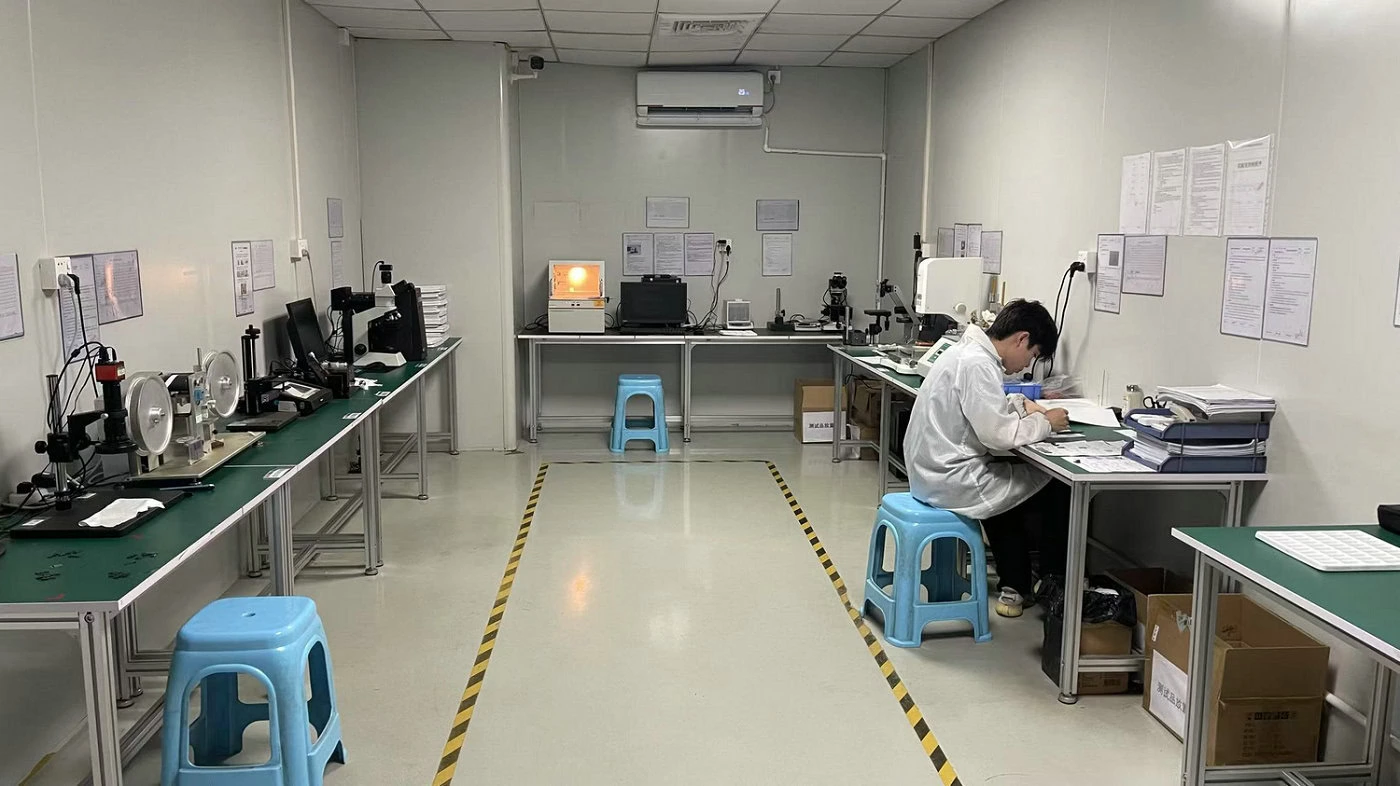
Material data is only the starting point. Production parts still need the appropriate inspection method and acceptance criteria to confirm that the final part meets drawing and application requirements.
| Property Requirement | Typical Verification Method | What to Confirm Before Testing | Engineering Risk If Ignored |
|---|---|---|---|
| Strength and elongation | Tensile test or customer-specified mechanical test | Material condition, heat treatment state, specimen method, and whether testing applies to a standard coupon or actual part geometry. | A part may appear suitable from nominal material data but fail because the real geometry has stress concentration or insufficient section thickness. |
| Hardness | Rockwell, Vickers, microhardness, or customer-specified hardness check | Surface condition, heat treatment state, test location, section thickness, and whether the surface is polished or as-sintered. | Hardness may vary by heat treatment, surface condition, or measurement location, leading to inconsistent acceptance results. |
| Density and porosity | Density check, metallographic review, or supplier-defined density verification | Target density, porosity sensitivity, sealing requirement, corrosion exposure, and whether pores affect the functional surface. | Residual porosity may reduce strength, corrosion performance, magnetic behavior, or sealing reliability. |
| Corrosion resistance | Salt spray, immersion test, passivation verification, customer exposure test, or application-specific corrosion test | Environment, surface finish, cleaning process, passivation condition, and actual chemical exposure. | A grade that works in a mild environment may fail under sweat, chloride, cleaning chemical, sterilization, or outdoor exposure. |
| Wear resistance | Application wear test, friction test, mating component test, or customer-specific life test | Contact load, counterface material, lubrication, surface finish, wear mode, and operating cycle. | A high-hardness material may still wear quickly if the contact system is not reviewed. |
| Magnetic properties | Permeability, coercivity, magnetic response, or customer-defined magnetic function test | Material family, density, heat treatment, part geometry, magnetic path, and operating condition. | The part may meet dimensional requirements but fail the actuator, sensor, shielding, or magnetic circuit function. |
| Thermal expansion or heat resistance | CTE test, thermal cycling test, oxidation exposure test, or service temperature validation | Operating temperature, assembly material, sealing requirement, and thermal cycling condition. | Incorrect material selection can cause mismatch, leakage, cracking, distortion, or assembly failure under temperature change. |
| Surface condition | Roughness check, visual inspection, coating adhesion check, passivation check, or cleanliness verification | Cosmetic requirement, friction requirement, corrosion exposure, coating process, and cleaning requirement. | Surface condition can change corrosion, wear, user-contact behavior, coating performance, and assembly fit. |
For regulated, safety-critical, high-load, corrosion-exposed, magnetic, or medical-contact projects, testing should be planned before tooling. This avoids approving a material from a name or datasheet while leaving the actual acceptance method undefined.
How to Review MIM Material Suitability Before Tooling
Before confirming a MIM material, the project should be reviewed from both material and manufacturing perspectives. The key question is not simply “Can this alloy be molded?” but whether the material, geometry, shrinkage behavior, heat treatment, surface condition, and inspection method can meet the functional requirement at the expected production volume.
| Review Area | What to Check | Why It Matters |
|---|---|---|
| Working environment | Humidity, sweat, salt, chemicals, cleaning agents, high temperature, oxidation, sterilization, body contact, or magnetic fields | The same material may behave differently in different service environments. |
| Mechanical load | Static load, impact load, fatigue risk, bending, torque, vibration, and assembly stress | The material must match the actual load path, not only nominal tensile strength. |
| Wear or contact condition | Wear mode, surface finish, lubrication, hardness, counterface, and contact pressure | Hardness alone does not define wear resistance. |
| Corrosion exposure | Consumer electronics, medical instruments, outdoor hardware, marine exposure, or cleaning chemical contact | “Corrosion resistant” can mean very different things depending on the environment. |
| Magnetic requirement | Target function, operating condition, assembly role, and testing expectation | A magnetic shielding part, sensor part, actuator part, and magnetic core may require different review criteria. |
| Heat exposure | Service temperature, thermal cycling, oxidation exposure, and heat-treatment requirement | Service heat resistance and heat treatability are different engineering questions. |
| Critical dimensions | Functional dimensions, mating surfaces, GD&T, post-treatment risk, and inspection method | Heat treatment or finishing may affect dimensions that are critical to assembly. |
| Surface finish | Appearance, friction, corrosion resistance, cleaning, coating adhesion, and user-contact performance | Surface condition can change both functional and cosmetic performance. |
| Standards or regulatory requirements | Medical, aerospace, automotive, electrical, or customer-specific requirements | The MIM supplier should not guess the compliance target from the drawing alone. |
Representative Engineering Scenario: When “Hardened Stainless Steel” Is Not Enough
A representative MIM project scenario shows why a material specification should be tied to the part’s functional requirements before tooling. The example is illustrative rather than a named customer project.
Initial requirement
A small locking component was specified only as “hardened stainless steel.” The part also needed edge stability, corrosion resistance, and repeated contact performance, but the drawing did not define the service environment, wear mode, heat-treatment condition, critical contact surface, or acceptance method.
Why the specification was incomplete
Hardness was being used as a shortcut for wear performance. In practice, wear also depends on contact load, surface finish, mating material, lubrication or dry-contact conditions, and geometry. Post-sintering heat treatment can also change flatness or mating dimensions, so a hardness target alone is not enough to approve the material direction.
Engineering review
The review therefore has to connect material family, heat-treatment response, sintering and distortion risk, contact geometry, surface condition, critical dimensions, and the inspection method. The question is not simply which stainless grade can reach a target hardness, but which material-and-process condition can meet the complete functional requirement.
What should be confirmed before tooling
Before final material approval, define the corrosion exposure, contact load and wear mode, hardness or strength target, mating surface, heat-treatment condition, critical dimensions, and verification method. This converts a vague grade-first requirement into a performance-based material specification that can be reviewed against the drawing and production process.
What to Provide for a MIM Material Selection Review
To evaluate the right MIM material, provide more than a material name. A useful RFQ or engineering review package should include the part geometry, performance target, application condition, and quality requirement.

A complete project package helps identify material risk, tooling risk, heat-treatment risk, tolerance feasibility, and inspection requirements before tooling investment.
Project files
- 2D drawing with tolerances
- 3D CAD file
- Preferred material, if already selected
- Required property, if material is not yet selected
Application requirements
- Application environment
- Load, wear, corrosion, magnetic, thermal, or biocompatibility requirement
- Critical dimensions and mating surfaces
- Surface finish or coating requirement
Production information
- Heat treatment requirement, if known
- Expected annual volume
- Prototype and production schedule
- Existing process, if converting from CNC, casting, die casting, stamping, or PM
Inspection expectations
- Critical dimensions
- Mechanical property targets
- Hardness, corrosion, magnetic, or surface requirements
- Inspection or testing requirement
For early projects, it is acceptable if the material is not yet finalized. The more important question is what the part must do in service. A drawing-based material review can help identify whether stainless steel, low alloy steel, titanium, cobalt-chromium, nickel alloy, magnetic alloy, controlled expansion alloy, tungsten alloy, or cemented carbide should be evaluated first.
Need a Material Selection Review for a MIM Part?
Send your drawing, 3D file, application environment, performance requirement, critical dimensions, surface finish requirement, and estimated annual volume. XTMIM can review material suitability together with tooling feasibility, sintering shrinkage, heat-treatment risk, tolerance requirements, secondary operations, and inspection needs before production planning.
FAQ: MIM Material Properties
What are the most common MIM material properties engineers compare?
Engineers usually compare sintered density, tensile strength, yield strength, elongation, hardness, wear resistance, corrosion resistance, magnetic behavior, heat treatment response, thermal expansion, and surface condition. The most important property depends on the part’s function and operating environment.
What affects the final properties of MIM parts?
Final MIM part properties are affected by alloy grade, powder quality, feedstock consistency, debinding control, sintering density, residual porosity, heat treatment, surface condition, part geometry, and inspection method. This is why material selection should be reviewed together with the drawing and service environment.
Is MIM 316L always the best choice for corrosion resistance?
No. 316L is commonly evaluated for corrosion resistance, but it is not automatically the best material for every environment. The final choice depends on corrosion exposure, strength requirement, surface finish, cleaning process, passivation condition, and application environment.
What is the difference between high-hardness and wear-resistant MIM materials?
High hardness is a material property. Wear resistance is an application result. Wear resistance depends on hardness, surface finish, load, lubrication, counterface material, contact pressure, and operating environment.
Can MIM materials be heat treated?
Yes, some MIM materials can be heat treated to improve strength, hardness, or mechanical performance. However, heat treatment can also affect dimensions, flatness, distortion, and inspection results, so it should be reviewed before tooling.
Are MIM properties comparable to wrought materials?
They can be comparable for some applications, but they should not be assumed identical. MIM uses fine metal powder, binder, injection molding, debinding, and sintering. Final properties depend on sintered density, residual porosity, heat treatment, surface condition, geometry, and process control.
Which MIM materials are suitable for magnetic parts?
Soft magnetic alloys such as Fe-3Si, Fe-50Ni, and Fe-50Co may be evaluated for magnetic MIM parts. The correct material depends on the required magnetic function, part geometry, heat treatment, density, and testing method.
Can MIM be used for medical materials?
MIM can be used for selected medical instruments, dental parts, surgical tools, and some regulated applications, depending on the material and validation requirements. For implant or regulated medical applications, formal standards, testing, cleaning, surface condition, and regulatory requirements must be confirmed.
When should I avoid confirming a MIM material from a table alone?
A material table is not enough when the part has tight tolerances, high load, wear contact, corrosion exposure, medical contact, magnetic requirements, heat treatment, special surface finish, or regulated application requirements. In these cases, material selection should be reviewed with the drawing and service condition.
What information should I provide before asking for a MIM material recommendation?
Provide a drawing, 3D file, target performance requirement, application environment, critical dimensions, surface finish requirement, expected annual volume, and any known strength, hardness, corrosion, magnetic, thermal, or regulatory requirements.
Standards and Validation Basis
MIM material selection should be checked against the current material standard, supplier data, the drawing, service conditions, and project-specific validation. MPIF Standard 35-MIM — Materials Standards for Metal Injection Molded Parts, 2025 Edition is the current MPIF/MIMA edition for MIM materials; MPIF/MIMA states that this edition supersedes prior editions. The 2025 edition adds standards for MIM-CpTi, MIM-Ti-6Al-4V, and MIM-420 HIP’d & HT, and updates corrosion-resistance information for MIM 17-4 PH.
ASTM B883-24 — Standard Specification for Metal Injection Molded (MIM) Materials remains directly relevant to ferrous MIM material discussions. It covers ferrous MIM materials produced through molding, debinding, and sintering, with or without subsequent heat treatment, and includes compositions such as MIM-2200, MIM-2700, MIM-4605, MIM-4140, MIM-316L, MIM-17-4 PH, MIM-420, MIM-430L, MIM-440, and MIM-Cu.
For medical or regulated applications, a broad alloy name is not enough. FDA currently lists ASTM F2885-17 with partial recognition for metal injection molded Ti-6Al-4V surgical implant components. Project teams should verify the current ASTM edition, the current regulatory recognition status, the intended device pathway, cleaning and surface requirements, and the required validation plan before production approval.
Technical References
- MIMA — Materials Range for Metal Injection Molding
- MPIF / MIMA — Standard 35-MIM, Materials Standards for Metal Injection Molded Parts, 2025 Edition
- ASTM B883-24 — Standard Specification for Metal Injection Molded (MIM) Materials
- EPMA — Metal Injection Moulding overview
- FDA Recognized Consensus Standards — ASTM F2885-17 (partial recognition)