MIM Materials / Special Alloys
MIM Controlled Expansion Alloys for Low CTE and Thermal Matching Parts
Controlled expansion alloys are considered for custom MIM components when temperature change can affect alignment, sealing, interface stress, or dimensional stability. This page provides family-level guidance for deciding whether a project should continue to an Invar, Kovar, Alloy 42, or standard MIM material review. XTMIM manufactures custom MIM components; it does not supply alloy sheet, bar, plate, wire, or stock material. Before tooling, confirm the functional CTE requirement, mating material, service temperature range, feedstock availability, sintering shrinkage, critical datums, post-machining allowance, and inspection method.
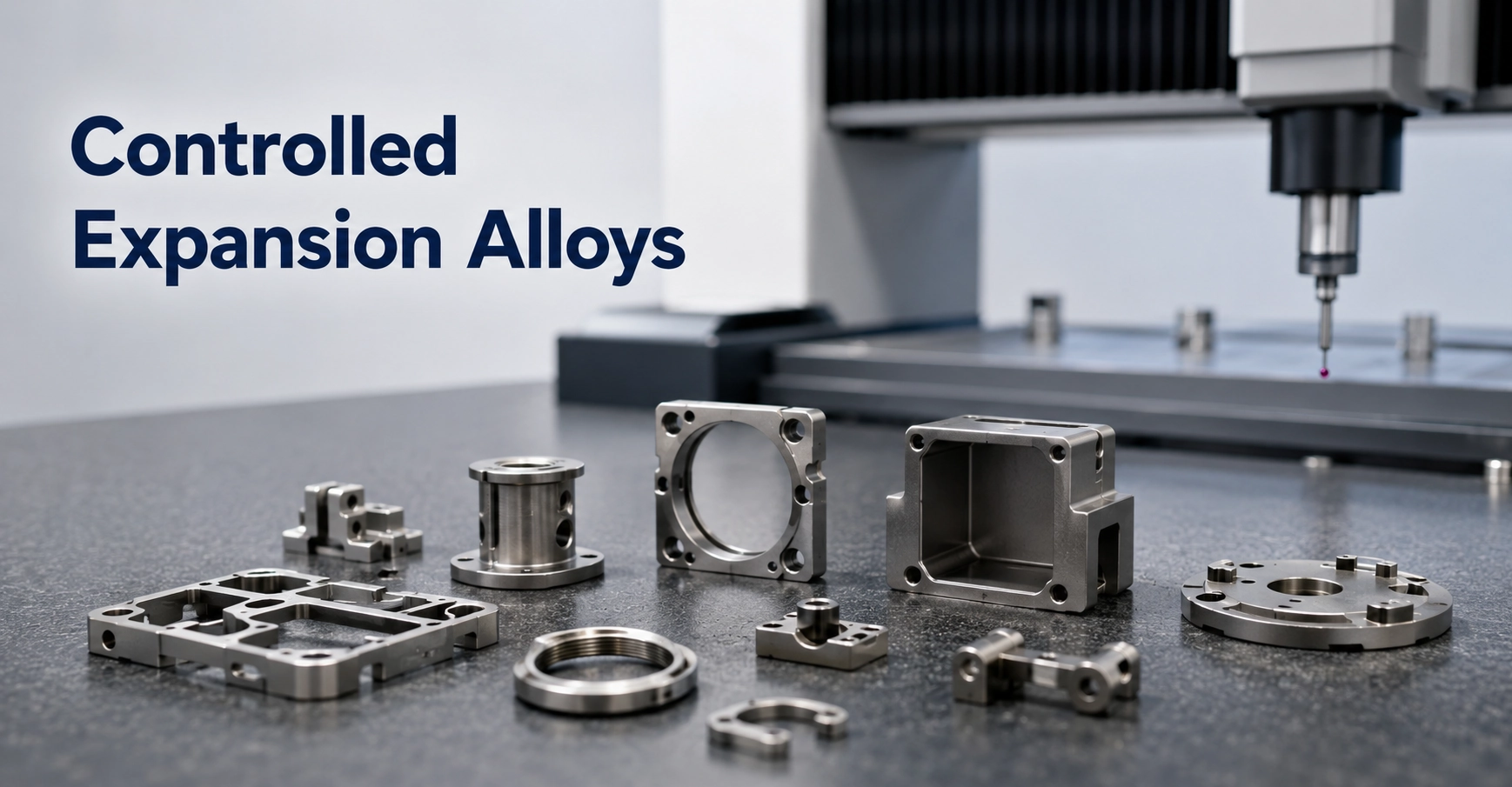
Controlled Expansion Alloys for Custom MIM Parts
Use this material family only when thermal expansion affects the function of the finished assembly. The page provides initial material-family and MIM feasibility guidance; grade-specific process limits and final acceptance requirements must be confirmed during the dedicated alloy and drawing review.
Supply scope: XTMIM quotes custom metal injection molded components. It does not sell controlled-expansion alloy sheet, bar, plate, wire, tube, or stock material.
Review This Material Family When
- A spacer, frame, housing, or interface part must remain stable across temperature change.
- The component mates with glass, ceramic, or another material with a different expansion rate.
- Small complex geometry may justify MIM instead of machining from wrought stock.
Use Another Material Route When
- The primary requirement is corrosion resistance, strength, hardness, wear, or magnetic behavior.
- The component is a large simple plate, ring, bar, or low-volume prototype.
- No operating temperature, mating material, or thermal acceptance criterion is defined.
Confirm Before Tooling
- Target thermal behavior and the applicable temperature range.
- Feedstock availability, sintering response, shrinkage, and distortion risk.
- Critical datums, interface surfaces, machining allowance, and inspection method.
When Low CTE or Thermal Expansion Matching Becomes a Real Material Requirement
A common mistake is to choose a controlled expansion alloy because it sounds more precise. In practice, these alloys should be considered only when thermal expansion affects function. If a part is only a bracket, cover, latch, or general structural component, stainless steel MIM, low-alloy steel MIM, or another standard MIM material may be more practical.
Controlled expansion alloys become relevant when a precision spacer must maintain distance across temperature change, an optical or sensor support must avoid alignment drift, a metal part is joined to glass or ceramic, a compact electronic package requires expansion compatibility, or a sealing/interface surface may crack, leak, or lose contact because of expansion mismatch.
Legacy drawings may reference ASTM F15-04(2022), ASTM F1684-06(2021), ASTM F30-96(2017), or related controlled-expansion alloy documents. ASTM lists these three specifications as withdrawn in 2024. Treat them as historical material references only, then confirm the current customer specification, alloy definition, test method, temperature range, and acceptance criteria before tooling. A historical specification does not establish finished MIM part performance by itself.
Choose the Correct Controlled-Expansion Alloy Review Path
Start from the assembly function rather than the alloy name. Use the dedicated Invar page for low-expansion dimensional stability, the Kovar page for expansion-matched sealing or interface requirements, and the Kovar vs Invar comparison page when both remain candidates. Alloy 42 and other Fe-Ni directions should remain project-specific until material specification, feedstock availability, sintering route, and validation requirements are confirmed.
Because iron–nickel terminology also includes structural Fe-2Ni, Fe-4Ni and Fe-8Ni grades as well as soft-magnetic Fe-50Ni, review iron–nickel alloys in MIM when a drawing uses a broad Fe-Ni description without clearly defining structural, magnetic, low-expansion or expansion-matching function.
Invar Review
Continue to the Invar page when the primary requirement is low thermal expansion, stable positioning, optical alignment, or dimensional stability across temperature change.
Review Invar alloys for MIMKovar Review
Continue to the Kovar page when the primary requirement is expansion matching at a glass, ceramic, metal, sealing, or electronic-package interface.
Review Kovar alloys for MIMKovar vs Invar Comparison
Use the dedicated comparison page when both alloys remain under consideration and the decision depends on sealing compatibility versus low-expansion dimensional stability.
Compare Kovar vs Invar for MIM parts| Project Requirement | Starting Review Direction | Next Page or Action |
|---|---|---|
| Low expansion for positioning, spacing, or alignment | Invar | Continue to the Invar review |
| Expansion matching with glass, ceramic, or a sealing interface | Kovar | Continue to the Kovar review |
| Both Kovar and Invar remain candidates | Side-by-side engineering comparison | Use the Kovar vs Invar comparison |
| Alloy 42 or another Fe-Ni controlled-expansion direction | Project-specific feasibility review | Confirm the specification, feedstock route, sintering behavior, and validation plan before tooling. |
| General corrosion resistance, strength, wear, or magnetic performance | Another MIM material family | Use the MIM material selection guide |

When MIM Is Suitable for Controlled Expansion Alloy Components
MIM is most suitable when the part combines material function with geometry that is difficult or expensive to machine. Controlled expansion alloys are usually more specialized than common stainless steels, so the process must provide a real manufacturing advantage. If the geometry is simple and the quantity is low, CNC machining from wrought stock may be the more practical starting point.
| MIM May Be Suitable When... | MIM May Not Be Suitable When... |
|---|---|
| The part is small and complex. | The part is a large simple plate, ring, or bar. |
| The part has fine features, holes, slots, steps, or compact 3D geometry. | The project only needs a few prototypes. |
| Annual volume can justify tooling and process development. | CNC machining is cheaper at the required quantity. |
| The design needs both low expansion and complex geometry. | Low CTE is not clearly defined as a functional requirement. |
| Some critical faces can be post-machined if necessary. | All dimensions require extremely tight tolerance without secondary operations. |
| The material requirement is reviewed together with the MIM process route. | The buyer expects wrought-material behavior without MIM validation. |
In production, the full route includes fine metal powder mixed with binder, feedstock preparation, injection molding, green part handling, debinding, sintering shrinkage, tooling compensation, and final inspection. Special alloys may need additional review because their sintering behavior, thermal response, contamination sensitivity, and dimensional stability can differ from common MIM stainless steels.
Related process pages: MIM process overview, MIM sintering, and DFM for MIM.

Typical MIM Parts Made from Controlled Expansion Alloys
Controlled expansion alloys should be shown through part functions, not only material names. The parts below are typical project directions for review; they should not be presented as guaranteed stock products or universal production cases.

| Part Type | Possible Alloy Direction | Why Controlled Expansion Matters | MIM Fit | Main Review Point |
|---|---|---|---|---|
| Precision spacers | Invar | Maintains distance under temperature change | Good if small and complex | Flatness, parallelism, and datum control |
| Optical support frames | Invar | Reduces alignment drift | Good for compact frame geometry | Warpage after sintering |
| Sensor housing components | Invar / Kovar | Controls interface stress and alignment | Good for miniature housings | Mating surfaces and assembly fit |
| Hermetic package bases | Kovar | Supports expansion matching with glass or ceramic | Project-dependent | Surface condition and sealing region |
| Ceramic-to-metal interface parts | Kovar / Alloy 42 | Reduces thermal stress mismatch | Project-dependent | Mating material and heat cycle |
| Low-expansion alignment brackets | Invar | Maintains reference position | Good if geometry benefits from MIM | Critical datums and post-machining allowance |
Engineering Risks Before Tooling
Controlled-expansion alloy MIM projects should be reviewed before tooling because the material requirement is tied to assembly function. A part can pass room-temperature dimensional inspection and still fail after thermal cycling if the mating material, interface condition, temperature range, or acceptance method is not defined.
| Risk Area | Why It Matters | What to Review Before Tooling |
|---|---|---|
| Feedstock availability | Not every controlled expansion alloy is readily available as MIM feedstock. | Confirm powder, binder system, particle behavior, and supplier route. |
| Sintering shrinkage | Shrinkage affects dimensions, flatness, and critical interfaces. | Review shrinkage compensation, critical datums, and first-article correction strategy. |
| Thermal expansion target | CTE depends on alloy, processing condition, temperature range, and testing method. | Define operating temperature range and mating materials. |
| Density and residual porosity | May affect strength, surface condition, and sealing-related performance. | Define density expectations, acceptance method, and whether functional testing is needed. |
| Surface condition | Interface or sealing areas may need controlled surface finish. | Review machining, polishing, cleaning, coating, or finishing needs. |
| Contamination sensitivity | Some Fe-Ni or Fe-Ni-Co alloys may be sensitive to furnace atmosphere or contamination. | Review debinding and sintering environment before committing to tooling. |
| Post-sintering machining | Some critical faces may not be suitable as-sintered. | Define machining allowance and final datum scheme. |
| Inspection method | Dimensions alone may not validate thermal or sealing function. | Define material certificate, dimensional checks, surface checks, and functional validation. |
Scenario disclosure: The examples below are representative engineering scenarios. They are not customer case studies, production records, or guarantees of material performance.
| Representative Scenario | Why the Risk Appears | Review Action Before Tooling |
|---|---|---|
| Low-expansion spacer shows alignment drift after thermal cycling. | The drawing controls room-temperature dimensions but does not define service temperature, mating-material expansion, or thermal alignment acceptance. | Confirm whether Invar is the correct review route, define critical datums and temperature conditions, and identify any required post-sintering machining. |
| Kovar interface component is specified without a defined sealing surface. | The material name is present, but glass or ceramic type, interface geometry, surface condition, thermal exposure, and validation method are missing. | Move the project to the dedicated Kovar review and define the mating material, sealing region, finish, thermal cycle, and functional validation method. |
| Compact ceramic-interface housing is quoted from a 3D file and alloy name only. | The RFQ does not identify the ceramic material, critical interface, service temperature, datum scheme, or machining allowance. | Complete the RFQ package with the mating material, operating conditions, critical surfaces, tolerance priorities, annual volume, and validation plan. |
Related engineering pages: MIM tolerances, inspection and testing capability, and MIM shrinkage compensation.
When to Use the Comparison Page or a Standard MIM Alloy
A controlled-expansion alloy should not be treated as a general upgrade. When both Kovar and Invar remain candidates, continue to the dedicated comparison page. When the actual requirement is corrosion resistance, structural strength, wear, high-temperature resistance, or magnetic behavior, move to the material family that owns that function.
| Requirement | Better Starting Point | Why |
|---|---|---|
| Both Kovar and Invar remain candidates | Kovar vs Invar comparison | The decision needs a focused comparison of sealing compatibility, thermal behavior, geometry, and MIM feasibility. |
| General corrosion resistance | Stainless steel MIM | A controlled-expansion alloy may add cost without solving the primary requirement. |
| High-strength structural loading | Low-alloy steel or precipitation-hardening stainless steel | Strength and heat-treatment response may matter more than CTE. |
| High-temperature oxidation or corrosion | Nickel alloys | High-temperature environmental resistance is a different material-selection problem. |
| Soft magnetic performance | Soft magnetic materials | Permeability, coercivity, saturation, and magnetic heat treatment should control the review. |
| Material requirement is not yet clear | MIM material selection guide | The project needs functional clarification before selecting an alloy family. |
How Engineers Should Specify Controlled Expansion Alloy MIM Parts
A controlled expansion alloy part should not be quoted from material name and quantity alone. The supplier needs enough information to understand how the part will function in the final assembly and which features are controlled by thermal behavior rather than ordinary dimensional tolerance.

Project Inputs to Provide
- 2D drawing with critical dimensions and tolerances
- 3D CAD file
- Target alloy or functional requirement
- Operating temperature range
- Mating material, such as glass, ceramic, stainless steel, aluminum, or another alloy
- Low CTE or thermal expansion matching requirement
- Critical datum scheme
Validation and Production Inputs
- Sealing, interface, or alignment areas
- Required surface finish
- Areas that may allow post-sintering machining
- Inspection method or acceptance requirement
- Expected annual volume and production stage
- Application background and assembly condition
Controlled expansion RFQ checklist: include the selected alloy or target CTE direction, mating glass / ceramic / metal material, service temperature range, thermal cycle if known, sealing or alignment areas, critical dimensions after thermal exposure, surface finish needs, post-machining allowance, annual volume, and whether the project is in prototype, validation, or production planning.
FAQ About MIM Controlled Expansion Alloys
Can controlled expansion alloys be processed by MIM?
Some controlled expansion alloys can be reviewed for MIM projects, but feasibility depends on powder and feedstock availability, sintering behavior, part geometry, volume, and validation requirements. A wrought-alloy designation should not be assumed to transfer directly to a finished MIM component without supplier and project-specific review.
Can Kovar be manufactured by metal injection molding?
Kovar can be reviewed for selected small, complex MIM components when expansion matching at glass, ceramic, metal, or package interfaces is required. Continue to the dedicated Kovar alloys page for alloy-specific process and RFQ review; final suitability still depends on feedstock, sintering, surface, and validation requirements.
Is Invar suitable for small MIM precision parts?
Invar may be suitable when a compact component needs low thermal expansion or dimensional stability and its geometry benefits from MIM. Continue to the dedicated Invar alloys page for alloy-specific review of service temperature, critical datums, machining allowance, and inspection.
Where should I compare Kovar and Invar for a MIM project?
Use the dedicated Kovar vs Invar comparison page when both alloys remain candidates. This family page only routes the initial decision: Kovar is generally reviewed for expansion matching at glass, ceramic, or metal interfaces, while Invar is reviewed for low-expansion dimensional stability.
Should I choose Invar or stainless steel for a precision MIM component?
Choose Invar only when low expansion or temperature-related dimensional stability is a real functional requirement. If the part mainly needs corrosion resistance, strength, or general precision, stainless steel MIM may be more practical and easier to validate.
Is Kovar suitable for glass-to-metal seal components made by MIM?
Kovar may be suitable for some small, complex glass-to-metal or ceramic-to-metal interface components, but the sealing region, surface condition, density, thermal cycle, and validation method must be reviewed before tooling. The alloy name alone does not guarantee sealing performance.
Can MIM guarantee the same CTE as wrought material?
No blanket guarantee should be made. CTE and functional behavior depend on alloy chemistry, powder and feedstock route, sintering condition, density, heat treatment, temperature range, and testing method. The requirement should be confirmed through project-specific material and process review.
What information is needed before quoting a controlled expansion alloy MIM part?
Provide 2D drawings, 3D CAD files, target alloy or functional requirement, operating temperature range, mating material, critical dimensions, sealing or interface areas, surface finish requirements, post-machining needs, annual volume, and application background.
Are Alloy 42 or other low expansion alloys available for MIM?
They may be reviewed as project-dependent options. Confirm feedstock availability, material specification, sintering route, and validation requirements before quotation or tooling.
Standards and Technical Reference Notes
Controlled-expansion alloy requirements should be checked against the customer drawing, applicable material specification, supplier process capability, and the required test or acceptance method. MPIF standards resources support communication about powder-metallurgy and MIM material definitions, but they do not replace project-specific confirmation for a special-alloy component.
The MIMA materials range identifies controlled-expansion alloys within the broader MIM material family and advises users to confirm actual alloy or substitute-alloy availability with the supplier. This is especially important when powder, feedstock, furnace route, or production experience is project-dependent.
ASTM lists ASTM F15-04(2022) as withdrawn in 2024. ASTM's electronics standards index also lists ASTM F30-96(2017) and ASTM F1684-06(2021) as withdrawn in 2024. These documents may still appear on legacy drawings and can provide historical material context, but they should not be described as current specifications. Confirm the customer's current material definition, revision, thermal-expansion test range, and acceptance criteria before quoting or tooling.
Wrought-material data can support early material discussion, but it should not be copied into finished MIM part guarantees. Final behavior depends on alloy chemistry, powder and feedstock route, sintering condition, density, heat treatment, machining, temperature range, test method, and the assembly interface.
Request a Controlled Expansion Alloy MIM Project Review
If your part requires low thermal expansion, thermal expansion matching, stable alignment under temperature change, or a glass / ceramic / metal interface, send XTMIM your 2D drawing, 3D CAD file, target material, mating material, operating temperature range, critical dimensions, surface requirements, estimated annual volume, and application background.
Controlled Expansion RFQ Inputs to Include
- Selected alloy direction, such as Invar, Kovar, Alloy 42, or target CTE requirement
- Mating material, such as glass, ceramic, stainless steel, aluminum, or another alloy
- Service temperature range and thermal cycle if known
- Sealing, optical alignment, sensor interface, or electronic package requirement
- Critical dimensions, datum scheme, surface finish needs, and post-machining allowance
- Estimated annual volume and project stage, such as prototype, validation, or production planning
XTMIM’s engineering review can help determine whether the part should be evaluated as an Invar, Kovar, Alloy 42, stainless steel, nickel alloy, or other MIM material project. The review can also identify tooling compensation risks, sintering distortion concerns, post-machining needs, and inspection requirements before tooling or production planning.
Contact XTMIM Engineering Team