MIM project process background
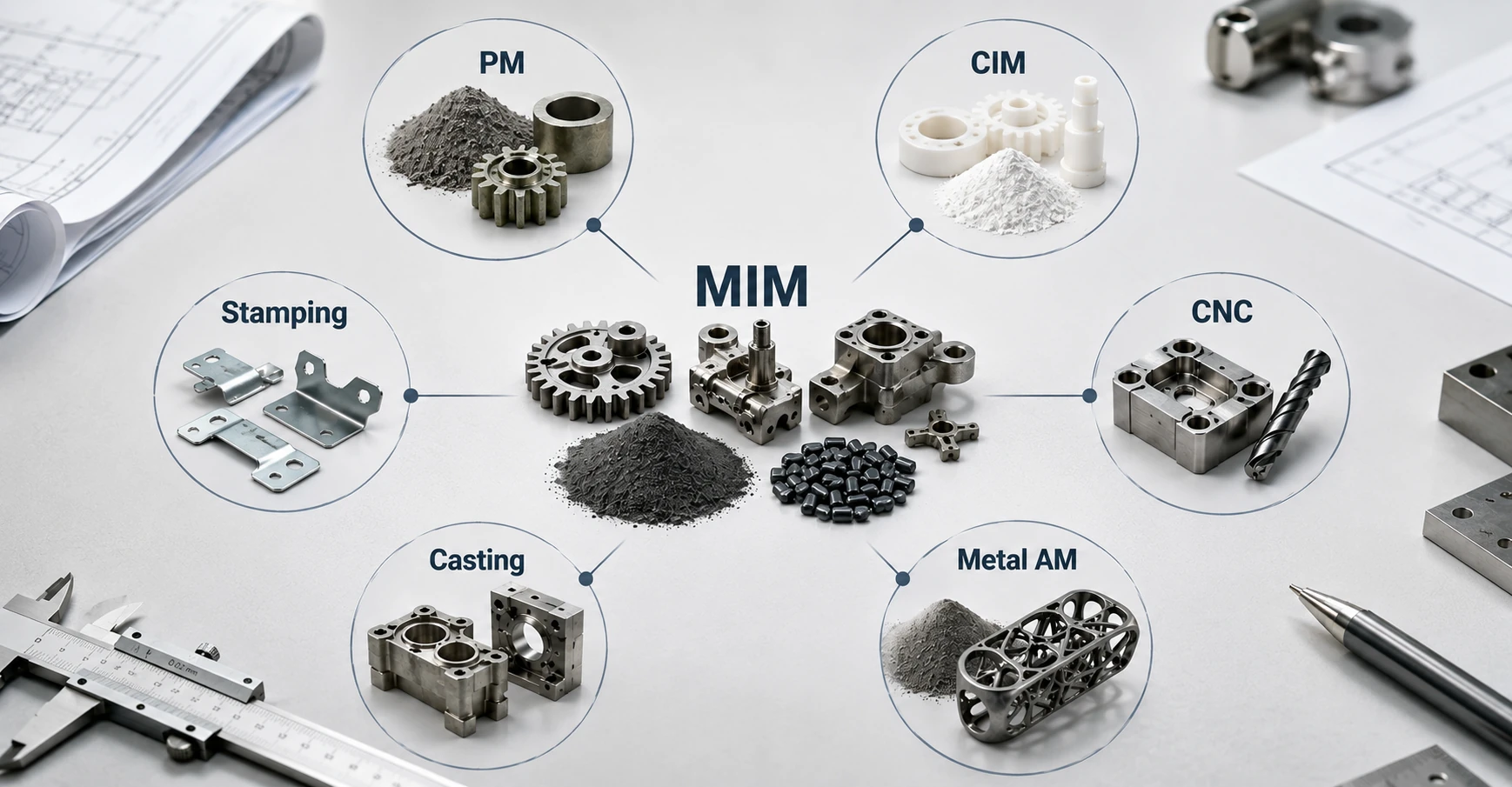
Related manufacturing processes for MIM projects include powder metallurgy, ceramic injection molding, CNC machining, metal 3D printing, casting, and stamping. Each route enters a project review for a different reason: material requirements, geometry, prototype needs, production volume, tooling economics, tolerance strategy, or secondary operations. Use this hub to identify the relevant route, then continue to the corresponding process page, MIM comparison guide, or drawing-based engineering review.
Choose the Right Page for Your Process Question
Use this hub when you need background on manufacturing routes that commonly appear around MIM projects. Use a direct comparison page when you are deciding between MIM and another process for a specific part. Use drawing review when geometry, material, tolerance, annual volume, or application conditions determine the answer.
| Your Question | Best Next Page | Use It For |
|---|---|---|
| What role does PM, CIM, CNC, metal AM, casting, or stamping play around a MIM project? | Related process subpages on this hub | Process background, terminology, and the reason a route enters project review. |
| Should this part use MIM or another manufacturing route? | MIM comparison guide | Part-specific route selection based on geometry, material, tolerance, volume, and production economics. |
| Is the current drawing suitable for MIM production? | Submit drawing for review | Engineering review of moldability, critical dimensions, material route, secondary operations, and project stage. |
Main Manufacturing Processes Related to MIM Projects
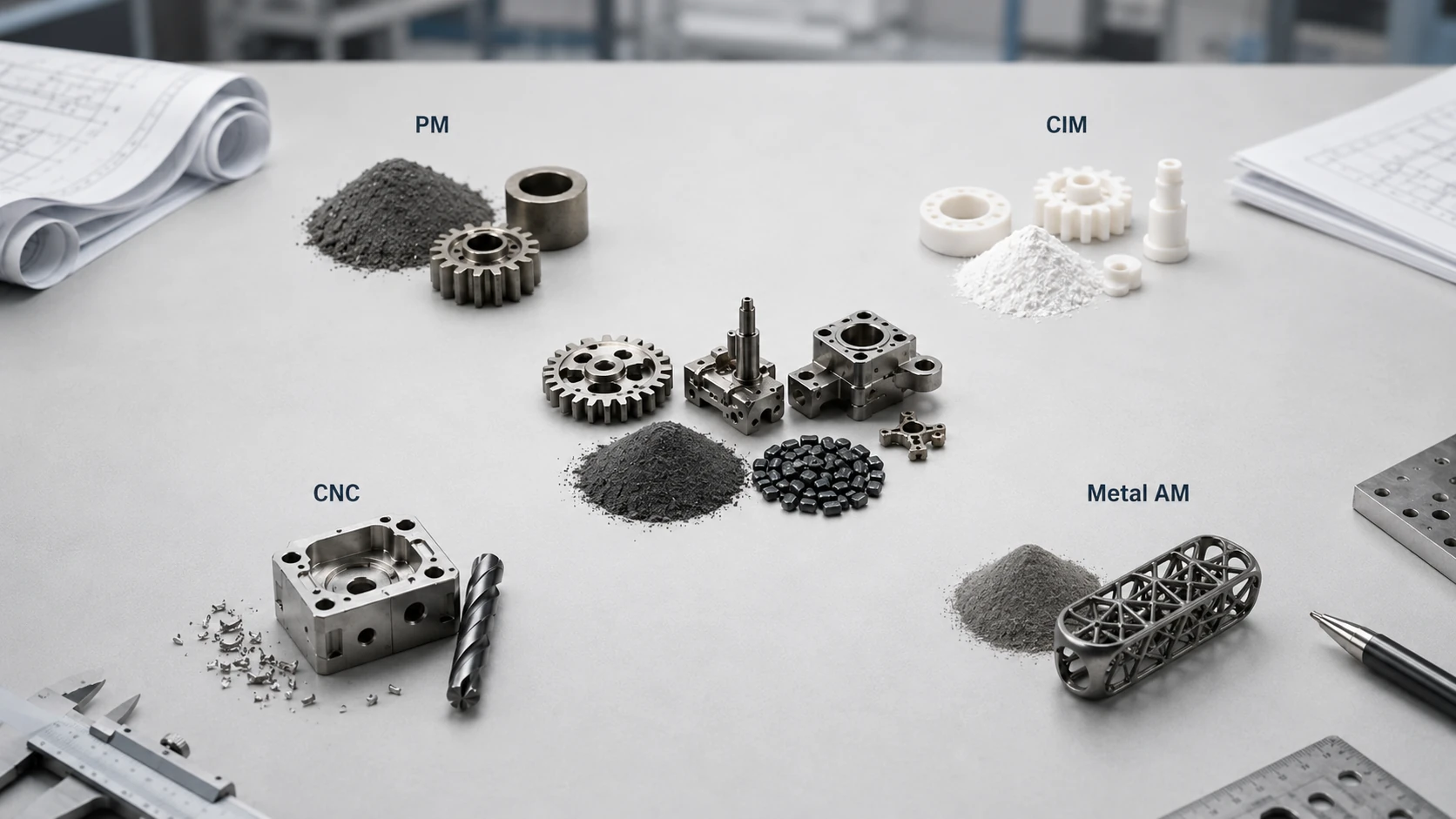
PM, CIM, CNC machining, and metal 3D printing are the four routes most frequently connected with MIM project evaluation. The summaries below explain why each route appears and where to continue for detailed process or comparison guidance.
Quick Process Route Screening
| Process Route | Why It Appears in a MIM Discussion | What to Check Next |
|---|---|---|
| Powder Metallurgy / PM | Both routes use metal powder and sintering, but PM normally forms parts by die compaction rather than feedstock injection molding. | Check whether the geometry is pressable or requires complex three-dimensional molding. |
| Ceramic Injection Molding / CIM | CIM shares injection molding, debinding, and sintering logic with MIM, but produces ceramic rather than metal parts. | Check whether the application requires metallic or technical ceramic properties. |
| CNC Machining | CNC often supports prototypes, low-volume production, or local precision features after MIM sintering. | Check design stability, annual volume, tooling justification, and local tolerance needs. |
| Metal 3D Printing | Metal AM often supports early validation, complex low-volume parts, or design iteration before production tooling. | Check whether the project remains in prototype development or is ready for repeat-production review. |
Powder Metallurgy / PM
Conventional PM compacts metal powder in a die and then sinters the compact. It is commonly considered for regular, pressable geometry and cost-sensitive production. MIM becomes more relevant when a small metal part requires complex three-dimensional features, thin walls, undercuts, or details that are difficult to form through one- or two-direction compaction.
Continue to PM process background or MIM vs PM for a part-specific decision.
Ceramic Injection Molding / CIM
CIM uses ceramic powder and binder feedstock, followed by injection molding, debinding, and ceramic sintering. It enters a MIM review when the application may require ceramic properties such as electrical insulation, wear resistance, chemical stability, or low magnetic response rather than metallic behavior.
For the broader process-family relationship, see how PIM relates to MIM and CIM. Continue to CIM process background or MIM vs CIM for material-route selection.
CNC Machining
CNC machining is commonly used for prototypes, changing designs, low-volume production, and local post-sintering features that need tighter control. A MIM review becomes useful when the design is stable, annual demand increases, and repeated machining of small complex geometry creates a production or cost concern.
Continue to CNC process background or MIM vs CNC for production-route evaluation.
Metal 3D Printing
Metal 3D printing supports design iteration, complex internal structures, prototypes, and low-volume parts without production tooling. MIM enters the discussion when the design becomes stable and repeat production, dimensional consistency, surface condition, post-processing, and unit economics require a tooling-based route review.
Continue to metal 3D printing process background or MIM vs metal 3D printing for production planning.

Other Manufacturing Routes in MIM Project Reviews
Die casting, investment casting, and stamping may also enter a MIM review when the same component is being evaluated across different material forms, part sizes, or production routes. Use the dedicated comparison pages for the detailed selection logic.
Die Casting
Die casting is commonly associated with aluminum, zinc, or magnesium housings, covers, brackets, and structural components. When a small part is being evaluated between die casting and MIM, review alloy needs, part size, wall sections, tooling, geometry, and annual volume.
Continue to MIM vs die casting.
Investment Casting
Investment casting can produce complex metal geometry and may overlap with MIM for some parts. It becomes especially relevant when the component is larger, the required alloy route differs, or the production economics do not support MIM tooling.
Continue to MIM vs investment casting.
Stamping
Stamping is generally more practical for flat or sheet-formed parts. MIM enters the review when the design requires three-dimensional thickness, bosses, undercuts, locking features, or integrated details that are difficult to form as a stamped assembly.
Continue to MIM vs stamping.
When a Direct Comparison Is More Useful
Open a dedicated comparison when the same drawing is actively being evaluated between MIM and another route. The comparison should address geometry, material, tolerance, tooling, secondary operations, annual volume, inspection, and production risk rather than relying on process names alone.
Start with the MIM comparison guide.
How These Process Families Relate to MIM Project Evaluation
The processes above are not just a list of alternatives. They belong to different manufacturing route families. Understanding the route family helps engineers and buyers avoid early selection mistakes.

| Route Type | Related Processes | Why It Matters in MIM Project Discussions |
|---|---|---|
| Powder-based route | PM, MIM, metal additive manufacturing | These processes may all use metal powder, but their forming and densification methods are different. |
| Injection molding route | MIM, CIM | Both use injection molding of feedstock, but MIM produces metal parts and CIM produces ceramic parts. |
| Subtractive route | CNC machining | Often used for prototypes, low volume, local precision features, and post-MIM machining. |
| Additive route | Metal 3D printing | Useful for early validation, design iteration, and complex low-volume parts. |
| Casting route | Die casting, investment casting | Commonly reviewed when the part is metallic, complex, or production-oriented. |
| Sheet forming route | Stamping | Relevant when the part is thin, flat, or formed from sheet metal. |
A common mistake is to compare processes only by the final part shape. The same visible geometry may be technically possible by more than one process, but the practical route depends on material, volume, tooling cost, tolerance, surface finish, production stability, secondary operations, and quality requirements.
When to Continue to a MIM Comparison Page
If the user only needs process background, this related process hub is enough. If the user is deciding which route should be used for a specific part, a MIM comparison page is more useful.
| Situation | Recommended Next Page |
|---|---|
| The part may be made by MIM or CNC machining | MIM vs CNC |
| The part may be made by MIM or conventional PM | MIM vs PM |
| The material route may be metal or ceramic | MIM vs CIM |
| The project is between prototype AM and production MIM | MIM vs metal 3D printing |
| The part may be made by MIM or die casting | MIM vs die casting |
| The part may be made by MIM or investment casting | MIM vs investment casting |
| The part may be made by MIM or stamping | MIM vs stamping |
How Engineers and Buyers Should Use These Related Process Pages
Different users should use this page in different ways. A design engineer may use it to understand whether the part geometry naturally points toward molding, compaction, machining, additive manufacturing, casting, or sheet forming. A sourcing manager may use it to prepare better questions before contacting suppliers. A project manager may use it to identify whether prototype, tooling, or production route should be reviewed first.
| User Type | How to Use This Page |
|---|---|
| Design engineer | Identify whether the part geometry fits a molding, compaction, machining, additive, casting, or sheet-forming route. |
| Sourcing manager | Understand process background before comparing supplier recommendations or requesting quotes. |
| Project manager | Decide whether the project is still in design validation or ready for production route review. |
| Supplier quality engineer | Recognize which process route may affect inspection strategy, dimensional stability, material behavior, or surface condition. |
| OEM buyer | Prepare clearer project communication before sending drawings, annual volume, and application requirements. |
Scenario disclosure: The following are representative engineering scenarios created to explain common route-review logic. They are not customer case studies, production records, or guaranteed project outcomes.
Representative Engineering Scenario: CNC Prototype Moving Toward MIM Review
- Problem
- A small metal component was validated by CNC machining, but repeated machining became a concern after the design stabilized and planned annual demand increased.
- Why route review was needed
- The prototype route provided flexibility during development, but prototype success did not confirm the best route for repeat production.
- Review direction
- Evaluate geometry, material, critical tolerances, surface requirements, secondary machining, tooling economics, and annual volume before considering MIM.
Related reading: MIM vs CNC machining.
Representative Engineering Scenario: PM Geometry Moving Toward MIM Review
- Problem
- A press-and-sinter PM component was revised with side features, small holes, and more three-dimensional geometry.
- Why route review was needed
- The updated design moved away from a straightforward compactable shape and introduced features that may be difficult to form efficiently through conventional die compaction.
- Review direction
- Review moldability, wall thickness, feature depth, shrinkage behavior, critical dimensions, and annual volume before selecting MIM or retaining PM.
Related reading: MIM vs PM and MIM design guide.
What to Prepare for a Process Route Review
If a drawing mentions PM, CNC machining, casting, additive manufacturing, or another process, the route should be reviewed before tooling or production planning. A part may be technically possible by several processes, but the practical choice depends on project-specific details.

| Information to Provide | Why It Matters |
|---|---|
| 2D drawing | Shows dimensions, tolerances, datums, threads, surface notes, and inspection expectations. |
| 3D CAD file | Helps review geometry, wall thickness, undercuts, internal features, and moldability. |
| Material requirement | Determines whether the part should be reviewed as MIM, PM, CIM, CNC, casting, or another route. |
| Tolerance requirements | Helps separate as-sintered dimensions from features that may need secondary machining. |
| Surface finish requirement | Affects process selection, post-processing, and inspection planning. |
| Estimated annual volume | Helps determine whether tooling-based production is practical. |
| Target production stage | Clarifies whether the project is still in prototype validation, tooling review, trial production, or repeat production planning. |
| Current manufacturing process | Reveals whether the project is a conversion, redesign, cost review, or new development. |
| Current pain point | Helps identify whether the review should focus on cost, geometry limits, dimensional control, delivery risk, yield, or secondary operations. |
| Application background | Helps evaluate load, wear, corrosion, temperature, assembly, and functional risks. |
| Critical dimensions or functional surfaces | Identifies features that need special review before tooling. |
| Known problems with the current process | Helps focus the review on real production risks rather than generic process descriptions. |
Submit Drawings for Process Route Review
If your part is being reviewed against PM, CNC machining, casting, stamping, CIM, metal 3D printing, or MIM, send your 2D drawing, 3D CAD file, material requirement, tolerance needs, surface finish, estimated annual volume, current process, current pain point, target production stage, and application background. XTMIM can review whether the project should continue as a MIM candidate, remain with the current process, or be compared with another manufacturing route before tooling or production planning.
FAQ About Related Manufacturing Processes
Is this page a MIM comparison guide?
No. This page is a process-route background hub for manufacturing processes related to MIM projects. Use it to understand why PM, CIM, CNC machining, metal 3D printing, casting, or stamping may appear in a MIM project discussion. If you need to choose between MIM and another process for a specific part, use the MIM comparison guide.
Are PM and MIM the same manufacturing process?
No. PM and MIM both use metal powder, but they use different forming routes. Conventional PM usually involves powder compaction and sintering, while MIM uses metal powder and binder feedstock that is injection molded, debound, and sintered. The suitable process depends on geometry, volume, material, tolerance, density requirements, and production economics.
Is CIM a type of MIM?
No. CIM and MIM share some powder injection molding logic, but they produce different material systems. MIM produces metal parts. CIM produces ceramic parts from ceramic powder and binder. CIM should be evaluated when the application requires ceramic properties such as insulation, wear resistance, heat resistance, or chemical stability.
Why is CNC machining related to MIM projects?
CNC machining is related to MIM projects because it is often used for prototypes, low-volume parts, design validation, and local secondary machining after MIM sintering. CNC may also remain the better route when the design is not stable or when production volume does not justify MIM tooling.
When does metal 3D printing appear in a MIM project discussion?
Metal 3D printing often appears during early-stage development, prototype validation, low-volume production, or complex geometry review. It may be useful before a design becomes stable enough for MIM tooling. For stable repeat production, a MIM vs metal 3D printing comparison may be needed.
Which related process should I review before sending an RFQ?
Review the process that best matches the current uncertainty. If the concern is regular pressed geometry, review PM. If the concern is ceramic material properties, review CIM. If the concern is prototype or low-volume production, review CNC machining or metal 3D printing. If the concern is stable repeat production for a small complex metal part, submit drawings for MIM route review.
Should I read related process pages or MIM comparison pages first?
Read related process pages first if you need process background. Read MIM comparison pages if you already need to choose between MIM and another process for a specific part. If you have a drawing, the most useful step is a drawing-based process route review.
Can XTMIM help review which process may fit my part?
XTMIM can review drawings, material requirements, tolerance needs, surface finish, annual volume, current process, current pain point, target production stage, and application background to help identify whether MIM should be evaluated, or whether CNC, PM, CIM, casting, stamping, metal 3D printing, or a hybrid route may need further review. Final feasibility depends on project-specific engineering details.
Technical References and Engineering Review
These references support the process definitions and route distinctions used on this page. Project-specific selection still requires drawing review, material confirmation, tolerance planning, production-volume evaluation, and supplier capability review.
Relevant technical background may include powder metallurgy resources from MPIF, MIM process information from MIMA, powder metallurgy and MIM resources from EPMA, and additive manufacturing resources from NIST. These references are useful for understanding process families and manufacturing terminology, but final route selection should be based on part geometry, material requirements, tolerance strategy, production volume, inspection expectations, and supplier-specific process capability.
- MPIF — Conventional Powder Metallurgy Relevant for understanding conventional PM as a press-and-sinter route and distinguishing it from MIM feedstock injection molding.
- MIMA — Metal Injection Molding Process Overview Relevant for the standard MIM route: feedstock preparation, molding, debinding, sintering, and final part review.
- NIST — Powder Bed Fusion Relevant for metal additive manufacturing background when metal 3D printing is considered during prototype or low-volume route review.
- EPMA — Powder Metallurgy Resources Relevant for powder metallurgy and MIM industry context, terminology, and process-family background.