Use this MIM DFM design checklist before RFQ or tooling to confirm whether a part is suitable for metal injection molding and whether its geometry, debinding path, sintering support, tolerance strategy, secondary operations, and inspection plan are realistic. A feature may mold successfully yet crack during debinding, distort during sintering, or require unexpected machining. The worksheet below separates items that can proceed from items that need redesign, supplier confirmation, secondary operations, or inspection control.
Printable MIM DFM Review Worksheet
Use this worksheet before RFQ, tooling release, or a formal design review. Record whether each item passes, needs review, and which engineering action should be assigned before the project proceeds.
| Review Item | Status | Required Action | Engineering Notes / Owner |
|---|---|---|---|
| Part suitability for MIM Size, complexity, metal performance, annual volume, and alternative process fit |
☐ Pass ☐ Review |
☐ Redesign ☐ Supplier confirmation ☐ Secondary operation ☐ Inspection control |
|
| Wall balance and local mass Thick sections, abrupt transitions, heavy bosses, ribs, and thin adjacent features |
☐ Pass ☐ Review |
☐ Redesign ☐ Supplier confirmation ☐ Secondary operation ☐ Inspection control |
|
| Corners, holes, slots, and undercuts Radii, blind features, tooling access, sliders, shutoffs, and post-sintering options |
☐ Pass ☐ Review |
☐ Redesign ☐ Supplier confirmation ☐ Secondary operation ☐ Inspection control |
|
| Gate and parting-line zones Flow direction, visible marks, sealing surfaces, assembly faces, and weld-line risk |
☐ Pass ☐ Review |
☐ Redesign ☐ Supplier confirmation ☐ Secondary operation ☐ Inspection control |
|
| Ejection and green-part handling Ejector locations, release direction, fragile features, and handling support |
☐ Pass ☐ Review |
☐ Redesign ☐ Supplier confirmation ☐ Secondary operation ☐ Inspection control |
|
| Binder escape and debinding risk Closed spaces, narrow passages, deep blind holes, and local mass concentration |
☐ Pass ☐ Review |
☐ Redesign ☐ Supplier confirmation ☐ Secondary operation ☐ Inspection control |
|
| Sintering support surface Orientation, contact marks, sagging, flatness, and asymmetric shrinkage |
☐ Pass ☐ Review |
☐ Redesign ☐ Supplier confirmation ☐ Secondary operation ☐ Inspection control |
|
| Shrinkage-sensitive geometry Long spans, U-shaped frames, uneven mass, thin arms, and profile stability |
☐ Pass ☐ Review |
☐ Redesign ☐ Supplier confirmation ☐ Secondary operation ☐ Inspection control |
|
| Critical dimensions and datums Functional relationships, datum scheme, tolerance priority, and measurement access |
☐ Pass ☐ Review |
☐ Redesign ☐ Supplier confirmation ☐ Secondary operation ☐ Inspection control |
|
| As-sintered vs. secondary control Machining, reaming, grinding, coining, sizing, heat treatment, and finishing |
☐ Pass ☐ Review |
☐ Redesign ☐ Supplier confirmation ☐ Secondary operation ☐ Inspection control |
|
| Tooling and support marks Acceptable locations for gates, ejectors, parting lines, and sintering contact |
☐ Pass ☐ Review |
☐ Redesign ☐ Supplier confirmation ☐ Secondary operation ☐ Inspection control |
|
| Inspection access and method CMM probing, gauges, fixtures, cosmetic criteria, and functional testing |
☐ Pass ☐ Review |
☐ Redesign ☐ Supplier confirmation ☐ Secondary operation ☐ Inspection control |
|
| RFQ input completeness CAD, drawing, material, volume, critical functions, surface needs, and acceptance criteria |
☐ Pass ☐ Review |
☐ Redesign ☐ Supplier confirmation ☐ Secondary operation ☐ Inspection control |
|
| Final project decision Proceed, redesign, supplier confirmation, secondary operation, or inspection control |
☐ Pass ☐ Review |
☐ Redesign ☐ Supplier confirmation ☐ Secondary operation ☐ Inspection control |
Critical MIM DFM Hold Gates Before Tooling
Tooling should remain on hold when any of the following questions is unresolved:
- MIM suitability has not been confirmed against part size, complexity, volume, metal performance, and alternative manufacturing routes.
- Heavy local mass, abrupt wall transitions, or fragile thin features have no agreed redesign or process-control direction.
- Closed geometry, deep blind features, or restricted passages create an unresolved binder-removal path.
- No stable sintering orientation or support surface has been identified for flatness-, profile-, or distortion-sensitive geometry.
- Critical dimensions are not connected to a functional datum strategy or practical inspection method.
- Tight tolerances have no clear as-sintered, sizing, coining, machining, or grinding decision.
- Gate, ejector, parting-line, or sintering-support marks conflict with functional, sealing, sliding, cosmetic, or measurement-critical surfaces.
- Drawing, material, surface, inspection, and acceptance requirements are too incomplete to support a controlled tooling release.
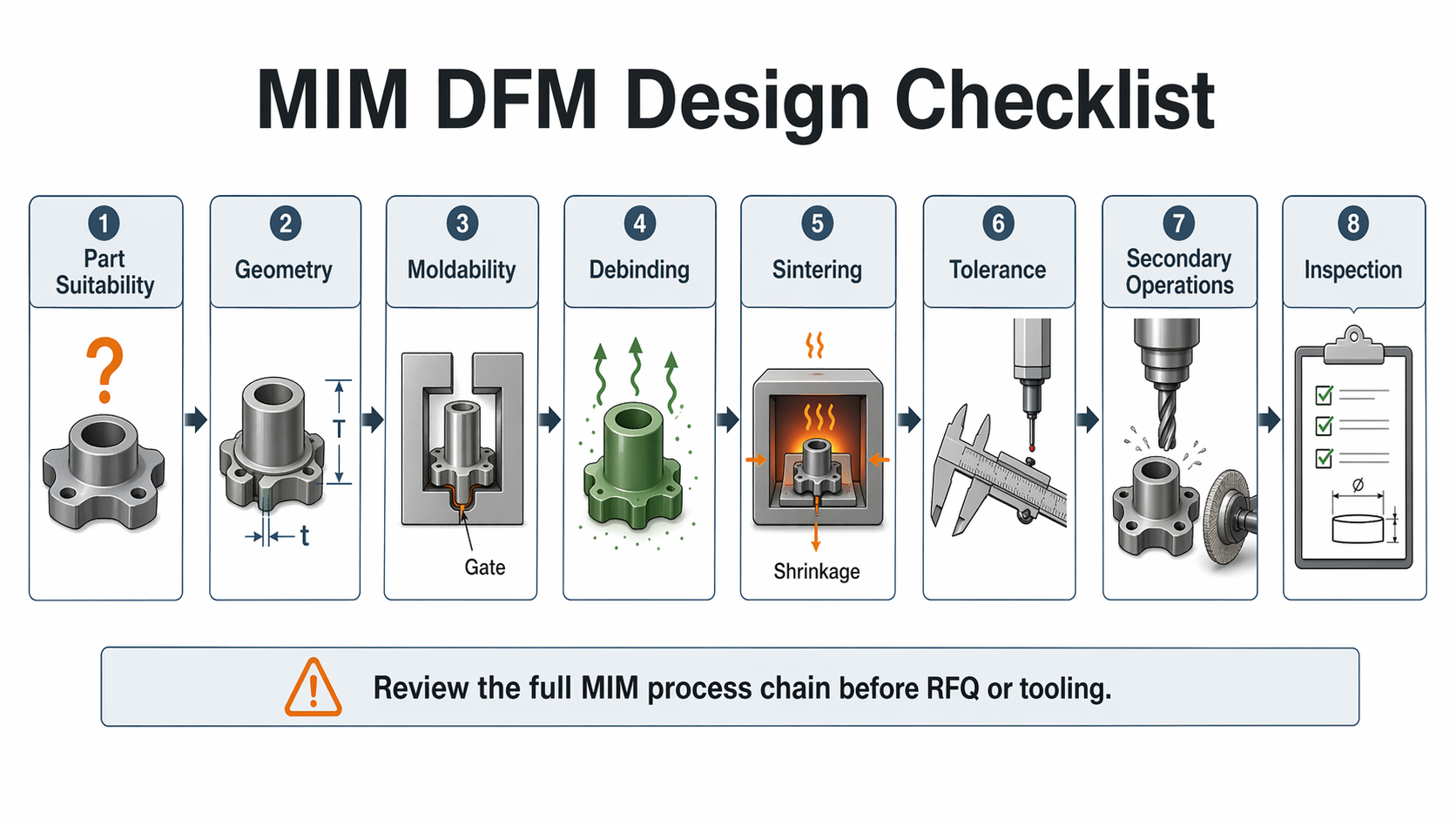
- Printable MIM DFM review worksheet
- Critical hold gates before tooling
- MIM DFM checklist at a glance
- Part suitability and manufacturing route check
- Geometry and wall thickness checklist
- Moldability checklist
- Debinding risk checklist
- Sintering shrinkage and support checklist
- Tolerance, datum, and secondary operation checklist
- Representative engineering scenario before tooling
- FAQ
MIM DFM Checklist at a Glance
A good checklist should not be a long list of generic design rules. It should help the project team decide what must be changed, what can be confirmed by the supplier, and what should be controlled later by machining, fixturing, heat treatment, or inspection.
| Review Area | What to Check | Why It Matters in MIM | Typical Action Before Tooling |
|---|---|---|---|
| Part suitability | Size, complexity, metal requirement, volume, cost target, and alternative processes | MIM is strongest when small metal parts have complex geometry and repeated production demand | Confirm whether MIM is the correct route before detailed quotation |
| Geometry | Wall balance, local mass, sharp corners, thin arms, holes, ribs, bosses, and support faces | Geometry affects molding, debinding, shrinkage, distortion, and inspection stability | Redesign risky features or separate critical and non-critical areas |
| Moldability | Gate position, parting line, ejection, undercuts, sliders, shutoffs, and tooling marks | A moldable feature still needs acceptable mark locations and stable production release | Reserve non-functional areas for gate, ejector, and parting line marks |
| Debinding | Thick sections, enclosed cavities, deep blind holes, narrow passages, and binder escape path | Poor debinding can cause cracks, blisters, internal defects, or long cycle risk | Reduce local mass, open escape paths, or change feature design |
| Sintering | Shrinkage direction, support surface, flatness, long thin features, asymmetric mass, and contact marks | High-temperature shrinkage can create warpage, sagging, and dimensional scatter | Review support orientation and define acceptable contact surfaces |
| Tolerances | Critical-to-function dimensions, datum scheme, general profile, hole positions, and post-sintering needs | Not every dimension should be controlled directly by as-sintered MIM capability | Separate as-sintered tolerances from machined or calibrated dimensions |
| Secondary operations | Machining, coining, heat treatment, surface finishing, tumbling, plating, passivation, or assembly | Secondary steps may improve function but change cost, lead time, and inspection planning | Assign secondary operations only where function requires them |
| Inspection | Datums, CMM access, gauge strategy, cosmetic surfaces, lot control, and acceptance criteria | If inspection is unclear, production release becomes unstable even when parts are functional | Define measurable criteria before tooling and sampling |
1. Part Suitability and Manufacturing Route Check
The first DFM question is not whether the part can be injected. The real question is whether MIM is the right manufacturing route for this part. MIM usually makes more sense when a part combines compact size, real metal performance, complex geometry, repeated production demand, and a cost problem in machining or assembly.
A small flat washer, a simple turned pin, or a low-volume prototype may not justify MIM tooling. A compact locking component with small holes, ribs, undercuts, functional faces, and high annual demand may be a stronger candidate. Before spending time on detailed mold and sintering review, the project team should confirm the business and engineering fit.
| Question | Good Sign for MIM | Warning Sign |
|---|---|---|
| Is the part small and complex? | Small precision metal part with multiple functional features | Large simple part or very simple geometry |
| Does it need real metal properties? | Strength, wear resistance, corrosion resistance, magnetism, or heat resistance matters | Plastic, die casting, stamping, or simple machining already meets the requirement |
| Is there enough production demand? | Repeated batches or long-term production can absorb tooling cost | One-time prototype or unstable demand |
| Is machining too slow or costly? | Complex features require repeated CNC operations or assembly from multiple pieces | Part can be made cheaply by one simple turning or stamping operation |
| Are tolerances realistic? | Only selected functional dimensions need tight control | Most surfaces demand tight tolerance without secondary machining allowance |
For detailed MIM design principles and feature-level explanations, use the DFM for MIM guide. For additional background on dimensional risk, see how part dimensions affect final MIM part quality. Use this checklist to document the project decision before RFQ and tooling.
2. Geometry and Wall Thickness Checklist
Geometry is usually where MIM DFM creates the most value. Buyers often send a finished CAD model and ask for a quotation, but the CAD model may already contain avoidable risks: heavy local mass, sudden wall transitions, sharp internal corners, deep blind holes, long unsupported features, or surfaces that cannot be supported during sintering.

Geometry review questions
- Are wall sections reasonably balanced, or does the part have heavy local mass next to thin features?
- Can sharp internal corners be changed to radii without affecting function?
- Can thick bosses be cored, shortened, lightened, or split into a more balanced structure?
- Are long thin arms supported during sintering, or are they likely to sag or twist?
- Are holes and slots designed for molding and inspection, or should some be machined after sintering?
- Can the part sit on a stable support surface during sintering without marking a critical face?
| Geometry Feature | DFM Risk | Preferred Review Direction |
|---|---|---|
| Thick solid boss | Debinding delay, internal defect risk, shrinkage imbalance | Core, lighten, reduce height, or confirm whether machining is better |
| Sharp internal corner | Stress concentration, mold filling issue, crack initiation | Add radius where function allows |
| Long thin arm | Filling difficulty, handling damage, sintering distortion | Increase support, modify section, or review sintering orientation |
| Deep blind hole | Tooling difficulty, powder/binder issue, inspection difficulty | Review whether the hole should be molded, drilled, or redefined |
| Flatness-critical surface | Sintering contact mark or distortion may affect function | Separate support face from functional sealing or assembly face |
For a deeper explanation of how geometry affects quality through molding, debinding, and sintering, see how part design affects MIM part quality. Use the checklist above to assign a pre-tooling action to each risky feature.
3. Moldability Checklist: Gate, Parting Line, Ejector, and Undercut Review
MIM uses injection molding equipment, so moldability still matters. Gate position, parting line, ejector layout, sliders, shutoffs, mold venting, and green part handling can affect cost and production stability. However, this is only one part of MIM DFM. A part can be moldable and still fail later during debinding or sintering.
Gate review
Check whether the gate can fill the part without creating visible marks on critical surfaces, unstable flow into thin features, or avoidable weld line risk near functional areas.
Parting line review
Confirm whether the parting line is acceptable for function, appearance, assembly, and post-processing. Do not place it across a sealing, sliding, or measurement-critical face without review.
Ejector review
Reserve ejector mark zones on non-critical surfaces. Green MIM parts are weaker than final sintered metal parts, so ejection and handling should be reviewed carefully.
Undercut review
Decide whether undercuts should be molded with slides, redesigned, machined later, or eliminated. Tooling complexity should be justified by function and volume.

4. Debinding Risk Checklist
Debinding is one of the reasons a MIM DFM checklist must be different from a normal injection molding checklist. After molding, the binder system must be removed in a controlled way before final sintering. If the part has thick local sections, closed cavities, narrow internal passages, or geometry that blocks binder escape, defects may appear even if the green part looks acceptable.
Debinding review questions
- Does the part have thick sections that may slow binder removal?
- Are there closed or semi-closed spaces that create trapped binder or gas risk?
- Are deep blind holes necessary, or can they be opened, shortened, or machined later?
- Can the binder removal path be supported by geometry rather than relying only on process adjustment?
- Will a local thick boss next to a thin feature create uneven debinding response?
| Debinding Risk Signal | Possible Result | DFM Response |
|---|---|---|
| Heavy local mass | Slow binder removal, cracking, internal void risk | Reduce mass, core feature, or redesign boss geometry |
| Closed cavity | Trapped gases or incomplete binder removal | Add escape path or reconsider whether the feature should be molded |
| Deep blind hole | Tooling difficulty and debinding uncertainty | Review drilling, reaming, or design change after sintering |
| Sudden thick-to-thin transition | Uneven thermal and binder response | Add transition radius or rebalance section layout |
The debinding review should also connect to feedstock stability. A design with difficult debinding geometry may become even harder to control if feedstock quality or solid loading consistency is unstable. For related background, see how feedstock affects part quality in MIM.
5. Sintering Shrinkage and Support Checklist
Sintering is where many hidden DFM issues become visible. During sintering, the part shrinks and densifies at high temperature. The design needs a reasonable shrinkage path, balanced geometry, and a support condition that does not damage critical surfaces. A long thin feature, U-shaped frame, asymmetric boss, or flatness-critical face can be risky even when the molded part looks good.

Sintering review questions
- Which surface can support the part during sintering?
- Is that support surface functional, cosmetic, or non-critical?
- Will long thin features sag or twist at high temperature?
- Does asymmetric mass create uneven shrinkage or flatness risk?
- Are contact marks acceptable on the proposed support face?
- Does the drawing define flatness or profile requirements that are unrealistic for the current support plan?
Sintering support and shrinkage should also be considered together with mold design. Gate position, parting line, ejection, and green part handling can influence how the part enters later process stages. For related reading, see how mold design affects MIM part quality.
6. Tolerance, Datum, and Secondary Operation Checklist
A DFM checklist should not treat every dimension equally. In practice, some dimensions are critical to assembly, sealing, locking, sliding, or alignment. Other dimensions are only general profile or cosmetic boundaries. If all dimensions are specified tightly without a clear datum and function logic, the project may become more expensive without improving the final product.
What to separate during tolerance review
| Dimension Type | Typical Review Question | Possible Control Method |
|---|---|---|
| Critical hole diameter | Does the hole control fit, pin assembly, fluid flow, or locking? | Molded if suitable, or drilled/reamed after sintering if tighter control is required |
| Critical distance between datums | Which datums define actual assembly function? | Define datum scheme clearly and review CMM or gauge access |
| Flatness-critical face | Is this face used for sealing, sliding, or positioning? | Review sintering support, grinding, coining, or machining allowance |
| Cosmetic profile | Does the surface need a visual limit or a functional tolerance? | Use reasonable general tolerance and surface finishing criteria |
| Thread or precision feature | Should it be molded, tapped, machined, or assembled? | Assign secondary operation where needed instead of forcing as-sintered control |
Secondary operations are not failures of MIM. They are part of a practical process plan when a small number of features require tighter control than the rest of the part. The mistake is using secondary operations everywhere without a function reason, or refusing them where they are clearly needed.
Secondary operation decision checklist
- Which dimensions are truly critical to function?
- Can these dimensions be controlled as-sintered with the required stability?
- Would machining one hole or one datum face reduce overall project risk?
- Will heat treatment or surface finishing change final dimensions or inspection sequence?
- Are cosmetic requirements compatible with gate marks, ejector marks, support marks, tumbling, or finishing?
Standards and tolerance note
MIM projects may refer to MPIF Standard 35-MIM and related MIMA / MPIF resources for material and specification discussions. Published tolerance guidance is not a universal project commitment. Final capability depends on material, geometry, part size, tooling strategy, sintering support, secondary operations, and inspection method, and should be confirmed through project-specific DFM review and sampling.
Useful reference sources: MIMA MPIF Standard 35-MIM and MPIF Standards.
7. Inspection and Production Release Checklist
Inspection should not be added after the part is already designed. If the drawing has unclear datums, hard-to-measure features, broad cosmetic language, or tight dimensions that cannot be accessed by CMM or gauges, production release becomes difficult. A MIM DFM checklist should identify inspection risk before tooling.
| Inspection Item | What to Confirm | Why It Matters |
|---|---|---|
| Datum scheme | Primary, secondary, and tertiary datums match real assembly function | Prevents measuring the part in a way that does not represent use |
| Critical dimensions | Only function-critical dimensions receive tight control | Reduces unnecessary sorting and cost |
| CMM or gauge access | Probe path, fixture location, and repeatability are practical | A dimension that cannot be measured reliably cannot be controlled reliably |
| Cosmetic criteria | Gate marks, ejector marks, support marks, and finishing limits are defined | Avoids disagreement during sampling and mass production |
| Lot acceptance | Sampling plan, function test, hardness, density, or surface requirement is agreed when relevant | Creates a clearer production release path |
Common Mistakes This Checklist Should Prevent
These mistakes make a MIM review incomplete or difficult to use before tooling. A process-specific checklist should identify whether each issue needs redesign, supplier confirmation, a secondary operation, or inspection control. Detailed explanations of individual design rules remain in the DFM for MIM guide.
| Mistake | Why It Creates Risk | Better Approach |
|---|---|---|
| Only checking injection moldability | Debinding and sintering risks are missed | Review the full MIM process chain from green part to final inspection |
| Using one tolerance rule for all dimensions | Critical and non-critical features are not separated | Classify dimensions by function, datum, process route, and inspection method |
| Ignoring sintering support until sampling | Warping, contact marks, and flatness issues appear late | Define support surface and orientation before tooling |
| Forcing all holes and precision features to be molded | Tooling and dimensional risk may increase | Decide which features should be molded and which should be machined after sintering |
| Writing a checklist without action decisions | The checklist becomes informational but not useful for RFQ | For each item, decide: redesign, supplier confirmation, secondary operation, or inspection control |
Representative Engineering Scenario Before MIM Tooling
This representative engineering scenario combines common MIM DFM review risks to illustrate the decision process. It is not presented as a named customer project, production record, or inspection result. The scenario shows how a review can turn “quote this CAD file” into a practical tooling and production decision.

Original situation
A small metal locking component appears suitable for MIM because it is compact and has several complex features. The CAD model includes a thick central boss, a deep blind hole, a sharp internal corner, two thin side arms, and a flat surface that is important for assembly.
Surface-level assumption
The first assumption is that the part only needs tooling quotation. Since the part is small and complex, MIM appears to be a good process route. However, a quotation without DFM review may miss several risks that affect sampling and mass production.
Real DFM findings
- The thick central boss may increase debinding and shrinkage imbalance risk.
- The deep blind hole may be difficult to mold and inspect consistently.
- The sharp internal corner may increase crack and stress risk.
- The thin arms may be vulnerable to sintering distortion.
- The flat assembly face should not be used as an uncontrolled support or tooling mark area.
Corrective direction before tooling
The revised direction is not to remove all complex features. Instead, the team separates function-critical features from features that can be adjusted. The boss is lightened or cored where possible, internal corners receive radii, the critical hole is considered for post-sintering machining, a non-functional surface is reserved for gate and ejector planning, and the support face is reviewed before mold construction.
Prevention logic
This prevents the project from discovering predictable risks during sampling. The supplier and buyer can agree on which dimensions are as-sintered, which dimensions need secondary machining, which surfaces can accept marks, and which inspection method will be used for release.
MIM DFM Information to Prepare Before RFQ
A checklist is most useful when it improves RFQ quality. Before sending a MIM part for quotation, the buyer or engineer should prepare more than a CAD file. The supplier needs to understand function, material, volume, critical dimensions, surface expectations, and inspection requirements.
| Information Needed | Why the Supplier Needs It |
|---|---|
| 3D CAD model and 2D drawing | CAD shows geometry; drawing shows tolerances, datums, material, finish, and inspection requirements |
| Function-critical features | Helps separate tight functional control from general profile dimensions |
| Material requirement | Material affects feedstock, sintering behavior, strength, corrosion resistance, heat treatment, and cost |
| Annual volume and batch pattern | Determines whether tooling, automation, and secondary operations are commercially reasonable |
| Surface and cosmetic expectations | Prevents conflict around gate marks, ejector marks, support marks, tumbling, polishing, or coating |
| Assembly or mating part information | Clarifies which dimensions matter and which tolerances may be over-specified |
| Testing and inspection requirements | Supports early planning for CMM, gauges, hardness, density, corrosion, or functional tests |
What a MIM Supplier Should Do During DFM Review
A useful supplier review should not only return a price. For a MIM project, the supplier should identify geometry risk, tooling mark zones, debinding concerns, sintering support strategy, tolerance risks, secondary operation needs, and inspection feasibility.
- Mark risky features directly on the CAD or drawing where possible.
- Explain whether each issue affects molding, debinding, sintering, machining, or inspection.
- Separate must-change items from supplier-confirmation items.
- Propose practical redesign directions instead of only saying “not possible.”
- Clarify which tolerances are expected as-sintered and which may need secondary operations.
- Confirm where gate marks, ejector marks, parting lines, and support marks may appear.
- Discuss sample validation and production release criteria before tooling is fixed.
Need a MIM DFM Review Before Tooling?
Send us your 3D model, 2D drawing, material requirement, estimated volume, and critical function notes. We can review geometry, moldability, debinding risk, sintering support, tolerance strategy, secondary operation needs, and inspection concerns before tooling decisions are fixed.
FAQ: MIM DFM Design Checklist
What is a MIM DFM design checklist?
A MIM DFM design checklist is a practical review tool used before tooling to check part suitability, geometry, moldability, debinding, sintering shrinkage, tolerance strategy, secondary operations, and inspection feasibility. It helps the project team find risks before they become tooling or sampling problems.
How is MIM DFM different from plastic injection molding DFM?
Plastic injection molding DFM mainly focuses on molded part formation, tooling, flow, ejection, shrinkage, and cosmetic quality. MIM DFM also needs to review binder removal, green part handling, sintering shrinkage, density, support marks, distortion, secondary machining, and final inspection.
When should DFM review be done in a MIM project?
DFM review should be done before final quotation and tooling release. If geometry risk, tolerance risk, or sintering support risk is found after tooling, corrections become slower and more expensive.
Can all tight tolerances be achieved directly by MIM?
No. Some dimensions may be controlled as-sintered, while very tight or function-critical dimensions may need machining, coining, grinding, reaming, or another secondary operation. Final tolerance capability should be confirmed through project-specific DFM review.
What geometry features are risky for MIM?
Common risky features include heavy local mass, sharp internal corners, sudden wall thickness changes, deep blind holes, long unsupported thin features, asymmetric structures, and critical surfaces that cannot be supported during sintering.
Does a part need to be redesigned before MIM tooling?
Not always. Some parts are already suitable for MIM. Others need small changes such as adding radii, reducing local mass, changing a hole strategy, defining gate mark zones, or separating as-sintered dimensions from machined dimensions.
What files should I send for a MIM DFM review?
Send the 3D CAD model, 2D drawing, material requirement, estimated annual volume, critical dimensions, surface requirements, assembly function, and any testing or inspection requirements. A CAD file alone is often not enough for a complete DFM review.