Quick Answer: What Is the Difference Between MIM and PM?
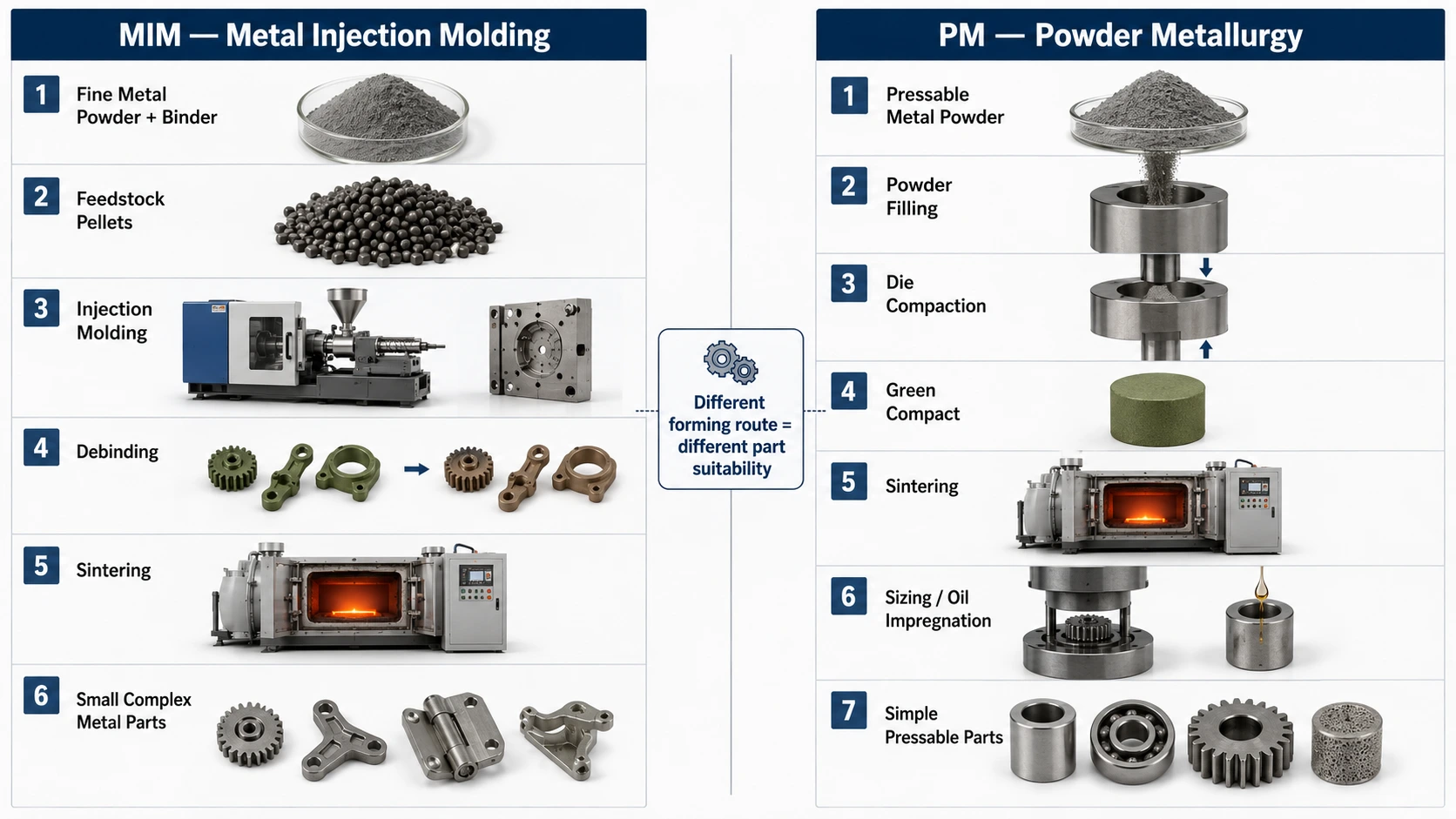
Metal injection molding, or MIM, uses fine metal powder mixed with binder to create moldable feedstock. The feedstock is injection molded, debound, and sintered into a dense metal part. Conventional powder metallurgy, or PM, usually compacts metal powder directly in a die, then sinters the green compact and may add sizing, coining, repressing, machining, or oil impregnation.
In practice, MIM is usually better for small complex metal parts with thin walls, undercuts, fine features, and higher density requirements. PM is usually better for simpler shapes that can be pressed and ejected reliably, such as bushings, bearings, simple gears, porous parts, and cost-sensitive high-volume components. The correct choice depends on geometry, density, porosity, tolerances, material, volume, and whether PM compaction can form the part without excessive secondary operations.
The part is small, complex, thin-walled, high-density, difficult to compact, or has undercuts, side features, fine details, or geometry that would require excessive machining.
The part is simple, pressable, high-volume, cost-sensitive, or designed for controlled porosity, oil impregnation, sizing, coining, or other press-and-sinter advantages.
Geometry, tolerance, density, porosity, material, cost, and volume point in different directions. A drawing-based review is more reliable than choosing from a part name.
MIM vs PM at a Glance
The fastest way to compare MIM and PM is to look at how each process forms the part. MIM forms feedstock in an injection mold. PM compacts loose powder in a die. That difference creates different design windows, cost structures, and quality risks.
| Factor | MIM | PM |
|---|---|---|
| Full name | Metal Injection Molding | Powder Metallurgy / Press and Sinter |
| Forming method | Injection molding of metal powder feedstock | Powder compaction in a die |
| Powder and binder | Fine metal powder mixed with a binder system | Pressable metal powder, usually without a MIM-style binder system |
| Main process route | Feedstock preparation, injection molding, debinding, sintering | Powder blending, die compaction, sintering, sizing, coining, or secondary operations |
| Geometry capability | Strong for small, complex, three-dimensional shapes | Strong for simpler shapes that can be pressed and ejected |
| Undercuts and side features | More feasible when mold design, gate position, and debinding path are reviewed | Limited by compaction direction, die filling, and ejection path |
| Thin walls and micro features | Often better suited, but filling, green strength, and sintering distortion still require review | More limited, depending on powder flow, pressure transfer, and part shape |
| Density and porosity | Usually higher density and lower porosity | Often lower density, but porosity may be useful for lubrication or filtration functions |
| Typical parts | Precision hinges, micro gears, brackets, watch parts, medical device components, electronic structural parts | Bushings, bearings, simple gears, porous filters, oil-impregnated parts, structural PM parts |
| Cost logic | Higher tooling and feedstock cost, but may reduce machining, welding, or assembly for complex parts | Often more economical for simple, high-volume, pressable parts |
| Best fit | Small complex precision metal parts | Simple, cost-sensitive, high-volume sintered parts |
The most important selection point is whether the geometry can be formed by compaction. If the part has complex side features, undercuts, thin walls, or small three-dimensional details, MIM often deserves evaluation. If the part can be pressed in a relatively simple direction and does not require high-density complex geometry, PM may be the more economical route.
Process Difference: Injection-Molded Feedstock vs Powder Compaction
MIM and PM both use metal powder, but they do not create the green part in the same way. For engineering review, that difference matters more than the shared word “powder.”
How MIM Forms Parts
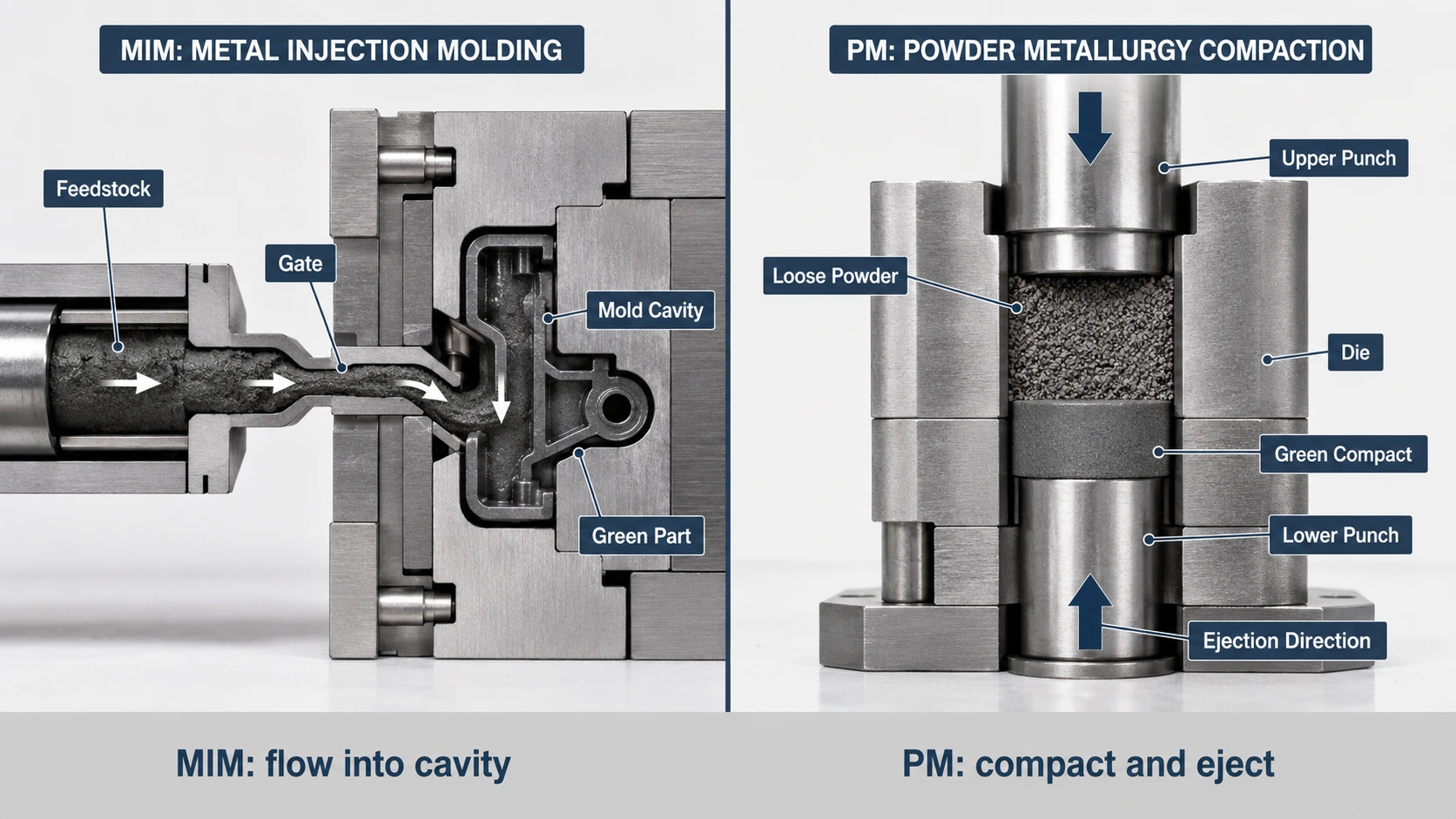
In metal injection molding, fine metal powder is mixed with a binder system to produce moldable feedstock. This feedstock is injected into a mold cavity in a process similar to plastic injection molding. The molded part is a green part. After molding, the binder is removed during debinding, and the part is then sintered to reach its final metallic structure.
From a design review perspective, MIM is useful because injection molding can form small and complex shapes that would be difficult to produce by conventional pressing. The process also brings its own risks: gate vestige, short shot, green part damage, debinding cracks, sintering distortion, and shrinkage variation must be reviewed before tooling. For a broader overview, see the MIM process page.
How PM Forms Parts
Conventional powder metallurgy usually forms parts by compacting metal powder in a die. The powder mixture is pressed into a green compact, then sintered to bond the particles. Depending on the part and application, PM parts may also require sizing, coining, repressing, machining, heat treatment, or oil impregnation. For a fuller process route, see the powder metallurgy process .
PM should not be treated as a lower-grade version of MIM. It is a different manufacturing route with its own advantages, especially for simple, high-volume, cost-sensitive parts where compaction is stable and controlled porosity or oil impregnation may be useful.
Why the Forming Route Controls the Selection
The real selection question is not “Which process is better?” The better question is: Can the part be compacted reliably, or does it require injection-molded geometry?
If the part can be compacted in a die with acceptable density distribution, ejection, tolerances, and cost, PM may be the better choice. If the part has complex three-dimensional geometry, undercuts, thin sections, small details, or features that would require extensive machining after PM compaction, MIM may be a stronger option.
This is why a drawing-based review is more reliable than choosing from a generic comparison table. The same part name, such as “gear” or “bracket,” may be suitable for MIM or PM depending on tooth geometry, wall section, size, density requirement, tolerance strategy, and functional surfaces.
Geometry and Design Freedom: Where MIM and PM Separate Clearly
Geometry is usually the clearest dividing line between MIM and PM. Before comparing unit cost, first check whether the part shape fits injection molding or powder compaction.

When MIM Has a Strong Design Advantage
MIM is often selected when a part is small, complex, and difficult to machine or compact economically. Typical design features that may favor MIM include:
- Thin walls
- Small holes
- Side features
- Undercuts
- Fine teeth
- Complex brackets
- Small hinges
- Multi-directional geometry
- Integrated features that would otherwise require assembly
- Parts that would require several CNC setups from bar stock or plate
A common mistake is to judge the process only by part size. A small part is not automatically a MIM part. MIM becomes more attractive when small size is combined with complex geometry, high material utilization, reduced machining, or reduced assembly.
Where PM Geometry Is More Limited
PM is strong when the geometry is compatible with die compaction and ejection. It is commonly used for relatively regular shapes such as bushings, bearings, simple gears, spacers, and structural components with pressable profiles.
PM becomes more difficult when the part requires features that are not compatible with the compaction direction. Lateral holes, deep undercuts, sharp local thickness changes, and complex three-dimensional shapes may require secondary machining, design changes, or a different process.
This does not mean PM cannot make useful engineered parts. It means PM design should respect the press-and-sinter forming route.
Why PM Is Limited by Compaction Direction and Ejection
PM compaction is usually limited by how powder fills the die, how pressure is transferred through the powder, and how the green compact is ejected. These factors affect density distribution, crack risk, dimensional stability, and production yield.
Several design conditions should be reviewed carefully before choosing PM:
- Undercuts: Features that block ejection may not be practical without design changes or secondary operations.
- Side holes: Holes perpendicular to the pressing direction may require machining after sintering.
- Tall or thin sections: These may increase density variation or green compact handling risk.
- Large thickness transitions: Uneven compaction can create inconsistent density and distortion.
- Complex multi-directional geometry: PM may require simplified geometry, split components, or additional machining.
From a manufacturing point of view, PM is most efficient when the part shape supports stable compaction, uniform density, and clean ejection.
Density, Porosity, and Mechanical Performance
Density and porosity are important selection factors, but they should not be simplified into “MIM is good and PM is bad.” In some PM parts, controlled porosity is part of the function.

Why MIM Usually Achieves Higher Density
MIM commonly uses fine metal powders and a sintering-based densification route. In practical terms, higher density and lower porosity can support better mechanical properties, better surface quality, and improved performance in demanding small components.
However, final performance still depends on the material system, sintering control, heat treatment, part geometry, and inspection requirements. A responsible MIM supplier should not promise performance based only on the process name. Material grade, density target, hardness, heat treatment, critical dimensions, and application conditions must be reviewed together.
Why PM Porosity Can Be a Feature, Not Only a Defect
PM often has more porosity than MIM, but porosity is not always a defect. In some PM applications, controlled porosity is part of the functional design. This is one reason PM remains important for powder metallurgy applications where lubrication, permeability, or controlled density is required.
- Oil-impregnated bearings
- Self-lubricating bushings
- Porous filters
- Controlled-density structural parts
- Certain magnetic or friction-related PM components
For these parts, choosing MIM only to reduce porosity may increase cost without improving the function. A PM bushing that requires oil impregnation, for example, may be a poor candidate for MIM even if MIM can produce higher density.
Cost, Tooling, and Production Volume
Cost comparison between MIM and PM depends on geometry, material, tolerances, secondary operations, and annual volume. A simple unit-price comparison can be misleading.

Why PM Is Often More Cost-Effective for Simple Parts
PM is often more economical for simple, pressable, high-volume parts. The process can be efficient when the part geometry is stable in compaction, the required density is achievable, and secondary operations are limited or predictable.
PM may be especially suitable for simple gears, bushings, bearings, spacers, structural parts with compactable geometry, porous or oil-impregnated components, and high-volume parts with strong cost sensitivity.
If the design already matches the PM process window, choosing MIM may add unnecessary feedstock, tooling, debinding, and sintering control cost.
Why MIM Can Be Cost-Effective for Complex Parts
MIM usually has higher tooling and feedstock cost than conventional PM. However, it can be cost-effective when the geometry is complex enough to reduce machining, assembly, welding, or multi-part construction.
MIM may reduce total cost when several machined features can be molded directly, multiple parts can be consolidated into one component, CNC machining would create high material waste, or the part requires small, repeatable, complex geometry.
The correct comparison should include tooling, material utilization, machining allowance, inspection burden, scrap risk, assembly cost, and annual production volume. For a deeper cost breakdown, see our guide to metal injection molding cost.
Tolerances and Dimensional Control
Tolerance capability must be reviewed differently for MIM and PM because the dimensional risks are different.
MIM Dimensional Control Depends on Shrinkage Management
MIM parts experience significant dimensional change during sintering. The mold must compensate for shrinkage, and the final part depends on feedstock consistency, mold filling, debinding stability, sintering support, part orientation, and furnace control.
Critical dimensions may require extra attention when the part has uneven wall thickness, long thin sections, thin ribs, unsupported areas during sintering, tight flatness or straightness requirements, critical holes, bearing surfaces, or datum features.
MIM can produce precise small parts, but tight tolerances must be separated into molded-and-sintered dimensions, dimensions that may need secondary machining, and features that should be adjusted during DFM. For more detail, review our pages on MIM tolerances and MIM shrinkage compensation.
PM Dimensional Control Often Relies on Sizing or Coining
PM dimensional control is influenced by powder fill, compaction pressure, green density, die wear, sintering change, and secondary sizing or coining.
For some PM parts, sizing or coining can improve dimensional accuracy after sintering. This is one reason PM works well for certain regular shapes and high-volume mechanical parts.
However, PM dimensional control becomes more difficult when the design includes complex multi-directional features, uneven density distribution, or geometry that does not support stable pressing and ejection.
Quality Risks to Review Before Selecting MIM or PM
A process comparison is incomplete without quality risk review. MIM and PM have different failure modes, so the inspection plan should follow the selected process.

| Risk Area | MIM Review Point | PM Review Point |
|---|---|---|
| Density | Sintering control and shrinkage uniformity | Compaction density distribution |
| Porosity | Usually minimized unless material-specific | May be functional or controlled |
| Dimensional stability | Shrinkage compensation, fixture support, sintering orientation | Sizing, coining, die wear, compaction direction |
| Cracking risk | Debinding stress, green part handling, sintering stress | Green compact strength, pressing defects, ejection stress |
| Distortion | Wall thickness balance, support design, sintering placement | Density gradient, shape stability, secondary sizing |
| Surface condition | Mold surface, gate area, sintering condition, finishing | Powder condition, die surface, secondary finishing |
| Secondary operation control | Machining allowance, heat treatment distortion, finishing effect on critical surfaces | Sizing pressure, coining repeatability, oil impregnation level, repressing stability, machining for side features |
| Inspection focus | Critical dimensions, density, hardness, surface condition, visual defects | Dimensions, density, porosity, oil content if relevant, functional fit |
A supplier should be able to explain not only which process can make the part, but also where the process risks are likely to appear and which features should be checked before tooling approval.
Material Selection: MIM Materials Are Not the Same as PM Materials
Material choice should be reviewed within the correct process route. A material that is common in PM is not automatically practical for MIM, and a material commonly used in MIM may not be the most economical PM choice.
Common MIM Material Families
MIM is commonly evaluated for small complex parts made from materials such as stainless steels, low alloy steels, soft magnetic alloys, titanium alloys, nickel alloys, cobalt-chromium alloys, and selected special alloys where MIM feedstock and sintering control are practical.
The final choice depends on corrosion resistance, strength, hardness, wear resistance, magnetic behavior, heat treatment response, and application environment. For the full material structure, see our MIM materials page.
Common PM Material Logic
PM material selection often focuses on structural performance, cost, density, porosity, wear behavior, or lubrication function. PM is especially important for iron-based structural parts, stainless PM parts, copper-based or bronze bearing materials, oil-impregnated bushings, porous materials, and selected soft magnetic parts.
For PM-specific material families, the powder metallurgy materials page should be used to evaluate iron-based materials, stainless steel PM materials, copper-based materials, bronze bearing materials, and porous materials within the press-and-sinter route.
This is why copper-based, bronze, oil-impregnated, and porous materials should usually be discussed in a PM context rather than treated as standard MIM material choices.
Typical Parts: Which Process Fits Which Component?
The part name alone is not enough to choose the process. A gear, bracket, or housing may be suitable for different processes depending on geometry, precision, material, density, and production volume.
| Part Type | Usually Better Fit | Reason |
|---|---|---|
| Small precision hinge | MIM | Small complex geometry and functional features favor injection molding |
| Micro gear | MIM or PM | Depends on tooth form, density, precision, and size |
| Simple spur gear | PM or MIM | PM may be economical if geometry is pressable; MIM may fit if the gear is very small or complex |
| Bushing | PM | Porosity and oil impregnation may be useful |
| Bearing component | PM | PM is widely used for self-lubricating bearing parts |
| Complex bracket | MIM | Multi-directional geometry and small detailed features favor MIM |
| Watch structural part | MIM | Small size, detail, and surface expectations often favor MIM |
| Porous filter | PM | Controlled porosity is normally required |
| Medical device small part | MIM | Complex small geometry and material performance may favor MIM |
| Large simple metal block | Usually neither first choice | CNC, casting, forging, or another route may be more practical |
When to Choose MIM Instead of PM
MIM should be selected because the geometry and production economics justify it, not simply because the part is small.
MIM Is Worth Evaluating When:
- The part is small and complex.
- The geometry cannot be compacted and ejected easily by PM.
- The part has undercuts, side features, thin walls, fine teeth, or micro details.
- Higher density and lower porosity are required.
- Machining from solid material would require multiple setups or create high material waste.
- Several components can potentially be consolidated into one molded part.
- The production volume can justify tooling and feedstock cost.
- The project requires repeatable geometry after design and sintering review.
What Must Be Reviewed Before Choosing MIM
- Can the feedstock fill the thin or detailed features reliably?
- Where should the gate be placed?
- Will the green part be strong enough for handling?
- Is there debinding crack risk due to thick sections or trapped binder pathways?
- Will sintering shrinkage be uniform enough for critical dimensions?
- Does the part need sintering support or special orientation?
- Are any critical tolerances better finished by secondary machining?
- Is the annual volume suitable for MIM tooling investment?
A well-designed MIM part starts before tooling. Most serious quality and cost problems are easier to prevent during DFM review than after mold completion.
When PM Is the Better Choice Than MIM
PM may be the better choice when the part shape is simple, pressable, cost-sensitive, or when controlled porosity is useful for the function.
- The part shape is simple and pressable.
- The project is highly cost-sensitive.
- Annual volume is high.
- The required density can be achieved through press-and-sinter processing.
- Controlled porosity is acceptable or useful.
- The part is a bushing, bearing, simple gear, porous part, or oil-impregnated component.
- The design does not require complex side features, thin micro details, or undercuts.
- Sizing, coining, or oil impregnation can meet the final functional requirements.
PM Secondary Operations That Often Decide Final Cost and Function
For many PM parts, the cost and final function are not decided by compaction and sintering alone. Secondary operations may be part of the normal press-and-sinter powder metallurgy process, especially when the part requires tighter dimensions, better surface performance, lubrication behavior, or post-sinter functional correction.
Used to improve dimensional accuracy, local shape control, or functional fit after sintering.
Used when additional density or dimensional correction is required for certain PM parts.
Important for self-lubricating bushings, bearings, and other porous PM components.
May be needed for side holes, sharp edges, datum surfaces, or features that cannot be pressed directly.
Used when hardness, wear resistance, or strength must be adjusted after sintering.
Applied when corrosion resistance, friction behavior, appearance, or surface function requires improvement.
These operations can make PM highly effective for suitable parts, but they also affect total cost. A fair MIM vs PM comparison should include the complete post-sinter route, not only the first formed part price.
Common Selection Mistakes When Comparing MIM and PM
Many process selection problems come from comparing MIM and PM too late, or comparing only unit price without reviewing geometry and quality risks.
Small size alone does not justify MIM. If the part is simple, pressable, and cost-sensitive, PM may be more economical. Possible result: unnecessary tooling cost, higher material cost, and no real manufacturing advantage.
PM may not be suitable for complex undercuts, side holes, thin local features, or multi-directional geometry. Possible result: redesign, secondary machining, poor yield, or unstable dimensional control.
A low unit price may hide machining, inspection, assembly, or rejection cost. A higher molded part price may still be reasonable if it eliminates several secondary operations.
PM porosity may be useful for oil-impregnated or porous functional parts. MIM density may be unnecessary or even misaligned with the application.
MIM and PM both use metal powder, but their forming routes, process controls, design rules, and cost structures are different.
DFM Review Checklist Before Choosing MIM or PM
A supplier cannot reliably recommend MIM or PM from a part name alone. A drawing-based DFM review should evaluate geometry, material, tolerances, density, porosity, volume, and application conditions together.

| Review Item | Why It Matters |
|---|---|
| Part size and weight | MIM is usually stronger for small complex parts; PM may be better for simple compacted parts |
| Wall thickness | Thin or uneven walls affect molding, compaction, debinding, and sintering |
| Undercuts and side features | These often favor MIM over conventional PM |
| Critical tolerances | May require shrinkage control, sizing, coining, or secondary machining |
| Density requirement | High-density parts often favor MIM; porous or oil-impregnated parts may favor PM |
| Material requirement | Some materials are more practical in one route than the other |
| Surface finish | Mold condition, powder, sintering, and secondary finishing affect final appearance |
| Annual volume | Tooling and process cost must be justified by production volume |
| Application conditions | Wear, corrosion, magnetism, lubrication, load, and temperature affect selection |
| Secondary operations | Machining, heat treatment, sizing, finishing, or assembly can change total cost |
For a reliable review, send the drawing, 3D file if available, material requirement, tolerance notes, surface requirements, estimated annual volume, and application background.
Composite Field Scenario for Engineering Training
The following scenarios are composite engineering examples for process-selection discussion. They are not disclosed customer projects and should be used as training references, not as guaranteed outcomes for every part.
Scenario A: A Small Complex Bracket Changed from PM to MIM
What problem occurred: A small metal bracket had side holes, thin local walls, and a small locking feature. PM looked attractive at first because the expected annual volume was high.
Why it happened: During review, the side features and undercut area created problems for powder compaction and ejection. Producing the part by PM would require secondary machining and design compromise.
What the real system cause was: The issue was not the material itself. The geometry did not match the press-and-sinter forming route.
How it was corrected: MIM became a better candidate because injection molding could form the complex features in one molded geometry. The key MIM review points were gate location, wall thickness balance, sintering support, and tolerance strategy for the functional holes.
How to prevent recurrence: Review compaction direction, ejection path, side features, and secondary machining demand before comparing unit price.
Scenario B: A Simple Bushing Stayed with PM Instead of MIM
What problem occurred: A cylindrical bushing was considered for MIM because the customer wanted a dense metal part and small size.
Why it happened: The part had a simple pressable shape and required lubrication behavior in service. It did not need undercuts, thin micro features, or high-density complex molding.
What the real system cause was: The functional requirement favored controlled porosity and oil impregnation, not maximum density.
How it was corrected: PM remained the better route because the part could be compacted efficiently and controlled porosity supported the application.
How to prevent recurrence: Start from part function, geometry, density requirement, and lubrication needs before choosing a process that sounds more advanced.
What to Send for MIM vs PM Review
A useful process recommendation requires more than a part name. The more clearly the drawing, function, tolerance, material, and volume are defined, the easier it is to compare MIM, PM, or another route before tooling.
Drawing and Technical Requirements
- 2D drawing with dimensions and tolerances
- 3D CAD file if available
- Material grade or target properties
- Critical dimensions and datum surfaces
- Surface finish requirement
- Hardness, density, porosity, or magnetic requirement
Project and Application Context
- Estimated annual volume
- Prototype or mass production stage
- Application environment and working load
- Current manufacturing process or failure point
- Required secondary operations
- Target cost range or sourcing constraint if available
Not Sure Whether Your Part Should Use MIM or PM?
Send us your drawing, 3D file, material requirement, tolerance notes, estimated annual volume, surface requirements, and application background. Our engineering team can review whether your part is better suited for MIM, PM, or another manufacturing route before tooling decisions are made.
During review, XTMIM will focus on forming feasibility, wall thickness, undercuts, density or porosity requirements, tolerance strategy, secondary operations, material suitability, and production volume fit.
Technical Reference Notes for MIM and PM Selection
Industry references are useful for terminology, material expectations, process understanding, and communication between engineering and sourcing teams. However, no general standard can replace drawing-level process selection.
For MIM and PM selection, standards and association resources should be used to support discussions about material, density, test methods, process terminology, and acceptance expectations. The final decision still depends on part geometry, production volume, tolerance strategy, functional requirements, and supplier manufacturing capability.
Recommended technical references for further reading include MIMA process overview for MIM, EPMA metal injection moulding overview, MPIF powder metallurgy standards, and MPIF conventional powder metallurgy process.
Final material acceptance, mechanical properties, density requirements, porosity limits, and test methods should be confirmed against the applicable MPIF, ASTM, ISO, customer drawing, purchase specification, or project-specific quality plan. This page is intended for early process selection and engineering communication, not as a replacement for formal material or inspection specifications.
Frequently Asked Questions About MIM vs PM
Is MIM a type of powder metallurgy?
Yes. MIM is a powder-based metal manufacturing process, but it is different from conventional press-and-sinter PM. MIM uses fine metal powder mixed with binder to create feedstock, then forms the part by injection molding, debinding, and sintering. Conventional PM usually compacts metal powder directly in a die before sintering.
Is MIM better than PM?
MIM is not simply better than PM. MIM is usually better for small, complex, high-density metal parts with thin walls, undercuts, or fine features. PM is often better for simpler, pressable, cost-sensitive, high-volume parts, especially when controlled porosity or oil impregnation is useful.
Is MIM stronger than PM?
MIM often achieves higher density and lower porosity than conventional PM, which can support stronger mechanical performance in suitable materials and designs. However, strength depends on material, density, heat treatment, sintering control, geometry, and inspection requirements. PM can also be appropriate for many structural and functional parts.
Is PM cheaper than MIM?
For simple, pressable, high-volume parts, PM is often more economical than MIM. MIM may become cost-effective when the part is small and complex enough to reduce CNC machining, assembly, welding, or multiple secondary operations. The correct comparison should include total manufacturing cost, not only unit price.
Can PM make complex parts?
PM can make useful engineered parts, but conventional powder compaction is limited by pressing direction, die filling, density distribution, and ejection. Parts with undercuts, lateral holes, thin local features, or complex three-dimensional geometry may require machining, design changes, or MIM evaluation.
Is MIM or PM better for gears?
It depends on gear size, tooth form, density requirement, tolerance, material, and production volume. Simple pressable gears are often suitable for PM, especially in high-volume cost-sensitive projects. Very small gears, gears with fine features, complex hubs, side features, or higher density requirements may need MIM review.
Can the same supplier evaluate both MIM and PM for one drawing?
Yes, if the supplier has engineering experience across powder-based manufacturing routes. A useful review should compare geometry feasibility, compaction limits, molding risk, density or porosity requirements, tolerances, material suitability, secondary operations, tooling cost, and annual volume before recommending MIM, PM, or another process.
When should I choose MIM instead of PM?
Choose MIM when the part is small, complex, difficult to compact, and requires features such as undercuts, thin walls, fine details, high density, or reduced machining. MIM is also worth evaluating when several machined or assembled components can be consolidated into one molded metal part.
When should I choose PM instead of MIM?
Choose PM when the part is simple, pressable, cost-sensitive, and produced in high volume. PM is often suitable for bushings, bearings, simple gears, porous parts, oil-impregnated components, and structural parts where the required density and tolerances can be achieved through press-and-sinter processing.
What information is needed to evaluate MIM vs PM?
A reliable process review needs a 2D drawing, 3D model if available, material requirement, critical tolerances, surface finish requirements, estimated annual volume, part weight or size, application conditions, and any special requirements such as wear resistance, corrosion resistance, magnetism, lubrication, or post-processing limits.