
MIM Parts for Small, Complex Metal Components
MIM parts are small, complex metal components produced by metal injection molding for production programs where machining, casting, stamping, or conventional powder pressing cannot efficiently meet geometry, repeatability, and material requirements. This page is a MIM Parts hub, not a detailed definition article. Use it to browse common MIM part types and reach the correct category page by industry, product or device, structural family, or performance requirement.
This hub helps you find MIM parts such as gears, hinges, brackets, shafts, pins, connectors, miniature housings, medical components, watch parts, and electronics parts by the right page path. For the full definition, process background, and basic explanation of what MIM parts are, use the supporting blog article instead of this aggregation page.
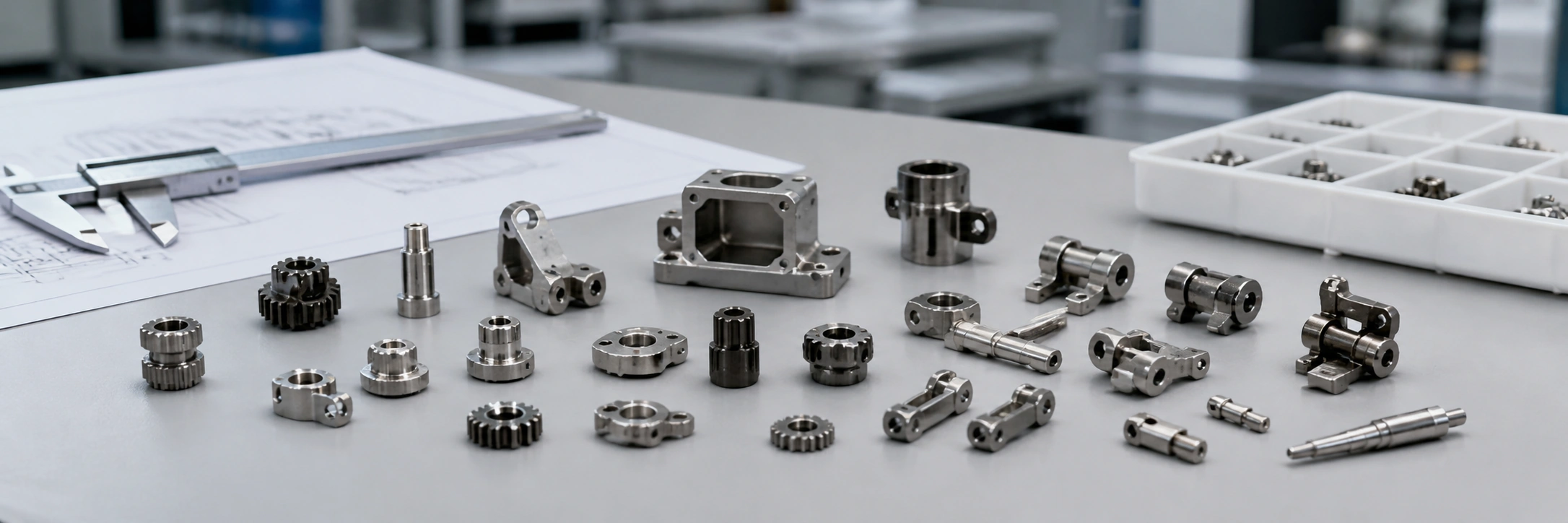
How This Hub Helps You Find MIM Parts
A search for “MIM parts” usually means the user wants examples, categories, and a practical path to the right page. This hub gives a short answer, then routes users to common part types, industry pages, product or device pages, structural part families, performance-based pages, and drawing review.
Use this page to browse
Find common MIM components such as gears, hinges, brackets, shafts, pins, medical parts, watch parts, electronics parts, and compact structural metal components.
Use the blog for definitions
This hub does not explain the full MIM process in detail. For the definition-level topic, read What Are MIM Parts? before choosing a category.
Use drawing review for projects
If you already have a drawing, CAD model, material requirement, tolerance note, or annual volume estimate, send it for MIM suitability review before tooling.
Common Types of MIM Parts
This section answers the main “mim parts” browsing intent before the page enters the detailed category logic. Use it to identify the part family or application path that best matches your drawing.
| Common MIM part type | Typical examples | Best next page path |
|---|---|---|
| Gears | Micro gears, compact gear features, precision tooth profiles | MIM Gear Parts or Micro Gears |
| Hinges | Laptop hinges, wearable hinges, compact rotating structures | MIM Hinge Parts |
| Brackets | Mounting brackets, support brackets, compact load-bearing parts | MIM Bracket Parts |
| Shafts and pins | Pivot pins, locating pins, micro shafts, precision cylindrical parts | MIM Shafts and Pins |
| Medical components | Endoscope parts, dental parts, surgical instrument components | Medical MIM Parts |
| Electronics components | Mobile phone parts, laptop parts, wearable device components, miniature housings | Consumer Electronics MIM Parts, Wearable Device Parts, or Drone Parts |
| Watch parts | Watch case parts, clasp-related parts, miniature precision mechanisms | Watch MIM Parts |
| Performance-based parts | Wear-resistant, corrosion-resistant, high-strength, high-precision, and soft magnetic parts | High-Precision MIM Parts, Wear-Resistant MIM Parts, or Soft-Magnetic MIM Parts |
How to Choose the Right MIM Parts Page
The same component may be searched by industry, product, shape, or performance requirement. This hub keeps those paths separate so users can choose the most useful page without reading duplicate content.
Start by industry
Use this path when the application market is the main context, such as consumer electronics, medical, automotive, watch, robotics, or industrial automation parts.
Start by product
Use this path when the drawing belongs to a known assembly, such as a mobile phone, laptop, wearable device, civilian drone, endoscope, surgical instrument, dental device, or watch product.
Start by structure
Use this path when the part name or geometry is the main issue, such as gears, hinges, brackets, shafts, pins, connectors, or compact structural components.
Start by performance
Use this path when the key requirement is high precision, wear resistance, corrosion resistance, high strength, heat resistance, or soft magnetic behavior.
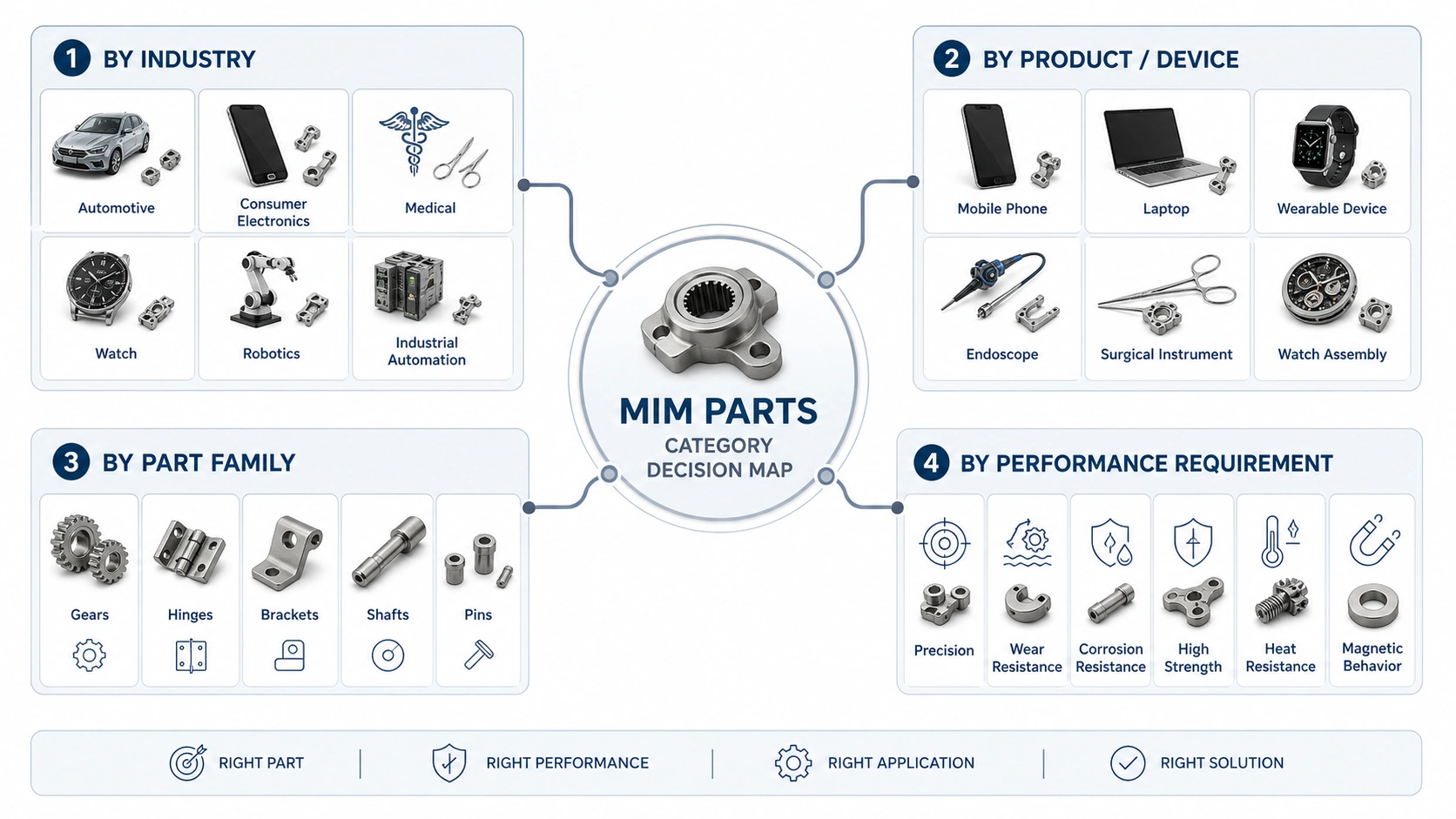
| If you search by... | Start with this category | Example entry pages |
|---|---|---|
| Industry | Industry-Based MIM Parts | Consumer Electronics Parts, Medical Parts, Automotive Parts, Robotics Parts, Industrial Equipment Parts |
| Product or device | Product / Device-Specific MIM Parts | Mobile Phone Parts, Laptop Parts, Wearable Device Parts, Drone Parts, Endoscope Parts |
| Structure or geometry | MIM Part Families | Gears, Hinges, Brackets, Shafts & Pins |
| Performance or material requirement | Performance / Material-Based MIM Parts | Wear-Resistant Parts, Corrosion-Resistant Parts, Soft-Magnetic Parts |
Industry-Based MIM Parts
Industry-based pages show which MIM parts are commonly used in a specific application field. They should not replace industry solution pages. Their job is to show part examples, structural patterns, material needs, tolerance concerns, surface requirements, and production suitability within that industry.
For broader sector-level screening, use the MIM industries hub to understand which industries use metal injection molding and how application environment, validation expectations, surface finish, material selection, tolerance planning, and inspection requirements affect MIM part review.
Automotive MIM Parts
Compact locking components, sensor-related parts, small brackets, shafts, pins, and precision structural components used where strength and repeatability matter.
Consumer Electronics MIM Parts
Small metal parts for phones, laptops, wearable devices, drones, compact hinges, brackets, connectors, miniature housings, and appearance-sensitive components.
Medical MIM Parts
Miniature structural parts, surgical instrument components, endoscope-related parts, dental parts, corrosion-resistant components, and inspection-critical features.
Watch MIM Parts
Small watch components such as case details, clasp parts, gear-related parts, miniature mechanisms, and compact precision metal structures.
Robotics MIM Parts
Compact mechanisms, small gears, shafts, pins, locating components, joint-related parts, and small structural metal features for robotic assemblies.
Industrial Equipment MIM Parts
Motion, locking, mounting, alignment, sensor, wear, fluid-control, and tool-mechanism components used in industrial equipment and automation systems.
Product and Device-Specific MIM Parts
Product and device-specific pages sit under the industry category. They answer a practical engineering question: which MIM parts are used inside this product or device, and which structural pages should the user visit next?
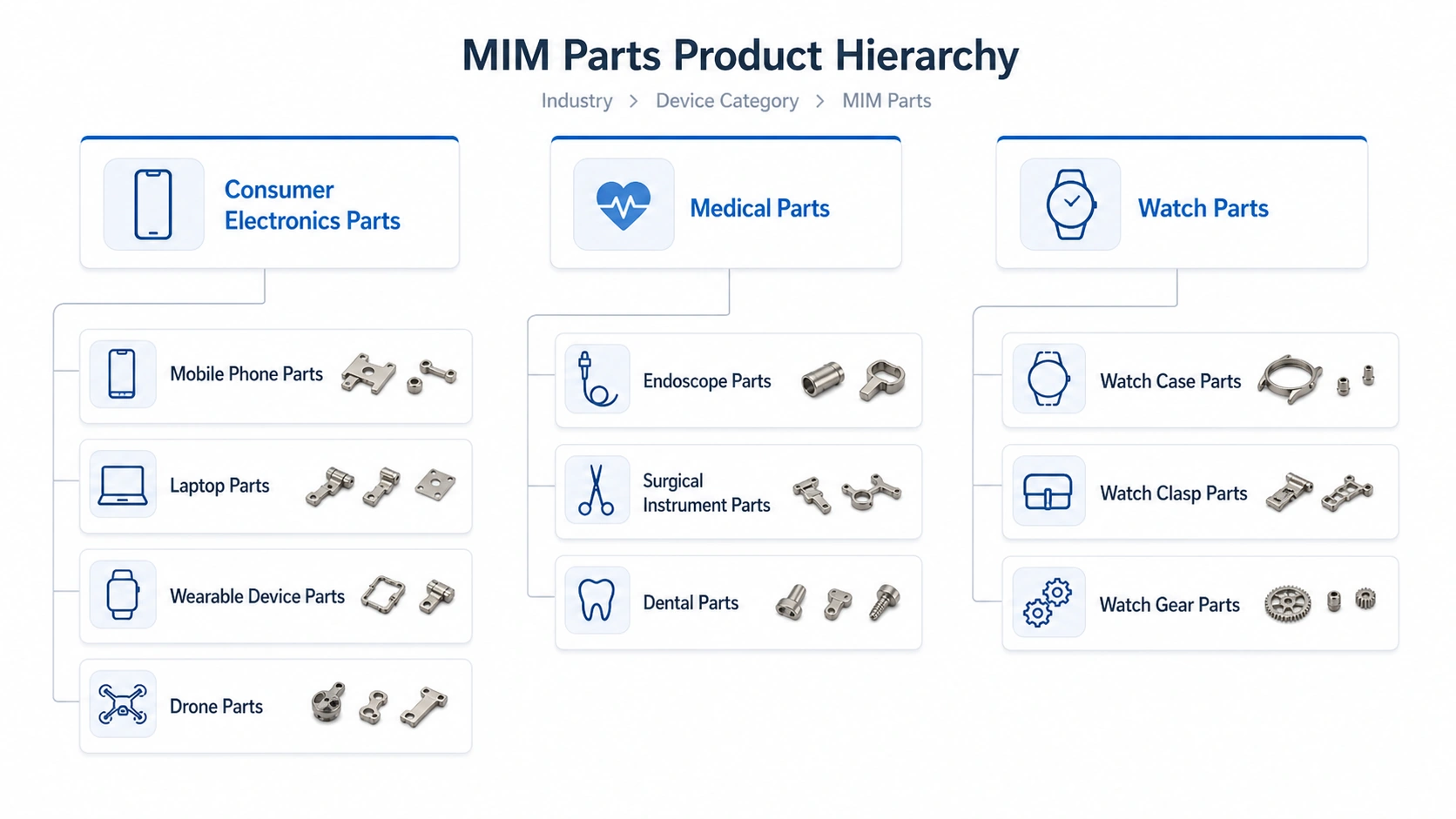
Consumer Electronics Product Parts
These pages show MIM part examples by product type, while linking specific structural parts back to their correct part-family parent pages.
Medical Device Parts
These pages focus on miniature structures, functional metal components, corrosion resistance, assembly requirements, and inspection needs.
Watch Product Parts
Watch product pages should show compact precision components while linking gear-specific content to the MIM gear family when the search intent is structural.
MIM Part Families and Structural Features
Part family pages organize MIM parts by geometry and structure. This is important because MIM manufacturability is usually controlled by wall thickness, section transitions, fine features, holes, gate location, debinding stability, sintering shrinkage, and post-sintering inspection. For the production route behind these part families, review the MIM process behind typical MIM parts, including feedstock, injection molding, debinding, sintering, sizing, secondary operations, and final inspection.

In practice, a part family page should explain manufacturability rather than only display part names. Gear details are now kept inside the part-family path instead of a separate hub-level gear module, so this page stays focused on aggregation and category routing.
Performance and Material-Based MIM Parts
Some users search by performance requirement instead of industry or shape. These pages should explain which parts need a specific property and how that requirement affects material selection, tooling review, secondary operations, and inspection. They should not duplicate the deeper MIM materials pages.

| Performance need | Typical MIM part examples | Review focus | Entry page |
|---|---|---|---|
| High precision | Micro gears, locating pins, compact mechanisms | Datum strategy, shrinkage control, inspection method | High-Precision MIM Parts |
| Wear resistance | Gears, pins, latch components, moving parts | Material selection, heat treatment, friction surfaces | Wear-Resistant MIM Parts |
| High strength | Brackets, shafts, structural components | Alloy selection, density, section thickness | High-Strength MIM Parts |
| Corrosion resistance | Medical, electronics, outdoor-use parts | Stainless steel selection and surface condition | Corrosion-Resistant MIM Parts |
| Heat resistance | Device parts exposed to elevated temperature | Alloy stability, oxidation risk, application limits | Heat-Resistant MIM Parts |
| Soft magnetic behavior | Magnetic components, actuator parts, sensor-related parts | Magnetic alloy selection and process control | Soft-Magnetic MIM Parts |
| Stainless steel or low-alloy steel | Medical, electronics, watch, structural and wear-related parts | Corrosion resistance, strength, heat treatment, cost balance | Stainless Steel Parts / Low-Alloy Steel Parts |
Is Your Part Suitable for MIM?
Not every metal part should be made by MIM. The process is usually reviewed when a part combines small size, complex geometry, production volume, and material performance requirements. If the part is simple, very large, very low-volume, or requires machining on most surfaces, another manufacturing route may be more practical.

| Review item | Good fit for MIM | Needs engineering review | May need another process |
|---|---|---|---|
| Geometry | Small, complex, multi-feature geometry | Local thick sections, deep holes, thin features | Simple pressable, stamped, or machined shapes |
| Size | Small precision metal components | Borderline size or weight | Large heavy parts |
| Production volume | Medium to high production volume | Unclear annual demand | One-off or very low-volume projects |
| Tolerance | MIM-level tolerance with key datum control | Very tight local features | Ultra-tight tolerance across most surfaces |
| Material | MIM-compatible stainless steel, low-alloy steel, or magnetic alloy | Special material request | Material not suitable for feedstock or sintering |
| Secondary operations | Limited machining, heat treatment, or finishing | Critical features need machining | Extensive machining on most surfaces |
Why Category Choice Matters Before Tooling
Composite field scenario for engineering training: a small laptop hinge component was first treated as a general consumer electronics part. During review, the real manufacturing risk was not the industry label. It was the hinge structure, rotation clearance, wear surface, and tolerance stack-up.
| Review step | Engineering finding |
|---|---|
| What problem occurred | The part was grouped only under a laptop parts page, so hinge-specific manufacturability questions were not reviewed early enough. |
| Why it happened | The team searched by product application but did not separate the structural intent from the product intent. |
| Real system cause | The primary URL and review path were not assigned clearly. The part needed both application context and hinge-family engineering review. |
| How it was corrected | The product page linked to the hinge family page, and the hinge review checked rotation clearance, datum surfaces, wear zones, and post-sintering dimensional control. |
| How to prevent recurrence | Assign one primary URL before content creation: industry page for application context, product page for device-level examples, and part family page for structural manufacturability. |
How XTMIM Reviews a MIM Part Before Tooling
For XTMIM, a MIM part review starts from the drawing, not from a generic part name. The same gear, hinge, bracket, shaft, pin, or miniature housing can have different manufacturing risks depending on wall thickness, material, tolerance, section changes, surface finish, secondary operations, and annual volume.

What Our Engineering Team Reviews
- 2D drawing and 3D CAD geometry
- Wall thickness, holes, slots, undercuts and fine details
- Material and performance requirements
- Critical dimensions, datum strategy and tolerance risks
- Sintering shrinkage, support and distortion concerns
- Secondary operations and inspection requirements
What to Send for Review
- 2D drawing
- 3D CAD file
- Material requirement or performance target
- Critical dimensions and tolerances
- Surface finish, heat treatment, plating or passivation needs
- Estimated annual volume and application background
XTMIM Engineering Team
This page is organized from the perspective of MIM part DFM, material suitability, tooling risk, sintering shrinkage, secondary operations, inspection planning, and production feasibility. Its purpose is to help engineers and sourcing teams enter the correct page path before sending drawings for review. For deeper DFM rules, use the MIM design guide after selecting the most relevant parts category.
Technical References and Limits
Public references from MPIF and MIMA are useful for understanding the general MIM process, but they do not replace project-specific engineering review. Critical tolerances, regulated applications, special materials, and magnetic performance targets must be confirmed from the drawing, material specification, inspection plan, and customer requirements before tooling.
MIM Parts FAQ
What parts can be made by MIM?
MIM can be used for small, complex metal parts such as gears, hinges, brackets, shafts, pins, connectors, miniature housings, medical device components, watch parts, sensor-related parts, and compact structural components. For the basic definition and process explanation, read What Are MIM Parts?.
What types of parts are best suited for MIM?
MIM is usually suitable for small, complex metal components with multiple features, fine details, production-volume demand, and material performance requirements. Common examples include gears, hinges, brackets, shafts, pins, connectors, miniature housings, and compact structural parts.
When should a part not be made by MIM?
A part may not be suitable for MIM if it is very large, very simple, very low-volume, mostly machined on critical surfaces, or made from a material that is not practical for feedstock preparation and sintering. Borderline parts should be reviewed before tooling.
How should I choose between industry pages and part family pages?
Use industry pages when you want to see what MIM parts are used in a market such as consumer electronics, medical devices, automotive, watches, robotics, or industrial automation. Use part family pages when your main question is about a structure such as gears, hinges, brackets, shafts, or pins.
Should micro gears be listed under gears or as a separate top-level page?
Micro gears should belong under the gear family. The correct structure is MIM Gear Parts as the parent page, with MIM Micro Gears as a subtype page. This keeps the URL hierarchy clear and avoids flat, confusing parts lists.
Can one MIM part appear in multiple categories?
Yes. A laptop hinge can appear in consumer electronics parts, laptop parts, and hinge-related content. However, it should have only one primary URL. Related pages should reference it through internal links instead of creating duplicate pages with the same intent.
Are stainless steel MIM parts the same as stainless steel MIM materials?
No. Stainless steel MIM materials pages should explain material systems, grades, properties, and processing considerations. Stainless steel MIM parts pages should explain which parts commonly use stainless steel, why the material is selected, and what design, surface, and application factors must be reviewed.
What information should I send for a MIM part quotation?
Send the 2D drawing, 3D CAD file, material requirement, critical tolerances, surface finish needs, secondary operation requirements, estimated annual volume, and application background. This allows the engineering team to review MIM suitability before tooling and quotation.
Submit Your Drawing for MIM Part Review
If your part is small, complex, metal, and intended for production volume, MIM may be worth reviewing before finalizing the manufacturing route. XTMIM can evaluate your drawing for process suitability, material selection, tolerance planning, shrinkage risk, secondary operations, and inspection requirements.
Send your drawing, CAD file, material requirement, tolerance needs, surface finish requirement, estimated annual volume, and application background. The review will help determine whether the part should move forward as a MIM project, be modified for manufacturability, or be considered for another process.