A MIM material should not be selected only by copying an alloy name from a CNC drawing or choosing a familiar stainless steel grade. Before a material is confirmed for metal injection molding, the project team should check the part function, working environment, mechanical load, geometry, critical tolerances, surface treatment, heat treatment, inspection requirements, and expected production volume. This matters because MIM combines fine metal powder, binder-based feedstock, injection molding, debinding, and high-shrinkage sintering. A material that looks suitable on paper may still create filling risk, distortion risk, heat-treatment variation, surface acceptance problems, or cost issues if the part design and RFQ inputs are incomplete. Use this checklist when you already have a drawing, preliminary material requirement, or application background and need to prepare for material review, DFM review, tooling discussion, or supplier quotation.
You have a drawing, target material, application requirement, or early RFQ package and need to check whether the material assumption is ready for supplier review.
A substitute for final material approval, material certificate review, customer specification review, or supplier-supported feedstock confirmation.
The alloy name may be correct, but geometry, tolerance, surface, heat treatment, and inspection requirements may still make the project risky or costly.
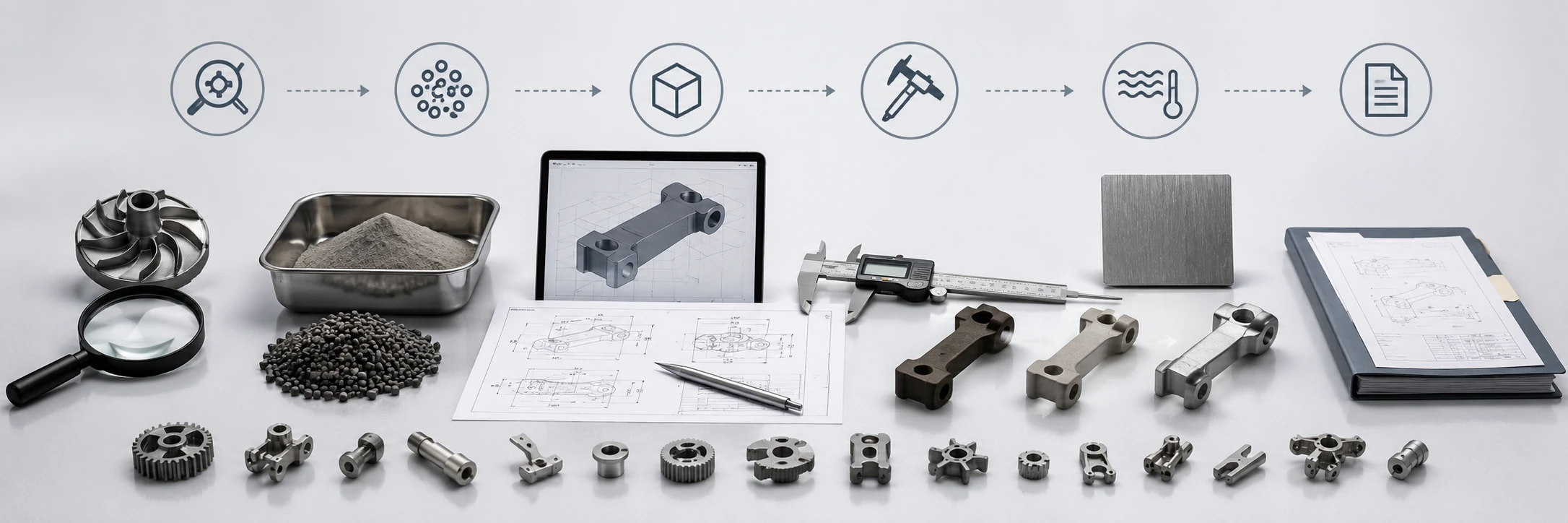
MIM Material Selection Checklist at a Glance
The first review should separate “what material is requested” from “what the part must do.” In practice, a supplier cannot judge material suitability accurately if the RFQ only includes a material name and a 3D model. The checklist below helps engineering and sourcing teams prepare the minimum information needed for a meaningful MIM material review.
| Checklist Area | What to Confirm | Why It Matters for MIM | Related Review |
|---|---|---|---|
| Application | Part function, assembly role, working position | Defines whether strength, corrosion resistance, wear resistance, magnetic behavior, or cosmetic stability matters most. | Application review |
| Environment | Moisture, sweat, salt, chemicals, oil, fuel, heat, cleaning exposure | Affects stainless steel choice, coating, passivation, or alternative alloy review. | Material and surface review |
| Mechanical Load | Static load, impact, wear, fatigue, bending, torque | Influences strength level, hardness, heat treatment, and secondary operation planning. | Mechanical performance review |
| Geometry | Thin walls, holes, slots, undercuts, sharp transitions, micro features | Affects feedstock flow, green part strength, debinding, sintering shrinkage, and distortion risk. | DFM review |
| Critical Tolerances | Datums, fits, mating dimensions, sealing surfaces | Determines whether dimensions can be as-sintered or require machining after sintering. | Tolerance review |
| Surface Requirements | Cosmetic areas, sealing areas, friction areas, coating zones | Impacts gate mark acceptance, polishing, plating, passivation, and inspection criteria. | Surface review |
| Heat Treatment | Hardness, strength, magnetic behavior, wear resistance | May affect dimensional stability, distortion risk, and post-processing sequence. | Process review |
| Volume | Prototype quantity, trial batch, annual demand | Influences tooling decisions, material economics, and production planning. | RFQ review |
| Inspection | Material certificate, hardness test, dimensional report, surface acceptance | Helps align supplier capability with customer acceptance requirements. | Quality review |
What Output Should This Checklist Produce?
This checklist should help the project team reach a clear next-step decision before RFQ, DFM review, or tooling discussion. It is not intended to approve the final material alone; it helps identify whether the project information is ready for supplier review or still incomplete.
Ready for Supplier Review
The material direction, application, geometry, tolerance, surface, inspection and volume inputs are complete enough for a meaningful engineering review.
Equivalent Material Needed
The drawing material may not directly match available MIM feedstock, so an equivalent or substitute material discussion is required.
DFM or Tolerance Review Required
Thin walls, holes, undercuts, heat treatment, shrinkage-sensitive dimensions, or post-machining needs should be reviewed before tooling.
RFQ Package Incomplete
The supplier cannot evaluate material suitability accurately until missing application, environment, load, surface, inspection, or volume data is provided.

What Application Conditions Should Be Checked First?
What function does the part perform in the assembly?
The first question is not “Which MIM material is best?” The first question is “What must this part do after sintering, finishing, assembly, and use?” A hinge pin, locking pawl, medical instrument component, connector housing, gear, sensor bracket, or magnetic component may all be made by MIM, but their material priorities are different.
- Whether the part carries load or mainly provides positioning.
- Whether the part contacts another moving component.
- Whether wear resistance or sliding performance matters.
- Whether corrosion resistance is functional or only cosmetic.
- Whether the part is visible to the end user.
- Whether the part is exposed to temperature, sweat, moisture, salt, oil, cleaning agents, or sterilization.
- Whether the part belongs to a regulated or customer-approved material system.
- Whether the current material callout is mandatory or open to supplier recommendation.
A common mistake is to write “stainless steel” on the drawing without explaining whether the real requirement is corrosion resistance, hardness, appearance, magnetic behavior, cleaning resistance, or customer-approved material matching. For a deeper explanation of how material choice affects real production behavior, see how material selection affects MIM part quality.
What environment will the part face?
Environment affects material selection because corrosion, discoloration, coating failure, or surface degradation may occur even when the mechanical design is acceptable. For example, a part used inside a dry mechanical assembly does not need the same review as a part exposed to sweat, salt, medical cleaning agents, outdoor humidity, or repeated handling.
| Environment Question | Why It Matters |
|---|---|
| Is the part used indoors, outdoors, or in a sealed assembly? | Defines whether general corrosion resistance is enough or whether environmental exposure must be reviewed. |
| Will it contact sweat, salt, water, oil, fuel, or cleaning fluid? | Helps determine whether stainless steel, coating, passivation, or alternative material review is needed. |
| Is the surface cosmetic, functional, or both? | A cosmetic surface may require different gate, polishing, or finishing discussion than a hidden structural feature. |
| Will the part experience repeated heating or cooling? | Heat exposure may affect material, heat treatment, oxidation, and dimensional stability review. |
| Are there customer or industry material restrictions? | Some projects require approved materials, restricted substance review, or documented material traceability. |
If corrosion resistance is the main requirement, the material review may need to connect with MIM stainless steel materials rather than selecting a generic stainless material name.
What Mechanical Performance Requirements Should Be Defined?
Strength, hardness and wear requirements
For MIM projects, mechanical performance should be stated as a functional requirement, not only as a material grade. The requested alloy may indicate a direction, but the supplier still needs to understand what property is critical and how it will be verified after sintering, heat treatment, and final inspection.
- Required hardness range, if applicable.
- Strength requirement or load condition.
- Wear surface or sliding contact area.
- Impact or shock load risk.
- Whether the part must retain ductility.
- Whether the part will be heat treated.
- Whether post-sinter machining is allowed.
- Whether final properties must be verified by a specific test method or customer acceptance rule.
From a design review perspective, “high strength” is not specific enough. A high-strength requirement may lead to low-alloy steel, precipitation-hardening stainless steel, tool steel, or another material family, but each choice may have different heat treatment, corrosion, tolerance, and cost implications. If strength is the main functional driver, review whether the part belongs in a high-strength MIM parts discussion.
Impact, fatigue and ductility concerns
If the part is exposed to repeated loading, vibration, impact, bending, torque, or assembly stress, the material review should include more than hardness. A very hard material may not be the safest choice if the application also needs ductility or impact resistance. In production, this usually depends on alloy system, sintered density, heat treatment route, feature geometry, and the location of stress concentration.
Before selecting a material, engineers should identify whether the load is static, sliding, rotating, bending, or impact-based; whether sharp corners, thin sections, holes, or transitions concentrate stress; and whether the part has any functional surfaces that require both hardness and dimensional control. If the working surface is the key risk, the material review should also consider wear-resistant MIM parts.
Heat treatment and post-sintering risk
Heat treatment can improve hardness, strength, wear resistance, or magnetic behavior, but it may also affect dimensional stability and final inspection planning. If a part has tight tolerances or mating features, the project team should decide whether critical dimensions are controlled as-sintered, after heat treatment, or after secondary machining.
How Do Geometry, Tolerance and Shrinkage Affect Material Selection?
Thin walls, holes and complex features
Material selection cannot be separated from geometry in MIM. The feedstock must fill the cavity, the molded green part must survive handling, binder must be removed without damaging the structure, and the sintered component must meet functional dimensions after shrinkage. A material choice that looks acceptable for a simple block may become risky in a thin-wall, long-flow, undercut, or micro-featured component.
Geometry details that should be reviewed before material confirmation include thin walls, wall thickness transitions, long flow paths, small holes, deep slots, undercuts, side holes, internal features, features that may need sintering support, areas where gate marks are not acceptable, and critical surfaces that may need post-processing. For the broader design framework, use the MIM design guide.

Critical dimensions and datum strategy
Critical dimensions should be identified before material selection is finalized. In MIM, sintering shrinkage, geometry balance, fixture support, and secondary operations can influence final dimensional control. A material that requires heat treatment or additional finishing may also change the inspection sequence.
The drawing should clearly define which dimensions are function-critical, which surfaces are used as datums, which holes or fits are assembly-critical, which dimensions can be as-sintered, and which dimensions may require CNC, grinding, reaming, tapping, or another secondary operation. For detailed dimensional planning, see MIM tolerances.
As-sintered dimensions vs post-machined dimensions
The real question is not whether MIM can produce accurate parts. The real question is which dimensions must be controlled directly from tooling and sintering, and which dimensions should be finished by secondary operation. This choice affects material selection because some materials are more likely to require heat treatment, polishing, machining, passivation, coating, or dimensional correction.
| Dimension Type | Preferred Review Question | Possible Engineering Action |
|---|---|---|
| Non-critical outer profile | Can this remain as-sintered? | Confirm general tolerance and visual acceptance. |
| Assembly hole | Is the hole size critical after sintering? | Consider reaming, drilling, or post-sinter machining if needed. |
| Sealing surface | Is surface finish or flatness functional? | Define surface finish, inspection method, and post-processing route. |
| Threaded feature | Should thread be molded, tapped, or machined? | Review material strength, tool access, and secondary operation sequence. |
| Heat-treated fit | Will heat treatment affect size or distortion? | Define inspection after heat treatment and possible machining allowance. |
If dimension risk is the dominant concern, continue with the MIM tolerance and shrinkage checklist instead of trying to solve all tolerance issues inside a material checklist.
What Surface Finish, Coating and Heat Treatment Details Should Be Confirmed?
Cosmetic surfaces and visible areas
If a MIM part has a visible cosmetic surface, the drawing should clearly mark it. A cosmetic surface may influence gate location, parting line discussion, polishing, tumbling, blasting, coating, passivation, or inspection criteria. Without this information, the supplier may quote the part based on normal functional acceptance, while the customer expects a higher visual standard.
The checklist should confirm which surfaces are visible after assembly, whether gate marks are acceptable, whether parting lines are acceptable, whether color consistency or surface texture matters, whether polishing or coating is required, and whether cosmetic inspection has defined acceptance criteria. Related tooling decisions may also connect with how mold design affects part quality in MIM.
Functional surfaces, sealing areas and friction surfaces
Functional surfaces need more careful review than cosmetic surfaces. A sealing surface, sliding surface, bearing contact, locking face, or mating feature may require specific surface roughness, flatness, hardness, coating, or post-machining. If these requirements are not defined before material review, the selected alloy may be technically possible but not production-efficient.
Passivation, plating, coating and heat treatment requirements
Finishing and heat treatment can change the cost and risk profile of a MIM project. A stainless steel part may need passivation; a wear component may need heat treatment; a cosmetic part may need polishing or coating; a functional feature may need machining after sintering. These requirements should be known before the material is confirmed. For a broader quality view, see factors affecting MIM part quality.
Material Selection Review Triggers Before RFQ
A good checklist should not only collect information. It should also identify conditions that need supplier review before RFQ or tooling. These review triggers do not mean the project is unsuitable for MIM, but they do mean that material, geometry, tolerance, and process assumptions should be reviewed together.

| Review Trigger | Why It Matters | What to Do Before RFQ |
|---|---|---|
| Alloy copied directly from a CNC or wrought material drawing | Wrought material assumptions may not match MIM material behavior, sintered density, heat treatment route, or available feedstock. | Confirm whether an equivalent MIM grade, substitute alloy, or supplier-supported material is available. |
| “Stainless steel” specified without corrosion environment | Stainless materials vary in corrosion resistance, hardness, heat treatment response, and cost. | Define exposure: moisture, sweat, salt, chemicals, cleaning agents, or cosmetic requirement. |
| High strength required but no load case defined | Strength requirement cannot be reviewed without understanding static load, impact, wear, fatigue, or assembly stress. | Provide load direction, functional role, and failure risk. |
| Tight tolerance combined with heat treatment | Heat treatment may affect final size, distortion, and inspection sequence. | Define critical dimensions, machining allowance, and final inspection condition. |
| Cosmetic surface not marked | Gate mark, parting line, polishing, and finishing requirements may be misunderstood. | Mark visible surfaces and unacceptable mark areas on the drawing. |
| Small holes or thin features with demanding material | Filling, green part handling, debinding, and sintering distortion may become more difficult. | Request DFM review before confirming material. |
| Unknown annual volume | Tooling, material economics, and process planning cannot be evaluated accurately. | Provide prototype quantity, trial order, and estimated annual demand. |
| Material chosen before DFM review | The material may be reasonable, but the part may still require geometry or tolerance adjustment. | Review material, geometry, tolerance, and secondary operations together. |
Material Review Red Flags Before Tooling
The following red flags should be resolved before tooling assumptions are finalized. They do not automatically reject a MIM project, but they indicate that material approval, geometry review, tolerance planning, or supplier-supported feedstock confirmation is not yet complete.
| Red Flag | Possible Project Risk | Recommended Action |
|---|---|---|
| CNC or wrought material grade copied directly into the MIM drawing | The specified alloy may not match available MIM feedstock, sintered properties, or heat treatment route. | Ask whether an equivalent MIM material or supplier-supported substitute can be reviewed. |
| Material is mandatory but supplier availability is not confirmed | Quotation may proceed with an unrealistic material assumption. | Separate mandatory customer specification from open material recommendation. |
| Tight tolerance combined with heat treatment | Final dimensions may change after sintering, heat treatment, or secondary operations. | Define final inspection condition, datum strategy, and post-machining allowance. |
| Corrosion requirement without exposure details | The selected stainless material or finishing route may not match the real service environment. | Provide moisture, salt, sweat, chemical, cleaning, or cosmetic exposure information. |
| Cosmetic or functional surface without acceptance criteria | Gate mark, parting line, polishing, coating, or surface inspection expectations may be misunderstood. | Mark critical surfaces and define surface finish, visual standard, or inspection method. |
Composite Field Scenario for Engineering Training: Material Name Was Correct, but the RFQ Inputs Were Incomplete
What problem occurred
A small locking component was submitted for MIM quotation with a stainless steel material requirement and a 3D model. The drawing did not define the operating environment, hardness expectation, visible surface, or critical functional dimensions. The customer expected corrosion resistance, wear resistance, and a clean cosmetic surface, but these expectations were not separated in the RFQ package.
Why it happened
The material name was treated as a complete engineering requirement. The sourcing team assumed that selecting stainless steel would automatically cover corrosion, strength, appearance, and long-term function.
What the real system cause was
The project lacked a material review checklist. Application environment, load condition, surface acceptance, heat treatment expectation, and tolerance strategy were not reviewed before quotation. As a result, the supplier could not judge whether the part needed a corrosion-focused stainless material, a heat-treatable material, secondary finishing, or post-sinter machining.
How it was corrected
The project inputs were reorganized into a material review package: application background, corrosion exposure, contact surfaces, critical dimensions, cosmetic surface zones, target hardness, and estimated annual volume. The material discussion was then combined with MIM DFM design checklist review before tooling assumptions were finalized.
How to prevent recurrence
Do not submit only an alloy name and CAD file when material performance matters. Before RFQ, provide the application, environment, load case, surface requirements, heat treatment needs, critical dimensions, and inspection expectations. This allows the supplier to review material suitability together with MIM process risks.
What Information Should You Provide for a MIM Material Review?

Drawing and CAD files
A material review should begin with geometry, not only material. The supplier needs to see how the material will be molded, debound, sintered, supported, inspected, and possibly post-processed. Provide 2D drawings, 3D CAD files, drawing revision, critical dimensions, datum references, marked cosmetic or functional surfaces, assembly context, and existing part samples if available. You can submit drawing for review when the material requirement is still uncertain.
Material and performance requirements
If the material is already specified by the customer, state whether it is mandatory or open to supplier recommendation. If the material is not fixed, provide the required function and performance target instead. Useful inputs include current or target material, substitute material permission, required strength, hardness, wear resistance, corrosion resistance, magnetic behavior, heat treatment, surface treatment, applicable customer specification, and any material restrictions.
Tolerance, surface and inspection requirements
Material review is more accurate when tolerance and inspection requirements are included. If a drawing has tight dimensions but does not show which ones are critical, the supplier may not know whether tooling control, sintering support, or secondary machining is needed. When shrinkage-sensitive dimensions are involved, review the logic in MIM shrinkage compensation.
Volume, application and project stage
Production volume affects material economics, tooling discussion, sampling plan, and process validation. A prototype request and a production RFQ may need different review depth. The supplier does not need confidential sales forecasts, but a practical range for prototype quantity, trial order, and expected annual demand helps evaluate whether MIM is the right production route.
| RFQ Input | Why It Helps |
|---|---|
| Prototype quantity | Helps determine early-stage trial expectations. |
| Estimated annual volume | Helps evaluate whether MIM tooling and material route are suitable. |
| Project stage | Shows whether the part is concept, prototype, redesign, or production transfer. |
| Target launch timing | Helps plan review sequence, sampling, tooling, and validation discussion. |
| Current manufacturing method | Helps compare whether MIM is replacing CNC, casting, stamping, PM, or another route. |
| Known failure issue | Helps identify whether the material, geometry, process, or inspection method is the real problem. |
If you are preparing a formal quotation package, use the RFQ preparation guide to organize drawings, material requirements, tolerances, surface treatment, expected volume, and project background.
Composite Field Scenario for Engineering Training: Tight Tolerance Was Reviewed Too Late
What problem occurred
A compact precision component was submitted with a heat-treatable material requirement and several tight assembly dimensions. The early RFQ focused on material grade and annual volume, but the drawing did not separate as-sintered dimensions from post-machined dimensions.
Why it happened
The project team assumed that material selection and tolerance review were separate steps. The material was confirmed first, while the heat treatment route, machining allowance, and inspection stage were discussed later.
What the real system cause was
Material selection, heat treatment, shrinkage behavior, and tolerance strategy were not reviewed together. The part had features that required dimensional control after sintering and heat treatment, but this was not visible in the first RFQ package.
How it was corrected
The drawing was updated to identify functional dimensions, datum surfaces, post-machined features, and final inspection conditions. The material review was then linked to DFM review and tolerance planning before tooling discussion continued.
How to prevent recurrence
For MIM projects with tight fits, heat treatment, or precision assembly features, always review material, shrinkage, tolerance, and post-processing together before tooling. A material selection checklist should not end at alloy selection; it should trigger dimensional risk review when needed. For more detail, see how part dimensions affect final MIM quality.
When Should You Use the Full MIM Material Selection Guide Instead?
Use this checklist when you already have a drawing, preliminary material, or project requirement and need to prepare RFQ inputs. Use the full material selection guide when you still need to compare material families, understand MIM material options, or decide whether stainless steel, low-alloy steel, tool steel, titanium alloy, magnetic alloy, or another material family may be more appropriate.
This checklist does not replace the full MIM material selection guide. It helps prepare project inputs after a preliminary material direction exists, while the guide should remain the main page for material family comparison and material selection strategy.
| User Question | Better Page |
|---|---|
| Which MIM material family should I consider? | MIM material selection guide |
| What information should I provide before material review? | MIM material selection checklist |
| Is stainless steel or low-alloy steel better for my application? | MIM materials and material family pages |
| What review triggers should I check before RFQ? | MIM material selection checklist |
| How do geometry, tolerance and shrinkage affect material review? | Checklist first, then DFM and tolerance pages |
| Can XTMIM review my drawing and material requirement? | Submit drawing for review |
FAQ: MIM Material Selection Checklist
What should be checked before selecting a MIM material?
Before selecting a MIM material, check the part function, application environment, mechanical load, critical tolerances, geometry risks, surface treatment, heat treatment, inspection requirements, and expected production volume. These inputs help the supplier judge whether the material is suitable for the MIM process and the final application.
Can I use a CNC material grade for MIM?
A CNC material grade can be a useful starting point, but it should not be treated as automatically suitable for MIM. MIM uses fine metal powder and binder-based feedstock, followed by injection molding, debinding and sintering. Material availability, sintered properties, heat treatment response, and dimensional control should be confirmed with the supplier.
Does material selection affect MIM tolerance and shrinkage?
Yes. Material selection can influence shrinkage behavior, sintering response, heat treatment, and secondary operation planning. If the part has critical fits or tight tolerances, material selection should be reviewed together with shrinkage compensation, datum strategy, and inspection requirements.
What is the difference between a MIM material selection guide and a material checklist?
A MIM material selection guide helps compare material families and choose a material direction. A material checklist helps prepare project inputs after a preliminary direction exists, including application, geometry, tolerance, surface, heat treatment, inspection, and RFQ information.
Should the customer specify the exact MIM material or allow supplier recommendation?
If the material is fixed by a customer specification, state it clearly and provide the required standard or acceptance condition. If alternatives are acceptable, tell the supplier whether an equivalent or substitute MIM material can be reviewed based on function, environment, tolerance, finishing, and production volume.
What RFQ information is needed for MIM material review?
A useful RFQ package should include 2D drawings, 3D CAD files, target material, application background, load condition, environment, critical dimensions, surface finish, heat treatment requirement, inspection requirement, prototype quantity, and estimated annual volume.
When should material selection be reviewed by a MIM supplier?
Supplier review is recommended before tooling when the part has thin walls, small holes, undercuts, tight tolerances, corrosion exposure, wear surfaces, cosmetic surfaces, heat treatment, or customer-specific material requirements. These factors can affect both feasibility and production risk.
Is this checklist enough to choose a final MIM material?
This checklist helps prepare project inputs and identify risks before material review. Final material confirmation should still consider supplier-supported feedstock, part geometry, sintering behavior, required properties, finishing needs, inspection criteria, and customer approval requirements.
Request a MIM Material and DFM Review
If your project involves a preliminary material choice, tight tolerance, corrosion exposure, wear load, heat treatment, cosmetic surface, or complex geometry, send your drawing package for engineering review before tooling discussion.
What to Provide
- 2D drawings and 3D CAD files
- Current or target material, and whether equivalent material is acceptable
- Application background and operating environment
- Critical tolerances and surface finish requirements
- Heat treatment, coating, or inspection requirements
- Prototype quantity and estimated annual volume
What XTMIM Reviews
- Material suitability and substitute material options
- DFM risk from geometry, holes, thin walls and undercuts
- Shrinkage and tolerance concerns before tooling
- Surface treatment, heat treatment and inspection needs
- Production feasibility before RFQ or trial production
Standards and Technical References
MIM material selection should be guided by project requirements, supplier-supported material data, and relevant industry references. MPIF standards are relevant because MPIF Standard 35-MIM covers common materials used in metal injection molding with explanatory notes and definitions. This can support material specification, grade selection, chemistry discussion, and purchaser-manufacturer agreement before production.
MIMA materials range information is relevant because it shows that MIM can use multiple material families and also advises users to confirm alloy or substitute alloy availability with the supplier. This supports the checklist approach used in this article.
EPMA’s MIM overview is relevant for process suitability because it explains MIM as a process for small precision components and complex shapes, and distinguishes MIM from conventional press-and-sinter PM. This supports the need to review material selection together with geometry, tolerance, and process route.
These references support material specification discussion, but they do not confirm a specific supplier’s feedstock availability, process window, heat treatment route, dimensional capability, or production approval. Final material confirmation should still be based on project-specific drawing review, supplier-supported material data, part geometry, sintering response, finishing requirements, and inspection criteria.