Resources / Project Checklists
MIM Project Checklists for DFM, RFQ and Supplier Review
Use this page to choose the MIM project checklist that matches the current review stage: suitability, drawing-based DFM, material selection, tolerance and shrinkage, quality inspection and acceptance, or supplier evaluation. The selected checklist helps organize RFQ inputs and identify when geometry, material, tooling, dimensional, inspection, or production questions require project-specific engineering review.
How This Checklist Hub Differs from the MIM Design Guide
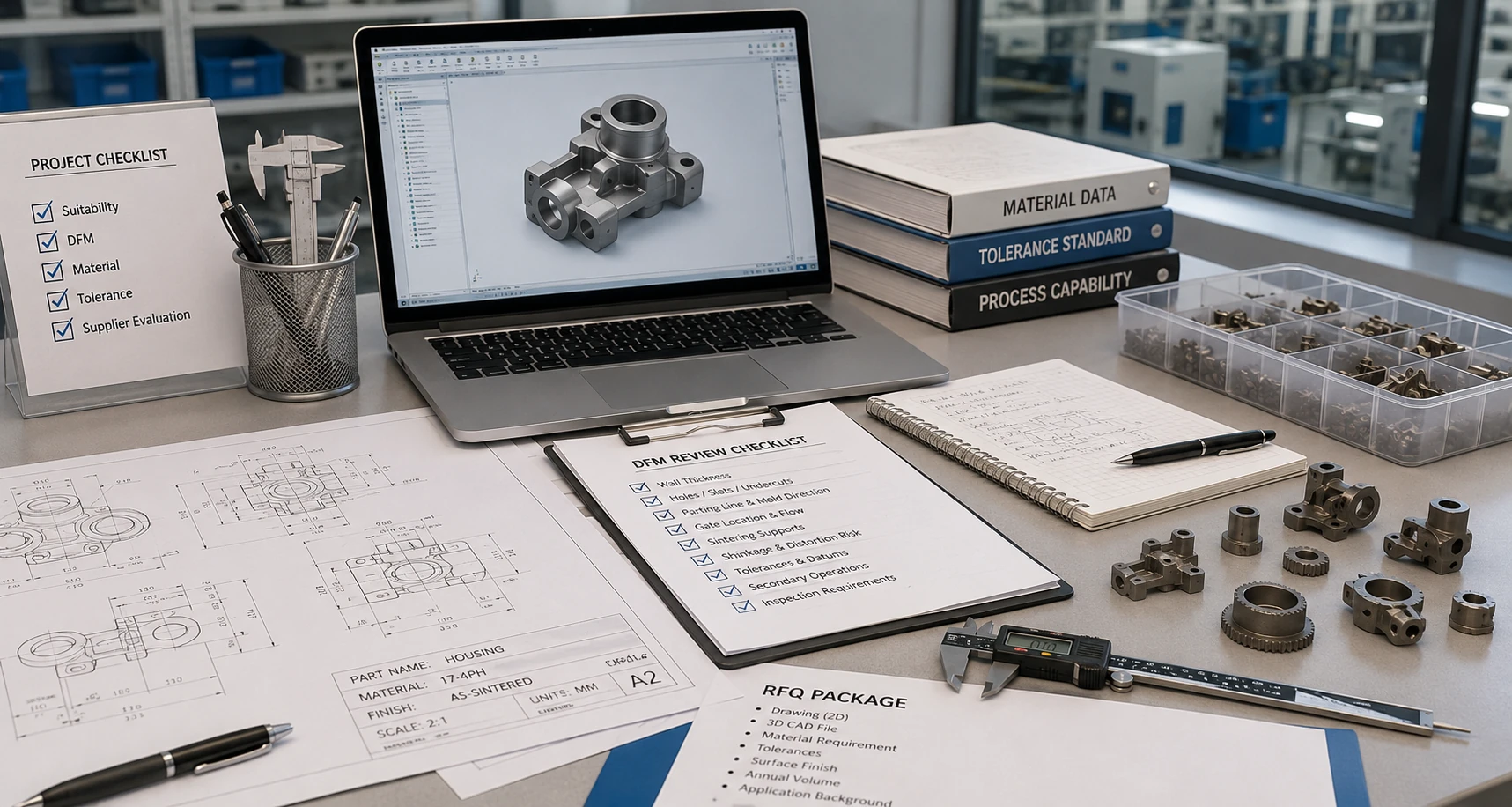
This page helps users choose the right MIM project checklist and prepare the right information before RFQ, tooling review, or supplier evaluation. It should not replace the MIM Design Guide, which explains deeper design principles for metal injection molding.
Use this checklist hub when your main question is “Which review should I perform next?” Use the design guide pages when your main question is “How should this feature be designed for MIM?” This boundary keeps the checklist pages focused on project readiness and keeps detailed engineering guidance in the design guide structure.
| Page Type | Main User Question | Content Depth | Correct Next Step |
|---|---|---|---|
| Project Checklists Hub | Which checklist should I use before RFQ, DFM, material review, tolerance review, or supplier evaluation? | Project-stage routing, checklist selection, RFQ readiness, and review preparation | Choose the relevant checklist or submit drawings for project review |
| MIM Design Guide | How should the part be designed for metal injection molding? | Design principles, feature-level DFM logic, tooling influence, sintering shrinkage, and tolerance strategy | Read the relevant design guide and apply the guidance to the drawing |
| Checklist Subpages | What should I verify before RFQ, tooling, material confirmation, or supplier selection? | Actionable review items for a specific project stage | Use the checklist, prepare missing inputs, and request drawing-based review |
Which MIM Project Checklist Should You Use First?
The right checklist depends on the project stage. A common mistake is starting with supplier comparison before confirming whether the part is a reasonable MIM candidate. Another common mistake is asking for a quote before the drawing identifies critical tolerances, functional surfaces, material expectations, or estimated annual volume.
Use the table below to choose the correct checklist first. If more than one condition applies, start with the checklist closest to the current risk. For example, a drawing-ready part with tight tolerances should usually move from DFM review into tolerance and shrinkage review before tooling approval.

| Project Situation | Best Checklist to Start With | Main Review Focus | Best For | Next Step |
|---|---|---|---|---|
| You are not sure whether MIM is suitable | MIM suitability review checklist | Geometry, part size, material, volume, feature complexity, and cost logic | Early project screening | Continue to DFM review if the part looks suitable |
| You already have 2D or 3D drawings | MIM DFM checklist before tooling | Wall thickness, holes, slots, undercuts, mold action, gate, sintering, tolerances | Drawing-ready projects | Submit drawings for engineering review |
| Material requirements are not finalized | MIM material selection review checklist | Strength, hardness, corrosion, wear, magnetic behavior, temperature, surface treatment | Material uncertainty | Discuss material options with engineering team |
| Tolerances or shrinkage risks are critical | MIM tolerance and shrinkage review checklist | CTQ dimensions, datum strategy, as-sintered vs machined tolerances, distortion risk | Precision or inspection-sensitive parts | Review tolerance strategy before tooling |
| You need to define inspection or acceptance requirements | MIM quality inspection checklist | CTQ reporting, dimensional inspection, material verification, surface condition, sample approval, and acceptance records | Quality planning and sample approval | Align inspection inputs before RFQ, sampling, or production release |
| You are comparing MIM suppliers | MIM supplier evaluation review checklist | DFM support, tooling discussion, quality control, sample approval, production feasibility | Supplier qualification | Contact suppliers with a structured RFQ package |
If you are not sure whether MIM is suitable
Start with the MIM suitability review checklist when the project is still in the screening stage. This is especially useful if the part is currently machined, cast, stamped, assembled from multiple components, or still under product development.
From a design review perspective, MIM should be considered when the part is small, complex, difficult to machine efficiently, or requires metal properties that are not suitable for plastic injection molding. Suitability review should begin with geometry, material, production volume, and feature complexity. Price comparison alone is too early if the part has not been screened for MIM process fit.
If you already have 2D or 3D drawings
Start with the MIM DFM checklist before tooling if you already have a 2D drawing, 3D CAD model, or prototype part. This checklist should help identify whether the design has risks related to wall thickness, holes, slots, undercuts, parting line, gate location, sintering support, shrinkage-sensitive dimensions, or secondary operations.
The real question is not only whether the part can be molded. In MIM, feedstock is injection molded into a green part, then the binder must be removed before sintering. Dimensional stability depends on geometry, material, tooling compensation, green part handling, debinding, sintering shrinkage, and final inspection strategy.
If material requirements are unclear
Use the MIM material selection review checklist when the project requirement says only “stainless steel,” “high strength,” “wear resistant,” or “corrosion resistant” without enough engineering context. A material name alone is rarely enough for a reliable MIM review.
The checklist should collect application environment, strength requirement, hardness expectation, corrosion exposure, magnetic requirement, temperature exposure, surface finish needs, heat treatment, coating, and any existing material specification. For deeper material family review, continue to MIM Materials.
If tolerances or shrinkage risks are critical
Use the MIM tolerance and shrinkage review checklist when the part has tight tolerances, critical-to-function dimensions, flatness requirements, concentricity, position tolerance, thin features, long unsupported spans, or surfaces that may distort during sintering.
In practice, tolerance review should not begin with a single general tolerance number. It should begin by separating critical dimensions from non-critical dimensions, defining datum references, identifying inspection methods, and deciding which dimensions may remain as-sintered and which may require secondary machining.
If inspection and acceptance requirements are critical
Use the MIM quality inspection checklist when the project needs defined inspection methods, CTQ reporting, sample approval criteria, material verification, surface-condition review, or production acceptance records. This is especially important when dimensional results must be tied to drawing datums, inspection equipment, sampling frequency, or agreed reporting formats.
The checklist should clarify which characteristics require measurement, which material or surface conditions require verification, what documents are expected with samples, and who approves deviations or corrective actions. Inspection planning should begin before tooling or sampling when acceptance requirements can influence datum strategy, fixture design, secondary machining, or final reporting.
If you are comparing MIM suppliers
Use the MIM supplier evaluation review checklist when the sourcing question is not simply “Who can quote this part?” but “Who can review this project before tooling and support the part through sample approval and production?”
A capable MIM supplier should be able to discuss DFM, feedstock and material selection, mold structure, gate-sensitive surfaces, debinding and sintering risks, shrinkage compensation, tolerance strategy, inspection planning, and secondary operations. This is also where the buyer should review the supplier’s manufacturing and engineering support capabilities.
MIM Project Checklist Library
This library routes project teams to six distinct review paths. Choose the checklist that matches the current decision, then use drawing-based engineering review when the answer depends on project-specific geometry, material, tolerance, tooling, inspection, or production requirements.

MIM Suitability Checklist
Screen whether the part is a reasonable MIM candidate based on geometry, size, material, volume, tolerance demand, and process economics.
Open suitability review checklistMIM DFM Design Checklist
Review drawing features that can affect molding, green-part handling, debinding, sintering, tooling, and final inspection.
Open DFM review checklistMIM Material Selection Checklist
Organize performance, environment, heat-treatment, magnetic, corrosion, wear, and surface requirements before material selection.
Open material review checklistMIM Tolerance & Shrinkage Checklist
Separate CTQ dimensions from general dimensions and review shrinkage, distortion, datum, machining, and measurement risks.
Open tolerance review checklistMIM Quality Inspection Checklist
Define dimensional inspection, material verification, surface-condition checks, sample approval, reporting, and acceptance requirements.
Open quality inspection checklistMIM Supplier Evaluation Checklist
Evaluate whether a supplier can support DFM, tooling, material, process, inspection, sampling, and production communication.
Open supplier review checklistHow the Six Checklists Divide Project Responsibility
| Review Route | Use It When | Main Decision | Do Not Use It to Replace |
|---|---|---|---|
| Suitability screening | The manufacturing process is still being selected. | Whether MIM is worth deeper evaluation for the part. | Drawing-based DFM or final cost confirmation. |
| DFM review | 2D drawings or 3D CAD are available. | Which geometry and tooling risks require design discussion. | Final tooling approval without engineering review. |
| Material review | Performance requirements are known but the alloy is not finalized. | Which material inputs must be confirmed before recommendation. | Supplier-specific material validation or qualification testing. |
| Tolerance and shrinkage review | CTQ dimensions, distortion, datums, or machining allowances are important. | Which dimensions can remain as-sintered and which need added controls. | Measured capability confirmation before tooling and sampling. |
| Quality inspection review | Inspection methods, acceptance records, or sample approval criteria must be defined. | How CTQs, materials, surfaces, reporting, and release requirements will be verified. | Project-specific inspection plans, gauges, or customer approval procedures. |
| Supplier evaluation | Suppliers are being compared before tooling, transfer, or production commitment. | Whether the supplier can support engineering review and controlled project execution. | Technical review of the actual drawing and requirements. |
How These Checklists Connect to MIM Design Guides
The checklists help you find project review questions. The design guides help you understand why those questions matter. This page should route users to the right checklist first, while the MIM Design Guide explains deeper DFM principles.
For example, the DFM checklist may flag uneven wall thickness. The wall thickness guide explains why thick-to-thin transitions can affect molding, debinding, sintering, and dimensional stability. The tolerance checklist may flag a tight position tolerance. The MIM tolerances guide explains how as-sintered dimensions, datum strategy, machining, and inspection planning interact.

| Checklist Topic | Related Design Guide | Why It Matters |
|---|---|---|
| Wall thickness review | Wall Thickness Guide | Thickness imbalance can affect molding, debinding, sintering, and dimensional stability. |
| Holes, slots, and undercuts | Holes, Slots & Undercuts Guide | Some features may require cores, slides, design changes, or secondary machining. |
| Mold and parting line | Mold Design Guide | Tooling structure affects cost, lead time, parting marks, and production risk. |
| Gate-sensitive surfaces | Gate Design Guide | Gate marks and flow behavior may affect cosmetic or functional surfaces. |
| Sintering distortion | Sintering Supports Guide | Long, thin, flat, or asymmetric parts may require support review. |
| Shrinkage-sensitive dimensions | Shrinkage Compensation Guide | Tooling compensation and first-article correction may be required. |
| Tight tolerances | MIM Tolerances Guide | Some dimensions may need secondary machining or special inspection planning. |
What Information Should You Prepare Before Using These Checklists?
A checklist is most useful when the project inputs are clear. If the only information available is a part photo and a material name, the review may remain preliminary. If the buyer provides drawings, CAD files, tolerance requirements, and application conditions, the checklist can support a much more practical engineering discussion.

| Information to Prepare | Why It Matters for MIM Review |
|---|---|
| 2D drawing with dimensions and tolerances | Shows CTQ dimensions, datum references, inspection requirements, and drawing maturity. |
| 3D CAD model | Helps review geometry, undercuts, wall thickness, mold direction, and support risk. |
| Material requirement or performance target | Supports material selection, heat treatment, corrosion, wear, magnetic behavior, or temperature review. |
| Surface finish requirement | Helps evaluate gate marks, polishing, coating, machining, or cosmetic surface expectations. |
| Heat treatment, plating, coating, or passivation needs | Affects final properties, corrosion behavior, dimensional planning, and process route. |
| Inspection, reporting, and acceptance requirements | Clarifies CTQ measurement, material verification, surface-condition checks, sample approval records, and production release expectations. |
| Estimated annual volume | Helps judge whether tooling investment, cavity planning, and repeat production are reasonable. |
| Application environment | Helps evaluate load, temperature, corrosion, wear, assembly, sealing, and functional risks. |
| Current manufacturing problem | Helps determine whether MIM is being considered for cost, geometry, assembly reduction, material performance, or production stability. |
In practice, a project can start with limited information. However, the review should become more drawing-based before tooling decisions are made. If you are preparing a supplier inquiry, use the RFQ Preparation Guide and then submit your drawing for review.
When Should You Move from Checklist Review to Engineering Review?
Move from checklist review to a drawing-based MIM engineering review when the project has risks that cannot be answered by a general checklist. A checklist can identify warning signs, but it cannot confirm final manufacturability, material suitability, tolerance capability, tooling compensation, or inspection strategy without project-specific drawings and requirements.
Scenario disclosure: The following examples are representative engineering scenarios compiled from common MIM project-review risks. They are not presented as specific customer case studies.
Representative Engineering Scenario: DFM Review Triggers Tolerance Review
- What problem occurred
- A small metal component appeared suitable for MIM because it had complex geometry and a reasonable production volume, but the drawing applied tight tolerances to nearly every surface.
- Why it happened
- The drawing was created from a machined prototype and carried over CNC-style tolerances without separating functional dimensions from non-critical surfaces.
- Underlying project gap
- The project moved directly from prototype drawing to RFQ without a MIM tolerance and shrinkage review.
- Review response
- The team separated CTQ dimensions from general surfaces, identified which features could remain as-sintered, and marked several dimensions for secondary machining discussion.
- Prevention
- Use the DFM Design Checklist and Tolerance & Shrinkage Checklist before RFQ, especially when converting a CNC part to MIM.
Representative Sourcing Scenario: Supplier Evaluation Before Tooling
- What problem occurred
- A buyer compared multiple MIM quotes but did not ask suppliers to review gate location, support surfaces, or shrinkage-sensitive dimensions before choosing a tooling partner.
- Why it happened
- The supplier selection process focused on unit price and tooling cost rather than engineering review capability.
- Underlying project gap
- The RFQ package did not require suppliers to comment on DFM, material, tolerance, and inspection risks.
- Review response
- The buyer updated the RFQ package to include drawing review questions, material requirements, CTQ dimensions, annual volume, and sample approval expectations.
- Prevention
- Use the Supplier Evaluation Checklist before tooling approval, not after sampling problems appear.
Submit Your MIM Project for Engineering Review
Contact XTMIM when your project has a small complex metal part, a drawing-ready MIM candidate, a CNC-to-MIM conversion idea, uncertain material requirements, tight tolerance concerns, or supplier qualification questions before tooling.
Please provide the project information that allows engineering review to be useful:
- 2D drawings and 3D CAD files;
- material requirements or performance targets;
- tolerance requirements and CTQ dimensions;
- surface finish, heat treatment, coating, or passivation needs;
- estimated annual volume and application background.
XTMIM can review MIM suitability, DFM risks, material options, tolerance strategy, tooling concerns, shrinkage-sensitive dimensions, sintering distortion risks, and inspection questions before tooling, trial production, or production transfer.
Frequently Asked Questions About MIM Project Checklists
Which MIM checklist should I use first?
If you are not sure whether the part is suitable for metal injection molding, start with the MIM Suitability Checklist. If you already have 2D or 3D drawings, start with the MIM DFM Design Checklist. If the main concern is tight tolerance or shrinkage risk, use the Tolerance & Shrinkage Checklist. If inspection methods, sample approval, or acceptance records are the main concern, use the MIM Quality Inspection Checklist.
Are these checklists a replacement for engineering review?
No. These checklists help identify project risks and organize information before RFQ or tooling discussion. Complex geometry, tight tolerances, uncertain materials, and critical inspection requirements still need project-specific engineering review.
What should I check before MIM tooling?
Before tooling, review part suitability, wall thickness balance, holes and undercuts, parting line, gate-sensitive surfaces, support surfaces, shrinkage-sensitive dimensions, tolerance strategy, material requirements, secondary operations, and inspection requirements.
Should engineers or buyers use these checklists?
Both can use them, but for different reasons. Engineers use the checklists to review geometry, material, tolerance, and manufacturability risks. Buyers use them to prepare RFQ information and evaluate whether a supplier can support technical review before tooling.
What documents should I prepare before using the DFM checklist?
Prepare a 2D drawing, 3D CAD model, material requirement, tolerance requirements, surface finish needs, estimated annual volume, and application background. If some information is not available yet, the checklist can still help identify what needs to be clarified.
What information is needed for a MIM quote?
A useful MIM quote request should include drawings or CAD files, material requirements, tolerance requirements, surface finish needs, heat treatment or coating requirements, estimated annual volume, target application, and any current manufacturing problem that the project is trying to solve.
How do I know if a material is suitable for MIM?
Material suitability depends on the alloy system, performance requirement, application environment, post-treatment needs, and supplier feedstock availability. Use the MIM Material Selection Checklist to organize these inputs before asking for material recommendations.
When should I use the MIM Quality Inspection Checklist?
Use it when CTQ measurement, datum alignment, material verification, surface-condition checks, sample approval documents, inspection reports, or production acceptance requirements need to be defined before RFQ, sampling, or production release.
When should I use the supplier evaluation checklist?
Use it before tooling approval or supplier selection. It helps sourcing and quality teams evaluate whether a supplier can support DFM review, tooling discussion, material review, tolerance planning, sample approval, and production communication.
Can XTMIM review a drawing before RFQ?
Yes. XTMIM can review drawings, CAD files, materials, tolerances, surface finish requirements, annual volume, and application background to discuss MIM suitability, DFM risks, material options, tolerance strategy, and tooling concerns.
Standards and Technical References Note
MIM project checklists should be used as engineering preparation tools, not as substitutes for official standards, supplier-specific process review, or drawing-based qualification.
- MPIF standards information is relevant for material specification discussions when buyers and engineers need to understand how industry material standards support MIM part specification work.
- MIMA / MPIF Standard 35 information is useful when buyers and engineers need to understand the role of Standard 35 for metal injection molded parts.
- EPMA Metal Injection Moulding information is relevant to shrinkage and sintering review because MIM parts undergo significant dimensional change during sintering, which must be controlled through tooling and process planning.