
316L stainless steel is a practical MIM material when a small metal part needs corrosion resistance, ductility, a clean stainless appearance, and geometry that would be inefficient to machine in volume. For a MIM project, however, “316L” on the drawing is only the material starting point. Final performance depends on powder quality, feedstock consistency, injection molding stability, debinding, sintering density, surface condition, secondary finishing, and inspection requirements. MIM 316L is often reviewed for medical and dental instrument components, wearable hardware, electronic brackets, watch parts, and compact corrosion-exposed precision components. It is usually not the first choice for high-hardness wear surfaces, heat-treated high-strength parts, or regulated applications without project-specific validation. This page helps engineers and sourcing teams decide when 316L is suitable for MIM, when another material should be reviewed, and what information should be prepared before RFQ.
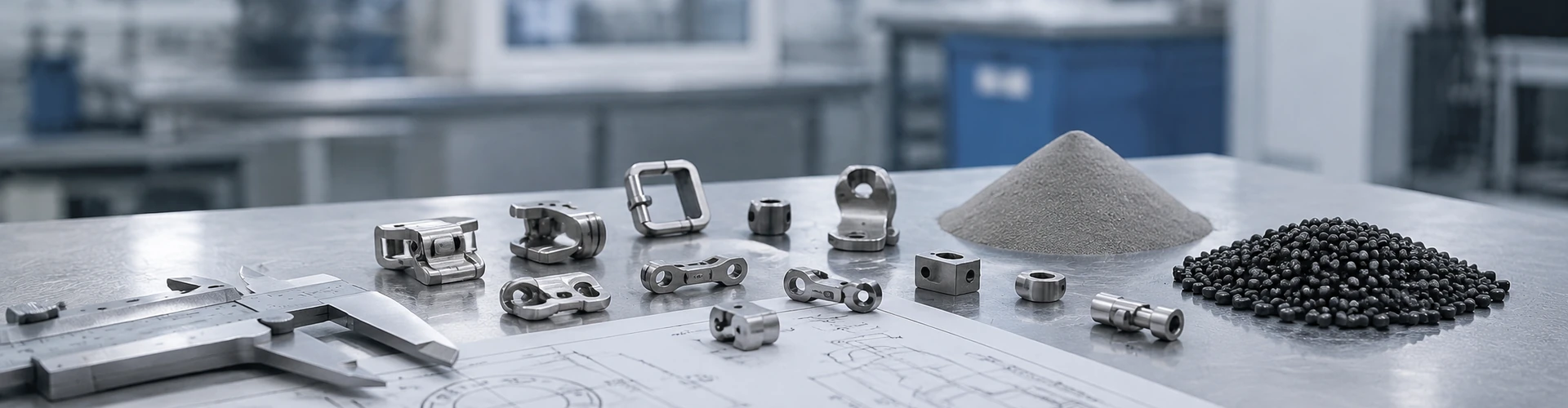
Core conclusion: A 316L material callout does not complete the engineering review. For MIM parts, the drawing must also be checked for feedstock behavior, molding feasibility, debinding risk, sintering shrinkage, gate marks, surface finish, tolerance strategy, and service environment.
Best Fit for MIM 316L
- Small corrosion-resistant stainless steel parts
- Polished or visible stainless hardware
- Complex geometry that is inefficient to machine in volume
- Medical or dental instrument components after specification review
- Wearable, watch, electronic, and compact industrial hardware
Review Another Material or Process
- High-hardness wear surfaces or cutting edges
- Heat-treated high-strength structural parts
- Severe chloride, marine, chemical, or regulated service without validation
- Low-volume simple parts better suited to CNC machining
- Parts where surface treatment and corrosion testing are not defined
For broader stainless grade selection, review stainless steel MIM material family. If the project is still comparing material families, start with the MIM material selection guide.
What MIM 316L Stainless Steel Means in a Real Project
MIM 316L stainless steel is an austenitic stainless steel grade processed through metal injection molding. In the MIM route, fine metal powder is mixed with a binder system to create feedstock, injected into a mold, debound to remove binder, and sintered to form a dense metal component.
The practical question is not only “Can 316L be made by MIM?” It can. The better question is whether the part geometry, corrosion exposure, surface requirement, tolerance target, and production volume make MIM 316L the right manufacturing route.
For B2B project review, 316L is not an unusual or experimental MIM material. It is a practical material option, but it still requires drawing-based review. A part may be chemically specified as 316L but still fail in production because of poor surface planning, distortion, tolerance stacking, or uncontrolled secondary operations.
316L is usually reviewed when the project needs:
- Small or medium-small metal part size
- Complex geometry that is difficult to machine efficiently
- Corrosion-resistant stainless steel
- Good ductility compared with hardenable stainless grades
- Fine surface potential after secondary finishing
- Production volume that can justify MIM tooling
316L still needs DFM review when the design has:
- Thin walls or local heavy sections
- Long unsupported features
- Tight flatness, roundness, or coaxiality requirements
- Deep holes, sealing areas, or thread features
- Visible cosmetic surfaces
- Critical dimensions that may need secondary machining

Core conclusion: Conventional 316L expectations cannot be copied directly into a MIM part. The MIM route changes how the alloy becomes a final component, especially through binder removal, sintering shrinkage, density development, surface condition, and final inspection.
316L Composition and Why It Matters in MIM
316L belongs to the austenitic stainless steel family. Its corrosion resistance is mainly supported by chromium, nickel, molybdenum, and low carbon content. In a MIM project, these alloying elements matter, but composition alone does not guarantee the final part behavior.
Main Alloying Elements in 316L
The table below explains the material logic in engineering terms. It is not a substitute for a project-specific material data sheet or customer acceptance standard.
| Element / Feature | Why It Matters | MIM Project Meaning |
|---|---|---|
| Chromium | Supports passive stainless behavior. | Helps form the corrosion-resistant surface condition expected from stainless steel. |
| Nickel | Stabilizes the austenitic structure. | Supports ductility and general toughness compared with hard martensitic grades. |
| Molybdenum | Improves corrosion resistance in more demanding environments. | Often one reason 316L is reviewed instead of 304 for moisture, cleaning, or chemical exposure. |
| Low carbon | Reduces carbon-related sensitization risk in conventional stainless applications. | Still requires MIM process control because binder removal, carbon control, and sintering atmosphere affect final behavior. |
Why Composition Alone Is Not Enough
A common mistake is to treat the chemical composition table as the whole material decision. For MIM 316L, the powder route, binder removal, sintering cycle, surface finish, and post-sintering treatment also affect the final part.
If the sintered surface is rough, contaminated, porous, or poorly finished, the corrosion behavior may not match the user’s expectation from conventional 316L stainless steel. For this reason, 316L should be evaluated through both material-level suitability and process-level suitability.
Key Properties of MIM 316L Stainless Steel
MIM 316L should be understood as a corrosion-resistant austenitic stainless steel option for molded metal components. It is not a universal stainless material for every project.
Typical MIM 316L Properties for Engineering Review
The values below are early-stage engineering reference ranges, not guaranteed purchase specifications. Final values must be confirmed against the required standard revision, supplier material data, sintering route, part geometry, surface condition, test method, and customer acceptance criteria.
| Property | Typical As-Sintered Reference | What to Confirm Before RFQ or Tooling |
|---|---|---|
| Material family | Austenitic stainless steel | Confirm whether 316L is mandatory or whether 304, 17-4 PH, 420, or 440C can be reviewed. |
| Density | Often reviewed around 7.6 g/cm³ or higher depending on sintering and specification | Confirm density requirement, measurement method, and whether corrosion or mechanical performance depends on a minimum density target. |
| Ultimate tensile strength | Often reviewed around 450–520 MPa as an as-sintered reference range | Confirm test method, sample condition, part geometry effect, and whether the project requires part-level testing. |
| Yield strength | Often reviewed around 140–175 MPa as an as-sintered reference range | Confirm whether yield strength or ductility is more important for the application load case. |
| Elongation | Often reviewed around 40–50% when density and process control are suitable | Confirm whether the application needs ductility, deformation tolerance, or fatigue-related validation. |
| Hardness | Typically moderate for austenitic 316L, often around HRB-level reference values | Review 420, 440C, 17-4 PH, or another alloy if the design needs high hardness or wear resistance. |
| Magnetic behavior | Generally treated as non-magnetic to weakly magnetic depending on processing and condition | If magnetic response is critical, specify the test requirement instead of assuming behavior from grade name alone. |
| Corrosion behavior | Strong candidate for many non-extreme corrosion environments | Confirm surface finish, passivation, density, exposure medium, cleaning method, and corrosion test requirement. |
Corrosion Resistance
316L is often reviewed when the part may face moisture, cleaning, body-contact environments, mild chemicals, or cosmetic stainless surface requirements. The molybdenum content is one reason 316L is commonly considered when corrosion resistance is more important than with general-purpose stainless options.
However, corrosion resistance is not automatic. Final corrosion behavior depends on processing, sintered density, surface condition, polishing, passivation, and the actual service environment. For critical corrosion applications, the buyer should provide the exposure medium, cleaning method, temperature range, surface finish requirement, passivation requirement, service environment, and any customer-specific corrosion test.
Ductility and Toughness
316L is an austenitic stainless steel. Compared with hardenable martensitic stainless steels, it is usually selected more for corrosion resistance, ductility, and general stainless behavior than for high hardness. This can be useful for small brackets, decorative stainless hardware, medical instrument components, and complex parts that require moderate mechanical performance with corrosion resistance.
The limitation is clear: if the part depends on high hardness, wear edge retention, or high load-bearing strength after heat treatment, 316L may not be the best starting point. In those cases, 17-4 PH, 420, 440C, or another alloy family should be reviewed.
Surface Finish and Cosmetic Potential
MIM 316L can be used for parts that require polishing, passivation, or visible stainless surfaces. But cosmetic success depends on early design planning. Visible areas should be identified before tooling. Gate marks, parting lines, ejector marks, polishing allowance, and local distortion can all affect the final appearance.
For wearable, watch, medical instrument, and electronic hardware parts, the cosmetic requirement should be discussed together with gate location and visible surface review, mold layout, MIM tolerance and critical dimension strategy, and finishing method.
Density, Sintering Quality, and Mechanical Reliability
In production, MIM 316L performance depends heavily on sintered density and defect control. Low density, internal pores, incomplete binder removal, surface contamination, or sintering distortion can reduce part reliability.
The engineering review should not ask only, “Can you make this in 316L?” It should ask whether the geometry can sinter uniformly, whether critical surfaces are protected from gate or parting line marks, whether tight dimensions are realistic as-sintered, and whether secondary machining or polishing is required.
When 316L Is a Good Choice for MIM Parts
316L is a strong candidate when corrosion resistance and design complexity are both important. If the part is simple, large, and low-volume, CNC machining may be more practical. If the part is small, complex, and required in repeatable production volumes, MIM 316L becomes more attractive.

Core conclusion: 316L is suitable for corrosion resistance, ductility, appearance, and complex geometry. It is usually not the first choice for high-hardness, high-wear, or heat-treated high-strength requirements.
Use the table below as a screening tool before detailed DFM review. It should not replace drawing-based evaluation.
| Project Requirement | 316L MIM Suitability | Engineering Reason |
|---|---|---|
| Corrosion-resistant small metal parts | Strong candidate | 316L provides useful corrosion resistance for many non-extreme environments. |
| Cosmetic stainless components | Strong candidate | Suitable for polished stainless surfaces when gate location and polishing allowance are controlled. |
| Medical or dental instrument components | Possible candidate | Good stainless behavior, but cleaning, passivation, validation plan, regulatory requirements, and customer acceptance criteria must be confirmed. |
| Thin or complex geometry | Good candidate if DFM passes | MIM can form complex features, but shrinkage and distortion require review. |
| High-hardness wear surface | Usually not first choice | 420 or 440C may be more suitable. |
| Heat-treated high-strength part | Usually not first choice | 17-4 PH or low-alloy steel may be reviewed. |
| Regulated implant-critical component | Requires caution | Do not assume suitability without customer specifications and validation. |
Good Candidate Conditions
- The part is small enough for MIM economics and tooling strategy.
- The geometry is complex enough to justify MIM over CNC.
- The corrosion environment is known and not extreme without testing.
- The design allows reasonable gate, parting line, and support planning.
- Critical tolerances are defined instead of applying tight tolerances everywhere.
- Cosmetic surfaces are clearly identified.
- The expected annual volume supports tooling investment.
For corrosion-driven part families, continue to corrosion-resistant MIM part applications. If the drawing is ready, use submit a 316L MIM drawing for manufacturability review for project-specific evaluation.
When 316L Is Not the Best MIM Material
A professional material page should explain when not to use 316L. This helps engineers avoid selecting a familiar stainless grade for the wrong reason.
High Hardness or Wear-Resistant Parts
316L is not normally selected for high hardness, cutting edges, locking wear surfaces, sliding contact, or abrasive service. If the part needs wear resistance, the material review should include martensitic stainless steels or tool steel options. For MIM stainless projects, MIM 420 stainless steel or MIM 440C stainless steel may be considered when hardness and wear behavior are more important than ductility and general corrosion resistance.
High-Strength Heat-Treated Parts
If the project needs higher strength through heat treatment, 316L is usually not the first candidate. 17-4 PH stainless steel is often reviewed for strength-driven MIM stainless parts because it is a precipitation-hardening stainless grade.
General Stainless Parts With Lower Corrosion Demand
If the part only needs general stainless behavior and the environment is not demanding, MIM 304 stainless steel may be enough. 316L may still be selected for safety margin or customer preference, but it should not be treated as the default answer for every stainless MIM part.
Extreme Corrosion, Regulatory, or Implant Requirements
316L is used in many medical and dental-related components, but the wording must be careful. A MIM 316L part should not be described as implant-ready, medical-certified, or suitable for a regulated device unless the customer’s specification, validation pathway, testing requirements, surface treatment, and quality documentation are reviewed.
Typical Applications of MIM 316L Stainless Steel
MIM 316L is most useful when the application combines corrosion exposure, stainless appearance, and complex geometry. This section lists typical application directions, but the final decision still depends on drawing review.

Core conclusion: The application value of MIM 316L comes from corrosion resistance, small complex geometry, and surface requirements—not from a single industry label.
The table below keeps application discussion at material-page depth. Detailed industry or part-family content should be handled on dedicated MIM parts pages.
| Application Area | Typical MIM 316L Parts | Why 316L May Fit | What to Review Before Tooling |
|---|---|---|---|
| Medical and dental instruments | Handles, brackets, small tool components | Corrosion resistance, cleaning exposure, stainless surface | Cleaning method, surface finish, passivation, validation plan, regulatory requirements, and customer acceptance criteria |
| Watch and wearable hardware | Links, buttons, cases, decorative metal parts | Cosmetic stainless surface, body-contact environment | Gate location, polishing allowance, visible surfaces |
| Consumer electronics | Small brackets, housings, connector hardware | Compact geometry and clean stainless appearance | Assembly tolerance, burr risk, cosmetic surface |
| Automotive and fluid-related parts | Sensor housings, small fittings, brackets | Moisture or fluid exposure with compact geometry | Leakage risk, thread or seat machining, inspection method |
| Industrial devices | Small corrosion-resistant structural parts | Balanced corrosion resistance and formability | Load condition, wear surface, dimensional control |
For deeper application review, see medical MIM parts, watch MIM parts, consumer electronics MIM parts, and automotive MIM parts.
MIM Processing Notes for 316L Stainless Steel
316L is not difficult to understand as a material, but it must be controlled correctly as a MIM product. The process route affects corrosion behavior, dimensional stability, mechanical reliability, and surface quality.

Core conclusion: MIM 316L quality control must connect feedstock, debinding, sintering, surface finishing, and final inspection. Material selection and process control should be reviewed together.
Feedstock and Powder Consistency
MIM begins with fine metal powder and binder. For 316L, powder chemistry, particle size distribution, powder shape, oxygen level, binder system, and feedstock homogeneity affect injection molding, debinding, sintering, and final density.
If feedstock consistency is poor, the result may include inconsistent shrinkage, surface defects, local density variation, or dimensional drift. The user does not need to specify every powder parameter in the RFQ, but the supplier should understand how powder and feedstock influence the final component.
Debinding and Sintering Control
Debinding removes binder before final sintering. If binder removal is incomplete or unstable, the part may experience cracking, contamination, blistering, carbon variation, or sintering defects. During sintering, the part shrinks and densifies. For 316L, sintered density and surface condition directly influence corrosion behavior and mechanical reliability.
Shrinkage and Dimensional Stability
MIM parts shrink during sintering, and tooling must compensate for this shrinkage. For 316L, the issue is not only material shrinkage. Geometry, wall thickness variation, support method, hole features, and local mass distribution can all affect final dimensions.
A common mistake is to apply tight tolerances to every dimension without separating critical-to-function dimensions from general dimensions. This increases tooling correction, inspection effort, and cost.
Surface Finishing, Polishing, and Passivation
316L projects often include surface requirements. Polishing, tumbling, passivation, machining, or local finishing may be required depending on the application. For cosmetic parts, visible areas should be marked on the drawing. For corrosion-exposed parts, passivation or surface treatment requirements should be reviewed based on the application environment.
316L vs Other MIM Stainless Steel Grades
The comparison below is intentionally short. A full comparison should be handled by the MIM material comparison guide, because each material decision depends on application environment, strength, hardness, finishing, tolerance, and cost.
| Material | Main Difference From 316L | When to Review Instead |
|---|---|---|
| 304 | General stainless option with lower corrosion margin in many demanding environments. | Less corrosive or cost-sensitive stainless applications. |
| 17-4 PH | Heat-treatable stainless with higher strength potential. | Structural strength, heat-treated performance, higher load requirements. |
| 420 | Martensitic stainless with hardness potential. | Wear, hardness, mechanical contact. |
| 440C | Higher hardness and wear-oriented stainless option. | Bearings, hard contact surfaces, wear parts. |
| Titanium | Lightweight and special corrosion or medical-related applications. | Weight-sensitive or special regulatory requirements. |
From a design review perspective, the material should be selected by function, not by familiarity. If the drawing says “316L” but the part actually needs wear resistance, 420 or 440C may be more appropriate. If the part needs strength after heat treatment, 17-4 PH may need review. If the part only needs general stainless behavior, 304 may be enough. For detailed grade-to-grade selection, use the MIM material comparison page instead of turning this 316L page into a full stainless steel selection guide.
Design and RFQ Checklist for MIM 316L Parts
Before requesting a quotation for MIM 316L parts, the buyer should prepare enough information for engineering review. A drawing without application context can lead to incorrect assumptions about tolerance, surface finish, corrosion resistance, and secondary operations.

Core conclusion: A MIM 316L quotation should not be based only on a material name. Drawings, CAD files, application environment, tolerances, surface requirements, and annual volume are needed for reliable review.
MIM 316L RFQ Input Checklist
This checklist helps the supplier review both material suitability and manufacturing feasibility before tooling.
| RFQ Input | Why It Matters |
|---|---|
| 2D drawing | Defines dimensions, tolerances, datums, surface finish, and inspection requirements. |
| 3D CAD file | Helps evaluate geometry, wall thickness, undercuts, parting line, and tooling feasibility. |
| Target material | Confirms whether 316L is required or whether equivalent material review is allowed. |
| Application environment | Determines corrosion, cleaning, temperature, fluid, or body-contact considerations. |
| Critical dimensions | Helps separate functional dimensions from general dimensions. |
| Visible surfaces | Supports gate, parting line, and polishing strategy. |
| Surface finish requirement | Affects polishing, tumbling, passivation, machining, and inspection. |
| Annual volume | Helps judge whether MIM tooling is economically reasonable. |
| Testing or customer standard | Clarifies acceptance requirements before tooling. |
What XTMIM Should Review Before Tooling
- Material suitability for the actual service environment
- Whether 316L or another stainless grade is more appropriate
- Wall thickness balance and local mass concentration
- Gate location and visible surface protection
- Sintering support and distortion risk
- Critical tolerance strategy
- Surface finishing and passivation requirements
- Secondary machining needs
- Inspection method and acceptance criteria
- Prototype, tooling, and production planning risks
Composite Field Scenario 1: Polished Wearable Hardware With Visible Gate Mark Risk
Composite field scenario for engineering training.

Core conclusion: For watch, wearable, and cosmetic 316L MIM parts, selecting the right material does not automatically solve appearance risk.
What problem occurred
A small wearable stainless hardware component was specified as 316L because the customer needed corrosion resistance and a polished visible surface. The initial drawing did not identify cosmetic surfaces, acceptable gate mark locations, or polishing allowance.
Why it happened
The material selection was reasonable, but the drawing treated all surfaces as equal. During tooling review, the most practical gate location was close to a visible surface. Without early cosmetic surface marking, the risk of visible gate marks and polishing inconsistency was easy to overlook.
What the real system cause was
The issue was not simply the 316L material. The system cause was incomplete communication between material selection, mold design, cosmetic surface planning, and finishing requirements.
How it was corrected
The visible surfaces were marked on the drawing. Gate location and parting line strategy were reviewed again. A small polishing allowance was considered in the design review, and inspection criteria were separated into cosmetic and non-cosmetic zones.
How to prevent recurrence
For MIM 316L wearable or watch-related parts, define visible surfaces, acceptable marks, polishing direction, and surface finish requirements before tooling. Do not wait until first samples to decide which surfaces are cosmetic.
Composite Field Scenario 2: Corrosion Expectation Without Surface Treatment Review
Composite field scenario for engineering training.
What problem occurred
A small 316L MIM component was selected for a moisture-exposed assembly. The buyer expected corrosion behavior similar to conventional polished stainless steel, but the early RFQ only specified “316L material” and did not define surface finish, passivation, or exposure conditions.
Why it happened
The material grade was treated as a complete corrosion requirement. In reality, corrosion behavior also depends on surface condition, sintered density, residual contamination, finishing, and the actual service environment.
What the real system cause was
The missing link was application-level corrosion review. The supplier was not given enough information about fluid exposure, cleaning method, temperature, or acceptance testing.
How it was corrected
The customer provided the operating environment, cleaning conditions, and surface expectations. The part was reviewed for surface finishing and passivation options. Critical surfaces were identified, and inspection expectations were clarified before production planning.
How to prevent recurrence
When specifying MIM 316L for corrosion resistance, provide the exposure environment and surface requirements with the RFQ. Do not assume that material grade alone defines final corrosion performance.
Request a MIM 316L Manufacturability Review
If your part requires corrosion-resistant stainless steel, complex geometry, visible surfaces, or tight assembly dimensions, send your drawing for a MIM 316L manufacturability review. Please include 2D drawings, 3D CAD files, material requirement, corrosion or cleaning environment, critical tolerances, surface finish needs, visible surfaces, annual volume, and any inspection requirements.
XTMIM can review whether 316L is the right MIM material, whether another stainless grade should be considered, and which tooling, sintering, finishing, or tolerance risks should be confirmed before mold development or production planning.
Submit Drawing for Review Request a Quote Contact XTMIMFAQ About MIM 316L Stainless Steel
Is 316L stainless steel suitable for metal injection molding?
Yes. 316L is a common MIM stainless steel option for small, complex parts that need corrosion resistance, ductility, and stainless surface behavior. The final decision still depends on part geometry, tolerances, surface finish, sintering control, and production volume.
Is MIM 316L corrosion resistant?
MIM 316L can provide useful corrosion resistance for many non-extreme environments, but performance depends on sintered density, surface finish, polishing, passivation, and exposure conditions. For critical applications, corrosion requirements should be reviewed before tooling.
What affects corrosion resistance in MIM 316L parts?
Corrosion resistance is affected by alloy chemistry, sintered density, porosity, surface roughness, residual contamination, debinding and sintering control, polishing, passivation, and the actual exposure medium. Critical corrosion applications should define the environment and test requirement before tooling.
Is MIM 316L stronger than machined 316L?
Not necessarily. Machined or wrought 316L and MIM 316L can show different mechanical properties because their density, grain structure, processing history, and defect profile are different. The correct comparison should be based on required test data, part geometry, and the applicable acceptance standard.
Is MIM 316L suitable for medical parts?
MIM 316L may be reviewed for some medical and dental instrument components, especially non-implant parts. It should not be assumed suitable for implant or regulated applications without customer specifications, validation requirements, surface treatment review, and testing.
Can MIM 316L be polished or passivated?
Yes. MIM 316L parts may be polished or passivated depending on the project requirements. Visible surfaces, acceptable gate marks, polishing allowance, and passivation requirements should be defined before mold design.
What is the difference between MIM 316L and MIM 17-4 PH?
MIM 316L is generally selected for corrosion resistance and ductility. MIM 17-4 PH is usually reviewed when higher strength and heat-treated performance are required. The right choice depends on load, environment, geometry, and inspection requirements.
When should I avoid 316L for MIM parts?
316L is usually not the first choice for high-hardness wear surfaces, cutting edges, heavy load-bearing features, or heat-treated high-strength requirements. 420, 440C, 17-4 PH, or other alloy families may be better candidates.
What should I send for a MIM 316L RFQ?
Send 2D drawings, 3D CAD files, target material, application environment, critical tolerances, visible surface requirements, surface finish needs, annual volume, and any testing or inspection requirements.
Standards and Technical References Note
Relevant standards and technical references can guide material discussion, but they should not replace project-specific DFM review, supplier process validation, material data sheets, or customer acceptance requirements. The exact standard revision and acceptance criteria should be confirmed for each project.
Standards and Association References
- ASTM B883 — Standard Specification for Metal Injection Molded Materials: relevant because it covers ferrous MIM materials and describes the MIM route of powder / binder mixing, injection, debinding, and sintering. It also identifies MIM-316L as an austenitic stainless steel MIM material.
- ISO 22068:2012 — Sintered-metal injection-moulded materials: relevant because it specifies chemical composition, mechanical properties, and physical properties for sintered MIM materials and is intended for components made by the MIM process.
- MPIF Standard 35-MIM: relevant because it covers common materials used in metal injection molding with explanatory notes and definitions.
- MIMA Materials Range: relevant because it identifies stainless steels and 316L among MIM material options while reminding users to confirm alloy availability with suppliers.
Technical Reading
- PIM International discussion of MIM 316L properties: useful technical reading because it explains that MIM 316L mechanical properties depend on final density, grain size, and process defects. It should be treated as industry technical reading, not as a formal material standard.