Manufacturing Process Comparison
MIM vs Stamping — Which Process Should You Review First?
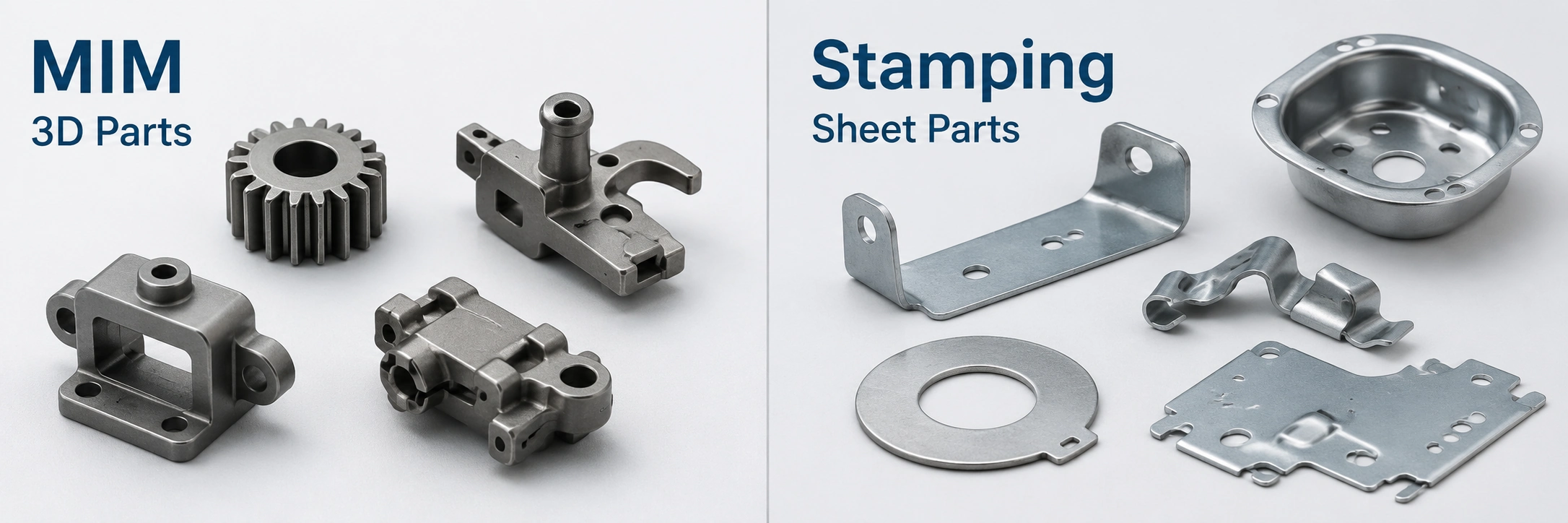
Metal injection molding and stamping solve different manufacturing problems. Stamping is usually the first process to review for flat, bent, drawn, or high-speed sheet metal parts. MIM should be reviewed when a small metal component needs complex 3D geometry, molded features, local thickness changes, reduced assembly, or functional integration that sheet metal forming cannot produce efficiently.
Compare the total finished component route, not only unit price. Stamping often remains the stronger option for simple sheet-metal parts, while MIM deserves review when machining, joining, alignment, inspection, or part consolidation drives cost. The first engineering question is: Is the part still controlled by sheet-metal geometry, or has it become a small complex 3D metal component?
Review Stamping First When
- The part is flat, bent, drawn, or formed from sheet metal.
- Wall thickness is mainly defined by sheet stock.
- High-speed production and low unit cost are the main priorities.
- Burrs, springback, bend angle, and edge condition can be controlled with the die and inspection plan.
Review MIM First When
- The part needs small complex 3D geometry.
- The design has bosses, side holes, slots, fine teeth, local thick sections, or integrated locating features.
- A multi-part stamped assembly may be consolidated into one MIM component.
- Secondary machining, riveting, welding, or assembly variation drives the real project cost.
- Quick Comparison Table
- Sheet-Metal Logic vs 3D Molded-Metal Logic
- When Stamping Is Better
- Stamping Can Be Complex
- When MIM Should Be Reviewed
- DFM Drawing Feature Triggers
- Cost Comparison
- Stamped Assembly to MIM
- Geometry and Design Limits
- Tolerance and Quality Risks
- Material Selection
- MIM vs Deep Drawn Stamping
- Common Mistakes
- Decision Matrix
- Engineering Review Checklist
- Send Drawing If
- Standards & Technical References
- FAQ
Quick Comparison Table: MIM vs Stamping
| Factor | Metal Injection Molding | Stamping |
|---|---|---|
| Starting material | Fine metal powder mixed with binder feedstock | Sheet metal, strip, or coil |
| Forming method | Injection molding, green part handling, debinding, and sintering | Press-and-die cutting, punching, bending, drawing, or forming |
| Best geometry | Small complex 3D metal parts with molded features | Flat, bent, drawn, or formed sheet metal parts |
| Main cost driver | Mold complexity, feedstock, shrinkage control, sintering stability, production volume | Die design, press speed, material utilization, forming sequence, secondary operations |
| Common quality risk | Short shot, gate marks, debinding cracks, sintering shrinkage, distortion, density variation | Springback, burrs, edge cracks, bend variation, die wear, surface scratches |
| Best use case | Compact metal components with 3D integration or assembly-reduction value | High-speed production of sheet-metal components |
| Typical review question | Can MIM reduce machining, assembly, or tolerance stack-up? | Can the design remain a sheet-metal part without unnecessary secondary work? |
MIM vs Stamping: Sheet-Metal Logic vs 3D Molded-Metal Logic
The main difference between MIM and stamping is the way each process creates geometry. Cost matters, but geometry usually decides which process deserves the first technical review.
Stamping starts with sheet metal. A press and die cut, punch, bend, draw, or form the sheet into the required shape. The final part is still strongly influenced by sheet thickness, bend radius, forming direction, die clearance, springback, blank layout, and material formability.
MIM starts with fine metal powder and binder feedstock. The feedstock is injected into a mold, the green part is handled and debound, and the part is sintered into a dense metal component. This route gives more freedom for small 3D shapes, molded details, local features, and part consolidation. For a deeper route explanation, see the XTMIM MIM process, including feedstock preparation, MIM injection molding, debinding, and sintering.

When Stamping Is Usually the Better Choice
Stamping is often the better route when the component is mainly a sheet-metal geometry. It is efficient for high-volume production of flat, bent, drawn, or formed parts, especially when thickness is defined by sheet stock and the required features can be produced through die operations.
Flat brackets, clips, washers, shields, terminals, spring contacts, simple bent parts, drawn cups, sleeves, and shells.
High-speed production with efficient material feeding, repeatable forming, and mature die control.
Springback, burrs, bend angle variation, edge condition, surface scratching, and die wear.
In practice, stamping should be reviewed first when the part is mostly flat, bent, or drawn; when the required wall thickness comes from sheet stock; when high-speed production is important; and when edge condition, flatness, springback, and bend angle can be controlled with die design and inspection.
Stamping Can Be Complex, But It Is Still Sheet-Metal Limited
Stamping should not be described as a low-complexity process. Progressive dies, transfer dies, compound dies, and deep drawing can produce efficient and repeatable sheet metal components. A progressive die can complete multiple cutting and forming operations in sequence, and deep drawing can produce cups, sleeves, shells, and thin-wall housings from sheet material.
The limitation is that stamping remains a sheet-metal forming route. The part must still be created from sheet stock, so the design is constrained by material thickness, bend radius, forming direction, springback, blank layout, die access, and formability.
This becomes important when the design begins to require local thick sections, molded bosses, side holes, internal grooves, fine 3D teeth, complex undercuts, multi-directional features, integrated locating structures, or solid 3D geometry. Those features may still be possible with stamping plus secondary work, but the project should then compare the total manufacturing route, not only the stamping operation.
When MIM Should Be Reviewed Instead of Stamping
MIM should be reviewed when the component is small, complex, three-dimensional, and difficult to manufacture efficiently from sheet metal. The process becomes more relevant when the required function depends on molded geometry rather than sheet-metal forming.
Bosses, slots, grooves, side holes, local thickness variation, fine teeth, or compact 3D functional features.
The stamped design needs machining, riveting, welding, manual assembly, or high inspection effort.
A multi-part stamped assembly may be redesigned as one integrated MIM component.
The strongest MIM candidates are not ordinary sheet metal parts. They are small metal components where the required function depends on 3D geometry, dimensional relationships, molded details, or assembly reduction.
| Design Situation | Better First Review | Reason |
|---|---|---|
| Simple flat bracket | Stamping | Geometry is still sheet-metal based. |
| Bent sheet metal clip | Stamping | Forming and bend control are usually more direct than MIM tooling. |
| Thin spring contact | Stamping | Sheet material and spring behavior usually define the design. |
| Drawn shell with uniform wall thickness | Stamping or deep drawing | Uniform thin-wall sheet geometry normally fits drawing better. |
| Small 3D latch with bosses and slots | MIM review | Molded 3D features may reduce secondary machining or assembly. |
| Miniature gear-like component | MIM review | Fine teeth and compact solid geometry are not natural sheet-metal features. |
| Multi-part stamped assembly with alignment issues | MIM review | Part consolidation may reduce tolerance stack-up and assembly steps. |
| Stamped part requiring heavy CNC machining | MIM review | The total route may be more expensive than near-net-shape molding. |
| Small part with complex side features | MIM review | Slides, cores, or molded features may be more suitable than post-forming operations. |
MIM can form complex features, but those features must still be reviewed carefully. Mold flow, gate position, green part strength, wall thickness transition, debinding stability, sintering support, shrinkage compensation, and inspection datums all affect whether the design is manufacturable.
DFM Review Table: Drawing Features That Trigger MIM Review
A MIM review does not mean the part should automatically be converted from stamping. It means the drawing has features that may require a total-route comparison before tooling. The table below helps engineering and sourcing teams identify when a stamped part or stamped assembly should be reviewed as a possible MIM candidate.
| Drawing Feature | Stamping Risk | Why MIM May Help | Still Need to Check |
|---|---|---|---|
| Bosses or raised locating features | May require welding, riveting, forming workaround, or secondary machining | Features may be molded into one integrated metal component | Gate position, draft, shrinkage compensation, tooling slides, and inspection datum |
| Side holes, grooves, or cross features | May need secondary punching, machining, or difficult die access | Molded cores or slides may form the feature more directly | Core strength, ejection, tolerance, wall thickness, and mold maintenance risk |
| Multi-part stamped assembly | Welding, riveting, staking, manual alignment, and tolerance stack-up | Part consolidation may reduce assembly steps and functional variation | Annual volume, tooling cost, material choice, sintering support, and final cost model |
| Local thick sections or 3D functional blocks | Not natural for uniform sheet metal thickness | MIM can create small solid 3D geometry and local features | Debinding path, sintering distortion, wall transition, and density consistency |
| Fine teeth, compact latches, or precision locking geometry | May require multiple forming steps or post-machining | MIM may form fine 3D details in the mold when size and tolerance are suitable | Tool wear, feature filling, sintered dimension control, and finishing requirement |
| Current part needs heavy CNC after stamping | Low stamped blank cost may be offset by machining and inspection cost | Near-net-shape MIM may reduce downstream operations | Critical tolerances, machining allowance, surface requirement, and total finished component cost |

Cost Comparison: Unit Price Is Not the Whole Decision
For simple sheet metal components, stamping usually has a strong cost advantage. Once the die is built and the process is stable, stamping can produce high volumes quickly and efficiently.
For complex small metal components, the comparison is different. A stamped part may appear cheaper at the individual part level, but the total finished component cost may increase if the design needs secondary machining, deburring, welding, riveting, staking, assembly, or repeated inspection.
MIM should be reviewed when the real cost is driven by more than the stamped part price. This is especially important when the current stamped solution requires additional secondary operations, alignment control, or machining after forming.
For a focused review of this cost trigger, see when secondary machining makes a stamped part worth reviewing for MIM.
| Cost Driver | MIM Cost Behavior | Stamping Cost Behavior |
|---|---|---|
| Tooling | Higher when complex molds, slides, cores, or tight shrinkage control are needed | Higher when progressive dies, transfer dies, or multiple stations are needed |
| Unit cost | Can be competitive for complex small parts at volume | Very competitive for simple sheet metal parts |
| Secondary operation | May reduce machining, welding, riveting, or assembly | May require deburring, bending, welding, riveting, assembly, or machining |
| Material waste | Near-net-shape potential for suitable geometries | Scrap depends on blanking layout, nesting, strip utilization, and part profile |
| Inspection effort | Focused on sintered dimensions, density-related risk, and critical molded features | Focused on burrs, flatness, bend angle, hole location, and assembly fit |
| Design change | Tooling changes can be expensive after shrinkage and cavity compensation are fixed | Die changes can also be expensive after strip layout and forming sequence are fixed |
| Best cost advantage | Complex 3D integration and part consolidation | Simple high-speed sheet production |
If a stamped design already works well, has low scrap, requires minimal secondary work, and is easy to inspect, stamping may remain the better choice. If the stamped design requires several parts, alignment operations, machining, and high inspection effort, MIM may deserve a project-level review.

When a Stamped Assembly Should Be Redesigned for MIM
MIM becomes especially relevant when a product uses several stamped parts assembled into one functional component. In these cases, the cost problem may not be the stamped part itself. The real cost may come from assembly, alignment, welding, riveting, staking, tolerance stack-up, or quality control.
For a narrower part-consolidation review, see when a stamped assembly may be redesigned as one one-piece MIM component.
- Several stamped pieces are joined by welding, riveting, staking, or fastening.
- Alignment variation affects product function.
- Burrs or edge conditions interfere with assembly.
- Bend angle variation causes tolerance stack-up.
- The assembly needs local thick sections or locating features.
- CNC machining is needed after stamping.
- Inspection cost is high because multiple parts must be checked together.
- A one-piece metal design could simplify the product.
Representative Engineering Scenario
Representative problem: A small mechanism uses three stamped pieces joined by riveting. Each stamped part is inexpensive, but the final assembly requires manual alignment and repeated inspection. The assembled mechanism sometimes shows functional variation because small dimensional errors from each stamped part accumulate.
Why it can happen: The issue is not only the stamping process. It comes from the complete system: several thin sheet-metal parts, bend angle variation, burr sensitivity, rivet positioning, and tolerance stack-up across the assembly.
System-level cause: The design depends on multiple formed parts behaving as one functional component. When assembly alignment is a critical dimension, the total process route may become less stable than the individual stamped part cost suggests.
Engineering review approach: During a MIM feasibility review, the team evaluates whether the three functions can be integrated into one molded metal component with built-in locating features, controlled wall transitions, suitable gate position, and manageable sintering support.
What to confirm before tooling: Before tooling, review annual volume, material, critical dimensions, wall thickness, joining method, inspection method, and whether assembly variation is the real cost driver.

Geometry and Design Limits: What Each Process Cannot Do Well
Both MIM and stamping have limitations. A professional process comparison should explain when not to use each process, because a poor process choice can create tooling cost, unstable dimensions, unnecessary secondary work, or delayed production approval.
Stamping Limitations
- Complex 3D solid geometry
- Local thick sections
- Molded bosses or raised functional features
- Internal grooves or undercuts
- Side features that cannot be reached by the die
- Multiple bends with tight tolerance stack-up
- Heavy CNC machining after forming
MIM Limitations
- Large flat sheet-like components
- Very simple stamped geometries
- Very low-volume prototypes
- Thin or long features with weak sintering support
- Extreme thickness variation
- Parts too large for practical MIM tooling and sintering control
- Parts already easy to stamp without assembly or machining issues
Tolerance and Quality Risks: Springback vs Sintering Shrinkage
Tolerance comparison between MIM and stamping should be handled carefully. It is not accurate to say one process is always more precise than the other. The controlling variables are different, so the inspection plan should focus on the dimensions that actually affect product function.
If variation is created across bends, holes, joining points, fixtures, and separate datums, review stamped assembly tolerance stack-up versus one-piece MIM.
In stamping, dimensional variation is often related to die clearance, sheet thickness, material formability, springback, bend sequence, burr formation, and die wear. Hole position, bend angle, flatness, edge condition, and burr height are common inspection concerns.
In MIM, dimensional variation is related to mold filling, gate position, green part handling, debinding stability, sintering shrinkage, sintering support, density, and secondary sizing or machining. Critical dimensions must be reviewed according to shrinkage behavior, datum strategy, and final inspection method.
| Quality Concern | MIM Review Point | Stamping Review Point |
|---|---|---|
| Dimensional control | Shrinkage compensation, sintering support, tooling offset, inspection datum | Die clearance, springback, bend sequence, forming direction |
| Surface condition | Gate mark, sintered surface, secondary finishing needs | Burrs, scratches, edge condition, coating or plating effects |
| Structural risk | Short shot, cracking, distortion, density issue | Edge cracks, bend cracks, formed-feature fatigue |
| Inspection focus | Critical dimensions after sintering, density-related risk, functional 3D features | Flatness, burr height, bend angle, hole location, assembly fit |
| Process drift | Feedstock, molding, debinding, sintering, furnace loading variation | Die wear, material coil variation, press setup, lubrication condition |

Material Selection: Sheet Availability vs MIM Feedstock Availability
Material selection can decide the process before geometry does. A material grade may be available as sheet stock, but that does not mean the same grade is practical as a MIM feedstock. The reverse is also true: a MIM-compatible material does not automatically behave well as sheet metal during cutting, bending, or drawing.
Stamping depends on sheet metal availability, sheet thickness, formability, coating, rolling direction, spring behavior, and surface condition. Even if a material has the required mechanical properties, it must still be suitable for cutting, bending, drawing, or forming.
MIM depends on feedstock availability, powder characteristics, sintering behavior, density requirements, heat treatment response, corrosion resistance, magnetic properties, and secondary operation compatibility. Review MIM materials when the project requires stainless steel, low alloy steel, soft magnetic alloy, or other MIM-compatible material systems.
For this reason, material selection should not be treated as a simple grade comparison. The project team should review material grade, corrosion resistance, strength, hardness, magnetic behavior, heat treatment requirements, surface finishing, critical dimensions, annual volume, and application environment.
MIM vs Deep Drawn Stamping
Deep drawn stamping is an important stamping variation. It is often suitable for cups, sleeves, shells, thin-wall housings, and drawn parts with relatively uniform wall thickness. If the required part is mainly a drawn sheet-metal shape, deep drawing may remain the better first choice.
MIM becomes more relevant when the part is no longer a drawn shell or sleeve, but a small functional 3D component with molded features. Examples include parts with bosses, slots, fine teeth, side features, irregular profiles, or integrated locating structures.
The decision changes when the geometry moves away from uniform sheet-metal walls and toward functional 3D metal features. If the part is a thin drawn shell, deep drawing should usually be reviewed first. If the part needs complex molded geometry or part consolidation, MIM should be reviewed before tooling.
Common Mistakes Before Choosing MIM or Stamping
Mistake 1: Choosing MIM for a Simple Sheet-Metal Part
If the part is a simple flat bracket, washer, shield, or bent sheet component, stamping is often more practical. MIM should not be used just because it can make metal parts. The part must have enough geometry, integration, or assembly value to justify MIM tooling and process control.
Mistake 2: Comparing Only Unit Price
A stamped component may have a lower unit price, but the final product may still cost more if it requires welding, riveting, CNC machining, deburring, or manual assembly. The correct comparison is total finished component cost, not only the price of one formed part.
Mistake 3: Ignoring Stamping Springback
Springback can affect bend angles, hole positions, flatness, and assembly fit. If the design has multiple bends or tight alignment requirements, springback should be reviewed before tooling.
Mistake 4: Ignoring MIM Shrinkage
MIM parts shrink during sintering. Tooling compensation, wall thickness, sintering support, material behavior, and inspection strategy must be reviewed before mold manufacturing.
Mistake 5: Assuming Complex Geometry Automatically Fits MIM
MIM can produce complex features, but not every complex part is a good MIM candidate. Very large parts, extreme wall thickness changes, unsupported thin features, or low-volume projects may not justify MIM.
Decision Matrix: Choose MIM or Stamping Before Tooling
| Project Condition | Choose Stamping First | Review MIM First |
|---|---|---|
| Flat or bent sheet geometry | Yes | No |
| Very thin uniform wall from sheet stock | Yes | Usually no |
| Simple bracket, clip, washer, or shield | Yes | Usually no |
| Drawn shell or sleeve | Yes | Maybe |
| Complex small 3D part | No | Yes |
| Local bosses, slots, grooves, or thick sections | Difficult | Yes |
| Multi-part stamped assembly | Maybe | Yes |
| Need to reduce welding, riveting, or assembly | Maybe | Yes |
| High-speed simple production | Yes | Usually no |
| Heavy CNC machining after stamping | Maybe | Yes |
| Low-volume prototype only | Maybe | Usually no |
| Tight functional integration in a small metal part | Difficult | Yes |
This matrix should not replace a drawing review, but it can help product teams decide which process to evaluate first. If the design is still a sheet-metal part, stamping usually remains the better starting point. If the design requires small complex 3D geometry, molded features, or assembly reduction, MIM should be reviewed before tooling decisions are made.
What to Send for a MIM vs Stamping Engineering Review
A process comparison becomes more accurate when it is based on a real drawing, material requirement, and production scenario. For a MIM vs stamping review, send as much of the following information as possible:
- 2D drawing
- 3D CAD file
- Material grade or performance requirement
- Current stamping drawing or sample photos
- Sheet thickness if the current part is stamped
- Critical dimensions and tolerances
- Estimated annual volume
- Current manufacturing method
- Current production problems, such as burrs, springback, assembly labor, deformation, machining cost, or failure issues
- Surface finish, plating, or heat treatment requirements
- Inspection requirements
- Application background
| Review Item | Why It Matters Before Tooling |
|---|---|
| Critical dimensions | Determines whether the risk is mainly stamping springback, die wear, MIM shrinkage, or sintering distortion. |
| Annual volume | Helps judge whether MIM tooling and process development can be justified. |
| Current production issue | Shows whether the real problem is part cost, assembly labor, secondary machining, inspection, or functional variation. |
| Material and surface requirement | Confirms whether sheet forming or MIM feedstock and sintering are practical for the required performance. |
A drawing-based review helps determine whether MIM is technically and commercially reasonable before tooling. It can also identify design changes that may reduce molding risk, sintering distortion, secondary machining, or assembly cost. For better RFQ preparation, review the RFQ preparation guide before sending project details.
Send Your Drawing for MIM Review If These Problems Exist
If the current stamping route is already stable and simple, MIM may not be necessary. A drawing review becomes more useful when the part or assembly has clear geometry, assembly, cost, or quality problems that stamping alone does not solve efficiently.
The current stamped solution uses two or more parts joined by welding, riveting, staking, or fastening.
The drawing needs bosses, side holes, grooves, fine teeth, local thick sections, or compact 3D functional features.
Secondary machining, deburring, alignment, or repeated inspection drives the real finished component cost.
Springback, burrs, flatness, or bend variation affects assembly fit or functional performance.
The part is technically stamped, but the total route includes too many downstream operations.
A one-piece molded metal component may reduce tolerance stack-up or simplify the product architecture.
Standards & Technical References Note
Metal injection molding should be evaluated as a powder-based manufacturing process, not as a simple substitute for sheet metal forming. MPIF describes MIM as a process using fine metal powder and binder feedstock, followed by binder removal and sintering to produce metal components. MIMA also explains that complex MIM features can be achieved with tooling elements such as slides and cores, but additional complexity can increase tooling and start-up engineering cost.
Sheet metal stamping should be evaluated as a press-and-die forming route. SME describes stamping dies as tools used to shape and cut sheet metal parts after sheet metal is fed into presses, and its stamping resources discuss forming operations such as drawing, bending, flanging, and hemming.
Springback should also be treated as a real engineering variable in stamping. ASM technical literature defines springback as the elastic-driven shape change that occurs after a formed material is released from the forming load. This supports why bend angle, material behavior, forming sequence, and tooling compensation must be reviewed before stamping tooling is finalized.
Useful references: MPIF Metal Injection Molding process overview, MIMA complex designs with MIM, SME sheet metal stamping dies and processes, and ASM Handbook springback reference.
Project decisions should still be based on the drawing, material data, tolerance requirements, expected volume, tooling strategy, and supplier process capability. Do not use general process descriptions as a substitute for a part-specific manufacturability review.
Request a MIM vs Stamping Manufacturability Review
If you are comparing metal injection molding with stamping for a small metal part, send your drawing, 3D file, material requirement, tolerance needs, annual volume, and current manufacturing method.
XTMIM can review whether MIM is technically and commercially reasonable before tooling, especially when your current stamped part requires secondary machining, assembly, welding, riveting, or tighter functional integration.
FAQ
What is the difference between MIM and stamping?
MIM uses metal powder feedstock, injection molding, debinding, and sintering to produce small complex 3D metal parts. Stamping uses sheet metal, dies, and presses to cut, punch, bend, draw, or form sheet-metal parts. The main difference is that MIM is a powder-based molded-metal route, while stamping is a sheet-metal forming route.
Is MIM better than stamping?
MIM is not always better than stamping. MIM is usually better for small complex 3D metal parts with molded features, functional integration, or assembly-reduction potential. Stamping is usually better for flat, bent, drawn, or high-volume sheet metal parts.
Is stamping cheaper than MIM?
Stamping is often cheaper for simple sheet metal parts, especially in high-volume production. However, MIM may become competitive when a stamped design requires secondary machining, welding, riveting, assembly, or high inspection effort. The correct comparison is total finished component cost, not only unit part price.
Can MIM replace stamped parts?
MIM can replace some stamped parts, but not all. It is most useful when a stamped part or stamped assembly becomes too complex, too assembly-dependent, or too limited by sheet-metal geometry. Simple sheet metal brackets, clips, washers, and shields usually remain better stamping candidates.
When should a stamped assembly be redesigned for MIM?
A stamped assembly should be reviewed for MIM when multiple stamped parts require welding, riveting, staking, manual alignment, or additional machining. If one MIM part can reduce assembly steps, tolerance stack-up, and inspection effort, MIM may be technically and commercially reasonable.
Which process is better for small complex metal parts?
MIM is usually more suitable for small complex 3D metal parts, especially when the design includes bosses, slots, grooves, side features, fine teeth, or integrated functional structures. The final decision still depends on part size, wall thickness, material, tolerance, annual volume, and tooling cost.
What information is needed for a MIM vs stamping quote?
A useful review should include a 2D drawing, 3D CAD file, material requirement, critical dimensions, tolerances, annual volume, current manufacturing process, surface requirements, inspection needs, and any current production problems such as burrs, springback, assembly labor, or machining cost.