Share your drawing, material requirements, annual volume, tolerance needs, or application details. Our engineering team will review your MIM project and respond with technical feedback or a quotation.
How Industry Requirements Affect MIM Material Selection
Quick Answer: Industry requirements affect MIM material selection by defining what the finished part must survive and how it must be verified. Corrosion resistance, strength, hardness, wear, magnetic behavior, density, surface finish, heat treatment, coating, post-sinter machining, and inspection requirements all influence whether a MIM material is suitable before tooling begins. Industry-driven MIM material selection …
Quick Answer: Industry requirements affect MIM material selection by defining what the finished part must survive and how it must be verified. Corrosion resistance, strength, hardness, wear, magnetic behavior, density, surface finish, heat treatment, coating, post-sinter machining, and inspection requirements all influence whether a MIM material is suitable before tooling begins.
Industry-driven MIM material selection should not start from a simple grade list. A medical jaw, automotive latch, wearable hinge, lock cam, soft magnetic core, and tungsten counterweight may all be MIM parts, but they should not be evaluated by the same material logic. 316L stainless steel may fit corrosion and cleaning requirements, 17-4PH may fit strength after heat treatment, 420 may fit wear and hardness, low-alloy steel may fit cost-sensitive strength with corrosion protection, and tungsten alloy may fit compact high-density requirements. The correct MIM material is selected by matching industry function, part geometry, feedstock behavior, debinding and sintering risk, material properties, surface treatment, testing requirements, and production consistency before tooling.
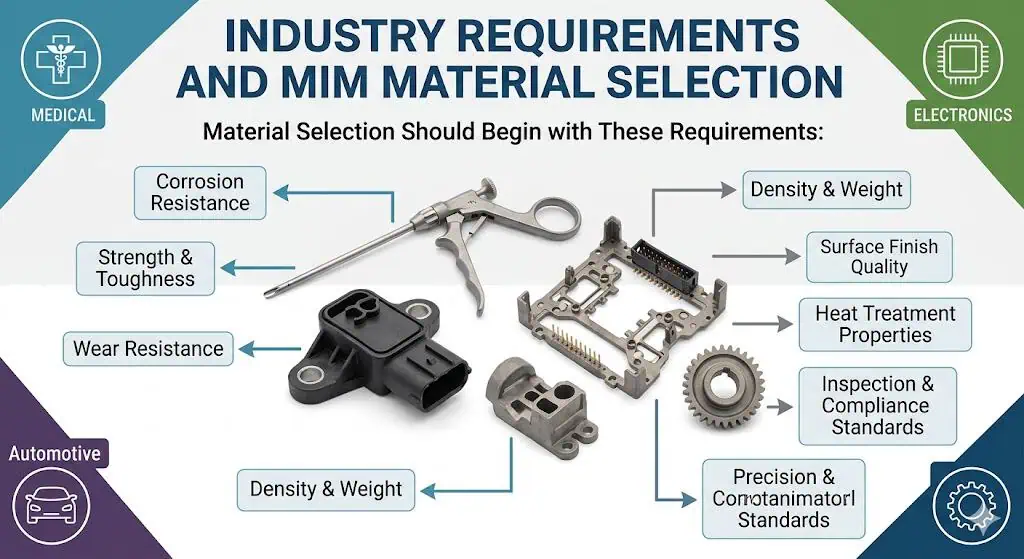
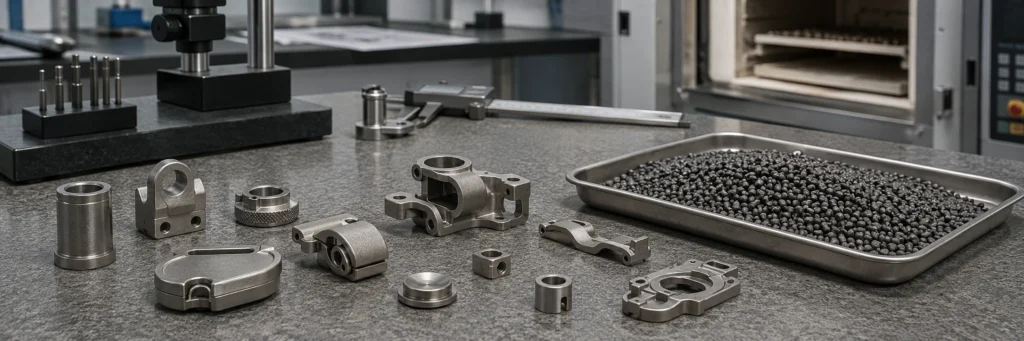
MIM material selection should begin with corrosion, strength, wear, density, surface finish, heat treatment, and inspection requirements.
If you are still evaluating whether a part should use MIM at all, start with the MIM Application Selection Guide. If you want to understand which markets commonly use MIM parts, see the guide on what industries use metal injection molding. For a broader material decision framework, review the MIM material selection guide. This article focuses only on how industry requirements influence MIM materials, testing, finishing, and production approval.
Why Industry Requirements Change MIM Material Selection
Metal injection molding material selection is different from choosing bar stock for CNC machining. In MIM, the material must survive the full manufacturing route: metal powder preparation, feedstock and binder mixing, injection molding, debinding, sintering, shrinkage compensation, optional heat treatment, secondary machining, polishing, plating, PVD, passivation, and final inspection.
ASTM B883 is useful when ferrous MIM materials are specified because it covers metal powders mixed with binders, injection molding, debinding, sintering, and possible heat treatment. MPIF Standard 35-MIM is useful when design engineers, material engineers, and buyers need a common material reference for MIM materials. These references help reduce ambiguity during RFQ, material approval, sampling, and production acceptance, but they do not replace project-specific drawing requirements, function testing, or supplier process validation.
For process context, the Metal Injection Molding Association process overview explains how debinding and brown part handling fit into the MIM route, while the European Powder Metallurgy Association describes MIM as a powder metallurgy process for complex metal parts. These links are useful background, but material approval still depends on drawing requirements, sample data, and production validation.
Industry requirements affect more than the material name. They affect powder choice, binder system, debinding sensitivity, sintering shrinkage, final density, hardness, corrosion resistance, magnetic behavior, coating compatibility, dimensional stability, and batch consistency. This is why a MIM material selection decision should start from the application requirement, not from a generic list of grades.
Industry Requirement vs MIM Material Selection Matrix
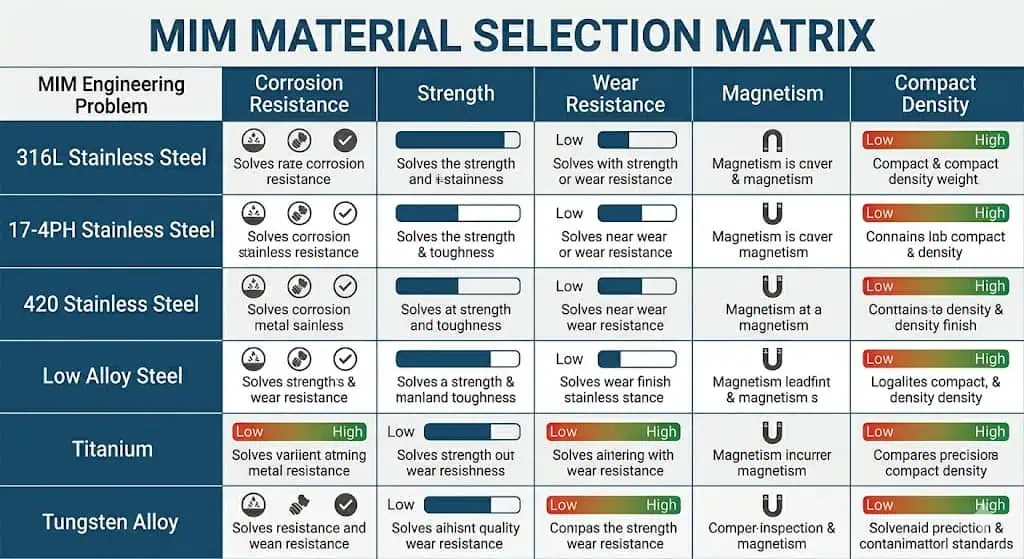
The table below gives a practical starting point for comparing common MIM materials. It should not be used as final approval data. Final material selection still requires drawing review, sample testing, heat treatment verification, density checks, surface treatment trials, application-specific inspection and testing requirements, and production validation. For a broader cross-grade reference, see the MIM material comparison page.
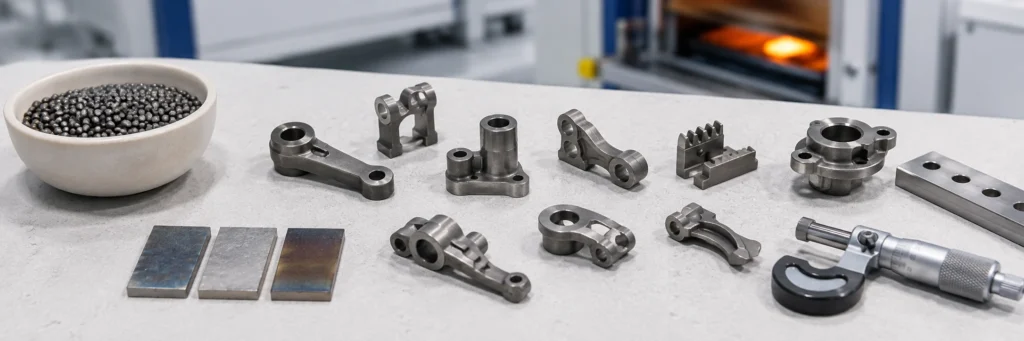
Different MIM materials solve different engineering problems, from corrosion resistance and strength to wear, magnetism, and compact density.
Industry Requirement
Common MIM Material Direction
Why It Is Considered
Main Risk to Verify
Corrosion resistance and cleaning
316L stainless steel, selected stainless grades
Useful for medical, dental, food-contact, and wearable parts
Useful for watch, eyewear, consumer electronics, and lifestyle hardware
Porosity after polishing, PVD defects, plating pits, visible parting lines
Medical and Dental MIM Materials: Corrosion, Cleanability, and Surface Control
Medical and dental MIM parts often start with corrosion resistance, cleaning requirements, passivation, burr control, and traceability. 316L stainless steel is commonly considered because it offers corrosion resistance and finishability, but the grade alone does not approve the part for medical use. The surface condition, density, residual porosity, cleaning route, passivation, and inspection criteria still need to be defined.
For a surgical jaw, dental bracket, endoscopic component, or small medical instrument part, the real material question is not only “Can we use 316L?” The better question is whether the selected MIM material, sintering density, surface roughness, polishing route, passivation process, and post-sinter machining can meet the functional and cleaning requirements.
In one composite field scenario for engineering training, a medical jaw was initially designed as a fully molded MIM component. The selected stainless material was acceptable on paper, but the gripping surface did not perform consistently during functional testing. The problem occurred because the project treated material selection and geometry as separate issues. The real system cause was that the sintered surface was expected to act as a precision contact surface without post-sinter machining. The correction was to keep the body as a near-net-shape MIM part, then machine the gripping face and functional datum after sintering. To prevent recurrence, medical MIM projects should define material grade, machined surfaces, passivated areas, burr limits, cleaning requirements, and inspection-controlled features before tooling.
Automotive MIM Materials: Strength, Heat Treatment, and Batch Consistency
Automotive MIM material selection usually focuses on strength, wear resistance, fatigue behavior, dimensional stability, heat treatment response, and production consistency. Materials such as 17-4PH stainless steel, low-alloy steel, and selected hardenable stainless grades may be considered depending on whether the part needs corrosion resistance, wear resistance, or higher strength after heat treatment.
Automotive parts also put pressure on batch consistency. A material may meet hardness in one trial batch but drift after heat treatment, furnace loading changes, or shrinkage variation. For small brackets, latches, actuator components, sensor-related parts, and transmission-related small hardware, the supplier should confirm density, hardness, microstructure, heat treatment distortion, critical dimensions, and functional gauging.
In one composite field scenario for engineering training, a small automotive bracket was converted from CNC machining to MIM using a material that met the strength target. First samples molded well, but final flatness drifted after sintering and heat treatment. The immediate problem looked like a tolerance issue, but the real system cause was a thick boss connected to a long thin arm, combined with material shrinkage and poor sintering support. The correction was to redesign the boss transition, adjust setter support, and review heat treatment distortion allowance. To prevent recurrence, automotive MIM material selection should be reviewed together with geometry, wall balance, sintering support, heat treatment, and functional gauge strategy.
Electronics and Wearable MIM Materials: Cosmetic Surface, Corrosion, and Coating Risk
Electronics and wearable MIM parts often require small geometry, corrosion resistance, assembly stability, and cosmetic surface control. Stainless steels such as 316L and 17-4PH are often considered, but the final choice depends on strength, polishing behavior, PVD or plating compatibility, and dimensional stability after secondary operations.
For hinges, buttons, watch components, phone hardware, connector parts, and wearable frames, surface treatment is not a final decorative step. It is part of material selection. Polishing may open near-surface pores. PVD may make small pits more visible. Electroplating may expose porosity or adhesion problems. Blasting may change small edges. Therefore, the material, density, surface roughness, polishing allowance, coating route, and cosmetic inspection standard must be agreed before tooling.
In one composite field scenario for engineering training, a wearable hinge made from a stainless MIM material passed dimensional inspection after sintering and polishing. After PVD coating, dark spots and small pits appeared on the visible surface. The problem happened because polishing opened near-surface pores and PVD increased the contrast. The system cause was not only coating quality. The team had approved samples without defining cosmetic zones, pore acceptance, polishing allowance, or pre-PVD inspection. The correction was to improve density control, adjust polishing steps, and inspect before coating. To prevent recurrence, wearable and electronics projects should select MIM materials together with coating route, visible surface criteria, and finishing yield expectations.
Locks, Tools, and Mechanical Hardware: Hardness, Wear, and Contact Stress
Locks, tools, and mechanical hardware usually need material choices based on wear, torque transfer, sliding contact, surface hardness, and sometimes corrosion protection. 420 stainless steel, 17-4PH stainless steel, low-alloy steel, and other hardenable MIM materials may be considered depending on the load, contact condition, and surface environment.
A common mistake is choosing stainless steel only because the part needs to look corrosion-resistant. If the part is a cam, pawl, latch, small gear, sliding block, or tool component, hardness and wear behavior may be more important than appearance. Low-alloy steel may perform better mechanically but need plating, black oxide, oiling, or another corrosion-protection route. 420 stainless steel may provide hardness but still requires heat treatment control and corrosion review.
In one composite field scenario for engineering training, a lock cam passed dimensional inspection but showed early wear during cycle testing. The selected stainless material had acceptable corrosion resistance but insufficient hardness for repeated sliding contact. The real system cause was material selection based on appearance and corrosion resistance rather than contact stress, sliding wear, lubrication, and hardness. The correction was to switch to a hardenable material, add controlled heat treatment, and verify hardness after processing. To prevent recurrence, mechanical hardware projects should review torque, contact area, lubrication, wear testing, heat treatment, corrosion protection, and edge condition before approving the MIM material.
Aerospace, Robotics, and High-Specification Assemblies: Qualification Before Material Approval
Aerospace-related, robotics, and high-specification assemblies may use MIM for small brackets, sensor housings, actuator components, compact structural parts, and mechanism elements. In these applications, material selection should not stop at grade choice. It should include qualification route, density, microstructure, mechanical testing, heat treatment, dimensional stability, traceability, and inspection repeatability.
Titanium alloys, stainless steels, low-alloy steels, soft magnetic materials, and special alloys may all be considered depending on the application. However, high-specification projects often require a higher evidence level than general consumer or industrial hardware. Buyers should ask for test data, sample reports, heat treatment records, dimensional capability, and batch control plan before production approval.
MIM should not be promoted as a shortcut for critical applications. If the part is fatigue-critical, safety-critical, or tightly controlled by customer qualification requirements, the project should define material acceptance, mechanical testing, inspection method, production traceability, and change-control rules before tooling release.
How Surface Treatment Changes MIM Material Selection
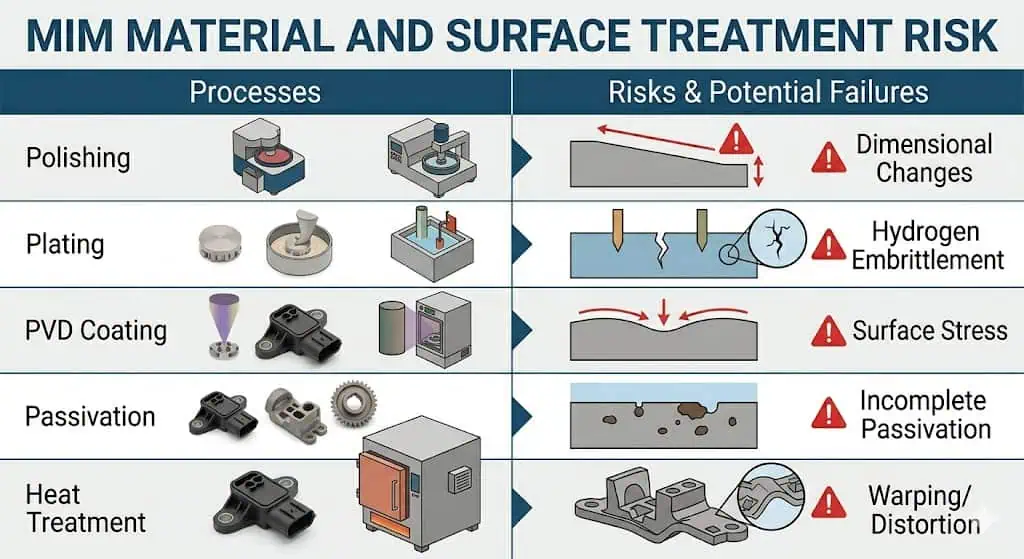
Surface treatment often changes the best MIM material choice. A material that works as-sintered may not work well after polishing, plating, or PVD. A material with good corrosion resistance may not provide enough hardness. A hardenable material may distort after heat treatment. A low-alloy steel may need coating to prevent rust.
Polishing, plating, PVD, passivation, and heat treatment can change material performance, surface quality, and dimensional stability.
Surface or Secondary Operation
Material Selection Impact
Risk to Verify
Polishing
Favors materials and processes with controlled porosity and stable surface response
Open pores, polishing waves, rounded edges
PVD
Requires stable substrate surface, suitable hardness, and clean pre-treatment
Pits, color inconsistency, adhesion, visible pores
Electroplating
May require low porosity, clean surface, and compatible base material
Common for stainless materials where corrosion resistance matters
Surface contamination, incomplete cleaning, wrong material expectation
Heat treatment
Important for 17-4PH, 420, low-alloy steels, and wear parts
Distortion, hardness variation, dimensional drift
Post-sinter machining
Needed when critical surfaces exceed molded tolerance capability
Tool wear, datum control, cost increase, burrs
Sand blasting
Useful for matte surfaces and surface uniformity
Edge rounding, dimensional impact on small features
MIM Material Selection by Performance Requirement
The same industry may require different materials for different parts. A medical handle, dental bracket, locking jaw, sensor housing, and sliding cam should not automatically use the same grade. The table below organizes material selection by engineering requirement and should be checked together with detailed MIM material properties during project review.
Performance Requirement
Material Direction
Typical MIM Parts
Validation Method
Corrosion resistance
316L, selected stainless steels
Medical parts, dental parts, wearable housings, food-contact hardware
Surface inspection, passivation check, corrosion testing if required
High strength
17-4PH, low-alloy steel
Brackets, latches, structural small parts, actuator parts
Watch parts, eyewear hardware, wearable hinges, decorative parts
Polishing trial, PVD or plating trial, cosmetic standard approval
When Not to Choose a Material Only by Grade Name
A grade name does not guarantee MIM performance. The same material family can behave differently depending on powder characteristics, binder system, powder loading, debinding route, sintering atmosphere, furnace loading, heat treatment, part geometry, and finishing process.
Do not select a MIM material only by matching a CNC drawing material. Wrought 316L, machined 17-4PH, and MIM 17-4PH do not automatically behave the same in every design. MIM introduces powder, binder, debinding, sintering shrinkage, density, porosity, and secondary operation variables that should be reviewed during material approval.
Common Mistake
Why It Is Risky
Better Engineering Approach
Choosing 316L for every medical-looking part
It may lack hardness or wear resistance for moving contact
Check corrosion, wear, surface, cleaning, and contact requirements
Choosing 17-4PH only for strength
Heat treatment may change size or flatness
Confirm heat treatment distortion and post-machining needs
Choosing 420 only for hardness
Corrosion and heat treatment control may be insufficient
Verify hardness, corrosion environment, and dimensional stability
Choosing low-alloy steel only for cost
Rust risk and coating cost may offset savings
Review total cost including plating, oiling, packaging, and inspection
Choosing tungsten alloy only for density
Heavy sections can increase sintering and distortion risk
Review geometry, support method, debinding time, and brittleness
Choosing titanium only for weight
Cost and qualification burden may be high
Confirm real weight benefit, qualification need, and production volume
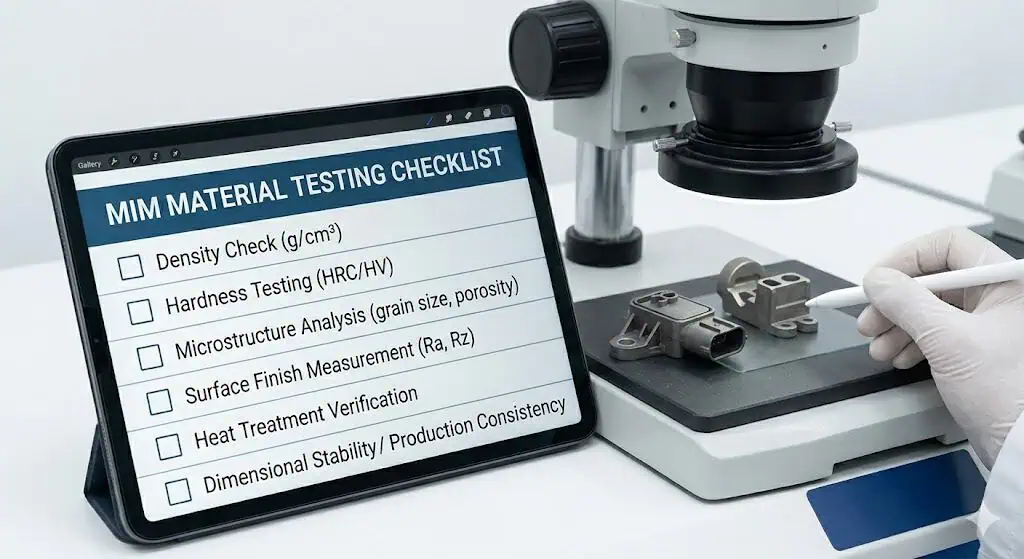
MIM Material Testing and Production Acceptance Checklist
Material selection is not complete until the project defines how the material will be verified. For production MIM parts, buyers should avoid vague requirements such as “good strength,” “good corrosion resistance,” or “good surface.” These should be converted into measurable inspection or qualification items.
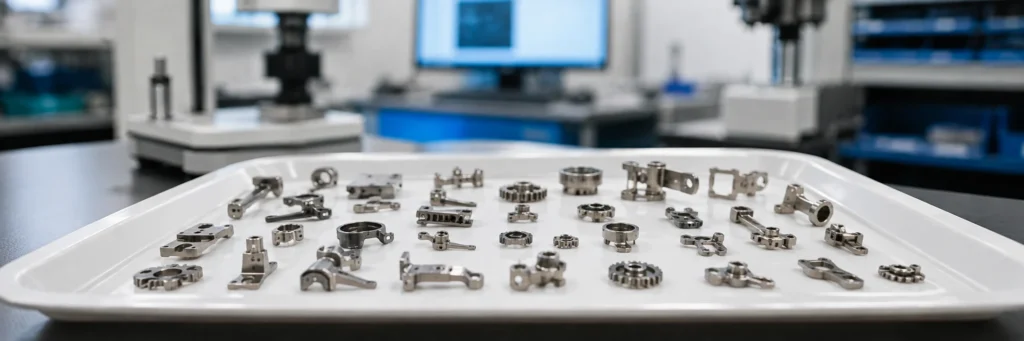
MIM material approval should include density, hardness, microstructure, surface finish, heat treatment, and production consistency checks.
Critical dimensions before and after heat treatment or coating
Prevents assembly failure and batch drift
Batch consistency
Cavity tracking, SPC data, inspection plan
Reduces mass production surprises
How to Discuss MIM Material Selection During RFQ
A good RFQ should not only ask for a material price. It should explain the function of the part and the industry requirement behind the material choice. The supplier cannot make a reliable recommendation if they only receive a 3D model with a vague grade name.
Before asking for a MIM quote, provide the part application, working environment, annual volume, material preference, corrosion requirement, hardness requirement, wear condition, magnetic requirement, surface finish requirement, heat treatment requirement, coating or plating requirement, critical dimensions, cosmetic surfaces, and inspection method.
Ask the supplier to confirm whether the requested material is suitable for MIM, whether an alternative MIM material would reduce risk, which dimensions may need post-sinter machining, whether heat treatment will affect size, whether polishing or coating may reveal pores, and what tests should be used for sample approval and mass production. If the material choice is still uncertain, you can submit your drawing for MIM material review before releasing tooling.
Material Selection Decision Table for Buyers and Engineers
If Your Main Requirement Is
Start by Reviewing
Do Not Forget
Corrosion resistance
316L, passivation, surface cleanliness
Wear and hardness may still be insufficient
High strength
17-4PH, low-alloy steel, heat treatment
Heat treatment may move dimensions
Sliding wear
420, low-alloy steel, hardenable materials
Lubrication, surface roughness, and edge condition matter
Cosmetic finish
316L, 17-4PH, polishing trial, PVD or plating trial
Porosity can appear after finishing
Magnetic behavior
430 or soft magnetic material
Magnetic testing is part of material approval
High density
Tungsten alloy
Debinding and sintering risk increase with heavy geometry
Low weight
Titanium alloy
Cost, oxygen control, and qualification burden must be justified
Lower cost
Low-alloy steel, simpler finishing route
Coating, rust prevention, and inspection may add cost back
When Material Choice Can Make MIM the Wrong Process
Sometimes the material requirement is the reason not to use MIM. If the project needs a material that is not proven in a MIM route, a very large cross-section that is difficult to debind, an ultra-smooth sealing surface without post-sinter machining, or a critical fatigue property without qualification data, MIM may not be the right first process. In those cases, CNC machining, forging, casting, or another powder metallurgy route may be safer.
This does not mean MIM is unsuitable for demanding parts. It means the material, geometry, testing plan, and production evidence must support the decision. A practical MIM material selection decision should always answer two questions: can the material be processed consistently by MIM, and can the finished part meet the industry requirement after sintering and secondary operations?
Final Engineering Rule for MIM Material Selection
The best MIM material is the one that fits the industry requirement, part function, geometry, process route, surface finish, inspection plan, and production volume together. It is not always the strongest material, the most corrosion-resistant material, or the lowest-cost material.
Use 316L when corrosion resistance and finishability are more important than hardness. Use 17-4PH when strength after heat treatment is needed and dimensional change can be controlled. Use 420 or hardenable materials when wear and hardness are central. Use low-alloy steel when strength and cost matter, but corrosion protection is acceptable. Use tungsten alloy when compact density is the real requirement. Use titanium alloy only when weight, corrosion resistance, and qualification requirements justify the added cost and process control.
A reliable MIM material decision connects industry requirements with engineering evidence. Before tooling, confirm the material grade, powder route, density target, heat treatment, post-sinter machining, surface treatment, test method, and acceptance criteria. When this review is skipped, the project may pass the first material discussion but fail during polishing, coating, assembly, wear testing, or mass production inspection.
Need Help Reviewing a MIM Material for Your Part?
If your drawing includes corrosion, strength, wear, magnetic, cosmetic, heat treatment, or inspection requirements, XTMIM can review whether the requested material is suitable for MIM and whether an alternative grade may reduce production risk.
FAQ: How Industry Requirements Affect MIM Material Selection
How do industry requirements affect MIM material selection?
Industry requirements affect MIM material selection by defining what the part must survive: corrosion, wear, load, cleaning, heat treatment, magnetic function, cosmetic finishing, coating, assembly, or qualification testing. The correct MIM material is selected by matching these requirements with the MIM process route and inspection plan.
Is 316L always the best MIM material for medical parts?
No. 316L is often considered for medical MIM parts because of corrosion resistance and finishability, but it is not automatically the best choice for wear, cutting, sliding, or high-hardness requirements. Medical MIM parts still need surface, cleaning, passivation, burr, density, and functional validation.
When should 17-4PH be used for MIM parts?
17-4PH is often considered when a MIM part needs higher strength after precipitation hardening and moderate corrosion resistance. It is commonly reviewed for structural small parts, brackets, latches, and mechanisms, but heat treatment distortion and dimensional change must be checked.
When is 420 stainless steel better than 316L for MIM?
420 stainless steel may be better than 316L when hardness and wear resistance are more important than maximum corrosion resistance. It may be considered for lock parts, small shafts, tool components, and wear parts, but heat treatment and corrosion conditions must be reviewed.
Why do MIM materials need density and porosity checks?
Density and porosity affect strength, fatigue behavior, polishing, plating, PVD appearance, corrosion risk, and leakage risk. A part may meet dimensions but still fail if porosity is too high for the required function or surface finish.
Can surface treatment change the best MIM material choice?
Yes. Polishing, plating, PVD, passivation, blasting, and heat treatment can all change material suitability. A material that works as-sintered may show pits after polishing or dimensional drift after heat treatment. Surface treatment should be reviewed before tooling.
What should buyers ask before approving a MIM material?
Buyers should ask for material grade confirmation, density expectations, heat treatment plan, surface treatment route, critical dimension strategy, hardness target, corrosion or wear test requirements, and production inspection plan. For critical parts, sample approval should include function testing, not only dimensional inspection.
Can the wrong material make MIM unsuitable?
Yes. If the required material is not proven for MIM, needs properties that cannot be validated after sintering, or requires surfaces that need heavy machining anyway, another process may be safer. Material selection should be reviewed together with geometry, testing, secondary operations, and production volume.