Demander un devis de moulage par injection de métal
Partagez votre dessin, vos exigences de matériau, votre volume annuel, vos besoins de tolérance ou les détails de votre application. Notre équipe d'ingénierie examinera votre projet MIM et répondra avec un retour technique ou un devis.
Comment les exigences industrielles influencent le choix des matériaux MIM
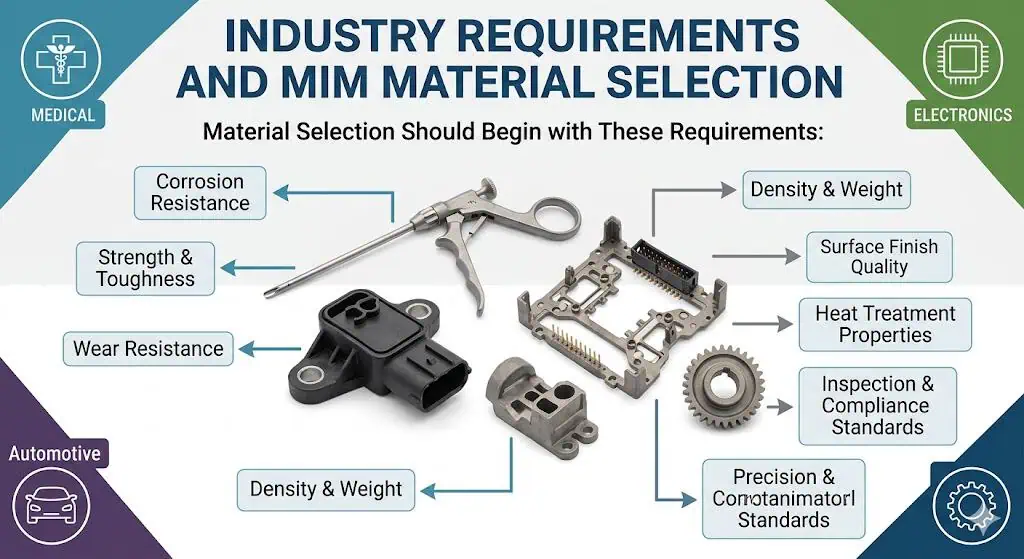
Réponse rapide : Les exigences industrielles affectent la sélection des matériaux MIM en définissant ce que la pièce finie doit supporter et comment elle doit être vérifiée. La résistance à la corrosion, la résistance mécanique, la dureté, l'usure, le comportement magnétique, la densité, l'état de surface, le traitement thermique, le revêtement, l'usinage post-frittage et les exigences d'inspection influencent tous la pertinence d'un matériau MIM avant le début de l'outillage. Sélection des matériaux MIM axée sur l'industrie…
Réponse rapide : Les exigences industrielles affectent la sélection des matériaux MIM en définissant ce que la pièce finie doit supporter et comment elle doit être vérifiée. La résistance à la corrosion, la résistance mécanique, la dureté, l'usure, le comportement magnétique, la densité, l'état de surface, le traitement thermique, le revêtement, l'usinage post-frittage et les exigences d'inspection influencent tous la pertinence d'un matériau MIM avant le début de l'outillage.
La sélection des matériaux MIM axée sur l'industrie ne doit pas commencer par une simple liste de nuances. Une mâchoire médicale, un loquet automobile, une charnière de portable, une came de verrouillage, un noyau magnétique doux et un contrepoids en tungstène peuvent tous être des pièces MIM, mais ils ne doivent pas être évalués selon la même logique de matériau. L'acier inoxydable 316L peut répondre aux exigences de corrosion et de nettoyage, le 17-4PH peut répondre à la résistance mécanique après traitement thermique, le 420 peut répondre à l'usure et à la dureté, l'acier faiblement allié peut répondre à la résistance mécanique sensible au coût avec protection contre la corrosion, et l'alliage de tungstène peut répondre aux exigences de haute densité compacte. Le bon matériau MIM est sélectionné en faisant correspondre la fonction industrielle, la géométrie de la pièce, le comportement du feedstock, le risque de déliantage et de frittage, les propriétés du matériau, le traitement de surface, les exigences de test et la cohérence de la production avant l'outillage.
Le choix du matériau MIM doit commencer par les exigences de corrosion, résistance, usure, densité, état de surface, traitement thermique et contrôle.
Si vous vous demandez encore si une pièce doit être fabriquée par MIM, commencez par le Guide de sélection des applications MIM. Si vous souhaitez comprendre quels marchés utilisent couramment les pièces MIM, consultez le guide sur quels secteurs utilisent le moulage par injection de métal. Pour un cadre de décision plus large sur les matériaux, consultez le Guide de sélection des matériaux MIM. Cet article se concentre uniquement sur la manière dont les exigences industrielles influencent les matériaux MIM, les tests, la finition et l'approbation de production.
Pourquoi les exigences industrielles modifient le choix du matériau MIM
Le choix du matériau en moulage par injection de métal est différent du choix d'une barre pour l'usinage CNC. En MIM, le matériau doit survivre à l'ensemble du processus de fabrication : préparation de la poudre métallique, mélange du feedstock et du liant, moulage par injection, déliantage, frittage, compensation du retrait, traitement thermique optionnel, usinage secondaire, polissage, placage, PVD, passivation et contrôle final.
ASTM B883 est utile lorsque des matériaux MIM ferreux sont spécifiés car il couvre les poudres métalliques mélangées à des liants, le moulage par injection, le déliantage, le frittage et un éventuel traitement thermique. La norme MPIF 35-MIM est utile lorsque les ingénieurs de conception, les ingénieurs matériaux et les acheteurs ont besoin d'une référence matérielle commune pour les matériaux MIM. Ces références aident à réduire l'ambiguïté lors de la demande de devis, de l'approbation des matériaux, de l'échantillonnage et de l'acceptation de production, mais elles ne remplacent pas les exigences spécifiques du projet en matière de dessins, les tests fonctionnels ou la validation du processus du fournisseur.
Pour le contexte du procédé, la aperçu du processus de la Metal Injection Molding Association explique comment le déliantage et la manipulation des pièces brunes s'intègrent dans le processus MIM, tandis que la European Powder Metallurgy Association décrit le MIM comme un procédé de métallurgie des poudres pour les pièces métalliques complexes. Ces liens sont utiles comme contexte, mais l'approbation des matériaux dépend toujours des exigences des dessins, des données d'échantillons et de la validation de production.
Les exigences industrielles affectent plus que le nom du matériau. Elles affectent le choix de la poudre, le système de liant, la sensibilité au déliantage, le retrait de frittage, la densité finale, la dureté, la résistance à la corrosion, le comportement magnétique, la compatibilité du revêtement, la stabilité dimensionnelle et la cohérence des lots. C'est pourquoi une décision de sélection de matériau MIM doit commencer par l'exigence de l'application, et non par une liste générique de nuances.
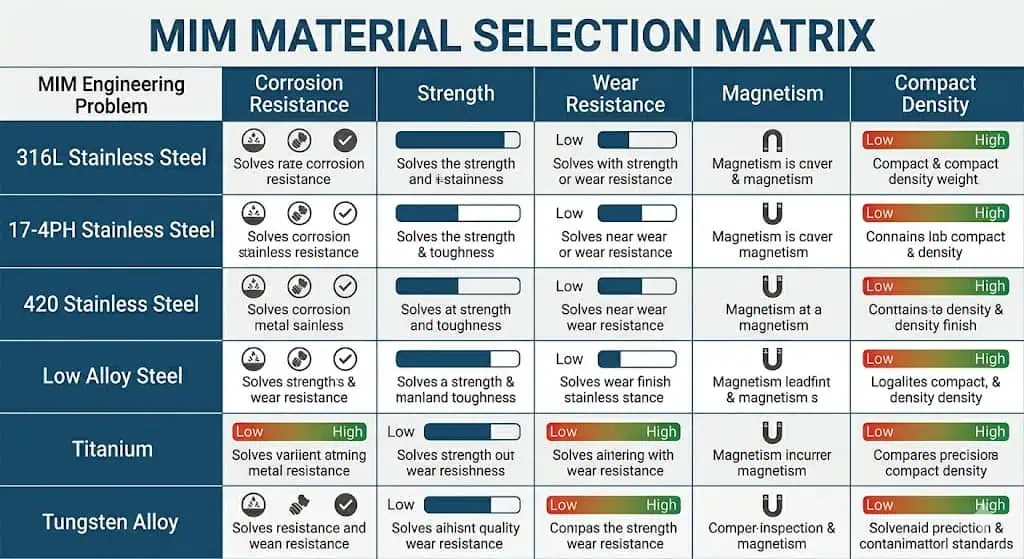
Matrice d'exigence industrielle vs sélection de matériaux MIM
Le tableau ci-dessous donne un point de départ pratique pour comparer les matériaux MIM courants. Il ne doit pas être utilisé comme données d'approbation finale. La sélection finale du matériau nécessite toujours une revue de plan, des tests d'échantillons, une vérification du traitement thermique, des contrôles de densité, des essais de traitement de surface, des essais spécifiques à l'application, exigences d'inspection et de test, et une validation de la production. Pour une référence inter-nuances plus large, voir le comparaison des matériaux MIM page.
Différents matériaux MIM résolvent différents problèmes d'ingénierie, de la résistance à la corrosion et la résistance mécanique à l'usure, au magnétisme et à la densité compacte.
Exigence industrielle
Orientation courante des matériaux MIM
Pourquoi c'est considéré
Risque principal à vérifier
Résistance à la corrosion et nettoyage
Acier inoxydable 316L, nuances inox sélectionnées
Utile pour les pièces médicales, dentaires, de contact alimentaire et portables
Passivation, rugosité de surface, piqûres de polissage, compatibilité de nettoyage
Résistance avec une résistance modérée à la corrosion
Acier inoxydable 17-4PH
Utile pour les petites pièces structurelles, charnières, loquets, supports et mécanismes
Déformation due au traitement thermique, variation de dureté, changement dimensionnel
Utile pour les capteurs, actionneurs, circuits magnétiques et pièces électroniques
Vérification des propriétés magnétiques, densité, contrôle du carbone, historique thermique
Haute densité dans un volume compact
Alliage de tungstène
Utile pour les contrepoids, le contrôle des vibrations, les pièces à masse compacte
Temps de déliantage, distorsion au frittage, fragilité, difficulté d'usinage
Faible densité et résistance à la corrosion
Alliage de titane
Utile pour certaines applications médicales, portables et aérospatiales
Coût de la poudre, contrôle de l'oxygène, contrôle du frittage, charge de qualification
Surface décorative ou cosmétique
316L, 17-4PH, aciers inoxydables sélectionnés
Utile pour les montres, lunettes, électronique grand public et quincaillerie de style de vie
Porosité après polissage, défauts PVD, piqûres de placage, lignes de joint visibles
Matériaux MIM pour le médical et le dentaire : résistance à la corrosion, nettoyabilité et contrôle de surface
Les pièces MIM médicales et dentaires commencent souvent par la résistance à la corrosion, les exigences de nettoyage, la passivation, le contrôle des bavures et la traçabilité. L'acier inoxydable 316L est couramment envisagé car il offre une résistance à la corrosion et une bonne finition, mais le grade seul n'approuve pas la pièce pour un usage médical. L'état de surface, la densité, la porosité résiduelle, le circuit de nettoyage, la passivation et les critères d'inspection doivent encore être définis.
Pour une mâchoire chirurgicale, un bracket dentaire, un composant endoscopique ou une petite pièce d'instrument médical, la vraie question matériau n'est pas seulement “ Pouvons-nous utiliser du 316L ? ” La meilleure question est de savoir si le matériau MIM sélectionné, la densité de frittage, la rugosité de surface, le circuit de polissage, le processus de passivation et l'usinage post-frittage peuvent répondre aux exigences fonctionnelles et de nettoyage.
Dans un scénario de domaine composite pour la formation en ingénierie, une mâchoire médicale a été initialement conçue comme un composant MIM entièrement moulé. Le matériau inoxydable sélectionné était acceptable sur le papier, mais la surface de préhension n'a pas fonctionné de manière cohérente lors des tests fonctionnels. Le problème est survenu parce que le projet traitait la sélection du matériau et la géométrie comme des problèmes distincts. La véritable cause système était que la surface frittée était censée agir comme une surface de contact de précision sans usinage post-frittage. La correction a été de conserver le corps comme une pièce MIM de forme quasi nette, puis d'usiner la face de préhension et la référence fonctionnelle après frittage. Pour éviter toute récidive, les projets MIM médicaux doivent définir le grade du matériau, les surfaces usinées, les zones passivées, les limites de bavures, les exigences de nettoyage et les caractéristiques contrôlées par inspection avant l'outillage.
Matériaux MIM pour l'automobile : résistance, traitement thermique et constance des lots
La sélection des matériaux MIM pour l'automobile se concentre généralement sur la résistance, la résistance à l'usure, le comportement en fatigue, la stabilité dimensionnelle, la réponse au traitement thermique et la constance de production. Des matériaux tels que l'acier inoxydable 17-4PH, l'acier faiblement allié et certains grades d'acier inoxydable trempable peuvent être envisagés selon que la pièce nécessite une résistance à la corrosion, une résistance à l'usure ou une résistance plus élevée après traitement thermique.
Les pièces automobiles exercent également une pression sur la constance des lots. Un matériau peut répondre à la dureté dans un lot d'essai, mais dériver après le traitement thermique, les changements de charge du four ou les variations de retrait. Pour les petits supports, loquets, composants d'actionneurs, pièces liées aux capteurs et petites quincailleries liées à la transmission, le fournisseur doit confirmer la densité, la dureté, la microstructure, la distorsion due au traitement thermique, les dimensions critiques et le calibrage fonctionnel.
Dans un scénario de domaine composite pour la formation en ingénierie, un petit support automobile a été converti de l'usinage CNC au MIM en utilisant un matériau qui atteignait l'objectif de résistance. Les premiers échantillons se sont bien moulés, mais la planéité finale a dérivé après le frittage et le traitement thermique. Le problème immédiat semblait être un problème de tolérance, mais la véritable cause système était un bossage épais relié à un long bras mince, combiné au retrait du matériau et à un mauvais support de frittage. La correction a été de reconcevoir la transition du bossage, d'ajuster le support de calage et de revoir la marge de distorsion due au traitement thermique. Pour éviter toute récidive, la sélection des matériaux MIM pour l'automobile doit être examinée conjointement avec la géométrie, l'équilibre des parois, le support de frittage, le traitement thermique et la stratégie de calibrage fonctionnel.
Matériaux MIM pour l'électronique et les wearables : surface esthétique, corrosion et risque de revêtement
Les pièces MIM pour l'électronique et les wearables nécessitent souvent une petite géométrie, une résistance à la corrosion, une stabilité d'assemblage et un contrôle de la surface esthétique. Les aciers inoxydables tels que le 316L et le 17-4PH sont souvent envisagés, mais le choix final dépend de la résistance, du comportement au polissage, de la compatibilité avec le PVD ou le placage, et de la stabilité dimensionnelle après les opérations secondaires.
Pour les charnières, les boutons, les composants de montres, le matériel téléphonique, les pièces de connecteurs et les cadres de wearables, le traitement de surface n'est pas une étape décorative finale. Il fait partie de la sélection des matériaux. Le polissage peut ouvrir les pores proches de la surface. Le PVD peut rendre les petites piqûres plus visibles. L'électroplacage peut révéler des problèmes de porosité ou d'adhérence. Le grenaillage peut modifier les petits bords. Par conséquent, le matériau, la densité, la rugosité de surface, la surépaisseur de polissage, la voie de revêtement et le critère d'inspection cosmétique doivent être convenus avant l'outillage.
Dans un scénario composite de terrain pour la formation en ingénierie, une charnière de wearable fabriquée à partir d'un matériau MIM en acier inoxydable a passé l'inspection dimensionnelle après frittage et polissage. Après revêtement PVD, des points sombres et de petites piqûres sont apparus sur la surface visible. Le problème est survenu parce que le polissage a ouvert les pores proches de la surface et que le PVD a augmenté le contraste. La cause système n'était pas seulement la qualité du revêtement. L'équipe avait approuvé des échantillons sans définir les zones cosmétiques, l'acceptation des pores, la surépaisseur de polissage ou l'inspection avant PVD. La correction a été d'améliorer le contrôle de la densité, d'ajuster les étapes de polissage et d'inspecter avant le revêtement. Pour éviter la récurrence, les projets de wearables et d'électronique devraient sélectionner les matériaux MIM en même temps que la voie de revêtement, les critères de surface visible et les attentes de rendement de finition.
Serrures, Outils et Quincaillerie Mécanique : Dureté, Usure et Contrainte de Contact
Les serrures, les outils et la quincaillerie mécanique nécessitent généralement des choix de matériaux basés sur l'usure, le transfert de couple, le contact glissant, la dureté de surface et parfois la protection contre la corrosion. L'acier inoxydable 420, l'acier inoxydable 17-4PH, l'acier faiblement allié et d'autres matériaux MIM trempables peuvent être considérés en fonction de la charge, des conditions de contact et de l'environnement de surface.
Une erreur courante est de choisir l'acier inoxydable uniquement parce que la pièce doit sembler résistante à la corrosion. Si la pièce est une came, un cliquet, un loquet, un petit engrenage, un bloc coulissant ou un composant d'outil, la dureté et le comportement à l'usure peuvent être plus importants que l'apparence. L'acier faiblement allié peut offrir de meilleures performances mécaniques mais nécessite un placage, une oxydation noire, une huilage ou une autre voie de protection contre la corrosion. L'acier inoxydable 420 peut offrir de la dureté mais nécessite toujours un contrôle du traitement thermique et une revue de la corrosion.
Dans un scénario composite de terrain pour la formation en ingénierie, une came de serrure a passé l'inspection dimensionnelle mais a montré une usure précoce lors des tests de cycle. Le matériau inoxydable sélectionné avait une résistance à la corrosion acceptable mais une dureté insuffisante pour un contact glissant répété. La véritable cause système était une sélection de matériau basée sur l'apparence et la résistance à la corrosion plutôt que sur la contrainte de contact, l'usure par glissement, la lubrification et la dureté. La correction a été de passer à un matériau trempable, d'ajouter un traitement thermique contrôlé et de vérifier la dureté après traitement. Pour éviter la récurrence, les projets de quincaillerie mécanique devraient revoir le couple, la surface de contact, la lubrification, les tests d'usure, le traitement thermique, la protection contre la corrosion et l'état des bords avant d'approuver le matériau MIM.
Aérospatial, Robotique et Assemblages Haute Spécification : Qualification avant Approbation du Matériau
Les assemblages liés à l'aérospatial, à la robotique et à haute spécification peuvent utiliser le MIM pour de petits supports, des boîtiers de capteurs, des composants d'actionneurs, des pièces structurelles compactes et des éléments de mécanisme. Dans ces applications, la sélection du matériau ne devrait pas s'arrêter au choix de la nuance. Elle devrait inclure la voie de qualification, la densité, la microstructure, les tests mécaniques, le traitement thermique, la stabilité dimensionnelle, la traçabilité et la répétabilité de l'inspection.
Les alliages de titane, les aciers inoxydables, les aciers faiblement alliés, les matériaux magnétiques doux et les alliages spéciaux peuvent tous être considérés selon l'application. Cependant, les projets haute spécification exigent souvent un niveau de preuve plus élevé que la quincaillerie grand public ou industrielle générale. Les acheteurs devraient demander des données de test, des rapports d'échantillons, des enregistrements de traitement thermique, la capacité dimensionnelle et un plan de contrôle de lot avant l'approbation de la production.
Le MIM ne devrait pas être promu comme un raccourci pour les applications critiques. Si la pièce est critique en fatigue, critique pour la sécurité ou strictement contrôlée par les exigences de qualification du client, le projet devrait définir l'acceptation du matériau, les tests mécaniques, la méthode d'inspection, la traçabilité de la production et les règles de contrôle des modifications avant le lancement de l'outillage.
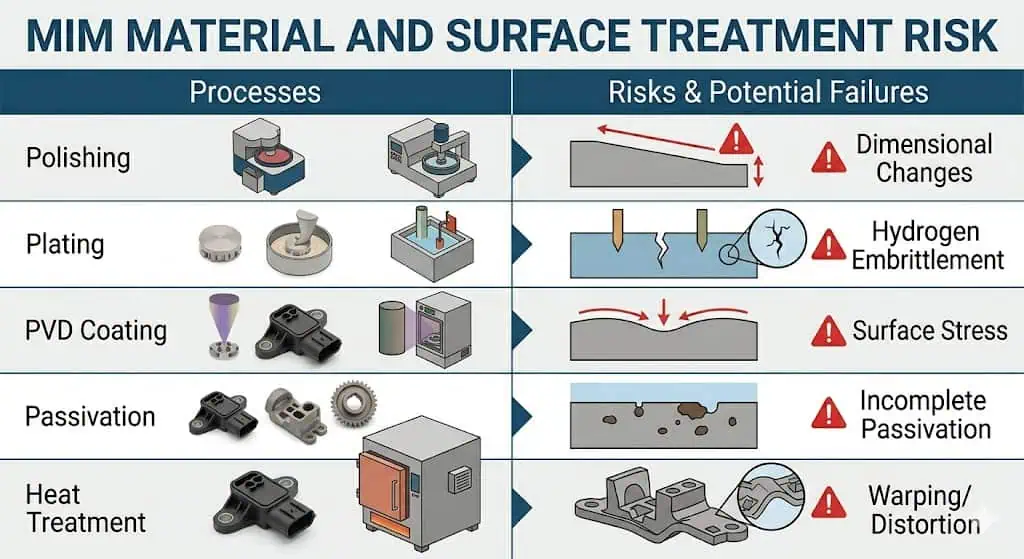
Comment le traitement de surface modifie le choix des matériaux MIM
Le traitement de surface modifie souvent le meilleur choix de matériau MIM. Un matériau qui fonctionne à l'état fritté peut ne pas convenir après polissage, placage ou PVD. Un matériau avec une bonne résistance à la corrosion peut ne pas offrir une dureté suffisante. Un matériau trempable peut se déformer après traitement thermique. Un acier faiblement allié peut nécessiter un revêtement pour éviter la rouille.
Le polissage, le placage, le PVD, la passivation et le traitement thermique peuvent modifier les performances du matériau, la qualité de surface et la stabilité dimensionnelle.
Opération de surface ou secondaire
Impact sur le choix du matériau
Risque à vérifier
Polissage
Favorise les matériaux et procédés avec une porosité contrôlée et une réponse de surface stable
Pores ouverts, ondulations de polissage, arêtes arrondies
PVD
Nécessite une surface de substrat stable, une dureté appropriée et un prétraitement propre
Piqûres, irrégularité de couleur, adhérence, pores visibles
Électroplacage
Peut nécessiter une faible porosité, une surface propre et un matériau de base compatible
Défauts de piqûres, défaillance d'adhérence, solution piégée, variation d'épaisseur
Passivation
Courant pour les aciers inoxydables où la résistance à la corrosion est importante
Contamination de surface, nettoyage incomplet, attente erronée sur le matériau
Traitement thermique
Important pour le 17-4PH, le 420, les aciers faiblement alliés et les pièces d'usure
Déformation, variation de dureté, dérive dimensionnelle
Usinage post-frittage
Nécessaire lorsque les surfaces critiques dépassent la capacité de tolérance du moulage
Usure d'outil, contrôle de référence, augmentation de coût, bavures
Sablage
Utile pour les surfaces mates et l'uniformité de surface
Arrondi des arêtes, impact dimensionnel sur les petites fonctionnalités
Sélection des matériaux MIM selon les exigences de performance
Le même secteur peut nécessiter différents matériaux pour différentes pièces. Une poignée médicale, un bracket dentaire, une mâchoire de verrouillage, un boîtier de capteur et une came coulissante ne doivent pas automatiquement utiliser la même nuance. Le tableau ci-dessous organise la sélection des matériaux par exigence d'ingénierie et doit être vérifié conjointement avec les détails Propriétés des matériaux MIM lors de la revue du projet.
Exigence de performance
Orientation matériaux
Pièces MIM typiques
Méthode de validation
Résistance à la corrosion
316L, aciers inoxydables sélectionnés
Pièces médicales, pièces dentaires, boîtiers portables, matériel en contact avec les aliments
Inspection de surface, contrôle de passivation, essai de corrosion si nécessaire
Dureté, essai d'usure, inspection par contact, essai de cyclage
Fonction magnétique
430, matériaux MIM magnétiques doux
Pièces de capteur, noyaux magnétiques, composants d'actionneur
Essai de propriétés magnétiques, densité, examen de la microstructure
Haute densité
Alliage de tungstène
Contrepoids, pièces d'équilibrage compactes, pièces de contrôle des vibrations
Densité, stabilité dimensionnelle, contrôle de la distorsion de frittage
Faible poids et résistance à la corrosion
Alliage de titane
Pièces sélectionnées pour les secteurs médical, portable et aérospatial
Chimie, contrôle de l'oxygène, densité, essais mécaniques
Finition esthétique
316L, 17-4PH, aciers inoxydables sélectionnés
Pièces d'horlogerie, quincaillerie de lunettes, charnières pour wearables, pièces décoratives
Essai de polissage, essai de PVD ou de placage, approbation du standard esthétique
Quand ne pas choisir un matériau uniquement par son nom de nuance
Un nom de nuance ne garantit pas les performances MIM. Une même famille de matériaux peut se comporter différemment selon les caractéristiques de la poudre, le système de liant, le taux de charge en poudre, la voie de déliantage, l'atmosphère de frittage, la charge du four, le traitement thermique, la géométrie de la pièce et le processus de finition.
Ne sélectionnez pas un matériau MIM uniquement en faisant correspondre un matériau de dessin CNC. Les aciers 316L corroyé, 17-4PH usiné et MIM 17-4PH ne se comportent pas automatiquement de la même manière dans chaque conception. Le MIM introduit des variables liées à la poudre, au liant, au déliantage, au retrait de frittage, à la densité, à la porosité et aux opérations secondaires qui doivent être examinées lors de l'approbation du matériau.
Erreur courante
Pourquoi c'est risqué
Meilleure approche technique
Choisir le 316L pour chaque pièce d'aspect médical
Il peut manquer de dureté ou de résistance à l'usure pour un contact mobile
Vérifier les exigences de corrosion, d'usure, de surface, de nettoyage et de contact
Choisir le 17-4PH uniquement pour la résistance
Le traitement thermique peut modifier la taille ou la planéité
Confirmer la distorsion due au traitement thermique et les besoins d'usinage post-traitement
Choisir le 420 uniquement pour la dureté
La résistance à la corrosion et le contrôle du traitement thermique peuvent être insuffisants
Vérifier la dureté, l'environnement corrosif et la stabilité dimensionnelle
Choisir l'acier faiblement allié uniquement pour le coût
Le risque de rouille et le coût du revêtement peuvent annuler les économies
Examiner le coût total incluant le placage, l'huilage, l'emballage et l'inspection
Choisir l'alliage de tungstène uniquement pour la densité
Les sections épaisses peuvent augmenter le risque de frittage et de déformation
Examiner la géométrie, la méthode de support, le temps de déliantage et la fragilité
Choisir le titane uniquement pour le poids
Le coût et la charge de qualification peuvent être élevés
Confirmer le réel avantage en poids, le besoin de qualification et le volume de production
Liste de contrôle des essais et de l'acceptation de production des matériaux MIM
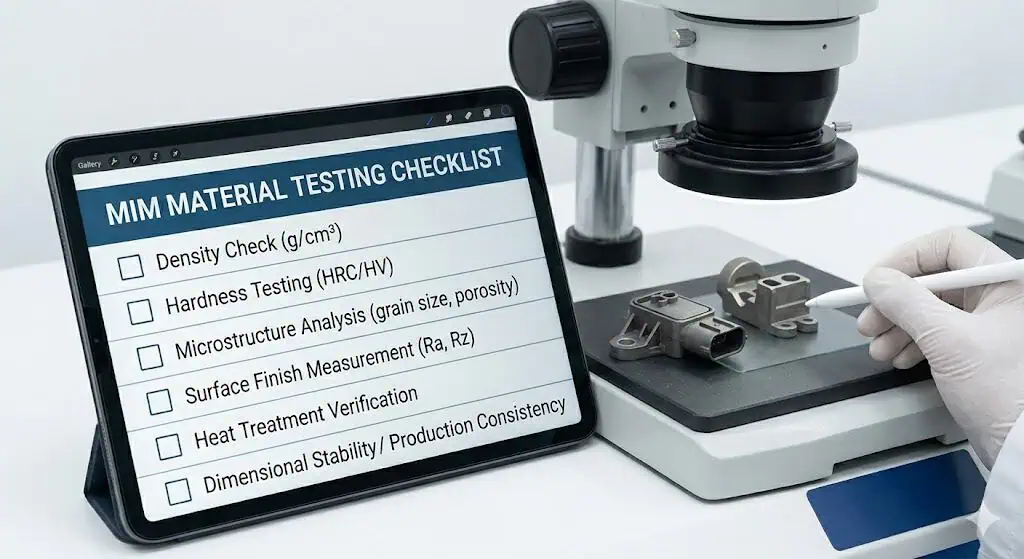
La sélection du matériau n'est pas complète tant que le projet n'a pas défini comment le matériau sera vérifié. Pour les pièces MIM de production, les acheteurs doivent éviter les exigences vagues telles que “ bonne résistance ”, “ bonne résistance à la corrosion ” ou “ bon état de surface ”. Celles-ci doivent être converties en éléments d'inspection ou de qualification mesurables.
L'approbation du matériau MIM doit inclure des contrôles de densité, dureté, microstructure, état de surface, traitement thermique et de constance de production.
Critère d'acceptation
Éléments à confirmer
Pourquoi c'est important
Nuance de matériau
Matériau MIM spécifié, composition chimique, confirmation du fournisseur
Empêche la substitution de matériau erronée
Densité et porosité
Objectif de densité, acceptation de porosité, métallographie si nécessaire
Affecte la résistance, la fatigue, le polissage, le placage et le risque de fuite
Dureté
Dureté à l'état fritté ou après traitement thermique
Contrôle l'usure, la résistance et la durée de vie fonctionnelle
Propriétés mécaniques
Essai de traction, d'impact, de fatigue ou spécifique au projet si nécessaire
Important pour les pièces structurelles et liées à la sécurité
Traitement thermique
Cycle, résultat de dureté, variation dimensionnelle
Critique pour le 17-4PH, le 420 et l'acier faiblement allié
Comportement à la corrosion
Passivation, brouillard salin ou essai de corrosion spécifique client si requis
Important pour les applications médicales, portables, marines et extérieures
Propriétés magnétiques
Essai de performance magnétique si la fonction en dépend
Important pour les capteurs, actionneurs et circuits magnétiques
Finition de surface
Rugosité, piqûres, ligne de joint, marque de porte, aspect du revêtement
Contrôle la qualité de surface cosmétique et fonctionnelle
Stabilité dimensionnelle
Dimensions critiques avant et après traitement thermique ou revêtement
Empêche les défaillances d'assemblage et les dérives de lot
Régularité des lots
Suivi de cavité, données SPC, plan d'inspection
Réduit les surprises en production de masse
Comment aborder la sélection des matériaux MIM lors d'un RFQ
Un bon RFQ ne doit pas seulement demander un prix de matériau. Il doit expliquer la fonction de la pièce et l'exigence industrielle derrière le choix du matériau. Le fournisseur ne peut pas faire de recommandation fiable s'il ne reçoit qu'un modèle 3D avec un nom de nuance vague.
Avant de demander un devis MIM, fournissez l'application de la pièce, l'environnement de travail, le volume annuel, la préférence de matériau, l'exigence de corrosion, l'exigence de dureté, l'état d'usure, l'exigence magnétique, l'exigence de finition de surface, l'exigence de traitement thermique, l'exigence de revêtement ou de placage, les dimensions critiques, les surfaces cosmétiques et la méthode d'inspection.
Demandez au fournisseur de confirmer si le matériau demandé convient au MIM, si un matériau MIM alternatif réduirait les risques, quelles dimensions peuvent nécessiter un usinage post-frittage, si le traitement thermique affectera la taille, si le polissage ou le revêtement peuvent révéler des pores, et quels tests doivent être utilisés pour l'approbation des échantillons et la production de masse. Si le choix du matériau est encore incertain, vous pouvez soumettez votre dessin pour une revue des matériaux MIM avant de lancer l'outillage.
Tableau de décision pour la sélection des matériaux destiné aux acheteurs et aux ingénieurs
Si votre exigence principale est
Commencez par examiner
N'oubliez pas
Résistance à la corrosion
316L, passivation, propreté de surface
L'usure et la dureté peuvent encore être insuffisantes
Le traitement thermique peut modifier les dimensions
Usure par glissement
420, acier faiblement allié, matériaux trempables
La lubrification, la rugosité de surface et l'état des arêtes sont importants
Finition esthétique
316L, 17-4PH, essai de polissage, essai PVD ou placage
La porosité peut apparaître après la finition
Comportement magnétique
430 ou matériau magnétique doux
Le test magnétique fait partie de l'approbation du matériau
Haute densité
Alliage de tungstène
Le risque de déliantage et de frittage augmente avec une géométrie massive
Faible poids
Alliage de titane
Le coût, le contrôle de l'oxygène et la charge de qualification doivent être justifiés
Coût réduit
Acier faiblement allié, voie de finition plus simple
Le revêtement, la protection antirouille et l'inspection peuvent ajouter du coût
Quand le choix du matériau peut faire du MIM le mauvais procédé
Parfois, l'exigence de matériau est la raison de ne pas utiliser le MIM. Si le projet nécessite un matériau non éprouvé dans une voie MIM, une très grande section difficile à déliander, une surface d'étanchéité ultra-lisse sans usinage post-frittage, ou une propriété de fatigue critique sans données de qualification, le MIM peut ne pas être le premier procédé approprié. Dans ces cas, l'usinage CNC, le forgeage, la coulée ou une autre voie de métallurgie des poudres peuvent être plus sûrs.
Cela ne signifie pas que le MIM est inadapté aux pièces exigeantes. Cela signifie que le matériau, la géométrie, le plan d'essai et les preuves de production doivent soutenir la décision. Une décision pratique de sélection de matériau MIM doit toujours répondre à deux questions : le matériau peut-il être traité de manière cohérente par MIM, et la pièce finie peut-elle répondre à l'exigence industrielle après frittage et opérations secondaires ?
Règle d'ingénierie finale pour la sélection des matériaux MIM
Le meilleur matériau MIM est celui qui correspond à l'exigence industrielle, à la fonction de la pièce, à la géométrie, à la voie de procédé, à l'état de surface, au plan d'inspection et au volume de production ensemble. Ce n'est pas toujours le matériau le plus résistant, le plus résistant à la corrosion ou le moins coûteux.
Utilisez le 316L lorsque la résistance à la corrosion et l'aptitude à la finition sont plus importantes que la dureté. Utilisez le 17-4PH lorsque la résistance après traitement thermique est nécessaire et que le changement dimensionnel peut être contrôlé. Utilisez le 420 ou les matériaux durcissables lorsque l'usure et la dureté sont centrales. Utilisez l'acier faiblement allié lorsque la résistance et le coût importent, mais que la protection contre la corrosion est acceptable. Utilisez l'alliage de tungstène lorsque la densité compacte est la véritable exigence. Utilisez l'alliage de titane uniquement lorsque le poids, la résistance à la corrosion et les exigences de qualification justifient le coût supplémentaire et le contrôle du procédé.
Une décision fiable sur les matériaux MIM relie les exigences industrielles aux preuves d'ingénierie. Avant l'outillage, confirmez la nuance de matériau, la voie de poudre, la densité cible, le traitement thermique, l'usinage post-frittage, le traitement de surface, la méthode d'essai et les critères d'acceptation. Lorsque cette revue est ignorée, le projet peut réussir la première discussion sur le matériau mais échouer lors du polissage, du revêtement, de l'assemblage, des essais d'usure ou de l'inspection en production de masse.
Besoin d'aide pour examiner un matériau MIM pour votre pièce ?
Si votre dessin inclut des exigences de corrosion, de résistance, d'usure, magnétiques, cosmétiques, de traitement thermique ou d'inspection, XTMIM peut examiner si le matériau demandé convient au MIM et si une nuance alternative peut réduire le risque de production.
FAQ : Comment les exigences industrielles affectent-elles la sélection des matériaux MIM ?
Comment les exigences industrielles affectent-elles la sélection des matériaux MIM ?
Les exigences industrielles affectent la sélection des matériaux MIM en définissant ce que la pièce doit supporter : corrosion, usure, charge, nettoyage, traitement thermique, fonction magnétique, finition esthétique, revêtement, assemblage ou essais de qualification. Le matériau MIM correct est sélectionné en faisant correspondre ces exigences avec la voie de procédé MIM et le plan d'inspection.
L'acier inoxydable 316L est-il toujours le meilleur matériau MIM pour les pièces médicales ?
Non. Le 316L est souvent considéré pour les pièces médicales MIM en raison de sa résistance à la corrosion et de son aptitude à la finition, mais il n'est pas automatiquement le meilleur choix pour les exigences d'usure, de coupe, de glissement ou de dureté élevée. Les pièces médicales MIM nécessitent toujours une validation de l'état de surface, du nettoyage, de la passivation, des bavures, de la densité et de la fonctionnalité.
Quand faut-il utiliser le 17-4PH pour les pièces MIM ?
Le 17-4PH est souvent envisagé lorsqu'une pièce MIM nécessite une résistance plus élevée après durcissement par précipitation et une résistance modérée à la corrosion. Il est couramment examiné pour les petites pièces structurelles, les supports, les loquets et les mécanismes, mais la distorsion due au traitement thermique et le changement dimensionnel doivent être vérifiés.
Quand l'acier inoxydable 420 est-il meilleur que le 316L pour le MIM ?
L'acier inoxydable 420 peut être meilleur que le 316L lorsque la dureté et la résistance à l'usure sont plus importantes que la résistance maximale à la corrosion. Il peut être envisagé pour les pièces de serrure, les petits arbres, les composants d'outillage et les pièces d'usure, mais les conditions de traitement thermique et de corrosion doivent être examinées.
Pourquoi les matériaux MIM nécessitent-ils des contrôles de densité et de porosité ?
La densité et la porosité affectent la résistance, le comportement à la fatigue, le polissage, le placage, l'apparence PVD, le risque de corrosion et le risque de fuite. Une pièce peut respecter les dimensions mais échouer si la porosité est trop élevée pour la fonction requise ou l'état de surface.
Le traitement de surface peut-il modifier le meilleur choix de matériau MIM ?
Oui. Le polissage, le placage, le PVD, la passivation, le grenaillage et le traitement thermique peuvent tous modifier l'adéquation du matériau. Un matériau qui fonctionne à l'état fritté peut présenter des piqûres après polissage ou une dérive dimensionnelle après traitement thermique. Le traitement de surface doit être examiné avant l'outillage.
Que doivent demander les acheteurs avant d'approuver un matériau MIM ?
Les acheteurs doivent demander la confirmation de la nuance du matériau, les attentes en matière de densité, le plan de traitement thermique, la voie de traitement de surface, la stratégie des dimensions critiques, l'objectif de dureté, les exigences de test de corrosion ou d'usure, et le plan d'inspection de production. Pour les pièces critiques, l'approbation des échantillons doit inclure des tests fonctionnels, pas seulement une inspection dimensionnelle.
Un mauvais matériau peut-il rendre le MIM inadapté ?
Oui. Si le matériau requis n'est pas éprouvé pour le MIM, nécessite des propriétés qui ne peuvent pas être validées après frittage, ou exige des surfaces qui nécessitent un usinage intensif de toute façon, un autre procédé peut être plus sûr. La sélection du matériau doit être examinée conjointement avec la géométrie, les tests, les opérations secondaires et le volume de production.