
Sélection de matériaux MIM — Réponse rapide
Sélectionnez les matériaux MIM en fonction des conditions de service de la pièce finie et des propriétés obligatoires, puis utilisez la matrice de sélection de matériaux MIM pour établir une liste restreinte. Vérifiez l'approvisionnement en poudre et en feedstock, la capacité de déliantage et de frittage, le risque dimensionnel, les exigences de finition et le coût total de la pièce avant de choisir une nuance préférée. Convenez des tests spécifiques à la pièce et des critères d'acceptation avant de vous engager dans l'outillage. Une nuance adaptée aux pièces usinées ou forgées peut ne pas avoir d'équivalent réalisable en production par MIM.
La sélection des matériaux dépend de trois conditions : la nuance doit satisfaire la fonction, le fournisseur doit disposer d'une voie crédible pour la géométrie réelle, et le composant final doit répondre aux exigences de coût et de vérification du projet. La matrice est un outil de dépistage ; elle n'autorise pas l'outillage.
Le matériaux MIM hub couvre les familles d'alliages plus larges et les pages de matériaux individuelles.
Quelles exigences doivent guider la sélection des matériaux MIM ?
La sélection des matériaux commence par la fonction du composant fini, et non par une nuance sur un ancien dessin CNC ou de fonderie. Un alliage résistant à la corrosion peut toujours être inadéquat sur un bord de contact chargé ; une nuance de haute dureté peut être inutilement cassante pour une caractéristique fine. Définissez d'abord les conditions de service de la pièce, puis traduisez-les en un petit ensemble d'exigences qu'un matériau doit réellement satisfaire.
Fonction de la pièce, charges et environnement de service
Définissez la fonction réelle de la pièce : transfert de force, verrouillage, pivotement, usure par glissement, flux magnétique, transfert de chaleur ou adaptation de la dilatation thermique. Spécifiez les charges continues et de pointe, les charges cycliques ou d'impact le cas échéant, les surfaces de contact, les matériaux d'accouplement et l'exposition à l'humidité, à la sueur, aux agents de nettoyage ou à la température. Un composant de capteur magnétique peut être régi par la perméabilité et la coercitivité ; une fonction de verrouillage peut être régie par la contrainte de contact locale et la déformation permanente.
Par exemple, la résistance à la corrosion n'est qu'une exigence utilisable lorsque le milieu d'exposition, le temps de contact, la méthode de nettoyage et l'apparence acceptable sont connus. De même, “ haute résistance à l'usure ” est incomplet tant que l'ingénieur ne comprend pas le mouvement, la surface d'accouplement, la lubrification et le mode de défaillance. Les applications médicales ou de contact cutané nécessitent un examen séparé des spécifications clients et réglementaires applicables ; un nom de matériau seul n'établit pas la biocompatibilité.
Propriétés indispensables vs. exigences flexibles
Divisez les exigences en obligatoires (défaillance signifie rejet), préféré (des compromis sont possibles), et inconnu (le concepteur ou le client doit clarifier). Une chimie spécifiée, une résistance minimale dans une condition définie, une qualification de corrosion ou une tolérance d'accouplement critique peuvent être obligatoires. L'aspect de surface, la finition secondaire ou l'utilisation d'un grade familier particulier peuvent être flexibles, sauf si le dessin ou la spécification client le rend obligatoire.
Une exigence utilisable relie le risque de défaillance à une condition d'acceptation. Pour la corrosion, identifiez le milieu d'exposition, l'état de surface livré et la vérification requise. Pour la résistance, définissez le cas de charge, l'état final du matériau et la propriété minimale. Un grade de matériau seul fournit rarement ces informations ; les seuils doivent provenir de la spécification de conception.
Exemple de charnière pour appareil portable (illustratif) : un petit maillon de charnière peut devoir résister à des chargements répétés, au contact de la sueur et à un ajustement contrôlé du trou de pivot. Ce sont des exigences distinctes. Demander simplement de l“” acier inoxydable » ne montre pas quelle propriété est critique ni ce que l'assemblage fini doit réussir.
Conservez le matériau listé sur un dessin CNC, de coulée ou d'estampage existant comme grade de référence. Confirmez si cette composition exacte est obligatoire ou si un matériau approuvé peut être sélectionné en fonction des performances de la pièce finie. Les dimensions critiques et les exigences de surface doivent rester dans le cadre de la revue du matériau.
La première revue doit identifier la fonction requise, les conditions d'acceptation obligatoires, les préférences négociables et les informations que le client doit encore confirmer.
Comment présélectionner les matériaux MIM pour votre pièce ?
Commencez par les propriétés obligatoires et identifiez les familles de matériaux susceptibles de les satisfaire. Pour chaque candidat, enregistrez à la fois son avantage fonctionnel potentiel et les preuves nécessaires pour le maintenir en considération. La matrice de sélection des matériaux MIM ci-dessous soutient le dépistage précoce ; elle n'établit pas la disponibilité des grades, les propriétés de la pièce finie ou l'approbation de production.
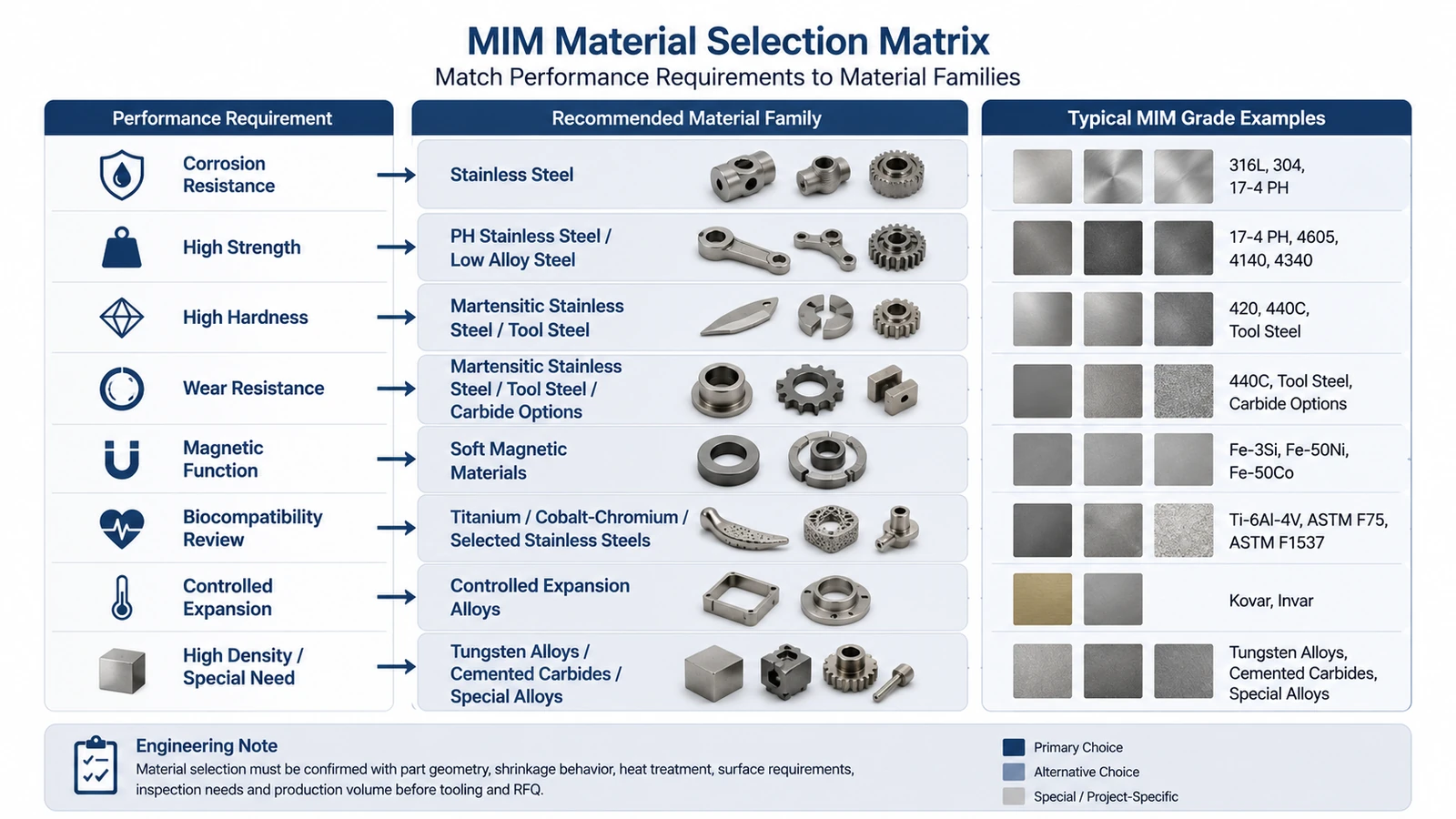
Faire correspondre les exigences critiques aux familles de matériaux candidates
Commencez par l'exigence de performance dominante, puis testez chaque candidat par rapport aux autres conditions obligatoires. Le tableau donne des orientations représentatives souvent pertinentes pour la conception MIM ; la sélection finale dépend de la composition réelle, des conditions de fabrication, des données du fournisseur et de l'application de la pièce.
Pour chaque ligne de la matrice, vérifiez les exigences restantes. Une nuance n'est un candidat crédible que lorsque toutes les conditions obligatoires sont étayées par des données pertinentes sur les matériaux MIM ou un plan de qualification défini.
| Exigence critique | Orientation du matériau à étudier | Pourquoi cela peut qualifier | Déclencheur d'exclusion ou preuves encore nécessaires |
|---|---|---|---|
| Exposition à la corrosion ou au nettoyage | Acier inoxydable 316L ou 304 ; 17-4 PH si la résistance est également importante | Les options d'acier inoxydable offrent différentes combinaisons de comportement à la corrosion et de réponse mécanique. | Média réel, passivation, état de surface final et minimums mécaniques ; aucune nuance n'est universellement résistante à la corrosion. |
| Haute résistance structurelle | 17-4 PH, MIM-4605 et aciers faiblement alliés appropriés | Precipitation-hardenable stainless and heat-treatable low-alloy routes may serve loaded components. | Required condition, heat treatment, ductility, corrosion demand, and actual MIM performance data. |
| Hardness / wear at contact surfaces | 420, 440C, or other qualified hard/wear-resistant routes | Relevant where abrasion, contact wear, or locking-edge behavior matters. | Wear mechanism, edge toughness, mating material, lubrication, and post-treatment. |
| Fonction magnétiquement douce | Fe-3Si, Fe-50Ni, Fe-50Co directions | Magnetic response can be the primary function rather than structural strength. | Required permeability, coercivity, saturation, heat treatment, and supplier-specific MIM availability. |
| Lightweight or application-specific corrosion needs | Ti-6Al-4V or commercially pure titanium where qualified | May be considered when density, environmental behavior, or defined application requirements justify it. | Oxygen/interstitial control, special sintering route, price, and qualification requirements. |
| Dilatation thermique contrôlée | Invar- or Kovar-type alloy routes | May be reviewed when the mating materials, thermal cycle, and expansion matching govern function. | Specify the coefficient of thermal expansion over the working temperature range, joining interface, supplier feedstock, and process qualification. |
| High density or balancing mass | Qualified tungsten-heavy-alloy directions | May suit applications where a defined density or mass in limited space is critical. | Density target, powder/feedstock maturity, furnace suitability, dimensional control, and total cost. |
| Thermal / electrical conductivity or unusual chemistry | Suitable copper-based MIM routes or other project-specific alloys | Can be investigated when conventional structural MIM alloys cannot achieve the required function. | Define the conductivity or chemistry target, finished condition, MIM-grade data, supplier qualification, and economics; do not assume equivalence. |
For deeper property definitions, use Propriétés des matériaux MIM. For family-specific information, the published acier inoxydable, acier faiblement allié, et soft magnetic material pages provide separate starting points. They are not interchangeable material families; for example, structural Fe-Ni grades and high-nickel soft-magnetic grades serve different functions.
Fe-50Ni gas-flow-sensor components: a documented MIMA case uses MIM Fe-50Ni for a casing and ground component where high magnetic permeability and low coercivity were important. The case also discusses thin features and sintering arrangements used to control distortion. Magnetic performance therefore governs the shortlist, but geometry and process support still determine whether the selected route is viable.
For a soft-magnetic sensor component, specify the magnetic property, measurement condition, and finished material state. Tensile strength alone cannot determine suitability. The MIMA case documents another manufacturer’s work; it does not establish production capability at XTMIM.
Eliminate Materials That Fail Essential Requirements
Use mandatory requirements as pass/fail gates. If a candidate cannot meet the required service environment or a non-negotiable chemistry restriction, remove it even when its tensile strength is attractive. If an essential property is not supported by a MIM-condition datasheet or a proposed validation method, mark it non encore vérifié instead of treating an absence of information as a pass or a failure.
Classify candidates as retained when current evidence supports the requirement, excluded when a mandatory condition is demonstrably unmet, or pending when property or process evidence remains insufficient. Do not treat a missing test result as proof of success or failure.
In the wearable-hinge illustration, 316L may be investigated for corrosion exposure and 17-4 PH for a different balance of strength and environmental performance. The selection cannot be completed until the required load, surface condition, and validated material state are known. A “316L versus 17-4 PH” headline by itself cannot determine the best choice; see the dedicated 316L vs 17-4 PH comparison when that specific pair becomes the decision point.
Avoid ranking candidates by maximum hardness, maximum strength, or a single corrosion claim. Every mandatory requirement must be satisfied, and any remaining trade-off or evidence gap must be recorded.
Record the shortlisted grades, the reason each remains eligible, any confirmed exclusion reason, and the outstanding evidence needed for engineering review.
Is the Candidate Material Feasible for MIM Manufacturing?
A grade may meet the functional specification but still lack a reliable MIM route at the proposed supplier. Confirm that the powder and binder feedstock can be molded, debound, sintered, and processed into the required final condition. Supplier capability must be assessed for the specific grade and part geometry, not inferred from a generic alloy list.
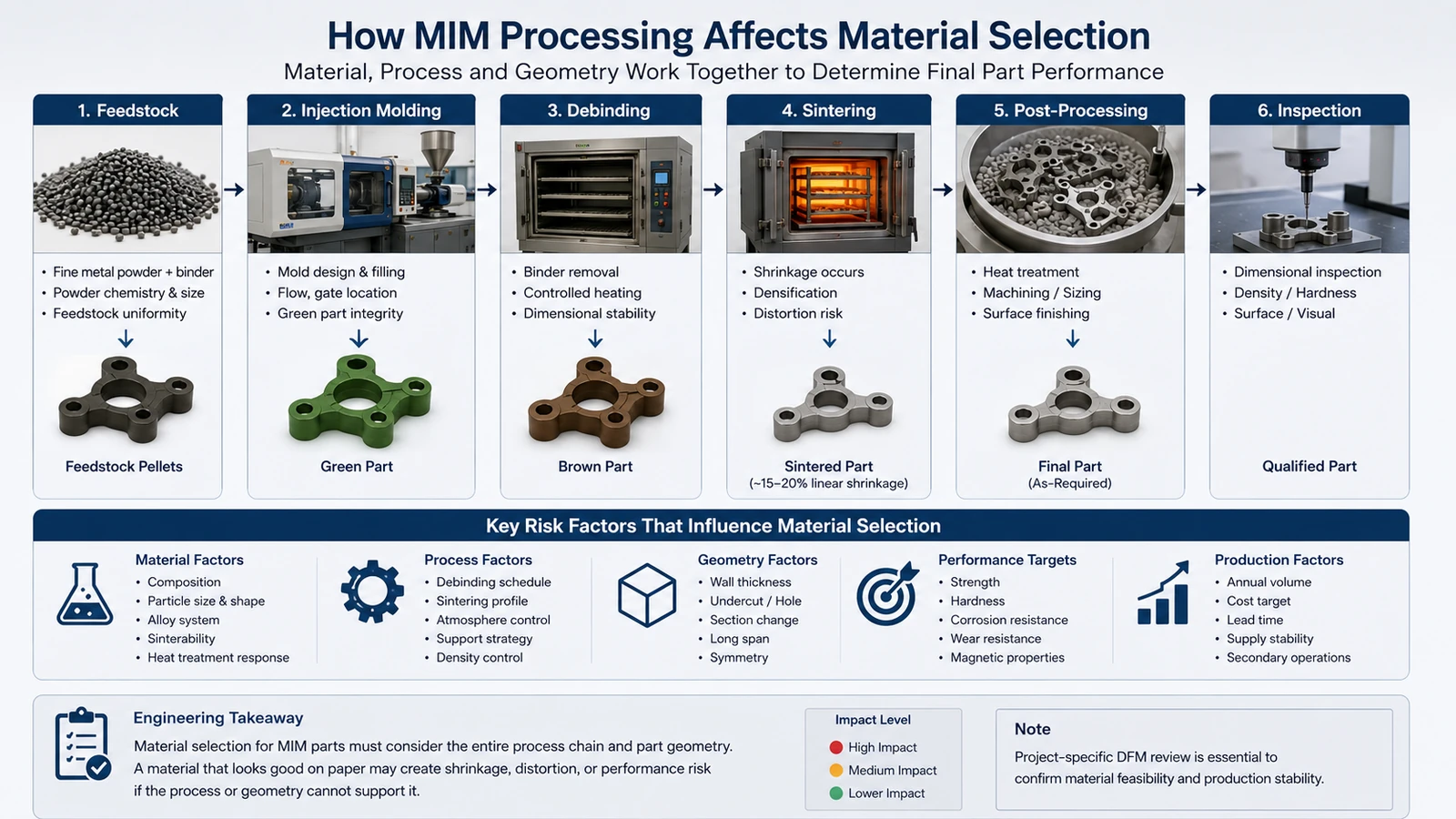
Disponibilité de la poudre et du feedstock
Confirm the actual composition and grade, whether suitable powder or ready-made feedstock can be sourced, whether the binder system is compatible with the equipment, and whether the supply is dependable at the intended order volume. Particle characteristics, powder chemistry, loading, and binder behavior influence molding and debinding. A supplier's ability to procure raw powder alone does not establish a qualified feedstock or finished-part route.
Debinding, Sintering, and Supplier Process Capability
The review should identify an appropriate debinding method, furnace atmosphere or vacuum requirements, sintering control, contamination and distortion risks, and heat treatment if required. Different alloy systems may need different process windows and equipment preparation. Ordinary production experience with iron-based steels cannot automatically be extended to titanium, copper alloys, tungsten alloys, or other special materials. The procédé de frittage MIM page gives the broader process background.
For the wearable hinge, ask whether the proposed supplier has feedstock and process evidence for each remaining stainless candidate in the required condition. Confirm the heat-treatment route and any finishing or dimensional inspection needed for the pivot features. Wrought-material data alone cannot settle the MIM route.
| Manufacturing readiness | Evidence to look for | What it means for the project | Décision suivante |
|---|---|---|---|
| Documented manufacturing route | Relevant feedstock, equipment, and processing records are available for the proposed grade and condition; the actual part still requires DFM and qualification. | Reasonable to proceed with the drawing review and an agreed part-specific validation plan; not an automatic production approval. | Proceed to geometry, cost and test planning. |
| Feasibility / qualification needed | Potential powder and process route exists, but sufficient production evidence for this grade, condition, or geometry is missing. | Performance and process outcomes are uncertain; extra trials, time, and cost may be required. | Agree on a feasibility plan before committing to tooling. |
| Not currently supported | No viable supply route, equipment/process fit, acceptable testing plan, or commercial basis has been confirmed. | Do not present the material as ready for production. | Review alternatives or change the manufacturing plan. |
This distinction is especially important for alliages MIM spéciaux. A published alloy specification or a laboratory demonstration is not proof of a mature production route at XTMIM. Ask the supplier what evidence they have, what conditions are covered, and what remains unqualified before design freeze.
Special-alloy evidence is not uniform: ASTM B883-24 includes MIM-Cu alongside specified ferrous grades, but a standard grade is not proof that a given factory has qualified copper feedstock or sintering. Aluminum MIM requires extra caution: EPMA identifies the persistent oxide layer as a significant sintering barrier. Treat any proposed aluminum route as supplier- and alloy-specific feasibility work, not routine capability.
Limit of published MIM case evidence: an external award or application case can document that a specific manufacturer made a particular component from a stated material. It does not qualify another supplier’s feedstock, furnace, tolerances, inspection, cost, or production consistency. Those require evidence from the supplier proposing the job.
Assign each candidate a manufacturing-readiness status and the evidence or trial needed next. Do not promote an unverified material to an approved option during the cost comparison.
Can the Material Meet Your Part's Geometry, Tolerance, and Finishing Requirements?
A viable material route must also work for the part you are actually making. Two components using the same alloy can have very different MIM risks because of wall transitions, unsupported lengths, local masses, holes, small edges, and required tolerance zones. Review material and drawing together before assuming the chosen feedstock will deliver the final dimensions.
Material-Sensitive Shrinkage and Dimensional Risks
Sintering causes densification and shrinkage. Tooling compensation addresses the expected change, but asymmetric mass, abrupt section transitions, long unsupported spans, and sensitive datum relationships may still distort. Review which dimensions are function-critical and which features require support, machining allowance, or trial measurements. Shrinkage and tolerance depend on material, part geometry, processing, and inspection condition; there is no reliable universal figure for every MIM part.
For a hinge or latch, a narrow pivot bore and its distance from a mating face may be more important than the general external profile. A supplier may need to assess those features in the proposed sintered state, rather than approving the alloy simply because a nominal material property looks suitable. For broader design rules, see the Guide de conception MIM.

316L gas-chromatography flow block. Le published MIMA case describes a 316L specimen-inlet component with two internal gas channels connecting five ports. The 90-degree passages required multi-direction tooling with hydraulic core pulls; selecting a corrosion-resistant stainless grade did not remove the need to engineer the channel geometry.
Process constraint: the case describes only one suitable flat surface for supporting the component during debinding and sintering. Preformed holes were tapped after sintering. Support strategy, thread completion, and channel integrity were therefore part of the manufacturing plan.
A material decision for a flow component must include leak-sensitive channels, the forming route, sintering support, and the finished thread and inspection requirements. These considerations cannot be inferred from the alloy name alone.
Heat Treatment, Machining, and Surface Finishing Compatibility
Determine whether the finished part can be used as-sintered or needs heat treatment, sizing, CNC machining, passivation, polishing, plating, coating, or other finishing. Heat treatment may support strength or hardness requirements but can introduce dimensional changes; a cosmetic finish may remove material or reveal surface defects. State the requirement in the final delivered condition and review the sequence of operations—not merely the base alloy.
Revue du dessin : identify critical features, likely distortion risks, final machined areas, and the dimensions that need inspection after sintering and finishing. A material recommendation becomes actionable only when those part-specific constraints have been addressed.
Classify the geometry and finishing route as supported by supplier evidence, feasible subject to agreed trials or design changes, or not currently supportable. Keep unqualified routes conditional.
How Do You Choose Between Feasible MIM Materials?
If multiple candidates remain technically credible, compare them against every mandatory requirement before considering preferences, cost, or nominal performance. If only one candidate survives, still document why it meets the functional, processing, and commercial requirements rather than assuming the absence of alternatives proves suitability. Published strength or powder price alone cannot decide the project; process maturity, post-processing, supplier continuity, inspection burden, and total finished-part cost also matter.
Compare Performance Margins and Engineering Trade-offs
Compare material properties in the proposed MIM and post-treatment condition, using the relevant specification and supplier evidence. Ask whether each requirement is passed, whether the supporting data match the actual environment, and whether a less demanding option could still satisfy the product. High hardness does not by itself establish wear life; corrosion resistance cannot be judged without the exposure; and a strong alloy does not eliminate fatigue, edge loading, or geometry risks.
Balance Manufacturing Risk, Supply, and Total Part Cost
Compare powder and feedstock cost, sourcing availability, minimum batch constraints, tooling and sintering support, secondary machining, heat treatment, finishing, scrap, and qualification work. Annual volume affects how these costs are distributed across accepted parts. Use supplier estimates for the same drawing revision, final finish, inspection scope, and production volume; a cheaper alloy cannot offset failure of a mandatory requirement.
| Final decision criterion | Candidate A | Candidate B | Decision rule / evidence |
|---|---|---|---|
| All mandatory functional requirements | Pass / fail / unknown | Pass / fail / unknown | A failed mandatory criterion eliminates the option; unknown needs validation. |
| Final condition and property margin | Record measured / specified state | Record measured / specified state | Use comparable MIM-condition data, not unrelated wrought data. |
| Manufacturing readiness and geometry risk | Verified / trial / unsupported | Verified / trial / unsupported | Document feedstock, sintering, tooling and part-specific DFM evidence. |
| Supply and total production cost | Supplier estimate + assumptions | Supplier estimate + assumptions | Compare at the same volume, final finish and acceptance level. |
| Unresolved qualification work | Tests and approvals needed | Tests and approvals needed | Do not confuse an attractive candidate with an approved one. |
| Recommendation | Preferred / backup / reject | Preferred / backup / reject | State the reason and any conditions attached to the choice. |
Compare both candidates in the same final delivery condition and at the same project volume. A lower price cannot offset failure of a mandatory requirement. If manufacturing or validation evidence is missing, the recommendation remains conditional.

17-4 PH cable-tie installation tool components. A published MIMA award case identifies six metal-injection-molded mechanism parts in a hand tool used to grip, tension, and cut nylon cable ties: a pinion, nosepiece, gripper pawl, insertable rack, cutoff cam, and short link.
Secondary operations still matter: four of the six components required limited reaming or coining after sintering. Near-net shape did not mean every mating feature could be accepted as-sintered.
For a material and process comparison, include the cost and quality effect of the finished bore, gear engagement, mating surfaces, and any necessary post-sintering work. Compare accepted finished components rather than feedstock price alone.
Illustrative hinge decision: if a candidate stainless route meets the verified load and exposure requirements with acceptable finishing and a proven MIM process, it can be preferred over a stronger but higher-risk route. If strength is the limiting condition, a different candidate may become preferable—but only after confirming corrosion, heat-treatment condition, dimensions, and actual performance. No fixed grade is declared the winner in this example.
Utilisez le comparaison des matériaux MIM pages when a specific pair of grades remains under consideration; their detailed property data can then feed into the project decision.
What If Your Preferred Material Is Not Feasible for MIM?
If the preferred material cannot meet a critical requirement, lacks an executable supplier route, or has not yet been demonstrated, identify the cause before deciding what to change. First determine whether the drawing requires the exact alloy chemistry or the final functional outcome. A route with missing evidence should be described as unverified, not automatically rejected; an intrinsically unsuitable route should not move to tooling simply because its nominal grade is familiar.
Can an Existing MIM Material Meet the Same Functional Requirements?
For a part converted from CNC or casting, check whether another MIM grade can meet the required corrosion behavior, load capacity, wear mechanism, dimensional stability and final finish. A substitution is only acceptable if the customer permits it and the actual minimum requirements and acceptance methods are satisfied. Similar nominal alloy names, or one matching property, do not prove equivalence.
For special requirements such as controlled thermal expansion, high density, copper-based conductivity, or unusual alloy chemistry, confirm whether the supplier has a real production route. Otherwise, investigate the matériaux MIM sur mesure evaluation pathway only when project volume, technical need, available resources, and qualification budget justify it.
When Should You Reconsider the Part Design or Manufacturing Process?
If no available MIM grade meets a mandatory performance or chemistry requirement, first check whether customer-approved design changes or secondary operations could achieve the needed function. Otherwise, keeping CNC, casting, conventional powder metallurgy, or another established route may be the more defensible choice. Compare those options before new tooling using the MIM versus autres procédés criteria.
Three outcomes are possible: keep the specified grade only with the required qualification; seek documented customer approval for a mature material alternative when the specification permits substitution; or recommend a design revision or different process when no viable MIM option meets the mandatory requirements. Nonstandard material development requires its own trial, cost, and approval plan.
Stop rule: if the customer requires an exact composition or regulated qualification that the supplier cannot demonstrate, do not label an alternative “equivalent” or approve tooling without explicit engineering and customer acceptance.
Document whether the original route is acceptable, requires qualification, needs an authorized substitution, or should be stopped pending a different material or manufacturing plan.
How Do You Validate the Selected MIM Material Against Part Requirements?
Choosing a grade is not the same as accepting a finished component. A material datasheet typically describes a defined material condition and test basis; it does not automatically guarantee the properties or service behavior of every final part geometry. Convert each critical requirement into an agreed acceptance criterion, verification method, and evidence record before final tooling and production sign-off.
Define the Final Material Condition and Acceptance Criteria
Record the proposed grade, chemical specification, sintered or heat-treated condition, surface finish, and any machining or coating that is part of delivery. A hardness or strength target without the test condition may be ambiguous. Decide whether acceptance is based on material specimens, finished components, functional testing, dimensional inspection, or a defined combination. The customer and supplier should agree on this scope for each critical requirement.
316L case data are not universal specification limits. Le published MIMA flow-block case reports a density of 7,6 g/cm³, tensile strength of 520 MPa, and yield strength of 175 MPa. These are values reported for that application, not guaranteed acceptance limits for every MIM 316L part. For a new drawing, agree on the applicable material condition, specimen or finished-part testing basis, sampling plan, and customer limits.
Match Critical Requirements to Appropriate Tests
Select tests that address the part’s actual failure risks. Mechanical performance, corrosion, magnetic response, porosity, and critical dimensions need different methods and acceptance conditions. The table links engineering requirements to suitable forms of verification; it is not a compulsory inspection package for every part.
| Exigence critique | Critère d'acceptation à définir | Appropriate evidence or test to agree | Material / part state and open question |
|---|---|---|---|
| Strength or ductility | Specified minimum property in the relevant condition | Material-specification data and tensile testing where required (for example, an applicable ASTM E8/E8M method) | Which specimen, production lot, heat-treatment state, and relationship to actual part behavior? |
| Hardness or contact wear | Required hardness range or functional wear acceptance | Suitable hardness method, surface condition review, or project-specific functional test | Where is hardness measured, and is wear performance adequately represented? |
| Critical geometry and fit | Drawing tolerance, datum, and functional fit criteria | Dimensional inspection, gauges, or CMM when appropriate | As-sintered or finished condition? Which dimensions are critical-to-function? |
| Density / porosity-sensitive function | Project-appropriate density, leakage, or integrity criterion | Applicable density method or part-level integrity assessment | Does the test method represent the actual functional risk? |
| Corrosion, cleaning, or surface exposure | Defined media, exposure, appearance or corrosion limit | Agreed surface/passivation review and project-specific corrosion test if needed | What is the final surface condition and exposure protocol? |
| Magnetic or thermal function | Defined magnetic response or thermal property threshold | Agreed property test and sampling plan | Which direction, operating condition, and post-treatment state apply? |
For the wearable hinge, the design team might need exposure testing on the finished surface, evidence for repeated loading, and inspection of pivot-hole fit after finishing. The customer must define acceptance thresholds before a supplier can confirm whether the selected grade and route meet them.
Le MPIF Standard 35-MIM (édition 2025) supports MIM material specification discussions. ASTM B883-24 is a specification for its listed MIM materials; it is not a universal requirement for every special alloy. ASTM E8/E8M-25 describes metallic tensile testing, but standard specimens do not necessarily represent all finished-part service behavior. For an agreed density requirement, the applicability of ASTM B962-23 depends on the PM part or specimen and porosity condition. Select standards only when they match the actual requirement and customer specification.
Record each mandatory property with its acceptance limit, test or inspection method, final material condition, responsible reviewer, and evidence status. Where the inspection method or pass limit is still undecided, keep the material recommendation conditional.
How Do You Finalize a MIM Material Recommendation Before Tooling?
A material recommendation should state what is proposed, why it is likely to meet the part requirements, which process assumptions remain open, and what must be confirmed before tooling. If a critical requirement is unknown, record it rather than naming a final grade without evidence.
Summarize the Recommended Material and Remaining Risks
Use the following decision record to transfer the shortlist, process review, and verification requirements to the project team. An entry in the record is not a material approval.
| Material selection review item | What the project team should record |
|---|---|
| Function and mandatory requirements | Service environment, critical loads, failure modes, chemical restrictions and material acceptance conditions. |
| Preferred / alternative material | Exact grade and proposed final condition, with the engineering reason for each candidate. |
| MIM manufacturing readiness | Evidence for powder/feedstock, debinding/sintering route, supply, and any needed qualification. |
| Geometry and finishing risks | Critical dimensions, shrinkage-sensitive features, post-processing and open DFM questions. |
| Validation and acceptance | Tests, inspection methods, acceptance criteria and status of supporting evidence. |
| Project constraints | Expected annual volume, cost target, development stage and whether substitution is permitted. |
| Action suivante | Proceed to engineering review, request missing data, plan a trial, seek approval for substitution, or stop the MIM route. |
Wearable hinge review: 316L and 17-4 PH can remain candidates while the team confirms load capacity, sweat-exposure limits, supplier feedstock readiness, the finished pivot-hole tolerance, and any required heat treatment. Until the pass criteria and process evidence are agreed, the recommendation is conditional; either material may be rejected after testing.
Confirm the Next Engineering Action Before Tooling
Send the 2D drawing, available 3D CAD, existing or preferred material, key loads and exposure conditions, critical dimensions, finishing and heat-treatment requirements, and estimated production volume. Include the material decision record and any agreed specifications. The Liste de contrôle pour la sélection des matériaux MIM provides a detailed document-preparation checklist.
The supplier review should return one of four decisions: proceed to detailed DFM and quotation, complete targeted material or process trials, obtain customer approval for substitution, ou do not pursue MIM with the current requirements. None of these early decisions guarantees final sample acceptance or production qualification.
The selection is complete only when the required function, manufacturing route, and acceptance evidence agree. A familiar alloy name without a tested route and a defined next action is not a finished material decision.
Demander une revue des matériaux et de la fabricabilité MIM
Send the drawing, required properties, service environment, critical tolerances, final finish, and expected volume. XTMIM can review the proposed material against the part geometry, identify process and finishing risks, and discuss whether a confirmed material route, further trials, or a customer-approved alternative is appropriate before tooling.
Normes et références techniques
MPIF material standards explain the importance of agreeing on material grade, chemistry, minimum properties, and applicable processes before production. The Aperçu technique MIM de l'EPMA describes powder and feedstock processing, debinding, sintering, dimensional shrinkage, and post-sintering operations. For a specific material or property, use the current standard and applicable test method rather than a generic grade claim.
Technical standards define their own scope; access to a standard does not demonstrate that a particular supplier has qualified the corresponding alloy or part. For safety-critical, regulated, or qualification-sensitive projects, follow the customer's current specification, required approvals, and documented test plan.