
MIM Malzeme Seçimi — Hızlı Cevap
MIM malzemelerini bitmiş parçanın servis koşulları ve zorunlu özelliklerine göre seçin, ardından bir kısa liste oluşturmak için MIM malzeme seçim matrisini kullanın. Tercih edilen bir sınıfı seçmeden önce toz ve besleme stoğu tedarikini, bağlayıcı giderme ve sinterleme yeteneğini, boyutsal riski, yüzey işleme gereksinimlerini ve toplam parça maliyetini doğrulayın. Takım imalatına başlamadan önce parça özelinde testler ve kabul kriterleri üzerinde anlaşın. İşlenmiş veya dövme parçalar için uygun bir sınıfın, üretime hazır eşdeğer bir MIM rotası olmayabilir.
Malzeme seçimi üç koşula bağlıdır: sınıf işlevi karşılamalıdır, tedarikçi gerçek geometri için güvenilir bir rotaya sahip olmalıdır ve nihai bileşen projenin maliyet ve doğrulama gereksinimlerini karşılamalıdır. Matris bir tarama aracıdır; takım imalatını onaylamaz.
Bu MIM malzemeleri hub, daha geniş alaşım ailelerini ve bireysel malzeme sayfalarını kapsar.
MIM Malzeme Seçimini Hangi Gereksinimler Yönlendirmeli?
Malzeme seçimi, eski bir CNC veya döküm çizimindeki bir dereceden ziyade, bitmiş bileşenin işleviyle başlar. Korozyona dayanıklı bir alaşım, yüklü bir temas kenarında hala yetersiz olabilir; yüksek sertlikte bir derece, ince bir özellik için gereksiz yere kırılgan olabilir. Parçanın hizmet koşullarını önce tanımlayın, ardından bunları bir malzemenin gerçekten karşılaması gereken küçük bir gereksinim kümesine çevirin.
Parça Fonksiyonu, Yükler ve Hizmet Ortamı
Parçanın gerçek işlevini tanımlayın: kuvvet aktarımı, kilitleme, pivotlama, kayar aşınma, manyetik akı, ısı transferi veya termal genleşme eşleşmesi. Sürekli ve tepe yükleri, ilgili olduğu yerlerde döngüsel veya darbe yüklemesini, temas yüzeylerini, eşleşen malzemeleri ve neme, tere, temizlik maddelerine veya sıcaklığa maruz kalmayı belirtin. Manyetik bir sensör bileşeni geçirgenlik ve zorlama ile yönetilebilir; bir kilitleme özelliği yerel temas stresi ve kalıcı deformasyon ile yönetilebilir.
Örneğin, korozyon direnci yalnızca maruz kalma ortamı, temas süresi, temizleme yöntemi ve kabul edilebilir görünüm bilindiğinde kullanılabilir bir gerekliliktir. Benzer şekilde, mühendis hareket, eşleşen yüzey, yağlama ve arıza modunu anlamadan “yüksek aşınma direnci” eksiktir. Tıbbi veya ciltle temas eden uygulamalar, geçerli müşteri ve düzenleyici spesifikasyonların ayrı olarak incelenmesini gerektirir; yalnızca bir malzeme adı biyouyumluluğu sağlamaz.
Zorunlu Özellikler ve Esnek Gereksinimler
Gereksinimleri bölümlere ayırın zorunlu (arızanın reddedilmesi anlamına gelir), tercih edilen (ödünleşimler mümkündür) ve bilinmiyor (tasarımcı veya müşteri tarafından netleştirilmelidir). Belirli bir kimya, tanımlanmış bir koşulda minimum mukavemet, korozyon yeterliliği veya kritik eşleşen tolerans zorunlu olabilir. Yüzey görünümü, ikincil işlem veya belirli bir bilinen kalitenin kullanımı esnek olabilir - çizim veya müşteri spesifikasyonu zorunlu kılmadığı sürece.
Kullanılabilir bir gereksinim, arıza riskini bir kabul koşuluna bağlar. Korozyon için, maruz kalma ortamını, teslim edilen yüzey durumunu ve gerekli doğrulamayı tanımlayın. Mukavemet için, yük durumunu, son malzeme durumunu ve minimum özelliği tanımlayın. Tek başına bir malzeme kalitesi nadiren bu bilgiyi sağlar; eşikler tasarım spesifikasyonundan gelmelidir.
Giyilebilir menteşe örneği (açıklayıcı): küçük bir menteşe bağlantısı tekrarlanan yüklere, terle temasa ve kontrollü bir pivot deliği uyumuna dayanmalıdır. Bunlar ayrı gereksinimlerdir. Sadece “paslanmaz çelik” istemek, hangi özelliğin kritik olduğunu veya bitmiş montajın neleri geçmesi gerektiğini göstermez.
Mevcut bir CNC, döküm veya damgalama çiziminde listelenen malzemeyi bir referans kalite. Bu tam bileşimin zorunlu olup olmadığını veya onaylanmış bir malzemenin bitmiş parçanın performansına karşı seçilip seçilemeyeceğini onaylayın. Kritik boyutlar ve yüzey gereksinimleri malzeme incelemesinin bir parçası olarak kalmalıdır.
İlk inceleme, gerekli işlevi, zorunlu kabul koşullarını, müzakere edilebilir tercihleri ve müşterinin hala doğrulaması gereken bilgileri belirlemelidir.
Parçanız İçin MIM Malzemelerini Nasıl Kısa Listeye Alırsınız?
Zorunlu özelliklerle başlayın ve bunları karşılayabilecek malzeme ailelerini belirleyin. Her aday için hem potansiyel fonksiyonel avantajını hem de değerlendirmede tutmak için gereken kanıtları kaydedin. Aşağıdaki MIM malzeme seçim matrisi erken taramayı destekler; kalite bulunurluğunu, son parça özelliklerini veya üretim onayını belirlemez.
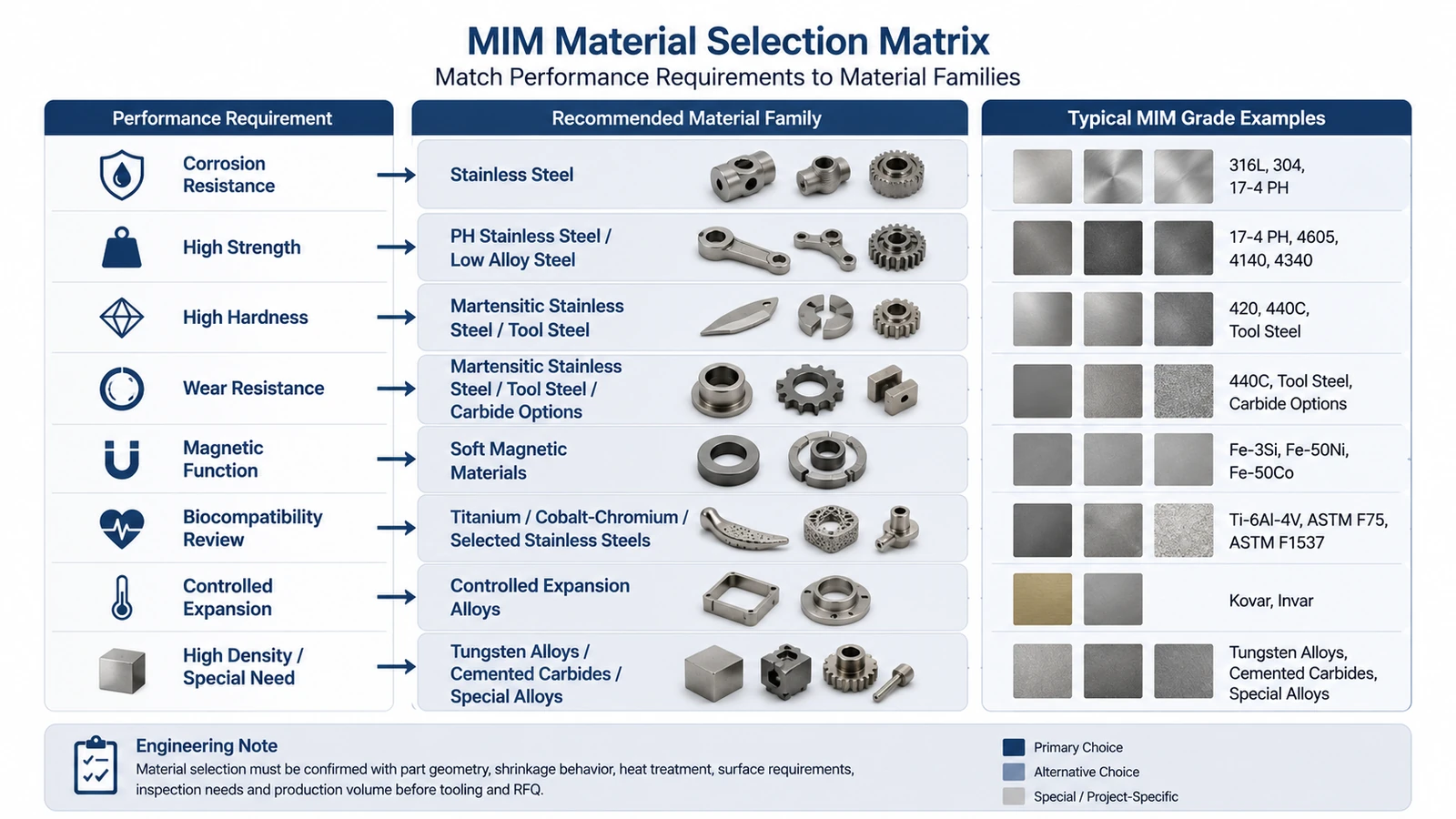
Kritik Gereksinimleri Aday Malzeme Aileleriyle Eşleştirin
Baskın performans gereksinimiyle başlayın, ardından her adayı diğer zorunlu koşullara karşı test edin. Tablo, MIM tasarımı için genellikle geçerli olan temsili yönleri vermektedir; nihai seçim, gerçek bileşime, üretim koşullarına, tedarikçi verilerine ve parça uygulamasına bağlıdır.
Her matris satırı için kalan gereksinimleri doğrulayın. Bir kalite, yalnızca ilgili MIM malzeme verileri veya tanımlanmış bir yeterlilik planı tarafından desteklenen tüm zorunlu koşullar mevcut olduğunda güvenilir bir adaydır.
| Kritik gereksinim | Araştırılacak Malzeme yönü | Neden uygun olabilir | Dışlama tetikleyicisi veya hala ihtiyaç duyulan kanıt |
|---|---|---|---|
| Korozyon veya temizlik maruziyeti | 316L veya 304 paslanmaz çelik; güç de önemliyse 17-4 PH | Paslanmaz çelik seçenekleri, farklı korozyon davranışı ve mekanik tepki kombinasyonları sunar. | Gerçek ortam, pasivasyon, nihai yüzey durumu ve mekanik minimumlar; hiçbir kalite evrensel olarak korozyona dayanıklı değildir. |
| Yüksek yapısal mukavemet | 17-4 PH, MIM-4605 ve uygun düşük alaşımlı çelikler | Yüklenmiş bileşenler için çökelme sertleşebilir paslanmaz ve ısıl işlem görebilen düşük alaşımlı yollar kullanılabilir. | Gerekli koşul, ısıl işlem, süneklik, korozyon gereksinimi ve gerçek MIM performans verileri. |
| Sertlik / temas yüzeylerinde aşınma | 420, 440C veya diğer nitelikli sert/aşınmaya dayanıklı yollar | Aşınma, temas aşınması veya kenetleme kenarı davranışı söz konusu olduğunda geçerlidir. | Aşınma mekanizması, kenar tokluğu, eşleşen malzeme, yağlama ve işlem sonrası muamele. |
| Yumuşak manyetik işlev | Fe-3Si, Fe-50Ni, Fe-50Co yönleri | Manyetik tepki, yapısal mukavemetten ziyade birincil işlev olabilir. | Gerekli geçirgenlik, zorlayıcılık, doygunluk, ısıl işlem ve tedarikçiye özel MIM bulunabilirliği. |
| Hafif veya uygulamaya özel korozyon ihtiyaçları | Nitelikli titanyum veya ticari olarak saf titanyum | Yoğunluk, çevresel davranış veya tanımlanmış uygulama gereksinimleri haklı çıkardığında düşünülebilir. | Oksijen/interstisyel kontrol, özel sinterleme rotası, fiyat ve yeterlilik gereksinimleri. |
| Kontrollü termal genleşme | Invar veya Kovar tipi alaşım rotaları | Eşleşen malzemeler, termal döngü ve genleşme eşleşmesi işlevi yönettiğinde incelenebilir. | Çalışma sıcaklığı aralığı boyunca termal genleşme katsayısını, birleştirme arayüzünü, tedarikçi besleme stoğunu ve proses yeterliliğini belirtin. |
| Yüksek yoğunluk veya dengeleyici kütle | Nitelikli tungsten ağır alaşım yönleri | Sınırlı alanda tanımlanmış bir yoğunluğun veya kütlenin kritik olduğu uygulamalar için uygun olabilir. | Yoğunluk hedefi, toz/besleme stoğu olgunluğu, fırın uygunluğu, boyutsal kontrol ve toplam maliyet. |
| Termal / elektriksel iletkenlik veya alışılmadık kimya | Uygun bakır bazlı MIM rotaları veya diğer proje özel alaşımları | Geleneksel yapısal MIM alaşımlarının gerekli işlevi yerine getiremediği durumlarda araştırılabilir. | İletkenlik veya kimya hedefi, bitmiş durumu, MIM sınıfı verileri, tedarikçi yeterliliği ve ekonomiyi tanımlayın; eşdeğerlik varsaymayın. |
Daha derin özellik tanımları için MIM malzeme özellikleri. yayınlanan paslanmaz çelik, düşük alaşımlı çelik, ve yumuşak manyetik malzeme sayfaları ayrı başlangıç noktaları sağlar. Bunlar birbirinin yerine geçebilecek malzeme aileleri değildir; örneğin, yapısal Fe-Ni sınıfları ve yüksek nikelli yumuşak manyetik sınıflar farklı işlevler görür.
Fe-50Ni gaz akış sensörü bileşenleri: a belgelenmiş MIMA vakası yüksek manyetik geçirgenlik ve düşük zorlayıcılığın önemli olduğu bir kasa ve toprak bileşeni için MIM Fe-50Ni kullanır. Kasa ayrıca distorsiyonu kontrol etmek için kullanılan ince özellikler ve sinterleme düzenlemelerini de tartışmaktadır. Bu nedenle manyetik performans kısa listeyi belirler, ancak geometri ve işlem desteği seçilen rotanın geçerli olup olmadığını hala belirler.
Yumuşak manyetik bir sensör bileşeni için, manyetik özelliği, ölçüm koşulunu ve bitmiş malzeme durumunu belirtin. Sadece çekme mukavemeti uygunluğu belirleyemez. MIMA vakası başka bir üreticinin çalışmasını belgelemektedir; XTMIM'de üretim yeteneği oluşturmaz.
Temel Gereksinimleri Karşılamayan Malzemeleri Eleme
Zorunlu gereksinimleri geçme/kalma kapıları olarak kullanın. Bir aday, gerekli hizmet ortamını veya pazarlık edilemez bir kimya kısıtlamasını karşılayamıyorsa, çekme mukavemeti cazip olsa bile onu çıkarın. Temel bir özellik, bir MIM koşul veri sayfası veya önerilen bir doğrulama yöntemi tarafından desteklenmiyorsa, onu işaretleyin henüz doğrulanmadı bilgi eksikliğini geçme veya kalma olarak ele almak yerine.
Adayları sınıflandır tutuldu mevcut kanıt gereksinimi desteklediğinde, hariç tutuldu zorunlu bir koşulun açıkça karşılanmadığı durumlarda veya beklemede mülkiyet veya süreç kanıtı yetersiz kaldığında. Eksik bir test sonucunu başarı veya başarısızlık kanıtı olarak değerlendirmeyin.
Giyilebilir menteşe örneğinde, korozyon maruziyeti için 316L ve farklı bir mukavemet/çevresel performans dengesi için 17-4 PH araştırılabilir. Gerekli yük, yüzey durumu ve doğrulanmış malzeme durumu bilinene kadar seçim tamamlanamaz. Tek başına bir “316L - 17-4 PH Karşılaştırması” başlığı en iyi seçimi belirleyemez; özel 316L - 17-4 PH Karşılaştırmasına bakın, bu özel eşleşme karar noktası haline geldiğinde.
Adayları maksimum sertlik, maksimum mukavemet veya tek bir korozyon iddiasına göre sıralamaktan kaçının. Her zorunlu gereksinim karşılanmalı ve kalan herhangi bir ödünleşme veya kanıt boşluğu kaydedilmelidir.
Kısa listeye alınan sınıfları, her birinin neden uygun kaldığını, teyit edilmiş herhangi bir hariç tutma nedenini ve mühendislik incelemesi için gereken bekleyen kanıtları kaydedin.
Aday Malzeme MIM Üretimi İçin Uygun mu?
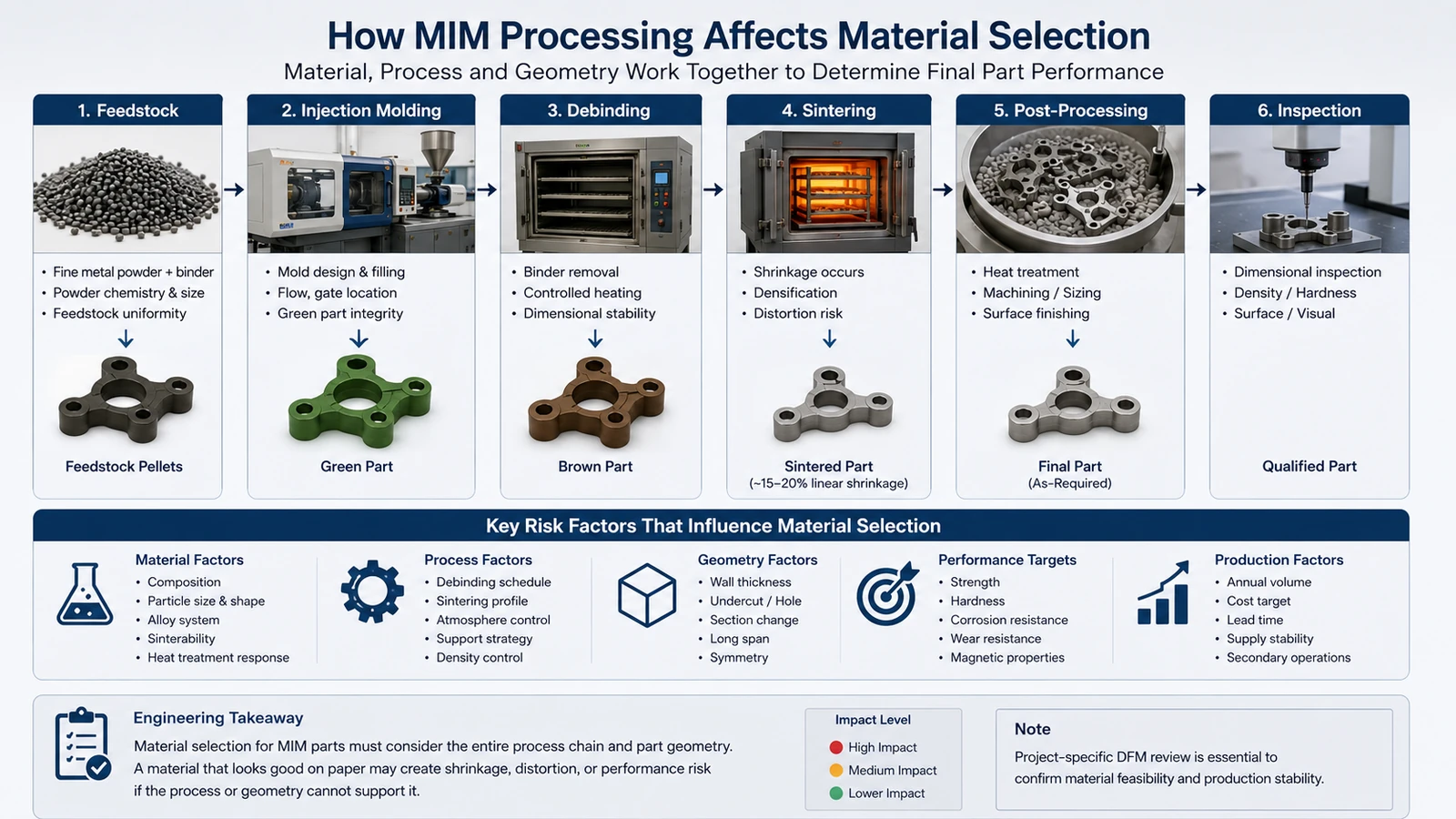
Bir malzeme, işlevsel spesifikasyonu karşılayabilir ancak önerilen tedarikçide güvenilir bir MIM rotası eksik olabilir. Toz ve bağlayıcı besleme stoğunun kalıplanıp, bağlayıcısı giderilip, sinterlenip ve gerekli nihai duruma işlenebileceğini doğrulayın. Tedarikçi yeteneği, genel bir alaşım listesinden çıkarım yapılarak değil, belirli derece ve parça geometrisi için değerlendirilmelidir.
Toz ve Besleme Stoku Bulunabilirliği
Confirm the actual composition and grade, whether suitable powder or ready-made feedstock can be sourced, whether the binder system is compatible with the equipment, and whether the supply is dependable at the intended order volume. Particle characteristics, powder chemistry, loading, and binder behavior influence molding and debinding. A supplier's ability to procure raw powder alone does not establish a qualified feedstock or finished-part route.
Debinding, Sintering, and Supplier Process Capability
The review should identify an appropriate debinding method, furnace atmosphere or vacuum requirements, sintering control, contamination and distortion risks, and heat treatment if required. Different alloy systems may need different process windows and equipment preparation. Ordinary production experience with iron-based steels cannot automatically be extended to titanium, copper alloys, tungsten alloys, or other special materials. The MIM sinterleme prosesi page gives the broader process background.
For the wearable hinge, ask whether the proposed supplier has feedstock and process evidence for each remaining stainless candidate in the required condition. Confirm the heat-treatment route and any finishing or dimensional inspection needed for the pivot features. Wrought-material data alone cannot settle the MIM route.
| Manufacturing readiness | Evidence to look for | What it means for the project | Sonraki karar |
|---|---|---|---|
| Documented manufacturing route | Relevant feedstock, equipment, and processing records are available for the proposed grade and condition; the actual part still requires DFM and qualification. | Reasonable to proceed with the drawing review and an agreed part-specific validation plan; not an automatic production approval. | Proceed to geometry, cost and test planning. |
| Feasibility / qualification needed | Potential powder and process route exists, but sufficient production evidence for this grade, condition, or geometry is missing. | Performance and process outcomes are uncertain; extra trials, time, and cost may be required. | Agree on a feasibility plan before committing to tooling. |
| Not currently supported | No viable supply route, equipment/process fit, acceptable testing plan, or commercial basis has been confirmed. | Do not present the material as ready for production. | Review alternatives or change the manufacturing plan. |
This distinction is especially important for özel MIM alaşımları. A published alloy specification or a laboratory demonstration is not proof of a mature production route at XTMIM. Ask the supplier what evidence they have, what conditions are covered, and what remains unqualified before design freeze.
Special-alloy evidence is not uniform: ASTM B883-24 includes MIM-Cu alongside specified ferrous grades, but a standard grade is not proof that a given factory has qualified copper feedstock or sintering. Aluminum MIM requires extra caution: EPMA identifies the persistent oxide layer as a significant sintering barrier. Treat any proposed aluminum route as supplier- and alloy-specific feasibility work, not routine capability.
Limit of published MIM case evidence: an external award or application case can document that a specific manufacturer made a particular component from a stated material. It does not qualify another supplier’s feedstock, furnace, tolerances, inspection, cost, or production consistency. Those require evidence from the supplier proposing the job.
Assign each candidate a manufacturing-readiness status and the evidence or trial needed next. Do not promote an unverified material to an approved option during the cost comparison.
Can the Material Meet Your Part's Geometry, Tolerance, and Finishing Requirements?
A viable material route must also work for the part you are actually making. Two components using the same alloy can have very different MIM risks because of wall transitions, unsupported lengths, local masses, holes, small edges, and required tolerance zones. Review material and drawing together before assuming the chosen feedstock will deliver the final dimensions.
Material-Sensitive Shrinkage and Dimensional Risks
Sintering causes densification and shrinkage. Tooling compensation addresses the expected change, but asymmetric mass, abrupt section transitions, long unsupported spans, and sensitive datum relationships may still distort. Review which dimensions are function-critical and which features require support, machining allowance, or trial measurements. Shrinkage and tolerance depend on material, part geometry, processing, and inspection condition; there is no reliable universal figure for every MIM part.
For a hinge or latch, a narrow pivot bore and its distance from a mating face may be more important than the general external profile. A supplier may need to assess those features in the proposed sintered state, rather than approving the alloy simply because a nominal material property looks suitable. For broader design rules, see the MIM tasarım kılavuzu.

316L gas-chromatography flow block. Bu published MIMA case describes a 316L specimen-inlet component with two internal gas channels connecting five ports. The 90-degree passages required multi-direction tooling with hydraulic core pulls; selecting a corrosion-resistant stainless grade did not remove the need to engineer the channel geometry.
Process constraint: the case describes only one suitable flat surface for supporting the component during debinding and sintering. Preformed holes were tapped after sintering. Support strategy, thread completion, and channel integrity were therefore part of the manufacturing plan.
A material decision for a flow component must include leak-sensitive channels, the forming route, sintering support, and the finished thread and inspection requirements. These considerations cannot be inferred from the alloy name alone.
Heat Treatment, Machining, and Surface Finishing Compatibility
Determine whether the finished part can be used as-sintered or needs heat treatment, sizing, CNC machining, passivation, polishing, plating, coating, or other finishing. Heat treatment may support strength or hardness requirements but can introduce dimensional changes; a cosmetic finish may remove material or reveal surface defects. State the requirement in the final delivered condition and review the sequence of operations—not merely the base alloy.
Çizim incelemesi: identify critical features, likely distortion risks, final machined areas, and the dimensions that need inspection after sintering and finishing. A material recommendation becomes actionable only when those part-specific constraints have been addressed.
Classify the geometry and finishing route as supported by supplier evidence, feasible subject to agreed trials or design changes, or not currently supportable. Keep unqualified routes conditional.
How Do You Choose Between Feasible MIM Materials?
If multiple candidates remain technically credible, compare them against every mandatory requirement before considering preferences, cost, or nominal performance. If only one candidate survives, still document why it meets the functional, processing, and commercial requirements rather than assuming the absence of alternatives proves suitability. Published strength or powder price alone cannot decide the project; process maturity, post-processing, supplier continuity, inspection burden, and total finished-part cost also matter.
Compare Performance Margins and Engineering Trade-offs
Compare material properties in the proposed MIM and post-treatment condition, using the relevant specification and supplier evidence. Ask whether each requirement is passed, whether the supporting data match the actual environment, and whether a less demanding option could still satisfy the product. High hardness does not by itself establish wear life; corrosion resistance cannot be judged without the exposure; and a strong alloy does not eliminate fatigue, edge loading, or geometry risks.
Balance Manufacturing Risk, Supply, and Total Part Cost
Compare powder and feedstock cost, sourcing availability, minimum batch constraints, tooling and sintering support, secondary machining, heat treatment, finishing, scrap, and qualification work. Annual volume affects how these costs are distributed across accepted parts. Use supplier estimates for the same drawing revision, final finish, inspection scope, and production volume; a cheaper alloy cannot offset failure of a mandatory requirement.
| Final decision criterion | Candidate A | Candidate B | Decision rule / evidence |
|---|---|---|---|
| All mandatory functional requirements | Pass / fail / unknown | Pass / fail / unknown | A failed mandatory criterion eliminates the option; unknown needs validation. |
| Final condition and property margin | Record measured / specified state | Record measured / specified state | Use comparable MIM-condition data, not unrelated wrought data. |
| Manufacturing readiness and geometry risk | Verified / trial / unsupported | Verified / trial / unsupported | Document feedstock, sintering, tooling and part-specific DFM evidence. |
| Supply and total production cost | Supplier estimate + assumptions | Supplier estimate + assumptions | Compare at the same volume, final finish and acceptance level. |
| Unresolved qualification work | Tests and approvals needed | Tests and approvals needed | Do not confuse an attractive candidate with an approved one. |
| Recommendation | Preferred / backup / reject | Preferred / backup / reject | State the reason and any conditions attached to the choice. |
Compare both candidates in the same final delivery condition and at the same project volume. A lower price cannot offset failure of a mandatory requirement. If manufacturing or validation evidence is missing, the recommendation remains conditional.

17-4 PH cable-tie installation tool components. A published MIMA award case identifies six metal-injection-molded mechanism parts in a hand tool used to grip, tension, and cut nylon cable ties: a pinion, nosepiece, gripper pawl, insertable rack, cutoff cam, and short link.
Secondary operations still matter: four of the six components required limited reaming or coining after sintering. Near-net shape did not mean every mating feature could be accepted as-sintered.
For a material and process comparison, include the cost and quality effect of the finished bore, gear engagement, mating surfaces, and any necessary post-sintering work. Compare accepted finished components rather than feedstock price alone.
Illustrative hinge decision: if a candidate stainless route meets the verified load and exposure requirements with acceptable finishing and a proven MIM process, it can be preferred over a stronger but higher-risk route. If strength is the limiting condition, a different candidate may become preferable—but only after confirming corrosion, heat-treatment condition, dimensions, and actual performance. No fixed grade is declared the winner in this example.
Bu MIM malzeme karşılaştırması pages when a specific pair of grades remains under consideration; their detailed property data can then feed into the project decision.
What If Your Preferred Material Is Not Feasible for MIM?
If the preferred material cannot meet a critical requirement, lacks an executable supplier route, or has not yet been demonstrated, identify the cause before deciding what to change. First determine whether the drawing requires the exact alloy chemistry or the final functional outcome. A route with missing evidence should be described as unverified, not automatically rejected; an intrinsically unsuitable route should not move to tooling simply because its nominal grade is familiar.
Can an Existing MIM Material Meet the Same Functional Requirements?
For a part converted from CNC or casting, check whether another MIM grade can meet the required corrosion behavior, load capacity, wear mechanism, dimensional stability and final finish. A substitution is only acceptable if the customer permits it and the actual minimum requirements and acceptance methods are satisfied. Similar nominal alloy names, or one matching property, do not prove equivalence.
For special requirements such as controlled thermal expansion, high density, copper-based conductivity, or unusual alloy chemistry, confirm whether the supplier has a real production route. Otherwise, investigate the özel MIM malzemeleri evaluation pathway only when project volume, technical need, available resources, and qualification budget justify it.
When Should You Reconsider the Part Design or Manufacturing Process?
If no available MIM grade meets a mandatory performance or chemistry requirement, first check whether customer-approved design changes or secondary operations could achieve the needed function. Otherwise, keeping CNC, casting, conventional powder metallurgy, or another established route may be the more defensible choice. Compare those options before new tooling using the MIM versus other processes criteria.
Three outcomes are possible: keep the specified grade only with the required qualification; seek documented customer approval for a mature material alternative when the specification permits substitution; or recommend a design revision or different process when no viable MIM option meets the mandatory requirements. Nonstandard material development requires its own trial, cost, and approval plan.
Stop rule: if the customer requires an exact composition or regulated qualification that the supplier cannot demonstrate, do not label an alternative “equivalent” or approve tooling without explicit engineering and customer acceptance.
Document whether the original route is acceptable, requires qualification, needs an authorized substitution, or should be stopped pending a different material or manufacturing plan.
How Do You Validate the Selected MIM Material Against Part Requirements?
Choosing a grade is not the same as accepting a finished component. A material datasheet typically describes a defined material condition and test basis; it does not automatically guarantee the properties or service behavior of every final part geometry. Convert each critical requirement into an agreed acceptance criterion, verification method, and evidence record before final tooling and production sign-off.
Define the Final Material Condition and Acceptance Criteria
Record the proposed grade, chemical specification, sintered or heat-treated condition, surface finish, and any machining or coating that is part of delivery. A hardness or strength target without the test condition may be ambiguous. Decide whether acceptance is based on material specimens, finished components, functional testing, dimensional inspection, or a defined combination. The customer and supplier should agree on this scope for each critical requirement.
316L case data are not universal specification limits. Bu published MIMA flow-block case reports a density of 7,6 g/cm³, tensile strength of 520 MPa, and yield strength of 175 MPa. These are values reported for that application, not guaranteed acceptance limits for every MIM 316L part. For a new drawing, agree on the applicable material condition, specimen or finished-part testing basis, sampling plan, and customer limits.
Match Critical Requirements to Appropriate Tests
Select tests that address the part’s actual failure risks. Mechanical performance, corrosion, magnetic response, porosity, and critical dimensions need different methods and acceptance conditions. The table links engineering requirements to suitable forms of verification; it is not a compulsory inspection package for every part.
| Kritik gereksinim | Tanımlanacak kabul kriteri | Appropriate evidence or test to agree | Material / part state and open question |
|---|---|---|---|
| Strength or ductility | Specified minimum property in the relevant condition | Material-specification data and tensile testing where required (for example, an applicable ASTM E8/E8M method) | Which specimen, production lot, heat-treatment state, and relationship to actual part behavior? |
| Hardness or contact wear | Required hardness range or functional wear acceptance | Suitable hardness method, surface condition review, or project-specific functional test | Where is hardness measured, and is wear performance adequately represented? |
| Critical geometry and fit | Drawing tolerance, datum, and functional fit criteria | Dimensional inspection, gauges, or CMM when appropriate | As-sintered or finished condition? Which dimensions are critical-to-function? |
| Density / porosity-sensitive function | Project-appropriate density, leakage, or integrity criterion | Applicable density method or part-level integrity assessment | Does the test method represent the actual functional risk? |
| Corrosion, cleaning, or surface exposure | Defined media, exposure, appearance or corrosion limit | Agreed surface/passivation review and project-specific corrosion test if needed | What is the final surface condition and exposure protocol? |
| Magnetic or thermal function | Defined magnetic response or thermal property threshold | Agreed property test and sampling plan | Which direction, operating condition, and post-treatment state apply? |
For the wearable hinge, the design team might need exposure testing on the finished surface, evidence for repeated loading, and inspection of pivot-hole fit after finishing. The customer must define acceptance thresholds before a supplier can confirm whether the selected grade and route meet them.
Bu MPIF Standard 35-MIM (2025 baskısı)" supports MIM material specification discussions. ASTM B883-24 is a specification for its listed MIM materials; it is not a universal requirement for every special alloy. ASTM E8/E8M-25 describes metallic tensile testing, but standard specimens do not necessarily represent all finished-part service behavior. For an agreed density requirement, the applicability of ASTM B962-23 depends on the PM part or specimen and porosity condition. Select standards only when they match the actual requirement and customer specification.
Record each mandatory property with its acceptance limit, test or inspection method, final material condition, responsible reviewer, and evidence status. Where the inspection method or pass limit is still undecided, keep the material recommendation conditional.
How Do You Finalize a MIM Material Recommendation Before Tooling?
A material recommendation should state what is proposed, why it is likely to meet the part requirements, which process assumptions remain open, and what must be confirmed before tooling. If a critical requirement is unknown, record it rather than naming a final grade without evidence.
Summarize the Recommended Material and Remaining Risks
Use the following decision record to transfer the shortlist, process review, and verification requirements to the project team. An entry in the record is not a material approval.
| Material selection review item | What the project team should record |
|---|---|
| Function and mandatory requirements | Service environment, critical loads, failure modes, chemical restrictions and material acceptance conditions. |
| Preferred / alternative material | Exact grade and proposed final condition, with the engineering reason for each candidate. |
| MIM manufacturing readiness | Evidence for powder/feedstock, debinding/sintering route, supply, and any needed qualification. |
| Geometry and finishing risks | Critical dimensions, shrinkage-sensitive features, post-processing and open DFM questions. |
| Validation and acceptance | Tests, inspection methods, acceptance criteria and status of supporting evidence. |
| Project constraints | Expected annual volume, cost target, development stage and whether substitution is permitted. |
| Sonraki adım | Proceed to engineering review, request missing data, plan a trial, seek approval for substitution, or stop the MIM route. |
Wearable hinge review: 316L and 17-4 PH can remain candidates while the team confirms load capacity, sweat-exposure limits, supplier feedstock readiness, the finished pivot-hole tolerance, and any required heat treatment. Until the pass criteria and process evidence are agreed, the recommendation is conditional; either material may be rejected after testing.
Confirm the Next Engineering Action Before Tooling
Send the 2D drawing, available 3D CAD, existing or preferred material, key loads and exposure conditions, critical dimensions, finishing and heat-treatment requirements, and estimated production volume. Include the material decision record and any agreed specifications. The MIM malzeme seçim kontrol listesi provides a detailed document-preparation checklist.
The supplier review should return one of four decisions: proceed to detailed DFM and quotation, complete targeted material or process trials, obtain customer approval for substitution, veya do not pursue MIM with the current requirements. None of these early decisions guarantees final sample acceptance or production qualification.
The selection is complete only when the required function, manufacturing route, and acceptance evidence agree. A familiar alloy name without a tested route and a defined next action is not a finished material decision.
MIM Malzeme ve Üretilebilirlik İncelemesi Talep Edin
Send the drawing, required properties, service environment, critical tolerances, final finish, and expected volume. XTMIM can review the proposed material against the part geometry, identify process and finishing risks, and discuss whether a confirmed material route, further trials, or a customer-approved alternative is appropriate before tooling.
Standartlar ve Teknik Referanslar
MPIF material standards explain the importance of agreeing on material grade, chemistry, minimum properties, and applicable processes before production. The EPMA MIM teknik genel bakışı describes powder and feedstock processing, debinding, sintering, dimensional shrinkage, and post-sintering operations. For a specific material or property, use the current standard and applicable test method rather than a generic grade claim.
Technical standards define their own scope; access to a standard does not demonstrate that a particular supplier has qualified the corresponding alloy or part. For safety-critical, regulated, or qualification-sensitive projects, follow the customer's current specification, required approvals, and documented test plan.