
High-strength MIM materials are chosen by the part's failure mode, operating environment and required final material condition—not by the highest tensile-strength number in a catalog. 17-4 PH paslanmaz çelik is a leading candidate when strength and corrosion resistance must be balanced. MIM 4605 low-alloy steel is useful where load-bearing strength is important and corrosion can be managed. 4140, 4340 ve Ti-6Al-4V require grade-specific process and performance checks before approval.
Start with the required resistance to permanent deformation, fracture or cyclic loading. Then compare candidate MIM alloys in their specified sintered or heat-treated condition and check whether the supplier can produce and verify the finished part.
01 / Define the Requirement
What Strength Requirements Matter When Selecting a MIM Material?
A miniature bracket that must not bend permanently, a latch that cycles repeatedly and a part exposed to impact do not necessarily need the same alloy. Define the unacceptable failure first, then state the mechanical property and finished material condition that will be used to judge the material.
Identify the Primary Load and Failure Mode
Record the direction, magnitude and duration of the principal load. A component that must retain its shape is often governed by yielding; a part subjected to repeated motion may be governed by fatigue; a suddenly loaded feature may require particular attention to ductility and impact response. Geometry and contact conditions can influence these failure modes, but a full part-design review belongs in the yüksek mukavemetli MIM parçaları kılavuzuna aittir.
| Actual service concern | Property or evidence to request | What not to assume |
|---|---|---|
| Permanent bending or loss of fit | Yield strength in the specified final condition, plus part load assessment | A high ultimate tensile strength alone prevents yielding |
| Separation or sudden fracture | Ultimate strength together with elongation and appropriate toughness evidence | The strongest nominal grade is also the toughest |
| Repeated engagement or vibration | Fatigue-relevant evidence, surface condition and part-level cyclic tests where needed | Static tensile data demonstrate long-term fatigue life |
| Impact or assembly shock | Ductility, application-appropriate impact assessment and local geometry review | Hardness proves resistance to cracking |
| Indentation or sliding contact | Hardness, tribological conditions, mating surface and wear assessment | Wear resistance and bulk strength are interchangeable |
Define the Mechanical Properties That Must Be Met
Akma dayanımı is particularly relevant when permanent deformation would impair an assembly; nihai çekme dayanımı describes a different point on a tensile test. Uzatma helps describe ductility, while fatigue and impact behavior require their own assessment. Density, dimensional stability and corrosion exposure may not be strength measures, but they can still decide whether a candidate alloy is practical. ASTM E8/E8M explains the role and limits of metallic tensile testing; it does not make a tensile coupon equivalent to a finished component.
If indentation or sliding wear is the controlling concern, compare yüksek sertlikte MIM malzemeleri veya aşınmaya dayanıklı MIM malzemeleri rather than choosing solely for tensile strength. If the load is modest but corrosion exposure is severe, review korozyona dayanıklı MIM malzemeleri ilk.
State whether the specification calls for minimum yield strength, minimum tensile strength or an allowable load on the finished part. Repeated loading also needs a load range, cycle count and service environment. Record missing load or acceptance data as open requirements; an assumed strength target can lead to the wrong material and heat treatment.
The material comparison should therefore start with a defined failure mode, the relevant mechanical properties and any environmental requirement that cannot be compromised.
02 / Compare Candidates
Which High-Strength MIM Materials Should You Compare?
The first alloys to compare for load-bearing MIM parts are often precipitation-hardening stainless steel and low-alloy steels. Titanium enters the shortlist when mass reduction matters enough to justify a more demanding process. The MIMA malzeme aralığı identifies industry options but does not establish that any individual supplier has a qualified route for every listed grade.
| Aday alaşım | Neden kısa listeye alınabilir | Ana ödünleşme | Evidence or capability to confirm |
|---|---|---|---|
| 17-4 PH paslanmaz çelik | Strength together with stainless corrosion behavior | Heat-treatment condition affects strength and ductility; corrosion suitability depends on the media | MIM grade and condition, treatment route, relevant strength and corrosion requirements |
| MIM 4605 low-alloy steel | Load-bearing structural applications when stainless corrosion resistance is not essential | Protective finishing may be needed; final properties depend on processing | Heat-treatment condition, corrosion protection and part-specific performance |
| MIM 4140 low-alloy steel | Additional low-alloy strength / toughness route for engineering review | Material availability and final condition cannot be inferred from wrought 4140 data | Qualified MIM feedstock and processing route; representative test data |
| 4340 düşük alaşımlı çelik | Potential option when a project needs a different low-alloy steel property balance | MIM availability and supplier experience require explicit confirmation | Actual MIM chemistry, production route, heat treatment and inspection plan |
| Ti-6Al-4V titanium alloy | Weight-sensitive parts where specific strength is commercially useful | Higher process-control burden and usually greater project cost | Titanium feedstock, sintering atmosphere, contamination control and appropriate tests |
ASTM B883-24 includes MIM-17-4 PH, MIM-4605 and MIM-4140 among the ferrous MIM materials within its scope. MIMA also lists 4340, while the 2025 MPIF Standard 35-MIM güncellemesi includes a MIM-Ti-6Al-4V material standard. These are different references; none confirms that XTMIM currently qualifies all of these materials.
17-4 PH Stainless Steel for Strength and Corrosion Resistance
17-4 PH offers a useful strength-and-corrosion starting point for compact mechanisms and precision stainless structural parts. The required precipitation-hardening condition must be stated: the word “17-4 PH” alone does not fix the final strength, ductility or dimensional response. Its stainless behavior is not a universal solution for aggressive chemical or chloride exposure. When corrosion is the dominant requirement and loading is modest, evaluate alternatives such as 316L rather than automatically specifying a stronger grade.
MIM 4605 and Other Low-Alloy Steels for Structural Strength
MIM 4605 is an important structural-strength candidate when the environment permits appropriate corrosion management. Its practical value depends on the specified sintered or heat-treated state, geometry, finishing and acceptance tests. 4140 ve 4340 should be treated as distinct candidates, not assumed substitutes for 4605 or for their wrought equivalents. Confirm qualified feedstock, sintering, heat treatment and validation before putting either on a production drawing. See the low-alloy steel MIM material family for grade-specific context.
Special cases: Ti-6Al-4V is relevant when mass reduction provides a real functional benefit, but titanium MIM demands close control of chemistry, contamination and processing. When hardness or contact wear dominates, 420 veya 440C can change the discussion, with ductility and impact trade-offs. Cobalt-chromium and nickel alloys are specialist environment-driven options, not default structural steels; review these separately only when the application requires them.
Exclude alloys that cannot meet the required mechanical or environmental performance. Keep any grade with an unconfirmed MIM processing route on a provisional list, not an approved drawing.
03 / Make the Trade-Off
How Do You Choose the Right High-Strength MIM Material for Your Requirements?
Rank the conditions that can disqualify a material—corrosion exposure, fatigue, allowable mass or mandatory finishing—before comparing grade cost. The matrix below provides a preliminary shortlist; final approval requires data for the intended MIM process and heat-treated condition.
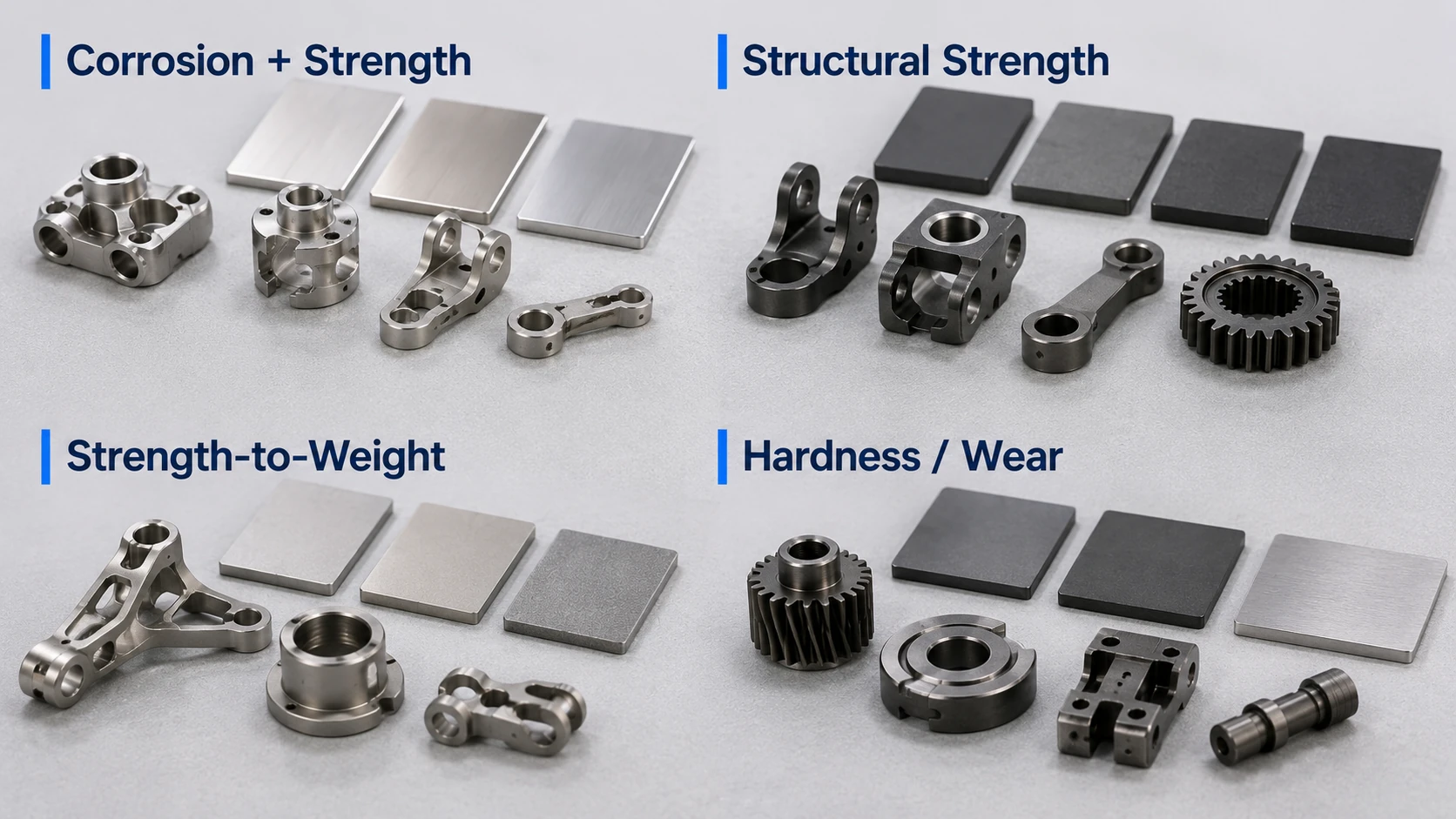
| Baskın gereksinim | Initial shortlist | Why this direction fits | Trade-off / what to confirm |
|---|---|---|---|
| High load + moderate corrosion exposure | 17-4 PH | Potential strength with stainless behavior | Actual exposure, final aging condition, ductility, corrosion suitability |
| Load-bearing structure + controlled environment + cost pressure | 4605 first; 4140/4340 if supported | Low-alloy steel route may meet structural targets without paying for stainless behavior | Qualified feedstock, heat treatment, protective finish, tooling economics |
| Repeated mechanical movement | Do not choose on grade name alone; compare feasible steel conditions | Fatigue and notch behavior may control the result | Cyclic load, critical radius, surface quality, fatigue or functional test plan |
| Strength with lower component mass | Ti-6Al-4V, subject to capability review | High specific strength can benefit a weight-sensitive design | Specialized processing, contamination limits, qualification cost |
| Contact indentation / sliding wear dominates | 420 / 440C or wear-oriented route | Hardness and wear behavior become the main selection criteria | Brittleness, ductility, counterface, lubrication and wear evidence |
| Corrosion dominates but load is modest | 316L or other corrosion-focused grade | A high-strength grade may be unnecessary | Confirm exposure media; use corrosion-focused material guidance |
| Severe fatigue, impact or high-consequence failure | No grade approved from a generic comparison | Application risk overrides a simple shortlist | Supplier capability, part-level testing and potential process reconsideration |
When Strength and Corrosion Resistance Are Both Required
For a compact stainless mechanism that must resist mechanical load and a defined level of corrosion, 17-4 PH may be a stronger starting candidate than an austenitic corrosion-focused grade. But “stainless” is not a corrosion guarantee: test against the actual service medium and finishing condition. If the load is limited and corrosion is the decisive requirement, corrosion-driven material selection may lead to a different alloy.
When Structural Strength, Toughness, and Cost Must Be Balanced
Review MIM 4605 first where a qualified structural low-alloy route exists and the environment allows a practical corrosion-control method. If a different strength–ductility balance is necessary, consider 4140 or 4340 only after confirming available MIM-specific material and heat-treatment evidence. Compare total production needs, including coating, secondary operations, inspection and dimensional changes—not just powder cost. For a focused grade comparison, see 17-4 PH ve MIM 4605 Karşılaştırması.
A low-alloy steel is a poor shortlist choice when the part needs inherent corrosion resistance and protective finishing cannot be relied upon. If corrosion is not demanding, the extra cost of a stainless alloy should be justified by a functional requirement. Material availability, processing and inspection cost belong in the comparison alongside strength.
When Fatigue, Weight, or Special Conditions Change the Choice
A high static-strength number cannot settle a hinge, locking-arm or repeated-contact decision. Cyclic loading, notch geometry, surface finish and local contact stresses may alter the shortlist or force additional testing. Where weight reduction produces measurable system value, Ti-6Al-4V can be assessed against the added processing burden. If the real problem is wear or surface damage, switch to the appropriate hardness or wear selection criteria rather than forcing a “high-strength” label.
Carry a preferred grade, an alternative and the unresolved trade-offs into the manufacturability review. A grade with no qualified feedstock or treatment data remains provisional.
Published industry example · Material choice
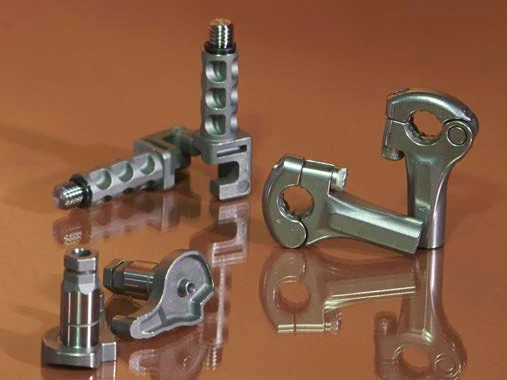
17-4 PH and MIM 4605 in a hydraulic proportional-valve assembly. MIMA's published case reports 17-4 PH stainless steel for the two base components and 4605 low-alloy steel for the catcher and tension bar in valves used on off-highway and agricultural equipment.
The base components were produced to their specified dimensions directly by MIM, including an internal thread. The catcher was ground and burnished for outside-diameter tolerance and finish; the tension bar received a turned external thread. Material selection and finishing were made at the component level, even within the same assembly.
The case does not give enough information to reconstruct the complete load-and-corrosion calculation for each material choice. The photograph shows the group, but individual pieces are not assigned material labels by image alone. This is independent industry evidence, not an XTMIM customer project or material-performance guarantee.
04 / Verify the MIM Route
Can the Selected Alloy Achieve the Required Properties Through MIM?
An alloy designation describes chemistry, not the properties of a finished MIM component. Powder and feedstock quality, debinding, sintering atmosphere, achieved density, heat treatment and geometry all affect the result. A material can be listed in a standard without being established as a repeatable production process for a particular supplier and drawing.
Confirm Feedstock Availability and Sintering Feasibility
Ask whether the supplier has a documented feedstock route for the specified MIM alloy, appropriate powder chemistry and binder handling, and controlled debinding and sintering capability. Residual porosity and chemistry deviations can change mechanical behavior; shrinkage and support strategy can affect dimensions. Being able to obtain a powder does not by itself demonstrate stable molding, densification or repeatable production. For uncommon alloys, request a material- and geometry-specific feasibility review before tooling approval.
Evaluate the Final Sintered and Heat-Treated Material Condition
Compare data only for identified final conditions. The sintered state and a later aged, quenched, tempered or otherwise treated condition are not interchangeable. Processing may achieve desired hardness or strength but can also shift ductility, flatness and critical fits. A heat-treatment requirement therefore belongs in the material specification and the dimensional inspection plan from the beginning. See ısıl işlem görebilen MIM malzemeleri for the broader property context.
Bu Parmaco 2019 MIM 17-4 PH material specification reports separate mechanical-property requirements for the as-sintered, H900 and H1000 conditions. These values describe that manufacturer's documented process and must not be used as XTMIM guarantees or universal minimums for all MIM 17-4 PH.
| Parmaco MIM 17-4 PH condition | 0.2% yield strength (MPa) | Ultimate tensile strength (MPa) | Elongation A (%) |
|---|---|---|---|
| Sinterlenmiş | 670-790 | 880-1020 | 4-8 |
| H900 | ≥950 | ≥1150 | ≥2 |
| H1000 | ≥750 | ≥900 | ≥5 |
In the cited data sheet, H900 has a higher specified minimum yield strength, while H1000 has a higher minimum elongation requirement. Both the specified treatment and the applicable acceptance values must be carried into the drawing. The table contains reported ranges and minimum requirements rather than statistical averages; it is not a cross-supplier grade ranking. Source: Parmaco MIM 17-4 PH material specification (Rev. 03, 2019).
| Üretim faktörü | Potential effect on project | Supplier evidence / engineering question |
|---|---|---|
| Powder chemistry and feedstock route | Composition variability or material unavailability | Is this a qualified MIM feedstock, or only a potential custom material? |
| Sinterlenmiş yoğunluk ve kalan gözeneklilik | Mechanical properties and consistency may differ from published reference values | What density, chemistry and test results represent this final condition? |
| Debinding, shrinkage and sintering support | Distortion, local variation or critical-dimension drift | How will shrinkage, support, geometry and dimensional sampling be assessed? |
| Heat treatment / finishing | Strength–ductility trade-offs, dimensional movement and surface effects | What treatment state and post-treatment inspections are specified? |
| Stress concentration, fatigue and impact | Finished part may fail despite adequate coupon strength | Which loaded regions or duty cycles need application-specific verification? |
A high-strength alloy will not eliminate stress concentration at a thin hinge root or sharp section transition. Cyclic load, surface condition and local geometry must be reviewed alongside material condition. For detailed feature design, see the MIM tasarım kılavuzu ve wall-thickness guidance.
When feedstock supply is uncertain, sintering or heat-treatment capability is unproven, or a severe fatigue requirement cannot be verified, the alloy should not be approved for production tooling. The project may require additional testing, a different material condition or a different manufacturing route.
Before tooling, ask for evidence of the intended MIM feedstock and process route, final condition, achievable properties and the inspection plan for critical dimensions and features.
Published industry example · Process evidence
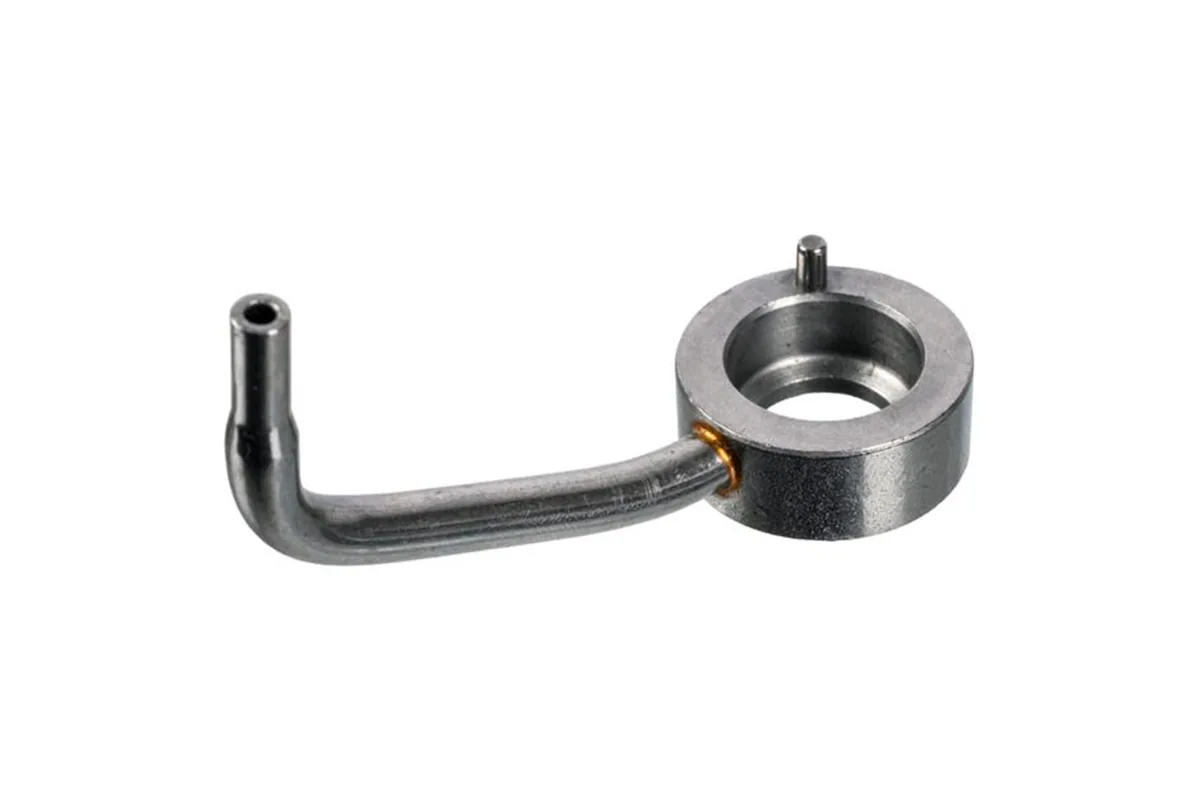
Heat-treated MIM 4605 and complex oil passages. A 2021 MIMA automotive case documents an oil spray piston cooler made from MIM-4605 for a heavy-vehicle engine. The report records a density of 7.55 g/cm3 and an ultimate tensile strength of 1.550 MPa for the documented case.
The component includes two oil holes intersecting a central passage at different angles. The producer's challenge was to mold the passage geometry while avoiding restrictions or machining burrs that could disrupt oil flow. The producer's report identifies the material as heat-treated MIM 4605.
What the result establishes: this particular material, processing route and geometry were achieved in a published industrial application. What it does not establish: 1,550 MPa is not a universal minimum for all MIM 4605 parts or an XTMIM guarantee. Any new project needs its own specified final condition and acceptance tests.
05 / Define Acceptance Evidence
How Should High-Strength MIM Material Performance Be Verified?
Manufacturability and acceptance are separate questions. The supplier may be able to mold and sinter an alloy, but the part still needs agreed evidence that it meets the specified strength and service requirements. Define the grade, final condition, test method, specimen or production-part sampling, acceptance limits and relevant duty cycle before tooling release.
Compare Material Data Under Equivalent Conditions
Use comparable MIM material conditions rather than combining data from annealed material, heat-treated bar stock, wrought forgings and unspecified MIM test coupons. For tensile properties, record the test method, specimen type, final thermal condition and relevant results. ASTM B883-24 provides a ferrous MIM material specification scope, while MPIF Standard 35-MIM is a MIM-specific reference family. Their public listings are not a substitute for obtaining the relevant detailed requirements and project-specific material reports.
Confirm Material-Level and Part-Level Validation
ASTM E8/E8M addresses metallic tensile testing, but coupon results may not describe every feature of a finished part. Where repeated loading is decisive, ASTM E466 is an example of a laboratory axial fatigue practice; a project may additionally need component-level cyclic or functional tests under its own duty cycle. Define which evidence is required to accept the actual design rather than assuming every standard test is necessary for every component.
For cyclic service, specify the load or stress range, required cycle count, service environment and acceptance criteria. Hardness or static tensile results do not establish a particular fatigue life. Critical components may need dedicated part-level cyclic testing and documented control of their production condition.
| Claim being verified | Evidence to agree on | What would remain unresolved |
|---|---|---|
| The supplied alloy matches the specification | Agreed grade, composition identification and material documentation | A generic label without a specified MIM condition |
| The required static properties are met | Agreed minimums and representative tensile / yield / elongation data from the specified final MIM condition, as appropriate | Wrought-alloy or unrelated heat-treatment data |
| The treatment produces the expected material state | Heat-treatment record, hardness or other agreed condition checks | An unspecified “heat treated” statement |
| Dimensional and surface criteria are met | Critical-dimension inspection, surface assessment and agreed sampling | A coupon test with no finished-part inspection |
| The part survives repeated or severe service loading | Application-matched fatigue / functional testing, load cycle or duty definition, and an agreed acceptance criterion | Only a static tensile-strength result |
Material standards support specification discussions; the finished OEM component is accepted against its drawing and the tests agreed for its use. The public standard listings below identify scope or publication status and do not reproduce the full numerical material requirements.
- MPIF standards resource ve 2025 Standard 35-MIM edition announcement.
- ASTM B883-24, Metal Enjeksiyon Kalıplı (MIM) Malzemeleri İçin Standart Spesifikasyon.
- ASTM E8/E8M, Tension Testing of Metallic Materials ve ASTM E466, Axial Fatigue Testing Practice.
- MIMA malzeme aralığı, for identifying industry material candidates and confirming the need for supplier-specific availability checks.
Hold approval if required test evidence is missing, the treatment state is unverified or part-level failure risk remains unresolved. Additional tests are more useful than assuming a favorable value from an unrelated material data sheet.
06 / Prepare the Engineering Review
What Information Is Needed to Confirm a High-Strength MIM Material?
Send a preferred alloy and an alternative together with the final property targets, expected loads, service environment and drawing. The supplier also needs to know which data remain unverified. A quotation based only on the material name can overlook corrosion controls, heat treatment, secondary machining or functional testing.
| İnceleme maddesi | What the project team should provide or decide |
|---|---|
| Drawing and project stage | 2D drawing, 3D CAD, current manufacturing process and whether the design is still changing |
| Preferred and fallback grades | Current material, candidate MIM grades, why each is being considered and any substitution limits |
| Functional load and environment | Load direction, static / cyclic / impact duty, corrosion exposure, temperature and service expectations |
| Target properties and final state | Required strength, elongation or hardness where relevant; heat-treatment and surface-treatment requirements |
| Critical geometry and tolerances | Loaded thin sections, hole / contact locations, key datums, fit-critical dimensions and surface specifications |
| Acceptance evidence | Applicable material standard, representative test reports, finished-part inspection and functional test needs |
| Üretim planı | Prototype / validation quantity, expected annual demand and schedule constraints for a tooling decision |
Doğrulamaya devam et
A feasible material and process route are identified, with explicit sample and testing requirements.
Request missing evidence
Material condition, supplier capability, load data or inspection acceptance remains unclear.
Reconsider the route
Unmet performance, geometry or production constraints require another alloy or manufacturing option.
Example drawing-review note: “Evaluate 17-4 PH in a specified final condition where strength and corrosion resistance are both required. Consider protected 4605 only if the corrosion-control method is acceptable. Confirm yield-strength requirement, cyclic loading, critical tolerances and supplier-specific test evidence before material approval.” The example describes an evaluation format, not a material recommendation for an unseen design.
For other material families, consult the MIM malzeme seçim kılavuzu. MIM malzemeleri genel bakışını ve malzeme özellikleri hub cover broader requirements.
Next Step / Drawing-Based Review
Submit Your Drawing for High-Strength MIM Material Review
If you have a candidate grade or an unmet strength target, share the drawing, expected volume, load conditions and required final properties. XTMIM can review material suitability, available process routes, shrinkage and heat-treatment risks, and the verification questions that should be resolved before tooling. A feasibility review is not a promise that an unqualified specialty material can be produced.