
高強度MIM材料は、カタログ上の最も高い引張強度数値ではなく、部品の破壊モード、使用環境、および要求される最終材料状態によって選択されます。 17-4 PHステンレス鋼 強度と耐食性のバランスが必要な場合に有力な候補となります。 MIM 4605 低合金鋼 荷重支持強度が重要で、腐食管理が可能である場合に有用です。 4140, 4340 および Ti-6Al-4V 承認前にグレード固有のプロセスと性能チェックが必要です。
永久変形、破壊、または繰り返し荷重に対する要求される耐性から始めます。次に、指定された焼結または熱処理状態での候補MIM合金を比較し、サプライヤーが完成部品を製造および検証できるかを確認します。
01 / 要件定義
MIM材料選定において、どのような強度要件が重要になりますか?
永久的な曲がりが許容されない小型ブラケット、繰り返しサイクルするラッチ、衝撃にさらされる部品は、必ずしも同じ合金を必要とするわけではありません。まず許容できない故障を定義し、次に材料を判断するために使用される機械的特性と最終材料状態を明記してください。
主要な荷重と故障モードの特定
主要な荷重の方向、大きさ、期間を記録します。形状を維持する必要がある部品は降伏強度によって決まることが多く、繰り返し運動を受ける部品は疲労によって決まる可能性があり、急に荷重がかかる機能は延性や衝撃応答に特別な注意が必要になる場合があります。形状や接触条件がこれらの故障モードに影響を与える可能性がありますが、部品設計全体のレビューは、 高強度MIM部品 ガイドをご参照ください。.
| 実際のサービス上の懸念 | 要求される特性または証拠 | 仮定してはいけないこと |
|---|---|---|
| 永久的な曲がりまたはフィットの喪失 | 最終状態での降伏強度、および部品の負荷評価 | 高い引張強さだけでは降伏を防げない |
| 分離または突然の破断 | 伸びと適切な靭性証拠を伴う引張強さ | 最も強い公称グレードが最も靭性も高い |
| 繰り返しのかみ合いまたは振動 | 疲労関連の証拠、表面状態、および必要に応じた部品レベルのサイクルテスト | 静的引張データは長期疲労寿命を示す |
| 衝撃または組み立て時のショック | 延性、用途に応じた衝撃評価、および局所的な形状レビュー | 硬度は亀裂に対する抵抗力を証明する |
| 圧痕または滑り接触 | 硬度、トライボロジー条件、相手面および摩耗評価 | 耐摩耗性とバルク強度を交換可能に |
満たすべき機械的特性を定義する
降伏強さ 永久変形がアセンブリを損なう可能性がある場合に特に重要です。 引張強度 引張試験における別の点を説明します。 伸び 延性を説明するのに役立ちますが、疲労および衝撃挙動には独自の評価が必要です。密度、寸法安定性、腐食暴露は強度測定値ではないかもしれませんが、候補合金が実用的であるかどうかを決定する可能性があります。ASTM E8/E8M は金属引張試験の役割と限界を説明していますが、引張試験片を完成部品と同等にするものではありません。
圧痕摩耗または滑り摩耗が主な懸念事項である場合は、比較してください 高硬度MIM材料 または 耐摩耗性MIM材料 引張強度のみで選択するのではなく。荷重は小さいが腐食暴露が深刻な場合は、レビューしてください 耐食性MIM材料 まず、.
仕様が最小降伏強度、最小引張強度、または完成部品への許容荷重を要求しているかどうかを示します。繰り返し荷重には、荷重範囲、サイクル数、およびサービス環境も必要です。欠落している荷重または受け入れデータは、未解決の要件として記録してください。想定される強度目標は、誤った材料と熱処理につながる可能性があります。
したがって、材料比較は、定義された破壊モード、関連する機械的特性、および妥協できない環境要件から開始する必要があります。
02 / 候補の比較
比較すべき高強度MIM材料はどれですか?
負荷のかかるMIM部品の比較対象として、まず析出硬化系ステンレス鋼と低合金鋼が挙げられます。質量削減がプロセス要求の正当化に十分なほど重要であれば、チタンが候補に入ります。 MIMA材料範囲 は業界の選択肢を特定しますが、個々のサプライヤーが記載されたグレードすべてに対して資格のあるルートを持っていることを確立するものではありません。
| 候補合金 | 候補となる理由 | 主なトレードオフ | 確認のための証拠または能力 |
|---|---|---|---|
| 17-4 PHステンレス鋼 | ステンレス鋼の耐食性と強度 | 熱処理条件は強度と延性に影響し、耐食性は媒体に依存します | MIMグレードと条件、処理ルート、関連する強度と耐食性の要件 |
| MIM 4605 低合金鋼 | ステンレス鋼の耐食性が不可欠でない場合の荷重支持構造用途 | 保護仕上げが必要な場合があります。最終特性は処理に依存します | 熱処理条件、耐食性保護、および部品固有の性能 |
| MIM 4140 低合金鋼 | エンジニアリングレビューのための追加の低合金強度/靭性ルート | 材料の入手性と最終条件は、鍛造4140のデータからは推測できません | 認定されたMIMフィードストックと処理ルート。代表的な試験データ |
| 4340低合金鋼 | プロジェクトで異なる低合金鋼の特性バランスが必要な場合の潜在的な選択肢 | MIMの利用可能性とサプライヤーの経験については、別途確認が必要です | 実際のMIM化学組成、製造ルート、熱処理、および検査計画 |
| Ti-6Al-4V チタン合金 | 比強度を商業的に活用できる重量制限のある部品 | より高いプロセス制御負荷と通常はより大きなプロジェクトコスト | チタンフィードストック、焼結雰囲気、汚染管理、および適切な試験 |
ASTM B883-24 鉄系MIM材料の範囲内には、MIM-17-4 PH、MIM-4605、MIM-4140が含まれます。MIMAは4340もリストしていますが、 2025 MPIF Standard 35-MIM 更新 MIM-Ti-6Al-4V材料規格が含まれています。これらは異なる参照であり、XTMIMが現在これらの材料すべてに適合していることを確認するものではありません。
強度と耐食性を備えた17-4 PHステンレス鋼
17-4 PHは、コンパクトな機構や精密ステンレス構造部品にとって、有用な強度と耐食性の出発点となります。必要な析出硬化条件を指定する必要があります。「17-4 PH」という言葉だけでは、最終的な強度、延性、または寸法応答は確定しません。そのステンレス鋼としての特性は、攻撃的な化学薬品や塩化物への曝露に対する万能の解決策ではありません。腐食が主要な要件であり、負荷が小さい場合は、代替案を評価してください。 316L より強力なグレードを自動的に指定するのではなく。
構造強度向けのMIM 4605およびその他の低合金鋼
MIM 4605は、適切な腐食管理が可能であれば、重要な構造強度候補となります。その実用価値は、指定された焼結または熱処理状態、形状、仕上げ、および受け入れ試験によって決まります。 4140 および 4340 4605またはその鍛造同等品とみなされる代替品ではなく、個別の候補として扱ってください。どちらかを量産図面に適用する前に、認定されたフィードストック、焼結、熱処理、および検証を確認してください。詳細は「 低合金鋼 MIM材料ファミリー 」のグレード別コンテキストを参照してください。
特殊ケース: Ti-6Al-4Vは、質量削減が実際の機能的利点をもたらす場合に有効ですが、チタンMIMは化学組成、汚染、および加工の厳密な管理が必要です。硬度または接触摩耗が支配的な場合、 420 または 440C が議論を変える可能性があり、延性や衝撃とのトレードオフが発生します。コバルトクロム合金およびニッケル合金は、特殊な環境駆動型の選択肢であり、デフォルトの構造用鋼ではありません。アプリケーションでそれらが必要とされる場合にのみ、個別にレビューしてください。
必要な機械的または環境的性能を満たせない合金は除外してください。MIM加工ルートが未確認のグレードは、承認図面ではなく、暫定リストに保持してください。
03 / トレードオフの決定
要求仕様に最適な高強度MIM材料をどのように選択しますか?
材料を失格させる可能性のある条件(腐食暴露、疲労、許容質量、または必須の仕上げ)を、グレードコストと比較する前にランク付けしてください。以下のマトリックスは予備的なショートリストを提供しますが、最終承認には意図したMIMプロセスと熱処理状態のデータが必要です。
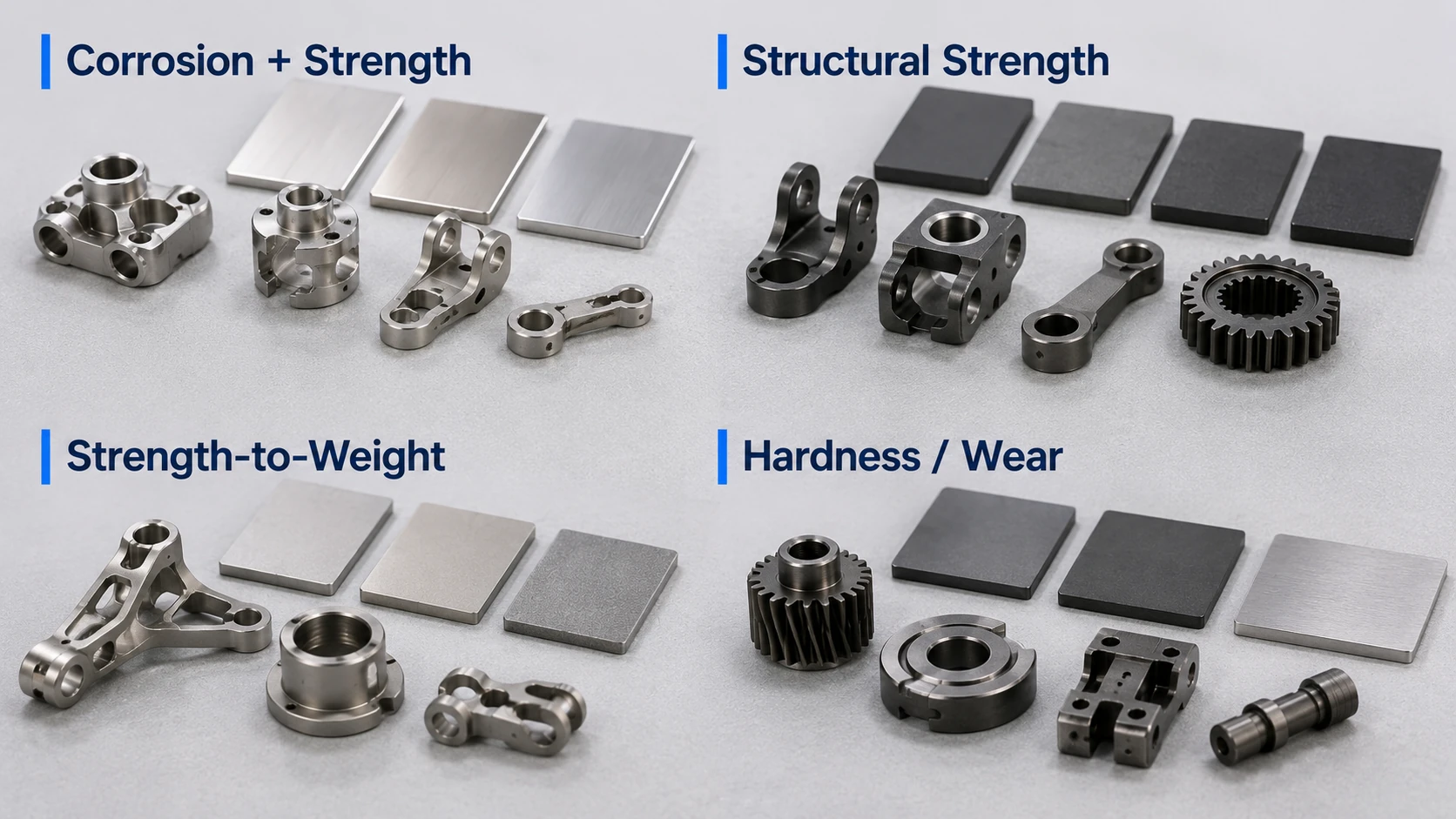
| 主要な要求事項 | 初期ショートリスト | この方向性が適している理由 | トレードオフ / 確認事項 |
|---|---|---|---|
| 高負荷 + 中程度の腐食環境 | 17-4 PH | ステンレス鋼のような挙動で潜在的な強度を発揮 | 実際の暴露、最終的な時効処理状態、延性、腐食適合性 |
| 荷重支持構造 + 管理された環境 + コスト圧力 | 4605を第一候補とし、サポートされる場合は4140/4340 | 低合金鋼ルートは、ステンレス鋼のような挙動のコストをかけずに構造目標を満たす可能性があります | 認定フィードストック、熱処理、保護仕上げ、金型経済性 |
| 繰り返し機械的動作 | グレード名だけで選ばず、実現可能な鋼の状態を比較してください | 疲労およびノッチ挙動が結果を左右する可能性があります | Cyclic load, critical radius, surface quality, fatigue or functional test plan |
| Strength with lower component mass | Ti-6Al-4V, subject to capability review | High specific strength can benefit a weight-sensitive design | Specialized processing, contamination limits, qualification cost |
| Contact indentation / sliding wear dominates | 420 / 440C or wear-oriented route | Hardness and wear behavior become the main selection criteria | Brittleness, ductility, counterface, lubrication and wear evidence |
| Corrosion dominates but load is modest | 316L or other corrosion-focused grade | A high-strength grade may be unnecessary | Confirm exposure media; use corrosion-focused material guidance |
| Severe fatigue, impact or high-consequence failure | No grade approved from a generic comparison | Application risk overrides a simple shortlist | Supplier capability, part-level testing and potential process reconsideration |
When Strength and Corrosion Resistance Are Both Required
For a compact stainless mechanism that must resist mechanical load and a defined level of corrosion, 17-4 PH may be a stronger starting candidate than an austenitic corrosion-focused grade. But “stainless” is not a corrosion guarantee: test against the actual service medium and finishing condition. If the load is limited and corrosion is the decisive requirement, corrosion-driven material selection may lead to a different alloy.
When Structural Strength, Toughness, and Cost Must Be Balanced
Review MIM 4605 first where a qualified structural low-alloy route exists and the environment allows a practical corrosion-control method. If a different strength–ductility balance is necessary, consider 4140 or 4340 only after confirming available MIM-specific material and heat-treatment evidence. Compare total production needs, including coating, secondary operations, inspection and dimensional changes—not just powder cost. For a focused grade comparison, see 17-4 PHとMIM 4605の比較.
A low-alloy steel is a poor shortlist choice when the part needs inherent corrosion resistance and protective finishing cannot be relied upon. If corrosion is not demanding, the extra cost of a stainless alloy should be justified by a functional requirement. Material availability, processing and inspection cost belong in the comparison alongside strength.
When Fatigue, Weight, or Special Conditions Change the Choice
A high static-strength number cannot settle a hinge, locking-arm or repeated-contact decision. Cyclic loading, notch geometry, surface finish and local contact stresses may alter the shortlist or force additional testing. Where weight reduction produces measurable system value, Ti-6Al-4V can be assessed against the added processing burden. If the real problem is wear or surface damage, switch to the appropriate hardness or wear selection criteria rather than forcing a “high-strength” label.
Carry a preferred grade, an alternative and the unresolved trade-offs into the manufacturability review. A grade with no qualified feedstock or treatment data remains provisional.
Published industry example · Material choice
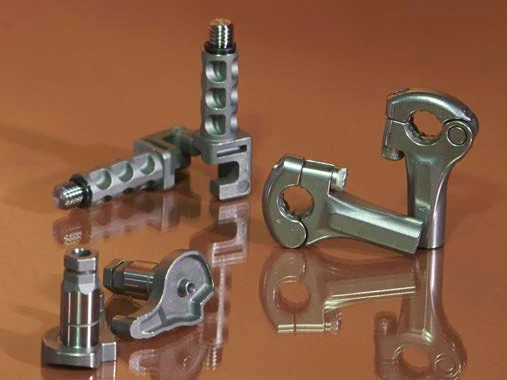
17-4 PH and MIM 4605 in a hydraulic proportional-valve assembly. MIMA's published case reports 17-4 PH stainless steel for the two base components and 4605 low-alloy steel for the catcher and tension bar in valves used on off-highway and agricultural equipment.
The base components were produced to their specified dimensions directly by MIM, including an internal thread. The catcher was ground and burnished for outside-diameter tolerance and finish; the tension bar received a turned external thread. Material selection and finishing were made at the component level, even within the same assembly.
The case does not give enough information to reconstruct the complete load-and-corrosion calculation for each material choice. The photograph shows the group, but individual pieces are not assigned material labels by image alone. This is independent industry evidence, not an XTMIM customer project or material-performance guarantee.
04 / Verify the MIM Route
Can the Selected Alloy Achieve the Required Properties Through MIM?
An alloy designation describes chemistry, not the properties of a finished MIM component. Powder and feedstock quality, debinding, sintering atmosphere, achieved density, heat treatment and geometry all affect the result. A material can be listed in a standard without being established as a repeatable production process for a particular supplier and drawing.
Confirm Feedstock Availability and Sintering Feasibility
Ask whether the supplier has a documented feedstock route for the specified MIM alloy, appropriate powder chemistry and binder handling, and controlled debinding and sintering capability. Residual porosity and chemistry deviations can change mechanical behavior; shrinkage and support strategy can affect dimensions. Being able to obtain a powder does not by itself demonstrate stable molding, densification or repeatable production. For uncommon alloys, request a material- and geometry-specific feasibility review before tooling approval.
Evaluate the Final Sintered and Heat-Treated Material Condition
Compare data only for identified final conditions. The sintered state and a later aged, quenched, tempered or otherwise treated condition are not interchangeable. Processing may achieve desired hardness or strength but can also shift ductility, flatness and critical fits. A heat-treatment requirement therefore belongs in the material specification and the dimensional inspection plan from the beginning. See 熱処理可能MIM材料 for the broader property context.
この Parmaco 2019 MIM 17-4 PH material specification reports separate mechanical-property requirements for the as-sintered, H900 and H1000 conditions. These values describe that manufacturer's documented process and must not be used as XTMIM guarantees or universal minimums for all MIM 17-4 PH.
| Parmaco MIM 17-4 PH condition | 0.2% yield strength (MPa) | Ultimate tensile strength (MPa) | Elongation A (%) |
|---|---|---|---|
| 焼結後 | 670-790 | 880-1020 | 4-8 |
| H900 | ≥950 | ≥1150 | ≥2 |
| H1000 | ≥750 | ≥900 | ≥5 |
In the cited data sheet, H900 has a higher specified minimum yield strength, while H1000 has a higher minimum elongation requirement. Both the specified treatment and the applicable acceptance values must be carried into the drawing. The table contains reported ranges and minimum requirements rather than statistical averages; it is not a cross-supplier grade ranking. Source: Parmaco MIM 17-4 PH material specification (Rev. 03, 2019).
| 製造上の要因 | Potential effect on project | Supplier evidence / engineering question |
|---|---|---|
| Powder chemistry and feedstock route | Composition variability or material unavailability | Is this a qualified MIM feedstock, or only a potential custom material? |
| 焼結密度と残留気孔率 | Mechanical properties and consistency may differ from published reference values | What density, chemistry and test results represent this final condition? |
| Debinding, shrinkage and sintering support | Distortion, local variation or critical-dimension drift | How will shrinkage, support, geometry and dimensional sampling be assessed? |
| Heat treatment / finishing | Strength–ductility trade-offs, dimensional movement and surface effects | What treatment state and post-treatment inspections are specified? |
| Stress concentration, fatigue and impact | Finished part may fail despite adequate coupon strength | Which loaded regions or duty cycles need application-specific verification? |
A high-strength alloy will not eliminate stress concentration at a thin hinge root or sharp section transition. Cyclic load, surface condition and local geometry must be reviewed alongside material condition. For detailed feature design, see the MIM設計ガイド および wall-thickness guidance.
When feedstock supply is uncertain, sintering or heat-treatment capability is unproven, or a severe fatigue requirement cannot be verified, the alloy should not be approved for production tooling. The project may require additional testing, a different material condition or a different manufacturing route.
Before tooling, ask for evidence of the intended MIM feedstock and process route, final condition, achievable properties and the inspection plan for critical dimensions and features.
Published industry example · Process evidence
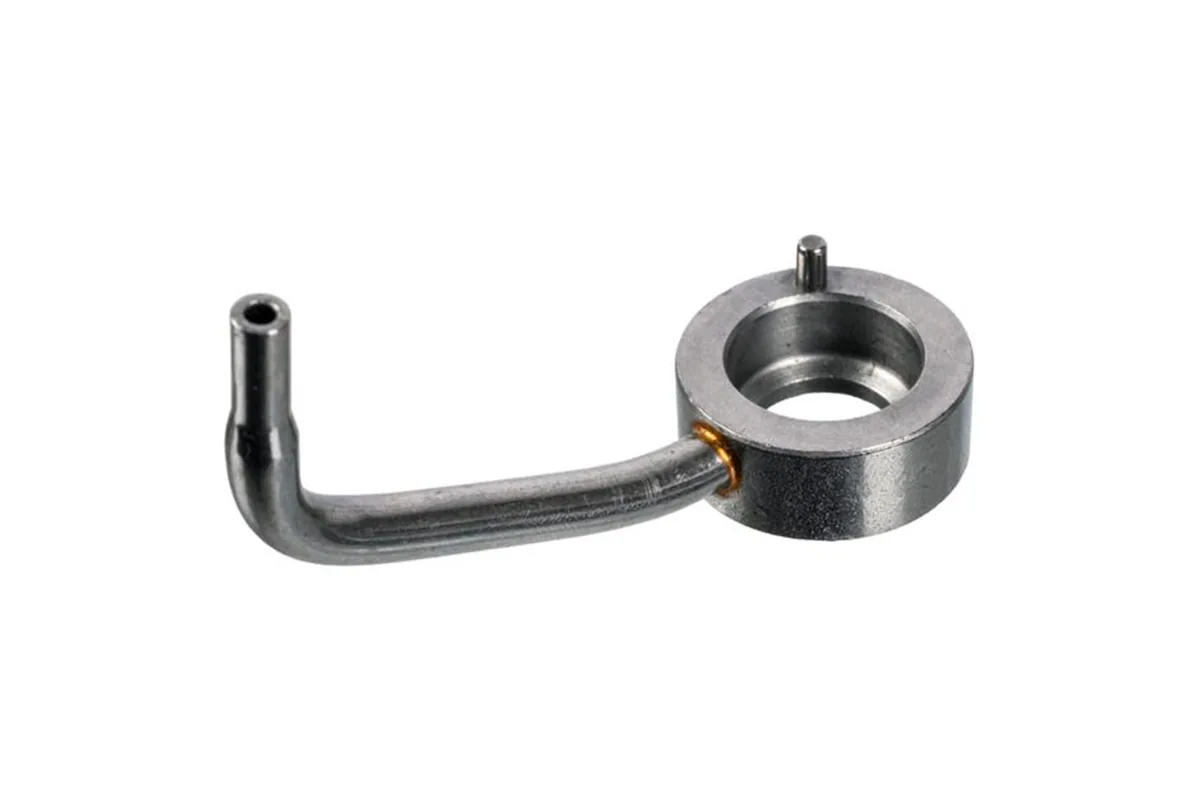
Heat-treated MIM 4605 and complex oil passages. A 2021 MIMA automotive case documents an oil spray piston cooler made from MIM-4605 for a heavy-vehicle engine. The report records a density of 7.55 g/cm3 and an ultimate tensile strength of 1,550 MPa for the documented case.
The component includes two oil holes intersecting a central passage at different angles. The producer's challenge was to mold the passage geometry while avoiding restrictions or machining burrs that could disrupt oil flow. The producer's report identifies the material as heat-treated MIM 4605.
What the result establishes: this particular material, processing route and geometry were achieved in a published industrial application. What it does not establish: 1,550 MPa is not a universal minimum for all MIM 4605 parts or an XTMIM guarantee. Any new project needs its own specified final condition and acceptance tests.
05 / Define Acceptance Evidence
How Should High-Strength MIM Material Performance Be Verified?
Manufacturability and acceptance are separate questions. The supplier may be able to mold and sinter an alloy, but the part still needs agreed evidence that it meets the specified strength and service requirements. Define the grade, final condition, test method, specimen or production-part sampling, acceptance limits and relevant duty cycle before tooling release.
Compare Material Data Under Equivalent Conditions
Use comparable MIM material conditions rather than combining data from annealed material, heat-treated bar stock, wrought forgings and unspecified MIM test coupons. For tensile properties, record the test method, specimen type, final thermal condition and relevant results. ASTM B883-24 provides a ferrous MIM material specification scope, while MPIF規格35-MIM is a MIM-specific reference family. Their public listings are not a substitute for obtaining the relevant detailed requirements and project-specific material reports.
Confirm Material-Level and Part-Level Validation
ASTM E8/E8M addresses metallic tensile testing, but coupon results may not describe every feature of a finished part. Where repeated loading is decisive, ASTM E466 is an example of a laboratory axial fatigue practice; a project may additionally need component-level cyclic or functional tests under its own duty cycle. Define which evidence is required to accept the actual design rather than assuming every standard test is necessary for every component.
For cyclic service, specify the load or stress range, required cycle count, service environment and acceptance criteria. Hardness or static tensile results do not establish a particular fatigue life. Critical components may need dedicated part-level cyclic testing and documented control of their production condition.
| Claim being verified | Evidence to agree on | What would remain unresolved |
|---|---|---|
| The supplied alloy matches the specification | Agreed grade, composition identification and material documentation | A generic label without a specified MIM condition |
| The required static properties are met | Agreed minimums and representative tensile / yield / elongation data from the specified final MIM condition, as appropriate | Wrought-alloy or unrelated heat-treatment data |
| The treatment produces the expected material state | Heat-treatment record, hardness or other agreed condition checks | An unspecified “heat treated” statement |
| Dimensional and surface criteria are met | Critical-dimension inspection, surface assessment and agreed sampling | A coupon test with no finished-part inspection |
| The part survives repeated or severe service loading | Application-matched fatigue / functional testing, load cycle or duty definition, and an agreed acceptance criterion | Only a static tensile-strength result |
Material standards support specification discussions; the finished OEM component is accepted against its drawing and the tests agreed for its use. The public standard listings below identify scope or publication status and do not reproduce the full numerical material requirements.
- MPIF standards resource および 2025 Standard 35-MIM edition announcement.
- ASTM B883-24、金属射出成形(MIM)材料標準仕様書.
- ASTM E8/E8M, Tension Testing of Metallic Materials および ASTM E466, Axial Fatigue Testing Practice.
- MIMA材料範囲, for identifying industry material candidates and confirming the need for supplier-specific availability checks.
Hold approval if required test evidence is missing, the treatment state is unverified or part-level failure risk remains unresolved. Additional tests are more useful than assuming a favorable value from an unrelated material data sheet.
06 / Prepare the Engineering Review
What Information Is Needed to Confirm a High-Strength MIM Material?
Send a preferred alloy and an alternative together with the final property targets, expected loads, service environment and drawing. The supplier also needs to know which data remain unverified. A quotation based only on the material name can overlook corrosion controls, heat treatment, secondary machining or functional testing.
| レビュー項目 | What the project team should provide or decide |
|---|---|
| Drawing and project stage | 2D drawing, 3D CAD, current manufacturing process and whether the design is still changing |
| Preferred and fallback grades | Current material, candidate MIM grades, why each is being considered and any substitution limits |
| Functional load and environment | Load direction, static / cyclic / impact duty, corrosion exposure, temperature and service expectations |
| Target properties and final state | Required strength, elongation or hardness where relevant; heat-treatment and surface-treatment requirements |
| Critical geometry and tolerances | Loaded thin sections, hole / contact locations, key datums, fit-critical dimensions and surface specifications |
| 受け入れ証拠 | Applicable material standard, representative test reports, finished-part inspection and functional test needs |
| 生産計画 | Prototype / validation quantity, expected annual demand and schedule constraints for a tooling decision |
バリデーションに進む
A feasible material and process route are identified, with explicit sample and testing requirements.
Request missing evidence
Material condition, supplier capability, load data or inspection acceptance remains unclear.
Reconsider the route
Unmet performance, geometry or production constraints require another alloy or manufacturing option.
Example drawing-review note: “Evaluate 17-4 PH in a specified final condition where strength and corrosion resistance are both required. Consider protected 4605 only if the corrosion-control method is acceptable. Confirm yield-strength requirement, cyclic loading, critical tolerances and supplier-specific test evidence before material approval.” The example describes an evaluation format, not a material recommendation for an unseen design.
For other material families, consult the MIM材料選定ガイド. MIM材料 概要と 材料特性 hub cover broader requirements.
Next Step / Drawing-Based Review
Submit Your Drawing for High-Strength MIM Material Review
If you have a candidate grade or an unmet strength target, share the drawing, expected volume, load conditions and required final properties. XTMIM can review material suitability, available process routes, shrinkage and heat-treatment risks, and the verification questions that should be resolved before tooling. A feasibility review is not a promise that an unqualified specialty material can be produced.