Réponse rapide : Le MIM mérite d'être évalué pour des pièces métalliques compactes et détaillées avec une demande de production répétée. La fonderie à cire perdue peut être plus pratique pour des composants plus grands ou plus lourds, des alliages spécifiques à la fonderie, ou des projets où la fonderie et la finition répondent déjà aux exigences de coût et de qualité. Examinez d'abord le matériau et la géométrie, vérifiez les exigences fonctionnelles, puis comparez le coût par pièce finie acceptée sur la durée de vie attendue de la production.
MIM vs Fonderie à Cire Perdue : Différences Clés
Dans une comparaison entre le moulage par injection de métal (MIM) et la fonderie à cire perdue, la distinction clé réside dans la manière dont le métal prend forme : le MIM utilise la mise en forme à base de poudre et le frittage, tandis que la fonderie à cire perdue utilise du métal en fusion et un moule en céramique consommable. Cela affecte les formes, les matériaux, les tolérances et les quantités de production que chaque procédé peut gérer économiquement.
| Facteur de comparaison | Moulage par injection de métal (MIM) | Fonderie à cire perdue (moulage de précision) |
|---|---|---|
| Principe de formage | Injection de poudre métallique et de liant, suivie d'un déliantage et d'un frittage | Modèle en cire, coque en céramique et coulée de métal en fusion |
| Profil typique de pièce | Pièces compactes et détaillées avec une demande de production répétée | Formes complexes moulées sur une gamme de tailles et de masses plus étendue |
| Voie matière | Nécessite un feedstock adapté et une voie de frittage validée | Nécessite un alliage de coulée disponible et un procédé de fonderie adapté |
| Géométrie | Fines caractéristiques moulées là où l'outillage et le démoulage le permettent | Contour et caractéristiques internes complexes là où les modèles et les noyaux le permettent |
| Contrôle dimensionnel | Compensation du moule, contrôle du frittage et support | Précision du modèle, comportement de la cire perdue, solidification et finition |
| Opérations secondaires | Peut réduire l'usinage ; les surfaces critiques peuvent encore nécessiter une finition | Retrait et nettoyage de l'alimentation ; usinage ou finition selon les besoins |
| Économie | Souvent intéressant lorsque le volume répété et les économies de caractéristiques compensent l'outillage | Souvent intéressant lorsque l'alliage de coulée, la masse ou l'investissement initial favorisent cette voie |
Le tableau aide à affiner le choix ; l'approbation de l'outillage nécessite toujours une revue de plan. Les deux procédés peuvent être économiques à des volumes de production substantiels ; aucun n'a d'avantage de coût universel. Voir le comparaison des procédés de fabrication - aperçu pour d'autres paires de procédés.
Fonctionnement du MIM et de la Fonderie à Cire Perdue
Moulage par Injection de Métal (MIM) : Mise en forme de la poudre et frittage
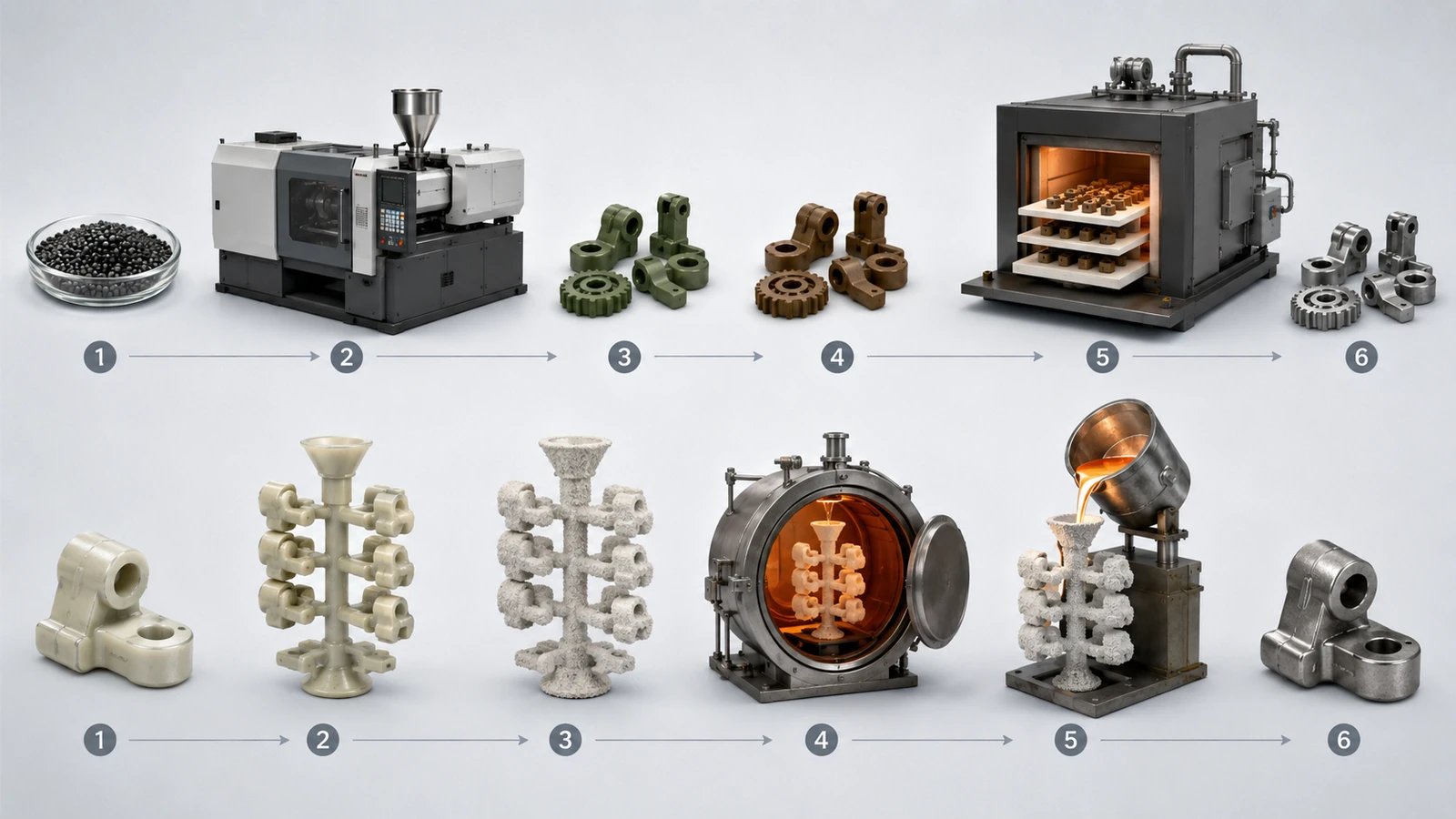
Une poudre métallique fine est mélangée à un liant pour produire un matériau moulable feedstock MIM. L'injection crée une pièce brute (pièce verte), qui subit une élimination contrôlée du liant pendant le déliantage. La pièce déliantée (pièce brune) est densifiée par le frittage. Les dimensions de l'outillage doivent tenir compte du retrait de frittage ; la géométrie et le support doivent permettre une modification dimensionnelle contrôlée.
Casting de Précision : Modèles en cire perdue et solidification du métal
Le casting de précision crée un modèle en cire, généralement assemblé en un « arbre ». Des couches successives de barbotine céramique et de revêtements réfractaires forment une coquille autour des modèles. La cire est retirée, la coquille est préparée pour la coulée, et le métal en fusion se solidifie dans la cavité. La coquille est brisée, les pièces individuelles sont séparées et la finition suit selon les besoins. La précision du modèle, l'état de la coquille, le flux du métal et la solidification affectent tous le résultat. L' référence sur la construction de coquille de l'Investment Casting Institute explique l'étape de la coquille perdue.
Les deux méthodes sont des procédés de mise en forme quasi-nette, mais l'ingénieur MIM doit gérer l'élimination du liant et le retrait de frittage, tandis que l'ingénieur en fonderie doit gérer le remplissage, l'alimentation et la solidification. Ces différences expliquent pourquoi une conception de pièce coulée réussie n'est pas nécessairement une conception MIM prête pour l'outillage.
Compatibilité des Matériaux et Limitations du Procédé
Disponibilité des matériaux et des matières premières MIM
Vérifiez l'alliage spécifié avant d'évaluer le coût de l'outillage ou de la pièce. Les aciers inoxydables et les aciers faiblement alliés sont des familles MIM établies ; d'autres matériaux peuvent être disponibles par des voies spécialisées. La poudre métallique disponible dans le commerce n'est pas nécessairement adaptée au feedstock MIM, au déliantage ou à un frittage stable. Confirmez la disponibilité du feedstock, la chimie requise, les propriétés atteignables et la capacité de production avant de payer pour un moule.
For example, when comparing MIM 17-4 PH with a precipitation-hardening stainless steel casting, confirm the applicable grade specification, heat-treatment condition and required properties; the alloy family alone does not establish interchangeability. The guide des matériaux MIM provides additional selection context. MPIF Standard 35 for MIM materials is a useful starting point where the specified grade is covered.
Investment Casting Alloys and Material Availability
Investment casting can accommodate many steel, stainless steel, nickel, cobalt and selected nonferrous alloy families, depending on the foundry and application. Some cast-specific compositions, solidification structures or contractual material specifications cannot simply be substituted by a powder metallurgy grade. Confirm the required standard and whether an alternative manufacturing route is permitted.
| Material situation | Décision avant outillage |
|---|---|
| Established grade available through both routes | Compare required chemistry, heat treatment and verified final properties. |
| Cast-specific alloy or mandatory cast product specification | Retain casting unless an approved alternative material and process can be qualified. |
| Specialized powder exists but feedstock or sintering is unproven | Do not assume MIM production feasibility; confirm the full route first. |
| Performance specified without a fixed alloy | Evaluate candidate materials against actual corrosion, wear, strength or magnetic requirements. |
Some alloys available in the industry may not be supported by XTMIM. Confirm specialized alloy availability and an established production route before ordering.
Taille de pièce, poids et épaisseur de paroi
Part Size and Weight Limits
MIM is particularly useful when a compact part contains enough functional detail to justify powder-based forming. As part mass increases, feedstock consumption, binder-removal time, furnace loading and handling can reduce its economic benefit. A palm-sized part is not automatically suitable: mass distribution, maximum section and support geometry can be more important than envelope alone.
Investment casting can remain attractive for larger or heavier shapes because it does not require binder removal from a molded metal-powder compact. However, a large cast component still requires a workable filling and feeding plan, a stable shell and suitable foundry capacity.
Wall Thickness and Section Geometry
In MIM, isolated thick regions and abrupt thick-to-thin transitions can complicate binder removal and shrinkage balance. In investment casting, thick regions can form hot spots, while thin or extended sections may be difficult to fill before the metal freezes. Assess the entire section profile, not only a nominal wall thickness.
| Caractéristique du dessin | Analyse MIM | Investment casting review |
|---|---|---|
| Heavy local boss | Binder removal, mass balance and sintering distortion | Feeding and local solidification |
| Bras long et fin | Feedstock filling, green-part handling and sintering support | Metal filling before freezing and pattern/shell integrity |
| Abrupt section transition | Shrinkage balance and potential stress concentration | Hot spots, feeding and solidification sequence |
| Large overall mass | Powder consumption, furnace handling and economics | Foundry capacity, gating and casting yield |
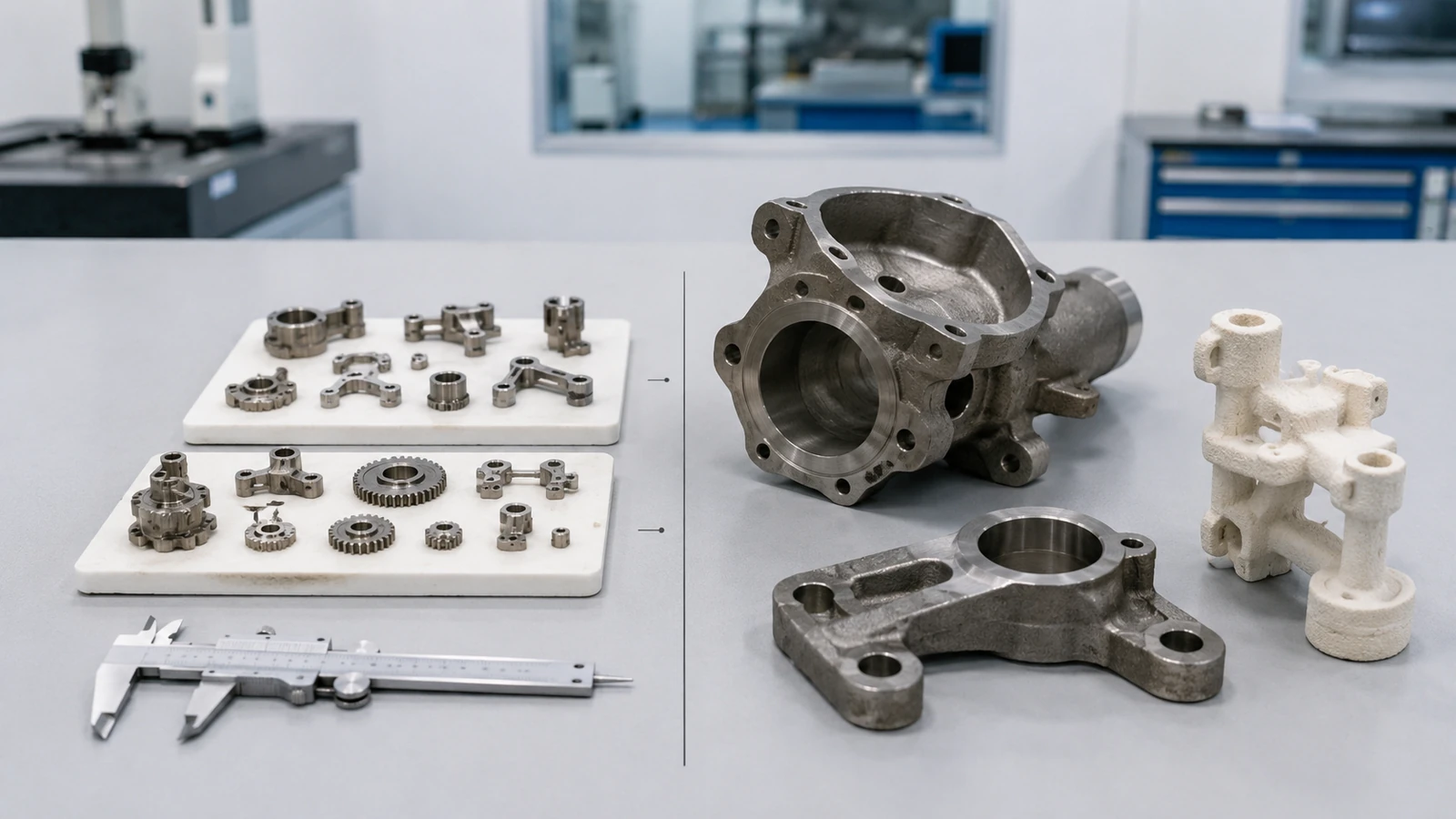
If the part is near a supplier’s size or weight limit, send the CAD model, estimated mass and section views so the supplier can assess the actual geometry. Size and weight stop signals explains when size or weight may rule out conversion.
Géométrie, Caractéristiques Fines et Contraintes de Conception
Holes, Slots, Bosses and Fine Details
MIM may reduce machining by forming small holes, slots, grooves, teeth and other details during injection, provided the mold can fill and release the geometry reliably. A small hole is not automatically moldable: its depth, core-pin strength, direction and functional tolerance all matter. Investment casting can also create detailed contours; the wax pattern, shell coverage and feature filling determine practical limits.
Separate features that must be accurate from features that merely need to exist. A molded or cast pilot hole may reduce machining without eliminating final drilling or reaming. Count the machining operations each route can eliminate, rather than simply counting the features on the drawing.
Undercuts, Internal Features and Tooling Constraints
For MIM, cross holes and undercuts may require side actions, inserts or other tooling solutions. The mold must release the green part without damaging it. For investment casting, wax tooling and expendable patterns or suitable cores can enable internal shapes that may be difficult to release from a conventional MIM tool. Both routes have cost and manufacturing limits.
Identify each feature as directly formed, formed with specialized tooling, or finished by machining. If a feature cannot be produced without compromising another critical requirement, redesign or retain the alternative route. Review the MIM holes, slots and undercuts design guide et Le guide de conception MIMA for related engineering principles.
| Caractéristique | MIM route to assess | Investment casting route to assess |
|---|---|---|
| Axial hole or slot | Direct molding with adequate core support; finish if critical | Pattern or core feature; drill or ream if critical |
| Side hole or external undercut | Slide or split tooling; evaluate flash and release | Pattern tooling or expendable pattern strategy; evaluate shell access |
| Enclosed internal passage | Specialized removable core or redesign; confirm feasibility | Suitable expendable core; confirm core removal and internal quality |
Précision Dimensionnelle et Répétabilité
As-Sintered and As-Cast Tolerances
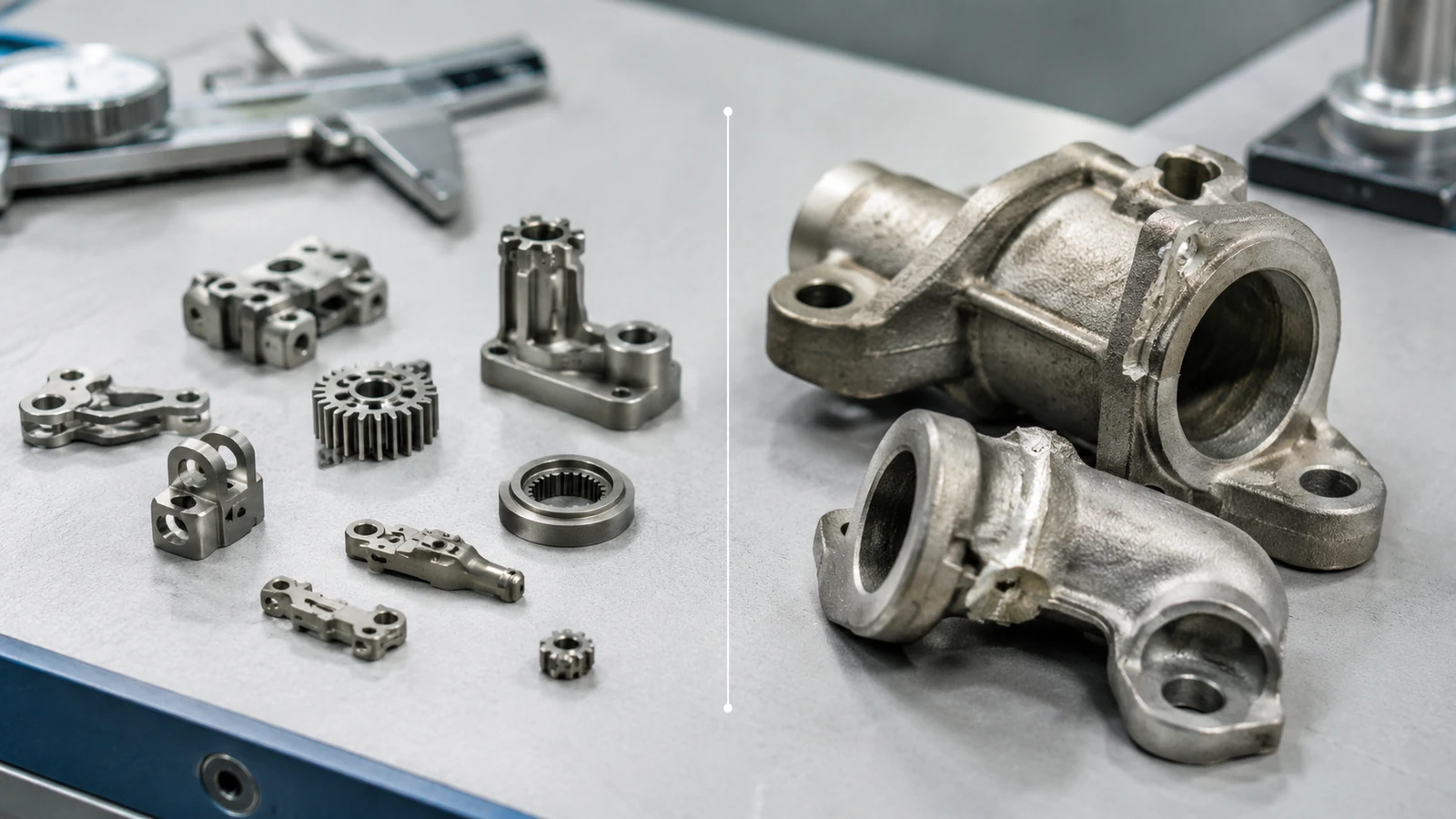
Compare parts in equivalent manufacturing states. An as-sintered MIM dimension and an as-cast investment casting dimension are not comparable to a dimension achieved after precision CNC machining. A nominal tolerance alone does not show whether a supplier can maintain the required datum relationship or geometric tolerance across production lots. For example, a bore specified at 5.00 ± 0.02 mm has a 4.98–5.02 mm acceptance interval; this is a drawing example, not a claimed process capability. Ask each supplier whether the interval is achievable as formed or only after finishing, and how it will be measured. For a mating bore, diameter alone is insufficient: position relative to the assembly datums and the required fit must also be accepted. If both routes require reaming, compare the remaining operations rather than crediting MIM with eliminating that step.
| Exigence | Évaluation MIM | Investment casting assessment |
|---|---|---|
| General linear dimensions | Mold compensation and measured sintering variation | Pattern and shell variation plus casting shrinkage |
| Planéité et grandes portées | Support direction and distortion after sintering | Solidification, cooling and distortion after casting |
| Precision bores or fits | Direct forming, sizing or final machining as appropriate | Casting allowance and final machining as appropriate |
| Répétabilité | Trial data by cavity, lot and inspection datum | Trial data by pattern/tool, casting lot and inspection datum |
ISO 8062-3:2023 addresses general dimensional and geometrical tolerances and machining allowances for castings. It is not a guarantee of a particular foundry's capability. Specify the applicable drawing requirements and obtain supplier-specific evidence; do not apply casting tolerance grades directly to MIM. For an initial casting quotation, the 2024 Investment Casting Institute technical conference proceedings discuss typical linear tolerances and the need to agree them with the foundry before fixing machining requirements. These published casting tolerances can guide an initial quotation, but they do not establish relative MIM capability under the same conditions.
Shrinkage, Distortion and Dimensional Stability
MIM requires repeatable densification and shrinkage across molding, debinding and sintering. Uneven sections, poorly supported spans and process variation can cause distortion. Investment casting has its own dimensional changes associated with the wax pattern, shell, metal solidification and cooling. In both cases, first-article results should be followed by representative production measurements when repeatability matters.
Mark functional dimensions, datum surfaces and geometric tolerances separately from general dimensions. Agree on the inspection method, allowable machining and measurement conditions before tooling. The guide des tolérances MIM explains additional design considerations.
Propriétés Mécaniques, Densité et Qualité Interne
Microstructure and Mechanical Performance
Strength, hardness, ductility, corrosion resistance and fatigue behavior depend on alloy chemistry, microstructure, porosity, heat treatment and the final surface condition. Even similar alloy names do not establish equivalent mechanical performance between a sintered part and a casting. Compare data for the required material condition and relevant test method, then verify functional requirements on representative parts where necessary. A material certificate or tensile coupon may establish chemistry or bulk properties, but does not by itself establish the fatigue life of a thin arm, the strength of a notched section or the leak tightness of a finished housing. If fatigue life, local strength or leak tightness determines whether the part is usable, agree on a test of the finished part before approving either process.
Density is useful for monitoring material consolidation, but it cannot alone establish the size, location or effect of internal defects. A sealing component, a cyclically loaded mechanism and a cosmetic housing may have very different acceptance requirements.
Porosity, Internal Defects and Quality Verification
MIM may experience molding defects, debinding cracks, residual porosity and sintering distortion. Investment casting may experience gas porosity, shrinkage cavities, inclusions, incomplete filling or shell-related defects. A visible surface defect is not necessarily evidence of an internal defect, and a visually acceptable part does not establish internal soundness.
| Quality concern | Potential MIM source | Potential casting source | Verification to consider |
|---|---|---|---|
| Internal voids | Incomplete densification or process-related defects | Gas or feeding-related shrinkage cavities | Bulk density for overall consolidation; sectioning or qualified internal examination for local voids |
| Cracks or discontinuities | Molding, debinding or thermal processing | Solidification or subsequent processing | Visual inspection and suitable surface or internal examination |
| Performance fonctionnelle | Material condition, defects or dimensional variation | Material condition, defects or dimensional variation | Application-specific mechanical, leakage or assembly testing |
| Lot consistency | Feedstock, molding and thermal cycle variation | Pattern, shell, pouring and heat treatment variation | Representative lot sampling and agreed acceptance criteria |
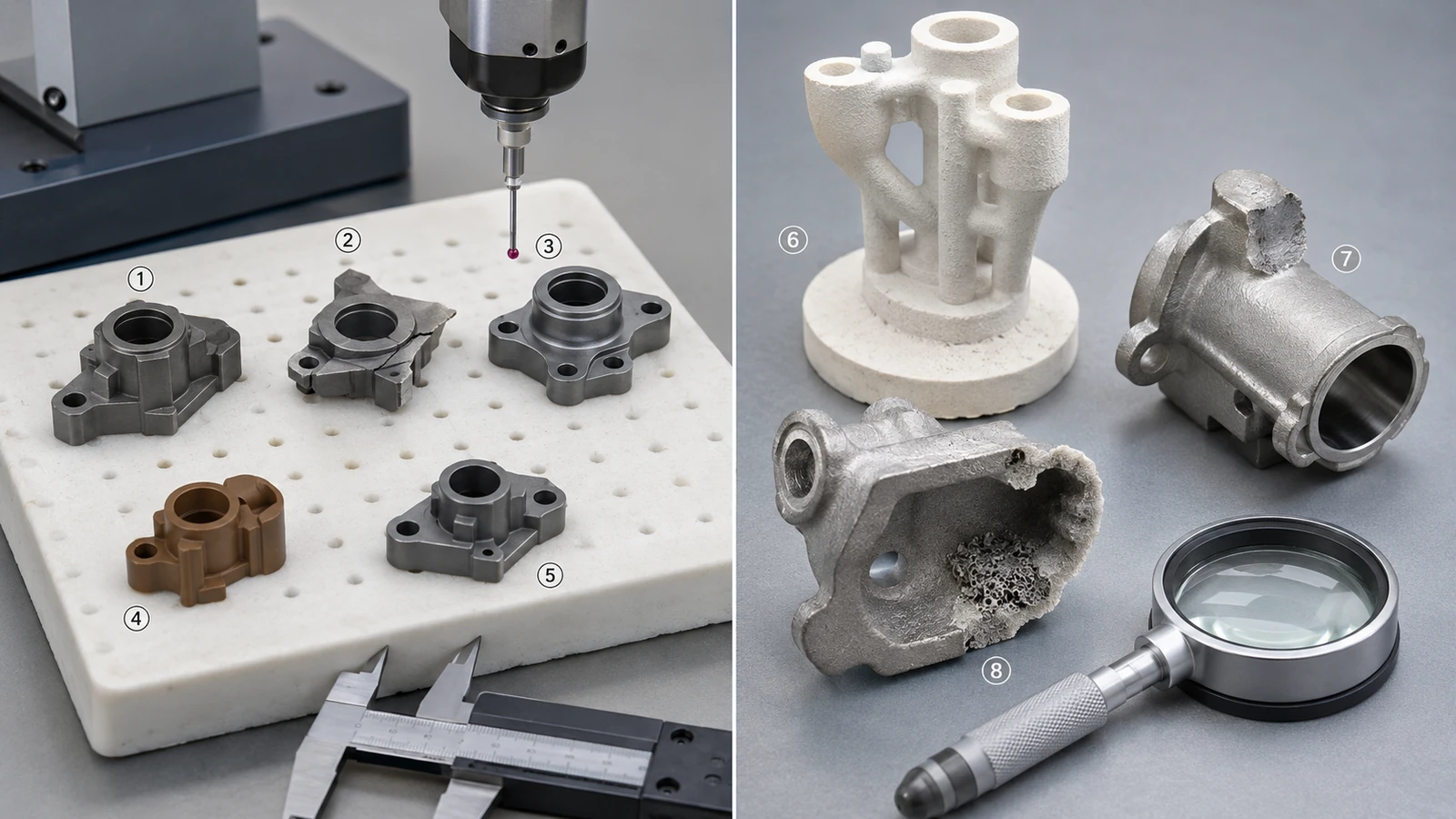
Choose inspection methods according to material, geometry, defect type and risk. For instance, penetrant testing detects suitable surface-breaking indications, not hidden internal pores. Radiography or computed tomography may be appropriate for selected internal features, subject to resolution and access. Define allowable defect size, location and inspection sensitivity where relevant; a zero-porosity requirement cannot be verified without an agreed measurement and acceptance basis.
État de surface et opérations secondaires
MIM can reproduce mold details and may reduce finishing on suitable features. Mold parting lines, gates and sintering-support contact can still leave marks. Investment casting surfaces reflect pattern and shell conditions, and gate removal or shell cleanup can require grinding or blasting.
Both processes may require machining of datum faces, sealing surfaces, precision bores or threads. Other operations may include heat treatment, polishing, passivation or coating, depending on material and final requirements. Opérations secondaires MIM should be included in the manufacturing plan rather than treated as an unexpected extra.
Define the final surface requirement by location: functional roughness, cosmetic appearance, coating or corrosion performance. Compare the same finished condition and specify any areas where gate or support marks are unacceptable.
Coût et volume de production : MIM vs fonderie à cire perdue
Tooling and Development Investment
MIM normally requires dedicated injection tooling, shrinkage compensation, process trials and inspection setup. Investment casting may require wax-pattern tooling, pattern assembly fixtures and casting development. Alternative pattern methods can sometimes reduce early tooling commitment. The actual upfront investment depends on complexity, tooling strategy and qualification requirements.
Production Volume and Cost Amortization
Repeat production can spread development costs over more accepted parts. Multi-cavity MIM tools may improve output for suitable designs, while investment casting can also scale through pattern production and casting trees. Evaluate annual demand, order frequency, tool life and the expected project lifetime. There is no single quantity at which every MIM project becomes cheaper.
Total Finished-Part Cost
Compare the cost per accepted finished part, including development, manufacturing, secondary work and quality losses. A simple model is:
Cost per accepted part = allocated development cost + recurring cost per accepted part.
Allocated development cost = total one-time development cost / expected accepted lifetime quantity. Recurring cost includes manufacturing, finishing, inspection and applicable yield losses without counting the same item twice.
| Illustrative example (USD) | MIM | Moulage à la cire perdue |
|---|---|---|
| One-time development cost | $6,000 | $2,000 |
| Recurring cost per accepted finished part | $1.80 | $2.60 |
| At 2,000 accepted parts | $4.80 | $3.60 |
| At 10,000 accepted parts | $2.40 | $2.80 |
These hypothetical numbers illustrate the calculation only; they are not XTMIM quotes, industry averages or actual project data. Under these assumptions the break-even quantity is ($6,000 − $2,000) / ($2.60 − $1.80) = 5,000 accepted parts, at $3.00 per part. If recurring costs favor casting instead, a MIM break-even point may never occur. Recalculate using actual supplier quotations and demand assumptions. In this example, if the expected MIM recurring cost rises from $1.80 to $2.20 because an additional finishing step is needed, the saving falls from $0.80 to $0.40 per accepted part and the break-even quantity doubles to 10,000. If credible lifetime demand is only 8,000, the original choice would reverse. Check the effect of any uncertain finishing costs before authorizing tooling.
Comparing Manufacturing Quotes
Request the same material and heat-treatment condition, drawing revision, delivery condition, inspection scope and quantity from both suppliers. Confirm tooling ownership, maintenance and whether machining, finishing and yield losses are already included. A cheaper blank can be more expensive once all acceptance requirements are met. For wider cost considerations, see coût du moulage par injection de métal.
Quand choisir le MIM ou la fonderie à cire perdue
First rule out processes that cannot meet the material, geometry or functional requirements. Compare costs only for the remaining options. If one route cannot meet a mandatory requirement, reject or redesign it before comparing price.
| Condition du projet | Décision initiale | Ce qui pourrait changer la décision |
|---|---|---|
| Compact part, proven feedstock, repeat demand and moldable details | Evaluate MIM first | Core-pin limits, sintering distortion or extensive finishing |
| Larger mass or cast-specific alloy | Évaluer d'abord la fonderie à cire perdue | A validated alternative material or substantial redesign |
| Both routes feasible but critical bores or datums require machining | Compare finished-part quotations | Machining burden, inspection yield and lifetime quantity |
| Neither route has verified functional or material capability | Stop and resolve feasibility | Approved specification changes or another manufacturing route |
When MIM Is the Better Fit
Exemple : a compact stainless steel latch with several slots and molded engagement features is needed repeatedly. If a proven feedstock, suitable release directions and stable sintering support are available, MIM may avoid several machining operations. A precision pivot bore can still be finished separately. The decision rests on the operations avoided and the verified cost of accepted parts. The projected saving disappears or must be recalculated if the slots still need full machining; if the engagement features fail the assembly test, the design or process must be corrected before approval.
When Investment Casting Is the Better Fit
Exemple : a larger curved housing with a heavy flange and a cast-specific alloy is already suited to shell casting. MIM powder consumption and section-related risks may outweigh any benefit from injection molding. Casting followed by machining of the flange may remain the more practical route, provided internal quality is verified.
When Both Processes Require Engineering Evaluation
Exemple : a small bracket contains a thick boss, a thin arm and a critical flatness requirement. Its size alone suggests MIM, but the section imbalance and long span create possible distortion. Casting also requires careful feeding and machining allowance. Compare the original casting design with a feasible MIM redesign, then validate critical dimensions and cost. If the thick boss cannot be reduced without compromising load capacity, do not approve the redesign solely to improve sintering. Compare the casting route with any technically acceptable MIM alternative that retains the required function. These examples illustrate selection principles; they are not XTMIM customer projects.
Quand est-il judicieux de passer de la fonderie à cire perdue au MIM ?
Opportunities for Casting-to-MIM Conversion
An existing investment-cast part deserves review when the current route creates avoidable machining, assembly, finishing, sorting or rework, or when repeat demand has increased enough to justify new tooling. Record the current machining, rework or assembly costs before estimating what a switch to MIM could save.
When Keeping Investment Casting Makes More Sense
Retain the existing process if it already meets cost, quality and delivery requirements, if a mandatory material cannot be replaced, or if the expected remaining demand cannot recover the cost of switching. Existing tooling expenditure is generally sunk; focus on future costs, replacement or maintenance needs and the cost of changing the process.
| Conversion trigger | Stop or delay if |
|---|---|
| Repeated machining of fine features | Most critical features still require the same machining after MIM. |
| Increasing annual demand | Forecast is uncertain or remaining product life is short. |
| Recurring variation or rework | The cause has not been established or MIM introduces a similar risk. |
| Potential part consolidation | Redesign compromises function, assembly or qualification. |
| Lower projected finished-part cost | Tooling, validation and transition costs eliminate the expected savings. |
Include requalification, parallel supply, inventory and customer approval where applicable. To estimate how many parts are needed to recover the conversion investment, divide the additional switching cost by the recurring saving per accepted part. If there is no recurring saving, this cost-based payback calculation cannot justify a switch. Compare that quantity with credible remaining demand. Use the current avoidable casting cost, not the historical average cost including already-paid tooling. Include future tooling replacement only when it is expected during the remaining project life. If the forecast is uncertain, test a lower-demand scenario before committing. Even a technically feasible conversion may not pay back within the remaining product life.
Comment évaluer une pièce de fonderie pour une conversion MIM
Drawing Review and Design Adaptation
Use the existing casting drawing as a functional reference rather than a tooling-ready MIM drawing. Review wall thickness, thick-to-thin transitions, gate position, parting line, release direction, debinding paths, shrinkage compensation, sintering support, datum strategy and machining allowances. Remove or redistribute nonfunctional mass only with design approval. The casting-to-MIM drawing review guide covers feature-level checks in more detail.
Exigences matérielles et fonctionnelles
Confirm the required chemistry, material standard, heat treatment and functional acceptance criteria. Document any proposed material substitution and obtain approval before tooling. Recheck critical dimensions and inspection methods rather than automatically transferring casting allowances; see casting drawing tolerance notes for MIM review.
Prototype Testing and Production Validation
Proceed from DFM review and preliminary costing to approved design, tooling trials, dimensional inspection and functional testing. A machined prototype may validate fit or function, but it does not establish MIM sintering behavior or production capability. Use representative molded and sintered samples for process-specific verification, then confirm repeatability in trial production before full release. Agree in advance which results allow release: dimensional acceptance at the specified datums, material condition and relevant functional tests, followed by representative lot results and an acceptable finished-part cost. If a critical result fails, identify the cause and repeat validation after the approved corrective action rather than treating sample approval as automatic production approval.
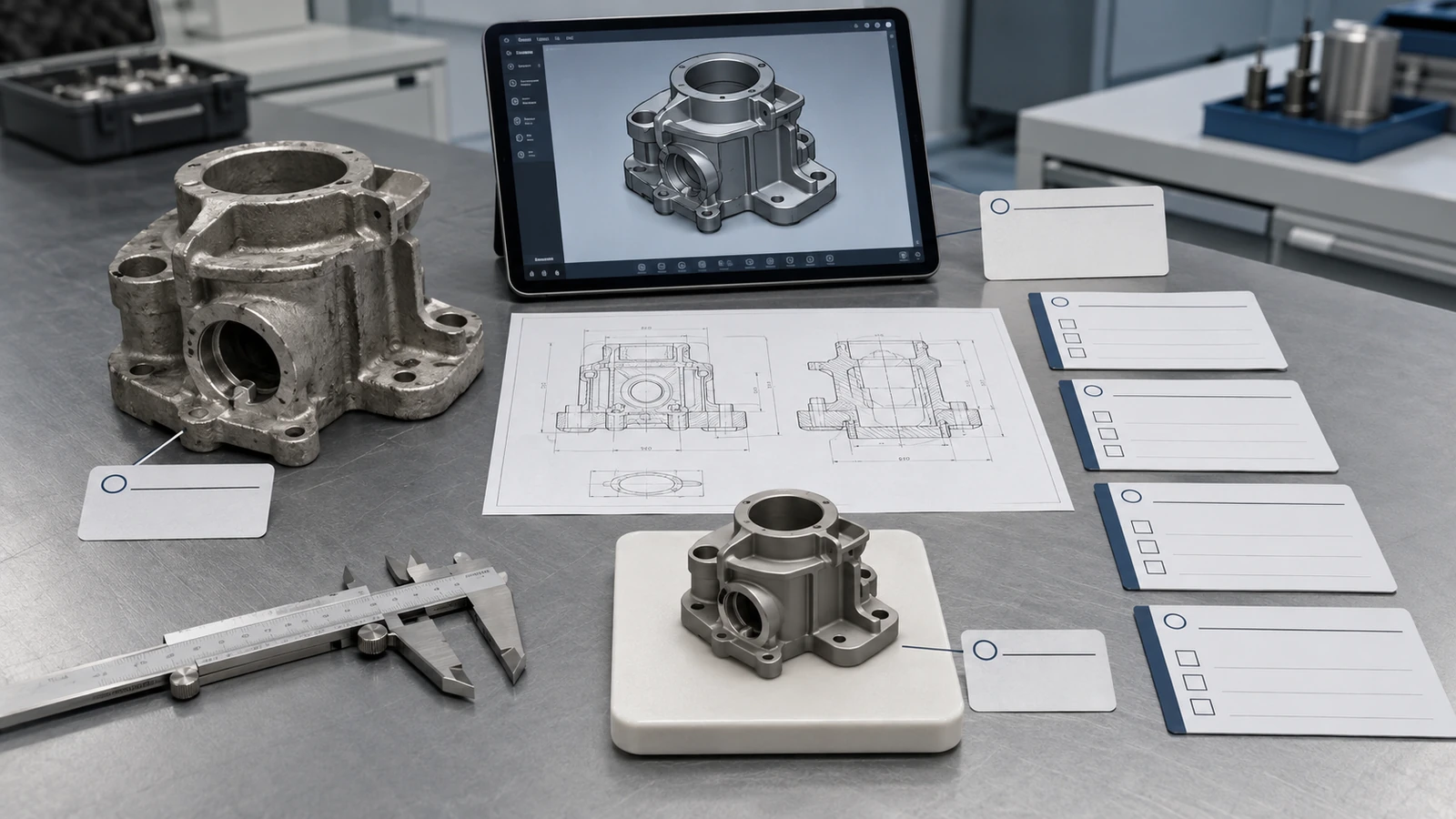
Before switching suppliers or processes, agree on the material and design requirements, cost targets, sample acceptance criteria, production trial results and supply transition plan. Do not retire an established casting supply route before the replacement is approved.
Préparation de votre projet pour l'examen technique
For a new part or an existing investment casting project, provide the following information. A photograph alone cannot establish material, tolerances or manufacturing cost.
- Dessin 2D et modèle CAO 3D
- Material grade, standard and required condition
- Part mass, envelope and critical section details
- Dimensions critiques, datums et tolérances
- Surface, heat treatment and quality requirements
- Functional requirements and operating environment
- Expected annual and lifetime production quantities
- Current manufacturing steps, cost or quality concerns, if applicable
XTMIM can assess the MIM route, identify design or material questions, and review whether a conversion merits further work. See our capacité de revue d'ingénierie et services de moulage par injection de métal for details of our review and manufacturing services.
Have a drawing ready? Submit it for a MIM feasibility review before committing to tooling or changing your manufacturing route.
Questions fréquemment posées
L'investissement est-il identique à la fonderie sous pression ?
No. Investment casting uses an expendable ceramic shell made around a removable pattern. High-pressure die casting injects molten metal into a reusable die. If your project involves the latter, see the MIM vs die casting comparison.
Le moulage par injection de métal est-il un procédé de fonderie ?
Non. Le MIM conventionnel est un procédé de métallurgie des poudres dans lequel un mélange de poudre métallique et de liant est moulé par injection, le liant est retiré, puis le compact métallique est fritté. Le composant n'est pas formé par coulée de métal en fusion dans un moule de fonderie.
Un moule de fonderie à cire perdue peut-il être réutilisé pour le MIM ?
Généralement non. L'outillage du modèle en cire et l'outillage d'injection MIM ont des exigences différentes en matière de feedstock, de compensation de retrait, de canaux d'alimentation, de démoulage et de durabilité. Le modèle CAO ou le dessin existant peut être un point de départ utile, mais l'outillage MIM nécessite sa propre conception et sa propre validation.