
Comparer le MIM avec l'usinage CNC, la fonderie, le forgeage, la métallurgie des poudres (PM), l'estampage, le CIM et l'impression 3D métal
Le moulage par injection de métal (MIM) mérite une comparaison lorsqu'une pièce est petite, complexe, métallique et difficile à produire de manière répétée par usinage, fonderie, compaction, formage, traitement céramique ou fabrication additive. Le MIM n'est pas le choix par défaut pour chaque composant métallique. Il devient un candidat sérieux lorsque le contrôle du retrait de frittage, la compensation d'outillage, le feedstock de poudre métallique et liant, le moulage par injection, le déliantage et l'inspection finale permettent de produire la géométrie requise à un volume de production pratique. Pour les ingénieurs produit et les équipes d'approvisionnement, la décision principale n'est pas simplement “ MIM ou un autre procédé ”. La vraie question est de savoir si la géométrie de la pièce, le comportement du matériau, les tolérances critiques, le volume annuel, les opérations secondaires et le modèle de coût total orientent vers le MIM, l'usinage CNC, la fonderie sous pression, la fonderie à cire perdue, le forgeage, la métallurgie des poudres, l'estampage, le CIM ou l'impression 3D métal.
Cette page est un hub de sélection de procédés destiné aux ingénieurs, aux équipes d'achat et aux chefs de projet OEM. Utilisez-la pour passer en revue les principales voies de fabrication, puis accédez à la page de comparaison spécifique qui correspond à votre problème de production actuel. Pour une analyse basée sur un plan, XTMIM peut évaluer la géométrie, le matériau, la tolérance, le volume, le risque d'outillage, le risque de frittage, les opérations secondaires et les exigences d'inspection avant la planification de l'outillage ou de la production.
Résumé technique : Quand le MIM vaut-il la peine d'être comparé ?
Le MIM mérite d'être envisagé lorsque la pièce est non seulement métallique, mais aussi petite, complexe, reproductible et difficile à produire économiquement par un autre procédé. Il n'est généralement pas choisi parce qu'une pièce est “ complexe ” dans un sens général. Il est sélectionné lorsque la géométrie, le matériau, le volume annuel, le contrôle dimensionnel et l'économie d'outillage fonctionnent ensemble.
Règles rapides de sélection de procédé
Choisir le MIM lorsque la pièce est petite, complexe, métallique et reproductible en volume de production. Choisir l'usinage CNC pour les prototypes, les faibles volumes ou les caractéristiques d'usinage locales serrées. Choisir la métallurgie des poudres pour les formes simples compressibles en poudre. Choisir l'emboutissage pour les pièces en tôle plane.
Petites pièces métalliques complexes
Utilisez le MIM lorsque la géométrie 3D complexe, le volume reproductible et les propriétés métalliques doivent être équilibrés dans une seule voie de production.
Prototype ou faible volume
Utilisez l'usinage CNC lorsque la conception n'est pas stable, les quantités sont faibles ou que seules certaines caractéristiques locales nécessitent un usinage serré.
Formes simples pressables
Utilisez la métallurgie des poudres conventionnelle lorsque la pièce peut être compactée efficacement et ne nécessite pas de formes moulées 3D complexes.
Pièces en tôle plane
Utilisez l'emboutissage lorsque la pièce est principalement un composant en tôle plane ou formée plutôt qu'une pièce métallique solide compacte.
Géométrie complexe de petite taille
Le MIM est souvent envisagé pour les parois minces, les trous, les fentes, les contre-dépouilles, les micro-caractéristiques, les surfaces courbes et les profils 3D compacts qui nécessiteraient des opérations d'usinage CNC répétées ou un assemblage difficile si réalisés par un autre procédé.
Demande de production répétable
Le MIM devient généralement plus intéressant lorsque la conception est stable, la demande annuelle est répétable et le coût de développement du moule et du procédé peut être amorti sur la production plutôt que sur quelques prototypes.
Propriétés techniques des métaux
Le MIM peut convenir lorsque la pièce nécessite un acier inoxydable, un acier faiblement allié, un alliage magnétique doux ou un comportement d'alliage spécial sélectionné dans une géométrie compacte qui ne peut pas être formée efficacement par pressage, emboutissage ou coulée.
Erreur courante : Le MIM ne doit pas être comparé uniquement sur la base du prix unitaire. Une comparaison utile inclut le coût d'outillage, la géométrie de la pièce, le comportement du matériau, la stabilité du déliantage et du frittage, les tolérances critiques, les opérations secondaires, le plan d'inspection et le cycle de vie attendu du produit.
Si vous avez besoin d'une analyse ciblée des avantages, des compromis et des limites de risque de projet du MIM avant de choisir un procédé, consultez le avantages et limites du moulage par injection de métal .
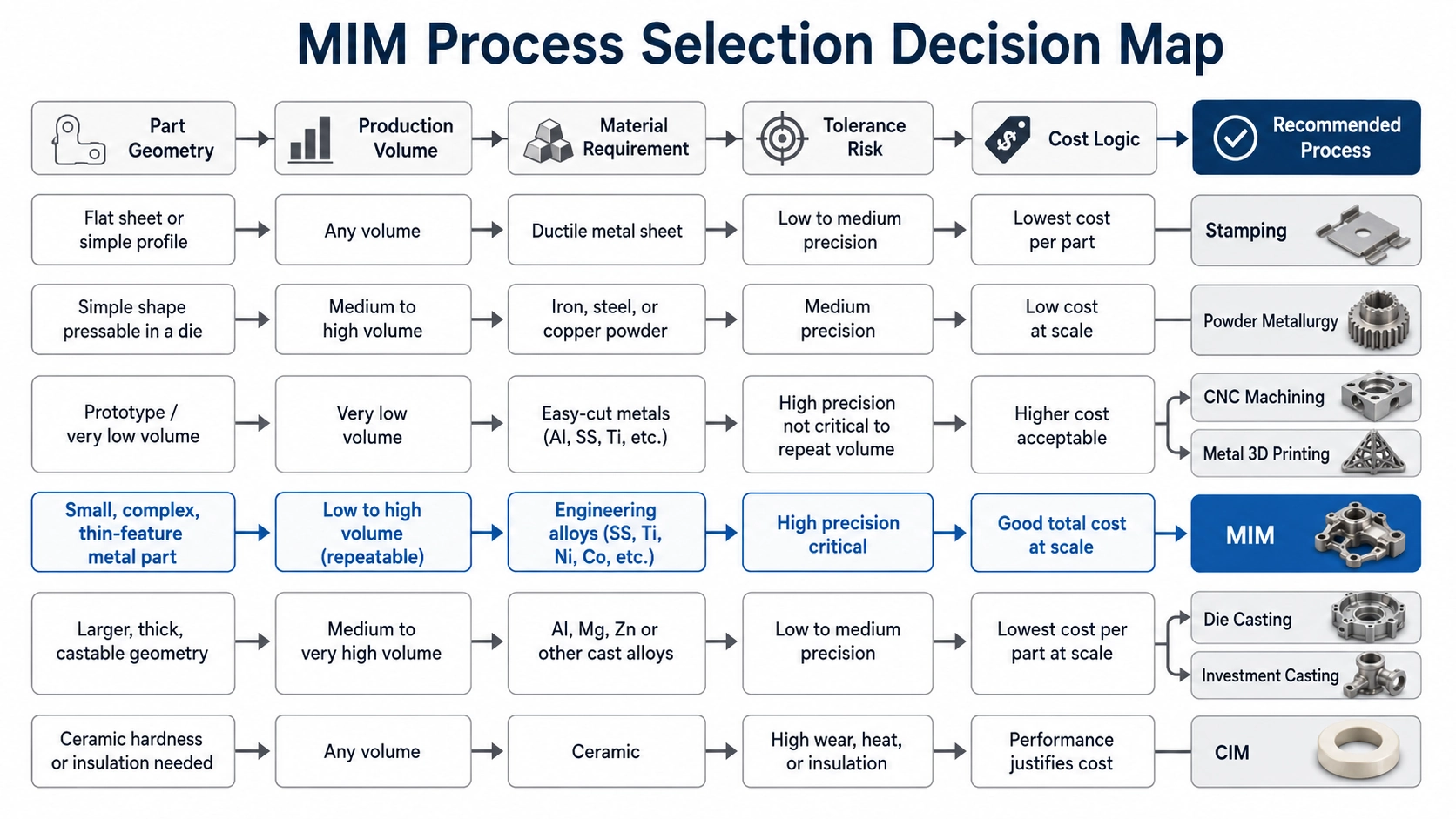
MIM vs autres procédés de fabrication : tableau comparatif rapide
Ce tableau constitue un premier filtre technique, et non une recommandation finale de fournisseur. Une décision finale dépend toujours de l'analyse du dessin, de la stratégie de tolérance, du choix du matériau, de la compensation du retrait, des exigences d'opérations secondaires, de la méthode d'inspection et de l'objectif de coût. L'objectif est d'aider les utilisateurs à choisir la bonne voie de comparaison détaillée sans mélanger différentes voies de fabrication.
| Procédé | Idéal pour | Principale limitation | Quand le MIM peut être meilleur |
|---|---|---|---|
| Usinage CNC | Prototypes, pièces en faible volume, caractéristiques locales serrées et pièces nécessitant un usinage direct à partir de barres, de billettes ou de plaques. | Coût unitaire élevé lorsque de petites pièces complexes nécessitent des trajectoires d'outil répétées, de multiples configurations ou un enlèvement de matière important. | Lorsqu'une petite pièce métallique complexe a une demande stable et que le temps d'usinage répétitif devient le principal facteur de coût. |
| Moulage sous pression | Pièces moulées non ferreuses en grand volume, généralement en alliages d'aluminium, de zinc ou de magnésium. | La gamme de matériaux, l'échelle des pièces et les défauts de moulage peuvent limiter l'adéquation pour les pièces compactes en acier ou en acier inoxydable à haute densité. | Lorsque la pièce nécessite de l'acier inoxydable, de l'acier faiblement allié, un matériau magnétique doux ou une géométrie métallique compacte de précision. |
| Fonderie à cire perdue | Pièces métalliques de taille moyenne à grande avec une complexité de fonderie et une liberté de conception modérée à élevée. | Les caractéristiques de très petite précision et les géométries miniatures hautement reproductibles peuvent être plus difficiles à contrôler économiquement. | Lorsque la pièce est petite, riche en détails et nécessite une géométrie moulée cohérente sur l'ensemble des lots de production. |
| Forgeage | Pièces plus grandes supportant des charges, composants soumis à des impacts, structures critiques pour la fatigue et conceptions bénéficiant d'un flux de grain directionnel. | Les petites pièces complexes peuvent nécessiter un perçage, un fraisage, un rainurage, une finition ou un assemblage multi-pièces important après forgeage. | Lorsque la pièce est petite, riche en détails, intensive en usinage et adaptée au MIM après examen des charges, des matériaux, de la fatigue et validation. |
| Métallurgie des Poudres | Formes simples pressables, bagues, roulements, engrenages, pièces poreuses et composants imprégnés d'huile. | La géométrie est limitée par la direction de compactage, la distribution de densité, les contraintes d'éjection et la nécessité de formes relativement régulières. | Lorsque des caractéristiques 3D complexes, des sections minces, des trous dans plusieurs directions ou des petites pièces à haute densité sont nécessaires. |
| Emboutissage | Pièces en tôle plates ou formées telles que clips, ressorts, supports, rondelles, écrans et bornes conductrices. | Géométrie 3D solide limitée, changement d'épaisseur local et caractéristiques structurelles intégrées. | Lorsque la pièce est un composant métallique solide compact plutôt qu'une forme de tôle plate ou pliée. |
| CIM | Pièces céramiques nécessitant dureté, isolation, résistance à l'usure, stabilité chimique ou comportement thermique céramique. | Les matériaux céramiques sont fragiles et ne conviennent pas lorsque la ductilité, la ténacité, le magnétisme ou la conductivité électrique métalliques sont requis. | Lorsque l'application nécessite une résistance, une ténacité, un magnétisme, une résistance à la corrosion, une réponse au traitement thermique ou une ductilité métalliques. |
| Impression 3D Métal | Prototypes, pièces complexes en faible volume, validation de conception et itération rapide avant l'outillage. | Coût unitaire élevé, cadence de production plus lente, exigences de finition de surface et limites de passage à l'échelle pour la fabrication en volume répétée. | Lorsqu'une conception validée passe de la validation du prototype à une production reproductible de volume moyen à élevé. |

Comment les ingénieurs choisissent entre le MIM et d'autres procédés
En pratique, les ingénieurs ne doivent pas comparer le MIM à d'autres procédés uniquement par le nom de la catégorie. Une approche plus fiable consiste à examiner ensemble la géométrie de la pièce, le volume annuel, le besoin en matériau, le risque de tolérance, le comportement au frittage, les opérations secondaires, la méthode d'inspection et la logique de production totale.
Commencez par la géométrie de la pièce
Un simple clip en tôle plate relève généralement de l'emboutissage. Une simple bague cylindrique peut relever de l'usinage conventionnel la métallurgie des poudres. Un grand boîtier coulé peut relever de la fonderie sous pression ou de la fonderie à la cire perdue. Un prototype complexe unique peut relever de l'usinage CNC ou de l'impression 3D métal.
Le MIM devient plus intéressant lorsque la pièce présente une petite taille, des parois minces, des fentes, des trous dans plusieurs directions, des surfaces courbes, de petits engrenages, leviers, supports, charnières, verrous, arbres ou inserts structurels. D'un point de vue revue de conception, la vraie question est de savoir si la pièce peut être moulée, déliantée, frittée, supportée, inspectée et répétée en production.
Vérifier le volume de production avant l'outillage
Le MIM nécessite un outillage. Pour de très faibles quantités ou des prototypes précoces, le MIM peut ne pas être économique. Une fois la conception stable et la demande annuelle en hausse, le MIM peut réduire le coût unitaire en remplaçant l'usinage répétitif, en réduisant les déchets de matière, en formant une géométrie complexe quasi nette ou en consolidant de petites fonctionnalités qui nécessiteraient autrement un assemblage.
Avant l'outillage, la question clé est de savoir si le volume de production attendu peut justifier le développement du moule, la qualification du feedstock, les essais de moulage, la validation du déliantage et du frittage, ainsi que la planification des inspections.
Examiner les exigences de matériau et de performance
Le MIM utilise une fine poudre métallique mélangée à un liant pour former le feedstock. Le feedstock est injecté dans un moule pour former une pièce verte, puis délianté et fritté pour obtenir un composant métallique dense. Cette voie est différente de la métallurgie des poudres conventionnelle, où la poudre est compactée en une ébauche verte puis frittée.
Elle est également différente du moulage par injection de céramique, qui utilise de la poudre céramique et un liant pour produire des composants céramiques. Le MIM doit être envisagé lorsque la pièce doit rester métallique, ductile, magnétique, résistante à la corrosion, traitable thermiquement ou conductrice d'électricité.
Comparer la tolérance, le retrait et le risque d'inspection
Les pièces MIM rétrécissent pendant le frittage. Ce retrait est prévu et compensé par la conception de l'outillage et le contrôle du procédé, mais le risque n'est pas égal pour chaque pièce. Les dimensions critiques, les parois minces, les longues sections non supportées, les transitions d'épaisseur brusques, les fentes profondes, les trous fins et la géométrie asymétrique peuvent augmenter le risque de distorsion ou de variation dimensionnelle.
Pour les dimensions fonctionnelles serrées, les ingénieurs doivent décider tôt si la caractéristique peut être formée par moulage, nécessite opérations secondaires, ou doit être contrôlée par une méthode d'inspection définie.

Note de revue de conception : Une pièce peut être moulable en forme mais rester faible en tant que projet MIM si les chemins de déliantage sont mauvais, le support de frittage est instable, les tolérances critiques ne sont pas définies, ou le volume annuel requis ne peut justifier l'outillage. Ces points doivent être examinés avant le déverrouillage du moule, et non après que les pièces d'essai montrent une distorsion ou une dérive dimensionnelle.
Quel procédé devriez-vous comparer avec le MIM ?
Choisissez la comparaison qui correspond à votre problème de fabrication actuel. Cette page centrale présente la logique de sélection ; chaque page de comparaison dédiée doit approfondir le coût, la géométrie, les tolérances, le comportement des matériaux, l'outillage, les opérations secondaires, les exigences de contrôle et les risques de production.
MIM vs Usinage CNC
L'usinage CNC devient-il trop coûteux pour une petite pièce complexe en volume de production ?
La CNC est performante pour les prototypes, les petites séries et les caractéristiques locales serrées. Le MIM devient intéressant à évaluer lorsque l'usinage répété, le gaspillage de matière, les changements d'outils ou les multiples configurations rendent la pièce coûteuse une fois la demande stabilisée.
MIM vs moulage sous pression
Avez-vous besoin de petites pièces en acier ou en acier inoxydable plutôt que de grandes pièces moulées non ferreuses ?
Le moulage sous pression est couramment utilisé pour les pièces en aluminium, zinc ou magnésium en grande série. Le MIM doit être comparé lorsque la pièce est plus petite, plus dense, plus riche en détails ou fabriquée à partir d'un métal technique adapté au MIM.
MIM vs moulage à cire perdue
La pièce est-elle trop petite ou trop riche en détails pour une cire perdue stable ?
La cire perdue peut produire des formes métalliques complexes. Le MIM peut être un meilleur candidat lorsque la pièce est beaucoup plus petite, présente des détails moulés fins et nécessite une production en grande série reproductible avec une constance des caractéristiques maîtrisée.
MIM vs Forgeage
Une petite pièce forgée entraîne-t-elle des coûts d'usinage ou d'intégration de fonctionnalités inutiles ?
Le forgeage reste souvent la voie privilégiée pour les sections plus importantes, les impacts sévères, les contraintes de fatigue exigeantes ou les performances dépendant d'un flux de grain directionnel. Le MIM mérite d'être examiné lorsqu'une pièce est petite, complexe, intensive en usinage et produite à un volume stable après définition des exigences de cas de charge et de validation.
MIM vs Métallurgie des Poudres
La pièce est-elle trop complexe pour un compactage uniaxial de poudre ?
La métallurgie des poudres conventionnelle est performante pour les pièces simples compressibles telles que les bagues, les roulements, les engrenages, les composants poreux et les pièces imprégnées d'huile. Le MIM est plus adapté lorsque des caractéristiques 3D complexes, des sections minces ou des caractéristiques multidirectionnelles ne peuvent pas être facilement formées par compactage de poudre.
MIM vs Emboutissage
La pièce ressemble-t-elle davantage à un composant métallique 3D compact qu'à une pièce en tôle plate ?
L'emboutissage est efficace pour les pièces en tôle plates ou formées. Le MIM devient plus pertinent lorsque la pièce est un composant métallique solide compact avec une géométrie 3D complexe, des transitions d'épaisseur, des bossages, des trous ou des caractéristiques intégrées.
MIM vs Moulage par injection de céramique
La pièce doit-elle être en métal ou en céramique ?
Le MIM et le CIM partagent une logique d'injection similaire, mais ils ne sont pas la même voie de fabrication. La première décision concerne le comportement du matériau : résistance, ténacité, magnétisme, conductivité ou réponse au traitement thermique du métal, par rapport à la dureté, l'isolation et la résistance à l'usure de la céramique.
MIM vs Impression 3D Métal
Le projet passe-t-il du prototype à la production en série ?
L'impression 3D métal est utile pour les prototypes, les pièces complexes en faible volume et l'itération de conception. Le MIM devient plus pertinent lorsque la conception est validée et que le projet évolue vers une production en série où le coût unitaire, le rendement et la cohérence des contrôles sont prioritaires.
Principaux risques de fabrication à vérifier avant de choisir le MIM
Un procédé peut être adapté en principe mais rester risqué en production. Pour le MIM, la principale préoccupation n'est pas seulement de savoir si une pièce peut être injectée. Les ingénieurs doivent également examiner le comportement au retrait, la stabilité des parois, l'emplacement du point d'injection, la manipulation des pièces vertes, les chemins de déliantage, le support au frittage, les besoins d'usinage post-frittage et la stratégie de contrôle.

| Zone de risque | Pourquoi c'est important en MIM | Ce qui doit être examiné avant l'outillage |
|---|---|---|
| Retrait de frittage | Le retrait doit être compensé par l'outillage et contrôlé pendant Frittage MIM. | Matériau, facteur de surdimensionnement, méthode de support, dimensions critiques et plan de contrôle. |
| Parois minces | Les sections minces peuvent affecter le remplissage, le déliantage, le support, la distorsion ou le risque de rupture. | Épaisseur minimale de paroi, transitions d'épaisseur, écoulement du feedstock, résistance à la manipulation et support au frittage. |
| Tolérances critiques | Certaines dimensions peuvent nécessiter un usinage secondaire, un calibrage, un contrôle par montage ou une planification d'inspection spéciale. | Dimensions fonctionnelles, stratégie de référence, calibre d'inspection, et si la caractéristique est moulée ou usinée après. |
| Emplacement du point d'injection et du plan de joint | Les marques d'injection, zones de soudure, bavures ou lignes de joint peuvent affecter les surfaces esthétiques et les zones de contact fonctionnelles. | Surfaces fonctionnelles, surfaces visibles, sens d'éjection, plan de joint du moule et surépaisseur d'usinage. |
| Comportement du matériau | Différents alliages réagissent différemment lors du frittage, du traitement thermique, de la finition et de l'évaluation des performances de corrosion ou magnétiques. | Norme de matériau, propriété cible, cycle de traitement thermique, état de surface et environnement d'application. |
| Opérations secondaires | L'usinage CNC, le traitement thermique, le polissage, le revêtement ou la finition de surface peuvent modifier le coût total et le délai de livraison. | Quelles caractéristiques doivent rester à l'état fritté et lesquelles nécessitent un post-traitement contrôlé. |
| Méthode d'inspection | Les dimensions critiques, la densité, la dureté, l'état de surface ou la fonction peuvent nécessiter un plan d'inspection défini. | Méthode de mesure, critères d'acceptation, plan d'échantillonnage et caractéristiques critiques pour la fonction. |
Caractéristiques à l'état fritté vs usinées
Une décision importante concernant le coût et la tolérance en MIM est de savoir si une caractéristique peut rester à l'état fritté ou doit être contrôlée par un usinage secondaire, un calibrage ou une autre opération post-frittage. Cette décision doit être prise avant la conception du moule, car elle affecte la surépaisseur d'outillage, la stratégie de référence, la méthode d'inspection et le coût total de la pièce.
| Type de caractéristique | Généralement adapté à l'état fritté | Peut nécessiter un usinage ou un calibrage |
|---|---|---|
| Profils généraux | Formes extérieures, contours non fonctionnels, rayons non critiques et surfaces neutres esthétiquement. | Surfaces ou profils de référence qui contrôlent directement l'ajustement d'assemblage, l'étanchéité ou l'alignement fonctionnel. |
| Trous et alésages | Trous non critiques, trous de dégagement ou trous avec des exigences de tolérance modérées. | Trous serrés, alésages de palier, caractéristiques coaxiales, trous de presse ou trous utilisés comme références d'inspection. |
| Filetages | Certaines formes de filetage non critiques ou à faible charge peuvent être évaluées par revue de conception. | Filetages de précision, filetages à charge élevée, filetages d'étanchéité ou filetages avec des exigences de calibre strictes. |
| Surfaces de contact | Zones de contact non critiques ou surfaces avec une texture brute de frittage acceptable. | Surfaces de palier, surfaces de glissement, surfaces d'étanchéité, faces de verrouillage ou surfaces fonctionnelles à forte usure. |
| Dimensions critiques | Dimensions avec tolérance générale et faible sensibilité fonctionnelle. | Dimensions CTQ, références d'assemblage critiques, fentes de précision, faces de positionnement et caractéristiques sensibles à la planéité. |
Quand un “ bon candidat MIM ” nécessite encore une refonte avant l'outillage
Quel problème s'est produit : Une pièce métallique compacte semblait adaptée au MIM car elle était petite, complexe et nécessitait une production répétable, mais un examen précoce a révélé des parois minces, une transition d'épaisseur brutale et un trou critique situé près d'une zone à fort retrait de frittage.
Pourquoi cela s'est produit : La conception avait été convertie à partir d'un prototype usiné sans ajuster la géométrie pour la manipulation de la pièce verte, le déliantage, le support de frittage et la compensation du retrait.
Quelle était la véritable cause système : Le problème n'était pas seulement la complexité de la pièce. Le véritable risque système était que l'outillage, l'écoulement du feedstock, l'élimination du liant, le retrait de frittage et la stratégie des références d'inspection n'avaient pas été examinés ensemble.
Comment cela a été corrigé : La géométrie a été examinée pour la transition de paroi, la position du point d'injection, la direction du support, la priorité des tolérances et l'allocation d'usinage secondaire avant la libération du moule.
Comment éviter la récurrence : Avant de choisir le MIM, examinez le dessin comme un système de production complet : la géométrie moulée, la manipulation de la pièce verte, la stabilité du déliantage, le support de frittage, les opérations post-frittage et l'inspection finale doivent être considérées ensemble.
Quand le MIM n'est peut-être pas le bon procédé
Une comparaison crédible du MIM doit également expliquer quand ne pas choisir le MIM. Les séries à très faible volume, les très grandes pièces, les composants simples en tôle et les géométries compactées de base peuvent être plus pratiques avec d'autres méthodes. Cette limite est importante car forcer une pièce inadaptée dans le MIM augmente généralement le risque d'outillage, le temps de validation ou le coût total.

| Situation | Pourquoi le MIM peut ne pas convenir | Procédé à examiner en premier |
|---|---|---|
| Prototypes en très faible quantité | Le coût de développement du moule et du procédé peut ne pas être économique. | Usinage CNC ou impression 3D métal. |
| Très grandes pièces métalliques | Le retrait, le support, le chargement du four et le contrôle de la distorsion deviennent plus difficiles. | Moulage à la cire perdue, moulage sous pression, fabrication ou usinage selon le matériau et la géométrie. |
| Pièces simples en tôle plate | L'emboutissage est généralement plus efficace pour les géométries en tôle. | Emboutissage ou formage. |
| Formes simples pressables en poudre | La métallurgie des poudres conventionnelle peut être plus rentable pour les formes régulières et la porosité contrôlée. | Métallurgie des poudres. |
| Pièces complexes uniques | L'usinage CNC ou l'impression 3D métal peuvent être plus rapides car le MIM nécessite un outillage. | Usinage CNC ou fabrication additive. |
| Pas de budget d'outillage | Le MIM nécessite le développement d'un moule avant la production stable. | Usinage de prototypes, fabrication additive ou voies de processus avec outillage réduit. |
Préparatifs pour une revue d'adéquation du procédé
Une comparaison utile du MIM ne peut pas être réalisée à partir du seul nom de la pièce. Les ingénieurs ont besoin de détails de projet qui définissent la géométrie, la fonction, le matériau, le volume et les risques. Une revue basée sur le dessin peut déterminer si le MIM est techniquement adapté, si une refonte est nécessaire, si des tolérances spécifiques nécessitent des opérations secondaires, et si un autre procédé peut être plus pratique.

Données géométriques
- Plan 2D
- Modèle 3D
- Caractéristiques critiques
- Informations sur l'assemblage ou la pièce de liaison
Données techniques
- Exigence de matériau ou propriété cible
- Tolérances critiques et notes de référence
- Exigence de finition de surface
- Exigence de traitement thermique ou de revêtement
Intrants de production
- Volume annuel estimé
- Processus de fabrication actuel
- Problème actuel de coût, de rendement ou de qualité
- Exigences d'inspection et d'acceptation
Avant de demander une comparaison : envoyez votre dessin 2D, modèle 3D, exigence de matériau, besoins de tolérance, volume annuel estimé, processus de fabrication actuel, problème de coût ou de qualité actuel, exigence de surface, exigence de traitement thermique, environnement d'application et exigences d'inspection.
FAQ
Le MIM est-il meilleur que l'usinage CNC ?
Le MIM n'est pas automatiquement meilleur que l'usinage CNC. L'usinage CNC est généralement préférable pour les prototypes, les très faibles volumes de production, les pièces usinées simples et les caractéristiques locales nécessitant un usinage direct. Le MIM devient plus intéressant lorsqu'une petite pièce métallique complexe atteint un volume de production moyen ou élevé et que l'usinage répété rend le coût unitaire trop élevé.
Quelle est la meilleure alternative au moulage par injection de métal ?
La meilleure alternative au moulage par injection de métal dépend de la pièce. L'usinage CNC est généralement préférable pour les prototypes ou les pièces en faible volume. La métallurgie des poudres est souvent meilleure pour les formes simples pressables. L'emboutissage est généralement préférable pour les pièces en tôle plate. Le moulage sous pression ou la fonderie à cire perdue peuvent être meilleurs pour les pièces coulables de plus grande taille, tandis que l'impression 3D métal peut être meilleure pour les prototypes complexes en faible volume.
Quelles pièces ne conviennent pas au MIM ?
Les pièces très grandes, en volume extrêmement faible, de formes simples en tôle plate, de formes simples pressables en poudre, ou les composants prototypes uniques ne sont souvent pas idéaux pour le MIM. Ces projets peuvent être plus pratiques avec l'usinage CNC, l'emboutissage, la métallurgie des poudres conventionnelle, la fonderie, la fabrication ou l'impression 3D métal.
Le MIM est-il un procédé de fonderie ou un procédé de métallurgie des poudres ?
Le MIM est généralement considéré comme un procédé de métallurgie des poudres, et non comme un procédé de fonderie. Il utilise de la poudre métallique fine mélangée à un liant pour former un feedstock, qui est injecté, délianté et fritté. Bien que l'étape de moulage puisse ressembler au moulage par injection de plastique, la pièce métallique finale est créée par frittage à base de poudre plutôt que par coulée de métal liquide.
Le MIM est-il moins cher que le moulage ?
Le MIM peut être plus rentable que la fonderie pour les petites pièces métalliques complexes et riches en détails, mais il n'est pas automatiquement moins cher. La décision dépend de la taille de la pièce, du matériau, de la géométrie, du coût du moule, du volume de production, des opérations secondaires, des exigences de surface et des besoins d'inspection. Les pièces coulables plus grandes peuvent encore être mieux adaptées au moulage sous pression ou à la fonderie à cire perdue.
Quelle est la principale différence entre le MIM et la métallurgie des poudres ?
Le MIM utilise de la poudre métallique fine mélangée à un liant pour former un feedstock, qui est injecté, délianté et fritté. La métallurgie des poudres conventionnelle utilise généralement le compactage de poudre suivi du frittage. La MP est souvent meilleure pour les formes simples pressables, les pièces poreuses, les bagues et les roulements, tandis que le MIM est meilleur pour les petites pièces métalliques 3D complexes avec une plus grande liberté géométrique.
Quand dois-je comparer le MIM avec l'emboutissage ?
Comparez le MIM avec l'emboutissage lorsque la pièce n'est plus un simple composant plat ou formé en tôle. Si la pièce présente des caractéristiques 3D pleines, des épaisseurs variables, des bossages, des trous multiples, des structures intégrées ou un potentiel de réduction d'assemblage, le MIM peut valoir la peine d'être évalué. Si la pièce est principalement une forme de tôle plate, l'emboutissage est généralement plus efficace.
Le MIM peut-il remplacer l'impression 3D métal ?
Le MIM peut parfois remplacer l'impression 3D métal lorsqu'une conception validée passe du prototypage ou de la production en faible volume à une production en volume répétable. L'impression 3D métal est souvent utile pour le développement précoce et les pièces complexes en faible volume. Le MIM est généralement plus performant lorsque le coût unitaire, la répétabilité et l'évolutivité de la production deviennent plus importants.
Dois-je choisir le MIM ou le CIM ?
Choisissez le MIM lorsque la pièce doit être métallique et nécessite des propriétés telles que la ductilité, la ténacité, la résistance à la corrosion, le comportement magnétique, la réponse au traitement thermique ou la conductivité électrique. Choisissez le CIM lorsque la pièce nécessite une dureté céramique, une isolation, une résistance à l'usure ou un comportement thermique céramique. La première décision est la fonction du matériau, pas seulement la forme de la pièce.
Quelles informations sont nécessaires avant qu'un fournisseur MIM puisse recommander un procédé ?
Un fournisseur doit examiner le dessin 2D, le modèle 3D, l'exigence de matériau, les tolérances critiques, le volume annuel estimé, les exigences de surface, les besoins de traitement thermique, les exigences d'inspection et l'environnement d'application. Sans ces informations, une recommandation de procédé peut être trop générale pour soutenir les décisions d'outillage ou de devis.
Note sur les normes et références techniques
La sélection du procédé MIM doit être soutenue par les normes de matériaux, la capacité du fournisseur, l'examen du dessin et la validation spécifique au projet. Les sources de référence utiles incluent aperçu du processus de la Metal Injection Molding Association, ressources des normes MPIF, et la Aperçu du moulage par injection de métal selon l'EPMA.
Les normes sont utilisées comme référence pour les matériaux et la terminologie ; la fabricabilité finale, les tolérances, la méthode d'inspection et le coût doivent être confirmés par une revue basée sur le dessin. Pour la spécification des matériaux, les ingénieurs doivent confirmer les exigences MPIF, ASTM, ISO, client ou spécifiques à l'industrie applicables avant l'outillage. Cet article ne présente pas de promesses de tolérance fixes, de seuils de coût universels ou de performances matérielles garanties. La sélection finale du procédé doit être confirmée par une revue du dessin, des données matérielles, des exigences d'inspection, des conditions d'application et de la capacité de fabrication du fournisseur.
Besoin de comparer le MIM avec votre procédé de fabrication actuel ?
Si vous comparez le MIM avec l'usinage CNC, la fonderie, la métallurgie des poudres, l'emboutissage, le CIM ou l'impression 3D métal, envoyez votre dessin et vos exigences de projet pour une revue d'adéquation du procédé. XTMIM peut évaluer la géométrie, le matériau, la tolérance, le volume, le risque d'outillage, le risque de déliantage et de frittage, les exigences d'opérations secondaires et la planification de l'inspection avant la libération du moule, la production d'essai ou la fabrication en série.
Veuillez inclure votre dessin 2D, modèle 3D, exigence matérielle, tolérances clés, volume annuel estimé, procédé de fabrication actuel, problème de coût ou de qualité actuel, exigence de surface, exigence de traitement thermique, environnement d'application et attentes d'inspection.