
Quick Answer: When Are Corrosion-Resistant MIM Parts Suitable?
Corrosion-resistant MIM parts are suitable when small, complex metal components need corrosion-resistant alloy performance, repeatable molding production, and stable surfaces for humidity, cleaning exposure, mild chemical contact, sweat, outdoor moisture, or light fluid contact. For XTMIM, the target is not only standard stainless steel parts, but also custom corrosion-resistant metal parts that combine material selection, compact geometry, surface finish, and application exposure requirements. MIM is especially useful when the part has thin walls, small holes, sleeves, rings, housings, brackets, connector features, undercut-like details, or integrated functions that would be inefficient to machine one by one. Corrosion resistance should not be judged by "316 stainless steel" alone. The review must consider alloy family, sintered density, residual porosity, passivation or polishing needs, exposed surfaces, trapped-fluid risk, mating metals, and the actual service environment. If the part is large, simple, extremely low-volume, or exposed to severe corrosion without a defined test method, it should be reviewed carefully before tooling.
- Best fit: custom corrosion-resistant metal parts with small size, complex geometry, and repeat production needs.
- Primary review focus: corrosion-resistant MIM parts should be evaluated by alloy family, exposed surfaces, finishing route, and working environment.
- Next step: send drawings, target material, corrosion exposure, surface finish notes, and annual volume for engineering review.
What This Page Covers — And What It Does Not Cover
This page focuses on corrosion-resistant MIM parts and custom corrosion-resistant metal parts as a performance-based parts category under the MIM parts section. It helps engineers evaluate what kinds of small metal components may need corrosion-resistant MIM review, which part forms are commonly suitable, which material families may be considered, and which surface or exposure requirements should be clarified before quotation.
This page covers
- Corrosion-resistant MIM part types.
- Exposure environments such as humidity, cleaning agents, mild chemicals, chloride exposure, and fluid contact.
- Initial material selection logic for stainless steel and specialty alloy MIM parts.
- Surface condition, passivation, polishing, and finishing considerations.
- DFM risks that may affect corrosion performance.
- RFQ information needed for drawing-based engineering review.
This page does not replace
- A detailed MIM materials hub.
- A stainless steel grade-specific material page.
- A medical, watch, connector, hinge, or shaft structural page.
- A formal corrosion test specification.
- Project-specific DFM, material, finishing, or validation review.
Custom Corrosion-Resistant Metal Part Forms for MIM Review
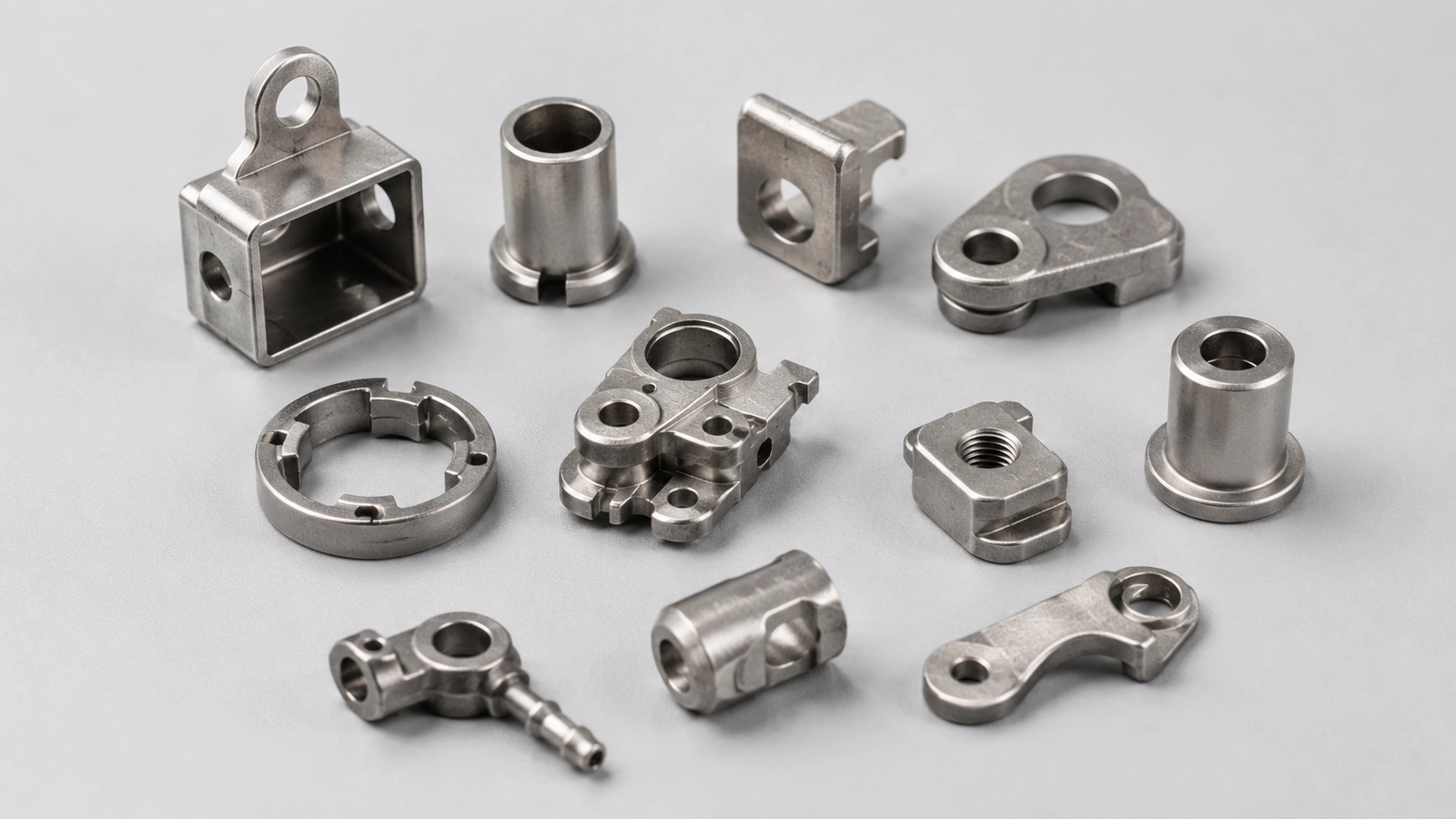
Corrosion-resistant MIM parts should not be presented as one fixed industry or one fixed material grade. This page uses part-form logic: small stainless-steel-like or corrosion-resistant alloy components that may need humidity, sweat, cleaning-agent, outdoor-moisture, or light fluid-contact review. The goal is to help buyers understand which custom corrosion-resistant metal parts may be suitable for MIM before the project moves into DFM, tooling, and material validation.

| Representative Part Form | Typical Corrosion Concern | Why MIM May Fit |
|---|---|---|
| Compact brackets and support parts | Humidity, cleaning residue, exposed edges, or cosmetic staining. | MIM can combine compact 3D geometry, holes, bosses, and support features in one small metal part. |
| Small connector housings and sleeves | Moisture, mating-metal contact, surface oxidation, or assembly exposure. | MIM can support small cavities, sleeves, slots, and repeatable interface geometry. |
| Thin-wall rings, collars, and frames | Exposed surface condition, polishing access, and corrosion-sensitive edges. | MIM may reduce machining steps when circular or frame-like features are combined with small details. |
| Miniature fluid-contact hardware | Light fluid contact, trapped liquid, cleaning difficulty, or sealing-surface risk. | MIM can be considered when the part is compact and complex, but sealing surfaces and hidden pockets must be reviewed. |
| Small housings and enclosure features | Humidity, cosmetic appearance, cleaning exposure, and local surface staining. | MIM can form small enclosure details, internal bosses, and integrated mounting features. |
| Custom compact metal components | Project-specific exposure, finish, inspection, and material requirements. | MIM may fit when corrosion resistance is combined with small size, complex shape, and repeat production volume. |
The first visual example on this page should therefore show a realistic set of small corrosion-resistant MIM part forms, rather than a single 316L part, a single industry application, or a finished consumer product. This keeps the page focused on corrosion-resistant MIM parts and leaves grade-specific details to material pages.
When Corrosion-Resistant MIM Parts Make Engineering Sense
From a design review perspective, corrosion-resistant MIM parts make the most sense when corrosion performance is only one part of the requirement. The stronger fit usually appears when the component is also small, geometrically complex, difficult to machine efficiently, and planned for repeat production.
| Requirement | MIM Suitability | Engineering Reason |
|---|---|---|
| Small complex geometry | Strong fit | MIM can form complex features that may be costly or slow to machine. |
| Stainless steel or specialty alloy required | Strong fit | MIM commonly supports stainless steel and selected specialty alloy systems. |
| Medium to high annual volume | Strong fit | Tooling cost can be distributed across repeat production. |
| Thin walls, small slots, internal features, or undercuts | Good fit after DFM review | Molding, green part handling, debinding, and sintering risks must be reviewed before tooling. |
| Large simple part | Weak fit | CNC, stamping, casting, or fabrication may be more economical. |
| Severe chemical exposure | Project-specific | Material, surface condition, testing, and validation must be agreed before production. |
| Ultra-low-volume prototype | Usually weak fit | CNC or additive manufacturing may be better for early proof-of-concept parts. |
MIM should not be selected only because a part needs stainless steel. It should be selected when the geometry, corrosion exposure, material choice, production volume, tooling investment, shrinkage compensation, and inspection requirements point toward a realistic MIM route. For users still comparing the process itself, the broader metal injection molding overview is the correct next step.
Corrosion Resistance Is Not Only a Material Name
The real issue is not only whether MIM can produce stainless steel parts. The more important question is whether the selected material, geometry, process route, surface condition, and exposure environment can work together in production.
Material factors
- Material grade and chemistry.
- Carbon and oxygen control.
- Heat treatment condition.
- Strength, hardness, and corrosion trade-offs.
Process factors
- Feedstock consistency and molding stability.
- Debinding and sintering control.
- Final density and residual porosity.
- Dimensional stability after shrinkage.
Surface factors
- Surface roughness after sintering.
- Polishing and passivation.
- Finishing access to hidden surfaces.
- Galvanic contact with other metals.
Composite Field Scenario for Engineering Training: Stainless Steel Part Still Showed Staining
What problem occurred: a small stainless steel MIM housing used in a wearable assembly showed surface staining after repeated use exposure.
Why it happened: the project initially specified only “stainless steel” and “corrosion resistant,” without defining exposure condition, surface finish, cleaning method, or cosmetic acceptance criteria.
What the real system cause was: the issue was not only material selection. Surface roughness, polishing accessibility, passivation requirement, and cosmetic-zone definition were not reviewed early enough.
How it was corrected: the drawing was updated to separate cosmetic surfaces from hidden functional surfaces. The material and surface finish requirements were reviewed together, and passivation / polishing requirements were clarified before production planning.
How to prevent recurrence: for wearable or visible parts, define exposure condition, cosmetic surfaces, roughness expectations, passivation needs, and inspection method before tooling.
Material Selection Guide for Corrosion-Resistant MIM Parts
Material selection should start with the operating environment, not with a material name. In practice, engineers should define what the part is exposed to, whether the surface is cosmetic or functional, whether the part carries load, and whether hardness, wear resistance, magnetism, or biocompatibility also matters. For deeper grade-level discussion, use the stainless steel for MIM page rather than treating this parts page as a material database.

| Material Family | Typical Role in Corrosion-Resistant MIM Parts | Caution |
|---|---|---|
| 316L stainless steel | General corrosion resistance; common candidate for medical, dental, wearable, consumer, and appearance-sensitive parts. | Lower hardness and strength than hardened stainless grades; not automatically suitable for every chloride or chemical environment. |
| 304 / 304L stainless steel | General stainless steel applications. | May not be enough for chloride-heavy or aggressive environments. |
| 17-4 PH stainless steel | Balance of strength and corrosion resistance. | Heat treatment condition and corrosion requirement must be reviewed together. |
| 420 stainless steel | Hardness and wear resistance. | Corrosion resistance is not equivalent to 316L. |
| 440C stainless steel | Higher hardness and wear applications. | Corrosion performance needs application-specific review. |
| Titanium alloys | Corrosion resistance and biocompatibility potential. | Higher cost and process review requirements. |
| Co-Cr alloys | Medical, dental, and high-performance applications. | Regulatory, material, and application requirements must be reviewed carefully. |
Application Environments That Should Be Defined Before Tooling
A corrosion-resistant MIM part cannot be evaluated properly if the application environment is unclear. “Outdoor use,” “medical use,” “wearable use,” and “chemical resistant” are not enough by themselves. The engineering team needs to know what the part actually contacts, how often, for how long, and what acceptance method will be used.
| Exposure Environment | What the Engineer Should Confirm |
|---|---|
| Humidity / condensation | Material, surface finish, sealing interface, hidden cavities. |
| Wearable-device exposure | Stainless grade, polishing, passivation, cosmetic surface definition. |
| Cleaning agents | Chemical type, concentration, temperature, cleaning frequency. |
| Salt spray / chloride exposure | Whether standard stainless steel is enough; whether test conditions and acceptance criteria are defined. |
| Mild fluid contact | Sealing surface, corrosion medium, inspection method. |
| Medical or dental cleaning | Material, regulatory, cleaning, and sterilization requirements. |
| Outdoor or automotive humidity | Environmental cycling, coating or passivation needs, assembly exposure. |
Composite Field Scenario for Engineering Training: Fluid-Contact Part Needed More Than a Material Change
What problem occurred: a small internal MIM part for a fluid-control assembly was requested in a corrosion-resistant stainless steel.
Why it happened: the buyer focused on material grade but did not initially identify the sealing surface, cleaning fluid, and inspection requirement.
What the real system cause was: the corrosion risk was linked to both material and geometry. A hidden pocket could retain fluid, and one functional surface required tighter surface control than the rest of the part.
How it was corrected: the DFM review separated sealing surfaces from non-critical surfaces. The supplier and buyer reviewed whether secondary machining or polishing was needed on the functional area.
How to prevent recurrence: for fluid-contact MIM parts, define fluid type, exposure duration, sealing areas, allowable surface condition, and acceptance method before tooling release.
Surface Finishing and Passivation Considerations
For many corrosion-resistant MIM parts, the as-sintered surface may not be the final functional surface. Depending on the application, surface finishing for MIM parts may involve polishing, passivation, electropolishing, tumbling, secondary machining, or localized finishing.

Surface condition matters because corrosion rarely develops evenly across an entire small part. In practice, the visible cosmetic face, the sealing surface, the hidden pocket, the gate area, and the secondary machined area may all behave differently after sintering and finishing. An as-sintered surface may be acceptable for a hidden non-critical area, while a sealing surface may require secondary machining or polishing. A visible wearable surface may require polishing and passivation, while an internal blind feature may be difficult to treat or inspect. These differences should be marked on the drawing instead of being handled as a general note after samples are produced.
| Surface Zone | Typical Concern | Review Before Tooling |
|---|---|---|
| As-sintered surface | Roughness, retained residue, or appearance variation may matter in exposed areas. | Confirm whether the surface is hidden, cosmetic, functional, or exposed to fluid. |
| Polished cosmetic surface | Visible staining, scratches, and appearance consistency. | Define cosmetic zones, polishing direction, and visual acceptance criteria. |
| Passivated stainless surface | Surface chemistry and cleanliness affect passive-layer behavior. | Confirm material grade, cleaning process, passivation need, and inspection method. |
| Electropolished area | May improve surface smoothness for selected geometries, but access can be limited. | Review geometry accessibility, masking needs, and functional surface priority. |
| Secondary machined sealing surface | Tool marks, flatness, leakage, and local corrosion risk. | Define sealing area, tolerance, surface finish, and post-machining cleaning. |
| Hidden surface or blind feature | Difficult to polish, passivate, clean, or inspect. | Check whether the hidden feature can trap fluid or cleaning residue in use. |
Visible surfaces may require polishing, texture control, or appearance inspection.
Sealing, sliding, and mating surfaces may require different finishing than general surfaces.
These processes may be useful for selected stainless steel applications, but they must be planned with material and geometry.
Internal pockets and blind features may be difficult to polish, passivate, clean, or inspect.
Surface finish and corrosion requirements should be part of the RFQ, not an afterthought after sample inspection.
A common mistake is to request a corrosion-resistant alloy but ignore surface state. In production, a rough hidden surface, machining mark, retained residue, or untreated stainless surface may behave differently from a polished and passivated visible surface. If a surface controls sealing, appearance, sliding wear, or cleaning behavior, it should be marked on the drawing before quotation.
Corrosion Requirement vs MIM Review Focus
Before tooling, the corrosion requirement should be translated into engineering review items. A vague note such as “corrosion resistant stainless steel” is usually not enough for material selection, surface finishing, or inspection planning.
| Corrosion Requirement | Typical User Meaning | MIM Review Focus | Information Needed Before RFQ |
|---|---|---|---|
| Moisture / humidity resistance | The part should not stain or degrade in normal humidity or condensation. | Stainless grade, density, surface roughness, hidden cavities, and passivation need. | Use environment, humidity exposure, visible surfaces, and cosmetic acceptance. |
| Sweat / wearable exposure | The part may contact skin, sweat, and cleaning residue. | Material family, polishing, passivation, coating compatibility, and cosmetic-zone definition. | Wearable location, skin-contact area, surface finish target, and appearance requirement. |
| Cleaning agent resistance | The part may be wiped, washed, sterilized, or cleaned repeatedly. | Cleaning chemistry, temperature, surface accessibility, and post-treatment requirement. | Chemical type, concentration, cleaning frequency, and inspection method. |
| Chloride or salt exposure | The part may face salt spray, marine air, or chloride-containing fluid. | Material suitability, surface finish, passivation, and project-specific corrosion test criteria. | Test method, exposure duration, acceptance criteria, and mating materials. |
| Fluid-contact function | The part contacts liquid or works near sealing surfaces. | Sealing surface quality, hidden pockets, secondary machining, and cleaning accessibility. | Fluid type, pressure or sealing role, functional surfaces, and leakage acceptance. |
This review keeps the current page focused on part suitability. Detailed alloy selection, material property comparisons, and grade-specific performance should be handled through the MIM materials section rather than overloading this parts page.
DFM Risks for Corrosion-Resistant MIM Parts
DFM review is especially important when corrosion resistance is connected to hidden surfaces, retained fluid, polishing access, or functional contact areas. A design may be moldable, but still create corrosion or cleaning problems after assembly.

| Design Feature | Corrosion-Related Risk | Review Action |
|---|---|---|
| Deep blind slot | Fluid retention or cleaning difficulty. | Review drainage, cleaning path, and surface accessibility. |
| Sharp internal corner | Surface treatment difficulty and local stress. | Add radius where function allows. |
| Thin wall near functional edge | Distortion or inconsistent surface after sintering. | Review wall balance and sintering support. |
| Sealing surface | Leakage or corrosion at interface. | Consider secondary machining, polishing, or inspection control. |
| Hidden internal surface | Difficult passivation or inspection. | Confirm whether the hidden area is exposed in use. |
| Moving hinge or pin area | Corrosion and wear may interact. | Review material hardness, finish, and lubrication condition. |
| Gate mark near cosmetic or sealing surface | Appearance or functional risk. | Review gate location before tooling. |
| Assembly with another metal | Galvanic corrosion possibility. | Review mating material and exposure environment. |
DFM for corrosion-resistant MIM parts is not only about wall thickness and shrinkage. It must also review how the geometry interacts with the corrosion environment. Fluid retention, polishing access, surface roughness, passivation accessibility, mating metal contact, gate location, and sintering distortion can affect performance even when the selected material is appropriate.
Submit your drawing for review when corrosion resistance depends on hidden surfaces, sealing areas, moving contact zones, or finishing access.
When MIM Is Not the Best Choice for Corrosion-Resistant Parts
MIM is not the right answer for every corrosion-resistant metal part. A supplier that understands MIM should also be able to explain when not to use it.
MIM may be unsuitable when
- The part is large and geometrically simple.
- The annual volume is too low to justify tooling.
- Corrosion resistance is the only requirement and CNC or stamping is cheaper.
- The part requires severe chemical resistance but no test method is defined.
- The part is a pressure boundary, safety-critical component, or regulated device without complete validation planning.
Alternative routes may fit better when
- CNC machining is needed for low-volume prototypes or fully machined surfaces.
- Stamping is enough for flat stainless parts.
- Casting or machining is more practical for larger components.
- PM pressing and sintering fits regular powder metal shapes better than MIM.
- The design is still changing and tooling would create unnecessary risk.
Corrosion-Resistant MIM Parts vs CNC, Stamping, Casting, and PM
This page should not replace a full process comparison, but corrosion-resistant part buyers often need a quick manufacturing route check.
| Process | Better Fit | Limitation for This Topic |
|---|---|---|
| MIM | Small, complex, high-volume corrosion-resistant parts. | Tooling cost, shrinkage control, and DFM review are required. |
| CNC machining | Low volume, prototypes, tight machined surfaces. | Higher cost for complex high-volume small parts. |
| Stamping | Flat or sheet-like stainless parts. | Limited 3D complexity and integrated features. |
| Casting | Larger metal parts. | Fine details, surface condition, and tolerance may need more finishing. |
| PM pressing and sintering | Regular geometry, cost-sensitive parts. | Less suitable for highly complex 3D miniature features. |
| CIM | Non-metallic ceramic applications. | Different material route and performance limits. |
The key decision is not “which process is best overall.” The better question is: which process can meet the geometry, corrosion environment, tolerance, volume, and cost target with the lowest production risk?
RFQ Checklist for Corrosion-Resistant MIM Parts
Before requesting a quotation, provide enough information for an engineering review. A drawing alone may not explain the corrosion requirement. For broader quotation preparation, use the RFQ preparation guide together with the corrosion-specific checklist below.

| RFQ Input | Why It Matters |
|---|---|
| 2D drawing | Defines dimensions, tolerances, notes, surface requirements, and inspection points. |
| 3D CAD file | Allows geometry, wall thickness, undercut, and tooling review. |
| Target material or current material | Helps compare stainless steel or specialty alloy options. |
| Corrosion environment | Defines whether the risk is humidity, chloride, cleaning agent, or fluid contact. |
| Surface finish requirement | Affects appearance, corrosion behavior, cost, and inspection. |
| Passivation / polishing / electropolishing requirement | May be necessary for selected stainless steel applications. |
| Critical dimensions | Helps identify areas affected by shrinkage, sintering distortion, or secondary machining. |
| Functional surfaces | Separates cosmetic, sealing, sliding, and assembly surfaces. |
| Annual volume | Determines whether tooling investment is reasonable. |
| Inspection or acceptance standard | Prevents vague corrosion claims and unclear quality expectations. |
If the project involves a new material, special finish, regulated application, or demanding corrosion requirement, the RFQ should be treated as an engineering review rather than a simple price request.
Request an Engineering Review for Corrosion-Resistant MIM Parts
For small complex parts requiring corrosion resistance, send your 2D drawing, 3D CAD file, target material, exposure medium, cleaning or sterilization condition, cosmetic surface notes, sealing or sliding surface requirements, tolerance needs, and estimated annual volume. XTMIM can review whether MIM is suitable for the part geometry, whether stainless steel or another alloy family should be considered, where sintering or finishing risks may appear, and which issues should be clarified before tooling, trial production, or repeat production.
FAQ: Corrosion-Resistant MIM Parts
Are MIM parts corrosion resistant?
MIM parts can be corrosion resistant when the correct material, sintering process, surface condition, and finishing route are selected for the application. Stainless steel MIM parts such as 316L or 17-4 PH may be considered for corrosion-resistant applications, but final performance depends on the exposure environment and project requirements.
Is 316L always the best choice for corrosion-resistant MIM parts?
No. 316L stainless steel is often considered when general corrosion resistance is important, but it is not automatically the best choice for every part. If the part also needs higher strength, hardness, wear resistance, heat treatment response, or special regulatory review, another material family may need to be evaluated.
Which MIM material is best for corrosion resistance?
There is no single best material for every corrosion-resistant MIM part. 316L stainless steel is often considered when general corrosion resistance is important, while 17-4 PH may be reviewed when both strength and corrosion resistance are needed. Hardened stainless grades may improve wear resistance but may not provide the same corrosion behavior as 316L.
Is 316L stainless steel MIM suitable for medical or wearable parts?
316L stainless steel MIM may be suitable for some medical, dental, wearable, and consumer hardware applications, but the final decision depends on the part function, surface finish, cleaning exposure, regulatory requirements, and validation method. For medical or wearable applications, material and finishing requirements should be reviewed before tooling.
Does passivation improve corrosion resistance of MIM stainless steel parts?
Passivation may improve corrosion behavior for selected stainless steel MIM parts by supporting a more stable passive surface condition. Whether it is required depends on the stainless grade, surface finish, application environment, and inspection requirements. It should be specified during RFQ if it affects performance or acceptance.
When should I not use MIM for corrosion-resistant parts?
MIM may not be the best choice when the part is large and simple, the volume is too low to justify tooling, the corrosion requirement can be met by a simpler CNC or stamped part, or the exposure condition is severe but no validation method is defined. In these cases, the manufacturing route should be reviewed before committing to tooling.
What information should I provide for a corrosion-resistant MIM part quotation?
Provide 2D drawings, 3D CAD files, target material, corrosion exposure details, surface finish requirements, passivation or polishing requirements, critical dimensions, functional surfaces, annual volume, and any inspection or acceptance standard. If the part replaces CNC, casting, stamping, or another process, also share the existing failure or cost issue.
Standards and Technical References Note
Corrosion-resistant MIM parts should be reviewed using relevant MIM material standards, project drawings, application exposure conditions, and agreed inspection methods. MPIF Standard 35-MIM is relevant because it covers common materials used in metal injection molding with explanatory notes and definitions. The MIMA Standard 35-MIM resource is useful for confirming the current MIM industry material-standard direction. ASTM B883 is relevant because it covers ferrous metal injection molded materials made from metal powders and binders through injection molding, debinding, and sintering. ASTM A967 / A967M is relevant when stainless steel passivation is specified for a project because it covers chemical passivation treatments for stainless steel parts. The EPMA MIM overview is relevant for understanding MIM as a route for complex-shaped parts in higher quantities. These references support engineering review, but they do not replace project-specific DFM, material selection, surface finishing review, or validation testing.