Get a Quote

Fill the form below to receive a personalized consultancy by our expert team.

MIM Manufacturing Capabilities for Custom Metal Parts

From initial drawing review to mold development, trial validation, sintering control, secondary operations, and final inspection, we support the full process needed for custom MIM parts production.

Capability Overview

MIM Capabilities Built Around Real Project Requirements

A reliable MIM project requires more than molding equipment. It depends on coordinated support across manufacturing, engineering review, quality inspection, production equipment, and project execution.

Capability pages should not repeat the About Us page. This section focuses on what the factory can support in a real MIM project: manufacturing, engineering review, quality control, inspection, equipment, and production execution.
MIM Project Workflow

From Drawing Review to Controlled MIM Production

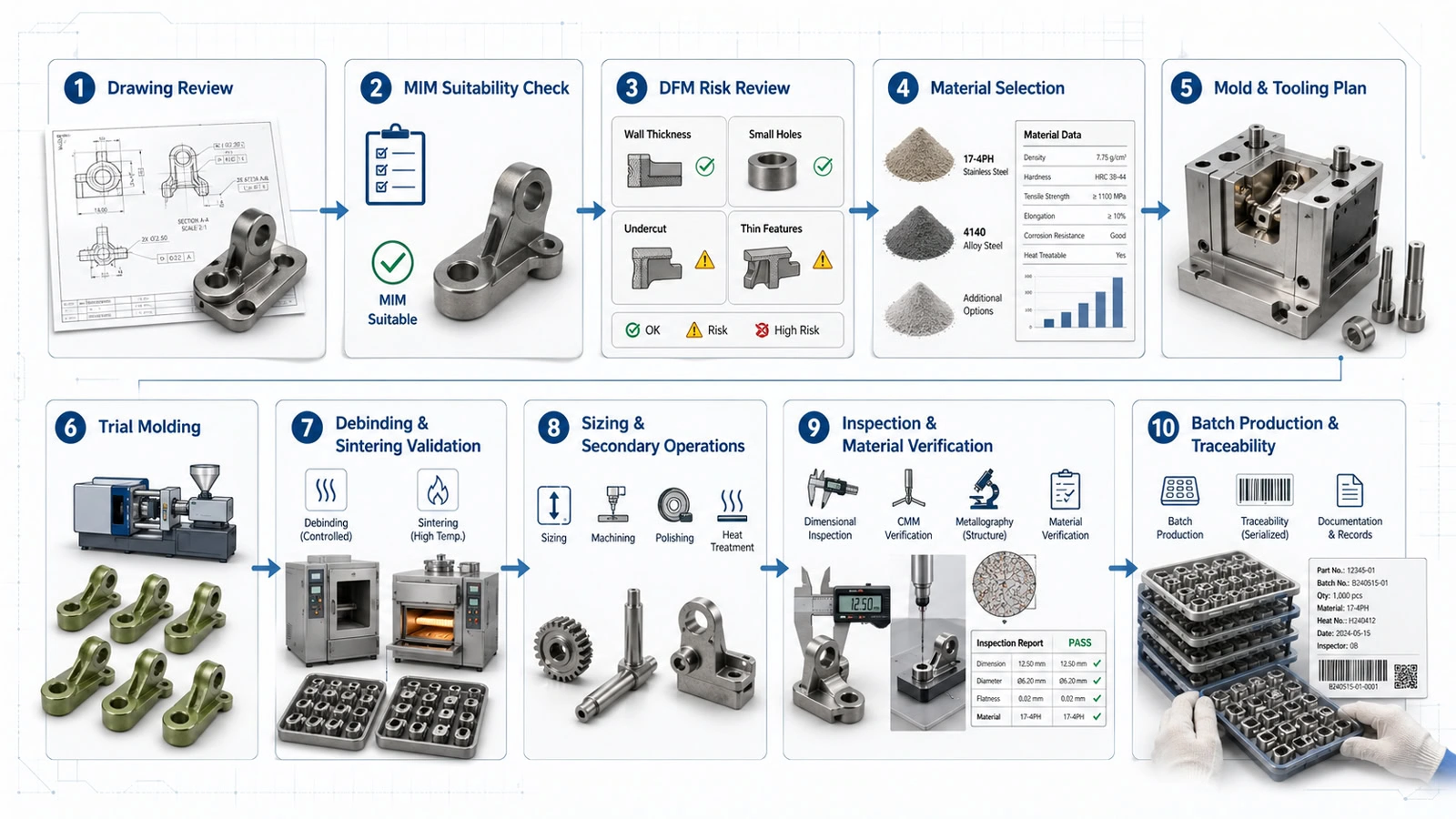
A successful MIM project depends on more than injection molding. Before tooling starts, the part design, material, tolerance requirements, shrinkage behavior, sintering risk, secondary operations, and inspection standards should be reviewed together.

MIM project workflow showing drawing review, DFM support, material selection, mold tooling, trial production, debinding, sintering, secondary operations, inspection, and batch production
A controlled MIM project workflow connects drawing review, DFM evaluation, material selection, tooling, trial validation, sintering, secondary operations, inspection, and batch production.
01

Drawing & Requirement Review

We review 2D drawings, 3D files, material requirements, expected quantity, tolerance needs, surface requirements, and application conditions.

Engineering Review →
02

MIM Suitability Check

Part size, weight, complexity, wall thickness, holes, slots, production volume, and alternative manufacturing routes are evaluated before tooling.

Suitability Review →
03

DFM Risk Review

Thin walls, thick sections, sharp corners, deep holes, long slots, parting line logic, support surfaces, and sintering distortion risks are checked.

DFM Support →
04

Material Selection Discussion

Material options are discussed according to strength, hardness, corrosion resistance, magnetic behavior, density, heat treatment, and service environment.

Material Selection →
05

Mold & Tooling Plan

Tooling planning considers shrinkage compensation, gate location, parting line, ejection method, mold life, and trial molding requirements.

Mold & Tooling →
06

Trial Molding

Trial molding verifies filling behavior, gate logic, parting line condition, flash risk, green part strength, and initial dimensional condition.

Trial Production →
07

Debinding & Sintering Validation

Debinding, sintering shrinkage, density, distortion, cracking risk, surface condition, and final dimensional trend are validated after molding.

MIM Manufacturing →
08

Sizing & Secondary Operations

Sizing, heat treatment, machining, polishing, blasting, plating, passivation, laser marking, or other post-processing steps can be arranged when required.

Secondary Operations →
09

Inspection & Material Verification

Dimensional inspection, visual inspection, hardness, density, material verification, and third-party testing support can be arranged according to project requirements.

Inspection Capability →
10

Batch Production & Traceability

Batch production can include material batch records, tooling status, production lot records, sintering batch records, inspection data, and shipment records.

Production Traceability →
Engineering Note

Why Early Review Matters

Early engineering review helps identify MIM suitability, DFM risks, material concerns, tooling challenges, sintering distortion risks, and inspection requirements before mold investment. This can reduce avoidable trial delays, tooling modifications, and batch quality issues.

Manufacturing Capability

Manufacturing Capability for Custom MIM Parts

Metal injection molding capability is not defined by injection molding alone. A reliable MIM project depends on coordinated control across part review, mold planning, material selection, molding, debinding, sintering, secondary operations, and production capacity planning.

Built Around the Full MIM Manufacturing Chain

Our manufacturing capability is built for custom MIM projects that require small, complex, and high-density metal parts. Before production, we review the part geometry, material requirements, tolerance targets, surface requirements, application conditions, and expected annual volume.

This helps determine whether the part is suitable for MIM, how the mold should be planned, which material route is more practical, and whether secondary operations are needed after sintering.

  • MIM injection molding for small and complex metal parts
  • Mold and tooling planning based on shrinkage and sintering behavior
  • Material selection support using commercially available MIM material systems
  • Debinding and sintering process control for dimensional and density stability
  • Secondary operations such as sizing, machining, heat treatment, polishing, plating, or passivation
  • Production capacity planning for trial runs, small batches, and repeat production
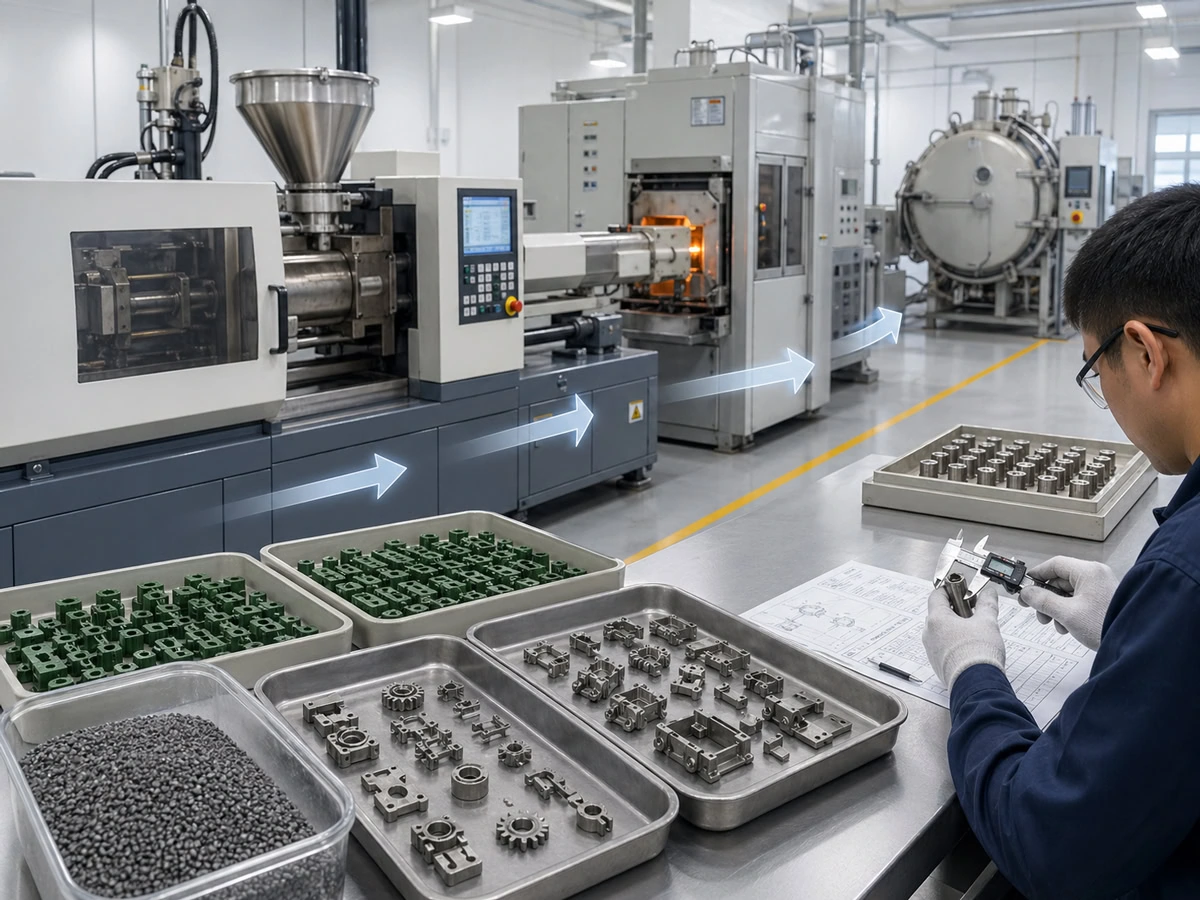
MIM manufacturing capability showing feedstock, injection molding, green parts, debinding, sintering, finished metal parts, and inspection for custom MIM production
MIM manufacturing capability should be evaluated as a complete process chain, including material selection, molding, debinding, sintering, secondary operations, inspection, and production planning.
01

MIM Manufacturing Capability

Core production support from molding to sintering.

MIM manufacturing involves more than injecting feedstock into a mold. The process must consider feedstock flow, green part strength, debinding stability, sintering shrinkage, density, distortion risk, and final dimensional control.

  • Injection molding process review
  • Debinding and sintering validation
  • Shrinkage and distortion consideration
  • Batch production process control
View Manufacturing Capability →
02

MIM Mold & Tooling Capability

Tooling planning for shrinkage, gate logic, and part release.

MIM tooling is different from conventional plastic injection tooling because the final part must pass through debinding and sintering. Mold planning should consider shrinkage compensation, gate location, parting line, ejection, green part strength, and sintering deformation risk.

  • Mold structure discussion
  • Gate and runner planning
  • Parting line and ejection review
  • Trial molding feedback
View Mold & Tooling Capability →
03

MIM Material Selection Support

Practical material selection for function and application environment.

Material selection in MIM should be based on strength, hardness, corrosion resistance, magnetic behavior, wear resistance, density, heat treatment needs, and working environment. This is practical material selection support, not new material development.

  • Stainless steel material selection
  • Low alloy steel options
  • Magnetic material discussion
  • Heat treatment and hardness review
View Material Selection Support →
04

Secondary Operations

Post-sintering operations for dimensional, surface, and functional requirements.

Many MIM parts require secondary operations after sintering, especially when the final application has strict dimensional, hardness, surface, assembly, or corrosion resistance requirements.

  • Sizing and calibration
  • CNC machining or tapping
  • Heat treatment
  • Polishing, plating, or passivation
View Secondary Operations →
05

Production Capacity

Capacity planning for trial production, small batches, and repeat orders.

Production capacity should match the real stage of the project. Early-stage MIM projects often require trial production, sample validation, and process adjustment before stable repeat production.

  • Trial production planning
  • Small batch support
  • Repeat production arrangement
  • Inspection and delivery coordination
View Production Capacity →
Engineering Note

Manufacturing Capability Is a Process Chain, Not a Single Machine

In MIM production, one stage can affect the next. Mold design affects green part quality. Green part quality affects debinding stability. Debinding and sintering affect density, shrinkage, distortion, and final dimensions. For this reason, manufacturing capability should be evaluated as a complete process chain rather than only by the number of molding machines.

Engineering Support

Engineering Support for MIM Project Development

MIM project success often depends on the engineering decisions made before mold manufacturing starts. Drawing review, DFM evaluation, material discussion, trial planning, and schedule coordination help reduce avoidable tooling changes, sampling delays, and production risks.

Engineering Review Before Tooling Starts

Before a MIM project moves into mold manufacturing, the part design should be reviewed from the full process chain. A geometry that looks acceptable in CAD may still create risks during molding, debinding, sintering, sizing, or final inspection.

We review drawings and project requirements with attention to part geometry, material selection, tolerance targets, wall thickness, holes, slots, sharp corners, surface requirements, secondary operations, and expected production volume.

This helps customers identify early risks and make practical decisions before investing in tooling.

  • Drawing and 3D model review before quotation or tooling
  • MIM suitability evaluation based on part size, complexity, material, and production volume
  • DFM review for wall thickness, holes, slots, ribs, undercuts, sharp corners, and distortion risk
  • Material and secondary operation discussion based on functional requirements
  • Prototype, trial production, and small batch planning
  • Project schedule review from tooling to sampling and repeat production
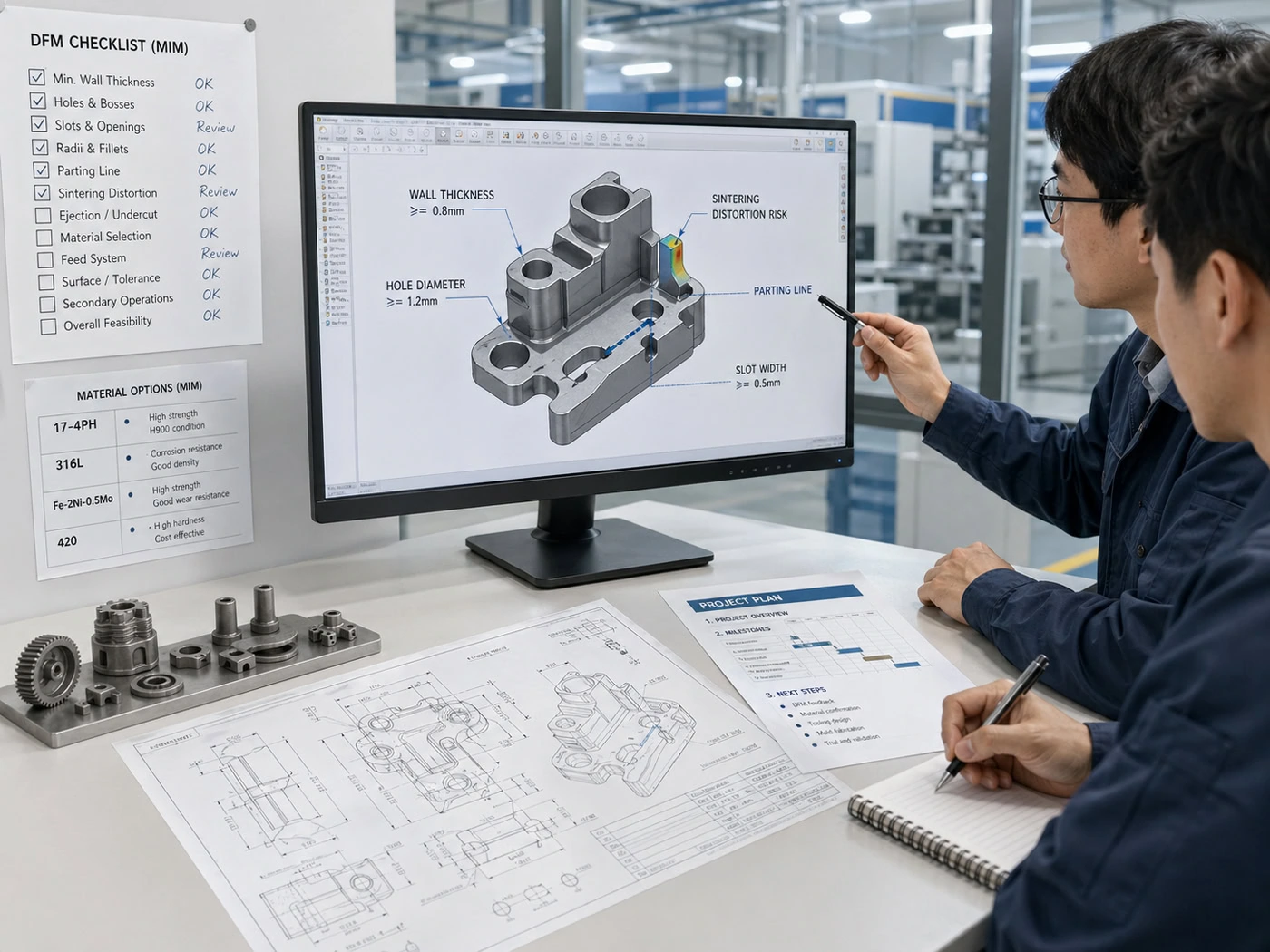
MIM engineering review showing 2D drawing, 3D CAD model, DFM checklist, and engineers reviewing manufacturability before mold investment
Engineering support helps review MIM suitability, DFM risks, material requirements, trial production needs, and project schedule before tooling starts.
01

Engineering Review

Initial review of drawings, 3D files, and project requirements.

Engineering review is the first step before mold planning. We check the part drawing, 3D model, material requirement, tolerance target, application condition, surface requirement, and estimated production volume.

  • 2D drawing and 3D model review
  • Part size and weight evaluation
  • Material and application review
  • Early project risk identification
View Engineering Review →
02

DFM Support

Design-for-manufacturing review for MIM process risks.

DFM support helps identify design features that may affect molding, debinding, sintering, dimensional control, or final part quality. These risks should be reviewed before mold manufacturing starts.

  • Wall thickness and transition review
  • Hole, slot, rib, and undercut evaluation
  • Parting line and ejection discussion
  • Sintering distortion risk assessment
View DFM Support →
03

MIM Project Development Support

Support from early feasibility review to production release.

MIM project development support connects engineering review, tooling discussion, material selection, trial production, inspection requirements, and batch production planning.

  • Project feasibility discussion
  • MIM process route planning
  • Tooling and sampling coordination
  • Production release preparation
View Project Development Support →
04

Prototype & Trial Production

Trial production support before stable batch manufacturing.

MIM projects usually require trial production before stable batch manufacturing. Trial production helps verify mold condition, molding behavior, debinding and sintering stability, shrinkage trend, surface condition, and dimensional results.

  • Tool trial and sample preparation
  • Green part and sintered part review
  • Shrinkage and dimensional trend checking
  • Small batch validation
View Prototype & Trial Production →
05

Lead Time & Project Scheduling

Project schedule planning from tooling to production.

Lead time in MIM should be reviewed by project stage, not only as a single delivery date. Tooling, trial molding, debinding, sintering, secondary operations, inspection, and shipment can all affect the final schedule.

  • Tooling schedule review
  • Trial production timing
  • Debinding and sintering batch planning
  • Inspection and shipment coordination
View Lead Time & Scheduling →
Engineering Note

Good Engineering Support Reduces Trial-and-Error

In MIM projects, many problems become expensive after mold manufacturing starts. Wall thickness imbalance, unsuitable tolerances, difficult ejection, weak green parts, sintering deformation, and unclear inspection standards can all lead to repeated trials or tooling modifications. Early engineering support helps reduce these risks before the project moves into tooling.

Factory & Equipment

Factory Environment and MIM Production Equipment

A stable MIM project depends on more than one production machine. The factory environment, molding equipment, debinding system, sintering furnace capacity, sizing equipment, secondary operation support, and inspection handover all affect part consistency and project delivery.

Production Environment Built Around the MIM Process Chain

MIM production requires coordinated equipment across multiple stages. Injection molding creates the green part, debinding removes binder without damaging the part structure, sintering controls shrinkage and density, and post-sintering operations help meet dimensional or surface requirements.

For this reason, factory capability should not be evaluated only by the number of machines. It should be evaluated by whether the production environment can support the full MIM process route, trial validation, batch arrangement, process control, and quality handover.

  • MIM injection molding equipment for trial and repeat production
  • Debinding equipment for binder removal and process validation
  • Sintering furnaces for different part sizes, batch requirements, and material systems
  • Small furnace support for trials, samples, and process verification
  • Medium and larger furnace support for batch production planning
  • Sizing and calibration equipment for post-sintering dimensional adjustment
  • Production environment management for part handling, batch flow, and inspection handover
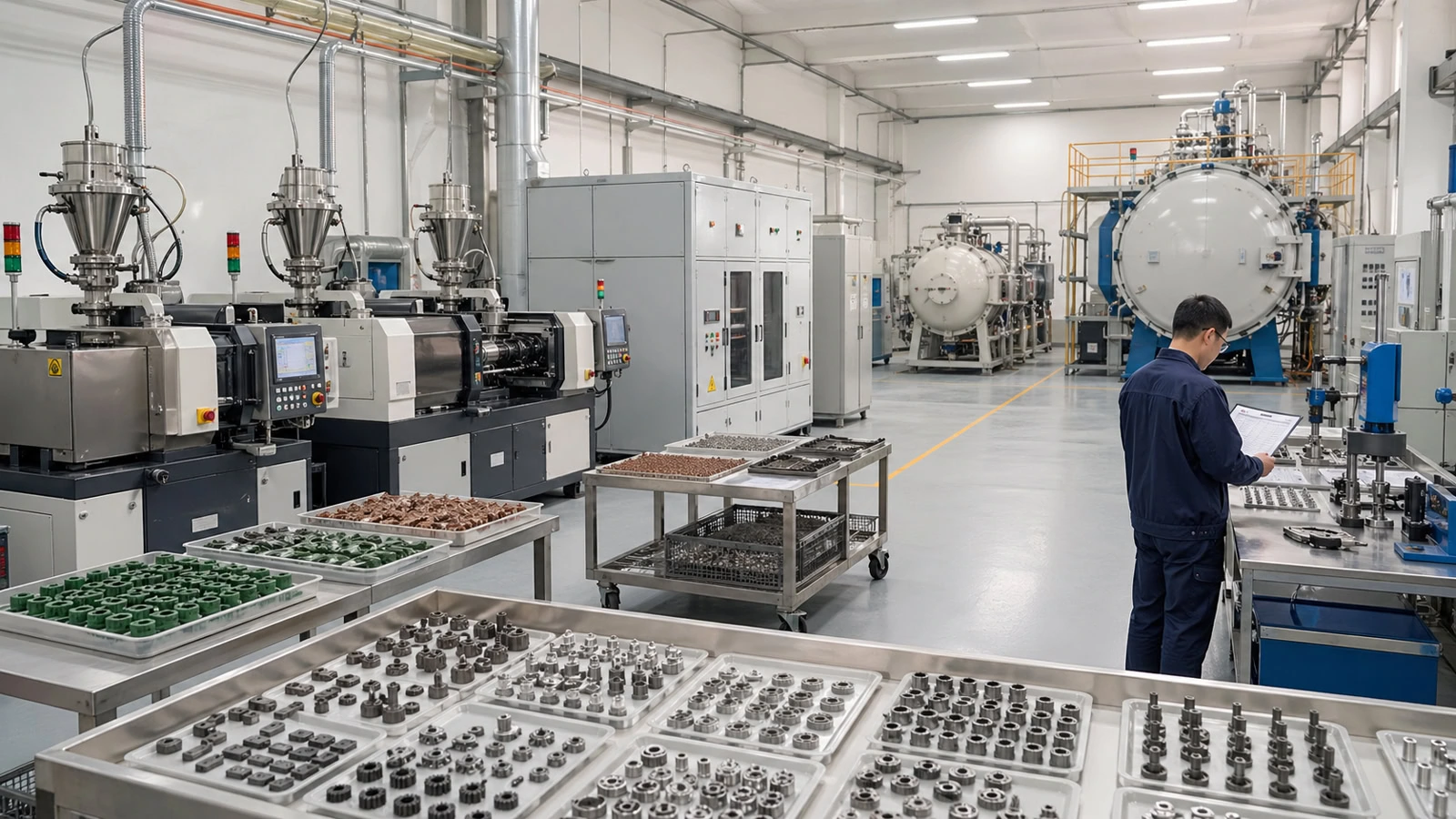
MIM production equipment and factory environment showing injection molding, debinding, sintering furnace, sizing workstation, parts trays, and process control for custom metal parts
MIM equipment capability should be evaluated by the complete process route, including molding, debinding, sintering, sizing, post-sintering operations, and inspection handover.
01

MIM Injection Molding Equipment

Supports green part forming for custom MIM components.

Injection molding equipment is used to form the green part from MIM feedstock. Stable molding conditions help control filling behavior, weld lines, short shots, gate marks, green part strength, and dimensional repeatability before debinding and sintering.

  • Trial molding support
  • Green part forming
  • Filling and gate behavior review
  • Repeat molding process control
02

Debinding Equipment

Binder removal support before high-temperature sintering.

Debinding is a critical stage between molding and sintering. Improper debinding may cause cracking, blistering, deformation, contamination, or weak brown parts. Debinding equipment and process control help prepare parts for stable sintering.

  • Binder removal process support
  • Solvent or thermal route discussion
  • Brown part handling
  • Debinding-to-sintering coordination
03

Sintering Equipment

Furnace capacity for shrinkage, density, and dimensional stability.

Sintering is one of the most important stages in MIM production. Furnace type, loading method, atmosphere control, part support, temperature profile, and batch arrangement can affect density, shrinkage, distortion, surface condition, and final mechanical properties.

  • Small furnace support for trials and samples
  • Medium and larger furnace support for batch production
  • Sintering batch arrangement
  • Shrinkage and distortion control support
04

Sizing and Post-Sintering Equipment

Supports dimensional adjustment after sintering.

After sintering, some MIM parts may require sizing, calibration, straightening, machining, tapping, polishing, heat treatment, or surface finishing. These operations help meet final assembly, dimensional, hardness, surface, or corrosion resistance requirements.

  • Sizing and calibration
  • Straightening or correction support
  • Machining and tapping coordination
  • Surface finishing coordination
Engineering Note

Equipment Capability Should Match the MIM Process Route

In MIM production, equipment capability should be evaluated by process coverage rather than machine quantity alone. A project may require suitable molding equipment, a stable debinding route, proper sintering furnace arrangement, post-sintering sizing, and inspection handover. The right equipment combination helps reduce trial delays, dimensional instability, deformation risk, and production scheduling problems.

When to Contact Us

When Should You Contact XTMIM for a MIM Project?

You do not need to wait until every detail is finalized before contacting us. Many MIM project risks should be reviewed before mold investment, especially when the part geometry, material, tolerance, surface requirement, or production volume may affect manufacturability.

01

You Have a Small Complex Metal Part

Suitable for early MIM feasibility review.

If your part is small, complex, difficult to machine, or requires multiple features in one compact metal component, MIM may be worth evaluating.

  • Small precision metal parts
  • Complex geometry
  • Thin walls, holes, slots, ribs, or fine features
  • High-volume or repeat production potential
02

You Are Comparing MIM with CNC, Casting, or PM

Useful when the current manufacturing route is costly or limited.

Many customers consider MIM when CNC machining becomes too costly, casting cannot achieve small features, or conventional powder metallurgy cannot produce the required shape complexity.

  • CNC cost reduction discussion
  • Casting-to-MIM conversion review
  • PM-to-MIM feasibility check
  • Design complexity and volume evaluation
03

You Need DFM Review Before Tooling

Recommended before mold manufacturing starts.

MIM tooling investment should not begin before key DFM risks are reviewed. Wall thickness imbalance, sharp corners, deep holes, long slots, difficult ejection, and sintering distortion risks should be discussed early.

  • Wall thickness and transition review
  • Hole, slot, rib, and undercut evaluation
  • Parting line and gate discussion
  • Sintering deformation risk review
04

You Are Unsure About Material Selection

Helpful when functional requirements are clear but material is not fixed.

If you know the required function but are unsure which MIM material is more suitable, we can discuss material options based on strength, hardness, corrosion resistance, magnetic behavior, wear resistance, and application environment.

  • Stainless steel selection
  • Low alloy steel discussion
  • Magnetic material requirements
  • Heat treatment and hardness targets
05

You Need Prototype or Trial Production Support

Useful for validation before repeat production.

MIM projects usually need trial production before stable batch manufacturing. Trial production helps verify mold condition, molding behavior, debinding and sintering stability, shrinkage trend, dimensional results, and inspection requirements.

  • Tool trial planning
  • Sample preparation
  • Small batch validation
  • Pre-production risk review
06

You Need Stable Repeat Production

Suitable for parts moving from samples to production.

If your project has passed sample validation or is preparing for repeat production, we can discuss production capacity, inspection requirements, secondary operations, packaging, traceability, and delivery planning.

  • Repeat order planning
  • Inspection and quality control
  • Secondary operation coordination
  • Batch production scheduling

What to Send for an Initial Review

Complete information is helpful, but not always required. If your design is still under development, you can send the available files and project requirements. We will review the project based on the information provided and identify what needs further clarification.

  • 2D drawing with dimensions and tolerance requirements
  • 3D CAD file if available
  • Target material or required mechanical properties
  • Estimated annual volume or trial quantity
  • Surface finish, heat treatment, plating, or passivation requirements
  • Application environment such as wear, corrosion, load, temperature, or magnetic function
  • Current manufacturing method if converted from CNC, casting, PM, or stamping
  • Known problems such as high cost, deformation, poor tolerance, difficult assembly, or unstable supply

When MIM May Not Be the Best Route

MIM is not suitable for every metal part. If the part is very large, very simple in geometry, required only in a few pieces, or does not justify mold investment, CNC machining, stamping, casting, or other manufacturing methods may be more practical.

  • The part is too large for economical MIM production
  • The geometry is simple and easy to machine or stamp
  • Only one or a few pieces are required
  • The project cannot support tooling investment
  • The tolerance requirement is unrealistic without secondary machining
  • The material requirement is not available through practical MIM material systems
Engineering Note

Early Contact Can Reduce Tooling and Trial Risks

In MIM projects, many issues are easier to correct before tooling starts. Once the mold has been manufactured, design changes, gate changes, tolerance adjustments, or secondary operation changes may increase cost and delay the project. Early communication helps clarify the process route before major investment is made.

Ready to Review a MIM Project?

Send your drawing, 3D model, material requirement, target quantity, or current manufacturing problem. We will help review whether MIM is a practical route and what should be clarified before tooling or trial production.