
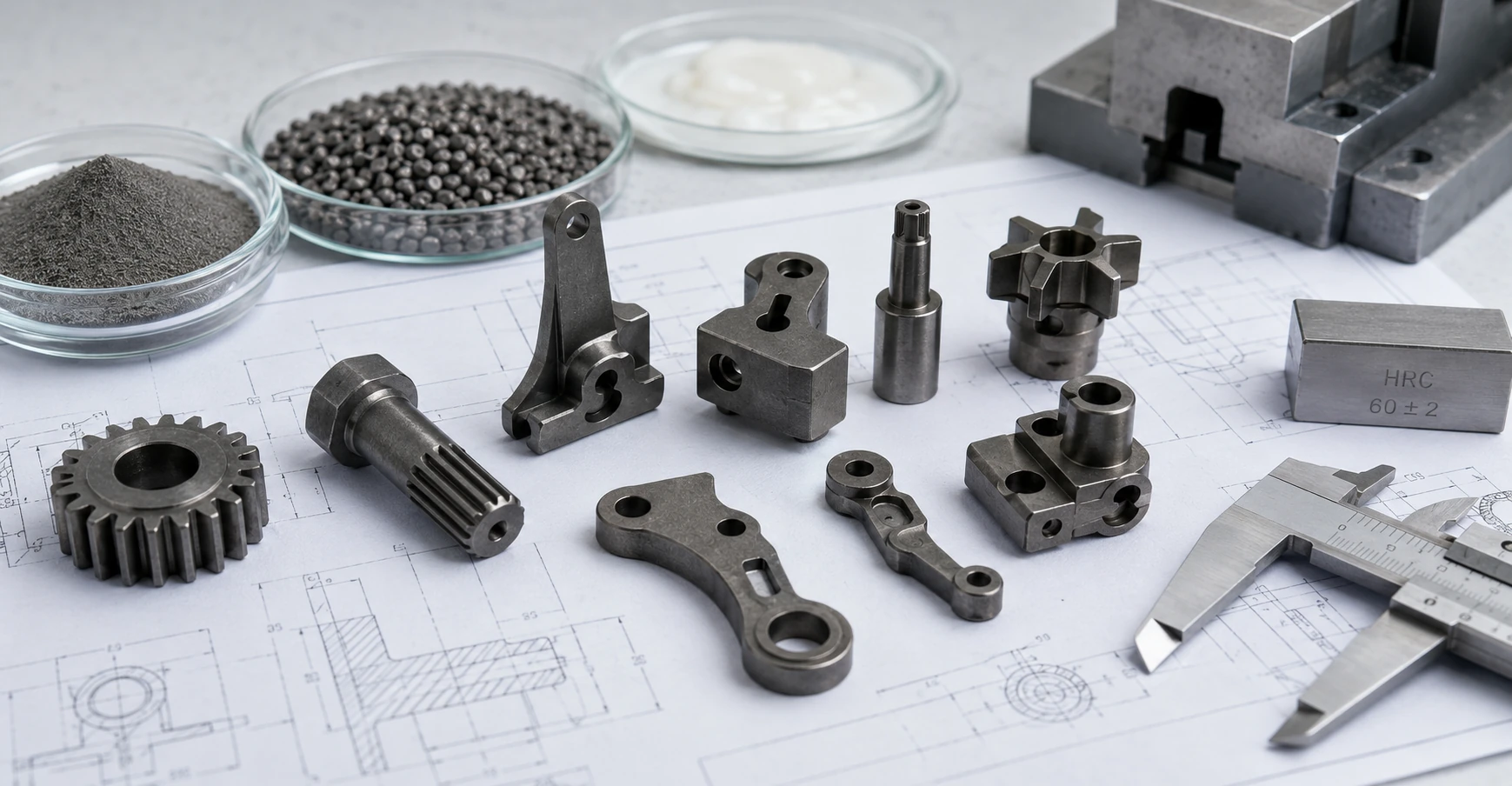
MIM 4605 low alloy steel is a heat-treatable ferrous material used for small, complex metal injection molded parts that need higher strength, hardness, or wear resistance than many non-hardened MIM options. It is not a stainless steel, so it should not be selected when corrosion resistance is the main design driver. For a design engineer or sourcing team, the key decision is not simply whether the drawing says “4605,” but whether the geometry, heat-treated condition, critical dimensions, surface requirement, inspection method, and annual volume make sense for MIM production. This page is useful when a compact gear, lever, latch, pin, shaft, locking component, or wear-loaded mechanism needs material validation before tooling or supplier RFQ review.
What Is MIM 4605 Low Alloy Steel in Metal Injection Molding?
MIM 4605 is a low alloy steel material used in MIM materials selection when a part requires a combination of strength, hardness, and wear resistance that may not be achieved by softer stainless steel choices. It belongs to the ferrous MIM material group, not the stainless steel family.
In production, this matters because MIM 4605 is not selected only by chemical name. It must be evaluated as a material + feedstock + injection molding + debinding + sintering + heat treatment + part geometry combination. Fine metal powder and binder behavior, green part handling, debinding stability, sintering shrinkage, tooling compensation, carbon control, heat treatment response, and final inspection all affect whether the part can meet the drawing.
For broader family-level context, this page should be read together with low alloy steel for MIM, while this terminal page focuses only on the 4605 grade.
Why 4605 Is Different from Stainless Steel
A common mistake is to compare 4605 directly with 316L or 17-4 PH only by strength. That is not enough. MIM 4605 is usually considered when strength, hardness, and wear behavior are more important than stainless-level corrosion resistance. If the part works in moisture, cleaning chemicals, outdoor use, or other corrosive environments, stainless steel for MIM may need to be reviewed instead.
When Should MIM 4605 Be Considered?
MIM 4605 should be considered when the part geometry favors MIM and the application requires a heat-treatable steel. It is usually a stronger candidate when the part is small, complex, difficult to machine efficiently, and expected to carry load, resist wear, or maintain functional contact surfaces after heat treatment.
If the drawing is defined primarily by structural load, torque transfer, shear, bending, locking force, or local stress concentration, continue the application review through high-strength MIM parts before treating 4605 as the final material decision.

| Project Requirement | Is MIM 4605 a Candidate? | Engineering Review Point |
|---|---|---|
| Small complex geometry | Yes | Confirm moldability, sintering support, gate location, and tooling compensation. |
| High strength after heat treatment | Often yes | Define hardness or strength target before tooling, then review whether the geometry can tolerate heat treatment movement. |
| Wear-loaded contact surface | Often yes | Review surface finish, mating material, contact stress, and post-treatment finishing needs. |
| Stainless-level corrosion resistance | Usually no | Compare 316L, 17-4 PH, 420, or 440C before committing to 4605. |
| Simple turned or milled part | Maybe no | CNC machining may be more direct when geometry is simple and tooling cost is not justified. |
| Very low annual volume | Maybe no | MIM tooling cost may not be justified unless the geometry is difficult to machine or the project will scale later. |
| Tight post-heat-treatment dimensions | Possible | Review heat treatment distortion, datum strategy, inspection method, and possible secondary machining. |
When Part Geometry Favors MIM
MIM becomes relevant when the part includes compact features, small holes, slots, ribs, undercuts, thin sections, or multi-surface geometry that would require several CNC setups. If a simple shaft or washer can be machined cheaply, 4605 by itself does not justify MIM. The material only becomes attractive when the geometry, volume, and performance requirement work together.
For broader project screening, use the MIM material selection guide. For geometry-related manufacturability review, continue to the MIM DFM review page.
Key Material Characteristics That Matter for MIM 4605
The key characteristics of MIM 4605 should be discussed in terms of project requirements, not as isolated material claims. Final performance depends on feedstock, sintering condition, heat treatment state, part section thickness, and inspection method.
Strength and Hardness Potential
MIM 4605 is commonly reviewed for parts that need higher strength or hardness after heat treatment. However, this page should not promise a fixed hardness or tensile value without project-specific conditions. The required condition should be written into the drawing or RFQ package, and the supplier should confirm whether the target is practical for the part geometry and process route.
Wear Resistance and Toughness Balance
Higher hardness can improve wear behavior, but it may also change toughness, dimensional response, or surface requirements. The correct question is not only whether 4605 can be hardened, but whether this part geometry can reach the needed performance while keeping critical dimensions, assembly fit, and contact surfaces under control.
Density and Sintered Condition
MIM parts are formed from fine metal powder and binder, then debound and sintered. Sintering shrinkage must be compensated in tooling, and the final density is affected by feedstock selection, process control, and part geometry. For 4605, density and mechanical performance should be reviewed together with heat treatment and inspection requirements.
Corrosion Limitation
MIM 4605 should not be treated as a substitute for stainless steel in corrosion-driven applications. If the part requires corrosion resistance more than hardness or strength, stainless MIM materials should be reviewed first.
MIM 4605 Specification Points to Confirm
For engineering and purchasing review, MIM 4605 should be specified through confirmation items rather than copied as a single generic material name. The table below helps define what should be confirmed before tooling, sample approval, or production transfer.
| Specification Item | What to Confirm | Why It Matters for MIM 4605 |
|---|---|---|
| Material designation | Confirm whether the drawing requires MIM-4605, an equivalent low alloy steel, or a supplier-approved substitute. | Prevents confusion between 4605, 4140, stainless grades, and internal material codes. |
| Composition reference | Confirm the applicable standard, customer specification, or material data sheet used for chemical composition review. | Supports material identity without inventing unsupported values in the RFQ stage. |
| As-sintered or heat-treated condition | Confirm whether the part is accepted as-sintered or requires quench and temper, hardening, or another defined heat-treated condition. | The required condition affects strength, hardness, distortion risk, inspection, and cost. |
| Hardness or strength target | Define the target range or functional load requirement if it is critical to the application. | 4605 is often selected for heat-treated performance, but the target must match geometry and process capability. |
| Density or mechanical property requirement | Confirm whether density, tensile strength, yield strength, elongation, or impact requirement is needed for acceptance. | Prevents over-testing while ensuring that true functional requirements are verified. |
| Critical dimensions after heat treatment | Mark bores, teeth, shafts, datums, mating surfaces, and fit dimensions that must be checked after heat treatment. | Heat treatment can change dimensional stability, especially in asymmetric or thin-section parts. |
| Surface finish or coating | Confirm wear surface, cosmetic surface, coating, blackening, polishing, tumbling, or anti-corrosion requirement. | 4605 is not a stainless material, so surface protection may be part of the project route. |
| Inspection method | Define hardness check, dimensional inspection, functional fit, material verification, or mechanical testing only where needed. | Inspection should match drawing risk, not become an unrelated checklist. |
For broader interpretation of density, strength, hardness, and inspection terminology, review MIM material properties.
Heat Treatment and Performance Planning for MIM 4605
Heat treatment is one of the main reasons engineers consider MIM 4605. It can support higher hardness, strength, and wear performance compared with many as-sintered or non-hardened material choices. But it also introduces risk. Heat treatment can influence dimensional stability, flatness, roundness, straightness, and the relationship between critical features.

What Buyers Need to Specify
Before a supplier can evaluate MIM 4605 properly, the RFQ should clarify whether the part requires a target hardness range, strength or load requirement, wear resistance at a functional surface, quench and temper or another defined heat-treated condition, post-heat-treatment inspection, secondary machining, grinding, sizing, coating, or a special surface finish.
A vague request such as “use 4605 steel” is not enough. The heat-treated condition and functional requirement are what determine whether the material selection is practical.
As-Sintered vs Heat-Treated Review
Some MIM 4605 parts may be evaluated in an as-sintered condition, while many strength- or wear-driven projects require a heat-treated condition. The as-sintered route may reduce secondary process complexity, but it may not meet the hardness or load requirement. The heat-treated route can improve performance, but it requires stricter review of distortion, critical dimensions, hardness verification, and post-treatment surface condition.
Dimensional Risk After Heat Treatment
Heat treatment can create dimensional movement, especially in parts with uneven wall thickness, long slender features, thin arms, sharp transitions, or asymmetric geometry. If a part has critical bores, shafts, gear teeth, flat contact faces, or precise assembly datums, these features should be marked before tooling. The supplier can then review whether the dimension can remain as-sintered, requires process compensation, or needs secondary finishing after heat treatment.
For dimensional strategy, review MIM tolerances. For shrinkage behavior and furnace-stage dimensional control, see the MIM sintering process.
Suitable MIM Part Applications for 4605 Low Alloy Steel
MIM 4605 is best discussed by part function, not by broad industry labels. It may be useful in compact mechanisms, hardware, industrial devices, consumer product mechanisms, and precision assemblies, but the real selection factor is the combination of compact geometry, heat-treated strength, wear load, and production volume.
| Part Type | Why MIM 4605 May Be Considered | Review Before Tooling |
|---|---|---|
| Locking components | Strength and wear resistance at contact areas. | Contact face, hardness target, distortion risk. |
| Small gears | Compact geometry and wear-loaded teeth. | Tooth profile, shrinkage, post-treatment movement. |
| Levers and actuator parts | Load-bearing function in small space. | Gate location, thin section, critical datum strategy. |
| Shafts and pins | Load, wear, or fit requirement. | Roundness, diameter tolerance, finishing method. |
| Structural brackets | Higher strength than softer non-hardened options. | Wall thickness, support, sintering deformation. |
| Hinge or latch parts | Repeated movement and localized wear. | Mating surfaces, coating, functional testing. |
Composite Field Scenario for Engineering Training: Heat-Treated Lever Distortion
This scenario is a composite engineering example for training and project review. It is not presented as a customer case study.
When MIM 4605 May Not Be the Best Material Choice
A professional material page should explain when not to use the material. MIM 4605 can be a strong candidate for heat-treated performance, but it is not the best answer for every MIM part.
When Corrosion Resistance Is the Main Requirement
If the part must resist corrosion from moisture, chemical exposure, cleaning agents, body contact, or outdoor service, 4605 may not be the correct starting point. Stainless steel materials should be reviewed first, especially when corrosion risk is more important than maximum hardness.
When MIM Tooling Is Not Economically Justified
If the part is simple and annual volume is low, CNC machining may be more practical. MIM usually becomes more attractive when complex geometry, repeat production, and material performance justify tooling investment.
When Heat Treatment Movement Cannot Be Accepted
Some parts have very tight alignment, flatness, or roundness requirements after heat treatment. MIM 4605 can still be considered, but the review must be strict. The project may need secondary machining, grinding, sizing, fixture control, or an alternative material/process route.
When Surface Finish Dominates the Design
If the part requires a highly controlled sealing surface, sliding surface, or cosmetic surface, the RFQ should specify the required surface condition. MIM surface finish, heat treatment, tumbling, machining, coating, or polishing must be evaluated as a complete route.
MIM 4605 vs Other MIM Materials
Material comparison should not turn this page into a full comparison guide. The purpose here is to help engineers understand where 4605 sits in the MIM material matrix. For broader material cross-selection, use the MIM material comparison hub.

MIM 4605 vs 4140: What Should Be Checked?
MIM 4605 and MIM 4140 low alloy steel are both low alloy steel options, but they should not be treated as interchangeable without review. The correct choice depends on the drawing specification, heat treatment response, supplier feedstock availability, performance target, and inspection plan.
| Decision Point | MIM 4605 Review | MIM 4140 Review |
|---|---|---|
| Drawing requirement | Use when the drawing or customer specification calls for 4605 or accepts a 4605 low alloy steel route. | Use when 4140 is specified or when a project requires a 4140-based low alloy steel review. |
| Heat treatment target | Review hardness, strength, wear surface, and dimensional stability after heat treatment. | Review the same items, but confirm supplier capability and whether 4140 feedstock is suitable for the part geometry. |
| Supplier confirmation | Confirm composition reference, heat treatment route, critical dimensions, and inspection method. | Confirm material availability, processing route, and whether the supplier recommends 4140 or another low alloy alternative. |
| Material | Better When | Main Limitation |
|---|---|---|
| MIM 4605 | Heat-treated strength, hardness, and wear behavior are important. | Not selected for stainless-level corrosion resistance. |
| MIM 4140 | A specific low alloy steel requirement or hardenability target is defined. | Supplier capability and project requirements must be confirmed. |
| 17-4 PH stainless steel | Strength and corrosion resistance need a balanced stainless option. | Different heat treatment and cost logic. |
| 316L stainless steel | Corrosion resistance is the main requirement. | Not selected for high hardness. |
| 440C stainless steel | High-hardness stainless wear components are needed. | Toughness, corrosion, and processing trade-offs must be reviewed. |
Design and Manufacturing Risks to Review Before Tooling
MIM 4605 projects should be reviewed before tooling because material performance and geometry risk are connected. A part can use the correct material but still fail because wall thickness, gate position, sintering support, heat treatment movement, or critical dimension strategy was not reviewed early enough.

| Review Item | Why It Matters |
|---|---|
| Wall thickness balance | Uneven sections increase sintering and heat treatment distortion risk. |
| Critical datums | Inspection must reflect how the part functions in assembly. |
| Thin arms or long features | These features may move during sintering or heat treatment. |
| Holes and bores | Post-sintering or post-heat-treatment finishing may be needed. |
| Gate location | Gate marks and flow behavior may affect functional or visible surfaces. |
| Contact surfaces | Wear behavior depends on hardness, finish, and mating material. |
| Heat treatment condition | Must be aligned with strength, hardness, and dimensional requirements. |
| Annual volume | Determines whether MIM tooling is economically reasonable. |
Common Design Mistake
A common mistake is to select 4605 for strength and then apply a tolerance scheme that assumes the part behaves like machined bar stock. MIM parts are shaped through molding and sintering shrinkage. For heat-treated 4605 parts, the final review must include post-sintering and post-heat-treatment dimensional behavior.
Composite Field Scenario for Engineering Training: Precision Bore After Heat Treatment
This scenario is a composite engineering example for training and project review. It is not presented as a customer case study.
Inspection and Acceptance Checks for MIM 4605 Parts
Inspection should be based on the drawing, application, heat-treated condition, and supplier process route. The inspection plan should match the risk level of the part, the drawing requirements, and the failure mode of the application.
| Check Item | Why It Matters |
|---|---|
| Material or chemistry confirmation | Supports material identity and alloy route verification. |
| Heat-treated condition | Confirms the part was processed to the required performance direction. |
| Hardness check | Verifies whether the heat treatment result aligns with the drawing. |
| Mechanical property requirement | Used when the application requires strength validation. |
| Critical dimension inspection | Confirms fit after sintering and heat treatment. |
| Surface condition | Affects wear, coating, sliding, sealing, or assembly. |
| Functional fit test | Confirms the part works in its actual assembly condition. |
For supplier quality engineers, the most important point is not to request every possible test by default. The inspection plan should match the drawing, application environment, heat-treated condition, and acceptance criteria.
RFQ Information Needed for MIM 4605 Parts
A useful MIM 4605 RFQ should describe both the part and the performance target. If the request only says “4605 material,” the supplier cannot fully evaluate whether the material, heat treatment, tolerance, and production route are suitable.

| RFQ Input | Why XTMIM Needs It |
|---|---|
| 2D drawing | Confirms dimensions, tolerances, GD&T, and critical features. |
| 3D CAD file | Supports moldability, shrinkage, gate, and geometry review. |
| Material target | Confirms whether 4605 is suitable or another MIM material should be reviewed. |
| Heat treatment requirement | Defines hardness, strength, and wear performance direction. |
| Critical dimensions | Identifies features that may need secondary machining or tighter inspection. |
| Surface finish or coating | Affects post-treatment planning and functional performance. |
| Application environment | Clarifies corrosion, wear, load, temperature, and assembly concerns. |
| Estimated annual volume | Helps determine whether MIM tooling is economically reasonable. |
| Project stage | Indicates whether the review is for concept, prototype, transfer, or production. |
To start the review, you can submit drawing for review or prepare a formal request a quote package.
Standards and Technical References for MIM 4605
ASTM B883 is relevant because the public ASTM page for the active B883-24 standard describes ferrous metal injection molded materials made from metal powders and binders, followed by injection molding, debinding, sintering, and optional heat treatment. It also lists MIM-4605 as a low alloy steel material. The active edition should be checked before using detailed values in a drawing or purchase specification.
MPIF Standard 35-MIM is relevant because MPIF describes Standard 35, Materials Standards for Metal Injection Molded Parts—2025 Edition, as a materials standard for the MIM industry. This supports material specification discussions, but it does not replace project-specific review of drawing requirements, heat treatment condition, supplier process capability, and inspection method.
MIMA Materials Range is useful for general MIM material family context. It lists low-alloy steels among common MIM material families and includes 4605 in the low-alloy steel material list. It should be used as background context, not as a substitute for supplier-specific material validation.
FAQ About MIM 4605 Low Alloy Steel
Is MIM 4605 stainless steel?
No. MIM 4605 is a low alloy steel, not a stainless steel. It should not be selected when stainless-level corrosion resistance is the main requirement.
Can MIM 4605 be heat treated?
Yes. MIM 4605 is commonly considered because heat treatment can support higher strength, hardness, and wear resistance. The final condition should be confirmed through the drawing requirement, heat treatment specification, part geometry, and inspection method.
When should I choose MIM 4605 instead of 316L?
Choose MIM 4605 when strength, hardness, or wear resistance is more important than corrosion resistance. Choose 316L when corrosion resistance is the primary requirement and high hardness is not the main design driver.
Is MIM 4605 suitable for tight-tolerance parts?
It can be used for precision MIM parts, but tight tolerances must be reviewed carefully. Sintering shrinkage, heat treatment movement, critical datum strategy, and possible secondary machining should be evaluated before tooling.
What parts are commonly suitable for MIM 4605?
MIM 4605 may be suitable for locking components, small gears, levers, actuator parts, pins, shafts, latch components, and wear-loaded mechanisms when the part geometry favors MIM and heat-treated performance is required.
What should I provide for a MIM 4605 RFQ?
Provide a 2D drawing, 3D CAD file, target material, heat treatment requirement, hardness or strength target, critical tolerances, surface finish, application environment, estimated annual volume, and project stage.
Does MIM 4605 rust?
MIM 4605 is a low alloy steel, so it should not be treated as a stainless corrosion-resistant material. If the part may face moisture, chemicals, outdoor exposure, or cleaning agents, the project should review stainless alternatives, coating, black oxide, plating, oiling, or another surface protection route.
What is MIM 4605 made of?
MIM 4605 is a ferrous low alloy steel material used in metal injection molding. For production use, the exact composition reference should be confirmed against the applicable standard, customer specification, supplier material data sheet, and project acceptance requirements.
MIM 4605 vs 4140: which should I choose?
Choose based on the drawing requirement, heat treatment target, feedstock availability, part geometry, and supplier process capability. MIM 4605 is often reviewed for heat-treated strength and wear performance, while 4140 should be considered when the drawing or application specifically requires a 4140-type low alloy steel route.
Submit Your MIM 4605 Part for Material and DFM Review
If your part requires compact geometry, heat-treated strength, wear resistance, or a controlled fit after sintering and heat treatment, send your drawing for a MIM 4605 material and DFM review. Please include 2D drawings, 3D CAD files, material requirements, tolerance requirements, surface finish needs, estimated annual volume, and application background. If applicable, include the required heat-treated condition or target hardness range. XTMIM’s engineering team can review the material target, part geometry, critical dimensions, heat treatment condition, surface requirements, secondary operation needs, and production feasibility before tooling or production planning begins.